
Have you ever stopped while writing a message because you weren’t sure which word to use: buy vs by vs bye? These three words sound almost identical, but they have very different meanings. The good news is that all three are correct English words. The challenge is knowing which one fits your sentence.
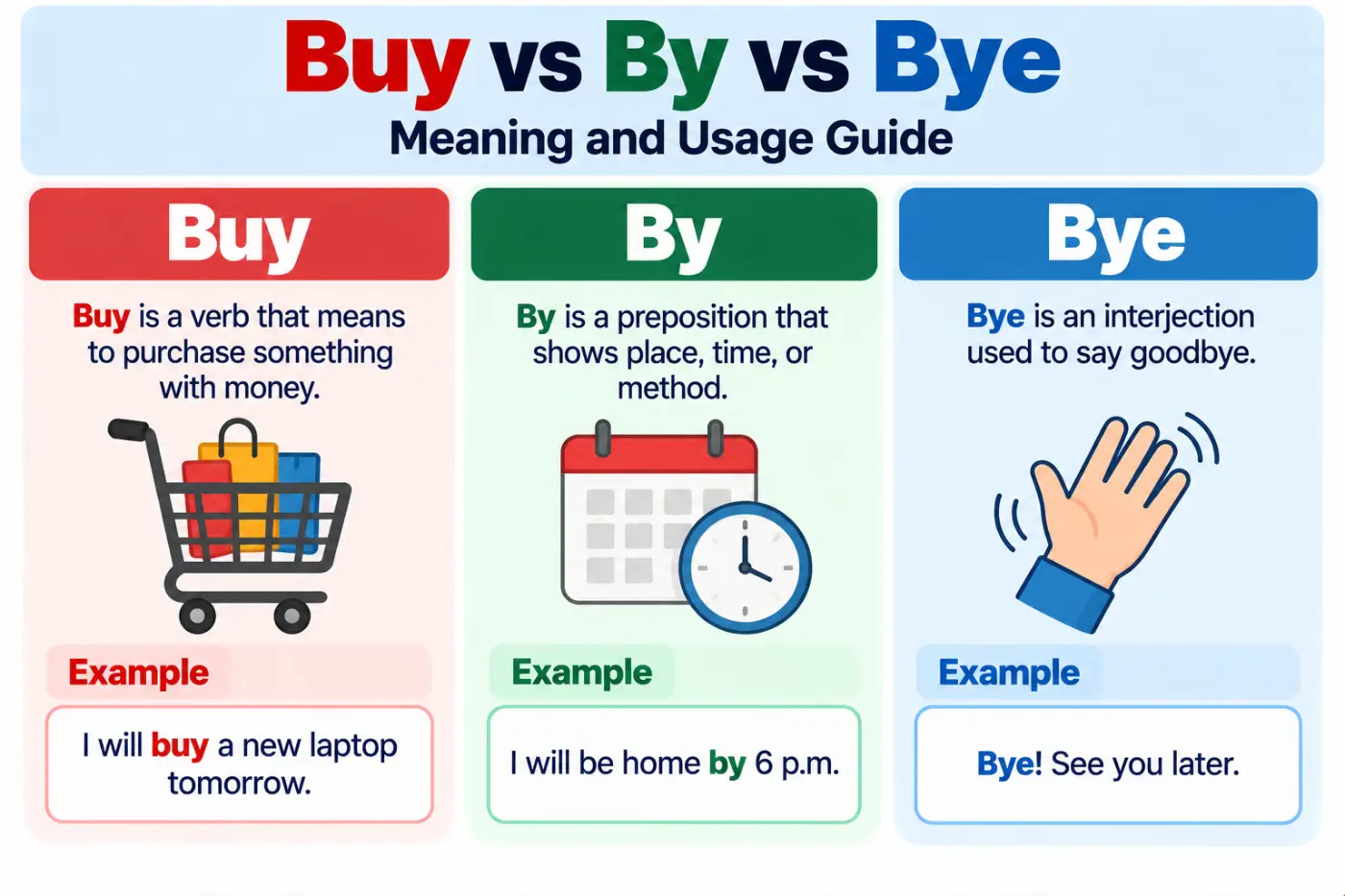
Use “buy” when you purchase something, “by” when you describe a method, agent, deadline, location, or way of doing something, and “bye” when you say goodbye. For example, you buy groceries, travel by bus, finish work by Friday, and say bye to a friend. Their similar sounds make them easy to mix up, especially when typing quickly or writing a short message.
The easiest way to choose correctly is to look at the meaning of the whole sentence. This guide explains each word in simple terms, compares their grammar and pronunciation, and gives practical examples. You’ll also learn common mistakes, useful memory tricks, and how to check your writing before sending it.
You may also want to read catchup or catch up Which Form Is Correct.
Quick Answer
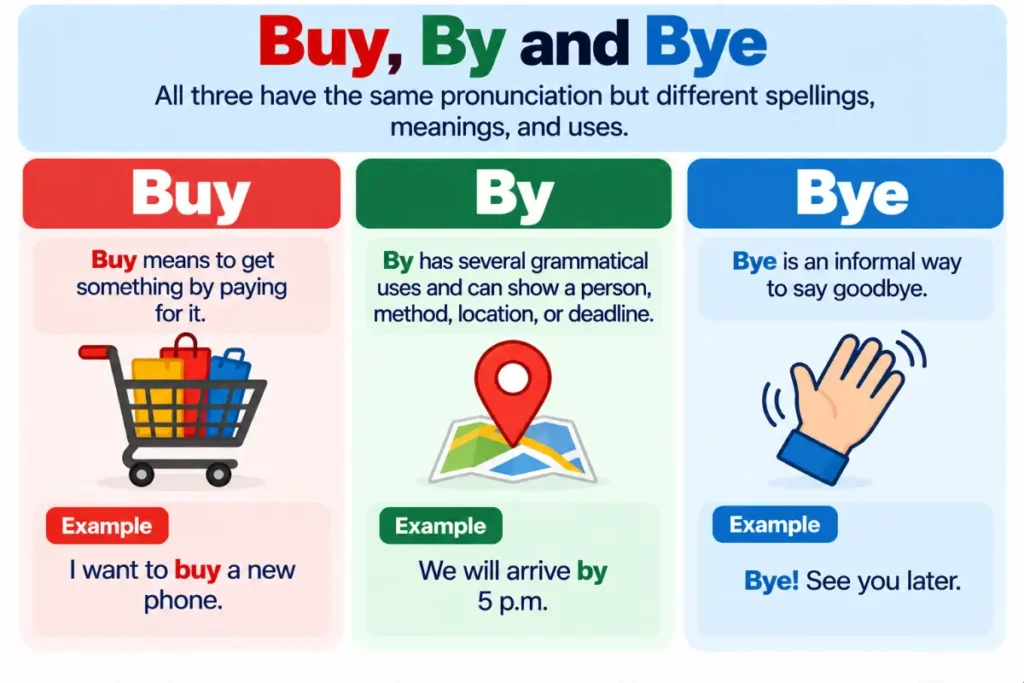
“Buy” means to get something by paying for it. “By” is a preposition used to show things such as who performs an action, how something happens, or when it must happen. “Bye” is an informal way to say goodbye. All three are correct, but they cannot be used interchangeably.
Comparison Table
| Word | Main Meaning | Part of Speech | Common Uses | Example |
|---|---|---|---|---|
| Buy | Get something in exchange for money | Verb and noun | Shopping, purchasing, business | I need to buy a new phone. |
| By | Shows method, agent, time, place, or proximity | Preposition and adverb | Travel, deadlines, descriptions, instructions | We traveled by train. |
| Bye | A way to say goodbye | Interjection and noun | Conversation, messages, informal communication | Bye! See you tomorrow. |
The words have different grammatical jobs. “Buy” describes an action or a purchase, “by” connects ideas and shows relationships, and “bye” is used when someone leaves or ends a conversation.
Meaning and Definition
What Does Buy Mean?
“Buy” is a verb that means to obtain something by paying money for it. You buy food, clothes, furniture, tickets, services, and many other things. The person who buys something is the buyer, and the person or business selling it is the seller.
For example, if you pay $20 for a book, you buy the book. If a company pays for new computers, it buys equipment. The word can describe small everyday purchases as well as large business transactions.
Common examples include:
- Buy groceries.
- Buy a house.
- Buy a gift.
- Buy a ticket.
- Buy a cup of coffee.
- Buy something online.
- Buy a used car.
- Buy supplies for school.
The verb has several forms:
| Verb Form | Example |
|---|---|
| Base form | I want to buy a laptop. |
| Third person | She buys fresh fruit. |
| Past tense | He bought a new jacket. |
| Present participle | They are buying a house. |
| Past participle | We have bought the tickets. |
Notice that the past tense is “bought,” not “buyed.” This is an irregular verb, so its past forms do not follow the usual pattern of adding “ed.”
“Buy” can also be a noun in informal business language. For example, “That car was a good buy” means the car was a good purchase or offered good value for its price.
What Does By Mean?
“By” is a preposition with several important uses. It can show who performs an action, how something is done, when a task must be completed, or where something is located. It can also function as an adverb in certain expressions.
Because it has many meanings, this word can appear in a wide range of sentences.
1. Showing the person or thing that performs an action.
In a passive sentence, “by” can introduce the person or thing responsible for an action.
Examples:
- The book was written by Maya.
- The painting was created by a local artist.
- The song was performed by the school choir.
In these sentences, the word identifies who did the work.
2. Showing a method or means.
Use it to explain how someone travels, communicates, pays, or completes an action.
Examples:
- We went to Chicago by train.
- She sent the document by email.
- You can pay by credit card.
Here, the word introduces the method used.
What Does Bye Mean?
“Bye” is an informal expression used when leaving someone or ending a conversation. It is a shorter form of “goodbye” and is common in everyday speech, phone calls, text messages, emails, and online chats.
Examples include:
- Bye! Have a great day.
- I have to go now. Bye!
- She waved and said bye to her friends.
- Send me a message when you get home. Bye!
Although it is usually an interjection, “bye” can also work as a noun in phrases such as “a quick bye” or “say your byes.” These uses are less common than the simple farewell.
In sports, a related but separate use of “bye” describes a scheduled rest period when a player or team does not compete. For example, a football team may have a bye week during its season. In a tournament, a player may receive a bye and advance to the next round without playing an opponent in that stage.
This sports meaning is different from saying goodbye, but the spelling is the same.
Are Any of These Words Incorrect?
No. All three are standard English words. The mistake happens when a writer chooses a valid word that does not match the sentence’s meaning.
For example:
- Incorrect: I want to by a new phone.
- Correct: I want to buy a new phone.
The word “by” is spelled correctly, but it does not mean purchase. The same problem occurs when someone writes “buy” instead of “by” in a sentence about a deadline or method.
Key Differences Explained
The simplest way to tell these words apart is to focus on what the sentence means. Their pronunciation is similar, but their jobs are different.
1. Spelling
Each word has a different spelling and a separate meaning.
- Buy contains the letter combination “uy” and refers to purchasing something.
- By is the shortest spelling and commonly shows a relationship, method, or deadline.
- Bye ends with “ye” and is used as a farewell.
A single letter can change the meaning of an entire sentence. That is why proofreading matters, especially in short messages where the surrounding context may not make the intended meaning obvious.
2. Meaning
“Buy” is connected to money and purchases. “By” connects parts of a sentence by showing relationships such as time, place, method, or the person responsible for an action. “Bye” signals that a conversation or meeting is ending.
Consider these three sentences:
- I will buy a new bag.
- I will travel by bus.
- I will say bye before I leave.
Each sentence uses a different word for a different purpose. Replacing one with another changes the meaning or makes the sentence incorrect.
3. Part of Speech
“Buy” is mainly a verb, although it can also be a noun in informal expressions such as “a good buy.” “By” is mainly a preposition, though it can function as an adverb in expressions such as “stand by.” “Bye” is usually an interjection, but it can also be a noun.
These grammatical roles explain why the words appear in different positions. A verb can describe an action, a preposition connects a noun or pronoun to another part of a sentence, and an interjection expresses a reaction or social expression.
4. Pronunciation
In most American accents, the three words are pronounced the same way: /baɪ/. This makes them homophones, which are words that sound alike but have different meanings and spellings.
Because pronunciation does not help distinguish them in speech, listeners rely on context. In writing, you must choose the spelling that matches the intended meaning.
5. Formality
All three forms are standard, but they appear in different kinds of communication. “Buy” and “by” are suitable for casual, academic, and professional writing. “Bye” is common in conversation and informal messages, although it can also appear in friendly workplace emails.
In a formal letter, “Sincerely” or “Best regards” may be more suitable than “Bye.” In a quick message to a coworker, however, “Bye” can sound perfectly natural.
6. Context
The words are not interchangeable because each one serves a different purpose.
| Intended Meaning | Correct Word | Example |
|---|---|---|
| Purchase something | Buy | I will buy a desk. |
| Show a method | By | We arrived by taxi. |
| Identify the creator | By | The article was written by Sam. |
| Set a deadline | By | Finish the task by noon. |
| Say goodbye | Bye | Bye, see you soon. |
| Describe a sports rest period | Bye | Our team has a bye this week. |
7. Regional Usage
American, British, Canadian, and Australian English use the same standard spellings and basic meanings. There is no major regional spelling difference among the three words.
Pronunciation can vary slightly between accents, but the words remain homophones in many English varieties. The meaning still comes from context rather than spelling differences tied to a particular country.
Which Form Is Correct?
All three are correct when used for their proper meanings. There is no single winner because each word performs a different job in English.
Use “buy” for a purchase, “by” for a relationship such as method, time, location, or agency, and “bye” for a farewell. Standard dictionaries treat them as separate entries because they have different meanings and grammatical functions.
Here is a quick way to check your choice:
- If you can replace the word with “purchase,” use “buy.” For example, “I need to buy milk” means “I need to purchase milk.”
- If the sentence describes a method, deadline, location, or person responsible for an action, use “by.”
- If you can replace the word with “goodbye,” use “bye.”
These substitutions are useful editing tests. They do not cover every possible use, but they solve most everyday spelling questions.
Sentence Examples
The examples below show how each word works in natural American English.
Ten Examples Using the Three Words
- Everyday shopping: I need to buy some fresh vegetables before dinner.
- Text message: Can you buy my favorite snack on your way home?
- Workplace communication: Please send the completed report by Thursday afternoon.
- School: The poem was written by a student in our class.
- Academic writing: The research paper examines how buying habits change during periods of economic uncertainty.
- Formal communication: All applications must be received by the end of the month.
- Social conversation: I had a wonderful time with everyone, but now I have to say bye.
- Online shopping: You can buy the headphones through the company’s website.
- Travel: We reached the hotel by train and walked to the entrance.
- Sports: The team has a bye this weekend and will return to play next Saturday.
These examples cover the most common situations. Notice that the word’s role remains the same even when the subject or setting changes.
Five Incorrect Examples and Their Corrections
The following sentences show mistakes that can happen when a writer chooses a word based only on its sound.
1. Incorrect: I need to by a birthday card.
Correct: I need to buy a birthday card.
Reason: The sentence describes a purchase.
2. Incorrect: Please finish the assignment buy Friday.
Correct: Please finish the assignment by Friday.
Reason: The sentence gives a deadline.
3. Incorrect: I said buy to my neighbors.
Correct: I said bye to my neighbors.
Reason: The sentence describes a farewell.
4. Incorrect: The movie was directed buy a famous filmmaker.
Correct: The movie was directed by a famous filmmaker.
Reason: The sentence identifies the person responsible for the work.
5. Incorrect: We should bye a new printer for the office.
Correct: We should buy a new printer for the office.
Reason: The sentence describes getting something in exchange for money.
Common Mistakes and Misspellings
Because the three words sound alike, writers sometimes choose the wrong spelling without noticing. These mistakes are especially common in quick messages, social media posts, and sentences written without proofreading.
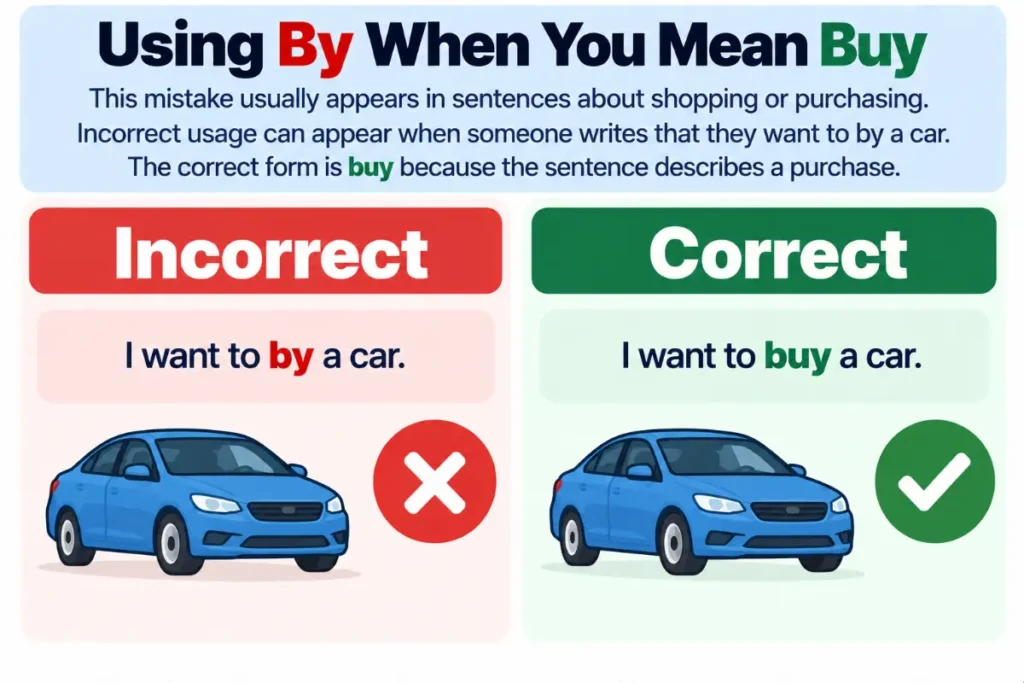
1. Writing By Instead of Buy
Incorrect: I want to by a new computer.
Correct: I want to buy a new computer.
The mistake happens because the writer hears the correct sound but selects the wrong spelling. Remember that “buy” is the word connected to a purchase. If money changes hands in the sentence, this is often the form you need.
2. Writing Buy Instead of By
Incorrect: The package should arrive buy Monday.
Correct: The package should arrive by Monday.
Here, the sentence gives a deadline. The preposition “by” means no later than the stated time. You can test the sentence by replacing it with “no later than”: the package should arrive no later than Monday.
3. Writing By Instead of Bye
Incorrect: I said by to my cousin.
Correct: I said bye to my cousin.
The sentence describes ending a conversation. Use “bye” as a short form of “goodbye.” A useful memory clue is that both “bye” and “goodbye” contain the letters “bye” in their spelling.
4. Writing Bye Instead of Buy
Incorrect: She wants to bye a new dress.
Correct: She wants to buy a new dress.
This mistake is common in casual writing because the two words sound the same. Think of shopping whenever you see the verb “buy.” The spelling also appears in related words such as “buyer” and “buying.”
5. Confusing By and Bye in Short Messages
Incorrect: I will see you buy the door.
Correct: I will see you by the door.
Incorrect: Bye the way, I forgot my keys.
Correct: By the way, I forgot my keys.
These examples show how easily a familiar expression can become confusing. “By the way” introduces an additional point, while “bye” is a farewell. Learning common phrases as complete expressions can prevent this type of mistake.
A Useful Memory Trick
Try these simple connections:
- Buy = purchase. Both words relate to shopping and spending money.
- By = beside or through. It often shows a relationship involving place, method, or time.
- Bye = goodbye. Both are used when someone leaves or a conversation ends.
You can also use the first letter as a clue. “Buy” begins like “bargain,” while “bye” is part of the familiar farewell “goodbye.” These clues are not grammar rules, but they make the spellings easier to remember.
You may also want to read Cord vs Chord: Meaning, Difference, and Usage.
Pronunciation Guide
How Do You Pronounce Buy?
“Buy” is pronounced /baɪ/ in standard American English. It has one syllable and rhymes with “my,” “sky,” and “try.” Start with the /b/ sound and finish with the vowel sound heard in “eye.”
How Do You Pronounce By?
“By” is also pronounced /baɪ/. It has one syllable and the same vowel sound as “buy.” In a sentence such as “The store is by the station,” the word sounds just like the verb used in “buy a ticket.”
How Do You Pronounce Bye?
“Bye” is pronounced /baɪ/, just like the other two words. It is one syllable and rhymes with “high,” “tie,” and “why.” In ordinary conversation, no special pronunciation separates it from the other forms.
Syllable Breakdown and Stress
| Word | IPA | Syllables | Stress |
|---|---|---|---|
| Buy | /baɪ/ | One | Full stress |
| By | /baɪ/ | One | Full stress |
| Bye | /baɪ/ | One | Full stress |
Since each word has only one syllable, there is no difference in syllable stress. All three share the same standard pronunciation.
Why Pronunciation Does Not Solve the Problem
These words are homophones. That means they sound the same but have different spellings and meanings. Other examples of English homophones include “their,” “there,” and “they’re,” as well as “two,” “to,” and “too.”
You cannot normally identify the correct spelling by listening to the word alone. Instead, look at the sentence around it. The grammar and meaning provide the clues that pronunciation cannot.
Etymology and Word Origin
The Origin of Buy
The verb “buy” comes from Old English “bycgan,” which meant to buy or purchase. It developed through earlier forms of English before becoming the modern spelling and pronunciation.
The word has remained closely connected to trade and exchange. Its forms include “buys,” “buying,” and “bought.” The past tense is irregular, which is why English speakers say “I bought a coat” rather than “I buyed a coat.”
The Origin of By
“By” developed from Old English forms associated with meanings such as near, beside, and around. Over time, its uses expanded to cover relationships involving place, time, method, agency, and measurement.
This broad development explains why it appears in so many expressions. Phrases such as “by hand,” “by the door,” “by Friday,” and “by the author” use the same preposition to express different relationships.
The Origin of Bye
“Bye” developed as a shortened form of “goodbye.” The longer farewell is associated with the expression “God be with ye,” which became shortened and changed through common speech.
Today, “bye” is a familiar farewell in everyday English. It also has the separate sports meaning of a player or team advancing without competing in a particular round.
Why Three Different Words Sound Alike
English spelling and pronunciation developed over many centuries. Some words that began with different histories eventually came to share the same pronunciation. This is why the three forms can sound identical even though their origins and meanings differ.
Their shared sound does not make them related in meaning. It simply means that modern pronunciation has brought them together.
Regional Usage
The spellings and basic meanings stay the same across major English varieties. American, British, Canadian, and Australian writers use the same three forms. There are no standard regional alternatives that change the distinction.
American English
In the United States, all three words are common. “Buy” appears in shopping, business, and everyday conversation. “By” is used in expressions involving deadlines, transportation, location, and authorship. “Bye” is a familiar way to end a conversation or message.
American speakers generally pronounce all three as /baɪ/. The surrounding sentence helps listeners understand the intended meaning.
British English
British English follows the same spelling and grammar rules. Someone in London might buy a train ticket, travel by bus, and say bye to a friend. The words have the same basic meanings as they do in American English.
Some accents may produce small differences in vowel quality, but those differences do not create separate spellings or meanings.
Australian English
Australian English also uses all three words in the same way. “Buy” describes a purchase, “by” introduces relationships such as method or time, and “bye” is a farewell. The sports meaning of “bye” is also used when a team has a scheduled break in a competition.
Canadian English
Canadian English follows the same standard forms. Writers use “buy” for purchases, “by” for prepositional meanings, and “bye” for farewells. There is no special Canadian spelling rule that changes these words.
For international readers, the safest approach is to follow the meaning and grammar rather than look for a regional spelling difference.
Grammar Rules and Part of Speech
Knowing the grammatical role of each word makes it easier to choose the correct spelling. One describes an action, one usually connects ideas, and one commonly expresses a farewell.
How to Use Buy in a Sentence
“Buy” is mainly a transitive verb. A transitive verb usually takes a direct object, which is the person or thing receiving the action. For example, in “I bought a notebook,” the noun “notebook” is the direct object.
Common grammatical patterns include:
- Buy something: She bought a new phone.
- Buy something for someone: I bought a gift for my mother.
- Buy someone something: He bought his daughter a bicycle.
- Buy from someone: We buy vegetables from a local farmer.
- Buy into an idea: Some people buy into the claim without checking the facts.
The final expression is figurative. “Buy into” can mean to accept or believe an idea, plan, or claim. It does not always involve money.
The verb also appears in passive sentences. For example, “The tickets were bought online” places the focus on the tickets rather than the person who purchased them.
How to Use By in a Sentence
“By” is mainly a preposition. It usually comes before a noun, pronoun, or noun phrase to show a relationship with another part of the sentence.
Common patterns include:
- By a person: The song was written by Alex.
- By a method: She paid by check.
- By a deadline: Please reply by tomorrow.
- By a location: The children played by the lake.
- By a measurement: The room measures 12 feet by 15 feet.
- By a process: The document was signed by hand.
It also appears in phrases where it describes how an action happens. “By working together, the group finished early” shows the method that led to the result.
How to Use Bye in a Sentence
“Bye” is usually an interjection. An interjection is a word or short expression that communicates a feeling, reaction, or social response. It can stand alone or appear at the beginning or end of a sentence.
Examples include:
- Bye! Have a safe trip.
- I have to go now. Bye.
- She waved and called out, “Bye!”
- We said our goodbyes before leaving.
When used as a noun, the related form “goodbye” is more common in formal writing. “Bye” is still natural in informal conversation and friendly messages.
Punctuation With Bye
A comma or exclamation point may follow the word depending on the sentence.
- Bye, I’ll call you tomorrow.
- Bye! Take care.
- She said bye and closed the door.
If you use it as a direct farewell, an exclamation point can show warmth or excitement. A period creates a calmer tone. Neither punctuation mark changes the spelling.
Formal and Informal Grammar
“Buy” and “by” are suitable in both formal and informal writing. Their use depends on meaning, not tone. “Bye” is more conversational, so a formal letter or business report may use “goodbye,” “farewell,” or a standard closing such as “Best regards.”
The best choice is the one that suits the audience and purpose. A friendly email can end with “Bye for now,” while a formal application letter usually needs a more professional closing.
Real Life Usage Examples
Daily Conversation
In everyday speech, these words appear in familiar situations. People talk about shopping, give directions, mention deadlines, and say goodbye throughout the day.
- “I need to buy some bread before the store closes.”
- “The coffee shop is right by the library.”
- “Bye! I’ll see you at the game tonight.”
- “Can you buy a bottle of water on your way here?”
The words sound alike when spoken, but their meanings are easy to understand from the full sentence.
Email and Workplace Communication
Workplace writing often uses “buy” in discussions about expenses and supplies. “By” appears frequently in instructions, schedules, and deadlines. “Bye” is possible in friendly internal messages, although formal emails usually end with a professional sign off.
- “Please approve the request to buy replacement monitors.”
- “Send your updated schedule by the end of the day.”
- “I have to leave now. Bye, everyone.”
- “The training materials were prepared by the human resources team.”
In a business email, a clear deadline can prevent confusion. Always make sure the preposition is correct when describing when a task must be completed.
Academic Writing
Academic writing uses these words in different ways. “Buy” may appear in research about consumer behavior, while “by” can identify an author, method, or measurement. “Bye” is less common in formal academic work, except in a discussion of language or a sports context.
- “The survey examined why consumers buy products from familiar brands.”
- “The experiment was conducted by a team of university researchers.”
- “The results were reviewed by two independent readers.”
- “The study measured changes in spending by age group.”
These examples show that the words are not limited to casual communication. Two of them are especially common in formal and academic sentences.
News and Journalism
News reports use “buy” when covering purchases, sales, markets, and consumer activity. “By” appears in reports about events, authorship, time, and location. “Bye” is less common, but it may appear in sports coverage when a team has a scheduled break.
- “The city plans to buy new buses for its public transportation system.”
- “The proposal was approved by the local council.”
- “The team will use its bye week to prepare for the next game.”
- “The report was released by the agency on Tuesday.”
Literature and Storytelling
In stories, “buy” can describe a character’s purchase or figurative belief. “By” helps describe where characters stand, how they travel, or who performs an action. “Bye” can add a natural touch to dialogue.
- “He stopped by the old bookstore to buy a gift for his sister.”
- “She whispered bye before stepping onto the train.”
- “The letter was written by a stranger who knew the family.”
- “He did not buy her explanation, but he kept listening.”
The last example uses “buy” figuratively. It means the character did not believe the explanation, rather than refusing to pay for it.
Related and Confused Terms
These eight words and expressions are useful because they connect to the meanings or grammar of the three main forms.
1. Purchase
“Purchase” is a more formal verb and noun for buying something. A customer may purchase a product, and a business may record a purchase in its accounts. It can replace “buy” in many contexts, although “buy” usually sounds more natural in everyday conversation.
Example: “We plan to purchase new office furniture next month.”
2. Buyer
A “buyer” is a person or organization that purchases something. The word is related to “buy” and is common in shopping, sales, real estate, and business.
Example: “The buyer asked for more information about the property.”
3. Seller
A “seller” is a person or business that offers something for sale. Buyers purchase goods or services from sellers. The two terms describe opposite sides of a transaction.
Example: “The seller agreed to lower the price.”
4. Beside
“Beside” means next to or at the side of something. It can sometimes replace “by” when describing physical location, but it cannot replace every use of that preposition.
Example: “The chair is beside the window.”
The sentence “Please finish by Friday” cannot use “beside” because it describes a deadline, not a location.
5. Through
“Through” can describe a method or means, much like some uses of “by.” However, the two words do not always fit the same sentence.
Example: “She applied through the company’s website.”
Compare this with “She applied by email.” The choice depends on the method or route being described.
6. Until
“Until” and “by” can both refer to time, but they express different ideas. “By Friday” sets a deadline that can be met earlier. “Until Friday” usually means an action or condition continues up to Friday.
Example: “Please send the form by Friday” means Friday is the latest acceptable time. “The office is closed until Friday” means it remains closed before that day.
7. Goodbye
“Goodbye” is the full farewell expression from which “bye” developed. It is suitable in casual and formal situations, although the tone of a farewell depends on the surrounding words.
Example: “He said goodbye to his colleagues before starting his new job.”
8. Good Buy
“Good buy” is a phrase meaning a worthwhile purchase or something that offers good value. It is different from “goodbye,” which is a farewell.
Example: “That used laptop was a good buy because it worked like new.”
This distinction is useful because the two expressions can sound similar in fast speech but have very different meanings.
Expert Editor Insight
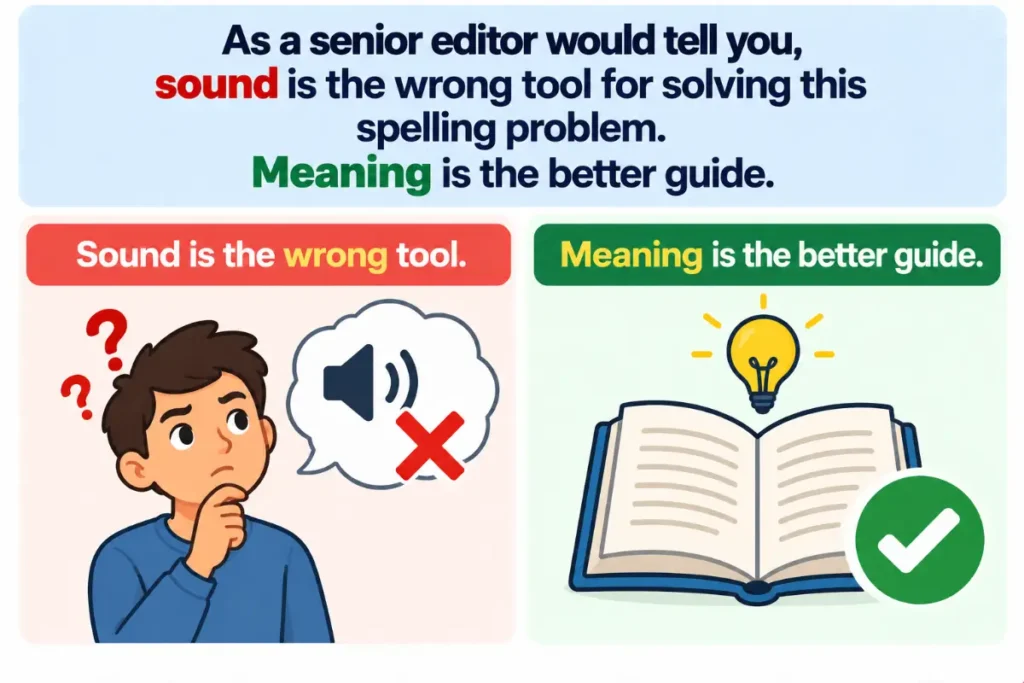
A careful editor checks the meaning of the sentence rather than relying on sound. Since these words are homophones, spellcheckers may not flag a wrong choice if the word is spelled correctly. For example, a program may accept “I will see you buy the door” even though “by” is needed. Read the sentence aloud, then test the word with a simple replacement: “purchase” for “buy,” “no later than” for a deadline use of “by,” and “goodbye” for “bye.” This small habit catches many errors that basic spelling checks miss.
Learn the difference in Ourselves vs Ourself Which Form Is Correct?.
Conclusion
Understanding “buy vs by vs bye” becomes simple once you connect each spelling with its meaning. Use “buy” for purchases, “by” for relationships involving time, place, method, or agency, and “bye” when saying goodbye. All three are correct English words, but they cannot replace one another. Since they sound alike, check the meaning of your sentence before choosing a spelling.
A useful editing trick is to substitute “purchase,” “near,” or “goodbye” and see which one makes sense. With this simple habit, you can avoid common mistakes in messages, schoolwork, emails, and professional writing.
FAQs
What Is the Difference Between Buy, By, and Bye?
“Buy” means to purchase something, “by” is commonly used to show a method, deadline, location, or person responsible for an action, and “bye” means goodbye. All three words are pronounced /baɪ/ in standard American English. Their meanings and grammatical roles are different, so you must use the sentence context to select the right spelling.
Is Buy or By Correct for Shopping?
Use “buy” when you mean to purchase something. For example, “I want to buy a new laptop” is correct because the sentence describes paying for an item. “By” does not have this meaning. A helpful memory trick is to connect “buy” with “buyer,” which describes someone who purchases goods or services.
Should I Write By or Bye in a Goodbye Message?
Use “bye” when you are ending a conversation or saying farewell. For example, “Bye, I’ll talk to you tomorrow” is correct. Use “by” in phrases such as “by the way” or “stand by.” If you can replace the word with “goodbye,” the correct spelling is “bye.”
How Can I Remember the Correct Spelling?
Connect each spelling with a familiar word or idea. “Buy” means purchase, “by” often means near or through, and “bye” comes from goodbye. You can also replace the word in your sentence with a simpler expression. If “purchase,” “near,” or “goodbye” fits, you have a useful clue.
Are Buy, By, and Bye Homophones?
Yes. They are homophones because they share the same pronunciation but have different spellings and meanings. In American English, all three are usually pronounced /baɪ/. This explains why people confuse them in writing. Since listening alone cannot identify the intended spelling, readers and writers use grammar and sentence context to understand each word.
Can By Start a Sentence?
Yes. “By” can start a sentence when it introduces a phrase that explains a method or action. For example, “By practicing every day, you can improve your writing.” It can also begin a phrase such as “By the time we arrived, the store had closed.” The sentence must still have a clear grammatical structure.
Is Bye Appropriate in Professional Writing?
“Bye” is acceptable in friendly workplace messages, especially when coworkers know one another well. However, formal business letters and professional emails usually benefit from closings such as “Best regards,” “Sincerely,” or “Thank you.” Choose a closing that matches your relationship with the reader and the purpose of the message.
What Does a Bye Mean in Sports?
In sports, a “bye” is a scheduled break or an automatic move to the next round without playing an opponent in that stage. For example, a football team may have a bye week during its season. The word has a separate meaning from the everyday farewell, although the spelling and pronunciation are the same.