
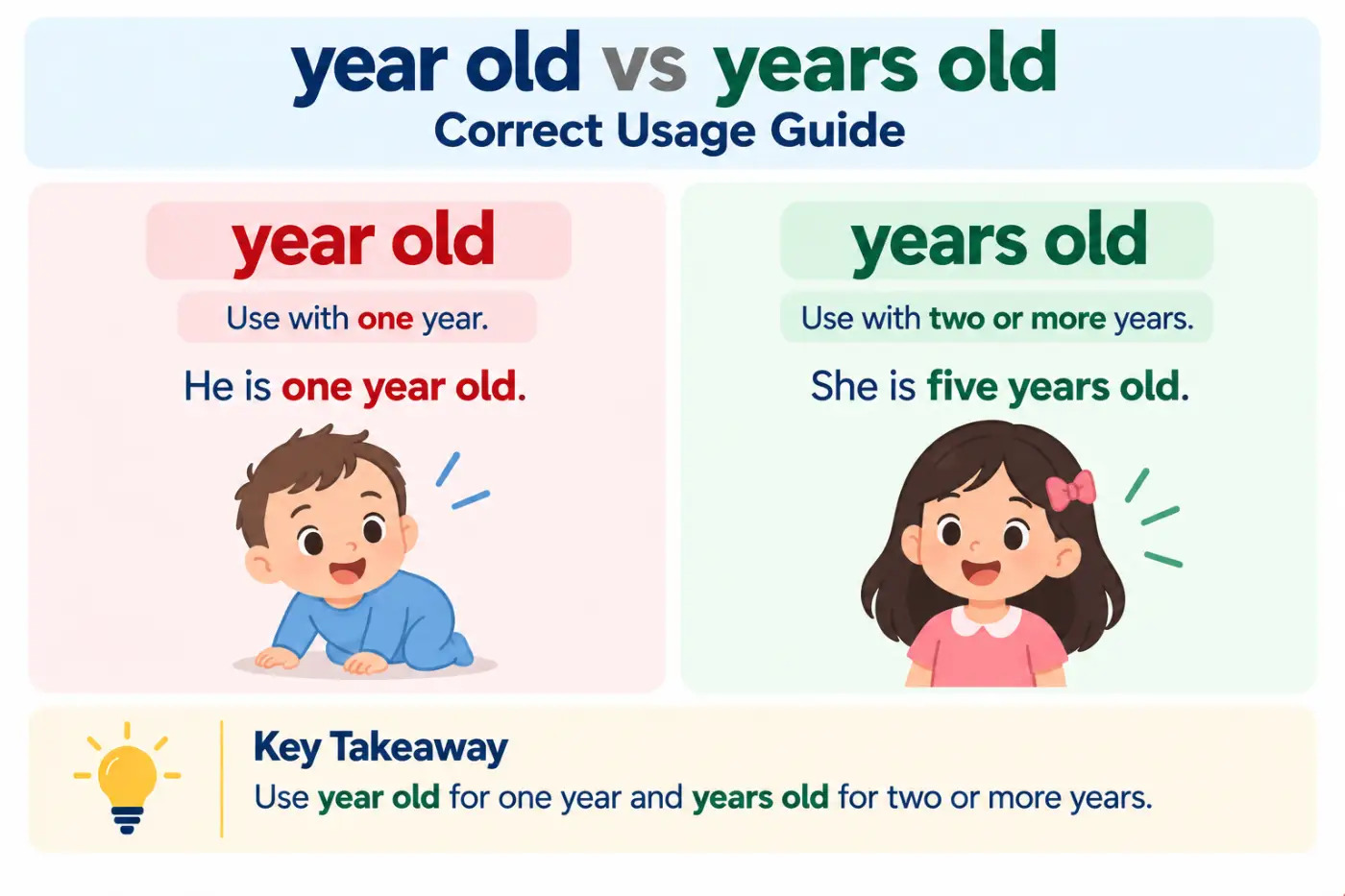
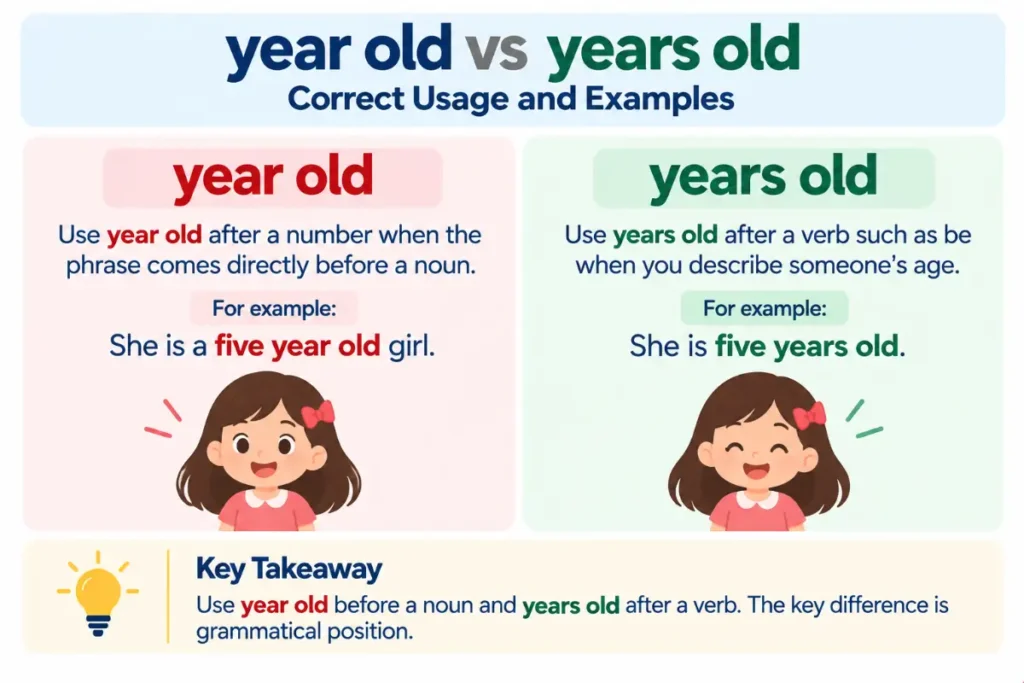
Many English writers pause when describing someone’s age. Should you write 5 year old vs 5 years old? The correct choice depends on how the age works in your sentence. Use years old after a person or thing when stating age, but use year old before a noun as part of a compound adjective. For example, write My son is 5 years old, but a 5 year old boy.
The difference may seem small, but it matters in everyday writing, school assignments, professional documents, and online communication. The confusion comes from the way English treats age expressions differently depending on their position. When an age follows a verb such as is or looks, the time unit is usually plural for ages greater than one. When the same age describes a noun directly, the expression usually takes a singular form and uses hyphens in standard edited writing.
Once you understand this simple grammar pattern, you can describe ages accurately without second guessing every sentence. The examples below explain the rule, show common mistakes, and help you choose the right form in different situations.
Need another quick comparison? Read Elicit vs Illicit Meaning and Usage Explained.
Quick Answer
Use years old after a subject and linking verb to state an age greater than one. For example, She is 8 years old. Use year old before a noun as a compound adjective: She is an 8 year old girl. In standard edited writing, hyphenate the compound adjective: an 8 year old girl.
Comparison Table
| Expression | Correct Use | Grammatical Function | Example |
|---|---|---|---|
| 1 year old | States an age of one year | Age expression | The baby is 1 year old. |
| 5 years old | States an age greater than one | Age expression | The child is 5 years old. |
| 5 year old | Describes a noun before it | Compound adjective | A 5 year old child started school. |
| 5 year old with hyphens | Standard edited form before a noun | Compound adjective | A 5 year old child started school. |
| a five year old | Names a person by age | Compound noun | A five year old can follow simple instructions. |
| five years of age | Formal way to state age | Age expression | The child is five years of age. |
| five year olds | Plural noun referring to children of that age | Compound noun | Five year olds enjoy active games. |
| five years | Describes a period of time | Noun phrase | She worked there for five years. |
Meaning and Definition
What Does Year Old Mean?
Year old is used in age expressions when the age appears before a noun as a compound modifier. It describes the age of the person, animal, or thing named by that noun.
For example:
- A 3 year old child.
- A 7 year old student.
- A 12 year old laptop.
- A 20 year old building.
- A 100 year old tree.
In standard edited writing, these expressions are normally hyphenated because the words work together to describe one noun. The recommended forms are a 3 year old child, a 7 year old student, and a 12 year old laptop when written with hyphens as a compound modifier.
The word year stays singular even when the number is greater than one. This happens because the expression functions as a compound adjective rather than a regular plural age phrase.
Think of the whole expression as one description. The number and the singular noun year combine to tell the reader how old the person or object is.
What Does Years Old Mean?
Years old is used when you state someone’s age after the subject and a linking verb. The noun years is plural for ages greater than one because it refers to multiple years of life or existence.
Examples include:
- My daughter is 6 years old.
- The building is 80 years old.
- Their dog is 4 years old.
- The company is 25 years old.
- I am 30 years old.
The expression can also appear after verbs such as looks, seems, and became.
For example:
- He looks 40 years old.
- The organization became 10 years old last month.
- The puppy seems 1 year old.
The singular form is used for an age of exactly one year: The baby is 1 year old. For ages greater than one, use the plural form in this sentence structure.
Why Does the Singular Form Appear Before a Noun?
English uses a special grammar pattern for compound modifiers. When two or more words work together to describe a noun, the words often form one unit. In age expressions, the singular form year is used within that unit.
Compare these sentences:
- The boy is 8 years old.
- The 8 year old boy is playing outside.
The first sentence states the boy’s age. The second uses the age as a description before the noun boy. The number has not changed, but the grammatical function has.
This pattern appears in other measurements too. You write a 10 foot pole, a 20 page report, and a 5 mile walk in standard compound adjective form. However, you write The pole is 10 feet long, The report has 20 pages, and The walk is 5 miles long.
The same principle explains why age expressions use year in the singular before a noun.
Is Year Old a Real Expression?
Yes. It is a standard part of English grammar when used in the right structure. The expression is not incorrect simply because the number is greater than one.
For example, a 9 year old child is correct as a compound adjective, while the child is 9 years old is correct as a statement of age. The two forms have different grammatical roles, so they should not be treated as interchangeable.
Key Differences Explained
1. Singular and Plural Forms
The main difference is the number of the word year. Use year in the singular when the age expression directly modifies a noun. Use years in the plural when you state an age greater than one after the subject.
Examples:
- Correct: My brother is 12 years old.
- Correct: My 12 year old brother lives in Texas.
- Incorrect: My brother is 12 year old.
- Incorrect: My 12 years old brother lives in Texas.
The number itself does not decide the form. The position and grammatical function of the expression decide it.
2. Position in a Sentence
The position of the age expression is one of the easiest ways to identify the correct form.
Use years old when the expression follows the subject and a linking verb:
- The child is 4 years old.
- The car is 15 years old.
- My parents are 60 years old.
Use year old when the expression comes directly before the noun it describes:
- A 4 year old child.
- A 15 year old car.
- My 60 year old parents.
In standard edited writing, add hyphens to the compound modifiers before nouns. This helps readers see that the words work together as one description.
3. Grammar and Part of Speech
The expression years old works as an age phrase that describes the subject. The phrase often follows a linking verb such as is, are, was, or were.
For example, The twins are 9 years old. The phrase 9 years old tells the reader the twins’ age.
By contrast, a 9 year old child uses the age expression as a compound adjective. It modifies the noun child and gives more information about it.
The entire expression a 9 year old can also function as a noun phrase when the noun is understood. For example, A 9 year old can usually read simple stories. In this case, the words refer to a child who is nine.
4. Hyphenation
Hyphens are important when an age expression appears before a noun as a compound modifier.
Correct:
- A 6 year old girl.
- A 10 year old student.
- A 25 year old house.
Incorrect in standard edited writing:
- A 6 years old girl.
- A 10 years old student.
- A 25 years old house.
When the age phrase follows the noun and verb, do not hyphenate it:
- The girl is 6 years old.
- The student is 10 years old.
- The house is 25 years old.
The hyphens help connect the words that work together to describe the noun. They are not needed when the age phrase follows the subject.
5. Formality and Writing Style
Both forms are appropriate in formal and informal English. The choice is grammatical, not a matter of formality.
In a school essay, you might write, The student is 11 years old. In a newspaper article, you might write, An 11 year old student won the competition and In both cases, the expression is correct when formatted according to its position.
For legal forms, medical records, applications, and official documents, use the format requested by the organization. Some forms may ask for an age in years, while others may ask for a date of birth.
6. Pronunciation
The two expressions sound slightly different because one uses a singular noun and the other uses a plural noun.
- Year old: one year old.
- Years old: five years old.
The final /z/ sound in years marks the plural. In fast speech, the difference may be less noticeable, which can make the written distinction harder to remember.
7. Regional Usage
The same grammar rule applies in American, British, Canadian, and Australian English. There is no major regional difference in choosing singular year before a noun and plural years when stating an age greater than one.
Some style guides may vary in how they handle numbers, spelling out ages, or hyphenation. However, the central grammar pattern remains the same.
Which Form Is Correct?
Both forms are correct when used in the right grammatical structure. The singular form year old belongs in a compound modifier before a noun, while years old is used to state an age greater than one after the subject.
Use these rules:
- Write She is 7 years old.
- Write She is a 7 year old girl, with hyphens in standard edited writing.
- Write The building is 50 years old.
- Write a 50 year old building, with hyphens in standard edited writing.
- Write a 1 year old child, not a 1 years old child.
The reason is that English treats compound age modifiers differently from ordinary age statements. The first structure uses year as part of a combined description. The second uses years as a plural noun to state a period of time.
A useful comparison is the difference between a 10 foot pole and a pole that is 10 feet long. The measurement becomes singular in the compound modifier but plural in the ordinary description. Age expressions follow the same pattern.
Sentence Examples
Here are 10 natural examples showing how to use both forms correctly in different settings.
Everyday Conversation
- My nephew is 6 years old, and he already knows how to ride a bicycle.
- We met a 9 year old boy who was selling handmade bookmarks.
Text Messages
- My daughter just turned 5 years old today.
- Is that your 2 year old puppy in the picture?
Workplace Communication
- The company is 15 years old and has offices in three states.
- We are looking for a 3 year old laptop model for a software compatibility test.
School and Academic Writing
- The study included children who were 8 years old at the start of the project.
- Each 8 year old participant completed the same reading activity.
Formal and Social Situations
- The foundation celebrated its 100 year anniversary, marking a century of community service.
- Her 30 year old brother organized the family reunion.
The examples show that the number can stay the same while the form changes according to its place in the sentence. Before a noun, the compound modifier uses singular year. After a linking verb, the age phrase uses plural years for ages greater than one.
Common Mistakes and Grammar Problems
1. Adding an S Before a Noun
Incorrect: She has a 7 years old daughter.
Correct: She has a 7 year old daughter.
The age expression comes before the noun daughter, so it works as a compound modifier. Keep year singular and connect the words with hyphens in standard edited writing.
2. Forgetting the S After a Linking Verb
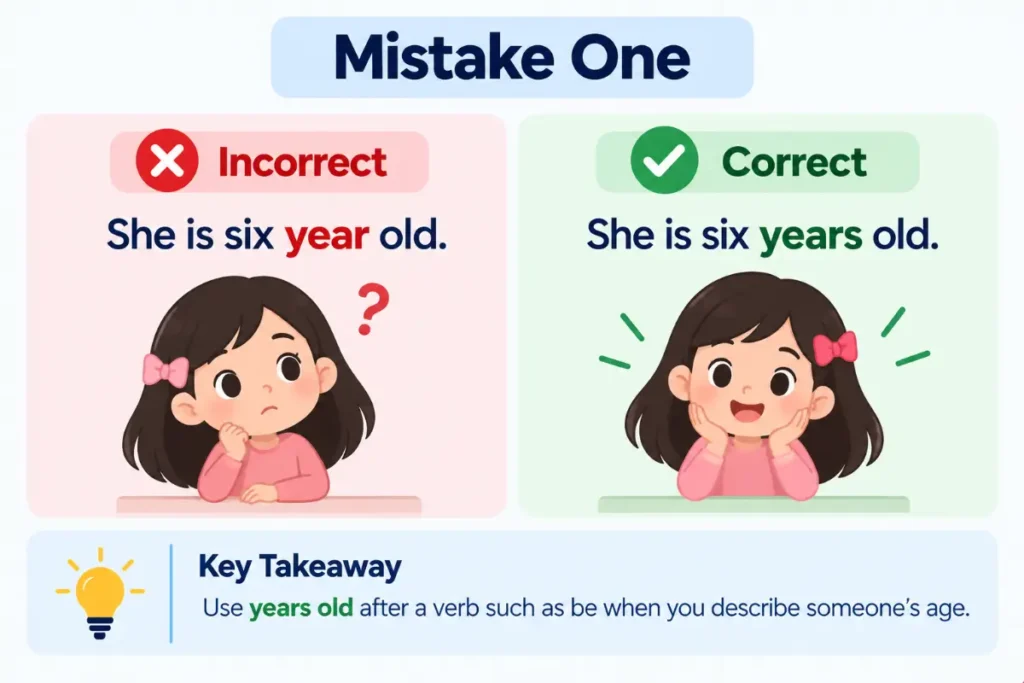
Incorrect: My son is 8 year old.
Correct: My son is 8 years old.
The phrase follows the linking verb is and states the child’s age. Since the age is greater than one, years must be plural.
3. Using Hyphens After the Verb
Incorrect: My daughter is 6-years-old.
Correct: My daughter is 6 years old.
Hyphens are used when the complete age expression comes before a noun as a compound modifier. They are not needed when the phrase follows a linking verb and simply states an age.
4. Writing the Number in the Wrong Form
Incorrect: A five years old student won the award.
Correct: A five year old student won the award.
The same rule applies to numbers written as words. The compound modifier uses singular year, regardless of whether the age is written as a numeral or spelled out.
5. Confusing Age Expressions With Periods of Time
Incorrect: She worked at the company for 10 year.
Correct: She worked at the company for 10 years.
This sentence does not describe someone’s age. It describes how long an activity continued. The noun years is plural because the period contains more than one year.
6. Using an Incorrect Plural Form for a Group
Incorrect: The five years old are playing outside.
Correct: The five year olds are playing outside.
When the expression refers to a group of children by age, it can function as a compound noun. The plural ending is added to the complete expression, not to the word year within it.
Pronunciation Guide
How Do You Pronounce Year Old?
The phrase year old is usually pronounced as two connected words. The word year has one syllable, and old has one syllable. In American English, year is commonly pronounced /jɪr/ or /jɪər/, depending on the speaker’s accent, while old is pronounced /oʊld/.
A simple guide is to say year as in the word yearly, followed by old as in the phrase old book. When the phrase appears before a noun, connect the words smoothly without adding an extra syllable.
How Do You Pronounce Years Old?
Years old has the same basic sounds as year old, but years ends with a voiced /z/ sound. The plural ending is important because it marks an age greater than one.
For example:
- One year old.
- Two years old.
- Ten years old.
The /z/ sound may blend into the next word during natural speech, but it should remain clear enough to distinguish the singular and plural forms.
Stress Pattern
In normal speech, the most important information is often the number. A speaker may emphasize the age to correct a misunderstanding or highlight how young or old someone is.
For example, I said she is five years old. The stress on five draws attention to the age, not the plural ending.
You may also want to read Coachs or Coaches Which Spelling Is Correct.
Etymology and Word Origin
The words year and old have long histories in English. Year comes from Old English gear, which referred to a year or annual period. Its roots are connected to older Germanic forms used to describe a cycle or period of time.
Old comes from Old English eald, meaning aged or having existed for a long time. Both words developed into their modern forms through the history of English.
The expression years old combines these familiar words to describe how long someone or something has existed. The compound modifier year old follows a broader English pattern in which a measurement noun often appears in the singular when it forms part of a description before another noun.
For example, English uses a 10 mile race, a 5 foot fence, and a 3 hour meeting. The singular measurement word becomes part of a compound description. This pattern explains the grammar of age expressions without requiring a special rule just for the word year.
Regional Usage
American English
In American English, the standard pattern is:
- My son is 10 years old.
- My 10 year old son is in fifth grade.
In the second example, standard edited writing uses hyphens in the compound modifier. American style guides also often recommend spelling out ages below a certain number in general prose, but the exact number rule depends on the publication or organization.
For example, one style guide may prefer five years old, while another may use 5 years old in all cases. The singular and plural grammar rule does not change.
British English
British English follows the same basic distinction. Writers use years old after a linking verb and year old before a noun.
For example:
- The child is 8 years old.
- An 8 year old child entered the competition.
British publications may follow different house rules for numerals and hyphens. However, these style choices do not change the underlying grammar.
Australian English
Australian English also follows the same pattern. Use year old in a compound modifier and years old when stating an age greater than one.
For example, an Australian writer might describe someone as a 12 year old student or write that the student is 12 years old. The spelling and grammatical distinction remain consistent with other major English varieties.
Canadian English
Canadian English uses the same standard forms. The age phrase changes according to its grammatical position, not according to a separate Canadian rule.
A Canadian newspaper might write that a 9 year old child won a contest, while a school report might state that the child is 9 years old. The difference is grammatical and applies across regions.
Grammar Rules and Part of Speech
Age expressions can work as adjective phrases, compound modifiers, or noun phrases. Understanding these functions makes the singular and plural forms easier to use.
Age Phrase After a Linking Verb
When you state someone’s age, the age expression usually follows a linking verb such as is, are, was, or were. The phrase describes the subject.
Examples:
- The baby is 1 year old.
- The children are 7 years old.
- My grandfather was 90 years old.
- The house is 60 years old.
Use years for ages greater than one. Use year for an age of exactly one.
Compound Modifier Before a Noun
When an age expression comes before a noun, it acts as a compound modifier. The word year stays singular, and the full modifier is usually hyphenated.
Examples:
- A 2 year old child.
- A 7 year old student.
- A 40 year old business.
- A 100 year old tree.
In standard edited writing, use the hyphenated forms: a 2 year old child, a 7 year old student, a 40 year old business, and a 100 year old tree.
The hyphens help show that the number and measurement work together as one description.
Age Expression Used as a Noun
Sometimes the noun after the age expression is left out because the reader already understands what it refers to. The whole expression then works as a noun phrase.
Examples:
- A 6 year old can usually follow simple instructions.
- The program is designed for 10 year olds.
- The three year olds played in the garden.
In these examples, the expression refers to children of a particular age. The plural ending is added to the complete compound noun when referring to more than one child.
Writing Ages as Words or Numerals
You can write ages using numerals or words, depending on the style guide and type of document. For example, both My daughter is 5 years old and My daughter is five years old can be correct.
The choice is usually a matter of style, not grammar. Academic papers, newspapers, books, and business documents may follow different number conventions. Keep the format consistent throughout the same document.
Punctuation and Hyphenation
Use hyphens when the complete age expression appears before a noun and works as a compound modifier.
Correct: The 8 year old student won the prize.
Correct: The student is 8 years old.
Do not add a hyphen to the second sentence because the age phrase follows the subject and verb. The phrase is not directly modifying a noun that comes after it.
Real Life Usage Examples
Daily Conversation
People often use age expressions when talking about children, relatives, pets, and objects. The sentence structure decides the form.
- My cousin is 12 years old, but she is already taller than me.
- We adopted a 3 year old dog from the local shelter.
The first sentence states an age. The second uses the age to describe the dog before the noun.
Email and Workplace Communication
Age expressions can appear in professional messages, reports, and product descriptions. Use the same grammatical rule in formal communication.
- The applicant is 21 years old and meets the minimum age requirement.
- We need a 5 year old version of the software to test compatibility with the older system.
The first sentence reports a person’s age. The second uses the age as a description of the software version.
Academic Writing
Research papers and school reports often describe participants by age. The same distinction applies.
- The participants were 10 years old when the study began.
- Each 10 year old participant completed a reading assessment.
In the first example, the phrase follows the verb were. In the second, the phrase modifies participant.
News and Journalism
News articles often use age expressions when reporting events involving children, adults, or long standing organizations.
- A 14 year old student won the regional science competition.
- The museum is 75 years old and remains a popular destination for visitors.
The first expression identifies the student’s age before the noun. The second states the museum’s age after the linking verb.
Literature and Storytelling
Writers use age expressions to introduce characters and describe how much time has passed.
- The 9 year old girl stood at the edge of the garden, holding a small red umbrella.
- By the time he returned home, the old house was nearly 100 years old.
These examples show how age descriptions can provide useful details without interrupting the flow of a story.
Related and Confused Terms
Several expressions are connected to age and time. Knowing the difference can help you avoid other common grammar mistakes.
1. Year and Years
Year is singular, while years is plural. Use year for one year and years for more than one in ordinary time expressions.
Examples:
- She is 1 year old.
- She is 8 years old.
- The project took 3 years.
The form can change in compound modifiers, where singular year is used before a noun even when the number is greater than one.
2. Year Old and Yearly
Year old describes age, while yearly means something that happens once every year or relates to a year.
Examples:
- The child is 5 years old.
- The company holds a yearly meeting.
The words serve different purposes and cannot replace each other.
3. Years Old and Years of Age
Both expressions can state someone’s age. Years old is more common in everyday English, while years of age can sound more formal.
Examples:
- My brother is 18 years old.
- My brother is 18 years of age.
The second version may appear in official forms, legal documents, or formal statements.
4. Five Year Old and Five Years Old
The first expression usually describes a noun before it, while the second states an age after a linking verb.
Examples:
- A five year old child.
- The child is five years old.
The difference is grammatical, not a change in the person’s age.
5. Age and Aged
Age is a noun that refers to how long someone or something has lived or existed. Aged can function as an adjective and is often used in formal descriptions.
Examples:
- Her age is 25.
- The aged building needs repairs.
Aged can also describe a person or object that has reached a particular stage or has been allowed to develop over time.
6. At the Age of
At the age of introduces the point in life when something happens. It is useful when describing an event rather than simply stating someone’s current age.
Example: She started school at the age of 5.
You can also write She started school when she was 5 years old. Both sentences communicate the same basic information.
7. In Their Twenties
In your twenties or in their twenties refers to the decade of life between ages 20 and 29. It does not identify an exact age.
Example: My parents met when they were in their twenties.
This expression is useful when the precise number is unknown or unnecessary.
8. Age Group
An age group is a set of people within a particular range of ages. It is often used in research, education, sports, and public services.
Example: The program is designed for children in the 5 to 7 age group.
This phrase describes a range rather than one person’s exact age.
Expert Editor Insight
An experienced editor checks the position of the age expression before changing its form. If the age comes after a linking verb, the editor uses years old for ages greater than one. If it comes before a noun, the editor uses singular year in a hyphenated compound modifier. Grammar tools may flag missing hyphens or incorrect plural forms, but they do not always understand the full sentence. A useful editing tip is to move the age phrase mentally: if it describes a noun directly after it, use the singular compound form; if it states the subject’s age, use the plural form for ages above one.
Key Takeaways
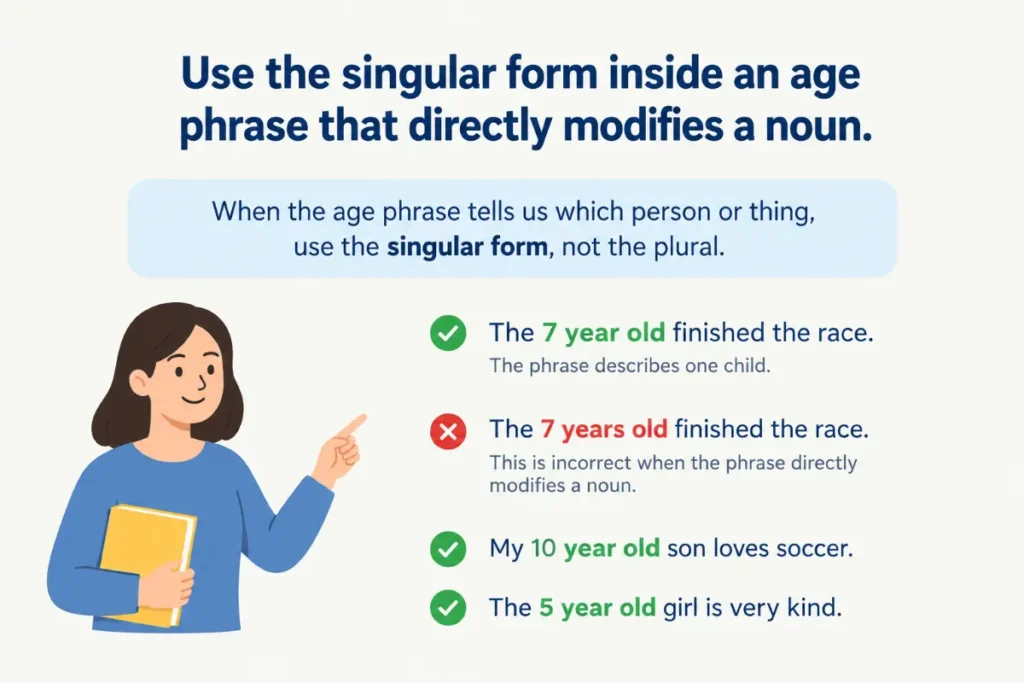
- Use the singular form inside an age phrase that directly modifies a noun.
- Use the plural form when stating age after a linking verb.
- The compound modifier normally takes hyphens in polished writing.
- One year old is singular in both common structures because one takes a singular noun.
- Numbers greater than one normally take years after a verb.
- Numbers greater than one still use singular year inside a compound modifier.
- The same basic rule works in American, British, Australian, and Canadian English.
- If the compound modifier becomes too long, rewrite the sentence for clarity.
For another common grammar confusion, see Quieter vs More Quiet Which Form Is Correct.
Conclusion
The difference between year old vs years old depends on how the age expression works in a sentence. Use years old when stating an age greater than one, as in My son is 8 years old. Use year old when describing a noun, as in My 8 year old son, and add hyphens in standard edited writing.
Both forms are correct when used in the right position. The easiest way to remember the rule is to check what follows the age. If a noun comes next, use the singular compound form. If the sentence simply states an age, use years for numbers above one.
FAQs
Is It 5 Year Old or 5 Years Old?
Both forms can be correct, but they belong in different sentence structures. Write My child is 5 years old because the phrase states an age after the linking verb. Write a 5 year old child when the expression comes before the noun. In standard edited writing, connect the words in the second example with hyphens.
Why Do We Say 10 Year Old Instead of 10 Years Old Before a Noun?
English uses singular measurement words in many compound modifiers. In a phrase such as a 10 year old child, the words work together as one description before the noun. This is why year stays singular. The same pattern appears in a 10 foot pole and a 3 hour meeting.
Should I Hyphenate Year Old?
Yes, use hyphens when the complete age expression appears before a noun as a compound modifier. For example, write a 7 year old student in standard edited form. Do not use hyphens when the phrase follows a linking verb: The student is 7 years old. The hyphens depend on the phrase’s position.
Is It 1 Year Old or 1 Years Old?
Use 1 year old because the number refers to exactly one year. The same singular form applies before a noun, as in a 1 year old child. The plural years is used for ages greater than one when stating age, such as 2 years old or 10 years old.
Is It Correct to Say 20 Years of Age?
Yes. Twenty years of age is a correct and more formal way to state someone’s age. For example, The applicant is 20 years of age is grammatically correct. In everyday conversation, The applicant is 20 years old sounds more natural. Both expressions communicate the same age, but they differ slightly in tone.
How Do You Write Ages in Formal Writing?
Follow the style guide required by your publication, school, or organization. The grammatical pattern remains the same: use singular year in a compound modifier before a noun and plural years when stating an age greater than one. Some style guides prefer numerals for ages, while others spell out certain numbers.
What Is the Plural of a 5 Year Old?
When referring to more than one child who is five, write five year olds. For example, The five year olds played outside. The plural ending belongs at the end of the compound noun. In standard edited writing, do not write five years olds because year remains singular within the compound expression.
Can I Write My 8 Year Old Is at School?
Yes. My 8 year old is at school is correct when the expression refers to a child and the noun is understood. The age phrase functions as a noun phrase. In standard edited writing, hyphenate the compound expression. You could also write My 8 year old child is at school.