
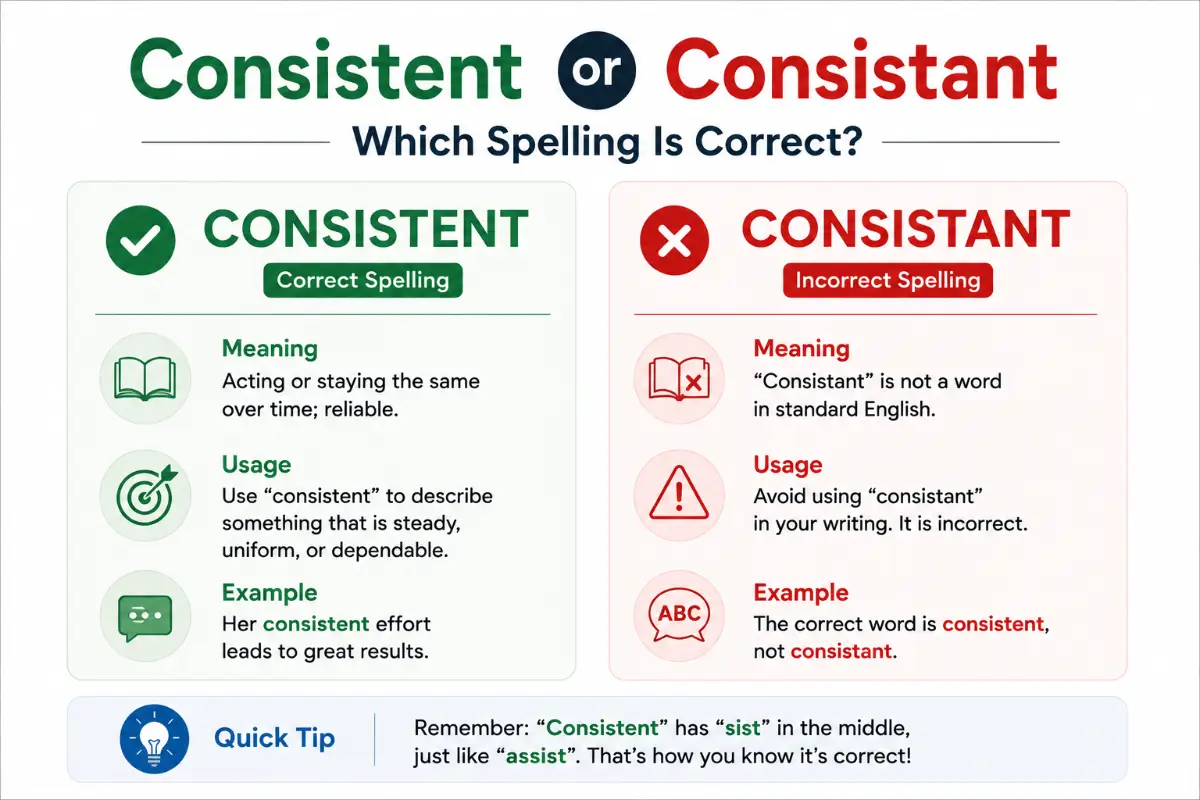
If you have ever paused while typing consistent or consistant, you are not alone. The correct spelling is consistent, with an e in the final syllable. Consistant is a common spelling mistake, not the standard form of the adjective. The confusion happens because the final sound can make the word seem as if it should end in ant, but English spelling does not always match pronunciation.
You use this word to describe something that stays the same, follows a pattern, or happens regularly. For example, a consistent student studies often, a consistent employee follows the same standards, and consistent results show little variation. The word is useful in school, business, science, sports, and everyday conversation.
Learning the correct spelling is easier when you understand its meaning, word structure, and relationship to other forms such as consistency and consistently. This guide explains the spelling difference, pronunciation, grammar, word origin, and common mistakes. You will also find natural examples and practical editing tips to help you use the word confidently in any type of writing.

Learn the difference in Correct or Correctly Which Word Should You Use.
Quick Answer
The correct spelling is consistent. The spelling consistant is incorrect in standard English and should not be used in formal or everyday writing. The adjective describes something that remains steady, regular, reliable, or in agreement with itself over time.
Comparison Table
| Feature | Consistent | Consistant |
|---|---|---|
| Spelling status | Correct standard spelling | Common misspelling |
| Meaning | Steady, regular, or in agreement | No standard English meaning |
| Part of speech | Adjective | Not a standard English adjective |
| Pronunciation | /kənˈsɪstənt/ | Usually intended to sound like consistent |
| Word origin | From Latin roots through French | Incorrect spelling based on sound or spelling confusion |
| Formality | Suitable for all writing styles | Avoid in standard writing |
| Common contexts | Work, school, habits, results, behavior | Typing and spelling errors |
| Example | Her work is consistent. | Her work is consistant. |
Meaning and Definition
What Does Consistent Mean?
Consistent is an adjective that describes something that stays the same, behaves in a regular way, or agrees with other facts, statements, or actions. It can refer to quality, behavior, performance, results, opinions, rules, or patterns.
For example, a consistent worker produces dependable results. A consistent exercise routine follows a regular schedule. A consistent explanation does not contradict itself. In each case, the word suggests steadiness, reliability, or agreement.
The adjective has several closely related meanings:
- Steady over time: Something does not change much from one occasion to another.
- Regular: Something happens in a repeated or predictable way.
- Reliable: A person or thing can be trusted to perform as expected.
- In agreement: Different statements, facts, or actions do not conflict.
- Uniform in quality: Something maintains a similar standard across different situations.
The exact meaning depends on the context. Consider the difference between a consistent employee and consistent evidence. An employee may show dependable behavior, while evidence may support the same conclusion as other available facts.
Meaning of the Incorrect Form
Consistant is not the standard spelling of this adjective. It is usually a spelling error caused by confusion about the final letters or by typing the word according to how it sounds.
The mistake does not create a separate accepted adjective with a different meaning. If you see it in an essay, email, report, or online post, the intended word is almost always consistent.
There may be isolated uses of the letter sequence in usernames, names, product labels, or other specially created forms. Those cases do not make it a standard English spelling. In ordinary writing, use consistent.
What Does Consistent Mean in Different Contexts?
The word can describe many things, so understanding its context helps you use it accurately.
Consistent behavior: A person acts in a steady and predictable way. For example, a manager who treats all team members fairly shows consistent behavior.
Consistent performance: Someone produces similar results over time. A student who earns strong grades throughout the year demonstrates consistent academic performance.
Consistent results: Findings or outcomes remain similar across tests, attempts, or periods. For example, repeated measurements may produce consistent results.
Consistent information: Details agree with one another and do not create contradictions. A witness gives a consistent account if the main details remain the same.
Consistent quality: A product or service maintains a similar standard each time. A restaurant may earn customer trust by serving consistent meals.
These uses share the central idea of steadiness or agreement. The word does not always mean that something is perfect. A person can be consistently late, and a machine can produce consistently poor results. The adjective describes the pattern, not necessarily its quality.
Key Differences Explained
1. Spelling
The correct form contains the letters e, n, and t at the end: consistent. The incorrect form replaces the e with an a: consistant.
This small difference matters because standard English recognizes only the first spelling for the adjective. Spellcheckers often catch the error, but you should still learn the correct form rather than depending entirely on software.
A useful way to remember the spelling is to connect it with consistency. Both words contain the same central spelling pattern: consist.
2. Meaning
Consistent has a clear meaning in standard English. It describes steadiness, regularity, reliability, or agreement.
Consistant has no separate standard meaning. It is generally an attempt to spell the same adjective incorrectly. You should not use it as an alternative spelling, even if readers can understand what you mean.
3. Grammar
Consistent is an adjective. It describes a noun or follows a linking verb to describe the subject.
Examples:
- She is a consistent performer.
- His results remain consistent.
- The company provides consistent service.
Consistant does not function as a standard English adjective. If you use it in a sentence, a reader will usually understand the intended meaning, but the spelling will still be incorrect.
4. Pronunciation
The standard pronunciation of consistent is /kənˈsɪstənt/. The word has three syllables: con-sis-tent. The main stress falls on the second syllable.
The incorrect spelling may look as if it represents a different sound, but it does not. People who write the wrong form usually intend to spell the same spoken word.
5. Formality
Consistent is appropriate in every type of writing. You can use it in a casual text, school assignment, business email, scientific report, or formal article.
Consistant is not appropriate in standard formal writing. It can make a document look careless and may distract readers from the message.
6. Context
The correct form works in many contexts, including:
- Personal habits.
- Academic performance.
- Workplace standards.
- Scientific findings.
- Business results.
- Sports performance.
- Customer service.
- Personal behavior.
The incorrect form should be corrected in all these settings.
7. Regional Usage
American, British, Canadian, and Australian English all use consistent. There is no standard regional spelling difference that makes consistant acceptable in one variety of English.
The adjective may appear more often in some professional or academic contexts than others, but its spelling remains the same.
8. Standard Versus Nonstandard Usage
Consistent is the accepted standard form. Consistant is a spelling error rather than a recognized alternative.
This distinction is useful because some English words have more than one accepted spelling. For example, certain words differ between American and British English. This is not one of those cases. The correct spelling stays the same across major English varieties.
Which Spelling Is Correct?
Consistent is the only correct standard spelling. The adjective ends in ent, not ant. Consistant is a misspelling and should be corrected whenever it appears in ordinary English writing.
The spelling is supported by the word’s established dictionary form and its related words, including consistency and consistently. These related forms help show the shared spelling pattern.
Consider these examples:
- Correct: The team has shown consistent improvement.
- Incorrect: The team has shown consistant improvement.
- Correct: We need consistent results before making a decision.
- Incorrect: We need consistant results before making a decision.
- Correct: Her attendance has been consistent this semester.
The correct form remains unchanged across formal and informal settings. You do not need to choose a different spelling for an email, school paper, workplace report, or personal message.
If you are unsure, remember the related noun consistency. The e in the correct adjective belongs to the same word family.
Sentence Examples
Here are ten natural examples that show how to use the correct form in different situations.
- Everyday conversation: I try to maintain a consistent sleep schedule during the week.
- Text message: Your advice has been consistent, and I really appreciate it.
- Workplace communication: We need a consistent approach to handling customer complaints.
- School: Consistent study habits can help students prepare for exams.
- Academic writing: The researchers found consistent patterns across the different samples.
- Formal writing: All departments must follow consistent procedures when reviewing applications.
- Social situations: A good friendship often depends on consistent communication and mutual respect.
- Online communication: Posting useful content on a consistent schedule can help readers know what to expect.
- Sports: The player delivered a consistent performance throughout the season.
- Customer service: The company is known for providing consistent support to its customers.
These sentences show that the adjective can describe people, actions, habits, methods, and results. It can appear before a noun or after a linking verb such as is, seems, remains, or becomes.
Common Mistakes and Misspellings
The most common problem is replacing the e in the final syllable with an a. However, writers can also make related errors when using the noun, adverb, or other forms of the same word family.
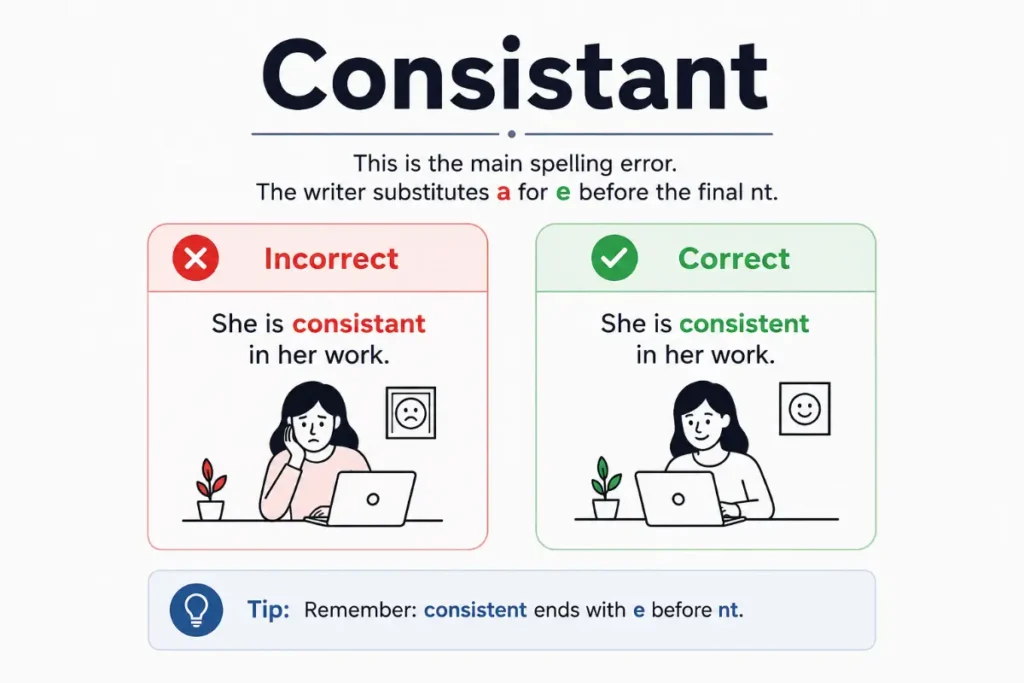
1. Writing Consistant Instead of Consistent
Incorrect: The employee provides consistant service.
Correct: The employee provides consistent service.
This is the main spelling mistake. The final syllable may sound similar to other English words ending in ant, which can lead writers to choose the wrong vowel. Remember the e before the final nt.
2. Writing Consistancy Instead of Consistency
Incorrect: Consistancy is important in customer service.
Correct: Consistency is important in customer service.
The noun is consistency, not consistancy. The correct spelling changes the final part of the adjective. Learning both forms together helps you avoid confusing their endings.
3. Writing Consistantly Instead of Consistently
Incorrect: She consistently follows the rules.
Incorrect spelling: She consistantly follows the rules.
Correct: She consistently follows the rules.
The adverb is consistently. It describes how an action happens. It keeps the same spelling pattern as the adjective and adds the adverb ending ly.
4. Confusing Consistent With Constant
Incorrect: The two words are interchangeable in every sentence.
Correct: Choose the word that matches the meaning.
Consistent describes something that remains steady, regular, or in agreement. Constant often describes something that continues without stopping or changing. For example, consistent effort means steady effort, while constant noise suggests noise that continues for a long time.
5. Using Consistent When You Mean Persistent
Incorrect: He was consistent in asking for a refund, so he refused to give up.
Better: He was persistent in asking for a refund.
Consistent and persistent are related, but they are not identical. Consistent emphasizes steadiness or regularity. Persistent emphasizes continuing despite difficulty, delay, or resistance. A person may be both consistent and persistent, but the words highlight different qualities.
Why Does This Spelling Mistake Happen?
Several factors can contribute to the error.
- Sound based spelling: People may choose a spelling that seems to match the way they hear the final syllable.
- Similar word endings: English has many adjectives ending in ant and ent, which can make the correct ending harder to remember.
- Typing habits: A writer may type the wrong vowel quickly and fail to notice the error.
- Limited word family awareness: Someone who knows the adjective but not the noun consistency may find the spelling harder to remember.
- Autocorrect dependence: Writers may assume their spelling is correct because a device does not highlight every mistake.
The best solution is to learn the adjective and its related forms together. This builds a stronger spelling pattern in your memory.
Pronunciation Guide
How Do You Pronounce Consistent?
In American English, consistent is pronounced /kənˈsɪstənt/. It has three syllables:
Con-sis-tent
The strongest stress falls on the second syllable, sis. The first syllable is usually weak, and the final syllable is also unstressed.
An easy pronunciation guide is:
kuhn-SIS-tuhnt
Say the middle syllable clearly and keep the other two lighter. This helps the word sound natural in conversation.
Common Pronunciation Mistakes
Some speakers may place too much stress on the first syllable or pronounce every syllable with equal force. This can make the word sound less natural.
Other speakers may confuse the final vowel sound because the spelling error uses a. However, the standard pronunciation belongs to the correct spelling. The incorrect written form does not create a separate accepted pronunciation.
Does the Spelling Change the Pronunciation?
No. In ordinary use, people who write the incorrect form generally intend the same spoken adjective. The spelling mistake does not establish a different word or a separate pronunciation.
The safest approach is to learn the standard spelling and say the word with stress on the second syllable.
For another common grammar confusion, see Dyeing vs Dying Which Spelling Is Correct.
Etymology and Word Origin
The word consistent developed through Latin and French before entering English. It is connected with Latin consistere, meaning to stand firm, remain in place, or take a position. The word passed through forms related to French consistent before becoming established in English.
Its history connects naturally with its modern meaning. Something consistent stands firm in the sense that it remains steady or agrees with other things. A consistent argument holds together, consistent behavior follows a pattern, and consistent results show a similar outcome.
The related noun consistency and adverb consistently developed within the same word family. Learning these forms together makes the spelling easier to remember and helps you recognize the shared meaning.
The historical origin also explains why the word has a sense of stability. It does not mean that something never changes under any condition. Instead, it describes a level of agreement, regularity, or steadiness within a particular situation.
Regional Usage
American English
Consistent is the standard spelling in the United States. It is widely used in school assignments, workplace documents, news writing, business communication, and everyday conversation.
American writers use it to describe steady effort, reliable performance, regular habits, and agreement between facts or statements. Consistant is considered a spelling error.
British English
British English uses the same spelling: consistent. There is no accepted British alternative ending in ant.
The word has the same main meanings and grammatical role as it does in American English. British writers use it in both everyday and formal communication.
Australian English
Australian English also follows the standard spelling. Consistent is used to describe regular behavior, dependable performance, and agreement between ideas or facts.
There is no meaningful regional spelling difference for this adjective.
Canadian English
Canadian English uses consistent as well. The spelling does not change based on Canadian writing conventions, and the incorrect form is not a recognized regional alternative.
Does the Spelling Change Between Countries?
No. Unlike words that have accepted American and British spelling variations, this adjective has one standard spelling across these major English varieties.
If you are writing for an international audience, use consistent. It is understood and accepted in all the English varieties discussed above.
Grammar Rules and Part of Speech
Consistent as an Adjective
Consistent is an adjective. Its main job is to describe a noun or provide information about a subject.
It can appear before a noun:
- She follows a consistent routine.
- The company maintains consistent standards.
- We need consistent results.
It can also appear after a linking verb:
- Her performance is consistent.
- The measurements remain consistent.
- His explanation seems consistent with the evidence.
In each sentence, the adjective describes a person, thing, result, or condition.
Common Grammatical Patterns
Several common structures help you use the word naturally.
Consistent with: Use this pattern to show that something agrees with another fact, statement, or standard.
Example: Her explanation is consistent with the available evidence.
Consistent in: Use this pattern to identify an area in which someone or something remains steady.
Example: He is consistent in his approach to customer service.
Consistent over time: Use this phrase to describe steadiness across a period.
Example: The company’s sales have remained consistent over time.
Consistent results: Use this phrase when outcomes are similar across tests, attempts, or periods.
Example: The new process produced consistent results.
Consistent performance: Use this phrase to describe dependable work or ability.
Example: The athlete has delivered consistent performance throughout the season.
Comparative and Superlative Forms
You can use more and most to compare levels of consistency.
- More consistent: This method is more consistent than the old one.
- Most consistent: She was the most consistent player on the team.
- Less consistent: The results became less consistent after the equipment change.
You can also use less and least to show a lower level of regularity or agreement.
Related Word Forms
The word family includes several useful forms.
| Word | Part of Speech | Meaning | Example |
|---|---|---|---|
| Consistent | Adjective | Steady or in agreement | Her work is consistent. |
| Consistency | Noun | The quality of being steady | Consistency matters in training. |
| Consistently | Adverb | In a steady or regular way | He consistently arrives early. |
| Inconsistent | Adjective | Not steady or not in agreement | The reports contain inconsistent details. |
| Inconsistency | Noun | A lack of agreement or steadiness | We noticed an inconsistency in the figures. |
| Inconsistently | Adverb | In an irregular or uneven way | The rules were applied inconsistently. |
These forms are useful because they let you express the same central idea in different grammatical ways. For example, you can describe a consistent person, talk about that person’s consistency, or explain that they behave consistently.
Common Grammar Errors
A frequent mistake is using the adjective when the sentence needs an adverb.
Incorrect: She works consistent.
Correct: She works consistently.
The first sentence uses an adjective where an adverb is needed to describe how she works. Another mistake is using the noun instead of the adjective.
Incorrect: The results are consistency.
Correct: The results are consistent.
Choose the form based on its role in the sentence. Use the adjective to describe something, the noun to name a quality, and the adverb to describe an action.
Formal and Informal Usage
The word is suitable for both formal and informal writing. You can use it in a casual conversation about habits or in a professional report about business performance.
Its meaning does not become more formal in academic writing. The main difference is the subject being discussed. A student may talk about consistent study habits, while a researcher may discuss consistent findings across several tests.
Real Life Usage Examples
Daily Conversation
In everyday conversation, the adjective often describes habits, behavior, and personal effort.
- I have been trying to keep a consistent bedtime during the week.
- Your cooking has been consistent every time I visit.
The first example describes a regular habit. The second describes a similar level of quality across different occasions.
Email and Workplace Communication
In professional settings, the word often refers to standards, methods, and results.
- Please use a consistent format for all monthly reports.
- We need consistent communication between the sales and support teams.
These sentences show how the adjective can help describe clear workplace expectations. It can refer to the way information is presented or the way a team works together.
Academic Writing
Students and researchers use the word to describe patterns, evidence, and findings.
- The experiment produced consistent results across three trials.
- The findings were consistent with the original hypothesis.
The first sentence focuses on similar outcomes. The second shows that the findings agree with an earlier idea.
News and Journalism
News writers may use the adjective to describe repeated trends or information that agrees with available facts.
- Officials reported consistent growth in local employment.
- The witness gave a consistent account of the incident.
In the first sentence, the word describes a steady trend. In the second, it describes an account that does not contain major contradictions.
Literature and Storytelling
In stories, the word can describe a character’s habits, personality, or behavior.
- Her consistent kindness made the new student feel welcome.
- The detective noticed that the suspect’s story was not consistent with the evidence.
The first example highlights a repeated positive quality. The second creates doubt because the details do not agree.
Related and Confused Terms
These eight words are closely connected to the meaning of the adjective. Some are useful synonyms, while others describe slightly different ideas.
1. Consistency
Consistency is the noun form. It describes the quality of remaining steady, regular, or in agreement.
Example: Consistency is one of the most important parts of building a good habit.
Use consistent when describing something. Use consistency when naming the quality itself.
2. Consistently
Consistently is the adverb form. It describes an action that happens in a regular or steady way.
Example: She consistently meets her deadlines.
The adjective describes a person or thing, while the adverb describes how an action happens.
3. Constant
Constant describes something that continues without stopping or changing much. It can overlap with consistent, but the two words are not always interchangeable.
Example: The constant noise made it difficult to concentrate.
Constant emphasizes continuation, while consistent emphasizes steadiness or agreement.
4. Reliable
Reliable describes someone or something that can be trusted to work well or behave as expected.
Example: We need a reliable source of information.
A reliable person may also be consistent, but the words emphasize different qualities. Reliability focuses on trust, while consistency focuses on steadiness.
5. Steady
Steady means stable, regular, or not changing suddenly.
Example: The business has experienced steady growth.
It is close in meaning to consistent, especially when describing progress, effort, or performance.
6. Regular
Regular describes something that happens at repeated times or follows a pattern.
Example: Regular exercise can support better health.
A regular schedule is consistent because it follows a pattern, but the words are not identical in every context.
7. Uniform
Uniform describes something that stays the same in form, appearance, or quality.
Example: The paint gives the walls a uniform finish.
This word is useful when different parts of something look or behave alike.
8. Persistent
Persistent describes someone who continues an effort despite difficulty or delay.
Example: Her persistent efforts helped the team finish the project.
Persistence focuses on continuing despite obstacles. Consistency focuses on maintaining a steady pattern. A person can show both qualities at the same time.
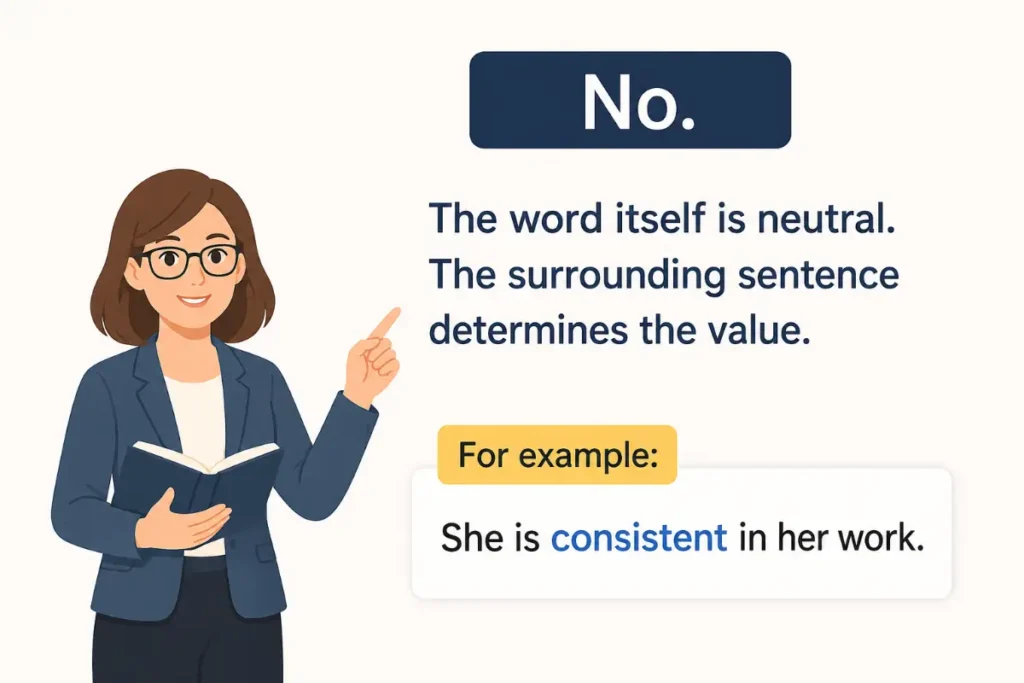
Is Consistent Always Positive
No.
The word itself is neutral. The surrounding sentence determines the value.
For example:
She is consistent in her work.
This usually sounds positive.
But:
He is consistently late.
Expert Editor Insight
An experienced editor checks the spelling, word form, and sentence function before approving this adjective. Native English speakers use consistent naturally to describe steady habits, reliable work, and information that agrees. The incorrect ending often appears because writers rely on sound rather than the established spelling. A spellchecker may flag the error, but it may not explain why the noun is consistency and the adverb is consistently. A useful editing habit is to check the whole word family together. If you can spell consistency correctly, you have a strong reminder of the e in the adjective.
Need another quick comparison? Read Born vs Borne Which Form Should You Use.
Conclusion
The correct spelling is consistent, not consistant. The adjective describes something steady, regular, dependable, or in agreement with other information. It works in everyday conversation, academic writing, business communication, and formal documents. The easiest way to remember the spelling is to connect it with the related noun consistency and adverb consistently.
All three forms share the same central spelling pattern. If you are unsure while writing, check the final syllable and remember that the standard adjective ends in ent. Using the correct form makes your writing clearer and helps your readers focus on your message rather than a spelling mistake.
FAQs
Is Consistant a Real Word?
Consistant is not a standard English spelling of the adjective. It is generally a misspelling of consistent, which means steady, regular, reliable, or in agreement. You may see the incorrect form in online posts or informal writing, but it should not appear in edited documents, school assignments, or professional communication.
What Is the Correct Spelling Consistent or Consistant?
The correct spelling is consistent, ending in ent. Consistant, ending in ant, is incorrect in standard English. The adjective describes something that stays steady, follows a regular pattern, or agrees with other information. Remember the related noun consistency to help you recall the correct spelling.
What Does Consistent Mean in Simple Words?
Consistent means staying the same in a steady or reliable way. A consistent person behaves dependably, a consistent routine follows a regular pattern, and consistent results remain similar across different attempts. The word can also describe information or statements that agree rather than contradict one another.
How Do You Pronounce Consistent?
Consistent is pronounced /kənˈsɪstənt/ in American English. It has three syllables: con-sis-tent. The strongest stress falls on the second syllable, sis. An easy guide is kuhn-SIS-tuhnt. The incorrect spelling does not represent a separate standard pronunciation.
Why Do People Spell Consistent Incorrectly?
People often make this mistake because the final syllable sounds similar to other English word endings. Fast typing and uncertainty about the difference between ent and ant can also contribute. Learning related forms such as consistency and consistently is a practical way to remember the correct spelling.
Is Consistent an Adjective or an Adverb?
Consistent is an adjective. It describes a noun or follows a linking verb, as in “Her performance is consistent.” The adverb form is consistently, as in “She performs consistently.” The noun form is consistency, which names the quality of being steady or reliable.
Is Consistent the Same as Constant?
No. Consistent describes something that remains steady, regular, or in agreement. Constant often describes something that continues without stopping or changing. For example, consistent effort means steady effort over time, while constant noise suggests noise that continues for a long period. The words overlap in some contexts but have different meanings.
Can I Use Consistent in Formal Writing?
Yes. Consistent is suitable for formal reports, academic papers, business emails, applications, and everyday communication. It is a standard adjective with a clear meaning. Just make sure you use the correct spelling and grammatical form. For example, write “consistent results” and “consistently applied rules.”