
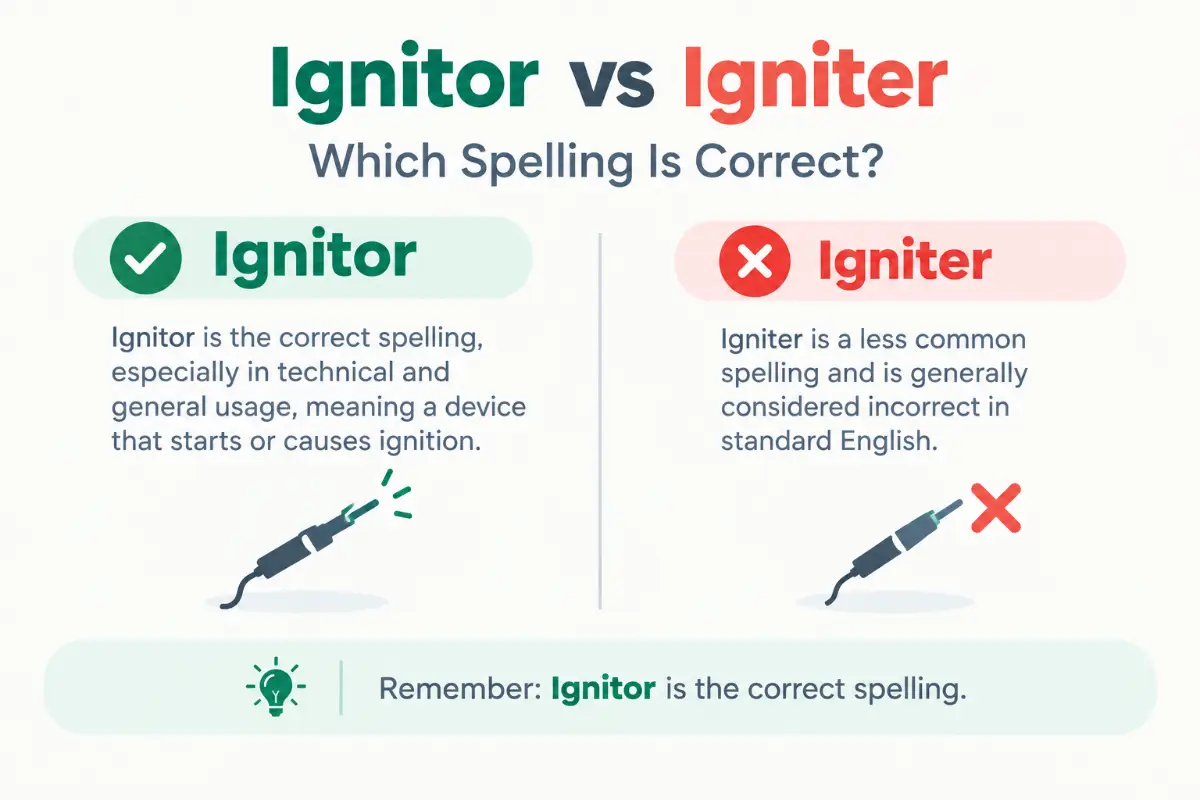
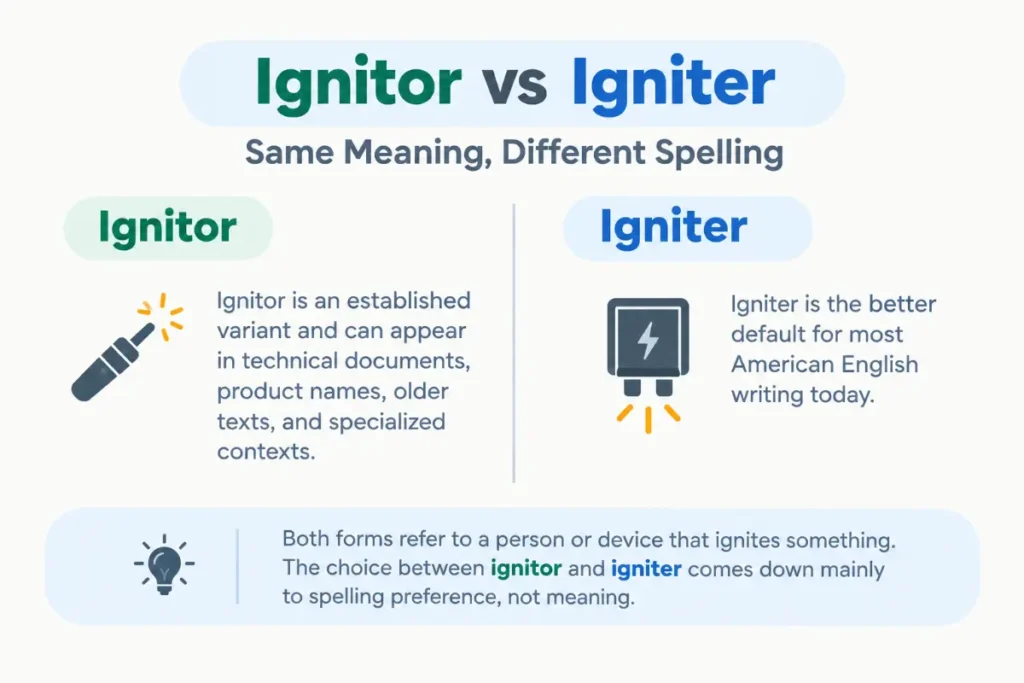
If you have seen both ignitor and igniter, you may wonder which spelling belongs in your writing. The good news is that both are correct English words. Each refers to a device or component that starts a flame, sparks a fuel mixture, or begins a combustion process. The difference is mainly a matter of spelling preference, regional usage, and industry convention.
You may encounter igniters in gas stoves, furnaces, water heaters, and vehicle systems. You may also see ignitors in technical documents, equipment descriptions, product names, and specialized industries. Neither spelling is automatically wrong, although one may be more common in a particular country or manufacturer’s terminology.
Choosing the right form becomes easier when you understand the word’s meaning and the context in which it appears. This guide explains both spellings, their pronunciation, their technical uses, and the differences in regional preferences. You will also learn how to use the word in sentences, avoid common spelling mistakes, and keep your writing consistent.
Need another quick comparison? Read felicitation meaning and correct usage.
Quick Answer
Both ignitor and igniter are correct spellings of the noun for a device that starts combustion or produces the initial spark or flame. Igniter is a widely used spelling in American English, while ignitor also appears in technical and commercial usage. Follow the spelling used by the manufacturer or style guide when referring to specific equipment.
Comparison Table
| Feature | Igniter | Ignitor |
|---|---|---|
| Correct spelling | Yes | Yes |
| Meaning | A device that starts ignition | A device that starts ignition |
| Part of speech | Noun | Noun |
| Word formation | Ignite + er | Ignite + or |
| Pronunciation | /ɪɡˈnaɪtər/ | /ɪɡˈnaɪtər/ |
| Main function | Starts a flame or combustion process | Starts a flame or combustion process |
| American English | Widely used | Also accepted |
| British English | Used | Also used |
| Technical contexts | Appliances, heating systems, engines, electronics | Equipment manuals, industrial systems, specialized products |
| Formality | Standard | Standard |
| Example | The furnace igniter needs replacement. | The system uses an electronic ignitor. |
Meaning and Definition
What Does Igniter Mean?
Igniter is a noun that describes a device or component used to start combustion. It may create an electrical spark, produce heat, or provide another form of energy that starts a fuel burning. The exact design depends on the equipment and the type of ignition system.
You may find an igniter in many household and industrial products. A gas stove, for example, may use an electrical component to create a spark near the burner. A furnace may use a hot surface igniter to heat up and help light the gas. In both cases, the component helps begin the combustion process.
The word also appears in automotive, aerospace, and industrial settings. Some systems use a small ignition component to start a larger process. The design and operating method can vary, but the basic purpose remains the same.
Common examples include:
- Gas stove igniter.
- Furnace igniter.
- Water heater igniter.
- Gas grill igniter.
- Engine igniter.
- Rocket motor igniter.
- Industrial burner igniter.
- Electronic ignition module.
In general writing, the word refers to the part that initiates ignition. In technical writing, the exact meaning may depend on the equipment design. For example, a hot surface igniter does not work in exactly the same way as a spark igniter, even though both help start combustion.
What Does Ignitor Mean?
Ignitor has the same basic meaning as igniter. It refers to a device, component, or mechanism that starts combustion by supplying an initial spark, heat source, or ignition energy.
For example, a manufacturer may describe a component in a gas appliance as an ignitor. A technical document may use the same spelling when discussing a burner system or an industrial ignition device.
The difference between the two forms does not normally indicate a different function. An ignitor is not automatically a different kind of component from an igniter. The spelling may reflect a manufacturer’s naming choice, an industry convention, or an editorial preference.
You might see this form in:
- Product descriptions.
- Equipment catalogs.
- Industrial manuals.
- Automotive parts listings.
- Electrical component specifications.
- Specialized ignition systems.
If a product manual uses ignitor, keep that spelling when discussing the named part. This helps maintain consistency with the manufacturer’s terminology and makes it easier for readers or technicians to identify the correct component.
Are Both Spellings Real Words?
Yes. Both forms are established English spellings. They are not simply a correct word and a common typo. Each is used as a noun for something that initiates ignition.
The reason both forms exist comes from English word formation. The suffixes er and or can both create nouns that describe a person or thing performing an action. English has many examples of this pattern, including worker and actor.
The two endings do not always follow one simple rule. Some verbs strongly favor one form, while others have accepted variations. In this case, both spellings have gained use, so writers should not label either one incorrect without considering the relevant style or technical context.
Key Differences Explained
1. Spelling
The most obvious difference is the final two letters.
- Igniter ends in er.
- Ignitor ends in or.
Both spellings are recognized. The choice does not change the basic meaning of the noun, and the two forms are generally pronounced the same way.
This is a spelling variation rather than a difference in function. If you are writing about a specific product, the manufacturer’s spelling is usually the best choice.
2. Meaning
Both words refer to a component that starts an ignition process. They can describe parts that produce a spark, create heat, or initiate combustion in an appliance or machine.
For example, an igniter in a gas furnace may heat up until it can ignite the gas. An ignitor in another system may use a spark to start combustion. The different operating methods come from the equipment design, not from the spelling.
Do not assume that one spelling always refers to a spark system and the other always refers to a heating system. The technical specifications determine how the component works.
3. Grammar
Both forms are countable nouns. You can use them with articles, adjectives, and plural endings.
Examples:
- The igniter is damaged.
- The technician replaced an ignitor.
- The appliance has two igniters.
- The manufacturer supplies replacement ignitors.
The grammar is the same for both. You can use either spelling as the subject or object of a sentence.
4. Pronunciation
In common English pronunciation, both forms are usually pronounced /ɪɡˈnaɪtər/. The stress falls on the second syllable, and the ending sounds like the final syllable in words such as writer or lighter.
The spelling difference does not normally create a noticeable difference in speech. A listener may not know which form you intend unless they see it written down.
5. Formality
Neither form is inherently more formal or more casual. Both can appear in technical documents, product descriptions, repair instructions, and general writing.
The important point is consistency. A repair manual should follow the spelling used in its technical documentation. A general article should choose one accepted form and use it throughout unless it is discussing both spellings directly.
6. Technical Context
In technical writing, a small spelling difference can matter for practical reasons. A manufacturer may use a particular term in product catalogs, part numbers, installation instructions, and service documents.
For example, a replacement part may be listed as a furnace ignitor in one catalog and a furnace igniter in another. The spelling alone is not enough to confirm compatibility. You must check the model number, part number, voltage, dimensions, and equipment specifications.
This is especially important when purchasing replacement parts. Two components with similar names may have different designs or may not fit the same appliance.
7. Regional Usage
Both forms appear in major English varieties. American writers commonly use igniter, but ignitor is also found in American technical and commercial material. British and other English speaking markets also use both forms.
There is no reliable rule that makes one spelling exclusively American and the other exclusively British. Product terminology and industry preferences can have more influence than national spelling conventions.
8. Standard and Nonstandard Usage
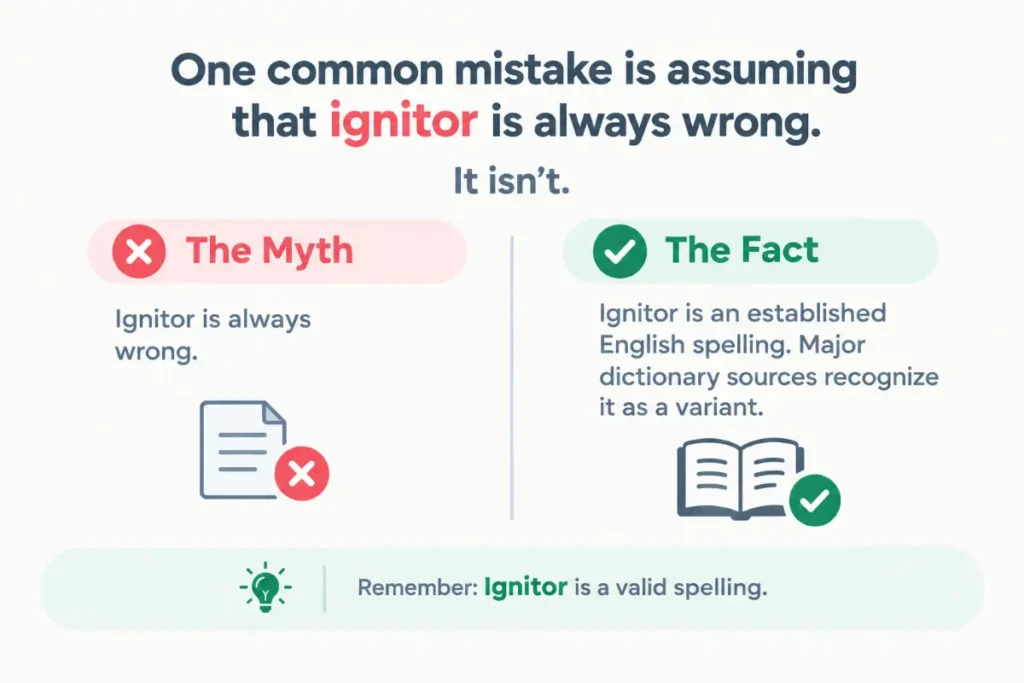
Both spellings are standard enough to be understood and used in English. Neither should automatically be marked as a misspelling.
However, a particular publication, manufacturer, or technical organization may prefer one form. That preference should guide writing within that document or organization. A style choice does not make the alternative spelling universally incorrect.
Which Form Is Correct?
Both igniter and ignitor are correct. If you need a general spelling for American English, igniter is a practical choice because it is widely recognized and commonly used. If you are referring to a product or component whose official name uses ignitor, retain that spelling instead.
English often forms nouns with the endings er and or. Both can identify something that performs an action. For example, a person who writes is a writer, while a person who acts is an actor. These endings have developed through different word formation patterns, and English does not apply one universal rule to every verb.
The verb ignite provides the base for both forms. Adding er produces igniter, while adding or produces ignitor. Both forms refer to the thing that initiates ignition.
Use these guidelines:
- Choose igniter for general writing if you do not have a specific style preference.
- Use ignitor if that is the spelling found in the product documentation.
- Follow the spelling in a manufacturer’s parts catalog when identifying a component.
- Keep one spelling consistent throughout an article or report.
- Do not change the spelling in a model name, product title, or official part description.
The safest choice is the one that matches your reader’s context. A homeowner looking for a replacement furnace part needs the manufacturer’s exact terminology. A general reader learning the word can understand either spelling.
Sentence Examples
The following examples show how both spellings work in natural sentences. The first group uses the widely recognized igniter form, while the second demonstrates the alternative spelling.
Ten Examples Using Igniter
- Everyday conversation: The gas stove will not light because its igniter may be faulty.
- Text message: Can you check the grill igniter before we start cooking?
- Workplace communication: The technician found a damaged igniter during the furnace inspection.
- School: An igniter helps start the combustion process in some heating systems.
- Academic writing: The experiment examined how the igniter affected the initial combustion rate.
- Formal writing: Replace the faulty igniter according to the equipment manufacturer’s instructions.
- Social situations: We could not use the outdoor grill because the igniter stopped working.
- Online communication: The repair guide explains how to inspect a gas stove igniter.
- Customer service: The replacement igniter is compatible with the listed appliance model.
- Technical reporting: The engine ignition system includes an igniter designed for reliable startup.
These examples cover everyday and specialized uses. In each sentence, the noun identifies a component involved in starting combustion. The exact technology may differ, so technical documents should explain the component’s function when readers need more detail.
Five Examples Using Ignitor
- The industrial burner uses an electronic ignitor to start the fuel mixture.
- The technician ordered a replacement ignitor for the heating unit.
- Check the ignitor connection before testing the appliance again.
- The equipment manual identifies the component as an ignitor assembly.
- The manufacturer recommends using the specified ignitor for this model.
These sentences are also grammatically correct. The alternative spelling does not change the meaning of the noun. It simply follows a different accepted spelling pattern.
Examples in Technical Contexts
The word can appear in several industries, and the surrounding details help explain its exact role.
- Home heating: The furnace uses a hot surface igniter to light the gas.
- Cooking appliances: The cooktop’s spark igniter helps light the burner.
- Outdoor equipment: The grill igniter produces a spark when the control button is pressed.
- Automotive systems: The ignition components help start combustion inside the engine.
- Aerospace equipment: A specialized igniter initiates the combustion process in a rocket motor.
These examples should not be taken as proof that every system uses the same type of component. Different products use different ignition designs. Always check the equipment documentation before identifying or replacing a part.
Common Spelling Mistakes and Usage Problems
Although both main forms are accepted, writers sometimes make other spelling errors. These mistakes often come from typing quickly, confusing similar words, or trying to apply a spelling rule too broadly.
1. Writing Ignitor as Igniter or the Other Way Around
Incorrect in a product specific context: Changing the official spelling in a manufacturer’s part name.
Preferred: Keep the spelling used in the official product documentation.
Both forms are valid in general English. However, changing the spelling of a named component can make it harder to match a part with a catalog or repair manual. Copy the official description when accuracy matters.
2. Writing Ignighter
Incorrect: The ignighter needs to be replaced.
Correct: The igniter needs to be replaced.
The extra h is unnecessary. It may appear because writers associate the word with light or the word lighter. The correct base is ignite, so the noun is formed as igniter or ignitor.
3. Writing Igniter as Igniterer
Incorrect: The igniterer is not working.
Correct: The igniter is not working.
The ending er already forms the noun. Adding another ending creates an incorrect and unnecessary form. Use the established noun rather than trying to build it again.
4. Confusing Igniter With Ignition
Incorrect: The ignition needs to be replaced when referring to the specific igniter component.
Better: The igniter needs to be replaced.
“Ignition” describes the process or system involved in starting combustion. “Igniter” names a component that helps begin that process. Some equipment may have an ignition system containing several parts, so the two terms should not be treated as exact synonyms.
5. Using Igniter for Every Part of an Ignition System
Incorrect: The igniter, spark plug, and ignition coil are all the same component.
Correct: The igniter, spark plug, and ignition coil can refer to different components, depending on the system.
An ignition system may contain several parts with separate functions. A spark plug creates a spark in an engine, while an ignition coil supplies the electrical energy needed for that spark. An igniter may refer to a different ignition control or starting component. Always use the equipment’s technical description rather than assuming the parts are interchangeable.
Pronunciation Guide
How Do You Pronounce Igniter?
The usual pronunciation is /ɪɡˈnaɪtər/. It has three syllables:
- Ig.
- Nite.
- Er.
The main stress falls on the second syllable. You can say it as ig NYE ter, with the long i sound in the middle.
The final syllable is usually pronounced with a relaxed American English sound, similar to the ending in writer or lighter. The exact sound may vary by accent, but the stress pattern remains easy to recognize.
How Do You Pronounce Ignitor?
Ignitor is generally pronounced the same way: /ɪɡˈnaɪtər/. The spelling ends in or, but that ending does not normally create a different spoken form in this word.
The two spellings are therefore homophones for many English speakers. You can hear the word in a conversation without knowing which spelling the speaker would use.
Common Pronunciation Mistakes
A common mistake is placing the main stress on the first syllable. The usual stress falls on the middle syllable: ig NYE ter.
Another mistake is trying to pronounce the final letters as two separate sounds. In ordinary speech, the ending is one relaxed syllable. Say the word smoothly rather than separating each letter.
Learn the difference in Catalogue or Catalog: Which Spelling Is Correct?.
Etymology and Word Origin
The Origin of Ignite
The word ignite comes from Latin roots associated with fire. It entered English through French and developed into the verb used today, meaning to set something on fire or cause it to begin burning.
The Latin root is connected with ignis, meaning fire. This root also appears in English words related to heat and combustion, such as igneous, which describes rock formed from cooled molten material.
How the Nouns Developed
The nouns igniter and ignitor come from the verb ignite. English uses noun forming endings such as er and or to describe a person or thing that performs an action.
In this case, both endings produce an accepted noun. The resulting words refer to a device that initiates ignition. Their meanings overlap, even though the spelling differs.
Why the Spelling Variants Exist
English spelling has many variations created by historical word formation and changes in usage. The endings er and or do not follow a single rule that works for every verb.
That is why both forms can exist without one being a simple typing error. In modern writing, usage patterns, technical terminology, and editorial choices all influence which form a writer selects.
Regional Usage
American English
Both spellings are used in the United States. Igniter is a familiar choice in general writing and appears in descriptions of appliances, heating equipment, and ignition systems. Ignitor also appears in technical material, product names, and commercial listings.
If you are writing for an American audience, igniter is a sensible default when no official product spelling or style guide applies. For repair work, use the exact term shown in the equipment manual or parts catalog.
British English
British English also recognizes both spellings. You may see either form in technical writing, product descriptions, and equipment documentation. There is no strict rule that reserves ignitor for British English or igniter for American English.
British readers will generally understand both forms. As in American English, the spelling used by a particular manufacturer or publication may determine the preferred choice.
Australian English
Australian English uses both forms in technical and general contexts. The spelling may vary between suppliers, manufacturers, and publications. There is no major regional distinction in meaning between the two versions.
Canadian English
Canadian English also uses both spellings. Writers can choose a preferred form for general text, but technical documents should follow the spelling used by the relevant manufacturer or industry source.
Is One Spelling More Common Worldwide?
The answer depends on the type of writing and the source being examined. General dictionaries, product catalogs, repair manuals, and technical documents may show different preferences. It is safer to describe both as accepted variants than to claim that one spelling is used everywhere.
For international writing, choose one spelling and apply it consistently. If the article refers to a specific product, preserve the official spelling used by its maker.
Grammar Rules and Part of Speech
Both spellings function as nouns. They name a device or component that helps start combustion. The grammatical rules are the same, so you do not need to learn separate patterns for each version.
Singular and Plural Forms
The singular form refers to one component. The plural form follows the normal English rule of adding s.
| Form | Example |
|---|---|
| Singular | The igniter is damaged. |
| Plural | The igniters need inspection. |
| Alternative singular | The ignitor is damaged. |
| Alternative plural | The ignitors need inspection. |
Both plural forms are correct. Keep the same spelling pattern throughout a document unless you are discussing the two variants.
Using Articles
Use a or an based on the sound that follows the article. Because the first sound in both words is a vowel sound, an is normally used.
Examples:
- The technician installed an igniter.
- The repair shop ordered an ignitor.
- An igniter can help start a gas burner.
Do not choose the article based only on the first written letter. Listen to the opening sound.
Using the Word as a Subject
The noun can act as the subject of a sentence.
Example: The igniter starts the combustion process.
Here, the component performs the action described by the verb. The sentence is direct and easy to understand.
Using the Word as an Object
It can also appear as the object of a verb.
Example: The technician replaced the ignitor.
In this sentence, the component receives the action. The word can also follow a preposition, as in “Check the wiring around the igniter.”
Using It as a Compound Noun
The noun often appears in compound expressions that identify the type of component or its application.
Common examples include:
- Gas stove igniter.
- Furnace igniter.
- Hot surface igniter.
- Spark igniter.
- Electronic ignitor.
- Burner ignitor.
The first word describes the equipment or type of component. These compounds are usually written as separate words, although official product names may follow a manufacturer’s own formatting.
Formal and Informal Writing
Both spellings are suitable for formal and informal writing. The choice should be guided by consistency and the intended meaning.
In a casual message, you might write, “The grill igniter isn’t working.” In a technical report, you might write, “The igniter failed during the startup test.” Neither sentence requires a different spelling because of its tone.
Real Life Usage Examples
Daily Conversation
In ordinary conversation, people usually use the word when discussing an appliance or machine that will not start.
- The stove igniter keeps clicking, but the burner will not light.
- I think the furnace igniter needs to be checked before winter.
These sentences use familiar household situations. They describe a component without requiring the speaker to explain its full technical design.
Email and Workplace Communication
In a workplace, clear part names help technicians, managers, and customers understand the issue.
- Please order a replacement igniter for the heating unit.
- The service report identifies the ignitor as the suspected cause of the startup problem.
The second sentence retains the alternative spelling because it may match the terminology used in the report. In professional communication, matching the equipment documentation helps prevent confusion.
Academic Writing
The noun can appear in scientific and engineering discussions about combustion, heat transfer, and ignition systems.
- The test measured the time required for the igniter to initiate combustion.
- The researchers compared the performance of two electronic ignitor designs.
These examples show how the word can be used in technical research. A formal paper should define the specific component and explain how it works within the system being studied.
News and Journalism
News articles may use the term when reporting on appliance recalls, equipment failures, or industrial safety issues.
- The company announced a repair program for a faulty furnace igniter.
- Investigators examined the burner system after the industrial ignitor failed.
A news report should avoid suggesting that a component caused an accident unless the investigation supports that conclusion. Accurate technical wording matters when reporting equipment problems.
Literature and Storytelling
In fiction, the word can appear in scenes involving machinery, outdoor cooking, or technical work.
- He pressed the button again, but the old stove igniter refused to spark.
- The engineer checked the ignitor before starting the machine.
These examples use the component as part of a larger action. A writer can add details about the spark, sound, heat, or failed startup to make the scene more vivid.
Related and Confused Terms
The following terms are closely connected to ignition and combustion. They are useful when discussing appliances, engines, heating equipment, and technical systems.
1. Ignition
Ignition is the process of starting combustion. An igniter is a component that helps begin this process. For example, the ignition system may contain an igniter along with other electrical or mechanical parts.
2. Igniter Electrode
An igniter electrode is a conductive part used in some ignition systems to create an electrical spark. It may be part of a larger assembly. The exact design depends on the appliance or burner.
3. Spark Plug
A spark plug is a component used in spark ignition engines. It creates an electrical spark inside the engine cylinder to ignite the compressed air and fuel mixture. It has a specific role and should not be treated as a general name for every ignition component.
4. Ignition Coil
An ignition coil is an electrical component that transforms a lower voltage into the high voltage needed by a spark ignition system. It often works with spark plugs in engines. It is not the same component as every device described as an igniter.
5. Pilot Light
A pilot light is a small, continuously burning flame used in some gas appliances to ignite the main burner. Some modern appliances use electronic ignition instead. A pilot light is a flame, not simply another spelling of the component name.
6. Burner
A burner is the part of an appliance or machine where fuel and air combine and burn. An igniter may help start the burner, but the burner performs the main combustion function during operation.
7. Hot Surface Igniter
A hot surface igniter is an electrical component that becomes hot enough to ignite fuel in certain heating systems. It is common in some modern furnaces. Its operating principle differs from a spark based ignition component.
8. Combustion
Combustion is the chemical process in which a fuel reacts with an oxidizer and releases energy, often as heat and light. An ignition component helps start this process, but ignition and combustion are not the same thing. Ignition begins the reaction, while combustion is the burning process itself.
Expert Editor Insight
An experienced editor treats both spellings as valid but checks the context before choosing one. In general American writing, igniter is a practical default, while a product manual or technical catalog may use ignitor as its official term. Spelling tools may flag one version based on their language settings or dictionaries, but that does not prove it is wrong.
Editors should check the manufacturer’s terminology, confirm that the sentence names the correct component, and use one spelling consistently. In technical writing, matching the exact part description is more useful than changing a valid spelling to fit a personal preference.
Key Takeaways
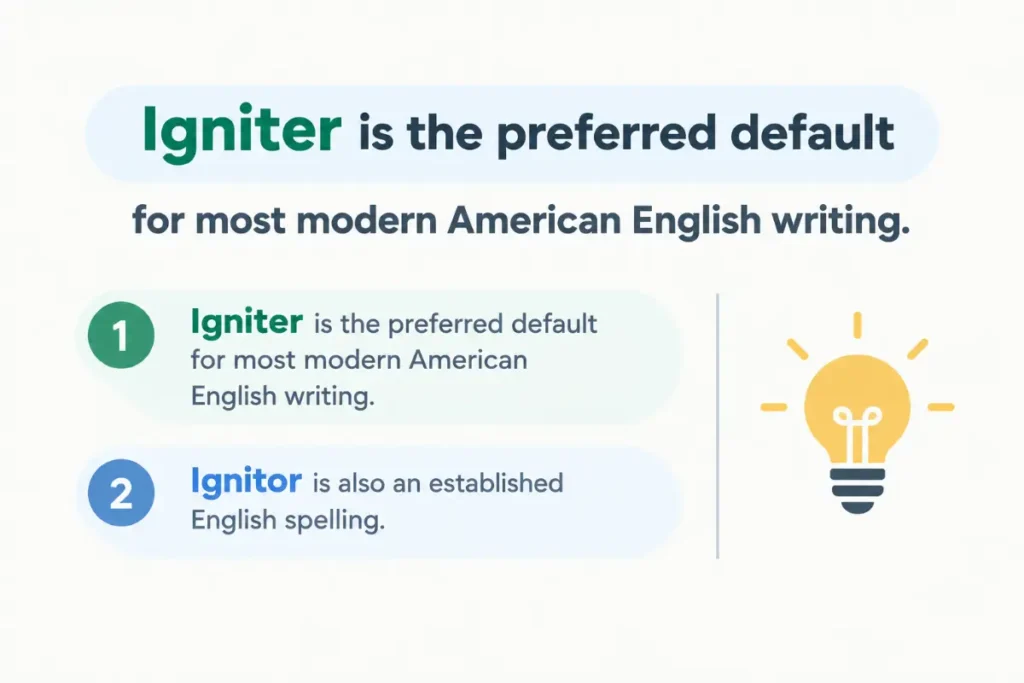
- Igniter is the preferred default for most modern American English writing.
- Ignitor is also an established English spelling.
- The two forms generally have the same basic meaning.
- Igniter is a noun that names something that causes ignition.
- Ignite is the related verb.
- Ignition names the process or act of starting combustion.
- The spelling difference doesn’t normally create a difference in meaning.
- Don’t automatically label ignitor as a spelling error.
- Follow official terminology when you’re writing about a specific product or technical system.
- For general US content, choose igniter and use it consistently.
Many readers also check Unphased or Unfazed Meaning And Usage Guide 2026.
Conclusion
The choice between ignitor vs igniter is mainly a matter of spelling preference, not meaning. Both forms describe a device that helps start combustion, and both are accepted English nouns. Igniter is a practical default for general American writing, but ignitor is also correct and may be the official spelling in a product catalog or technical manual.
The best editing tip is to check the manufacturer’s wording before naming a specific component, then keep that spelling consistent throughout your document. This approach keeps your writing clear and helps readers identify the right part without confusion.
FAQs
Is Igniter or Ignitor the Correct Spelling?
Both spellings are correct. They refer to a device or component that starts combustion, usually by creating a spark or providing heat. Igniter is a widely used choice in American English, while ignitor also appears in technical and commercial writing. Use the spelling found in official product documentation when discussing a specific part.
Is Ignitor a Real Word?
Yes. Ignitor is an established English noun, not simply a typing mistake. It describes a device that initiates ignition or starts combustion. The spelling uses the suffix or instead of er. Although some writers prefer the alternative form, both are understood and used in technical and general contexts.
What Does an Igniter Do?
An igniter helps start a combustion process. Depending on the equipment, it may create an electrical spark or produce enough heat to ignite fuel. You can find these components in gas stoves, furnaces, grills, and industrial burners. The exact method depends on the design of the ignition system.
Are Igniter and Ignitor Pronounced the Same Way?
Yes. Both spellings are generally pronounced /ɪɡˈnaɪtər/ in American English. The word has three syllables, with the main stress on the second syllable. The spelling difference does not normally change the spoken form, so listeners may not know which version someone uses until they see it written.
Is Igniter More Common in American English?
Igniter is a familiar and widely used spelling in the United States, especially in general writing and descriptions of household appliances. However, ignitor also appears in American product catalogs, technical documents, and specialized terminology. It is safer to follow the spelling used by the manufacturer when identifying a particular component.
Is There a Difference Between an Igniter and an Ignition System?
Yes. An igniter is a component that helps initiate combustion, while an ignition system refers to the wider arrangement of parts involved in starting the burning process. Depending on the equipment, the system may include electrical controls, wiring, electrodes, coils, or other components.
Can I Use Ignitor in Formal or Technical Writing?
Yes. Ignitor is acceptable in formal and technical writing. However, you should follow the terminology used by the relevant manufacturer, technical standard, or publication. If no preferred spelling exists, choose one form and use it consistently. Accuracy matters most when the word identifies a specific replacement part or component.
What Is the Plural of Igniter and Ignitor?
The plural of igniter is igniters, and the plural of ignitor is ignitors. Both forms follow the regular English rule of adding s to form a plural noun. For example, “The technician inspected two igniters” and “The catalog lists several replacement ignitors” are both grammatically correct.