
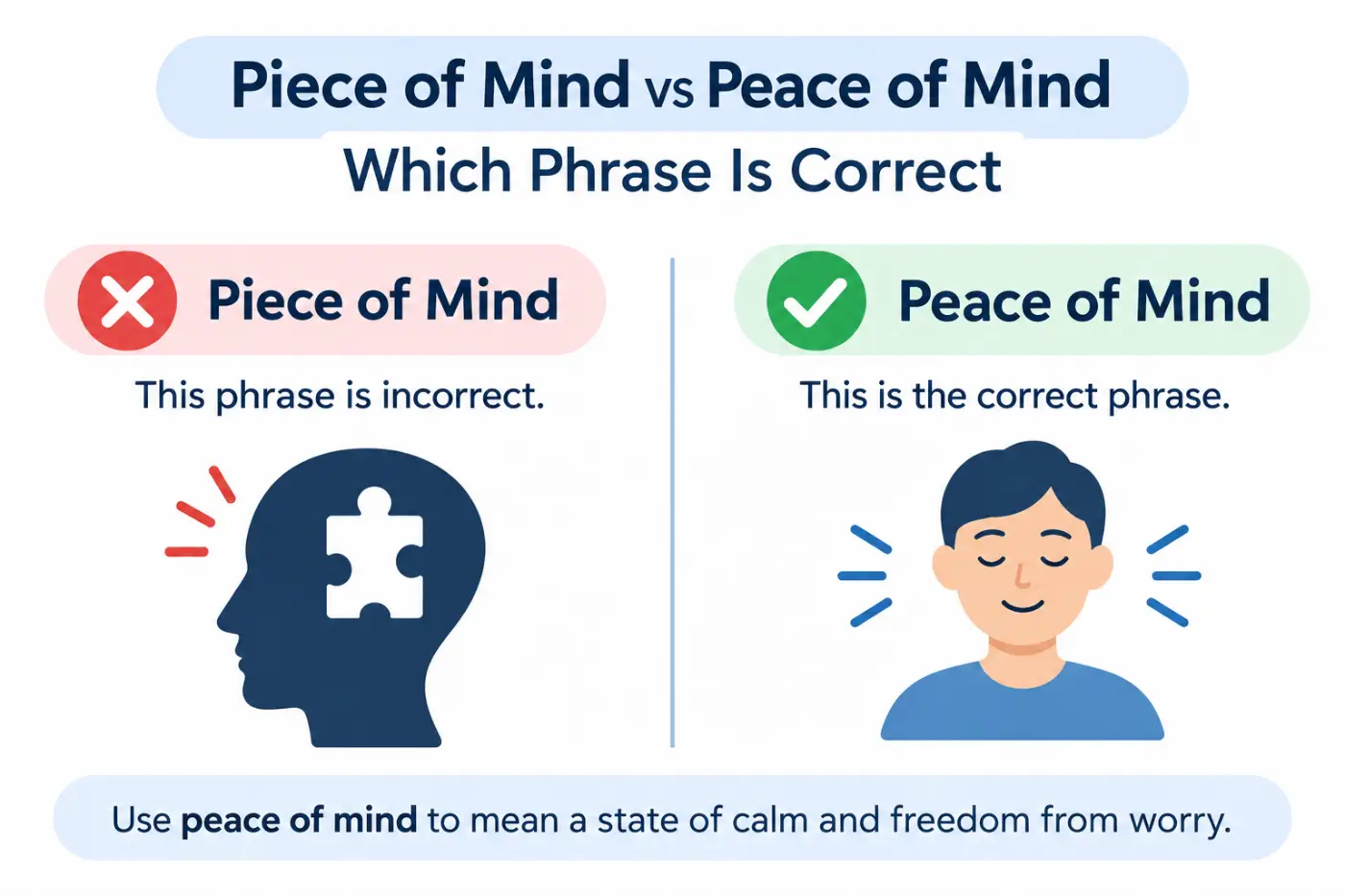
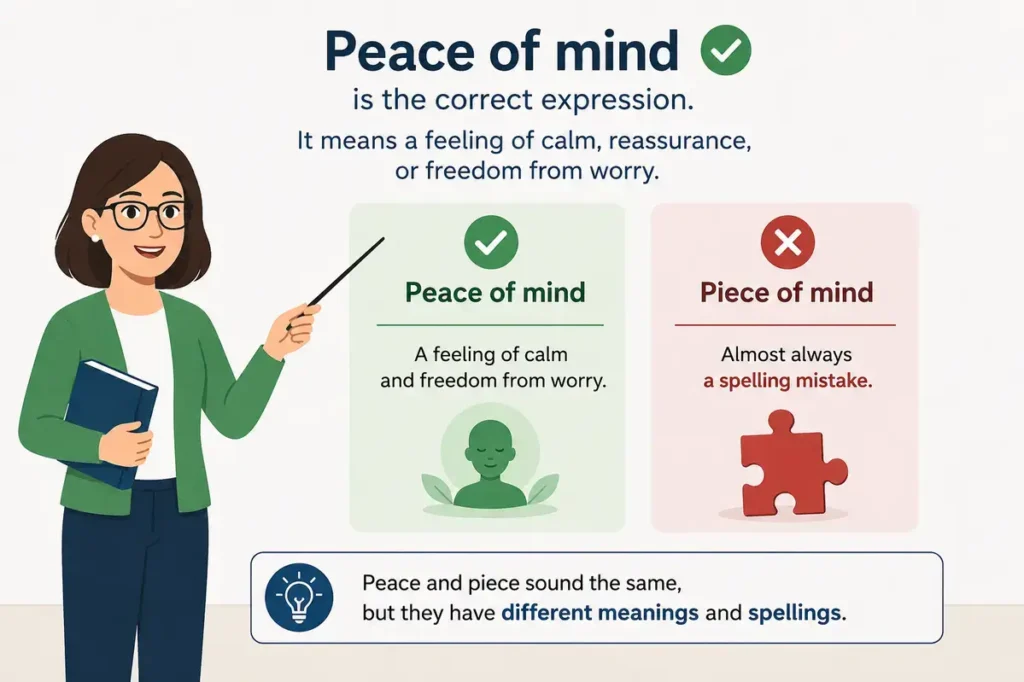
If you want to describe a feeling of calm, comfort, or freedom from worry, the correct expression is peace of mind. The phrase piece of mind has a different meaning and is not a standard substitute. Although the two expressions sound almost identical, the words piece and peace refer to very different things.
This confusion is common because both words are pronounced the same way in standard American English. However, peace means calm or freedom from conflict, while piece means a part or portion of something. As a result, peace of mind describes a relaxed state in which you feel safe, confident, or free from concern. A piece of your mind is a separate expression that means speaking angrily or frankly to someone about something they have done.
Choosing the correct phrase helps your writing sound clear and natural. Below, you will learn the meanings, spelling rules, pronunciation, common mistakes, and practical examples. You will also see how the expressions work in everyday conversation, professional writing, and formal communication.
Need another quick comparison? Read Affect vs Effect: Meaning and Correct Usage.
Quick Answer
Peace of mind is the correct expression when you mean a feeling of calm, security, or freedom from worry. Piece of mind is not correct for this meaning. However, a piece of your mind is a separate idiom that means expressing strong anger or criticism to someone.
Comparison Table
| Expression | Meaning | Part of Speech | Common Contexts | Example |
|---|---|---|---|---|
| Peace of mind | Calmness, comfort, or freedom from worry | Noun phrase | Health, safety, money, relationships, daily life | A secure home gives us peace of mind. |
| Piece of mind | Not a standard expression for calmness | Incorrect phrase in this context | Common spelling mistake | Incorrect: The warranty gives me piece of mind. |
| A piece of your mind | A strong or angry expression of opinion | Idiom and noun phrase | Arguments, complaints, disagreements | She gave the manager a piece of her mind. |
| A piece of mind | A portion of someone’s thoughts, only in a literal or unusual context | Noun phrase with literal meaning | Unusual or creative writing | He shared a piece of his mind in the discussion. |
The table highlights an important point: piece is not always wrong. It is wrong when you use it to describe calmness or freedom from worry. The idiom a piece of your mind is correct, but it communicates frustration or criticism rather than comfort.
Meaning and Definition
What Does Peace of Mind Mean?
Peace of mind is a noun phrase that describes a calm and comfortable mental state. It means feeling free from worry, fear, stress, or uncertainty about something that matters to you.
For example, knowing that your family is safe can give you peace of mind. Having enough savings to handle an emergency may also provide this feeling. In both situations, you feel more relaxed because something that once caused concern is now under control.
The expression is common in everyday English because people often want to describe emotional comfort and a sense of security. It can refer to several areas of life, including:
- Personal safety and protection.
- Financial stability and savings.
- Health and medical care.
- Family relationships.
- Reliable products and services.
- Travel plans and insurance.
- Job security and future planning.
The phrase does not mean that a person has no thoughts or problems. Instead, it describes a feeling of reassurance. You may still have responsibilities, but you feel less worried because you trust that an important matter is being handled.
For example, buying travel insurance may give you peace of mind because you know you have some protection if an unexpected problem occurs.
What Does Piece of Mind Mean?
Piece of mind is usually a misspelling when someone intends to describe calmness or freedom from worry. The confusion happens because piece and peace sound alike, even though their meanings are different.
The noun piece means a part, portion, section, or individual item. You can have a piece of cake, a piece of paper, or a piece of furniture. The word does not normally describe a calm mental state.
For example:
Incorrect: The security system gives me piece of mind.
Correct: The security system gives me peace of mind.
The first sentence uses the wrong word because the writer wants to describe reassurance, not a portion of someone’s thoughts.
However, there is a separate expression that uses piece correctly: a piece of your mind. This idiom means telling someone exactly what you think, often because you are angry or disappointed.
For example:
She gave the delivery company a piece of her mind after the package arrived damaged.
Here, the phrase suggests that she spoke strongly to the company and expressed her frustration. It has nothing to do with feeling calm or relaxed.
What Does Piece Mean?
Piece is a noun that refers to a part of a larger object, amount, or whole. It can describe physical things, sections of information, or parts of an activity.
Common examples include:
- A piece of bread.
- A piece of clothing.
- A piece of advice.
- A piece of information.
- A piece of furniture.
- A piece of artwork.
The word can also appear in idioms. A piece of your mind is one example. In that expression, the word piece contributes to an established figurative meaning rather than referring to a physical object.
What Does Peace Mean?
Peace is a noun that refers to freedom from conflict, violence, disturbance, or worry. It can describe relationships between countries, a quiet environment, or a person’s inner state.
For example, a peace agreement can end a conflict between groups. A peaceful room can provide quiet and comfort. Peace of mind describes the personal feeling of reassurance that comes from being free from worry or concern.
This meaning makes peace the correct word in the expression being discussed.
Key Differences Explained
1. Spelling
The first difference is the spelling. Piece contains the letters i and e in the order shown, while peace contains ea.
Although the words look different, they sound the same in standard American English. This makes them homophones. Homophones are words that share a pronunciation but have different meanings and spellings.
Other examples include:
- Right and write.
- Their and there.
- Sea and see.
- Flower and flour.
- Here and hear.
Because piece and peace sound alike, relying only on pronunciation can lead to spelling mistakes. You need to consider the meaning of the full sentence.
2. Meaning
Peace refers to calmness, harmony, or freedom from worry. Piece refers to a portion or part of something.
Compare these examples:
- I need some peace after a stressful week.
- I ate a piece of chocolate after dinner.
The first sentence describes a calm state. The second refers to a portion of food. The meanings are not interchangeable.
3. Grammar
Peace of mind functions as a noun phrase. The main noun is peace, and the words of mind explain the type of peace being described.
Piece of mind also has a noun as its main word, but it does not form the standard expression for emotional comfort. A piece of your mind is a separate idiomatic phrase.
4. Pronunciation
In standard American English, piece and peace are pronounced /piːs/. Both have one syllable and end with the /s/ sound.
The pronunciation is identical, so you cannot hear the spelling difference in ordinary speech. The surrounding words and intended meaning help you understand which word the speaker means.
5. Formality
Peace of mind is appropriate in casual, professional, academic, and formal writing. It is a standard expression used to describe reassurance and emotional comfort.
Piece of mind is not an acceptable substitute in formal writing. It may appear in informal messages or online posts as a spelling mistake, but that does not make it standard.
The idiom a piece of your mind is correct in informal and conversational writing. In a formal report, however, a phrase such as expressed strong criticism may communicate the same idea more precisely.
6. Context
Context is the most reliable way to choose the correct spelling.
Use peace when discussing:
- Emotional comfort.
- Freedom from worry.
- Personal security.
- Harmony between people.
- A quiet and calm state.
Use piece when discussing:
- A part of an object.
- A portion of food.
- A section of writing.
- An individual item.
- The idiom a piece of your mind.
7. Standard and Nonstandard Usage
Peace of mind is the standard expression for reassurance. Piece of mind is generally a spelling error when used with this meaning.
However, piece is a standard word and appears in many correct expressions. The mistake is not the word itself. The mistake is choosing it in a phrase that requires peace.
Which Form Is Correct?
Peace of mind is correct when you want to describe a feeling of calmness, reassurance, or freedom from worry. Piece of mind is incorrect for this meaning because piece refers to a portion or part, not emotional comfort.
The distinction comes from the established meanings of the two nouns. Peace describes a state of harmony or calm. Mind refers to a person’s thoughts, feelings, and mental activity. Together, peace of mind describes a mental state in which someone feels secure and relaxed.
Consider these examples:
- Correct: Having health insurance gives me peace of mind.
- Incorrect: Having health insurance gives me piece of mind.
- Correct: I finally have peace of mind about my finances.
- Incorrect: I finally have piece of mind about my finances.
- Correct: She gave her landlord a piece of her mind.
The last example is also correct because it uses a different idiom. It describes expressing anger or strong criticism.
A useful way to remember the distinction is to connect peace with peaceful feelings. If you are talking about calmness, comfort, or reassurance, choose peace. If you mean a portion of something or use the expression a piece of your mind, choose piece.
Sentence Examples
The following examples show how to use the standard expression naturally in different situations.
Ten Examples Using Peace of Mind
- Everyday conversation: Knowing that my children arrived safely gives me peace of mind.
- Text message: I just wanted to check that you got home safely for my peace of mind.
- Workplace communication: The new backup system gives our team peace of mind.
- School: Preparing for the exam early gave Maya peace of mind.
- Academic writing: Reliable access to information can provide students with greater peace of mind during research.
- Formal writing: The updated safety measures are designed to give residents peace of mind.
- Social situations: Having supportive friends gives me peace of mind during difficult times.
- Online communication: Reading the seller’s return policy gave me peace of mind before ordering.
- Financial planning: Building an emergency fund can provide peace of mind when unexpected expenses arise.
- Travel: Confirming the hotel reservation in advance gave the family peace of mind.
These examples show that the phrase can describe comfort in many areas of life. It often appears after verbs such as give, bring, provide, and offer. It can also follow expressions such as find, enjoy, and have.
Five Examples of the Correct Idiom A Piece of Your Mind
These examples show the separate expression that uses piece correctly.
- She gave her coworker a piece of her mind after he ignored her warning.
- The customer gave the manager a piece of his mind about the poor service.
- I wanted to give the contractor a piece of my mind after the unfinished work.
- He gave the referee a piece of his mind after the final decision.
- The passengers gave the airline staff a piece of their minds after the long delay.
This idiom usually suggests anger, frustration, or strong criticism. It is not a replacement for the expression that describes emotional comfort.
Common Mistakes and Misspellings
The main spelling problem comes from confusing two homophones. However, other mistakes can happen when writers mix up the idiom or choose an expression that does not fit the intended meaning.
1. Writing Piece of Mind for Emotional Comfort
Incorrect: The home security system gives us piece of mind.
Correct: The home security system gives us peace of mind.
The writer may know the pronunciation but forget which spelling carries the meaning of calmness. Remember that peace is connected with being peaceful and free from worry.
2. Writing Peace of Your Mind in the Anger Idiom
Incorrect: She gave him a peace of her mind.
Correct: She gave him a piece of her mind.
This mistake happens because people remember the spelling used in peace of mind and apply it to a different expression. In the idiom, piece refers to a figurative portion of someone’s thoughts or feelings that they express strongly.
3. Confusing Peace of Mind With Piece of Cake
Incorrect: I need a peace of cake.
Correct: I need a piece of cake.
A piece of cake means a portion of cake. It is also an idiom meaning something very easy. The noun piece is correct because the sentence refers to a portion of food or uses the established expression.
4. Using the Wrong Word in a Business Message
Incorrect: Our guarantee gives customers piece of mind.
Correct: Our guarantee gives customers peace of mind.
Businesses often use this phrase when discussing warranties, safety, customer service, or product quality. The intended meaning is reassurance, so peace is the correct spelling.
5. Confusing the Meaning of the Idiom
Incorrect: I gave my friend a piece of my mind, so now I feel calm and relaxed.
Better: I spoke honestly with my friend, and the conversation gave me peace of mind.
The first sentence is not grammatically impossible, but the idiom usually suggests strong criticism or anger. It does not mean that someone has found inner calm. If you mean that a conversation helped you feel better, describe that result directly.
How to Avoid These Mistakes
Use these simple checks before you finish writing:
- If you mean calmness or reassurance, choose peace.
- If you mean a portion of something, choose piece.
- If you mean telling someone exactly what you think in an angry way, use a piece of your mind.
- Read the full sentence and check its meaning instead of relying on sound.
- Use a spelling tool as a final check, but do not depend on it to understand the intended expression.
Pronunciation Guide
How Do You Pronounce Peace?
Peace is pronounced /piːs/ in standard American English. It has one syllable and rhymes with words such as fleece, lease, and niece.
The sound begins with /p/, followed by a long e vowel /iː/, and ends with /s/. You can think of it as saying the word see with a /p/ sound at the beginning.
How Do You Pronounce Piece?
Piece is also pronounced /piːs/. It has the same one syllable, the same long e sound, and the same final /s/ sound.
Because both words sound identical, pronunciation cannot tell you which spelling is correct. You need to understand the sentence and identify the intended meaning.
Syllable Breakdown and Stress
| Word | IPA | Syllables | Easy Pronunciation |
|---|---|---|---|
| Peace | /piːs/ | 1 | PEES |
| Piece | /piːs/ | 1 | PEES |
| Mind | /maɪnd/ | 1 | MYND |
The full phrase peace of mind contains three spoken syllables in ordinary pronunciation: peace, of, and mind. The main stress usually falls on peace and mind, depending on the sentence.
Why Pronunciation Causes Confusion
English has many homophones, and these two words are a clear example. The letters look different, but the sounds are the same. A listener may understand the intended meaning from context, but a writer must choose the correct spelling.
For this reason, spelling memory should connect each word with its meaning. Associate peace with calmness and harmony. Associate piece with a part or portion.
Many readers also check Farther vs Further Explained With Clear Examples.
Etymology and Word Origin
The Origin of Peace
The word peace has a long history in English. It entered Middle English through Anglo French and Old French forms related to Latin pax, meaning peace or an agreement to end conflict.
Over time, the word developed beyond the idea of peace between groups or nations. It also came to describe quiet, harmony, freedom from disturbance, and a calm state of mind.
That broader meaning explains the expression peace of mind. It describes an inner state of comfort rather than a political agreement or the absence of physical conflict.
The Origin of Piece
Piece also entered English through French, from forms related to Old French piece. Its earlier history is less certain, but the word developed the familiar meaning of a part, portion, or individual item.
Today, piece appears in many everyday expressions, including piece of paper, piece of furniture, and piece of advice. It also appears in the idiom a piece of your mind, where the phrase has a figurative meaning.
Why Their Origins Do Not Change the Rule
The words have different histories and meanings, even though modern pronunciation makes them sound alike. Their shared sound does not make them interchangeable.
The best way to choose correctly is to focus on meaning. Use peace for harmony and calmness. Use piece for a part or portion and in expressions that specifically require it.
Regional Usage
American English
In American English, peace of mind is the standard phrase for describing reassurance or freedom from worry. It appears in everyday speech, advertising, workplace communication, and formal writing.
For example, an American speaker might say, “Knowing the house is secure gives me peace of mind.” Writing piece of mind with this meaning is considered a spelling mistake.
The idiom a piece of your mind is also common in American English. It usually describes expressing anger or criticism directly to someone.
British English
British English uses the same spellings and meanings. Speakers use peace of mind for emotional comfort and a piece of your mind for strong criticism.
There is no meaningful British spelling difference between the two words. The distinction depends on meaning rather than regional preference.
Australian English
Australian English follows the same standard usage. Peace of mind describes calmness and reassurance, while piece refers to a portion or appears in the separate idiom about expressing anger.
The two words remain homophones in ordinary Australian pronunciation, so context is important when writing.
Canadian English
Canadian English also follows the same spelling and meaning rules. Writers use peace of mind for reassurance and piece of your mind for the idiom that describes strong criticism.
There is no special Canadian form of either expression. The same distinction applies across standard English varieties.
Grammar Rules and Part of Speech
Understanding the grammar of the phrase makes it easier to use it correctly in longer sentences.
Part of Speech
Peace is a noun. Mind is also a noun. In peace of mind, the word peace is the main noun, while of mind completes the expression and explains the kind of peace being described.
The entire phrase functions as a noun phrase. It can act as the subject, direct object, or object of a preposition.
Examples:
- Peace of mind matters to everyone.
- The warranty gives customers peace of mind.
- She worked hard for peace of mind.
- Nothing is more valuable than peace of mind.
Common Grammatical Patterns
The phrase often appears with verbs that describe gaining, giving, or maintaining reassurance.
Common patterns include:
- Give someone peace of mind. Example: The insurance plan gives families peace of mind.
- Provide peace of mind. Example: The safety check provides peace of mind.
- Bring peace of mind. Example: A clear schedule can bring peace of mind.
- Find peace of mind. Example: He found peace of mind after resolving the issue.
- Have peace of mind. Example: I have peace of mind knowing the bills are paid.
- Enjoy peace of mind. Example: They enjoy peace of mind in their new home.
These patterns are useful in both conversation and professional writing. The phrase usually appears as a complete noun expression rather than as a verb.
Can Peace of Mind Be Used With an Article?
Yes, but the choice depends on the sentence. You can write “a sense of peace of mind” when describing a particular feeling of reassurance. You can also write “the peace of mind that comes from preparation” when referring to a specific kind of comfort.
However, the phrase often appears without an article. For example, “Peace of mind is important” is natural because the sentence refers to the general idea.
Is Peace of Mind Singular or Plural?
The phrase is generally treated as singular because peace is an uncountable noun in this expression. You would normally write “Peace of mind is valuable,” not “Peace of mind are valuable.”
You can use a plural form when referring to different kinds or sources of reassurance, but the wording often changes. For example, “These measures provide several sources of reassurance” may sound more natural than trying to pluralize the phrase itself.
Punctuation and Sentence Position
The phrase can appear at the beginning, middle, or end of a sentence.
- Beginning: Peace of mind is worth protecting.
- Middle: Regular savings can provide peace of mind during emergencies.
- End: Knowing the children are safe gives their parents peace of mind.
No special punctuation is needed. Follow the normal punctuation rules for the full sentence.
Formal and Informal Usage
The phrase is suitable for both casual and formal writing. You can use it in a text message, business email, academic discussion, or customer service statement.
The idiom a piece of your mind is more conversational. In formal writing, alternatives such as expressed strong criticism or voiced frustration may be more suitable.

Real Life Usage Examples
Daily Conversation
People often use the phrase when talking about safety, family, and personal comfort.
- Knowing that the children are with a trusted babysitter gives me peace of mind.
- I feel better now that the repair is finished. It gives me peace of mind.
In conversation, the phrase often describes a feeling that comes from knowing a problem has been handled or a risk has been reduced.
Email and Workplace Communication
The expression can make professional messages sound reassuring and clear.
- The new security process should give employees greater peace of mind.
- Please review the attached confirmation for your peace of mind.
It is especially useful in messages about safety, customer support, insurance, warranties, and service quality. However, avoid using it as a vague promise. Explain what action or protection creates the reassurance.
Academic Writing
In academic writing, the phrase can describe a person’s sense of comfort or reduced concern.
- Access to clear information may give students peace of mind during the examination period.
- Reliable support systems can contribute to peace of mind among family caregivers.
For academic work, make sure the phrase fits the evidence and the subject. It is a general expression, so a more precise term may sometimes be better in a technical discussion.
News and Journalism
News reports may use the expression when discussing public safety, financial security, or community concerns.
- The city introduced new safety measures to give residents peace of mind.
- The updated policy is intended to provide customers with peace of mind.
Journalists should explain what creates the reassurance rather than relying on the phrase alone. Clear details help readers understand the practical effect of a policy or decision.
Literature and Storytelling
Writers can use the phrase to show a character’s emotional state.
- After hearing her father’s voice, Emma finally felt a sense of peace of mind.
- The locked door gave him little peace of mind as the storm grew stronger.
In storytelling, the phrase can show relief, trust, or the absence of worry. It can also be used to create contrast when a character still feels uncertain despite having a reason to feel safe.
Related and Confused Terms
These eight expressions are closely connected to calmness, reassurance, or the common spelling confusion.
1. Peace
Peace means freedom from conflict, disturbance, or worry. It can describe harmony between people or a calm mental state. It is the key word in peace of mind.
2. Piece
Piece means a part, portion, or individual item. It appears in expressions such as a piece of paper, a piece of advice, and a piece of furniture. It is not the correct choice for describing reassurance.
3. A Piece of Your Mind
This idiom means expressing strong criticism or anger to someone. For example, “I gave the manager a piece of my mind” suggests that the speaker openly complained or spoke angrily.
4. State of Mind
A state of mind is a person’s current mental or emotional condition. It can describe happiness, worry, confidence, or confusion. Peace of mind is one particular kind of state of mind.
5. Inner Peace
Inner peace describes a feeling of calm and balance within yourself. It is close in meaning to peace of mind, although it often suggests a deeper or more lasting sense of emotional calm.
6. Reassurance
Reassurance is comfort or confidence that comes from knowing something is safe, true, or under control. A clear answer from a doctor or a confirmed travel booking may provide reassurance and peace of mind.
7. Relief
Relief is the feeling that comes when pain, worry, pressure, or danger decreases. It may lead to peace of mind, but the words are not exact synonyms. Relief often follows a specific stressful event.
8. Tranquility
Tranquility means calmness and freedom from disturbance. It often describes a peaceful place or a quiet mental state. A calm environment may support peace of mind, but tranquility and reassurance do not always mean exactly the same thing.
Expert Editor Insight
An experienced editor checks the meaning of the full expression rather than relying on how the words sound. Since piece and peace are homophones, spelling tools may miss the error if both words are accepted individually. The best editing habit is to connect peace with calmness and piece with a portion. Editors also check the idiom a piece of your mind because it is correct but carries a completely different meaning. Read the sentence aloud for flow, then check its meaning before approving the spelling.
Key Takeaways
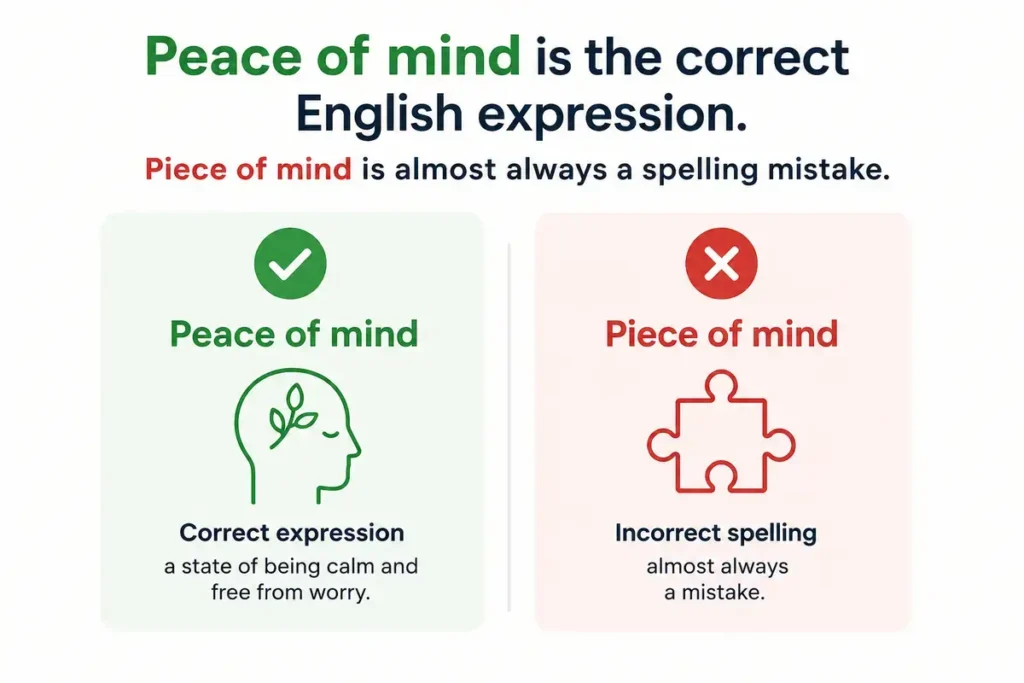
- Peace of mind is the correct English expression.
- Piece of mind is almost always a spelling mistake.
- Peace means calm, reassurance, or freedom from worry.
- Piece means a part of something and does not fit this idiom.
- Both phrases sound exactly the same because peace and piece are homophones.
- The expression is correct in both American English and British English.
- Remember the meaning instead of the sound. If you are talking about feeling calm, choose peace.
A related grammar guide is Flew or Flown Which One Is Correct?.
Conclusion
The correct expression for calmness, reassurance, and freedom from worry is peace of mind. Piece of mind is a common spelling mistake in this context because piece and peace sound alike. However, a piece of your mind is a correct idiom that means expressing strong criticism or anger.
The easiest way to remember the difference is to connect peace with peaceful feelings and piece with a portion of something. Before you finish writing, check the meaning of the whole sentence rather than relying on pronunciation alone. This simple habit will help you choose the right spelling in everyday and formal communication.
FAQs
Is Piece of Mind Ever Correct?
Piece of mind is not the standard expression for calmness or freedom from worry. However, piece is a correct English word and appears in many expressions. The idiom a piece of your mind is also correct, but it means telling someone exactly what you think, often in an angry or critical way.
What Does Peace of Mind Mean?
Peace of mind means a feeling of calmness, comfort, and freedom from worry. It often comes from knowing that something important is safe or under control. For example, having enough savings for emergencies can give you peace of mind because you feel more prepared for unexpected expenses.
Why Do People Confuse Piece and Peace?
People confuse these words because they are homophones. They have different spellings and meanings but sound exactly alike in standard American English. When someone writes from memory, the shared pronunciation can lead to the wrong choice. Understanding that peace relates to calmness and piece means a portion helps prevent the mistake.
Is It Peace of Mind or a Piece of Mind?
Use peace of mind when you mean emotional comfort or freedom from worry. Use a piece of your mind when you mean expressing anger or strong criticism to someone. The article and pronoun matter because the two expressions have different meanings. They are not interchangeable, even though they sound similar.
How Do You Pronounce Piece and Peace?
Both words are pronounced /piːs/ in standard American English. They have one syllable and rhyme with words such as fleece and lease. Since their pronunciation is identical, you cannot identify the spelling by sound alone. You must use the meaning and context of the sentence to choose correctly.
Can Peace of Mind Be Used in Formal Writing?
Yes. Peace of mind is suitable for formal writing, including business communication, reports, and general academic discussion. It describes reassurance or freedom from worry in a clear and familiar way. In highly technical writing, a more precise term such as reduced anxiety or perceived security may sometimes communicate the intended idea better.
What Is Another Way to Say Peace of Mind?
Useful alternatives include reassurance, inner peace, emotional comfort, calmness, and a sense of security. The best choice depends on the sentence. Reassurance emphasizes confidence that something is safe or under control, while inner peace often suggests a deeper feeling of calm. These expressions are related but are not always exact substitutes.
Is Peace of Mind Singular or Plural?
Peace of mind is normally treated as a singular noun phrase because peace is uncountable in this expression. For example, you should write “Peace of mind is important,” not “Peace of mind are important.” If you want to discuss different sources of reassurance, you can use a phrase such as several sources of comfort.