

Confused about flew or flown? Both are correct English words, but you cannot always use one in place of the other. The key difference is simple: “flew” is the simple past tense of “fly,” while “flown” is its past participle. You might say, “We flew to Chicago yesterday,” but “We have flown to Chicago several times.”
This difference matters because English uses different verb forms to show when an action happened and how it connects to the rest of a sentence. The simple past describes a completed action in the past. The past participle usually works with a helping verb, such as “have,” “has,” “had,” or “been,” to form perfect tenses or passive constructions.
Once you understand this pattern, choosing the right word becomes much easier. This guide explains the meanings, grammar rules, pronunciation, and differences between these forms. You will also find examples from everyday conversation, workplace writing, school assignments, and storytelling, along with common mistakes and easy ways to remember the correct form.

Still confused? Compare To Fast or Too Fast Which Phrase Is Correct.
Quick Answer
“Flew” is the simple past tense of “fly,” as in “The plane flew over the city.” “Flown” is the past participle, used with helping verbs, as in “The plane has flown over the city.” Both are standard English forms. Choose the one that fits the tense and grammatical structure of your sentence.
Comparison Table
| Feature | Flew | Flown |
|---|---|---|
| Base verb | Fly | Fly |
| Verb form | Simple past tense | Past participle |
| Main function | Describes a completed past action | Forms perfect tenses and passive constructions |
| Common pattern | Subject + flew | Subject + have, has, or had + flown |
| Example | She flew to Boston yesterday. | She has flown to Boston before. |
| Pronunciation | /fluː/ | /floʊn/ |
| Syllables | One | One |
| Formality | Standard in all styles | Standard in all styles |
| Regional usage | Standard in American and British English | Standard in American and British English |
| Common mistake | Using it after “have” | Using it alone as the simple past |
Meaning and Definition
What Does Flew Mean?
“Flew” is the simple past tense of the irregular verb “fly.” It describes an action that happened and was completed in the past. The word can refer to traveling by airplane, moving through the air, or moving quickly from one place to another.
For example, “Mia flew to Seattle last Friday” describes a completed trip. The time expression “last Friday” helps establish when the action took place, and the verb does not need a helping verb.
The word also has several figurative uses. You might say that time flew during a fun weekend, a bird flew out of a window, or a ball flew across the field. In each case, the verb describes movement or something that seemed to pass quickly.
What Does Flown Mean?
“Flown” is the past participle of “fly.” It usually appears with a helping verb to form a perfect tense or a passive construction. It can describe an experience, an action completed before another event, or a journey made by a person or aircraft.
Consider the sentence, “I have flown to Denver twice.” The helping verb “have” combines with the participle to describe past experience that remains relevant now. In “They had flown home before the storm began,” the phrase “had flown” places the trip before another past event.
The participle can also appear in passive constructions. For example, “The flag was flown at half mast” describes what was done to the flag. Here, the grammatical structure calls for the participle rather than the simple past form.
Is Flown a Real Word?
Yes. “Flown” is the standard past participle of “fly,” just as “written” is the past participle of “write” and “spoken” is the past participle of “speak.” It is not a misspelling or an informal alternative.
The confusion often comes from the fact that regular English verbs usually form both the simple past and past participle by adding “ed.” For example, “walked” can serve both functions. Irregular verbs follow different patterns, so their forms must be learned individually.
Key Differences Explained
1. The Verb Form
The most important difference is grammatical. “Flew” is the simple past form, while “flown” is the past participle.
Use the simple past to state that an action happened in the past.
Example: “The pilot flew the aircraft safely.”
Use the past participle when a helping verb or a participle construction calls for it.
Example: “The pilot has flown this aircraft for years.”
The two sentences describe related ideas, but their verb structures differ. The first reports a past action. The second connects past experience to the present.
2. Meaning and Time
Neither word has a completely separate dictionary meaning from the other. Both refer to the action of flying, but the surrounding grammar changes how the action relates to time.
“Flew” often appears with a specific past time, such as yesterday, last month, or two hours ago. “Flown” often appears in sentences about experience, duration, or an earlier event.
Compare these examples.
- “We flew to Miami last summer.”
- “We have flown to Miami several times.”
- “We had flown to Miami before we moved there.”
The first sentence reports a completed event. The second describes experience up to the present. The third describes a flight that occurred before another past event.
3. Helping Verbs
Helping verbs provide one of the easiest ways to choose the correct form. In standard English, the perfect tenses use the past participle.
Common patterns include:
- I have flown.
- She has flown.
- They had flown.
- We will have flown.
The simple past does not need these helping verbs.
- I flew.
- She flew.
- They flew.
- We flew.
A frequent error is writing “I have flew.” The correct sentence is “I have flown.” The word “have” signals the perfect tense, so the past participle is required.
4. Questions and Negative Sentences
Questions and negative statements follow the same principle. When “did” is the helping verb, use the base form “fly,” not either past form.
Correct: “Did you fly to Dallas?”
Incorrect: “Did you flew to Dallas?”
Correct: “I did not fly last week.”
Incorrect: “I did not flown last week.”
However, if the sentence uses “have,” “has,” or “had,” the participle is needed.
Correct: “Have you flown to Dallas?”
Correct: “She had not flown before that trip.”
5. Pronunciation
The two forms sound different.
- “Flew” rhymes with “blue,” “true,” and “grew.”
- “Flown” rhymes with “known,” “grown,” and “shown.”
Both words have one syllable. The vowel sound in “flew” is the long oo sound, while “flown” contains the long o sound followed by an n.
Pronunciation can help you recognize the words when speaking, but grammar determines which form belongs in a sentence.
6. Formality and Context
Neither form is more formal than the other. Both are accepted in school assignments, professional emails, academic writing, journalism, and everyday conversation.
The right choice depends on the sentence structure, not the level of formality. For example, “The delegation flew to Washington” works in a news report, while “The delegation has flown to Washington several times” is also suitable for formal writing.
7. Standard and Nonstandard Usage
Both words are standard English. The error occurs when a writer uses one form where the grammar requires the other.
For instance, “He has flew across the country” is nonstandard because the perfect tense requires “flown.” Likewise, “He flown across the country yesterday” is incorrect as a simple past sentence because it lacks the required grammatical structure.
The useful rule is not that one word is correct and the other is wrong. Both are correct, but they are not interchangeable.
Which Form Is Correct?
Both forms are correct, and the sentence tells you which one to use. Choose “flew” when you need the simple past tense. Choose “flown” when you need the past participle, usually after a form of “have” or “be.”
English has many irregular verbs with different past tense and participle forms. For example, “sing” becomes “sang” and “sung,” while “begin” becomes “began” and “begun.” The verb “fly” follows the same pattern: fly, flew, flown.
You can use three questions to check your sentence.
- Am I describing a completed past action? Use “flew” if the sentence needs the simple past. Example: “The bird flew away.”
- Does the sentence use have, has, or had to form a perfect tense? Use “flown.” Example: “The bird has flown away.”
- Is the sentence passive? The past participle may be needed after a form of “be.” Example: “The aircraft was flown by an experienced pilot.”
These checks solve most everyday usage problems. If you are still unsure, identify the main verb and any helping verbs before choosing a form.
Sentence Examples
Here are 10 natural examples that show how to use both forms correctly.
- Everyday conversation: “We flew to Florida for our family vacation last spring.”
- Text message: “I finally flew for the first time, and I loved the experience.”
- Workplace communication: “Our sales team flew to Denver for the annual meeting.”
- School assignment: “The Wright brothers flew an early powered airplane in 1903.”
- Formal writing: “The research team flew to the remote site to collect samples.”
- Travel experience: “I have flown with that airline several times, and the service has been reliable.”
- Past experience: “She had flown only once before she started her new job.”
- News style: “The rescue crew flew over the flooded area to assess the damage.”
- Social conversation: “Time flew while we were catching up over dinner.”
- Passive construction: “The national flag was flown outside the building during the ceremony.”
Notice how the helping verbs shape the sentence. Examples 6 and 7 use the past participle because they contain “have” and “had.” Example 10 uses it in a passive construction. The other examples use the simple past form or a figurative expression built around it.
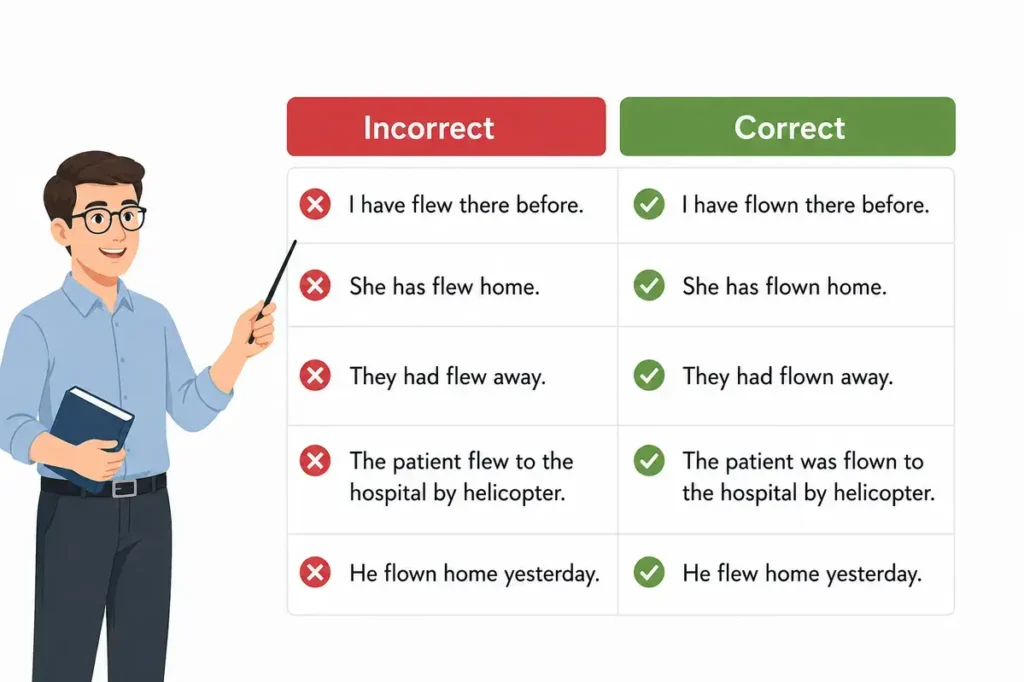
Common Mistakes and How to Fix Them
The most frequent errors happen when writers treat irregular verbs like regular ones or forget to check the helping verb.
1. Using Flew After Have
Incorrect: “I have flew to New York twice.”
Correct: “I have flown to New York twice.”
Why the mistake happens: Many speakers remember “flew” as the past form and use it after every reference to a past event. However, “have” forms the present perfect tense and needs the past participle.
2. Using Flown as the Simple Past
Incorrect: “She flown to California yesterday.”
Correct: “She flew to California yesterday.”
Why the mistake happens: Learners may remember the participle but forget that it usually needs a helping verb. In a simple past statement, the main verb should be “flew.”
3. Using Flew After Did
Incorrect: “Did they flew home last night?”
Correct: “Did they fly home last night?”
Why the mistake happens: The helping verb “did” already marks the past tense. The main verb returns to its base form, “fly.” The same rule applies to negative sentences such as “They did not fly home last night.”
4. Using Flown Without a Required Helping Verb
Incorrect: “We flown over the mountains.”
Correct: “We flew over the mountains.”
Why the mistake happens: A writer may know that “flown” is a past form but overlook its grammatical role. In a normal active statement about a completed past action, “flew” is the correct choice.
5. Confusing the Three Forms of Fly
Incorrect: “He has fly to London.”
Correct: “He has flown to London.”
Why the mistake happens: The base form, simple past, and past participle can blend together in memory. Learn the complete sequence as one set: fly, flew, flown. Practicing all three forms in short sentences makes the pattern easier to remember.
Pronunciation Guide
The pronunciation of each word is straightforward once you focus on its vowel sound.
| Word | IPA | Easy Guide | Rhymes With |
|---|---|---|---|
| Fly | /flaɪ/ | Fly | Sky |
| Flew | /fluː/ | Floo | Blue |
| Flown | /floʊn/ | Flohn | Known |
All three forms have one syllable. In “flew,” the vowel sounds like the oo in “food.” In “flown,” the vowel sounds like the o in “go,” followed by a clear n sound.
A common pronunciation error is making “flew” and “flown” sound alike. Keep the oo sound in the first word and the long o sound in the second. You do not need to add another syllable to either word.
Pronunciation helps you tell the forms apart in conversation, but it does not replace grammar. If you say “I have flew,” the listener may understand you, yet the standard grammatical form remains “I have flown.”
A related grammar guide is Correct or Correctly Which Word Should You Use.
Etymology and Word Origin
The verb “fly” has a long history in English. It comes from Old English “flēogan,” which meant to fly or move through the air. The word has Germanic roots and is related to similar verbs in other Germanic languages.
Over time, English developed several forms of the verb. The modern sequence is “fly” for the base form, “flew” for the simple past, and “flown” for the past participle. These forms reflect older patterns of vowel change that remain in many irregular English verbs.
This type of change is known as a strong verb pattern in historical grammar. Instead of creating the past tense by adding “ed,” the verb changes its internal vowel. Similar patterns appear in “drive, drove, driven” and “rise, rose, risen.”
The exact forms have changed over centuries, but the modern distinction is stable. English speakers learn the three forms as separate parts of one irregular verb.
Regional Usage
There is no major regional spelling difference between these forms. American, British, Canadian, and Australian English use the same standard forms, although accents may affect how the vowel sounds are pronounced.
American English
In the United States, “flew” is the normal simple past form, and “flown” is the standard past participle. A speaker might say, “We flew to Austin last weekend,” or “We have flown there before.”
Both forms are appropriate in casual speech, business writing, schoolwork, and professional communication. The grammar rule does not change with the level of formality.
British English
British English follows the same pattern. “Flew” describes a past action, while “flown” appears in perfect tenses and passive constructions.
For example, “The plane flew across the channel” uses the simple past. “The plane has flown across the channel” uses the past participle. The choice depends on the sentence, not on a difference between British and American spelling.
Australian English
Australian English also uses “flew” and “flown” according to the same standard grammar rules. Differences in accent may affect the sound of the vowels, but neither form has a special Australian spelling.
Canadian English
Canadian English follows the same rule as American and British English. A Canadian writer would normally write, “They flew to Toronto yesterday,” and “They have flown to Toronto before.”
Across these varieties, the main point stays the same: the simple past and past participle serve different grammatical functions.
Grammar Rules and Part of Speech
“Fly” is a verb, and its forms change to show tense and grammatical function. Understanding the main patterns helps you select the right form without memorizing every possible sentence.
The Three Main Forms
The most useful pattern to remember is:
- Base form: fly.
- Simple past: flew.
- Past participle: flown.
The base form appears in statements such as “Birds fly south in winter.” It also follows modal verbs, as in “We might fly tomorrow,” and the helping verb “did,” as in “Did you fly yesterday?”
The simple past form appears in sentences such as “The bird flew away.” It does not normally need a helping verb in an affirmative statement.
The past participle appears in structures such as “The bird has flown away.” It also appears in passive constructions such as “The aircraft was flown by a trained pilot.”
Simple Past Tense
Use the simple past to report an action that happened at a past time. It often appears with time expressions such as yesterday, last year, earlier today, or in 2022.
Examples:
- “The children flew kites in the park yesterday.”
- “Our manager flew to Atlanta for a conference.”
- “The ball flew over the fence.”
The action may last a moment or continue for some time. What matters is that the sentence presents it as a past event.
Present Perfect Tense
Use “have flown” or “has flown” to connect a past action with the present. This tense often describes life experience, repeated actions, or a result that matters now.
Examples:
- “I have flown on that route before.”
- “She has flown more than ten times this year.”
- “They have flown to several countries.”
The present perfect usually does not pair naturally with a finished past time expression such as “yesterday.” Say “I flew yesterday,” not “I have flown yesterday,” in standard American English.
Past Perfect Tense
Use “had flown” to describe an action that happened before another past event. This form can make the order of events clear.
Example: “By the time the meeting started, our director had flown back to Chicago.”
The flight happened first, and the meeting started later. The word “had” marks the past perfect tense, so the participle “flown” follows it.
Future Perfect Tense
The future perfect uses “will have” followed by a past participle. It describes an action expected to be complete by a future point.
Example: “By Friday, I will have flown to three cities for work.”
The phrase “will have flown” shows that the trips will be complete by Friday. The same structure works with other irregular verbs, such as “will have written” or “will have spoken.”
Passive Voice
The past participle can also form the passive voice. In passive sentences, the subject receives the action rather than performing it.
Example: “The aircraft was flown by a highly experienced pilot.”
The aircraft is the subject, but the pilot performs the action. The phrase “was flown” uses a form of “be” with the past participle.
Compare that sentence with “The pilot flew the aircraft.” This active version puts the person doing the action first and uses the simple past.
Questions and Negative Forms
When a question or negative statement uses “did,” use the base form “fly.”
- Correct: “Did he fly to Phoenix?”
- Correct: “He did not fly to Phoenix.”
- Incorrect: “Did he flew to Phoenix?”
- Incorrect: “He did not flown to Phoenix.”
When the helping verb is “have,” “has,” or “had,” use “flown.”
- Correct: “Has he flown to Phoenix?”
- Correct: “He has not flown to Phoenix.”
This is one of the easiest ways to spot an error. Identify the helping verb first, then choose the form that belongs with it.
Real Life Usage Examples
The difference becomes easier to remember when you see it in everyday situations. The examples below show how these verb forms work in conversation, work communication, academic writing, news reports, and storytelling.
Daily Conversation
People often use the simple past when talking about a trip or describing something that happened.
- “We flew to Orlando for spring break, and the flight was surprisingly smooth.”
- “I have flown in bad weather before, but that trip made me nervous.”
The first sentence describes a particular trip. The second talks about an experience the speaker has had at some point in life.
Email and Workplace Communication
In professional messages, the correct form helps you communicate clearly about travel and completed work.
- “I flew to our Dallas office yesterday and met with the regional team.”
- “Our consultant has flown to the site and is ready to begin the inspection.”
The first sentence reports a completed trip. The second connects the trip to the consultant’s current readiness.
Academic Writing
In school and research writing, use the simple past to report a completed event and the past participle when the sentence structure calls for it.
- “The researchers flew to the island to study the local bird population.”
- “Several research teams have flown to the region to gather data over the past decade.”
Both examples are appropriate in academic contexts. The choice depends on the intended time relationship and grammatical structure.
News and Journalism
News reports often use the simple past to describe a specific event. The past participle may appear in a perfect tense or a passive sentence.
- “The rescue team flew over the affected area early Tuesday morning.”
- “A medical team has flown to the remote community to assist local residents.”
The first sentence reports a completed event at a stated time. The second emphasizes a recent action and its current relevance.
Literature and Storytelling
Writers use the verb to describe physical movement and to create vivid scenes. They also use the participle when the narrative calls for a perfect tense.
- “A black bird flew from the old tower as the first light appeared.”
- “By sunrise, the travelers had flown across the mountains and reached the coast.”
The first sentence presents an action unfolding in a scene. The second places one completed event before another point in the story.
Related and Confused Terms
Several related words follow similar grammatical patterns. Learning them alongside the forms of “fly” can help you recognize irregular verbs and avoid repeating the same mistake.
1. Fly
“Fly” is the base form of the verb. Use it in the present tense with the appropriate subject, after modal verbs, and after “did.”
Examples: “Birds fly south in winter.” “We might fly home tomorrow.” “Did you fly last night?”
2. Flew
“Flew” is the simple past form. It describes an action that happened in the past without requiring a helping verb in a normal affirmative sentence.
Example: “The helicopter flew over the stadium.”
3. Flown
“Flown” is the past participle. It appears with helping verbs in perfect tenses and passive constructions.
Example: “The helicopter has flown over the stadium before.”
4. Driven
“Driven” is the past participle of “drive.” Its three main forms are drive, drove, and driven.
Correct: “She drove to work yesterday.” “She has driven to work every day this week.”
The pattern resembles fly, flew, flown. The simple past and participle are different forms.
5. Written
“Written” is the past participle of “write.” The sequence is write, wrote, written.
Correct: “He wrote a letter last night.” “He has written three letters today.”
Do not write “He has wrote three letters.” The helping verb “has” requires the participle “written.”
6. Gone
“Gone” is the past participle of “go.” The sequence is go, went, gone.
Correct: “They went home early.” “They have gone home.”
This is another common example of an irregular verb that changes form rather than simply adding “ed.”
7. Been
“Been” is the past participle of “be.” It appears in phrases such as “has been,” “have been,” and “had been.”
Example: “She has been busy all morning.”
Although “been” and “flown” are not synonyms, both can appear after helping verbs in perfect tenses.
8. Flew Away
“Flew away” is a phrase that describes something moving away through the air. It uses the simple past form when the action happened in the past.
Example: “The sparrow flew away when the door opened.”
For a present perfect version, use “has flown away.” For example, “The sparrow has flown away, so we cannot see it now.”
Expert Editor Insight
An experienced editor checks the verb structure before deciding which form belongs in a sentence. The main clue is often the helping verb: “have,” “has,” and “had” normally take “flown,” while a simple past statement takes “flew.” Grammar checkers can catch many errors, but they may miss mistakes when a sentence is grammatically possible in one context and wrong in another. For a reliable final check, read the full sentence, identify its tense, and confirm the role of each verb instead of relying only on a spelling tool.
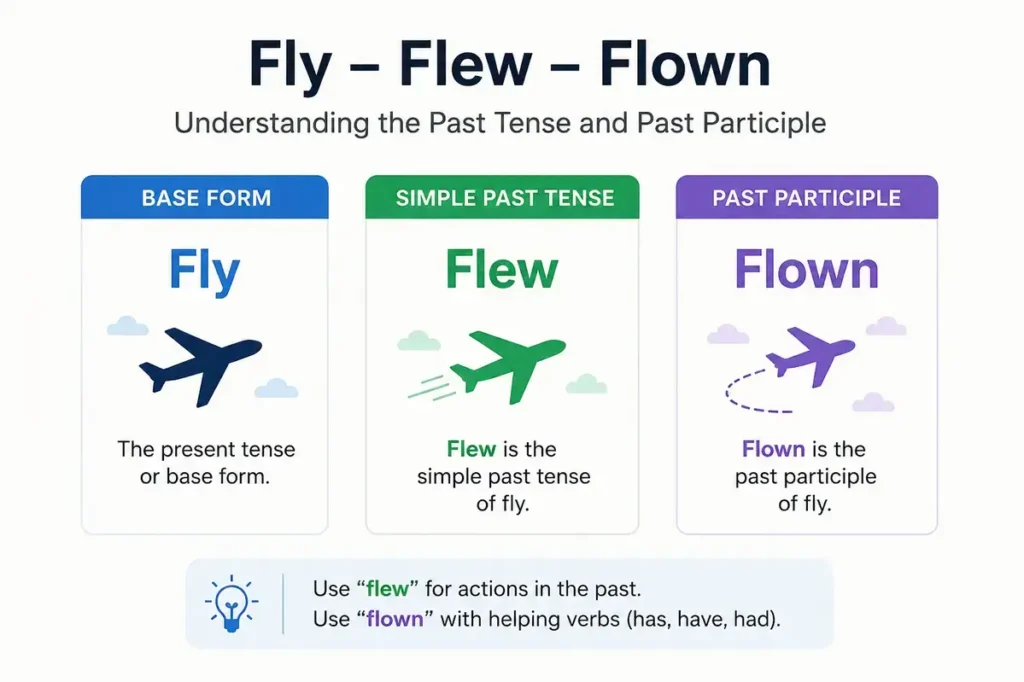
Key Takeaways
- Both flew and flown are correct English words.
- Flew is the simple past tense of fly.
- Flown is the past participle.
- Flown follows helping verbs such as has have had was and were.
- Never write have flew or has flew.
- Look for the helping verb before choosing the correct form.
- The grammar rule is the same in American English and British English.
- Reading and writing complete sentences is the fastest way to build confidence with irregular verbs.
Learn the difference in Stationary vs Stationery The Easy Way To Tell Them Apart.
Conclusion
Choosing flew or flown becomes simple once you remember the three forms of the verb: fly, flew, flown. Use “flew” to describe a completed past action, such as “We flew to Chicago yesterday.” Use “flown” after helping verbs in perfect tenses or in passive constructions, as in “We have flown to Chicago before.”
Both words are correct, but they serve different grammatical purposes. For a quick editing check, look for “have,” “has,” “had,” or a form of “be.” These words often signal that you need the past participle. Remembering this pattern will help you write clearer, more accurate sentences.
FAQs
Is “Flew” or “Flown” Correct?
Both forms are correct English. “Flew” is the simple past tense of “fly,” while “flown” is the past participle. Use “flew” in a sentence such as “We flew to Boston yesterday.” Use “flown” in “We have flown to Boston before.” The correct choice depends on the verb structure, not on a difference in spelling preference.
Is Flown a Real Word?
Yes, “flown” is the standard past participle of “fly.” It is used in perfect tenses, as in “She has flown overseas,” and in passive constructions, as in “The plane was flown by an experienced pilot.” It is not a slang term or a misspelling. The confusion arises because English uses a different form for the simple past.
What Does Flew Mean?
“Flew” is the simple past tense of “fly.” It describes an action that happened in the past, such as traveling by airplane or moving through the air. It can also describe fast movement or the quick passage of time. For example, “The bird flew away” describes physical movement, while “The afternoon flew by” uses the verb figuratively.
What Does Flown Mean?
“Flown” is the past participle of “fly.” It usually follows a helping verb to form a perfect tense, as in “I have flown to Denver.” It can also appear in passive sentences, such as “The aircraft was flown by the captain.” By itself, it is not normally the simple past form in an ordinary active sentence.
How Do You Pronounce Flew and Flown?
“Flew” is pronounced /fluː/, and it rhymes with “blue” and “true.” “Flown” is pronounced /floʊn/, and it rhymes with “known” and “grown.” Both words have one syllable, but their vowel sounds differ. Remember the oo sound in “flew” and the long o sound in “flown” to keep them distinct when speaking.
Can You Say “I Have Flew”?
No. In standard English, say “I have flown.” The helping verb “have” forms the present perfect tense and must be followed by the past participle. Since “flown” is the participle of “fly,” it is the correct form in this sentence. Use “I flew” when you want the simple past without “have.”
What Is the Difference Between Flew and Flown in a Sentence?
The difference is grammatical. “Flew” describes a completed past action, as in “They flew to Seattle yesterday.” “Flown” usually works with a helping verb, as in “They have flown to Seattle before.” Both refer to the same basic action, but each serves a different role in the sentence. Check the tense and helping verbs to choose correctly.
Is This Rule the Same in American and British English?
Yes. American and British English use the same standard verb forms: fly, flew, and flown. Canadian and Australian English follow the same pattern as well. Pronunciation can vary slightly between accents, but the grammar does not change. In all these varieties, use “flew” for the simple past and “flown” for the past participle.