
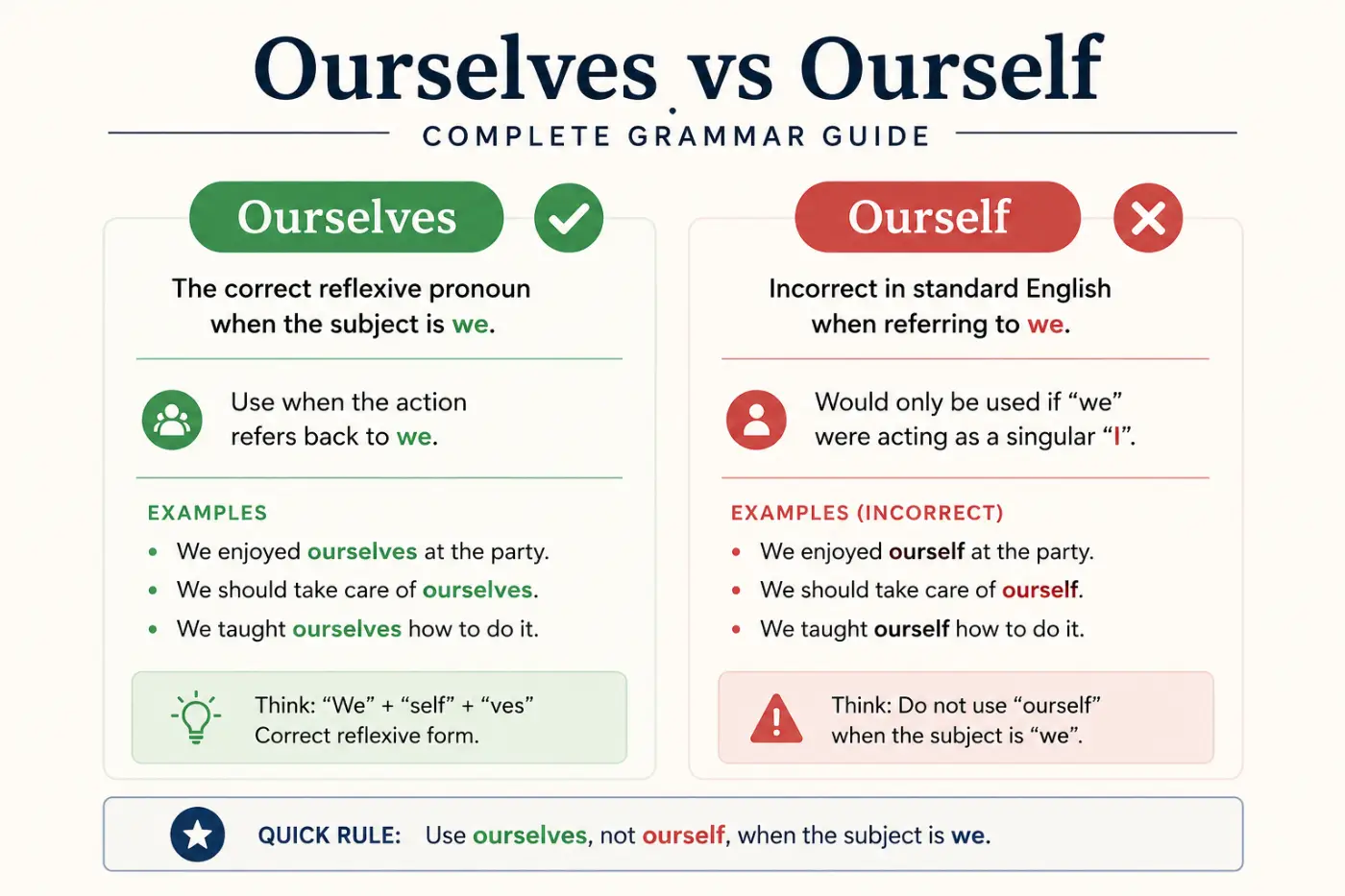
Choosing between Ourselves vs Ourself can be confusing because both forms appear in English, but they do not have the same grammatical role. Ourselves is the standard reflexive pronoun for the plural pronoun we. Ourself is less common and is mainly used when we refers to one person, such as a monarch speaking officially, or in certain formal, literary, and institutional contexts.
The difference becomes easier to understand when you look at the subject of the sentence. If we refers to several people, use ourselves. For example, We prepared ourselves for the meeting. If we refers to one person using the royal or editorial we, ourself may appear in specialized writing, though many modern writers prefer to avoid it.
This distinction matters in everyday conversation, professional writing, academic work, and formal communication. Using the right form helps your sentences sound natural and makes it clear who is performing the action. The examples and explanations below show how each pronoun works, when the less common form is acceptable, and which choice is safest in standard modern English.
Many readers also check Wack or Whack Which Word Is Correct? (2026).
Quick Answer
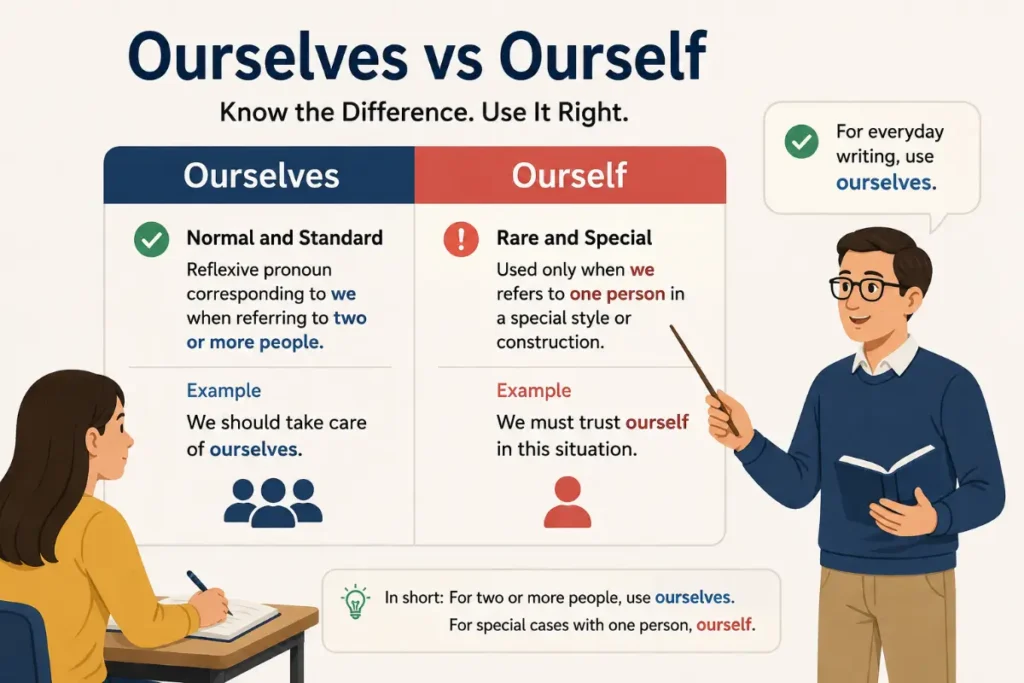
Ourselves is the standard reflexive and emphatic pronoun used with we when we refers to more than one person. Ourself is a rare singular form used mainly when one person refers to themselves as we, such as a monarch or an institutional speaker. In ordinary modern English, use ourselves in almost all situations.
Comparison Table
| Feature | Ourselves | Ourself |
|---|---|---|
| Main meaning | Refers back to a plural we | Refers back to a singular we |
| Part of speech | Reflexive or emphatic pronoun | Reflexive or emphatic pronoun |
| Number | Usually plural | Singular in specialized use |
| Standard usage | Standard modern English | Rare and specialized |
| Common context | Everyday speech and writing | Royal, formal, literary, or institutional language |
| Grammar pattern | We prepared ourselves. | We must examine ourself. |
| Formality | Suitable for all standard contexts | Unusual outside specific contexts |
| Example | We introduced ourselves to the guests. | The monarch referred to ourself in the formal statement. |
Meaning and Definition
What Does Ourselves Mean?
Ourselves is a plural reflexive pronoun. It refers back to the subject we when that subject represents two or more people. It can also add emphasis to the subject, showing that the people involved performed an action personally or without outside help.
For example, in We taught ourselves to cook, the subject we and the object ourselves refer to the same group. The people who learned the skill are also the people who taught it. This is the main purpose of a reflexive pronoun.
The word also works as an emphatic pronoun. In We built the garden ourselves, it emphasizes that the group completed the work personally rather than relying on someone else.
Common uses include:
- We introduced ourselves to the new neighbors.
- We prepared ourselves for the interview.
- We completed the project ourselves.
- We should take care of ourselves.
- We reminded ourselves to stay calm.
- We enjoyed ourselves at the party.
In each example, the pronoun refers to the people represented by we. It is the normal choice when the subject includes more than one person.
What Does Ourself Mean?
Ourself is a rare reflexive or emphatic pronoun associated with the singular use of we. It may appear when one person uses we to speak in an official, royal, or institutional voice. This use is sometimes called the royal we or the editorial we, depending on the setting.
For example, a monarch might use we in an official statement to speak with the authority of the crown. In that specialized context, ourself can refer to the single person represented by we rather than a group.
The form may also appear in older writing, literary works, or formal language that follows traditional conventions. However, it is uncommon in ordinary modern English. Many readers may find it unusual because they expect ourselves whenever they see the pronoun we.
Consider this specialized example:
We must remind ourself of the duty entrusted to the Crown.
Here, we refers to one monarch, not several people. The use of ourself reflects that singular meaning.
This does not mean that every individual who uses we should choose ourself. In most modern writing, it is clearer to avoid the unusual form and rewrite the sentence when possible.
Is Ourself a Real Word?
Yes. Ourself is a real English word, but it is rare and has a limited range of use. It is not simply a spelling mistake, although it is often incorrect when used as the reflexive pronoun for an ordinary plural subject.
Its use depends on what we represents. If we refers to several people, ourselves is the correct form. If we refers to one person in a specialized official or literary context, ourself may be appropriate.
For example:
- Standard plural use: We should protect ourselves.
- Specialized singular use: We must hold ourself accountable.
The second example is unusual in modern everyday English. A writer should use it only when the singular meaning of we is clear and the style supports that choice.
What Is a Reflexive Pronoun?
A reflexive pronoun is a pronoun that refers back to the subject of the sentence. It often appears when the subject performs an action that affects the same person or people.
For example, in She taught herself to swim, herself refers back to she. In We prepared ourselves for the trip, ourselves refers back to we.
English reflexive pronouns include:
- Myself.
- Yourself.
- Himself.
- Herself.
- Itself.
- Ourselves.
- Yourselves.
- Themselves.
Ourself is an uncommon form that appears in specialized uses. It is not the usual plural reflexive pronoun.
Key Differences Explained
1. Singular and Plural Meaning
The most important difference is number. Ourselves normally refers to more than one person, while ourself may refer to one person represented by the pronoun we.
For example:
- We introduced ourselves to the guests.
- The monarch referred to ourself in the official speech.
In the first sentence, we represents several people. In the second, we represents one person using an official form of speech.
This distinction explains why the two forms are not freely interchangeable. The pronoun must agree with the meaning of the subject.
2. Grammar and Pronoun Agreement
Reflexive pronouns usually agree with the subject in person and number. When we represents a group, the matching reflexive pronoun is ourselves.
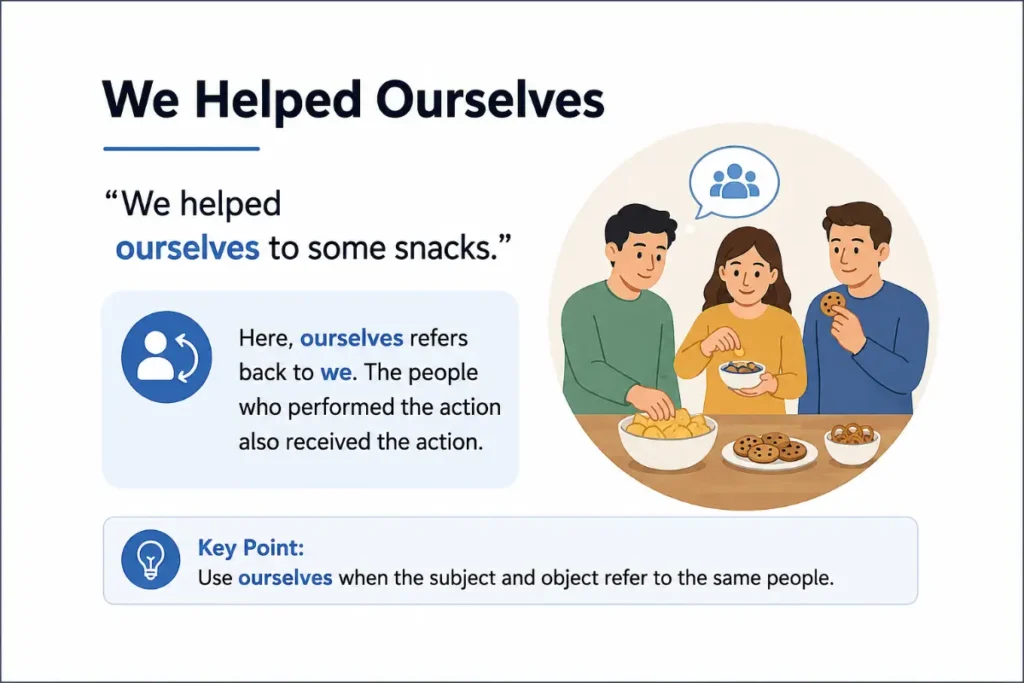
For example, We helped ourselves to the food is correct when several people took food. Writing We helped ourself to the food would usually be considered a grammatical error in ordinary plural use.
The rare singular use of we creates a special case. If a single person uses we as an official or royal pronoun, ourself may be used to maintain singular agreement. This is a marked construction, not the normal rule for everyday writing.
3. Everyday Usage
Ourselves is common in daily conversation. People use it when talking about personal actions, shared experiences, and group responsibility.
Examples include:
- We enjoyed ourselves at the concert.
- We need to look after ourselves.
- We can solve this problem ourselves.
Ourself is rarely heard in ordinary conversation. Most speakers would use myself if speaking as one individual, or ourselves if speaking as part of a group.
For example, a person would normally say I need to remind myself rather than We need to remind ourself, unless they are deliberately using an official or literary form of we.
4. Formal and Informal Writing
Ourselves is appropriate in both formal and informal writing. You can use it in a personal email, a school assignment, a business report, or a public statement when the subject we refers to multiple people.
Ourself belongs to a narrower range of styles. It may be used in a royal statement, a historical text, or a literary passage that intentionally uses singular we.
Writers should avoid using it merely to sound formal. In standard professional communication, ourselves is the safer choice for a group.
5. Pronunciation
The two forms are pronounced differently because one contains an additional syllable.
- Ourselves: /aʊərˈsɛlvz/.
- Ourself: /aʊərˈsɛlf/.
In common American pronunciation, ourselves is often spoken as two syllables, while ourself is also commonly pronounced as two syllables. The final sound differs: ourselves ends in a voiced /z/, while ourself ends in an unvoiced /f/.
6. Standard and Nonstandard Usage
Ourselves is the standard form when we refers to a plural subject. Ourself is not a general replacement for it.
However, calling ourself simply incorrect in every situation would be inaccurate. It has a recognized specialized use when we refers to one person. Its rarity means that readers should expect it only in specific contexts.
The safest rule is simple: use ourselves for a group and reserve ourself for a clear singular use of we in a style that supports it.
7. Regional Usage
There is no major difference in this distinction between American, British, Canadian, and Australian English. Ourselves is the ordinary plural reflexive pronoun in all these varieties.
Ourself remains rare and specialized. Differences in how often it appears are more likely to reflect formal tradition, literary style, or institutional wording than a regional grammar rule.
Which Form Is Correct?
For ordinary modern English, ourselves is the correct choice when we refers to more than one person. It follows the standard pattern of reflexive pronoun agreement: a plural subject takes a plural reflexive pronoun.
For example:
- Correct: We completed the assignment ourselves.
- Incorrect in ordinary plural use: We completed the assignment ourself.
The second sentence does not match the plural meaning of we. It may appear in a specialized context if one person uses we as an official or royal pronoun, but that is not the normal meaning most readers will understand.
The difference is not about spelling preference. Both forms exist, but they have different grammatical uses. Ourselves is the established form for plural subjects, while ourself is limited to rare singular uses of we.
If you are writing an essay, email, report, article, or everyday message, choose ourselves whenever you mean a group. If you are writing historical dialogue or a formal statement in the voice of a monarch, check the style and context before using the singular form.
Sentence Examples
Ten Natural Examples Using Ourselves
- Everyday conversation: We should introduce ourselves before the meeting begins.
- Text message: We can organize the event ourselves if everyone helps.
- Workplace communication: We need to prepare ourselves for the client presentation.
- School: We taught ourselves how to solve the difficult math problem.
- Academic writing: We limited ourselves to the most relevant research findings.
- Formal writing: We consider ourselves responsible for maintaining high standards.
- Social situations: We enjoyed ourselves during the family celebration.
- Online communication: We should remind ourselves to check the facts before sharing the post.
- Travel: We found ourselves in a small town after taking the wrong road.
- Personal development: We must challenge ourselves if we want to improve.
These examples show how the pronoun works in different sentence patterns. Sometimes it receives the action, as in We prepared ourselves. In other sentences, it adds emphasis, as in We organized the event ourselves.
Five Examples Showing the Specialized Use of Ourself
The following examples illustrate the rare singular use of we. They are not models for ordinary plural writing.
- Royal statement: We must remind ourself of the responsibility carried by the Crown.
- Formal literary voice: We have placed ourself in a difficult position.
- Historical style: We shall judge ourself by the duties we have fulfilled.
- Institutional voice representing one officeholder: We must hold ourself accountable for this decision.
- Deliberate literary usage: We found ourself alone with the consequences of our choice.
These sentences use we to represent one person. In ordinary modern writing, many editors would revise them to use I and myself for greater clarity.
Examples That Show the Difference
Compare these sentences to see how the subject changes the correct reflexive form.
1. We reminded ourselves to lock the door.
The subject represents several people, so ourselves is correct.
2. I reminded myself to lock the door.
The subject is one person using I, so myself is correct.
3. We prepared ourselves for the examination.
A group prepared together, so the plural form is needed.
4. The monarch used we in the official statement and referred to ourself.
The pronoun represents one person in a specialized formal voice.
The key is to identify the actual subject, not just count the letters in the pronoun. The word we can refer to a group or, in special contexts, one person.
Common Mistakes and Usage Problems
1. Using Ourself for a Group
Incorrect: We should take care of ourself.
Correct: We should take care of ourselves.
The subject we represents several people, so the reflexive pronoun must be plural. This is the most common situation in which writers choose the wrong form.
2. Using Ourselves With I
Incorrect: I completed the project ourselves.
Correct: I completed the project myself.
The subject I is singular, so it normally takes myself. Ourselves is not the correct reflexive pronoun for a single person using I.
3. Confusing Ourself With Myself
Incorrect in ordinary personal speech: I need to remind ourself to stay calm.
Correct: I need to remind myself to stay calm.
Myself refers back to I. Ourself belongs to a rare use of singular we and should not replace the ordinary first person singular form.
4. Using Ourselves When the Subject Is They
Incorrect: They prepared ourselves for the interview.
Correct: They prepared themselves for the interview.
The reflexive pronoun must match the subject. They takes themselves, not ourselves. This mistake often happens when writers lose track of the subject while building a long sentence.
5. Using Ourself Just to Sound Formal
Awkward: We have reviewed ourself and our performance.
Better: We have reviewed ourselves and our performance.
A formal tone does not make the singular form appropriate. If we refers to a team, company, committee, or group of people, ourselves is normally the correct choice.
A Simple Pronoun Agreement Check
Before using a reflexive pronoun, identify the subject and decide who it represents.
- I refers to one speaker and normally takes myself.
- We referring to several people takes ourselves.
- You referring to one person takes yourself.
- You referring to several people takes yourselves.
- They normally takes themselves.
- A singular we used by one person may take ourself in specialized contexts.
This check prevents most reflexive pronoun errors. It also helps you avoid choosing a pronoun based only on how a sentence sounds.
Pronunciation Guide
How Do You Pronounce Ourselves?
Ourselves is commonly pronounced /aʊərˈsɛlvz/ in American English. It is usually treated as a two syllable word, with the main stress on the second syllable.
A simple pronunciation guide is our SELVZ. The first part sounds like our, and the second part sounds like selves. The final sound is /z/, which is voiced.
Some accents pronounce the first part more like /ɑr/ or /aʊr/. These variations are normal and do not change the word.
How Do You Pronounce Ourself?
Ourself is commonly pronounced /aʊərˈsɛlf/. It also has two syllables, with stress on the second part.
A simple guide is our SELF. The ending is /f/, not /vz/. The difference in the final sound helps distinguish it from the plural form when speaking clearly.
Common Pronunciation Mistakes
Some speakers may pronounce the two words too similarly, especially in fast conversation. The most useful distinction is the ending. Ourselves ends with a voiced /z/ sound after the final consonant cluster, while ourself ends with /f/.
Do not add an extra syllable or place stress on the first part. In both words, the strongest stress normally falls on self or selves.
Learn the difference in atleast or at least correct spelling meaning and usage.
Etymology and Word Origin
The Origin of Our
Our comes from Old English forms related to the possessive pronoun used by speakers to refer to something belonging to or connected with a group. It developed through the history of English into the modern possessive form used today.
The word appears in expressions such as our house, our family, and our work. It also forms part of the reflexive pronouns ourselves and ourself.
The Origin of Self
Self has roots in Old English, where it appeared in forms used to refer to a person or thing itself. Over time, it developed into the modern noun and pronoun element found in words such as myself, yourself, herself, and themselves.
The combination of our and self creates a form that refers back to the speaker or speakers represented by we. The plural ending in ourselves reflects the usual plural use of the pronoun.
Why the Two Forms Developed
English has a group of reflexive pronouns that generally match their subjects in person and number. Most use patterns that are easy to recognize: myself with I, yourself with singular you, and ourselves with plural we.
Ourself reflects a less common situation in which we represents one person. It is tied to special uses of the pronoun rather than ordinary plural grammar. Its existence shows that English pronouns can vary according to meaning, context, and historical style.
Regional Usage
American English
In the United States, ourselves is the standard reflexive pronoun for a plural we. It appears in everyday speech, school writing, business documents, news articles, and formal communication.
Ourself is rare in American English. Most readers will recognize it as unusual and may associate it with royal language, historical writing, or a deliberate literary style. In ordinary communication, use ourselves for groups.
British English
British English follows the same general rule. Ourselves is the normal form when we refers to more than one person. Ourself may appear in formal, historical, or literary contexts where a single speaker uses we.
The royal we has a long association with formal public speech, which helps explain why the singular form may be encountered in older or ceremonial writing. It is still not a normal substitute for ourselves in everyday sentences.
Australian English
Australian English uses ourselves as the standard plural reflexive pronoun. The rare form ourself may appear in specialized writing, but there is no broad regional rule that makes it common in Australia.
Canadian English
Canadian English follows the same pattern as American and British English. Use ourselves for a group and reserve ourself for the rare singular use of we. There is no meaningful spelling difference between the forms across these varieties.
Grammar Rules and Part of Speech
Reflexive Pronoun
Both forms belong to the reflexive pronoun group. A reflexive pronoun refers back to the subject of its clause.
For example, in We taught ourselves to cook, ourselves refers to we. The people doing the teaching are the same people receiving the benefit of the action.
A reflexive pronoun is needed when the subject and object refer to the same person or group. Without it, the meaning may change or the sentence may become incomplete.
Emphatic Pronoun
A reflexive pronoun can also be used for emphasis. In this role, it highlights the person or people who performed an action.
For example, We painted the room ourselves means the group did the painting personally. The pronoun is not required for the basic sentence to make sense, but it adds emphasis.
You can test this use by removing the pronoun. We painted the room remains grammatically complete, but it no longer stresses that the group did the work without outside help.
Common Sentence Positions
The pronoun often appears after the verb when it acts as an object.
Example: We introduced ourselves to the new team.
It can also appear after the object for emphasis.
Example: We completed the report ourselves.
It may appear after a preposition when the action refers back to the subject.
Example: We kept the details to ourselves.
In all these examples, ourselves refers to a plural subject.
Reflexive Pronouns and Subject Agreement
The subject determines which reflexive pronoun you need. The following table shows the standard pattern.
| Subject | Reflexive Pronoun | Example |
|---|---|---|
| I | Myself | I taught myself to draw. |
| You, singular | Yourself | You should trust yourself. |
| He | Himself | He introduced himself. |
| She | Herself | She prepared herself. |
| It | Itself | The door closed by itself. |
| We, plural | Ourselves | We helped ourselves. |
| You, plural | Yourselves | You should prepare yourselves. |
| They | Themselves | They enjoyed themselves. |
Ourself is not part of the usual everyday pattern. It is reserved for the unusual singular use of we.
Can Ourselves Be Used Without a Verb?
Yes. It can appear in short replies or phrases when the meaning is clear from the conversation.
For example:
- We did it ourselves.
- We can handle it ourselves.
- We are responsible for ourselves.
The pronoun still refers back to we. It does not need to appear directly beside the subject, as long as the sentence structure makes the relationship clear.
Should You Use Ourself for a Company or Organization?
Usually, no. A company or organization may use we to refer to the people who work there or to speak as an institution. In ordinary modern writing, the standard plural form ourselves is generally preferred.
For example:
Our company considers ourselves responsible for customer satisfaction.
This can sound awkward if company is treated as a singular subject. A clearer version is:
We consider ourselves responsible for customer satisfaction.
Or:
Our company considers itself responsible for customer satisfaction.
The choice depends on the subject. If the subject is we, use ourselves for the group. If the subject is the company, use itself because company is grammatically singular in standard American English.
Real Life Usage Examples
Daily Conversation
People commonly use the plural form when talking about shared actions, responsibilities, or experiences.
- We should give ourselves more time to finish the project.
- We enjoyed ourselves at the birthday party.
Both examples refer to several people. The pronoun points back to the group represented by we.
Email and Workplace Communication
In professional writing, the plural form is useful when a team describes its own work or responsibilities.
- We have prepared ourselves for the upcoming client presentation.
- We will review the proposal ourselves before sending it to the director.
The first example describes preparation. The second emphasizes that the team will complete the review personally.
Academic Writing
Academic writers often use we to refer to the researchers or authors of a study. In this setting, the reflexive form is normally plural because the writing team represents more than one person.
- We limited ourselves to studies published during the selected period.
- We asked ourselves how the findings could affect future research.
If a single author uses we as an editorial convention, the sentence may still take ourselves in ordinary modern academic writing, especially when the author is using the conventional authorial plural. The rare singular form is generally not needed.
News and Journalism
Journalists may use the plural form when describing a group, a newsroom team, or people involved in a shared action.
- We found ourselves facing a difficult question during the investigation.
- The volunteers prepared themselves for a long day of interviews.
The pronouns refer to the people carrying out the actions. The wording keeps the relationship between the subject and the reflexive pronoun clear.
Literature and Storytelling
In stories, the plural form can describe a group’s emotions, reactions, and decisions.
- We found ourselves lost in the forest after sunset.
- We promised ourselves that we would never return to that place.
The rare singular form may appear in a story when a character deliberately speaks as a monarch or uses a formal royal voice. The writer should make that context clear so readers understand the unusual grammar.
Related and Confused Terms
1. Myself
Myself is the reflexive pronoun that normally refers back to I. Use it when one speaker performs an action that affects the same person.
Example: I taught myself to play the guitar.
Do not use ourselves when the subject is I in an ordinary sentence.
2. Yourself
Yourself is the singular reflexive pronoun used with you when addressing one person.
Example: You should give yourself a break.
It differs from ourselves because it refers to the person being addressed, not the speaker’s group.
3. Yourselves
Yourselves is the plural reflexive pronoun used with you when addressing two or more people.
Example: You should prepare yourselves for the trip.
It follows the same general plural pattern as ourselves.
4. Themselves
Themselves is the reflexive pronoun used with they.
Example: The children dressed themselves.
It refers back to the people or things represented by they. Do not use ourselves when the subject is they.
5. Each Other
Each other is a reciprocal pronoun expression. It describes people doing something to or for one another.
Example: We helped each other with the assignment.
This differs from ourselves. We helped ourselves means the group helped its own members or acted for its own benefit, while we helped each other emphasizes mutual help between members.
6. One Another
One another also expresses a mutual action between people. It is often used in the same way as each other.
Example: The team members encouraged one another.
It does not replace a reflexive pronoun when the subject and object refer to the same group acting on itself.
7. Our Own
Our own is a possessive expression that emphasizes ownership or association.
Example: We built our own website.
It does not function as a reflexive pronoun. Compare We built the website ourselves, which emphasizes who performed the work.
8. The Royal We
The royal we is a form of speech in which one person uses we instead of I, often to represent a monarch or an official position. It helps explain the rare singular use of ourself.
Example: A monarch may use we in an official declaration. The reflexive form may follow the singular meaning in specialized writing, although modern writers often rephrase the sentence for clarity.
Expert Editor Insight
An experienced editor checks the subject before choosing a reflexive pronoun. The main source of confusion is that we usually refers to a group, but it can also represent one person in a royal, official, or literary voice. Grammar tools may flag ourself because it is rare, but a tool’s warning does not always explain the context. In ordinary writing, use ourselves for groups and rewrite a singular official statement with I and myself if the special voice is not important. The best editing tip is to replace we temporarily with the people or person it represents, then choose the matching pronoun.
Key Takeaways
Ourselves is the standard reflexive pronoun associated with ordinary plural we.
Use ourselves when two or more people are included in we.
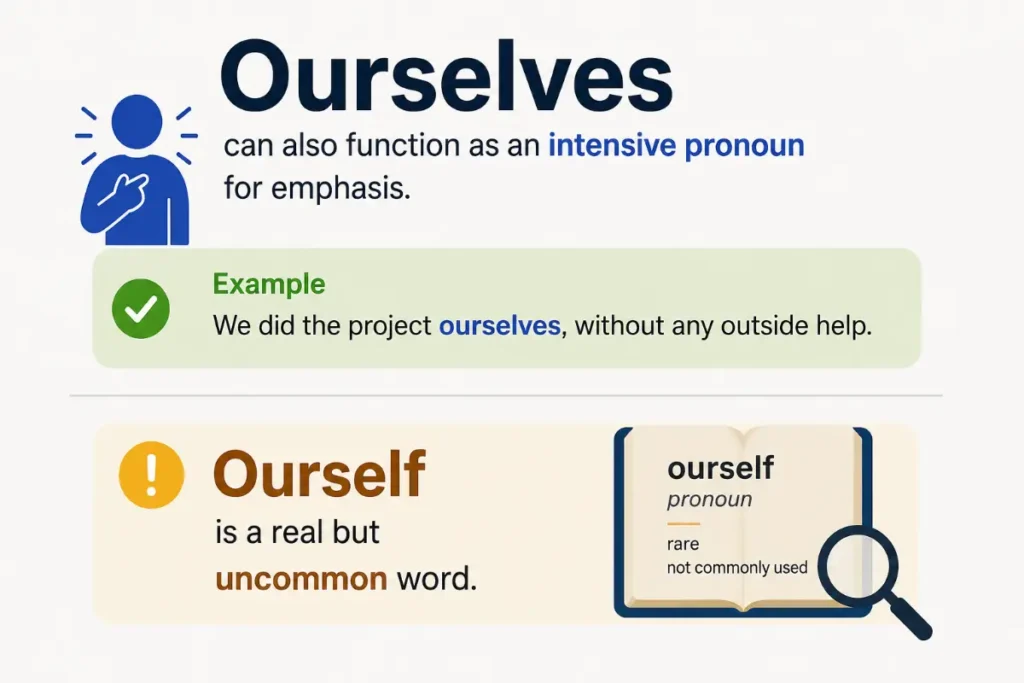
Ourselves can also function as an intensive pronoun for emphasis.
Ourself is a real but uncommon word.
Ourself can appear when we refers to one person in a special formal construction.
The royal we is one important context in which ourself can occur.
Still confused? Compare Buy vs By vs Bye How to Use Each Word Correctly.
Conclusion
The choice between Ourselves vs Ourself depends on the meaning of we. Ourselves is the standard reflexive and emphatic pronoun for a group, while ourself is a rare form used when one person speaks through a royal, official, or literary we. For everyday conversation, school assignments, business writing, and most formal documents, ourselves is the correct and natural choice.
Remember this simple editing rule: identify who we represents before choosing the reflexive pronoun. If it means several people, use ourselves. If it represents one person in a special formal voice, ourself may be suitable.
FAQs
Is Ourself a Real Word?
Yes. Ourself is a real but uncommon English reflexive pronoun. It may appear when one person uses we in a royal, official, or literary voice. It is not the standard form for a group. If we refers to several people, use ourselves instead. In everyday modern writing, ourself is rarely needed.
Which Is Correct for a Group of People?
Ourselves is correct when we refers to a group of people. For example, We prepared ourselves for the presentation is standard English. Ourself is not appropriate for an ordinary plural subject. The reflexive pronoun should match the number and meaning of its subject, so a group represented by we normally takes ourselves.
Why Do People Say Ourself Instead of Ourselves?
Some people use ourself because they confuse the singular and plural forms or because they are unfamiliar with the standard reflexive pronoun pattern. It may also appear in formal or literary writing where one person uses we. In ordinary conversation, however, ourselves is the expected form when we refers to multiple people.
Can a Single Person Use Ourself?
Yes, but only in limited contexts. A monarch, official speaker, or writer using the singular royal or institutional we may use ourself to refer to one person. This is uncommon in modern English. Most people should use I and myself when speaking as an individual rather than adopting the special use of we.
Is Ourselves a Reflexive or Emphatic Pronoun?
Ourselves can serve as both a reflexive and an emphatic pronoun. In We prepared ourselves, it is reflexive because it refers back to the subject. In We prepared the room ourselves, it adds emphasis by showing that the group did the work personally. Its grammatical role depends on the sentence.
Can I Use Ourselves With a Company Name?
Usually, a company name takes itself when it is the grammatical subject. For example, The company introduced itself is standard. If the company speaks as we, then ourselves can refer to the people represented by that plural pronoun. Choose the form based on the actual subject and intended meaning.
What Is the Difference Between Ourselves and Each Other?
Ourselves refers back to the subject we, while each other describes a mutual action between members of a group. We helped ourselves means the group acted for its own benefit. We helped each other means the members gave help to one another. The expressions are related but do not have the same meaning.
Is Ourself Appropriate in Formal Writing?
Ourself can appear in formal writing when a single person uses the royal or official we, but this is a specialized style. It is not the normal choice for a group. In business reports, academic work, emails, and general formal writing, use ourselves when we represents several people.