
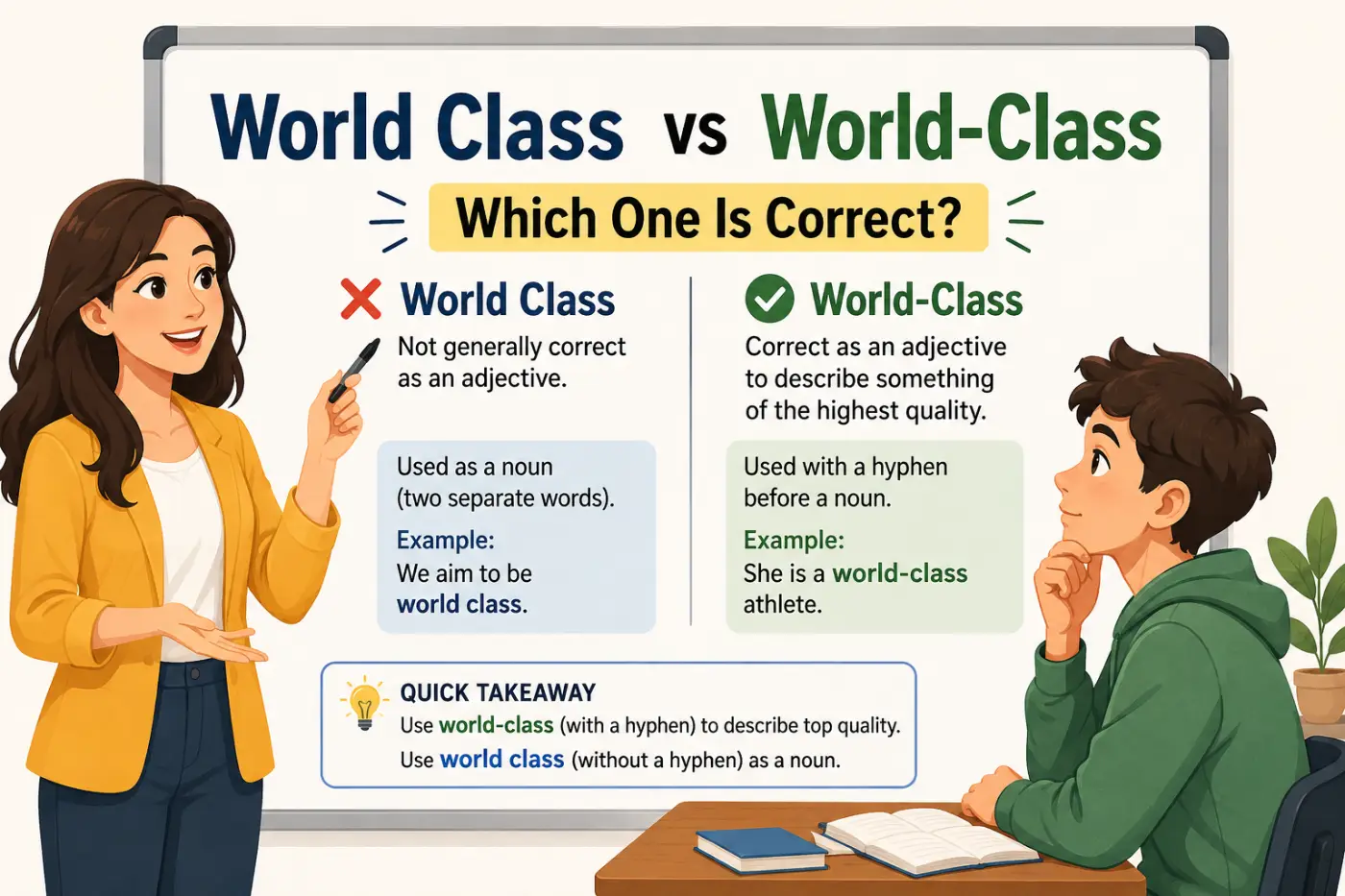
You may see world class vs world-class written in different articles, advertisements, resumes, and business descriptions. Both forms can be correct, but they do not usually serve the same grammatical purpose. The hyphenated form, world-class, is generally used as a compound adjective before a noun, while the open form, world class, is common when the expression functions as a noun phrase or appears after a linking verb in certain constructions.
For example, you can describe a world-class restaurant, a world-class athlete, or a world-class education. However, you would normally write that the restaurant is world class or that the athlete is world class. The meaning stays the same: something or someone has an exceptionally high standard, often comparable with the best in the world.
The confusion comes from English compound adjective rules. Writers often assume that a hyphen must appear every time two words work together, but punctuation depends on how the expression functions in a sentence. Understanding this simple difference will help you write the phrase correctly in professional documents, academic work, marketing copy, and everyday communication.
A related grammar guide is Cache vs Cash Which Word Should You Use.
Quick Answer
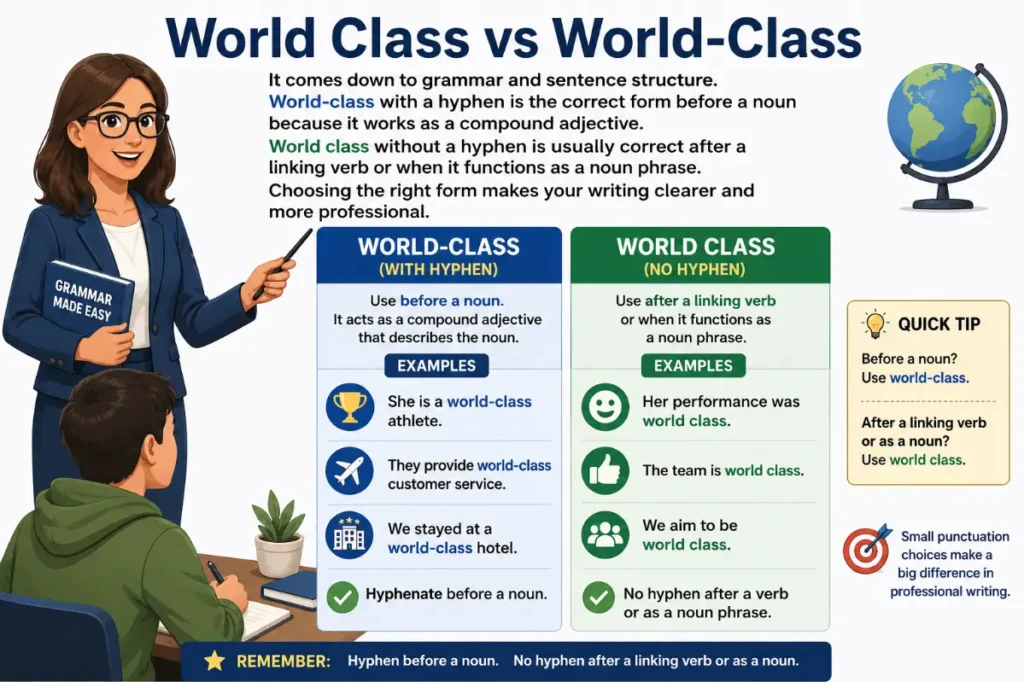
Use world-class with a hyphen when it comes directly before a noun and describes it, as in a world-class hotel. Use world class without a hyphen in common predicate constructions, such as the hotel is world class. Both forms express the same general idea of exceptional quality or excellence.
Comparison Table
| Feature | World Class | World-Class |
|---|---|---|
| Spelling | Two separate words | Two words joined by a hyphen |
| Main function | Noun phrase or predicate description | Compound adjective |
| Meaning | A standard associated with the best in the world | Of exceptionally high international quality |
| Common position | After a linking verb or as a noun phrase | Before the noun it describes |
| Example | The service is world class. | The hotel offers world-class service. |
| Grammar | Depends on the sentence structure | Usually a compound modifier |
| Formality | Standard English | Standard English |
| Common contexts | Descriptions, evaluations, general statements | Business writing, education, sports, marketing |
| Pronunciation | Same as the hyphenated form | Same as the open form |
| Regional usage | Used in major English varieties | Used in major English varieties |
Meaning and Definition
What Does World Class Mean?
World class describes a level of quality, skill, performance, or achievement that is comparable with the best found anywhere in the world. It suggests excellence that can compete with leading international standards.
For example, a world class hospital offers care that meets a very high standard. A world class athlete performs at a level associated with the best competitors. A world class university is known for strong teaching, research, or academic performance.
The expression can also function as a noun phrase in certain contexts. For example, someone might say that a company aims to reach world class. In this use, the phrase refers to a level or standard of excellence rather than directly modifying a noun.
Common meanings include:
- Exceptional quality.
- Internationally competitive performance.
- Outstanding skill or ability.
- A standard comparable with leading examples worldwide.
- Excellence in a professional, academic, artistic, or sporting field.
The expression is often used in business, sports, education, tourism, technology, healthcare, and marketing. Its exact meaning depends on the subject being described.
What Does World-Class Mean?
World-class is the hyphenated form of the same expression. It usually works as a compound adjective, meaning that two words combine to describe one quality.
You normally use it before a noun:
- A world-class university.
- A world-class football player.
- A world-class research center.
- A world-class customer service team.
- A world-class performance.
In each example, the two words work together to describe the noun that follows. The hyphen connects them and makes their combined function clear.
The hyphen does not change the meaning. A world-class athlete and an athlete who is world class both describe someone with exceptional ability. The difference is mainly grammatical position and style.
Is World-Class a Different Word From World Class?
No. The hyphen does not create a completely different meaning. Both forms refer to a very high standard of quality or ability.
The main difference is how the expression works in a sentence. Before a noun, the hyphenated form is the usual choice. After a linking verb, the open form is commonly used.
Compare:
- The company hired a world-class designer.
- The designer is world class.
Both sentences describe exceptional ability. The first uses a compound adjective before the noun designer. The second uses the expression after the linking verb is.
Key Differences Explained
1. The Hyphen and Sentence Position
The most useful rule is based on where the expression appears.
When the phrase comes before a noun and directly describes it, use the hyphenated form. This is called an attributive compound adjective.
Examples:
- A world-class chef.
- A world-class athlete.
- World-class facilities.
- World-class technology.
- A world-class education.
When the expression appears after a linking verb such as is, are, was, or seems, the open form is common.
Examples:
- The chef is world class.
- Their facilities are world class.
- Her performance was world class.
- The technology seems world class.
This distinction helps readers see how the words relate to the rest of the sentence.
2. Meaning
Both forms communicate the same basic idea. They describe exceptional quality or achievement that compares with leading standards around the world.
The hyphen does not make the quality higher, and the open form does not suggest a lower standard. A world-class hotel and a hotel that is world class express the same general judgment.
3. Grammar
World-class usually acts as a compound adjective. It modifies a noun and answers a question such as what kind of hotel, what level of service, or what type of athlete.
World class can appear as a predicate adjective after a linking verb. It describes the subject of the sentence.
Compare:
- The school provides world-class education.
- The school’s education is world class.
In the first sentence, the expression comes before and describes education. In the second, it describes education after the linking verb is.
4. Part of Speech
The hyphenated form usually functions as an adjective. It combines world and class into one descriptive unit.
The open form can function as an adjective in predicate position, as in the team is world class. It can also appear as a noun phrase in a context where it refers to a level or standard of excellence.
For example:
- The company offers world-class training.
- The training is world class.
- The company hopes to achieve world class.
The last example uses the phrase as a reference to a level of achievement.
5. Formality and Writing Style
Both forms are acceptable in standard writing. The hyphenated form is common in professional descriptions, advertisements, reports, and promotional material because it appears before nouns.
The open form is equally suitable in a sentence such as the service is world class. You do not need to add a hyphen simply because the writing is formal.
Professional writing should follow the grammatical role of the expression rather than use a hyphen everywhere for appearance.
6. Pronunciation
Both forms are pronounced in the same way. The hyphen changes the written structure, not the spoken sound.
In American English, the expression is generally pronounced with the stress on world and class. The two parts remain easy to recognize when spoken together.
7. Regional Usage
American, British, Canadian, and Australian English generally follow the same distinction. The hyphenated form commonly appears before a noun, while the open form is widely used after linking verbs.
There can be differences in individual style guides and editorial preferences, but there is no major regional difference in the core meaning.
8. Standard and Nonstandard Usage
Neither form is automatically incorrect. The mistake occurs when writers ignore the role of the phrase in the sentence or apply one spelling to every situation.
For example, world-class service is the usual form because the expression comes before the noun service. The service is world class is also standard because the phrase follows the linking verb is.
The correct form depends on sentence structure.
Which Form Is Correct?
Both forms are correct, but the hyphenated form is generally preferred before a noun. Use world-class service, world-class talent, and world-class facilities because the two words work together as one compound adjective.
Use world class in a predicate construction, such as the service is world class or the facilities are world class. In these examples, the expression follows a linking verb and describes the subject.
The reason comes from a common English punctuation rule. Hyphens can join two or more words that work together as a single modifier before a noun. This helps readers understand that the words form one descriptive unit.
Consider these examples:
- Correct: The school has world-class teachers.
- Correct: The teachers at the school are world class.
- Correct: They built a world-class sports center.
- Correct: The sports center is world class.
- Correct: The company provides world-class support.
The key is not to memorize two unrelated spellings. Learn the sentence pattern and apply it consistently.
Sentence Examples
Ten Natural Examples Using World-Class
- Everyday conversation: We visited a world-class restaurant during our vacation.
- Text message: That new gym has world-class equipment.
- Workplace: Our company wants to provide world-class customer service.
- School: The university is known for its world-class research facilities.
- Academic writing: The institute has developed a world-class program in environmental science.
- Formal writing: The organization is committed to delivering world-class healthcare services.
- Social situations: She gave a world-class performance at the concert.
- Online communication: This website offers world-class learning resources.
- Sports: The club signed a world-class goalkeeper for the new season.
- Business: The firm invested in world-class technology to improve production.
In all ten examples, the expression appears before a noun. The hyphen connects the two words because they work together to describe the noun that follows.
Five Natural Examples Using World Class
- The restaurant is world class.
- Her performance was world class.
- The team’s training facilities are world class.
- Their customer support is truly world class.
- The university aims to become world class in medical research.
These sentences use the open form after a linking verb or in a construction referring to a level of achievement. The expression still communicates exceptional quality.
Comparing Both Forms in Similar Sentences
The easiest way to understand the distinction is to compare two versions of the same idea.
| Before a Noun | After a Linking Verb |
|---|---|
| It is a world-class hotel. | The hotel is world class. |
| She is a world-class singer. | The singer is world class. |
| They built a world-class stadium. | The stadium is world class. |
| We offer world-class service. | Our service is world class. |
| He joined a world-class team. | His team is world class. |
The meaning remains nearly the same. Only the grammatical position changes.
Common Mistakes and Misspellings
The most common problems involve missing hyphens, unnecessary hyphens, and inconsistent spelling. Here are five mistakes to avoid.
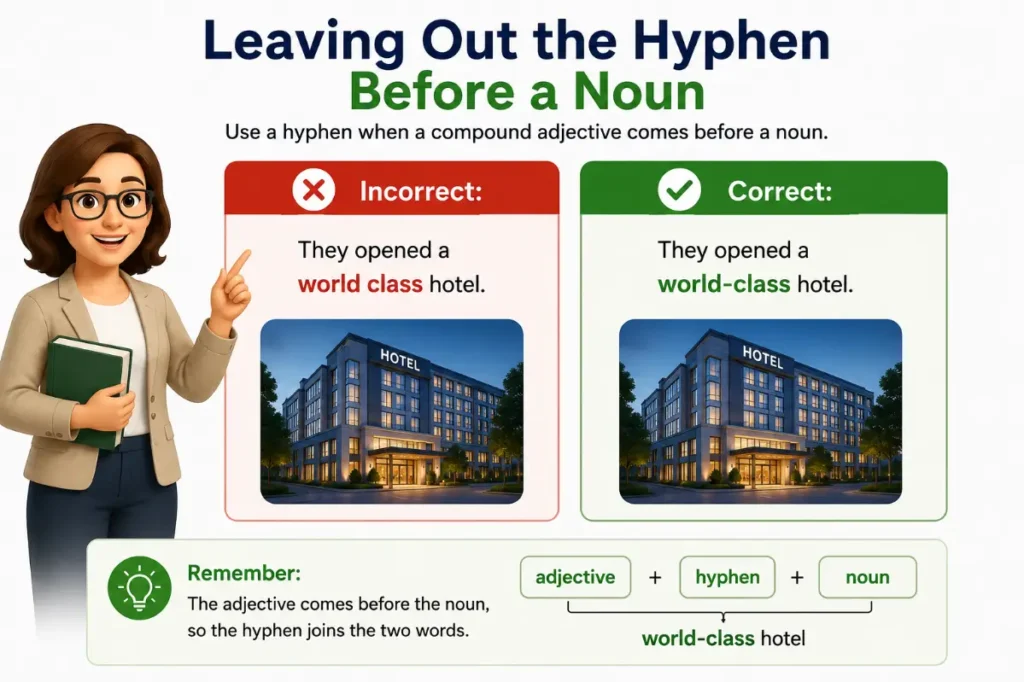
1. Leaving Out the Hyphen Before a Noun
Less preferred: The company offers world class customer service.
Preferred: The company offers world-class customer service.
The expression comes directly before customer service and works as one compound adjective. The hyphen makes the relationship between the words clear.
2. Adding a Hyphen After a Linking Verb
Less preferred in standard general usage: The customer service is world-class.
Preferred: The customer service is world class.
The phrase follows the linking verb is and describes the subject. The open form is the usual choice in this position. Some publications may use a consistent house style, but the open form is a safe general choice.
3. Using a Hyphen in Every Sentence
Incorrect approach: Always write world-class, regardless of sentence position.
Better approach: Use world-class before a noun and world class in common predicate constructions.
For example, write world-class facilities but the facilities are world class. The hyphen is not a permanent part of the expression in every grammatical position.
4. Confusing World Class With World-Class Level
Less clear: The company has world class level of service.
Clearer: The company provides world-class service.
Also possible: The company provides a world-class level of service.
The first sentence lacks a natural article and uses an awkward structure. The revised examples make the relationship between the description and the noun clearer.
5. Changing the Hyphen Within the Same Document
Inconsistent:
- The company provides world-class service.
- The service is world-class.
- We aim to deliver world class products.
More consistent:
- The company provides world-class service.
- The service is world class.
- We aim to deliver world-class products.
The problem with inconsistent usage is that readers may think the spelling changes randomly. Apply the same grammatical rule throughout the document, while also following any required publication style guide.
A Simple Editing Test
Before choosing the spelling, look at the word that follows the expression.
- If a noun follows and the phrase describes it, use world-class.
- If a linking verb comes before the expression and it describes the subject, use world class.
- If the phrase refers to a level or standard as a noun phrase, check the full sentence and use the form that fits the construction.
- If you are editing a document for a publication, follow its style guide consistently.
This quick check will solve most spelling and punctuation questions involving the expression.
Pronunciation Guide
How Do You Pronounce World Class?
The expression is pronounced the same way in both written forms. In American English, a common pronunciation is /ˌwɝːld ˈklæs/.
It contains two spoken parts:
- World: /wɝːld/.
- Class: /klæs/.
The main stress usually falls on class, while world also receives some emphasis. The hyphen does not create a pause or change the pronunciation.
Easy Pronunciation Guide
You can pronounce it as wurld klass. Say world first, then class, keeping the words connected in a natural rhythm.
The word world may be difficult for some English learners because it contains the /r/, /l/, and /d/ sounds close together. Practice it slowly before saying the complete expression.
Common Pronunciation Mistakes
- Leaving out the final sound in world. Make sure the word does not become wur.
- Adding an extra syllable to class. It should remain one syllable.
- Placing too much stress on world. The main emphasis commonly falls on class.
- Pausing unnaturally between the words. In normal speech, they form one connected expression.
The pronunciation remains the same regardless of the hyphen.
Still confused? Compare excelerate or accelerate Correct Spelling and Meaning.
Etymology and Word Origin
The Origin of World
The word world comes from Old English woruld or weorold. Its early sense was connected with human existence, life, and the age of people. Over time, its meaning developed into the modern idea of the earth and everything associated with human life.
Today, world can refer to the planet, humanity, a particular area of activity, or a broad international setting. In expressions such as world leader and world record, it signals a connection with the wider world.
The Origin of Class
The word class entered English through French from Latin classis. In Latin, it referred to a division or group, including groups used in the organization of citizens. Its modern meanings include a group of people, a category, a level of quality, and a lesson or teaching session.
In the expression under discussion, class refers to a level or standard of quality. The idea is that something belongs among the best examples of its type.
How the Expression Developed
The combination of world and class communicates a level of excellence that can compete internationally. The hyphenated form developed as a compound modifier, joining the two words when they work together before a noun.
The open form remains useful in predicate positions and in expressions referring to a standard. This is why both spellings continue to appear in modern English.
Regional Usage
American English
In American English, world-class is commonly used before nouns. Examples include world-class service, world-class athletes, and world-class universities.
After a linking verb, the open form is common. For example, the hotel is world class and the team’s performance was world class. This distinction follows general compound modifier conventions.
British English
British English uses both forms in much the same way. Writers commonly use the hyphenated spelling before a noun and the open spelling after a linking verb.
For example, a world-class university and the university is world class are both natural constructions. There is no major difference in meaning between the American and British forms.
Australian English
Australian English follows the same general pattern. The hyphenated form commonly appears before a noun, while the open form is used in predicate descriptions.
Examples include world-class sporting facilities and the facilities are world class. Individual publications may have their own style preferences.
Canadian English
Canadian English also uses both forms. Writers generally use the hyphen when the expression directly modifies a noun and leave it open in common predicate constructions.
The main point is that this is a grammatical distinction, not a regional spelling difference.
Grammar Rules and Part of Speech
World-Class as a Compound Adjective
A compound adjective combines two or more words to describe a noun. In this expression, world and class work together to describe a high level of quality or performance.
Examples:
- A world-class hospital.
- A world-class education system.
- World-class engineering.
- A world-class football team.
- World-class research.
The hyphen connects the words and shows that they form one descriptive unit. This is especially helpful when the expression appears immediately before the noun.
World Class as a Predicate Adjective
A predicate adjective describes the subject after a linking verb. The open form is commonly used in this position.
Examples:
- The hospital is world class.
- Their research is world class.
- The team looks world class.
- Her performance was world class.
- The service seems world class.
In each sentence, the phrase describes the subject rather than appearing directly before the noun.
Can World Class Be Used as a Noun?
Yes, in some constructions the open phrase can refer to a level or standard of excellence. For example, a company might aim to achieve world class.
However, this use is less common than the adjective patterns. In many sentences, a clearer option is to write achieve a world-class standard or reach a world-class level.
Hyphenation Before a Noun
Compound modifiers often use hyphens when they appear before the noun they describe. This helps readers understand that the words form a single unit.
For example:
- A high-quality product.
- A long-term plan.
- A full-time employee.
- A world-class athlete.
The hyphen joins the words in each compound modifier. However, not every group of words before a noun needs a hyphen. The decision depends on established usage and the chance of confusion.
Hyphenation After a Linking Verb
Many compound adjectives are written without a hyphen when they appear after a linking verb. The expression is clear in this position because the sentence structure already shows how the words relate.
For example:
- The product is high quality.
- The plan is long term.
- The employee works full time.
- The athlete is world class.
Some compound expressions have special style or dictionary conventions, so this pattern should not be applied blindly to every phrase. For this particular expression, the open form is the usual choice after a linking verb.
Capitalization
The expression follows normal capitalization rules. In the middle of a sentence, use lowercase letters: world-class service. At the beginning of a sentence, capitalize the first word: World-class service can improve a company’s reputation.
In a title, capitalization depends on the style guide. Some title styles capitalize both parts of a hyphenated compound, while others use a different rule. Follow the publication’s preferred style.
Real-Life Usage Examples
Daily Conversation
In casual speech, both forms appear naturally depending on sentence structure.
- We stayed at a world-class hotel near the beach.
- The food at that restaurant is world class.
The first expression comes before the noun hotel, so the hyphen is used. In the second sentence, the phrase follows is and describes the food.
Email and Workplace Communication
Professional communication often uses the expression to describe services, skills, and standards.
- Our team is committed to providing world-class support.
- The quality of our support is world class.
The first sentence describes support directly. The second makes a statement about its quality. Both are suitable for workplace communication when the claim is accurate.
Academic Writing
In academic work, the phrase may describe research centers, educational programs, facilities, or academic standards.
- The university has developed a world-class research program.
- Its research facilities are world class.
Academic writers should avoid using the expression as empty praise. If possible, explain what makes the program exceptional, such as its research output, specialist resources, or contribution to a field.
News and Journalism
News reports may use the phrase to describe major achievements, facilities, or public services.
- The city plans to build a world-class sports complex.
- The new stadium is expected to be world class.
Journalists should take care not to present promotional claims as proven facts. If the description comes from an official statement, make that clear when the distinction matters.
Literature and Storytelling
In storytelling, the expression can describe a character’s skill, a setting, or a major achievement.
- After years of practice, Lena became a world-class pianist.
- The small town was proud of its world-class theater.
The phrase adds a sense of high achievement. In a story, it works best when the surrounding details give readers a reason to believe the description.
Related and Confused Terms
These eight expressions are closely related to the idea of exceptional quality and can help you choose more precise wording.
1. High Quality
High quality describes something that meets a strong standard. It is often used for products, services, materials, and work. A world-class product is generally understood to be excellent, but high quality does not always claim that it competes with the best internationally.
2. First Class
First class can describe excellent quality, a high standard, or a premium category of service. It is also used for travel classes, such as first-class airline seating. In many attributive uses, it takes a hyphen, as in first-class service.
3. Best in Class
Best in class describes something considered the best within a particular category or group. It may refer to a product, company, service, or performance. Unlike world-class, it does not necessarily make a claim about the best examples worldwide.
4. Top Tier
Top tier means belonging to one of the highest levels of quality, skill, or performance. It is common in business, technology, education, and sports. For example, a top-tier university is regarded as belonging to a leading group.
5. State of the Art
State of the art describes the most advanced level of development in a field at a given time. It is often used for equipment, technology, and methods. A world-class facility may use state-of-the-art equipment, but the expressions do not have exactly the same meaning.
6. International Standard
International standard refers to a level or requirement recognized across countries or markets. It can be used in technical, professional, and quality-related contexts. Something may meet an international standard without necessarily being exceptional or the best in its field.
7. First Rate
First rate means excellent or of very high quality. It can describe a performance, service, product, or person. It is a useful alternative when you want to praise something without making a direct claim about worldwide competition.
8. Excellent
Excellent is a simple and flexible adjective that means very good or of outstanding quality. It works in everyday and formal writing. Unlike the expression being discussed, it does not specifically suggest an international level of achievement.
Expert Editor Insight
An experienced editor checks the phrase’s position before deciding on the hyphen. Native speakers commonly write world-class before a noun, as in world-class service, and world class after a linking verb, as in the service is world class. The confusion occurs because the meaning stays the same while the punctuation changes. Grammar tools may flag one form based on sentence patterns or a selected style guide, but automated suggestions are not always sensitive to context. A useful editing tip is to identify the noun being described. If the expression sits directly before that noun, the hyphenated form is usually the clearest choice.
Key Takeaways
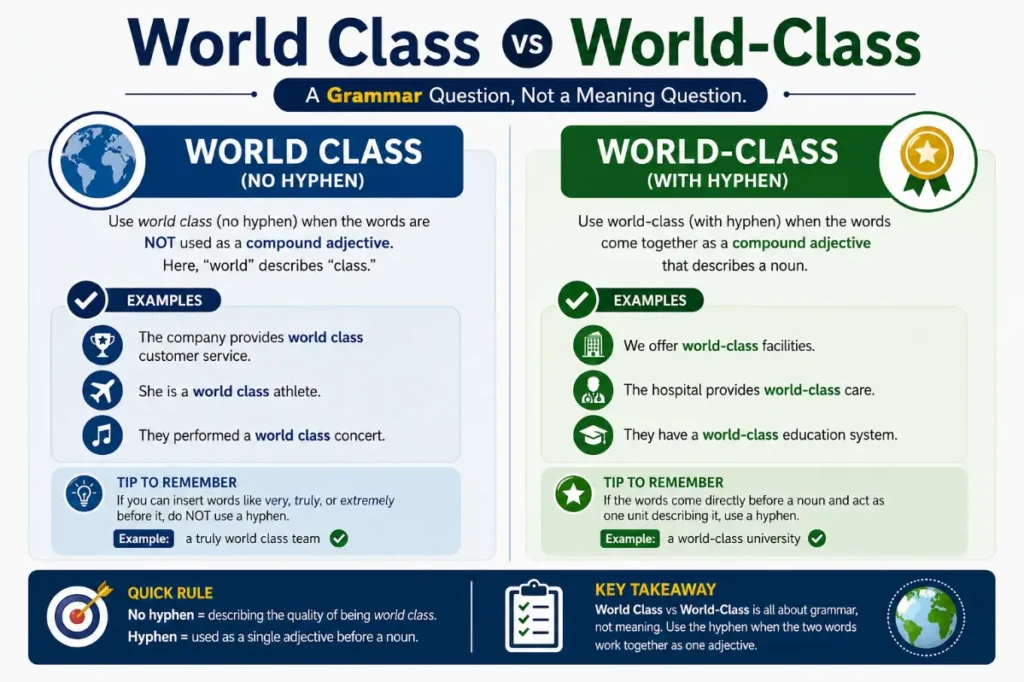
- World Class vs World-Class is a grammar question rather than a meaning question.
- Both forms describe something among the best in the world.
- Use world-class before a noun.
- Use world class after a linking verb.
- The hyphen creates a compound adjective.
- Following this simple rule makes your writing clearer and more professional.
- The same pattern applies to many other compound adjectives in English.
- Consistent punctuation helps readers understand your writing quickly.
Need another quick comparison? Read complement vs compliment Explained With Examples.
Conclusion
The choice between World Class vs World-Class depends mainly on sentence structure. Use the hyphenated form before a noun, as in world-class service or world-class education. Use the open form in common descriptions after linking verbs, as in the service is world class.
Both forms express the same idea of exceptional quality, so the hyphen does not change the meaning. For an easy editing check, look at the word that follows the expression. If it is the noun being described, use the hyphen. If the phrase follows a linking verb, the open form is usually the natural choice.
FAQs
Is World Class One Word or Two Words?
It is written as two words, with or without a hyphen depending on its grammatical position. Use world-class before a noun, as in a world-class hotel. Use world class in common predicate constructions, as in the hotel is world class. It is not normally written as one word.
Is World-Class Grammatically Correct?
Yes. World-class is grammatically correct when the two words work together as a compound adjective before a noun. For example, world-class service and a world-class athlete are standard constructions. The hyphen connects the words and shows that they form one descriptive unit. After a linking verb, the open form is generally preferred.
Should I Write World Class or World-Class Service?
Write world-class service because the expression directly modifies the noun service. The hyphen connects world and class so readers understand that the two words describe one quality. The same rule applies to world-class facilities, world-class education, and world-class performance. If the expression follows a linking verb, the open form is commonly used.
Is It Correct to Say the Service Is World Class?
Yes. The service is world class is a standard construction. The phrase follows the linking verb is and describes the subject, service. In this position, the open form is commonly used. The hyphenated spelling is generally used when the expression appears before a noun, as in world-class service.
Does World-Class Have a Different Meaning From World Class?
No. Both forms communicate the idea of exceptional quality or performance that compares with leading standards worldwide. The difference is mainly grammatical. The hyphenated form usually appears before a noun, while the open form is common after a linking verb. The hyphen does not make the quality stronger or change the basic meaning.
Is World Class Hyphenated in American English?
In American English, world-class is commonly hyphenated when it appears before a noun. For example, a world-class athlete is the usual form. After a linking verb, writers commonly leave it open, as in the athlete is world class. This pattern is also widely followed in British, Canadian, and Australian English.
Can World-Class Start a Sentence?
Yes. A sentence can begin with the hyphenated expression when it comes before a noun. For example, World-class facilities attract athletes from around the country. Capitalize the first word because it begins the sentence, but keep the hyphen because the expression still functions as a compound adjective before facilities.
Can I Use World Class in Formal Writing?
Yes. Both forms are suitable for formal writing when used in the correct grammatical position. Write world-class research before a noun and the research is world class after a linking verb. In academic or business writing, make sure the description is supported by clear evidence rather than using it as an empty promotional phrase.