
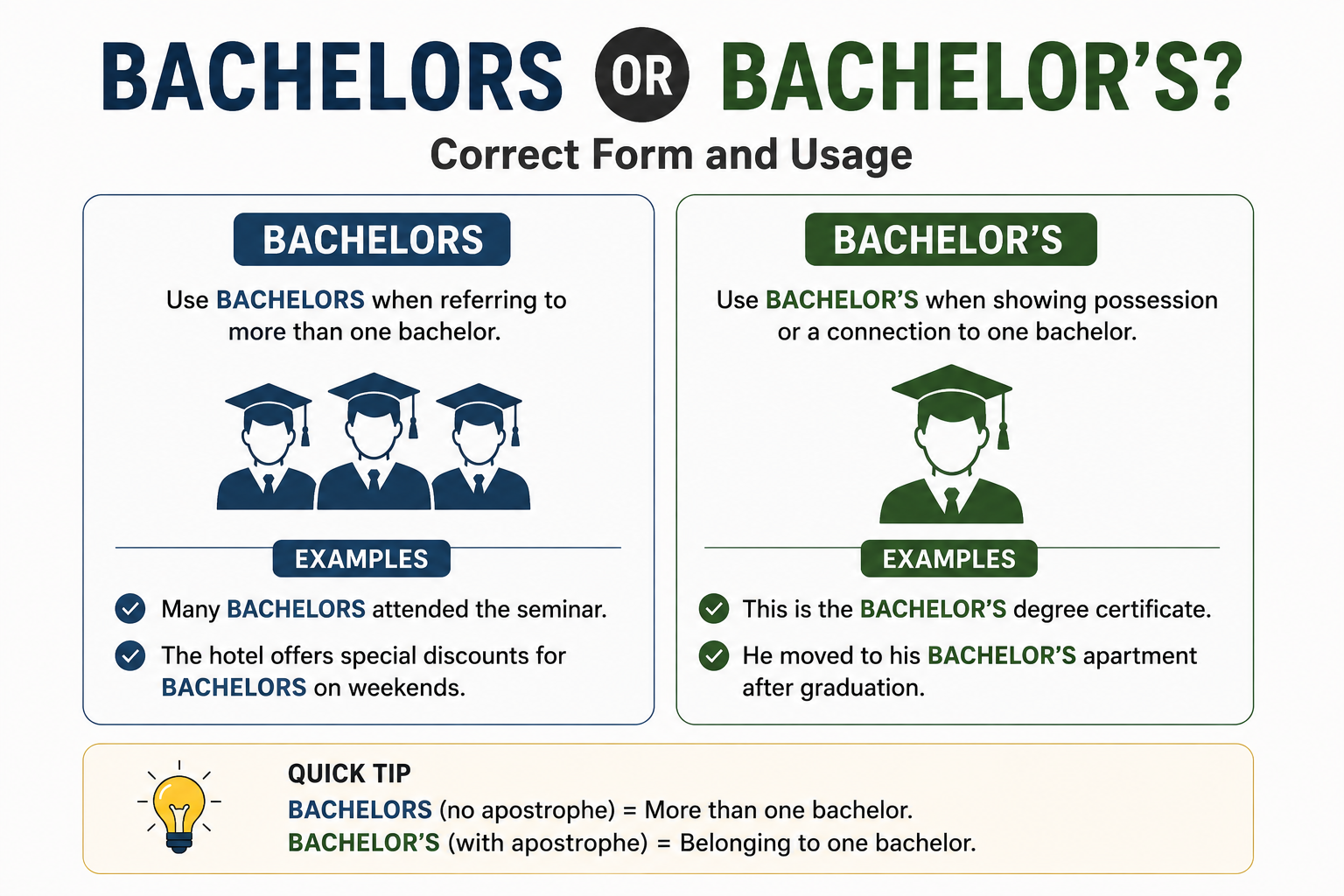
Writing about a college degree can raise a small but common spelling question: should you write bachelors or bachelor’s? The correct form for an undergraduate qualification is bachelor’s degree, with an apostrophe before the s. The word bachelors is also correct English, but it has a different meaning. It is the plural form of bachelor and usually refers to two or more unmarried men or, in some contexts, people who hold bachelor level qualifications.
The confusion often comes from the way degree names are written. You may see bachelor’s degree, Bachelor of Arts, Bachelor of Science, and bachelor’s degrees in the same document. Each form follows a different grammatical pattern, so the apostrophe and capitalization matter.
This guide explains the difference in simple terms. You will learn when to use each spelling, how to write degree names, how to handle plural forms, and how to avoid common mistakes in resumes, applications, essays, and professional communication. You will also find practical examples and answers to common grammar questions.
Learn the difference in Lay vs Lie Explained With Grammar Rules and Examples.
Quick Answer
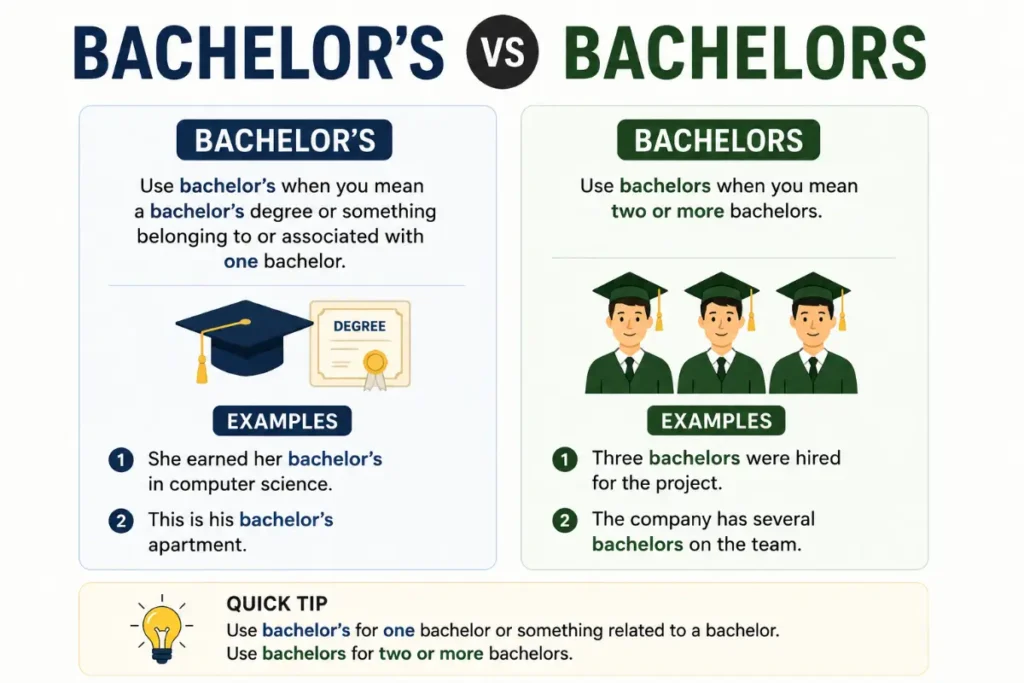
Use bachelor’s degree when referring to an undergraduate academic qualification, as in a bachelor’s degree in biology. The form bachelors is the plural of bachelor and does not normally replace the possessive form in a degree name. Write bachelor’s degrees when referring to more than one such qualification.
Comparison Table
| Form | Meaning | Part of Speech | Main Use | Example |
|---|---|---|---|---|
| Bachelor’s | Possessive form of bachelor | Noun in the possessive form | Shows the degree level in a qualification name | She earned a bachelor’s degree. |
| Bachelors | Plural of bachelor | Plural noun | Refers to two or more bachelors | The two bachelors shared an apartment. |
| Bachelor’s degree | An undergraduate academic qualification | Noun phrase | Names a degree awarded after undergraduate study | He has a bachelor’s degree in history. |
| Bachelor’s degrees | More than one undergraduate qualification | Plural noun phrase | Refers to multiple degrees | The university offers several bachelor’s degrees. |
| Bachelor of Arts | A specific type of undergraduate degree | Proper degree title | Names a formal academic award | She earned a Bachelor of Arts. |
| Bachelor of Science | A specific type of undergraduate degree | Proper degree title | Names a formal academic award | He completed a Bachelor of Science. |
Meaning and Definition
What Does Bachelor’s Mean?
Bachelor’s is the possessive form of the singular noun bachelor. In the expression bachelor’s degree, it identifies the level or type of academic qualification associated with a bachelor. The apostrophe is part of the standard spelling.
For example, a person who completes an undergraduate program may earn a bachelor’s degree in English, mathematics, business, or engineering. The qualification is commonly called a bachelor’s degree in everyday writing.
The word bachelor has several meanings. It can refer to an unmarried man, or it can describe a person who has earned an undergraduate degree. In the academic expression, the possessive form appears before degree.
Common examples include:
- A bachelor’s degree in psychology.
- A bachelor’s degree in computer science.
- A bachelor’s degree in education.
- A bachelor’s degree in economics.
- A bachelor’s degree in nursing.
The apostrophe does not indicate that the degree belongs to one particular man. Instead, it forms part of an established expression. This is why you write bachelor’s degree even when the graduate is a woman.
For example, both of these sentences are correct:
- Daniel earned a bachelor’s degree in chemistry.
- Maria earned a bachelor’s degree in chemistry.
The word does not change according to the graduate’s gender. It refers to the academic level of the qualification.
What Does Bachelors Mean?
Bachelors is the plural form of bachelor. It usually refers to two or more unmarried men. It can also refer to people who hold bachelor level degrees in a context where that meaning is clear, although this use is less common in everyday writing.
For example:
- The two bachelors rented an apartment near the university.
- Several eligible bachelors attended the social event.
In these sentences, bachelors refers to people, not academic qualifications. There is no apostrophe because the word is simply plural.
The distinction becomes clear when you compare the forms:
- A bachelor is one person.
- Bachelors refers to more than one person.
- A bachelor’s degree is an undergraduate qualification.
- Bachelor’s degrees refers to more than one undergraduate qualification.
The plural form does not automatically become the correct spelling just because a sentence discusses several graduates. If you mean several academic qualifications, write bachelor’s degrees.
What Does Bachelor’s Degree Mean?
A bachelor’s degree is an undergraduate academic qualification awarded by a college or university after a student completes a required program of study. It commonly takes around four years of full time study in the United States, although the time needed can vary by institution, subject, enrollment pattern, and program structure.
The qualification can cover many fields, including science, arts, business, education, engineering, and technology. Some programs require general education courses, major courses, electives, practical work, or a final project.
Common examples include:
- Bachelor of Arts.
- Bachelor of Science.
- Bachelor of Business Administration.
- Bachelor of Fine Arts.
- Bachelor of Engineering.
The phrase bachelor’s degree is a general name for the qualification. A formal degree title may use a different capitalization pattern and may not contain an apostrophe.
For example, a university may award a Bachelor of Arts in History. In a general sentence, you can write that someone earned a bachelor’s degree in history.
Is Bachelors Ever Correct in Academic Writing?
Yes. Bachelors is a correct plural noun, but it is not the standard spelling of the general degree phrase. It can be correct when referring to people or when used in a context that clearly identifies bachelor level graduates.
For example, the sentence The university invited several bachelors to the event uses the word as a plural noun referring to people. However, The university offers bachelors degrees is not the standard form. It should be The university offers bachelor’s degrees.
This distinction matters because a missing apostrophe can change the grammatical meaning of a phrase. The apostrophe is not an optional decoration. It helps form the possessive expression used in the academic term.
Key Differences Explained
1. The Apostrophe Changes the Meaning
The most visible difference is the apostrophe before the s. In bachelor’s, the apostrophe marks the possessive form of the singular noun bachelor. In bachelors, there is no apostrophe because the word is simply plural.
Compare these examples:
- The bachelor lives near the campus.
- The bachelors live near the campus.
- The student earned a bachelor’s degree.
- The college offers several bachelor’s degrees.
The first sentence refers to one person. The second refers to more than one person. The third names one academic qualification, and the fourth refers to multiple qualifications.
2. Singular and Plural Forms
A singular bachelor refers to one person. Its regular plural form is bachelors. The possessive form is bachelor’s, and the plural possessive form is bachelors’.
These forms have different jobs:
| Grammatical Form | Spelling | Example |
|---|---|---|
| Singular | bachelor | The bachelor moved abroad. |
| Plural | bachelors | The bachelors attended the event. |
| Singular possessive | bachelor’s | The bachelor’s apartment was small. |
| Plural possessive | bachelors’ | The bachelors’ apartments were nearby. |
The academic phrase bachelor’s degree uses the singular possessive form. When referring to multiple qualifications, add a plural s to the word degree, not to the word bachelor.
Correct: The school offers bachelor’s degrees in several subjects.
Incorrect: The school offers bachelors degrees in several subjects.
3. Meaning in Academic Contexts
In academic writing, the apostrophe helps distinguish the name of a qualification from a plural reference to people. The phrase bachelor’s degree identifies a level of higher education. The word bachelors alone does not normally communicate that meaning clearly.
For example, a student may write that she is working toward a bachelor’s degree in biology. A university brochure may say that it offers bachelor’s degrees in science and business. Both sentences use the possessive form correctly.
If you write that a group of bachelors attended a university event, the meaning changes. Readers will understand that you are referring to people, not degree programs.
4. Grammar and Word Function
Bachelor’s is a possessive form used in a noun phrase. In bachelor’s degree, it modifies the noun degree and forms part of the established name for the qualification.
Bachelors is a plural noun. It can act as the subject or object of a sentence.
For example:
- The bachelors attended the ceremony.
- The university invited the bachelors.
- She completed a bachelor’s degree.
- He is studying for a bachelor’s degree.
The first two examples use the plural noun. The last two use the academic expression.
5. Formality and Standard Usage
Both spellings are standard English when used in the right context. The difference is not about formal and informal language. It is about grammar and meaning.
In a resume, academic application, university essay, or professional biography, use bachelor’s degree when referring to the qualification. Use bachelors only when the sentence refers to people or another clearly intended plural meaning.
Apostrophe errors can look minor, but they may make an academic document appear less carefully edited. Correct spelling is especially useful in formal applications because readers expect degree names to be clear and accurate.
6. Capitalization
The general phrase bachelor’s degree is normally written in lowercase unless it begins a sentence or appears in a title that uses title case.
Formal degree names are capitalized according to the name of the award. For example:
- She earned a Bachelor of Arts in English.
- He completed a Bachelor of Science in Biology.
- She holds a bachelor’s degree in English.
- He holds a bachelor’s degree in biology.
The first two examples use formal degree titles. The last two use the general name of the qualification. The apostrophe remains in the general phrase, but the formal title does not normally use it.
7. Regional Usage
The basic spelling distinction is the same in American, British, Canadian, and Australian English. The apostrophe appears in bachelor’s degree, while bachelors is the plural form of bachelor.
There may be differences in the names of academic awards or the structure of university programs across countries. However, these differences do not change the basic apostrophe rule.
Which Form Is Correct?
For an undergraduate academic qualification, the correct general expression is bachelor’s degree. The spelling includes an apostrophe before the s because it uses the possessive form of bachelor.
Bachelors is also correct English, but it has a different grammatical function. It is the plural of bachelor and usually refers to people. It should not replace the possessive form in the name of an undergraduate degree.
Use these patterns:
- One qualification: bachelor’s degree.
- More than one qualification: bachelor’s degrees.
- One person: bachelor.
- More than one person: bachelors.
- Something belonging to one bachelor: bachelor’s.
- Something belonging to multiple bachelors: bachelors’.
The standard academic expression is established in English usage. You do not need to remove the apostrophe because the student is a woman, because the university offers several degrees, or because the sentence refers to more than one graduate.
For example, She earned two bachelor’s degrees is correct. The plural marker belongs to degrees, while bachelor’s remains in its standard form.
Sentence Examples
The following examples show how the different forms work in real sentences.
Ten Natural Examples Using Bachelor’s Degree
- Everyday conversation: I am planning to earn a bachelor’s degree in business.
- Text message: I finally finished my bachelor’s degree after years of hard work.
- Workplace communication: The position requires a bachelor’s degree in accounting or a related field.
- School: My sister is studying for a bachelor’s degree in psychology.
- Academic writing: A bachelor’s degree provides undergraduate training in a chosen subject.
- Formal writing: Applicants must provide proof of their bachelor’s degree before enrollment.
- Social conversation: He completed his bachelor’s degree while working part time.
- Online communication: The program offers a bachelor’s degree in information technology.
- Career discussion: A bachelor’s degree may help graduates qualify for certain professional roles.
- University application: I hope to pursue a bachelor’s degree in environmental science next year.
Each sentence uses the possessive form because it refers to an academic qualification. The field of study does not change the spelling. You still write bachelor’s degree in biology, bachelor’s degree in business, or bachelor’s degree in education.
Five Examples Using Bachelors Correctly
- The two bachelors shared a house near the city center.
- Several bachelors attended the charity dinner.
- The story follows three bachelors who become close friends.
- The bachelors organized a weekend trip together.
- The event welcomed eligible bachelors from across the region.
These examples use bachelors as a plural noun referring to people. They do not describe academic qualifications.
Examples With More Than One Degree
A common question is how to write the phrase when a person has completed multiple undergraduate qualifications. The correct form is bachelor’s degrees.
Examples:
- The university offers bachelor’s degrees in science and technology.
- She earned two bachelor’s degrees before starting graduate school.
- The report compares bachelor’s degrees from several institutions.
- Students can choose from a wide range of bachelor’s degrees.
- Both applicants hold bachelor’s degrees in engineering.
The word degree becomes plural because there is more than one qualification. The word bachelor’s keeps its apostrophe.
Common Mistakes and Misspellings
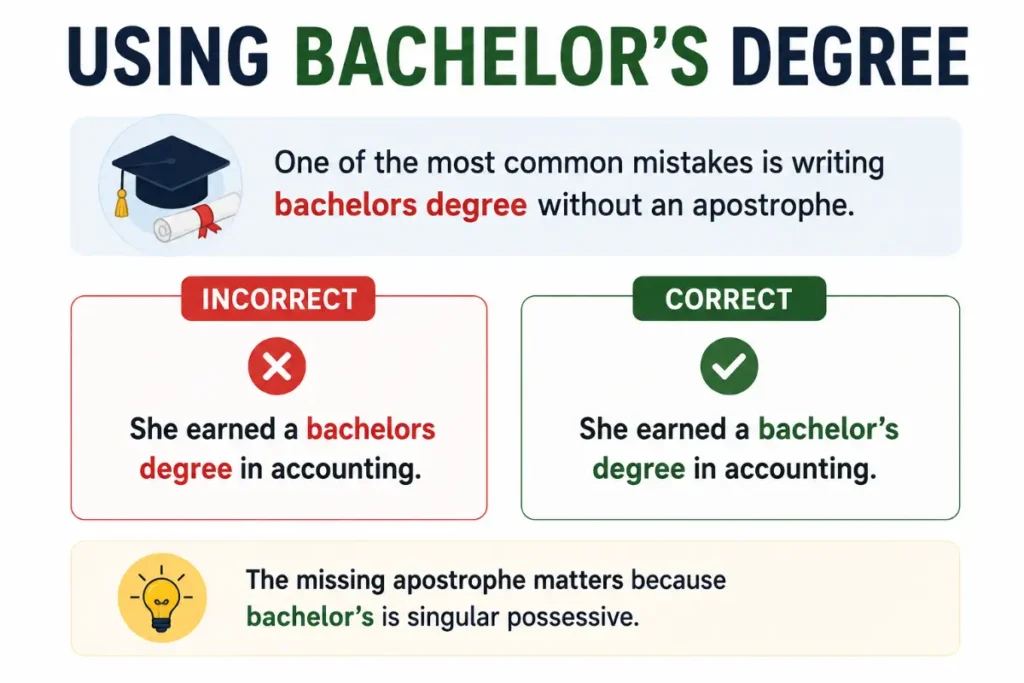
1. Writing Bachelors Degree
Incorrect: He earned a bachelors degree in finance.
Correct: He earned a bachelor’s degree in finance.
This is one of the most common errors. Writers may leave out the apostrophe because they think the s simply makes the word plural. However, the academic expression uses the possessive form, so the apostrophe is required.
2. Writing Bachelor’s Degrees as Bachelors Degrees
Incorrect: The college offers bachelors degrees in education.
Correct: The college offers bachelor’s degrees in education.
The plural word is degrees, not bachelors. The phrase keeps the singular possessive form before the plural noun.
3. Using Bachelors When Referring to One Graduate
Incorrect: He is a bachelors in computer science.
Correct: He has a bachelor’s degree in computer science.
The word bachelors is plural, so it cannot refer to one person in this sentence. The revised version also makes the academic qualification clear.
4. Writing Bachelor Degree Without the Apostrophe
Incorrect: She completed a bachelor degree in biology.
Correct: She completed a bachelor’s degree in biology.
In standard American English, the usual general expression includes the apostrophe and the final s. Some institutions use formal award titles such as Bachelor of Science, but that does not make bachelor degree the preferred general phrase.
5. Confusing Bachelor’s With Bachelor of Arts
Incorrect: She earned a bachelor’s of arts.
Correct: She earned a Bachelor of Arts.
Bachelor of Arts is the formal name of a degree. It does not normally use the possessive apostrophe. By contrast, bachelor’s degree is a general expression for an undergraduate qualification.
A Quick Way to Avoid These Errors
Before you finish a sentence, identify what you are describing.
- If you mean an undergraduate qualification, write bachelor’s degree.
- If you mean more than one qualification, write bachelor’s degrees.
- If you mean more than one unmarried man, write bachelors.
- If you are naming a formal award, use its official title, such as Bachelor of Arts or Bachelor of Science.
This simple check can prevent most apostrophe and plural errors.
Learn the difference in Flew or Flown Which One Is Correct?.
Pronunciation Guide
How Do You Pronounce Bachelor?
Bachelor is pronounced /ˈbætʃələr/ in many American English dictionaries, with some variation in the final unstressed vowel. It has three syllables:
- Bach.
- Uh.
- Ler.
The stress falls on the first syllable. The opening sound is similar to the first part of the word batch, followed by two lighter syllables.
How Do You Pronounce Bachelor’s?
Bachelor’s is pronounced /ˈbætʃələrz/ in American English. It has the same basic sound as bachelor, followed by a final /z/ sound.
The apostrophe does not create a new syllable. It marks the grammatical form in writing. You pronounce the word naturally as bachelor’s, with the same stress on the first syllable.
How Do You Pronounce Bachelors?
Bachelors is also commonly pronounced /ˈbætʃələrz/. The plural form and the possessive form may sound identical in ordinary speech.
This is one reason the spelling causes confusion. You can often hear the difference only from the sentence context, but you must show the correct grammatical form in writing.
For example, the spoken sound may be similar in these phrases:
- The bachelors arrived early.
- The bachelor’s degree was awarded.
The surrounding words make the intended meaning clear. The apostrophe in writing identifies the possessive form.
Etymology and Word Origin
The Origin of Bachelor
The word bachelor entered English through Old French, with earlier roots linked to medieval Latin. Its history is complex, and its original meaning was not limited to an unmarried man or an academic qualification.
Over time, bachelor became associated with an unmarried man. It later developed an academic meaning connected with an undergraduate degree. The exact historical path of the academic use reflects changes in European education and university traditions.
The Origin of Bachelor’s Degree
The academic expression developed from the use of bachelor as the name of an undergraduate degree holder or qualification level. English uses the possessive form in the general phrase bachelor’s degree.
The apostrophe is a grammatical feature of the modern expression. It does not mean that the degree literally belongs to a particular person. Instead, it forms part of the established name for the academic award.
Why the Word Has an Apostrophe
English often uses possessive forms in names and expressions. The apostrophe helps show the relationship between the words in a phrase.
In bachelor’s degree, the possessive form appears before degree. This is the conventional spelling used in standard English. The form remains the same even when the sentence refers to several degrees.
Regional Usage
American English
In the United States, bachelor’s degree is the standard general expression for an undergraduate qualification. It is common in university websites, job advertisements, resumes, application forms, and everyday conversation.
Formal award names are capitalized, as in Bachelor of Arts and Bachelor of Science. General references remain lowercase unless the phrase begins a sentence or follows a title capitalization style.
Examples:
- She earned a bachelor’s degree in marketing.
- He holds a Bachelor of Science in computer science.
British English
British English uses the same apostrophe in bachelor’s degree. The phrase is standard, although degree names and university structures may differ from those in the United States.
British institutions may use terms such as honours degree and may describe the qualification in ways that reflect their own academic systems. These differences do not remove the apostrophe from the general phrase bachelor’s degree.
Australian English
Australian English also uses bachelor’s degree as the standard general form. Universities may offer Bachelor of Arts, Bachelor of Science, and other formal awards.
The same distinction applies: bachelors is the plural noun, while bachelor’s is the possessive form used in the general name of the qualification.
Canadian English
Canadian English follows the same basic spelling convention. A person may earn a bachelor’s degree, and a university may offer several bachelor’s degrees.
Canadian institutions may use different program names or degree structures, but the apostrophe rule remains the same.
Grammar Rules and Part of Speech
Understanding the grammar behind the phrase makes it easier to use the correct spelling in longer sentences.
Bachelor’s as a Possessive Form
Bachelor’s is the possessive form of the singular noun bachelor. It appears before another noun in the academic expression bachelor’s degree.
Examples:
- She completed a bachelor’s degree.
- He is pursuing a bachelor’s degree in economics.
- The bachelor’s degree program lasts four years.
- A bachelor’s degree is required for the position.
The possessive form is part of the noun phrase. The word degree is the main noun, while bachelor’s identifies the type or level of qualification.
Bachelors as a Plural Noun
Bachelors is the plural form of bachelor. It usually refers to more than one unmarried man.
Examples:
- The bachelors attended the event.
- Several bachelors lived in the building.
- The story describes the lives of three bachelors.
In these examples, the word functions as a noun. It does not describe an academic award.
Bachelor’s Degrees as a Plural Noun Phrase
If you are referring to multiple undergraduate qualifications, make the main noun plural.
Correct: The university offers bachelor’s degrees in several fields.
Incorrect: The university offers bachelors degrees in several fields.
The word degrees carries the plural meaning. The possessive form bachelor’s stays unchanged.
Formal Degree Titles
Some academic awards use official names rather than the general phrase bachelor’s degree. These titles are written with capital letters.
Examples:
- Bachelor of Arts.
- Bachelor of Science.
- Bachelor of Fine Arts.
- Bachelor of Business Administration.
- Bachelor of Engineering.
Use the official title when you know the exact award. Use bachelor’s degree when you are referring to the qualification in a general way.
Capitalization in Sentences
Write the general phrase in lowercase in ordinary sentences.
Correct: She earned a bachelor’s degree in biology.
Correct: He is applying for a bachelor’s degree program.
Use capital letters for the formal name of the award.
Correct: She earned a Bachelor of Science in Biology.
The subject name may be capitalized in a formal degree title, but general references to a field of study are usually lowercase. Follow the official wording used by the institution when recording a specific qualification.
Apostrophes in Singular and Plural Possessives
The general rule for a singular noun is to add an apostrophe and s to form the possessive. For a regular plural noun ending in s, the apostrophe usually follows the final s.
Examples:
- The bachelor’s apartment was near campus.
- The bachelors’ apartments were near campus.
- The bachelor’s degree is widely recognized.
- The bachelors’ discussion focused on their shared housing.
Notice that the academic expression bachelor’s degree uses the singular possessive form. It does not become bachelors’ degree simply because several graduates are involved.
Real Life Usage Examples
Daily Conversation
People often use the general phrase when talking about education, career plans, and study choices.
- I want to earn a bachelor’s degree before applying for a graduate program.
- My cousin has a bachelor’s degree in graphic design.
The possessive form is natural in both sentences. It identifies the level of education without naming a specific award.
Email and Workplace Communication
In professional communication, degree names often appear in job requirements, staff biographies, and applications.
- The role requires a bachelor’s degree in accounting or a related subject.
- Please include the name of your bachelor’s degree on the application form.
These examples show why correct spelling matters. A missing apostrophe can make a qualification look poorly edited, especially in a formal document.
Academic Writing
Academic writing often uses the phrase when discussing educational backgrounds, admission requirements, or degree programs.
- Students must complete a bachelor’s degree before entering the graduate program.
- The study examined the career paths of people with bachelor’s degrees in science.
The first sentence refers to one required qualification. The second refers to multiple qualifications.
News and Journalism
News articles may use the phrase when reporting on education, employment, and changes in university programs.
- The report found that many job applicants held a bachelor’s degree.
- The university announced new bachelor’s degrees in health and technology.
The apostrophe remains in place even when the sentence refers to several programs or awards.
Literature and Storytelling
In a story, the word may appear when describing a character’s education or personal history.
- After earning a bachelor’s degree in history, Lena returned to her hometown.
- His bachelor’s degree helped him find work at a local museum.
These examples use the standard possessive form. The qualification does not need to be a formal title to use the apostrophe.
Related and Confused Terms
1. Bachelor
Bachelor is the singular noun. It can refer to an unmarried man or a person who holds a bachelor’s degree. Its meaning depends on the context.
Example: He is a bachelor who lives near the university.
2. Bachelors
Bachelors is the plural form of bachelor. It usually refers to more than one unmarried man.
Example: The bachelors attended a social event.
It does not normally replace bachelor’s in the name of an academic qualification.
3. Bachelor’s Degree
This is the standard general phrase for an undergraduate academic qualification.
Example: She earned a bachelor’s degree in chemistry.
The apostrophe is required in standard American English.
4. Bachelor’s Degrees
This is the plural form of the academic phrase. It refers to more than one undergraduate qualification.
Example: The college offers bachelor’s degrees in business and science.
The word degree becomes plural, while bachelor’s retains its apostrophe.
5. Bachelor of Arts
Bachelor of Arts is a formal degree title, often shortened to BA. It is used for an undergraduate award in arts, humanities, and other fields, depending on the institution.
Example: She earned a Bachelor of Arts in English.
The formal title does not normally include an apostrophe.
6. Bachelor of Science
Bachelor of Science is another formal undergraduate degree title, often shortened to BS or BSc depending on the country and institution.
Example: He completed a Bachelor of Science in physics.
Use the institution’s official award name when recording the qualification.
7. Master’s Degree
A master’s degree is a graduate qualification that usually follows a bachelor’s degree. It uses a similar possessive pattern, with an apostrophe before the s.
Example: She plans to earn a master’s degree in education.
Do not write masters degree in standard formal writing when you mean the academic qualification.
8. Associate Degree
An associate degree is an undergraduate qualification commonly awarded after a shorter program than a bachelor’s degree in the United States. The general phrase does not use an apostrophe.
Example: He earned an associate degree in information technology.
This term is useful to know because not every academic qualification follows the same possessive pattern.
Expert Editor Insight
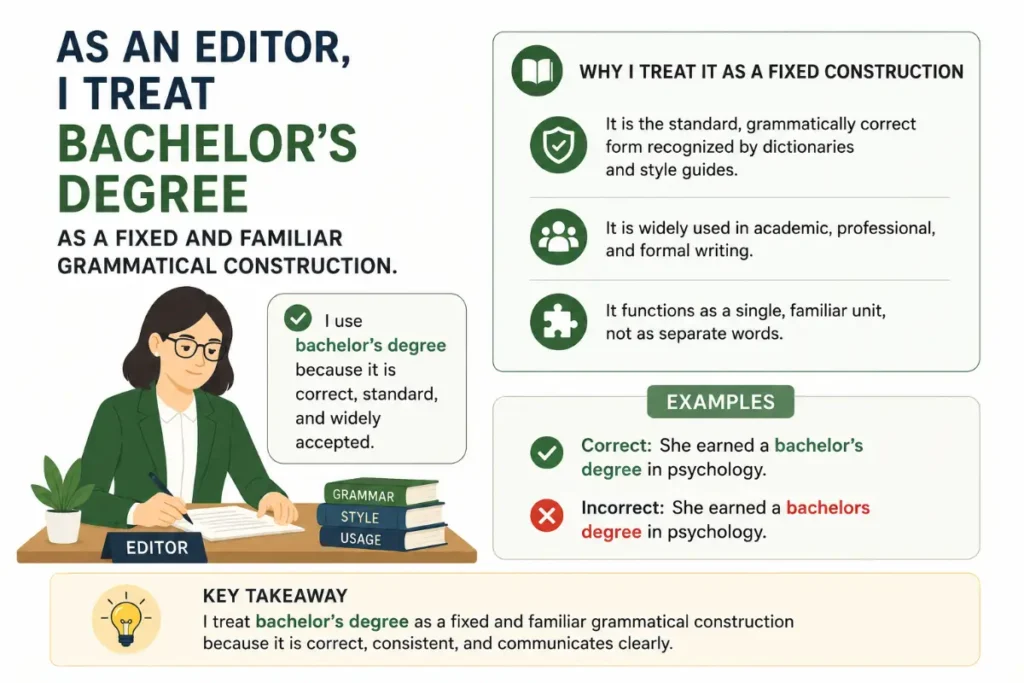
A professional editor checks the meaning of the sentence before correcting the apostrophe. The word bachelors is not automatically wrong; it is correct when used as the plural of bachelor. However, in a sentence about an undergraduate qualification, the standard phrase is bachelor’s degree. Editors also check capitalization because Bachelor of Arts is a formal award title, while bachelor’s degree is a general reference. Spelling tools may flag a missing apostrophe, but they may not understand the intended meaning. The best editing habit is to identify the main noun first, then check whether you need a plural form, a possessive form, or an official degree title.
Learn the difference in Emigrate vs Immigrate and How to Use Each Word.
Conclusion
The difference between bachelors and bachelor’s comes down to grammar and meaning. Use bachelor’s degree when referring to an undergraduate academic qualification, and write bachelor’s degrees for more than one qualification. Use bachelors when you mean two or more people described as bachelors.
Formal award names, such as Bachelor of Arts and Bachelor of Science, follow their own capitalization pattern and do not normally use an apostrophe. A useful editing tip is to check the main noun: if you mean a degree, keep the apostrophe in bachelor’s. This small check helps keep resumes, applications, and academic writing accurate.
FAQs
Is Bachelors Degree Correct?
No. In standard American English, the correct general expression is bachelor’s degree, with an apostrophe before the s. Bachelors is the plural form of bachelor and usually refers to people. If you are writing about an undergraduate qualification, include the apostrophe. For multiple qualifications, write bachelor’s degrees.
Why Does Bachelor’s Degree Have an Apostrophe?
The apostrophe marks the possessive form of the singular noun bachelor. This is the established spelling of the academic expression. It does not mean the degree belongs to a particular man. The phrase is used for graduates of any gender and remains the same in both singular and plural references to qualifications.
Is Bachelors a Real Word?
Yes. Bachelors is a correct plural noun. It usually refers to two or more unmarried men, although it can have other context specific uses. The word is not a correct replacement for bachelor’s in the general name of an undergraduate qualification. The intended meaning determines which form you should use.
Is It Bachelor’s Degree or Bachelor Degree?
Bachelor’s degree is the standard general expression in American English. It includes an apostrophe and a final s after bachelor. Some formal award titles use Bachelor of Arts or Bachelor of Science instead. These official titles do not normally include an apostrophe, so use the form that matches your intended meaning.
How Do You Write More Than One Bachelor’s Degree?
Write bachelor’s degrees when referring to multiple undergraduate qualifications. The word degrees becomes plural, while bachelor’s keeps its possessive form. For example, She earned two bachelor’s degrees is correct. Do not write bachelors degrees because the plural marker belongs to the main noun, not the word bachelor’s.
Should Bachelor’s Degree Be Capitalized?
The general phrase bachelor’s degree is normally lowercase in a sentence. Formal degree titles are capitalized, such as Bachelor of Arts and Bachelor of Science. If you are writing a resume or application, use the official name of your award when known. Otherwise, the lowercase general phrase is appropriate.
Is It Bachelor of Arts or Bachelor’s of Arts?
The correct formal degree title is Bachelor of Arts, without an apostrophe or final possessive s. You can also write bachelor’s degree in arts when speaking about the qualification in general terms, although the exact field and award name should match the institution’s official record.
Is Bachelor’s Degree Correct for Men and Women?
Yes. The phrase bachelor’s degree is used for graduates of all genders. The word bachelor in the academic expression refers to the undergraduate qualification level, not the graduate’s marital status or gender. A woman and a man can both earn a bachelor’s degree in the same subject, and the spelling does not change.