
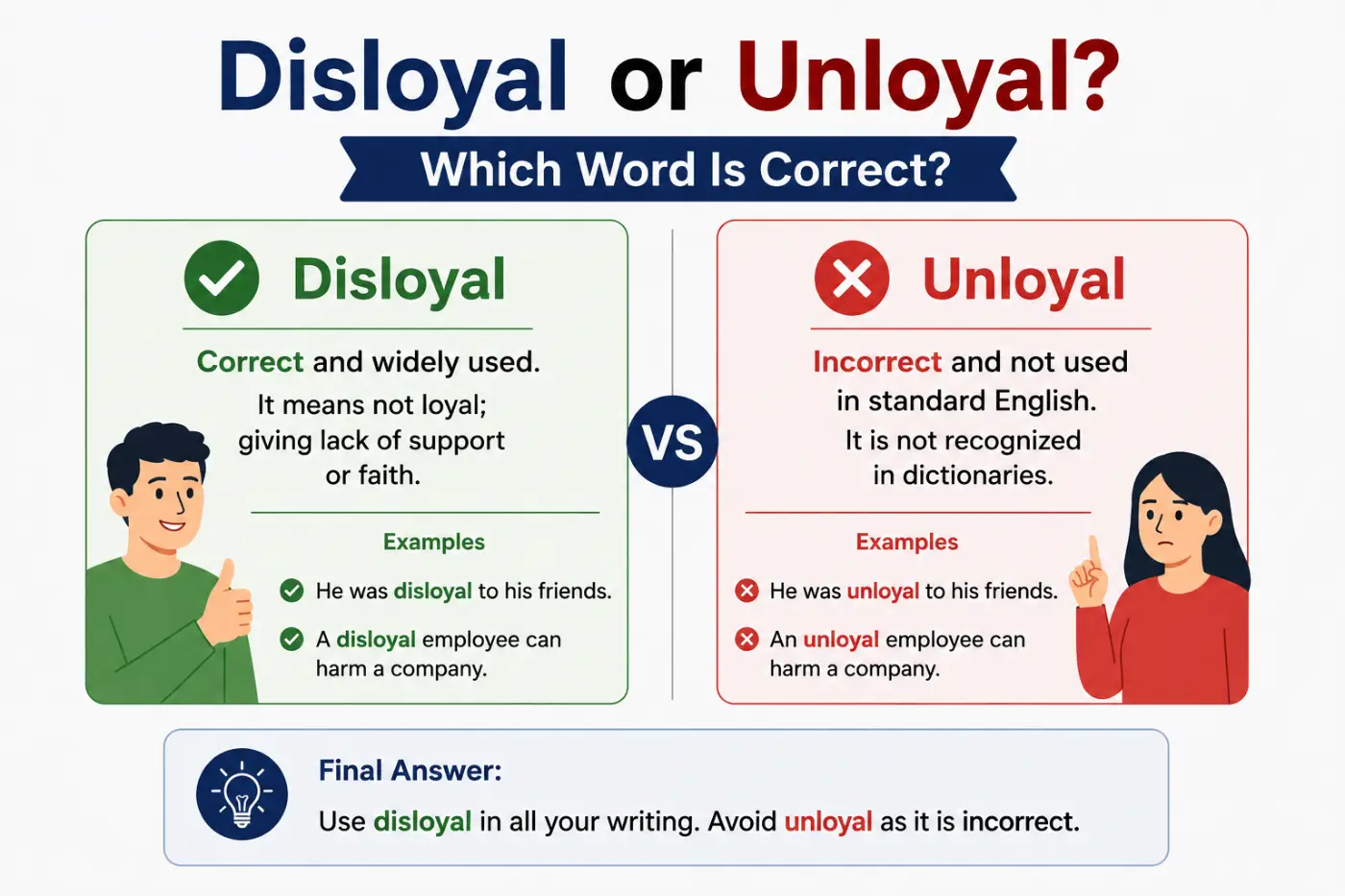
Confused about Disloyal or Unloyal? Both forms may seem logical because English uses the prefixes dis and un to express opposite meanings. However, they do not have the same standing in everyday English. If you want the safest and most natural word for a conversation, school assignment, professional email, or formal document, choose disloyal.
The word describes someone who fails to remain faithful, supportive, or committed to a person, group, promise, or cause. You might call a friend disloyal for sharing a private secret, an employee disloyal for deliberately betraying a trusted colleague, or a character in a novel disloyal for abandoning an important promise. The exact meaning depends on the situation, but the central idea is a lack of loyalty.
The confusion comes from a familiar English spelling pattern. Words such as unfair, unkind, and unhappy use un to express an opposite quality, so unloyal can look reasonable at first glance. Yet common usage does not treat every possible prefix combination as equally natural. This guide explains the correct choice, the meaning of each form, the grammar behind it, and how to use the word confidently in different situations.
Need another quick comparison? Read Imply vs Infer The Difference Explained.
Quick Answer
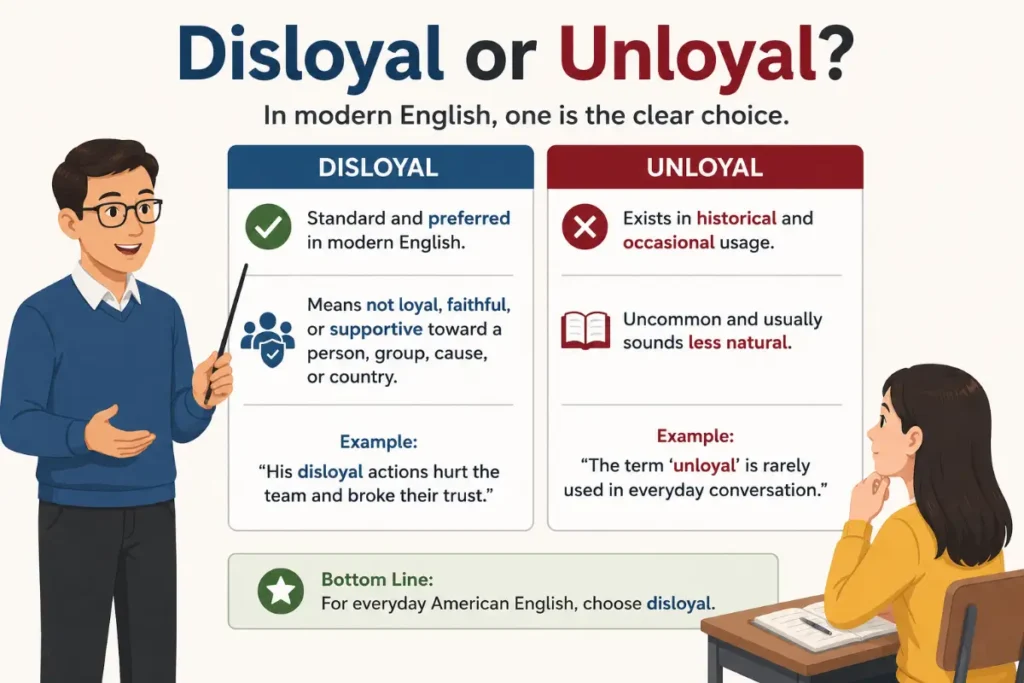
Disloyal is the standard and preferred spelling in modern English. It describes someone or something that shows a lack of loyalty, faithfulness, or support. Unloyal is a rare alternative that readers may understand, but it is much less common and is usually best avoided in edited writing.
Comparison Table
| Feature | Disloyal | Unloyal |
|---|---|---|
| Standard status | Standard English | Rare and less preferred |
| Meaning | Not loyal or faithful | Intended to mean not loyal |
| Part of speech | Adjective | Adjective when used |
| Prefix | Dis | Un |
| Pronunciation | dis LOY uhl | un LOY uhl |
| Formality | Suitable for formal and informal use | Usually avoid in formal writing |
| Common contexts | Relationships, work, politics, stories | Occasional nonstandard or uncommon usage |
| Example | His actions were disloyal to the team. | The writer used unloyal, but disloyal would be more natural. |
The main difference is not a major difference in meaning. Both forms can communicate a lack of loyalty, but they differ in how naturally they fit established English usage. In most situations, the standard form is the clearer choice.
Meaning and Definition
What Does Disloyal Mean
Disloyal is an adjective that describes a person, action, or attitude that fails to show loyalty. Loyalty means remaining faithful, dependable, or supportive toward someone or something. A disloyal person breaks that trust, withdraws support in a way that violates an expectation, or acts against a commitment.
For example, a friend who shares confidential information after promising to keep it private may be described as disloyal. An employee who deliberately reveals a company’s protected information to harm the business might also be called disloyal. In both cases, the word points to a failure to honor trust or commitment.
The word does not always mean the same thing as dishonest or cruel. Someone can disagree with a friend, leave a job, or criticize a group without automatically being disloyal. The label depends on the circumstances, the commitments involved, and the person’s actions.
Disloyal can also describe behavior rather than a whole person. Saying “That was a disloyal decision” focuses on one action. Saying “He is disloyal” makes a broader judgment about his character or conduct. The second statement is stronger because it describes the person rather than a single event.
What Does Unloyal Mean
Unloyal is an uncommon adjective formed by adding un to loyal. Readers can usually understand its intended meaning because un often expresses the opposite of an adjective, as in unhappy or uncertain. However, being understandable does not make a word equally natural or widely accepted.
In contemporary American English, most writers would choose disloyal instead. The less common form may appear in older material, individual writing, or contexts where someone forms a word by analogy with other adjectives. Its presence does not mean it is the best choice for general communication.
If you encounter this form in a message or a published text, consider the context. It may be a simple word choice rather than a spelling error in the strict sense. Still, if you are editing a school paper, business report, article, or other polished document, replacing it with disloyal will usually improve the wording.
Is Unloyal a Real Word
The answer depends on what you mean by a real word. People can form and understand uncommon words without those words becoming standard choices in everyday English. Unloyal is recognizable as a possible formation, but it is rare compared with disloyal.
That distinction matters because language has patterns as well as conventions. English speakers can often guess what a newly formed word means, yet they may still find it awkward or unusual. Standard writing favors forms that readers recognize quickly and that fit established usage.
For practical purposes, treat disloyal as the normal choice. You do not need to memorize a complicated exception or use the rarer form to sound more precise. The established adjective already expresses the intended meaning clearly.
Key Differences Explained
Spelling
The most visible difference is the prefix. Disloyal begins with dis, while unloyal begins with un. Both prefixes can create words with negative meanings, but English does not use them interchangeably in every situation.
The standard spelling is disloyal. It is the form readers are most likely to expect in everyday communication and edited writing. Choosing it avoids distracting readers with an uncommon word form.
Meaning
Both forms are intended to express a lack of loyalty. In ordinary use, there is no widely recognized difference in meaning that makes the rare alternative more precise.
The preferred word can describe betrayal, a failure to honor a commitment, or a lack of support. The seriousness of the action comes from the context, not from the prefix itself.
For example, a disloyal friend might reveal a secret, while a disloyal official might break a commitment to the public. The same adjective applies to different situations because the shared idea is a failure of loyalty.
Grammar
Disloyal is an adjective. It can describe a person, an action, a decision, a remark, or a relationship.
Consider these patterns.
- Before a noun: She made a disloyal choice.
- After a linking verb: His behavior seemed disloyal.
- After an adverb: The manager acted deeply disloyal to the team.
- In a comparison: That action was more disloyal than the earlier mistake.
In the third example, “deeply disloyal” is grammatically possible, although “profoundly disloyal” or “extremely disloyal” may sound more natural depending on the sentence. The adjective itself does not change to match a singular or plural noun.
Pronunciation
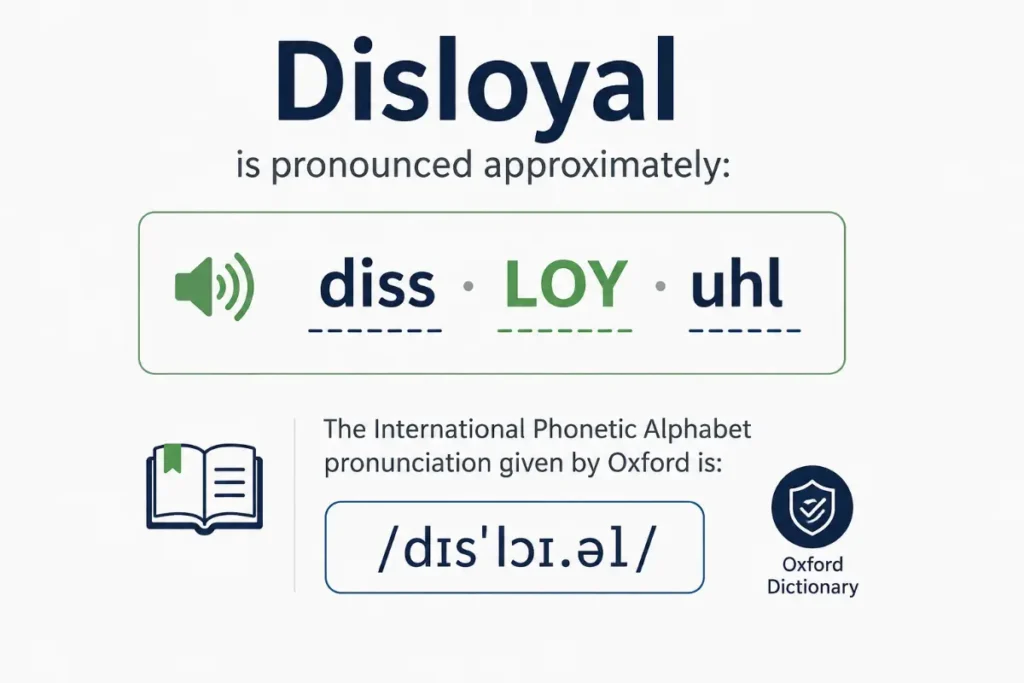
The standard adjective is pronounced dis LOY uhl. The first syllable begins with the sound used in disapprove, and the second syllable carries the main stress.
The uncommon alternative has a similar rhythm, with stress on LOY. Pronunciation alone will not usually help listeners distinguish the forms because the main difference occurs at the beginning of the word.
Formality
Disloyal works in casual conversations, academic writing, workplace messages, journalism, and fiction. It is a normal English adjective rather than slang.
Unloyal may be understood, but it can distract readers in formal writing. In a professional document, use the established form unless you are discussing the word itself or quoting someone who used it.
Context
The adjective often appears when trust, commitment, or allegiance matters. Common settings include personal relationships, teams, workplaces, political groups, military service, and fictional stories.
However, the word can carry a strong emotional judgment. Calling someone disloyal may imply that the person violated an expectation of faithfulness. Before using it, make sure the situation supports that judgment rather than merely showing disagreement or independence.
Regional Usage
There is no major regional spelling distinction between American and British English for this word. Disloyal is the standard form in both varieties, and it is also suitable in Canadian and Australian English.
The less common alternative does not have a strong, established regional role that makes it preferable in one of these varieties. If you are writing for an international audience, disloyal remains the safest choice.
Standard Versus Uncommon Usage
English word formation is flexible, but usage patterns still matter. A prefix may be grammatically possible without producing the form that most speakers naturally choose.
For instance, unkind is common, but that does not mean un can replace dis in every adjective. The correct choice often comes from established word history and repeated usage rather than a simple rule that works for all words.
Which Form Is Correct
Use disloyal in standard English. It is the established adjective for describing a lack of loyalty, faithfulness, or allegiance. It works in both everyday speech and formal writing.
The reason is not that the prefix un can never express an opposite quality. English has many adjectives beginning with un, including unhelpful, unfair, and uncertain. It also has many adjectives beginning with dis, including dishonest, disobedient, and disorganized. The preferred prefix depends on the particular word.
English spelling and word formation developed over time, so there is no universal rule that lets writers create every adjective by attaching either prefix. Some forms become common through long use, while other possible forms remain rare.
When editing your work, focus on the word that readers expect and understand without hesitation. Disloyal meets that need. The alternative is generally unnecessary because the standard adjective already communicates the intended idea.
If you are checking a dictionary, look for an entry that identifies the word’s current status and usage. Reliable dictionaries help distinguish a standard headword from a rare variant, historical form, or uncommon formation. Do not assume two forms are equally appropriate just because both appear in a search result.
Sentence Examples
The following examples show how the standard adjective works in different settings. Each sentence uses the word in a natural way.
- Everyday conversation: “I felt betrayed when my friend shared my secret, and the decision seemed disloyal.”
- Text message: “I thought we trusted each other, so that felt pretty disloyal.”
- Workplace communication: “Sharing confidential client information with a competitor would be disloyal to the company.”
- School assignment: “The character’s disloyal actions changed the course of the story.”
- Academic writing: “The study of group behavior can help explain why people view certain actions as disloyal.”
- Formal writing: “The committee considered the disclosure a disloyal act because it violated a clear agreement.”
- Social situation: “She did not see his disagreement as disloyal because he remained respectful and honest.”
- Online communication: “Criticizing a decision is not always disloyal, especially when the criticism is fair.”
- Family relationship: “He worried that moving away would seem disloyal to his family, even though they supported his plans.”
- Fiction and storytelling: “The king suspected that one of his closest advisers had become disloyal.”
These examples also show that the adjective does not automatically mean evil, unkind, or dishonest. It describes a failure of loyalty in a particular relationship or situation. The reader needs enough context to understand what commitment was broken.
Common Mistakes and Misspellings
Using Unloyal in Formal Writing
Incorrect or less preferred: “The employee’s conduct was unloyal to the organization.”
Preferred: “The employee’s conduct was disloyal to the organization.”
The less common form may communicate the idea, but the established adjective sounds more natural. In professional writing, choose the form that readers expect.
Assuming Un Always Creates the Correct Opposite
Incorrect reasoning: “Unhappy is correct, so unloyal must be equally standard.”
Better approach: Learn common words as complete forms instead of relying only on a prefix rule.
The prefix un is productive in English, but it does not combine naturally with every adjective. Familiarity with one word cannot determine the preferred spelling of another.
Confusing Disloyal With Dishonest
These adjectives overlap in some situations, but they are not interchangeable. Dishonest means not truthful or not honest. Disloyal means failing to show loyalty or remain faithful to a person, group, or commitment.
Someone might disagree with a friend honestly and remain loyal. Another person might reveal a private secret and act disloyally, even if the details they share are true.
Calling Every Disagreement Disloyal
A person can question a decision, offer criticism, or leave a group without betraying it. Loyalty does not require constant agreement or blind obedience.
Before describing behavior as disloyal, consider the expectations involved. Did the person break a promise, violate trust, or deliberately undermine a commitment? If not, another word such as disagreeable, critical, or independent may be more accurate.
Using the Adjective Without a Clear Reference
A sentence such as “That was disloyal” may leave readers wondering who was affected or what commitment was broken. Add context when the situation is not already clear.
For example, “Sharing the private message was disloyal to her friend” identifies the action and the relationship. The extra detail makes the judgment easier to understand.
Pronunciation Guide
The standard pronunciation is represented in the International Phonetic Alphabet as /dɪsˈlɔɪəl/ in a common transcription. Pronunciation can vary slightly by accent, but the word has three syllables and the main stress falls on the second one.
Syllable Breakdown
Disloyal can be divided into three spoken parts.
- Dis.
- Loy.
- Al.
Say the word as dis LOY uhl. The middle syllable should receive the strongest stress. The final part is usually short and relaxed rather than sharply emphasized.
Easy Pronunciation Tip
Start by saying dis, as in disagree. Follow it with loy, which rhymes with boy. Finish with a soft uhl sound. Put the parts together smoothly instead of pausing between each syllable.
A common mistake is to give every syllable equal stress. Another is to overpronounce the final syllable. In natural speech, the middle part stands out most clearly.
The rare form unloyal follows a similar rhythm, but its first syllable begins with un instead of dis. Because the pronunciation is close, spelling is usually the main concern when choosing between the forms in writing.
You may also want to read Bring vs Take Which Word Should You Use.
Etymology and Word Origin
The word disloyal is built from dis and loyal. The prefix dis has Latin roots and often expresses negation, reversal, or separation. Loyal entered English through French and is historically connected with words referring to faithfulness and allegiance.
Over time, English developed disloyal as a way to describe the opposite of loyalty. The form fits an established pattern in which dis combines with a base word to express the absence or rejection of a quality.
Loyal itself can refer to faithfulness toward a person, group, country, belief, or cause. The meaning may involve personal trust, public allegiance, or commitment to a shared purpose. Adding dis creates an adjective for a failure to meet that expectation.
The uncommon alternative uses un, another English prefix that often expresses negation. Its meaning is easy to guess, but its relative rarity shows why word formation alone cannot determine which version sounds most natural. Established usage favors disloyal.
Regional Usage
American English
In the United States, disloyal is the standard choice in conversation, education, journalism, business writing, and fiction. It can describe personal betrayal, political conduct, workplace behavior, or a failure to honor a commitment.
The adjective can sound emotionally strong, so American writers often choose a more specific description when the situation calls for a neutral tone. For example, “She disagreed with the manager” is less judgmental than “She was disloyal to the manager.”
British English
British English also uses disloyal as the normal form. There is no meaningful difference in spelling between British and American usage for this adjective.
British writers may use the word in discussions of personal relationships, political allegiance, military duty, or loyalty to an institution. The exact tone depends on the context, just as it does in American English.
Australian English
Australian English follows the same standard pattern. Disloyal is the natural choice for general and formal writing, and there is no established Australian spelling rule that favors the uncommon alternative.
In casual conversation, speakers may express the idea with phrases such as “not being loyal” or “letting someone down.” These expressions can sound softer or more conversational than the adjective.
Canadian English
Canadian English also uses disloyal as the standard form. Writers can use it confidently in schoolwork, workplace communication, news writing, and formal documents.
Across these English varieties, the main differences usually involve tone and context rather than spelling. The safest approach is to use disloyal and select a more specific phrase if the judgment feels too broad.
Grammar Rules and Part of Speech
Disloyal Is an Adjective
An adjective describes a noun or pronoun. Disloyal can describe a person, an action, a statement, a decision, or an attitude.
Examples include “a disloyal friend,” “a disloyal act,” and “a disloyal response.” In each phrase, the adjective tells the reader something about the noun.
The word does not change for plural nouns. You can write “a disloyal employee” or “several disloyal employees.” The adjective stays the same.
Use It Before a Noun
One common pattern places the adjective directly before the noun it describes.
Examples include:
- The disloyal adviser broke the agreement.
- The report described a disloyal action.
- They questioned the team’s disloyal behavior.
This pattern is useful because it connects the judgment to a clear person or action. If the accusation is serious, explain the behavior that supports it.
Use It After a Linking Verb
Disloyal can also follow linking verbs such as be, seem, appear, or become.
For example, “His actions were disloyal,” “The decision seemed disloyal,” and “She became disloyal to the group.” In these sentences, the adjective describes the subject rather than an object receiving an action.
Use Adverbs to Add Meaning
Adverbs can modify the adjective and show degree or intensity. Examples include deeply disloyal, openly disloyal, and clearly disloyal.
However, not every adverb works equally well in every sentence. “Deeply disloyal” emphasizes the seriousness of the judgment, while “openly disloyal” suggests that the lack of loyalty was visible or expressed openly.
Use the Correct Comparative Forms
You can compare degrees of disloyal behavior by using more and most.
- Her action was more disloyal than his earlier decision.
- The committee called it the most disloyal act in the report.
These forms are more natural than adding the endings er or est to the adjective. The same pattern works for many adjectives with several syllables.
Choose Punctuation Based on the Sentence
The adjective itself does not require special punctuation. Use commas only when the sentence structure calls for them.
For example, “His response was disloyal and hurtful” needs no comma because the adjectives work together to describe the response. In “His response, though disloyal, surprised no one,” the commas set off an interrupting phrase.
Be Careful With Strong Judgments
The word can carry moral or emotional weight. In sensitive situations, consider describing the action rather than labeling the whole person.
Instead of writing “She is disloyal,” you might write “She shared information that she had promised to keep private.” The second version gives readers a concrete fact and lets them understand the issue without relying on a broad personal judgment.
Real Life Usage Examples
Daily Conversation
In everyday speech, the adjective often appears during conversations about trust and friendship. It can express hurt or disappointment, but it may sound harsh if the facts are unclear.
- “I thought we were friends, so sharing that secret felt disloyal.”
- “You can disagree with me without being disloyal.”
The first example connects the word to broken trust. The second shows that disagreement and disloyalty are not automatically the same.
Email and Workplace Communication
At work, the word may describe conduct that violates a commitment or damages trust. Because it can sound accusatory, professional messages often benefit from specific language.
- “Sharing internal client details outside the approved team could be considered disloyal to the organization.”
- “I would prefer to address the disclosure directly rather than describe the employee as disloyal.”
These examples show two useful approaches. One identifies a potential breach of trust, while the other keeps the discussion focused on an action.
Academic Writing
Academic writing may use the adjective when examining group behavior, political allegiance, fictional characters, or social expectations. A clear definition helps prevent the word from becoming a vague label.
- “The novel presents the adviser as disloyal after he reveals the ruler’s plans.”
- “The analysis distinguishes disloyal conduct from ordinary disagreement within a group.”
In academic work, support the description with evidence. Explain the action, expectation, or relationship that justifies the term.
News and Journalism
News writing may use the word when discussing allegations of betrayal, internal disputes, or conflicts over allegiance. Journalists should be careful to distinguish a reported accusation from an established fact.
- “The party leader accused the former member of disloyal conduct.”
- “Several officials rejected the claim that criticism of the policy was disloyal.”
The first example clearly attributes the judgment to a speaker. The second separates criticism from the accusation made against it.
Literature and Storytelling
Fiction often uses loyalty as a source of conflict. A character may face a choice between personal friendship, family duty, political allegiance, and individual beliefs.
- “The captain saw the secret meeting as a disloyal act against the crew.”
- “Although the prince appeared disloyal, he was trying to protect his family.”
These examples show how context can change the reader’s judgment. A character may seem to betray one group while remaining faithful to another commitment.
Related and Confused Terms
Understanding nearby words helps you choose the most precise description. Disloyal is useful, but it is not always the best word for every failure of trust or support.
1. Loyal
Loyal is the direct opposite of disloyal. It describes someone who remains faithful, dependable, or supportive toward a person, group, cause, or commitment.
Example: “She remained loyal to her friends during a difficult period.”
2. Faithless
Faithless often suggests that someone has failed to keep a commitment or remain faithful in a personal relationship. It can sound more emotional or literary than disloyal.
Example: “The story portrays the ruler as faithless to his closest allies.”
3. Unfaithful
Unfaithful often refers to breaking a promise or failing to remain faithful in a romantic relationship. It can also describe someone who does not honor a duty or commitment.
Example: “He was unfaithful to his partner.”
The word may be more precise than disloyal when the issue specifically involves romantic fidelity.
4. Treacherous
Treacherous suggests betrayal that is especially dangerous, deceptive, or harmful. It is stronger than disloyal in many contexts and often describes actions that expose others to serious risk.
Example: “The guide’s treacherous decision put the travelers in danger.”
Do not use it for every disagreement or minor breach of trust.
5. Dishonest
Dishonest means not truthful or not honest. A dishonest person may lie, mislead someone, or conceal important facts.
Example: “The manager was dishonest about the missing funds.”
Dishonesty and disloyalty can occur together, but one does not always imply the other.
6. Betrayal
Betrayal is a noun that describes the act of breaking someone’s trust or violating an important commitment. Disloyal is an adjective that describes a person, action, or attitude.
Example: “Revealing the secret felt like a betrayal.”
The noun can sometimes describe the event more precisely than the adjective.
7. Untrustworthy
Untrustworthy describes someone or something that cannot be relied on. It focuses on dependability rather than loyalty to a specific person or cause.
Example: “The source was untrustworthy because its claims kept changing.”
A person may be untrustworthy in one area without necessarily betraying a particular relationship.
8. Disobedient
Disobedient means refusing or failing to follow an instruction, rule, or authority. It does not automatically mean a person is disloyal.
Example: “The student was disobedient when he ignored the classroom rule.”
A person can disobey an unfair instruction while remaining loyal to a broader principle or group.
Expert Editor Insight
An experienced editor will normally choose disloyal because it is the familiar, established form and communicates the intended meaning without distracting the reader. The confusion often comes from applying the common prefix un to a word that normally uses dis. Spellcheck tools may flag an uncommon form, but automated suggestions do not always explain why one option is more natural. For polished writing, use disloyal, then check that the surrounding sentence supports the judgment. If the situation involves simple disagreement rather than broken trust, a more neutral description may be more accurate.
Key Takeaways
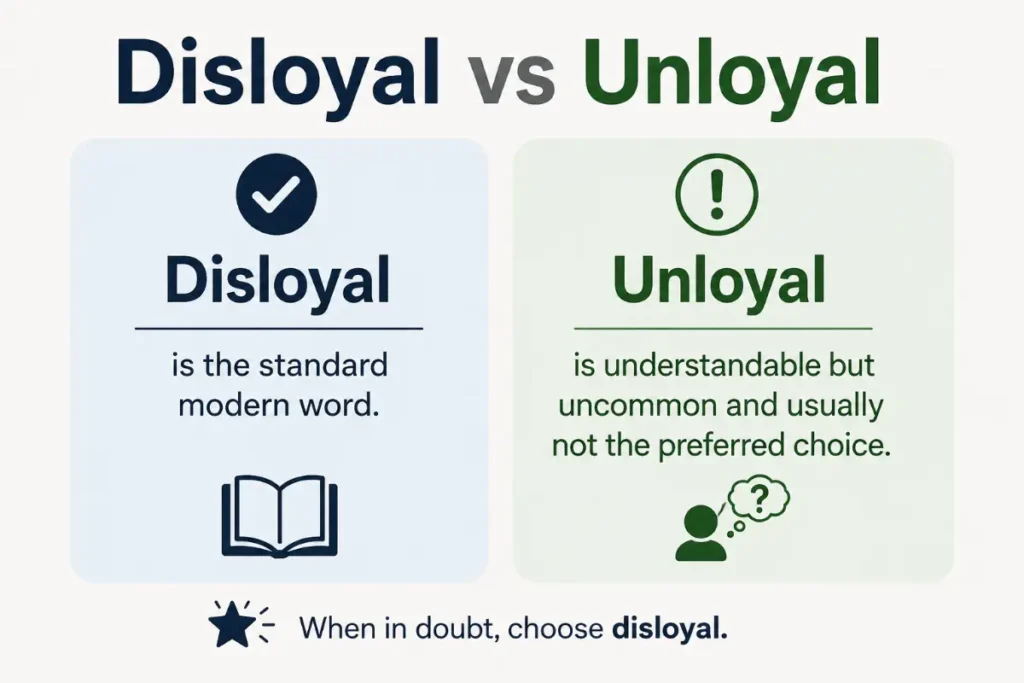
- Disloyal is the standard modern word.
- Unloyal is understandable but uncommon and usually not the preferred choice.
- Use disloyal as the normal opposite of loyal.
- The most common grammar pattern is disloyal to someone or something.
- Disloyal can describe people, actions, remarks, decisions, behavior, and statements.
- The noun form is disloyalty.
- The adverb form is disloyally.
- Disloyal does not automatically mean dishonest, evil, or untrustworthy.
- Disagreement does not automatically equal disloyalty.
- Unfaithful can be more precise when the context specifically involves romantic or marital infidelity.
- American and British English both favor disloyal.
- For professional, academic, and polished everyday writing, choose disloyal.
Still confused? Compare Perspective or Prospective Which Word Is Correct.
Conclusion
When deciding between Disloyal or Unloyal, choose disloyal for standard modern English. It is the established adjective for describing a lack of loyalty, faithfulness, or support, and it works in both casual and formal settings. The less common alternative may be understandable, but it rarely offers an advantage in ordinary writing.
Remember that English prefixes do not always follow one predictable pattern. A word can look logical without being the form most readers expect. For an easy editing habit, check the complete word rather than relying on the prefix alone. When trust or commitment has been broken, disloyal is the clear and natural choice.
FAQs
Is Unloyal a Real Word?
Unloyal is an uncommon formation that readers may understand as meaning not loyal. However, it is much less common than disloyal and is generally not the preferred form in standard modern English. If you are writing an essay, article, professional email, or formal report, use disloyal for a more natural and widely accepted result.
What Does Disloyal Mean?
Disloyal means failing to show loyalty, faithfulness, or support toward a person, group, promise, or cause. It can describe a person, an action, or an attitude. The word often suggests that someone has broken trust or acted against a commitment, although the exact meaning depends on the situation and the expectations involved.
Which Is Correct Disloyal or Unloyal?
Disloyal is the standard and preferred choice in modern English. Unloyal is understandable but uncommon, so most writers should avoid it in ordinary and formal communication. The difference mainly concerns established usage rather than a clear difference in meaning. If you want the form that readers expect, choose disloyal.
How Do You Pronounce Disloyal?
Disloyal is commonly pronounced dis LOY uhl, with the main stress on the middle syllable. Its IPA transcription is /dɪsˈlɔɪəl/. To say it naturally, begin with dis as in disagree, follow with loy as in boy, and finish with a short, relaxed uhl sound.
Can Disloyal Start a Sentence?
Yes. An adjective can appear at the beginning of a sentence when it forms part of a descriptive phrase or a complete clause. For example, “Disloyal to his friends, the character soon lost their trust.” In this sentence, the opening phrase describes the character. Make sure the phrase clearly connects to the subject that follows.
What Is a Synonym for Disloyal?
Useful alternatives include faithless, unfaithful, treacherous, and untrustworthy, but each carries a slightly different meaning. Faithless often suggests a broken commitment, while treacherous implies especially harmful betrayal. Untrustworthy focuses on a lack of dependability. Choose the synonym that matches the behavior you want to describe rather than replacing the word automatically.
Why Do People Confuse These Two Forms?
People often confuse them because English uses both dis and un to create negative meanings. Words such as unhappy and unfair make unloyal look logical, even though disloyal is the established form. English prefixes do not follow one universal rule, so learning familiar word forms is more reliable than creating alternatives based only on a general pattern.
Is Disloyal Appropriate in Formal Writing?
Yes. Disloyal is a standard adjective that works in academic writing, business communication, journalism, and formal reports. However, it can sound accusatory, especially when applied to a person’s character. In sensitive or evidence based writing, describe the specific behavior and explain why it violates a commitment. That approach makes the meaning clearer and avoids unsupported judgments.