
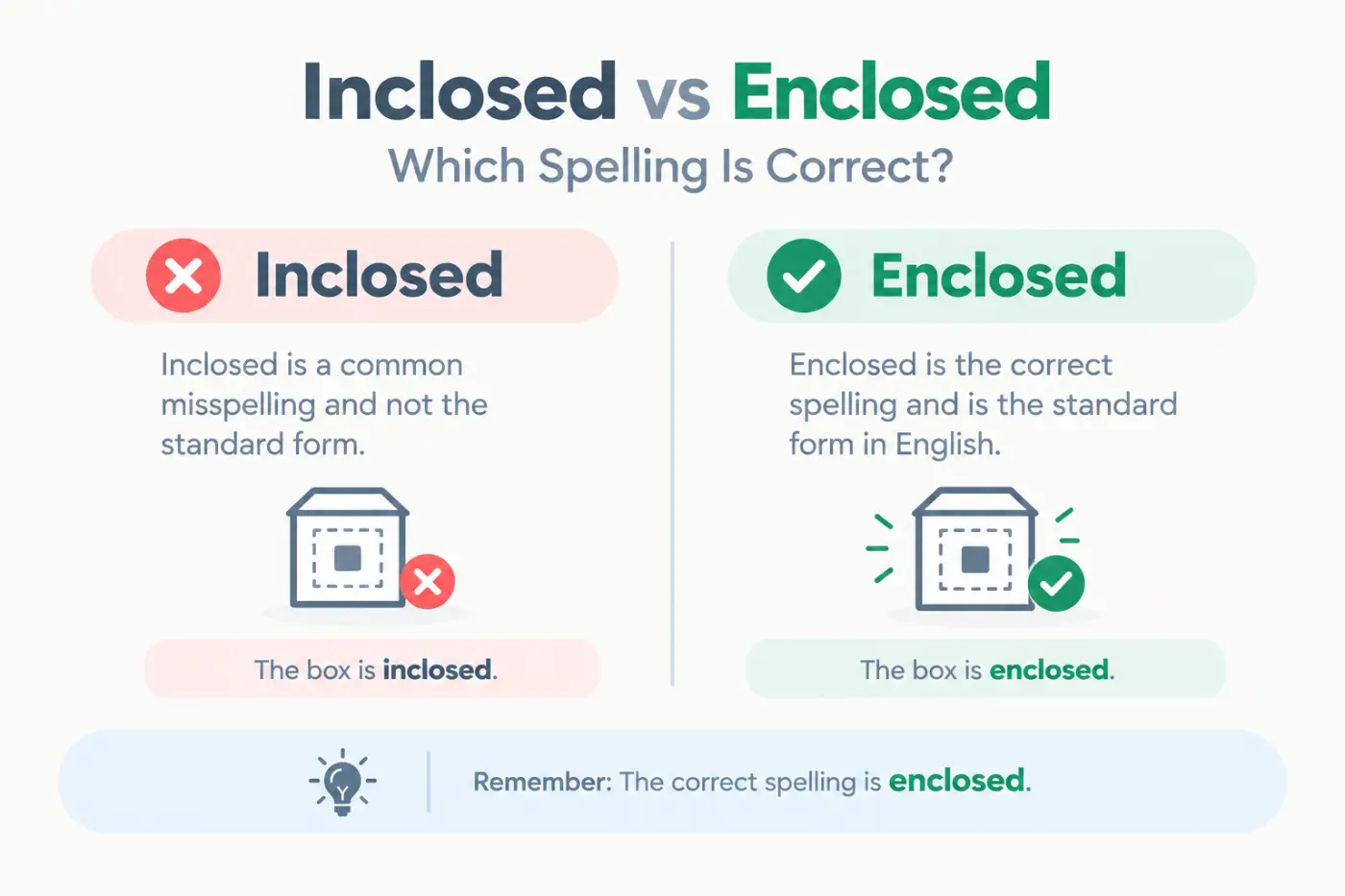
If you are unsure about inclosed vs enclosed, the correct spelling for almost all modern writing is enclosed. Both forms have appeared in English, so the confusion is understandable. However, enclosed is the standard form you should use in emails, business letters, school assignments, legal documents, and everyday communication.
The word usually means surrounded by something or placed inside an envelope, package, or container. For example, you might write, “The signed form is enclosed with this letter,” or “The garden is enclosed by a wooden fence.” In both sentences, the word shows that something is included within a boundary or placed inside something else.
The spelling inclosed appears in older writing and some historical records. You may recognize it in old letters or printed books, but it is not the usual choice in modern American English. Knowing the difference will help you avoid spelling errors and write with confidence.
You may also want to read stoped or stopped Correct Spelling And Usage.
Quick Answer.
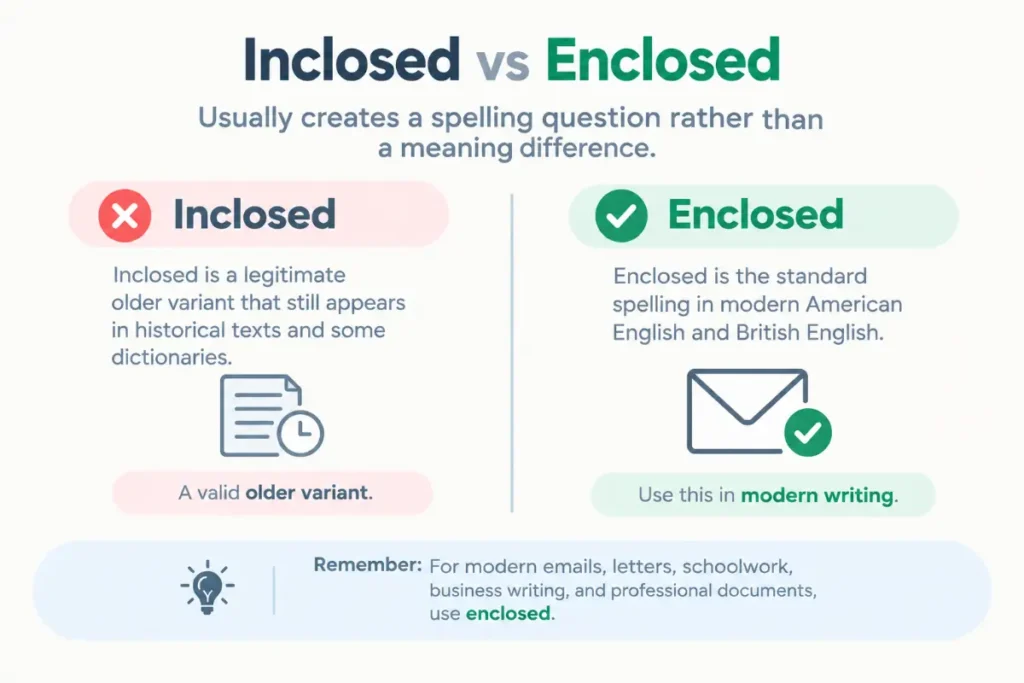
Enclosed is the correct and preferred spelling in modern English. It means surrounded by a boundary or included inside a letter, package, or other container. Inclosed is an older spelling that appears in historical texts but is uncommon in modern writing. For everyday communication, choose enclosed to keep your writing clear and standard.
Comparison Table for Both Spellings.
| Feature | Enclosed | Inclosed |
|---|---|---|
| Standard spelling | Yes | Historical variant |
| Meaning | Surrounded or included inside | Generally the same historical meaning |
| Part of speech | Verb form and adjective | Historical verb form and adjective |
| Modern usage | Common and accepted | Rare in modern writing |
| Formality | Suitable for formal and informal writing | Usually limited to historical contexts |
| American English | Standard | Unusual |
| British English | Standard | Mostly historical |
| Pronunciation | Usually pronounced the same | Usually follows the same pronunciation |
| Example | The document is enclosed. | Older texts may use the form inclosed. |
The main difference is spelling rather than meaning. The modern form is the practical choice for almost every writing situation.
Meaning and Definition.
What Does Enclosed Mean.
Enclosed means surrounded by something or placed inside a space, container, or package. It can also describe a document or item sent along with a letter.
The word serves as the past tense and past participle of the verb enclose. It can also work as an adjective that describes something surrounded by boundaries.
Consider these examples.
- The property is enclosed by a stone wall.
- I have enclosed a copy of the receipt.
- Please sign the enclosed application.
- The children played in an enclosed courtyard.
Each sentence uses the same basic idea of placing something within a boundary or including it inside something else.
The exact meaning depends on the context. A fence can enclose a garden, an envelope can contain an enclosed document, and a wall can create an enclosed room. The word can describe a physical boundary or the act of including an item with a message.
What Does Inclosed Mean.
Inclosed is an older spelling of the same word. It appeared in earlier English writing and can still be found in historical documents, old letters, and older printed material.
It generally carries the same meaning as enclosed. The difference lies in the spelling convention rather than a separate modern definition.
For example, a historical letter might use inclosed when referring to a document sent inside an envelope. A modern writer would normally use enclosed for the same purpose.
You should not treat every appearance of this older spelling as a simple typing mistake. In a historical source, the spelling may reflect the language conventions of its time. However, using it in new writing can look outdated or incorrect to modern readers.
Is Inclosed a Real Word.
Yes. Inclosed has existed as an English spelling variant, so calling it entirely invented would be inaccurate. However, it is now rare, and most contemporary readers expect enclosed.
If you are transcribing an old letter, quoting a historical document, or studying older English, preserving the original spelling may make sense. If you are writing a new email, report, article, or school assignment, use the modern standard form.
Key Differences Explained.
Spelling and Meaning.
The two forms differ by one letter. Enclosed begins with the prefix en, while inclosed begins with in. Despite that difference, the two forms have historically expressed essentially the same idea.
Modern English favors enclosed. Choosing the familiar spelling helps readers understand your message without pausing to question an unusual word.
Grammar and Part of Speech.
Both forms have been used as verb forms and adjectives. The modern spelling appears in several common grammatical patterns.
- As a past tense verb, use enclosed to describe an action that happened in the past. For example, “She enclosed the receipt in the envelope.”
- As a past participle, use enclosed with a helping verb. For example, “The receipt has been enclosed.”
- As an adjective, use enclosed to describe a noun. For example, “Please review the enclosed receipt.”
The spelling does not change to match the subject. You write “I enclosed the form,” “She enclosed the form,” and “They enclosed the form.”
Pronunciation.
In modern English, enclosed is pronounced with three syllables. The stress falls on the second syllable, and the opening sound is the short vowel sound heard in words such as end.
The historical spelling inclosed may appear in old sources, but readers should not assume that the spelling difference signals a different modern meaning or a useful pronunciation distinction. For present day communication, focus on the standard spelling and its usual pronunciation.
Formality and Context.
Enclosed works in casual messages and formal documents alike. You can use it in an email to a coworker, a letter to a customer, a school assignment, or a legal notice.
Inclosed, by contrast, may distract readers in contemporary writing because it looks unfamiliar. Unless you are preserving a historical source or discussing older spelling conventions, there is little reason to choose it.
Regional Usage.
The modern spelling is standard in American English and British English. There is no major regional distinction that requires American writers to use one form and British writers to use the other.
Some English words have different accepted spellings across countries, such as color and colour. This is not a similar case. Enclosed is the normal choice across the main varieties of English.
Which Form Is Correct.
For current writing, enclosed is the correct choice. Standard modern English uses enclose as the verb and enclosed as its past tense, past participle, and related adjective form.
The spelling follows a familiar English pattern. The prefix en often means to put something into a state or surround it with something. In enclose, that idea relates to creating a boundary around an area or placing an item inside another object.
The older form inclosed reflects historical variation in English spelling. English spelling has changed over time, and not every form found in older books remains equally common today. A word can have a documented history without being the best choice for present day writing.
Use enclosed in these situations.
- When you mention a document attached to or included with a letter.
- When you describe land surrounded by a fence or wall.
- When you refer to a room or area separated from its surroundings.
- When you write instructions, business correspondence, or formal reports.
- When you describe something contained within a package or other boundary.
For example, write “The requested documents are enclosed” rather than using the older spelling in a new business letter.
If you are quoting a historical document, keep the original wording when accuracy requires it. If you are paraphrasing the document in modern English, use the current standard spelling.
Sentence Examples.
These ten examples show how to use the preferred form naturally in different situations.
- Everyday conversation. “I enclosed the gift in a blue box so it would stay safe.”
- Text message. “I enclosed the signed form with the other papers.”
- Workplace email. “The revised proposal is enclosed for your review.”
- School assignment. “The enclosed diagram shows the main parts of a plant.”
- Academic writing. “The researchers studied insects in an enclosed environment.”
- Formal letter. “Please find the enclosed copy of your payment receipt.”
- Property description. “The house has an enclosed backyard where the children can play.”
- Online communication. “I’ve enclosed a screenshot to show the error I encountered.”
- Customer service. “Your return label is enclosed with the package.”
- Instructions. “Keep the equipment in an enclosed cabinet when it is not in use.”
Notice that the word can appear before a noun, after a linking verb, or as part of a verb phrase. Its position depends on the sentence, but the spelling stays the same.
Common Spelling Mistakes.
The historical variant can cause confusion, but several other mistakes are worth watching for. These are useful distinctions when proofreading everyday writing.
- Inclosed instead of enclosed. This is the main spelling confusion. The older form is recognizable, but modern writing normally calls for enclosed. Example: “The signed agreement is enclosed with this email.”
- Encloased instead of enclosed. This typo adds an unnecessary vowel and breaks the familiar spelling pattern. Check the word carefully when typing quickly.
- Enclosd instead of enclosed. This mistake leaves out the second e. Reading the sentence aloud may not reveal the error because the missing letter does not create a clear change in pronunciation.
- Enclose instead of enclosed. The base form is correct when the sentence needs a present tense verb or an instruction. However, it is not a substitute for the past tense. Write “I enclosed the document yesterday,” but “Please enclose the document.”
- Enclosed when attached is clearer. These words can overlap in email and business writing, but they do not always describe the same action. A digital file is usually attached to an email, while a paper document may be enclosed in a physical letter. Choose the word that matches the situation.
The best proofreading habit is to check both spelling and meaning. A spell checker may catch a typo, but it cannot always decide which word communicates your intended action most clearly.
Pronunciation Guide.
The standard pronunciation of enclosed is:
- IPA: /ɪnˈkloʊzd/.
- Syllables: en, closed.
- Easy pronunciation: in KLOHZD.
- Stress pattern: The second syllable receives the main stress.
The opening sound is a short vowel, similar to the vowel in the word sit. The middle syllable sounds like the beginning of close, and the final sound includes a voiced z sound.
Although enclosed and inclosed differ in spelling, the historical variant does not usually suggest a different pronunciation in modern reading. The difference that matters most today is the written form.
A common pronunciation mistake is to place the main stress on the first syllable. Another is to pronounce the final sound as a separate extra syllable. In ordinary speech, the word generally flows as two spoken beats, even though its standard syllable structure is often represented as two parts in simple spelling guides.
When speaking, focus on the stressed middle sound. When writing, remember that the standard form begins with en.
For another common grammar confusion, see focussed or focused Correct Spelling and Usage.
Etymology and Word Origin.
The word enclose developed from older French forms related to the idea of closing something in. Its history also connects to Latin roots associated with shutting or closing within a boundary.
Over time, English adopted the verb to describe putting something inside an area or surrounding a space with a barrier. The same basic idea remains in modern uses, from enclosing a document in an envelope to enclosing a field with a fence.
The spelling of English words has varied across different periods. Inclosed is one historical variant that appeared in earlier usage. As spelling conventions became more settled, enclosed became the established modern form.
This history explains why the older spelling can appear in books and documents without having a separate meaning. It also shows why an older form may be valid as part of a historical record but unsuitable as the normal choice in contemporary writing.
Regional Usage.
American English.
Enclosed is the standard spelling in the United States. It appears in business letters, shipping instructions, legal correspondence, property descriptions, and ordinary conversation.
For example, an American office worker might write, “The signed contract is enclosed for your records.” A homeowner might say, “The patio is enclosed by a privacy fence.”
In both cases, the word has a familiar meaning. Inclosed would look unusual in a newly written document unless the writer had a specific historical reason to use it.
British English.
British English also uses enclosed as the standard spelling. The word has the same main meanings and grammatical functions as it does in American English.
There is no general British rule that favors inclosed. A British writer preparing a modern letter or report should use enclosed, just as an American writer would.
Australian English.
Australian English follows the same standard spelling. Enclosed is used to describe a bounded space or an item included with a letter or package.
The historical form may appear in older Australian records because those documents reflect the spelling practices of their time. That does not make it the usual choice in current Australian writing.
Canadian English.
Canadian English also favors enclosed. The spelling does not follow a special Canadian convention that changes the first vowel.
Across these major English varieties, the practical advice stays the same. Use enclosed for modern writing, and preserve the older form only when the historical wording itself matters.
Grammar Rules and Part of Speech.
Understanding how the word works in a sentence makes it easier to choose the right form.
Enclosed as a Verb.
Enclosed is the simple past tense and past participle of enclose. The verb describes the action of placing something inside or surrounding something with a boundary.
Examples include “They enclosed the garden with a fence” and “I enclosed the invoice in the package.” In each case, the word describes an action that has already happened.
Enclosed as an Adjective.
The word can also describe a person, item, or place. In “Please read the enclosed instructions,” it describes the instructions included with a message or package.
In “The children played in an enclosed yard,” it describes the yard as a space surrounded by a boundary. The word does not need a helping verb to function as an adjective.
Common Grammar Patterns.
These patterns are especially useful in everyday writing.
- Enclose something in something. Example: “She enclosed the photograph in a protective sleeve.”
- Enclose something with something. Example: “The owners enclosed the garden with a wooden fence.”
- Be enclosed by something. Example: “The property is enclosed by a stone wall.”
- Be enclosed in something. Example: “The certificate was enclosed in an envelope.”
- The enclosed item. Example: “Please review the enclosed statement.”
The choice of preposition depends on the relationship you want to describe. Use in when you mean inside a container or space. Use by to identify the boundary or structure surrounding something.
Punctuation and Sentence Position.
The word itself does not require special punctuation. It can appear at the beginning, middle, or end of a sentence, depending on its grammatical role.
For example, “The enclosed file contains the latest figures” places the word before a noun. “The file is enclosed” places it after a linking verb. “I enclosed the file yesterday” uses it as a verb.
These forms are all correct. The key is to make sure the sentence structure matches the meaning you intend.
Real Life Usage Examples.
Daily Conversation.
In everyday speech, the word often describes something placed inside a container or an area surrounded by a boundary.
- “I enclosed the birthday card with your gift.”
- “We need an enclosed space so the dog cannot run into the street.”
The first example describes an included item. The second describes a protected area.
Email and Workplace Communication.
The word can help you refer to paper documents or items included with a formal message. For digital communication, attached may be more precise when you mean an electronic file.
- “The signed form is enclosed with the printed application.”
- “Please review the enclosed schedule before the meeting.”
If you send a PDF by email, a clearer sentence is often “I’ve attached the schedule to this email.” That phrasing matches the way digital files are sent.
Academic Writing.
In academic contexts, the word can describe a controlled setting or a document included in a submission.
- “The study examined plant growth in an enclosed chamber.”
- “The enclosed appendix provides additional measurements.”
These examples use the word in a precise and factual way. The surrounding sentence makes the meaning clear.
News and Journalism.
Writers may use enclosed when describing physical spaces, buildings, or restricted areas.
- “Workers moved the equipment into an enclosed storage area.”
- “The report described a courtyard enclosed by brick walls.”
Journalists should choose the word based on the facts being reported. Enclosed suggests a boundary or containment, but it does not automatically mean that a space is secure, locked, or inaccessible.
Literature and Storytelling.
In stories, the word can establish a setting or describe an object carried by a character.
- “The old house stood in an enclosed garden behind a stone wall.”
- “Inside the envelope, she found the letter he had enclosed years earlier.”
These uses help readers picture a place or understand how an object fits into the scene.
Related and Confused Terms.
Several words share part of the meaning of enclosed, but they are not always interchangeable.
- Included. Means that something forms part of a group, package, or arrangement. A document can be included in a report without being physically surrounded by anything.
- Attached. Usually describes something joined to another item. It is especially useful for digital files sent with an email.
- Contained. Means held or kept inside something. A bottle contains water, while an envelope can contain a letter.
- Surrounded. Means that something has objects or people on all sides. A garden surrounded by trees is not necessarily enclosed by a fence.
- Bounded. Describes an area with clear limits or edges. A bounded region may have a defined shape without having a physical wall.
- Confined. Suggests that movement or space is restricted. It can carry a negative meaning that enclosed does not always have.
- Sealed. Means closed tightly or made difficult to enter or escape. An enclosed package is not necessarily sealed.
- Enclosure. This noun refers to an enclosed space or a separate item included with a letter or message. For example, a business letter may list an enclosure at the end.
These distinctions matter because choosing a near synonym can change the message. A fenced garden may be enclosed, a document may be attached, and a person may be confined to a small room. Each word expresses a slightly different relationship.
Expert Editor Insight.
An experienced editor would normally change inclosed to enclosed in new writing unless the older spelling is part of a quotation or historical record. The confusion exists because both forms have appeared in English, and their meanings are largely the same. A spelling tool may flag the older form as unusual or suggest the modern spelling, but software cannot always recognize historical context. The safest editing habit is to check the intended meaning, the date of the source, and the needs of the reader before making a change.
Key Takeaways
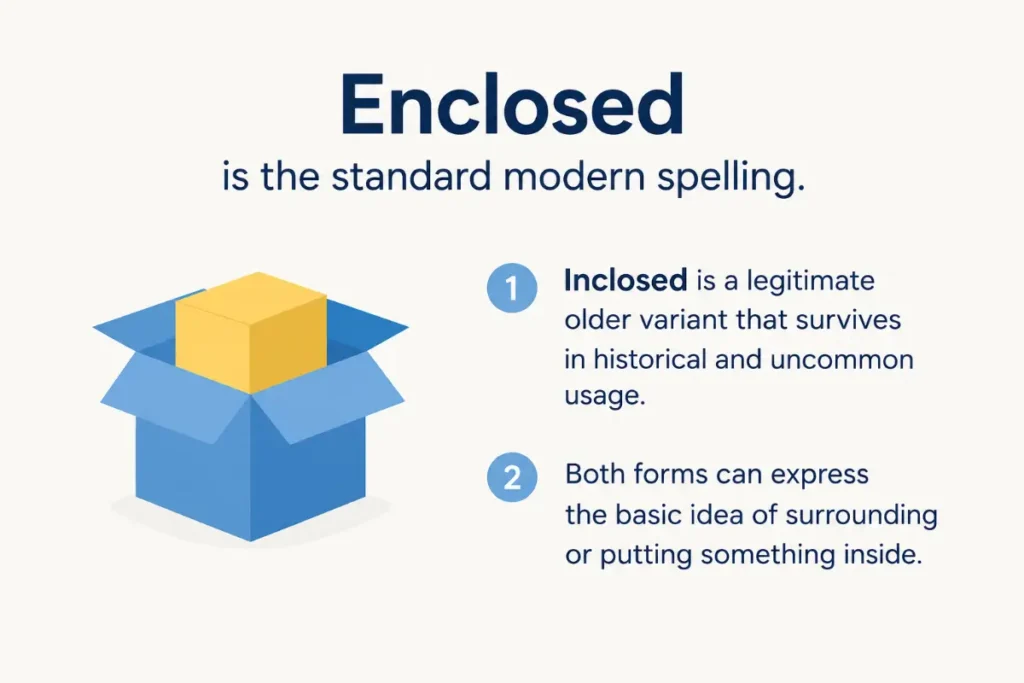
- Enclosed is the standard modern spelling.
- Inclosed is a legitimate older variant that survives in historical and uncommon usage.
- Both forms can express the basic idea of surrounding or putting something inside.
- Modern American English strongly favors enclosed.
- Modern British English also favors enclosed.
- Use enclosed for physical letters, packages, documents, spaces, and boundaries.
- Use attached for digital files sent by email in most professional situations.
- Use inclosed only when the historical or stylistic context makes the older spelling relevant.
- The word family includes enclose, enclosed, enclosing, and enclosure.
- Seeing inclosed in an old document does not automatically mean the original writer made a spelling mistake.
Learn the difference in Kinesthesiology vs Kinesiology Simple Rules Explained 2026.
Conclusion.
The difference between inclosed vs enclosed comes down to modern spelling standards rather than meaning. Enclosed is the accepted spelling for everyday American English and works in professional letters, academic assignments, emails, and general communication. Inclosed is an older variant that belongs mainly in historical contexts or faithful reproductions of original documents.
To remember the correct form, think of the word enclose and add d to form enclosed. This simple pattern will help you avoid the common spelling mistake. When editing your work, choose the modern spelling unless you have a clear reason to preserve an older form. Your writing will stay accurate, natural, and easy to understand.
FAQs.
Is Inclosed a Real Word?
Yes. Inclosed is a historical spelling variant of enclosed. It has appeared in older English texts and generally carries the same meaning. However, it is rare in modern writing and is not the preferred form for everyday communication. Use enclosed in new letters, reports, schoolwork, and business documents unless you need to preserve the original spelling of a historical source.
What Does Enclosed Mean?
Enclosed means surrounded by a boundary or placed inside something. It can describe a space surrounded by a fence or wall, a document included in an envelope, or an item placed inside a package. The word can function as a verb form or an adjective. Its precise meaning depends on the sentence and the relationship it describes.
Which Is Correct Inclosed or Enclosed?
Enclosed is the standard modern spelling. Inclosed is an older variant that readers may encounter in historical material. The two forms generally share the same meaning, but they do not have the same status in current writing. For American English and other major English varieties, enclosed is the appropriate choice in almost every ordinary situation.
How Do You Pronounce Enclosed?
Enclosed is commonly pronounced /ɪnˈkloʊzd/ in American English. It has two syllables in the usual pronunciation guide, with stress on the second syllable. The opening vowel sounds like the vowel in sit, while the second syllable rhymes with closed. The older spelling does not normally require a separate pronunciation in modern reading.
Can Enclosed Start a Sentence?
Yes. Enclosed can begin a sentence when it describes a noun or forms part of a sentence structure. For example, “Enclosed is a copy of the signed agreement” is a formal way to tell someone that a document accompanies a letter. You can also write “Enclosed in the package was a small instruction booklet.” Both examples use standard grammar.
What Is a Synonym for Enclosed?
The best synonym depends on the meaning. Included works for an item that forms part of a group or package. Surrounded describes objects on all sides, while contained focuses on something held inside another object. Attached often works for files sent with an email. These words overlap with enclosed, but each has a slightly different meaning, so choose the one that fits the situation.
Why Do People Confuse the Two Spellings?
People confuse the forms because both have existed in English and the difference is only one letter. Older books and historical documents can also expose readers to the less familiar version. Since the two spellings generally sound alike, pronunciation does not help much when choosing between them. Remembering the standard modern form is the simplest way to avoid the mistake.
Is Enclosed Appropriate for Formal Writing?
Yes. Enclosed is suitable for professional letters, legal correspondence, academic documents, and business communication. You can write “The requested records are enclosed for your review” in a formal letter. In email, attached may be clearer when referring to a digital file. Choose the word that accurately describes how the document reaches the reader, rather than relying on formality alone.