
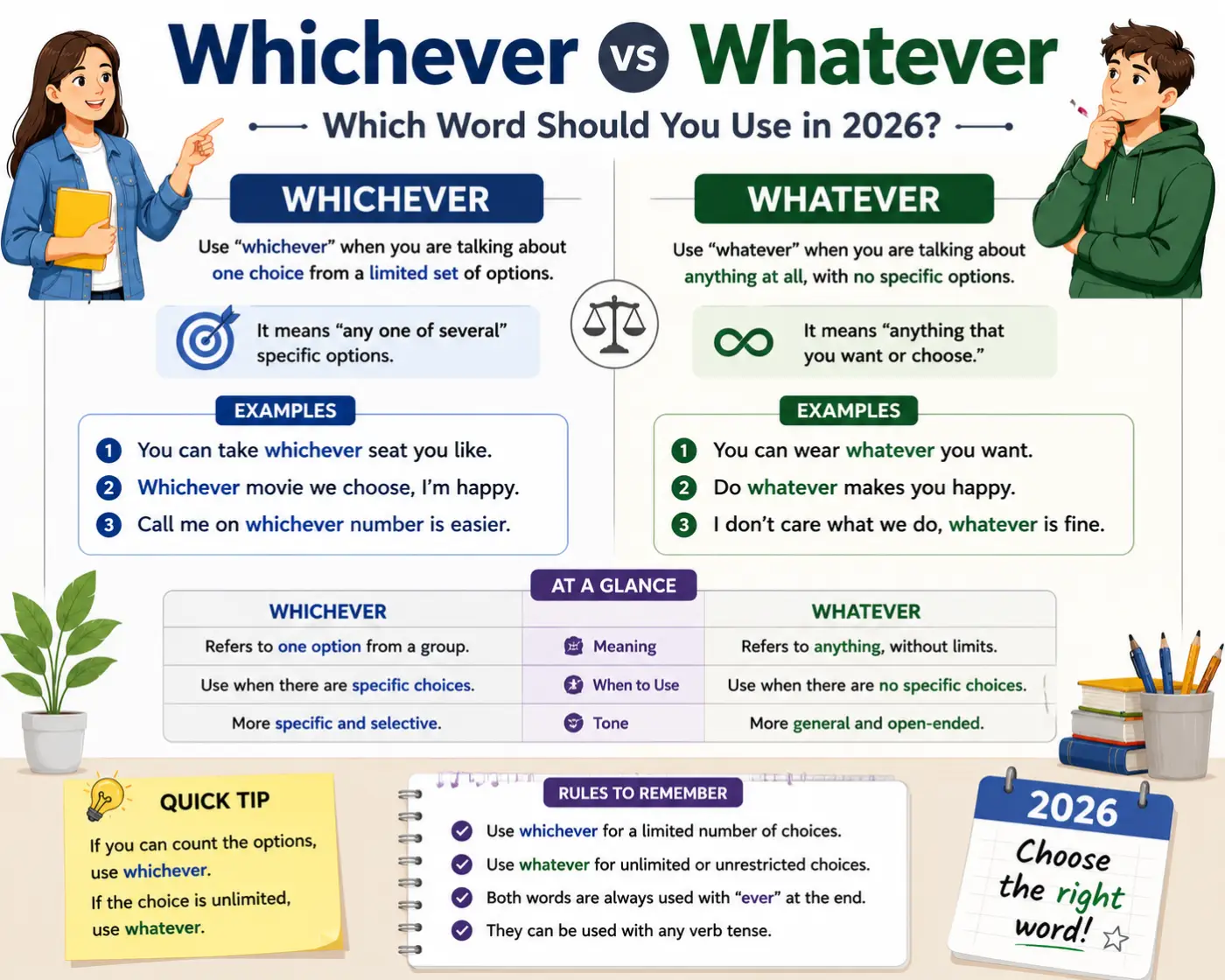
Choosing between whichever vs whatever can feel tricky because the two words sometimes appear in similar sentences. Both can refer to a choice, and both can introduce a clause. However, they don’t always mean the same thing. The right choice depends on what you want to express.
Use whichever when you mean any one option from a known or limited group. Use whatever when you mean anything that fits, anything that happens, or any thing that meets a particular condition. For example, you might say, Choose whichever shirt you like from these three. You might also say, Wear whatever makes you comfortable.
The difference becomes easier to understand once you look at the choices involved and the role each word plays in a sentence. You don’t need to memorize a long list of grammar rules. Instead, learn a simple distinction, recognize common sentence patterns, and practice with natural examples.
This guide explains the meaning, pronunciation, grammar, and everyday use of both words. You’ll also learn how to avoid common mistakes and choose the right expression in professional and academic writing.
Many readers also check Natzi or Nazi Meaning, Usage, and Correct Form 2026.
Quick Answer
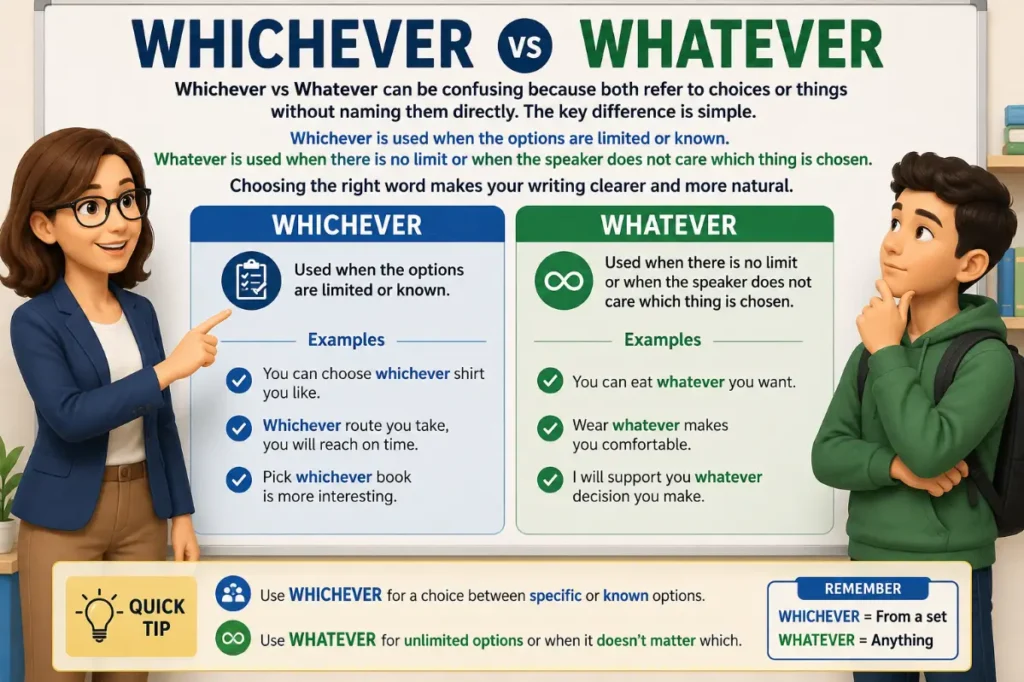
Whichever means any one of a particular group of options. Whatever means anything that fits a condition or any thing at all within the situation being discussed. Both are correct English words, but they serve different purposes. Use whichever when the available options matter. Use whatever when the range of possible things or outcomes matters more.
Meaning and Definition
What Does Whichever Mean?
Whichever refers to one choice from a group of available options. The options may be named directly, understood from the conversation, or limited by the situation.
For example, imagine that a friend offers you three desserts. You could say, Take whichever dessert you want. Your friend can choose any one of the desserts on offer, but the choice stays within that group.
The word can function as a determiner before a noun or as a pronoun that stands in for a noun. Consider these examples.
- Choose whichever route is shorter.
- Whichever you prefer is fine with me.
- You can take whichever seat is available.
In the first and third examples, the word appears before a noun. In the second, it works on its own because the reader already understands that the speaker means one of the available options.
The main idea is selection. The speaker gives someone freedom to choose, but the choice relates to a particular set of possibilities.
What Does Whatever Mean?
Whatever has a broader range of meanings. It can mean any thing that meets a condition, anything at all within a situation, or no matter what happens.
For example, Wear whatever feels comfortable allows a person to choose clothing without naming a fixed set of options. The speaker cares about comfort rather than a specific list of clothes.
Here are three common patterns.
- Take whatever you need.
- Whatever happens, stay calm.
- You can choose whatever color you like.
The first example gives someone freedom to take the things they need. The second expresses a condition that won’t change the speaker’s advice. The third permits a choice across a range of colors without identifying a fixed group.
The word can also express indifference or dismissiveness in conversation. If someone says, Whatever, they may mean that they don’t care or don’t want to continue the discussion. The tone and context determine how the expression sounds.
Key Differences Explained
The simplest way to tell these words apart is to ask what kind of freedom the sentence describes. Does the speaker mean one option from a particular group, or does the speaker mean anything that fits the situation?
Whichever Focuses on Available Options
Use this word when the options form a recognizable group. You don’t always need to list every option, but the context should make the choices clear.
For example, a manager might say, Select whichever proposal meets the budget. The team has several proposals and must choose one that satisfies the stated requirement.
The word can also express a choice among alternatives without sounding formal. A friend might ask, Which movie should we watch? You could reply, Whichever one you want.
Whatever Focuses on Things or Possibilities
Use this word when you want to leave the possibilities open or refer to anything that meets a condition.
For example, Bring whatever supplies you need. This sentence doesn’t restrict the supplies to a named list. The person can bring the items required for the task.
It also appears in expressions about events and circumstances. Whatever happens next, we’ll handle it together. Here, the speaker refers to any possible event that may occur.
Grammar and Sentence Structure
Both words can introduce clauses and work as determiners or pronouns. Their grammatical roles often overlap, so meaning provides the clearest guide.
Compare these sentences.
- Choose whichever book you want from this shelf.
- Read whatever book helps you understand the topic.
The first sentence points to books on a particular shelf. The second allows a broader choice based on the reader’s needs.
The distinction isn’t always absolute. A sentence can use either word when the intended meanings overlap. In those cases, choose the word that expresses your intended limit most clearly.
Formality and Tone
Both words are standard in American English and work in formal and informal settings. Neither word is automatically more professional than the other.
Whichever can sound more precise because it points toward alternatives. Whatever can sound more open ended because it allows a wider range of possibilities. However, the surrounding sentence matters more than the word alone.
In a workplace email, you might write, Please select whichever date works best for the team. In a broader instruction, you might write, Please include whatever information the reviewers need.
The first sentence concerns available dates. The second concerns any relevant information.
Comparison Table
| Feature | Whichever | Whatever |
|---|---|---|
| Main meaning | Any one from a group | Any thing that fits or applies |
| Main purpose | Selecting among alternatives | Allowing a broad choice or covering possibilities |
| Part of speech | Determiner or pronoun | Determiner or pronoun |
| Typical context | Known or limited options | Open choices or general conditions |
| Formality | Standard in formal and informal English | Standard in formal and informal English |
| Example | Pick whichever chair is free. | Bring whatever you need. |
Which Form Is Correct?
Both forms are correct. The choice depends on the meaning you want to convey, not on spelling or grammar alone.
Use whichever when the sentence points to one option among alternatives. Use whatever when it refers to any thing that fits a condition, any possible event, or an unrestricted choice within the situation.
Consider this practical example.
Your coworker asks you to choose a meeting room from three available rooms. You could say, Use whichever room has the best equipment. The sentence directs your coworker to select from those rooms.
Now imagine your coworker asks what equipment to bring to a presentation. You could say, Bring whatever equipment you need. The sentence leaves the choice of equipment open.
The grammar behind both expressions follows standard English usage. Major learner dictionaries such as Cambridge and Oxford explain these words through their meanings and grammatical functions. Their definitions support the central distinction between selecting from alternatives and referring to things or possibilities more broadly.
One useful point is that the group doesn’t always need to appear in the same sentence. The previous conversation can establish the available choices. If someone has already shown you three dresses, saying whichever looks best makes sense because the listener knows which dresses you mean.
Sentence Examples
These examples show how the two words work in natural situations.
Examples With Whichever
- You can take whichever seat is closest to the window.
- Choose whichever phone plan gives you the features you need.
- I’ll support whichever candidate the committee selects.
- Please submit whichever version contains the final edits.
- We can meet on whichever day works best for everyone.
- Pick whichever flavor you want for your birthday cake.
- The teacher will accept whichever topic meets the assignment requirements.
- You may use whichever method produces the most accurate results.
- I’ll review whichever document you send first.
- Select whichever option fits your budget and schedule.
Notice how each example refers to a choice among alternatives. Some sentences identify the options directly, while others rely on context to make the group clear.
Examples With Whatever
- Bring whatever snacks you want for the road trip.
- Wear whatever makes you feel comfortable.
- I’ll help you with whatever problem comes up.
- You can write about whatever subject interests you.
- Save whatever money you can each month.
- Whatever happens during the interview, stay calm and answer honestly.
- Please include whatever details the customer needs to understand the process.
- She decided to follow whatever advice her doctor provided.
- Whatever the final score, the team played with determination.
- You can ask me whatever questions come to mind.
These sentences allow a broad choice, refer to an open set of things, or cover possible events. The word doesn’t always mean unlimited freedom. A sentence can still impose a condition, such as choosing only items that fit a budget.
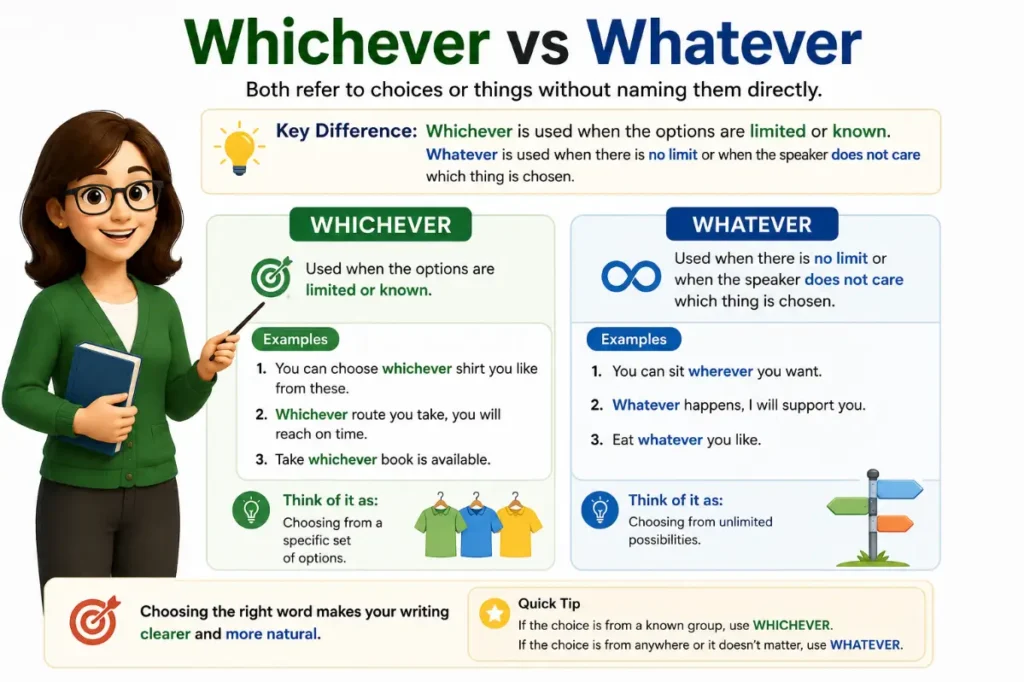
Common Mistakes and Confused Expressions
The biggest mistakes come from overlooking the difference between a limited group and a broader set of possibilities. Other errors involve punctuation, sentence structure, and tone.
Mistake One Using Whichever for an Open Ended Choice
Incorrect for the intended meaning. Take whichever you need.
Correct for an unrestricted choice. Take whatever you need.
The first version can work if the available items are understood as a particular group. The second is more natural when the speaker means any items the person needs without emphasizing a fixed set.
Mistake Two Using Whatever for a Specific Selection
Less precise in context. Choose whatever of these three rooms is largest.
Clearer. Choose whichever of these three rooms is largest.
The word whichever highlights the selection of one room from the three available choices. The broader word may still appear in casual speech, but the first version communicates the limited choice more directly.
Mistake Three Writing Whichever One When It Is Unnecessary
The phrase whichever one is grammatically acceptable. However, it can sound repetitive when the noun is already clear.
For example, Choose whichever one you prefer is natural in conversation. In tighter writing, Choose whichever you prefer often communicates the same idea more cleanly.
Use one when it adds clarity or emphasis. Remove it when it contributes nothing.
Mistake Four Confusing Whatever With Whenever
These words refer to different ideas. Whatever concerns things or possibilities, while whenever refers to time.
For example, Call me whenever you arrive refers to the time of arrival. Call me whatever you need is not a natural replacement because it doesn’t express a time.
Choose the word that matches the meaning of the sentence.
Mistake Five Treating Whatever as Always Polite
Whatever can sound dismissive when someone uses it as a standalone reply.
For example, if a friend asks for your opinion and you answer Whatever, they may think you’re annoyed or uninterested. In a sentence such as Take whatever you need, the word usually sounds neutral and helpful.
The grammatical form stays the same, but the conversational meaning changes with tone and context.
Pronunciation Guide
Both words are easy to pronounce once you recognize their syllables and stress patterns.
How to Pronounce Whichever
The IPA pronunciation is /wɪtʃˈɛvər/ in a common American English form.
- Syllables. Whichever has three syllables.
- Easy guide. wich EV er.
- Stress. Put the strongest emphasis on the second syllable.
- Common mistake. Avoid stressing the first syllable so strongly that the middle syllable becomes unclear.
In natural American speech, the final vowel may sound weaker than it does in careful dictionary pronunciation. Regional accents can also affect the sound of the final syllable.
How to Pronounce Whatever
A common American English pronunciation is /wətˈɛvər/.
- Syllables. Whatever has three syllables.
- Easy guide. wut EV er.
- Stress. Emphasize the second syllable.
- Common mistake. Avoid giving every syllable equal weight in ordinary speech.
The first vowel often becomes a relaxed sound in everyday conversation. Speakers may pronounce the opening syllable quickly, especially when they use the word in a familiar phrase.
Is There a Difference in Pronunciation?
Yes. The opening sounds distinguish the two words, although both share a similar ending and stress pattern. Listen for the short sound in the opening of whichever and the relaxed opening sound commonly heard in whatever.
Pronunciation can vary by accent. For clear speech, focus on the initial sound and the strong middle syllable rather than trying to imitate every small difference in casual conversation.
You may also want to read Plural of quiz Is It Quizzes or Quizzez.
Etymology and Word Origin
Both words developed from older English forms that combine a relative or interrogative element with ever. Their modern meanings reflect the idea of allowing a choice or covering a broad range of possibilities.
The Origin of Whichever
Whichever combines which with ever. Which has a long history in English as a word used to identify a person or thing from a set of alternatives. Adding ever extends the idea toward any member of that set.
That historical structure matches the word’s modern function. It allows a speaker to refer to any one of the available choices without naming the exact choice in advance.
The Origin of Whatever
Whatever combines what with ever. What commonly asks about or refers to things and information. The added element broadens the reference, allowing the word to cover any relevant thing or possibility.
Its modern uses include open choices, general conditions, and expressions of indifference. The exact meaning depends on the sentence and the speaker’s tone.
The shared element helps explain why the two words can seem similar. Their first elements carry much of the distinction. Which points toward alternatives, while what points more broadly toward things or information.
Regional Usage
Neither word has a major spelling difference across the main varieties of English. American, British, Canadian, and Australian speakers use both forms, although pronunciation and conversational tone can vary.
American English
Both words are standard in the United States. Whichever commonly appears in instructions involving choices, such as choosing a date, seat, plan, or method. Whatever appears in broad instructions, conditional statements, and casual conversation.
In American speech, whatever can also signal annoyance or indifference when used alone. That informal use is common, but it may sound rude in professional conversations.
British English
British English follows the same basic distinction. Speakers use whichever to select among alternatives and whatever to refer to things or possibilities more broadly.
Differences in pronunciation can occur across British accents, but the underlying grammar remains the same. Writers in the United Kingdom do not need a different spelling for either word.
Australian English
Australian English also uses both forms according to the same general rules. Everyday speech may use whatever as a casual response, but the word can still carry a dismissive tone depending on the conversation.
Whichever remains useful in practical choices and instructions. There is no special Australian spelling rule that changes the distinction.
Canadian English
Canadian English follows the same standard usage as American and British English. Both words appear in ordinary speech, workplace communication, and formal writing.
The intended meaning and sentence structure matter more than regional differences. If the available options form a defined group, whichever usually gives the clearest meaning.
Grammar Rules and Part of Speech
Both words can serve as determiners or pronouns. They can also introduce clauses that function as part of a larger sentence. Understanding these roles helps you use them correctly without relying on guesswork.
Using the Words as Determiners
A determiner appears before a noun and helps identify or describe it.
For example, Whichever route you choose will take about an hour uses whichever before route. Whatever book you select must be returned tomorrow uses whatever before book.
The first example points toward a choice among routes. The second permits a choice of book, subject to the return requirement.
Using the Words as Pronouns
A pronoun can stand in for a noun or noun phrase. Both words can work this way when the intended meaning is clear from context.
- Whichever wins will represent our school.
- Whatever you decide is fine with me.
- Choose whichever seems most practical.
- Take whatever is left in the kitchen.
In each sentence, the word introduces a choice or reference without requiring a noun immediately afterward.
Using the Words to Introduce Clauses
Both words can introduce clauses that act as subjects or objects within a sentence.
Consider this example. Whichever team finishes first will receive the award.
The clause beginning with whichever identifies the team that satisfies the condition. Now consider this sentence. Whatever you choose must meet the safety requirements.
The clause beginning with whatever identifies the choice, while the main clause sets a requirement.
These clauses can appear at the beginning or later in a sentence. Their position depends on the sentence structure and the emphasis you want.
Punctuation Rules
Neither word requires special punctuation simply because it appears in a sentence. Use commas according to the structure of the sentence and the role of the clause.
For example, Whatever happens, we’ll keep moving forward uses a comma after the introductory clause. The pause separates the condition from the main statement.
However, Choose whichever option works best doesn’t need a comma between whichever and option. The two words form part of the same noun phrase.
Using Whatever in Conditional Statements
Whatever often introduces a phrase that means no matter what or regardless of what happens.
For example, Whatever the outcome, we will learn from the experience.
The sentence says that the speaker’s response will remain the same across possible outcomes. This use is common in both everyday speech and formal writing.
Whichever can express a similar idea when the possibilities are clearly defined. For example, Whichever team wins, we will congratulate the players. The speaker refers to one winner from a known group of competing teams.
Real Life Usage Examples
The best way to understand these words is to see how people use them in different settings. The following examples show how context guides the choice.
Daily Conversation
- You can sit in whichever chair you like.
- Eat whatever you want from the buffet.
The first sentence points to available chairs. The second allows a broader choice of food, although the buffet itself still limits what’s available.
Email and Workplace Communication
- Please schedule the call for whichever time works for the client.
- Send me whatever documents the review team requires.
The first sentence concerns selecting a time from possible options. The second concerns gathering the documents needed for a task.
Both forms work well in professional communication. Choose the one that communicates the scope of the choice accurately.
Academic Writing
- Researchers may select whichever method best suits their study design.
- Whatever evidence supports the claim should be evaluated carefully.
The first sentence refers to choosing among methods. The second makes a broader statement about the evidence relevant to a claim.
In academic writing, clarity matters more than making one word sound more formal than the other. Both expressions are appropriate when used accurately.
News and Journalism
- The committee will approve whichever proposal meets the stated requirements.
- Whatever happens during the negotiations could affect the final agreement.
The first sentence describes a selection process. The second refers to possible developments and their consequences.
Writers should avoid vague references when readers need specific information. If the choices or conditions matter to the story, name them clearly whenever practical.
Literature and Storytelling
- She promised to follow whichever path led her brother home.
- Whatever awaited them beyond the mountains, they would face it together.
The first sentence narrows the choice to a path that meets a condition. The second creates suspense by leaving future events open.
Writers can use these words to shape a reader’s expectations. One focuses attention on a selection, while the other can widen the sense of possibility.
Related and Confused Terms
Several English words express ideas close to these two forms. Learning the distinctions can help you choose a more precise word.
Which
Which asks about or identifies a choice from a set of alternatives.
Example. Which color do you prefer?
Use which to ask a direct question about options. Use whichever to express permission or selection among those options, as in Choose whichever color you prefer.
What
What asks about or identifies a thing, action, or piece of information.
Example. What do you need?
Whatever extends this idea toward any relevant thing or possibility. Take whatever you need gives the listener freedom to select suitable items.
Whoever
Whoever refers to any person who meets a condition or carries out an action.
Example. Whoever arrives first can choose a seat.
This word concerns people rather than things or choices as such. It often appears in sentences about rules, conditions, and open possibilities.
Whomever
Whomever is the object form traditionally associated with whoever. It appears when the person referred to functions as the object of a verb or preposition.
Example. Give the invitation to whomever you choose.
In everyday American English, many speakers use whoever in situations where traditional formal grammar calls for whomever. In careful writing, check the role the word plays in the clause.
Whenever
Whenever refers to any time something happens or to every time a condition occurs.
Example. Call me whenever you need help.
This word concerns time rather than things. It can resemble the other expressions in sentence structure, but its meaning is different.
Wherever
Wherever refers to any place that fits the situation or to all places where something happens.
Example. You can sit wherever you feel comfortable.
It concerns location. The word whatever concerns things or possibilities, while whichever often emphasizes selection from alternatives.
However
However can mean in whatever way or can introduce a contrast between ideas.
Example. Arrange the furniture however you like.
Another use appears in a sentence such as The plan is expensive. However, it may save time.
The first example allows freedom in the method. The second introduces a contrast. Context determines which meaning applies.
Either
Either commonly identifies one of two options or allows a choice between two alternatives.
Example. You can take either road.
Use either when the context involves two choices. Whichever can cover a selection from a larger group and often sounds more natural when the number of options is not limited to two.
Expert Editor Insight
An experienced editor looks first at the meaning of the sentence rather than treating one word as a universal replacement for the other. If the writer refers to a defined group of options, whichever often makes the choice clearer. If the writer means any relevant thing or possible event, whatever usually fits better. Grammar checkers may accept both words because both are standard English, so an automated tool may not catch a mismatch in meaning. Read the sentence in context and ask what the speaker intends to include. That simple check often solves the problem faster than memorizing another rule.
Key Takeaways
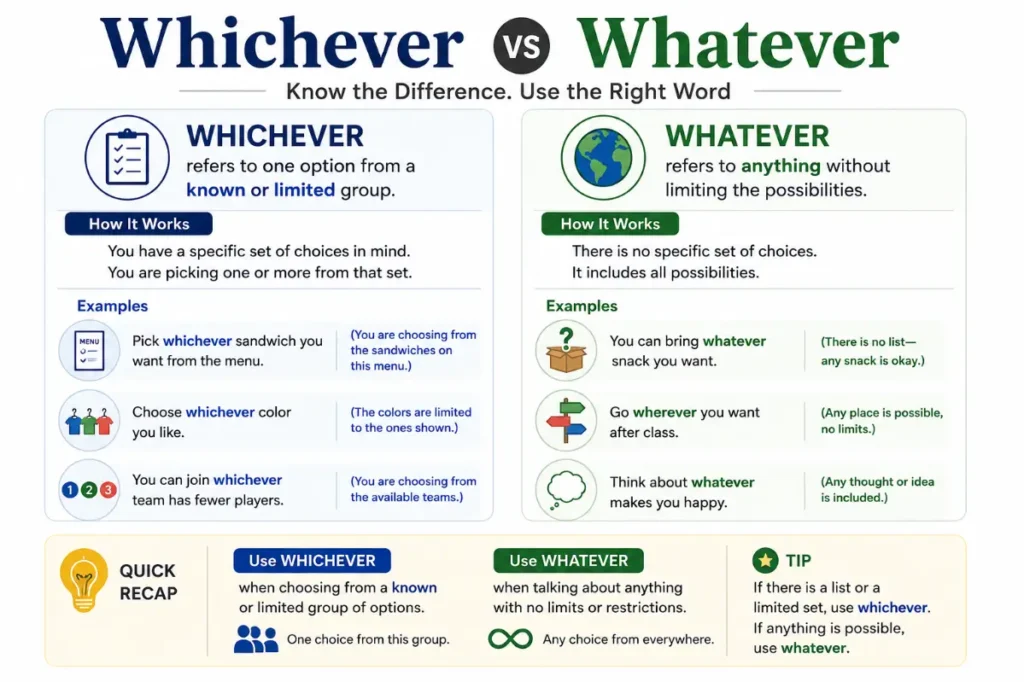
- Whichever refers to one option from a known or limited group.
- Whatever refers to anything without limiting the possibilities.
- Ask yourself if the available choices are limited.
- Use whichever for specific selections.
- Use whatever for unlimited possibilities or when the exact choice is unimportant.
- Both words are correct when used in the proper context.
- Native speakers sometimes blur the distinction in conversation, but precise writing follows the grammar rule.
- Mastering this difference improves both spoken and written English.
You may also want to read grisly vs grizzly: Correct Spelling, Meaning and Usage.
Conclusion
The difference between whichever vs whatever comes down to the kind of choice or possibility you want to express. Whichever usually identifies one option from a particular group, while whatever refers more broadly to things, conditions, or possible events. Both words are correct, and neither is limited to a particular variety of English or level of formality.
To remember the distinction, think of whichever as choosing from available options and whatever as allowing anything that fits. Before you finish a sentence, check the meaning you intend and choose the word that communicates it clearly. That small editing habit can make your writing more precise and natural.
FAQs
Is whichever a real word?
Yes. Whichever is a standard English word used to identify one option from a group. It can function as a determiner before a noun or as a pronoun on its own. For example, Choose whichever route is shorter refers to selecting a route from available alternatives. The word is correct in both casual conversation and formal writing.
What does whatever mean?
Whatever can mean any thing that fits a condition or any thing within a particular situation. It can also introduce statements about possible events, as in Whatever happens, stay calm. In casual conversation, it can express indifference or annoyance when used alone. The intended meaning depends on the sentence, the speaker’s tone, and the surrounding conversation.
Which word should I use for a choice?
Use whichever when you want someone to select one option from a group. Use whatever when you want to allow a broader choice or refer to anything that meets a condition. For example, Choose whichever shirt you like from these five points to a defined group. Wear whatever feels comfortable leaves the choice more open.
Can whichever and whatever be used in the same sentence?
Yes. Both words can appear in one sentence when they serve different purposes. For example, Choose whichever route you prefer and bring whatever supplies you need. The first word identifies a route from the available options. The second refers to any supplies needed for the trip. Each word contributes a different meaning.
How do you pronounce whichever and whatever?
Both words usually have three syllables in American English, with the strongest stress on the middle syllable. Whichever is commonly pronounced /wɪtʃˈɛvər/, while whatever is commonly pronounced /wətˈɛvər/. The opening sounds distinguish them. In natural conversation, the first syllable of whatever often sounds relaxed and unstressed.
Can whichever start a sentence?
Yes. Whichever can begin a sentence when it introduces a clause that identifies a choice. For example, Whichever team wins will advance to the final. The opening clause identifies the team that meets the condition, and the rest of the sentence explains what happens next. This structure is grammatically correct in both formal and informal English.
What are some synonyms for whichever and whatever?
The best alternative depends on the intended meaning. For whichever, phrases such as any one of the available options can work. For whatever, alternatives include anything that, no matter what, or any item that fits. These expressions aren’t interchangeable in every sentence, so check the original meaning before replacing one word with another.
Are these words appropriate in formal writing?
Yes. Both words are standard and appropriate in academic, professional, and formal writing. Whichever often works well when discussing choices among alternatives, while whatever can describe broad conditions or relevant things. However, using whatever as a standalone response may sound dismissive in a professional conversation. In formal writing, focus on precise meaning and clear sentence structure.