
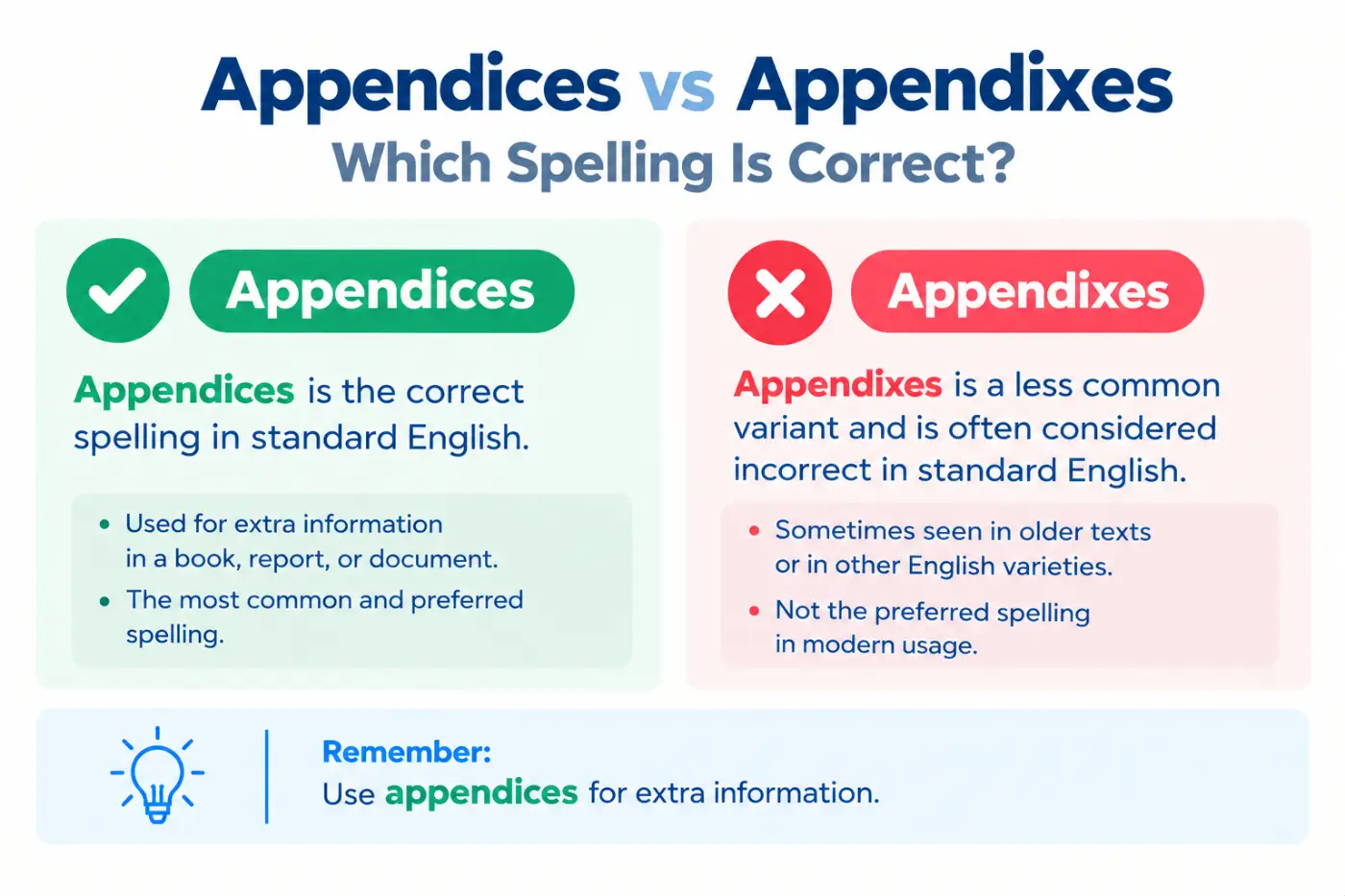
If you have ever finished a report or school paper and wondered how to label its extra pages, you are not alone. The question of appendices vs appendixes can be confusing because English sometimes gives one word two accepted plural forms. The good news is that both spellings are correct when you mean the supplementary sections at the end of a document.
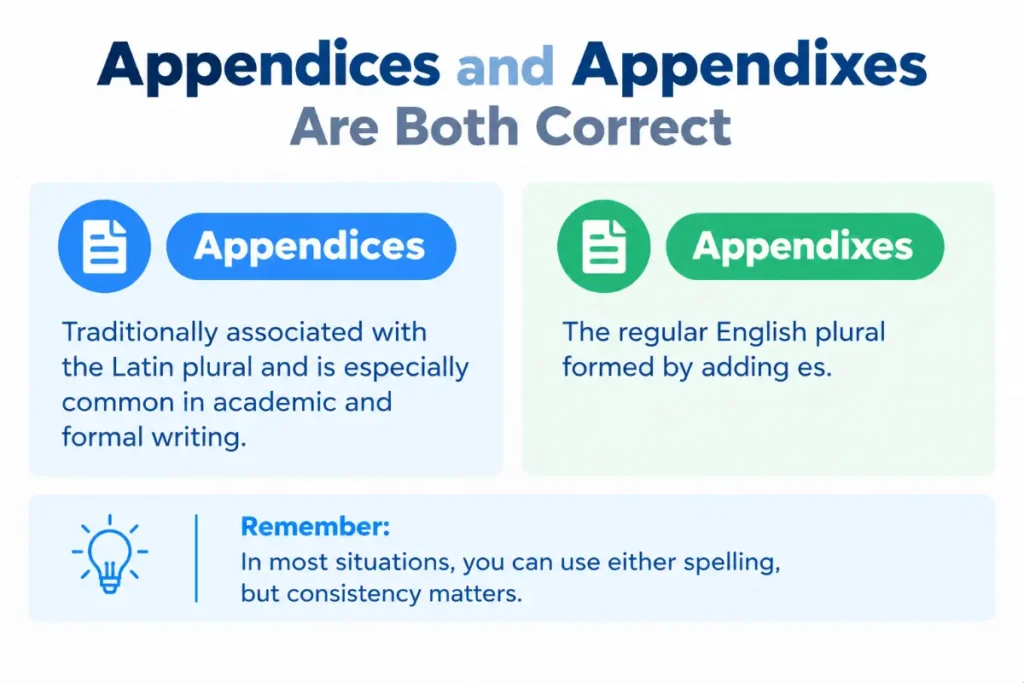
The difference comes down to word formation and usage rather than a strict rule that makes one spelling right and the other wrong. Appendices follows the traditional Latin plural pattern, while appendixes follows the regular English pattern of adding an s to a singular noun. Both forms appear in standard English, although a particular style guide or institution may prefer one.
Knowing the difference helps you write more confidently. You will learn what each form means, how to use it in a sentence, how to pronounce it, and which version works best in American English. You will also discover a simple editing tip that can help you keep your writing consistent from the first page to the last.
Many readers also check onsite vs on-site: Correct Usage Explained.
Quick Answer
Both appendices and appendixes are correct plural forms of appendix. Appendices follows a traditional Latin plural pattern, while appendixes uses the regular English plural ending. In American English, you can use either form for supplementary sections in a document. Choose the form preferred by your style guide or organization and use it consistently.
Comparison Table for Both Plural Forms
| Feature | Appendices | Appendixes |
|---|---|---|
| Correct spelling | Yes | Yes |
| Singular form | Appendix | Appendix |
| Part of speech | Plural noun | Plural noun |
| Meaning | Supplementary sections or other appendices | Supplementary sections or other appendixes |
| Word formation | Traditional Latin pattern | Regular English pattern |
| American English | Standard | Standard |
| British English | Standard | Standard |
| Formality | Suitable for formal and academic writing | Suitable for formal and academic writing |
| Pronunciation | Uh PEN dih seez | Uh PEN dik siz |
| Common contexts | Research papers, reports, books, technical documents | Reports, books, business documents, general writing |
The two forms have the same basic meaning. The spelling changes the sound of the final part of the word, but it does not change the grammatical function or the meaning of the plural noun.
Meaning and Definition
What Appendices Means
Appendices is the plural form of appendix. In a book, report, research paper, or other document, an appendix is a section that contains additional information supporting the main text. It may include tables, detailed calculations, survey questions, charts, source materials, or technical explanations.
For example, a research paper might explain its main findings in the body of the text and place the full survey questions in an appendix. If the paper contains several supplementary sections, the writer can call them appendices.
The word can also refer to the small, narrow pouch attached to the large intestine in the human body. In anatomy, appendix is singular and appendices is a recognized plural form. The surrounding sentence makes the intended meaning clear.
What Appendixes Means
Appendixes has the same plural meaning as appendices when referring to supplementary document sections or anatomical structures. It follows the regular English rule for forming the plural of many nouns by adding s or es.
For example, a technical manual might contain three appendixes with extra diagrams and maintenance instructions. The writer can use this form without making a spelling error.
Although the two spellings are interchangeable in many contexts, some organizations and editors prefer one. A university might specify appendices in its thesis guidelines, while a business might use appendixes in its internal reports. The important point is to follow the rules that apply to your document.
What Appendix Means in Different Contexts
The singular word appendix has two common meanings.
- A supplementary document section. An appendix provides information that supports the main text but does not need to appear in the main discussion.
- An anatomical structure. The appendix is a small pouch attached to the large intestine.
The intended meaning usually comes from the context. A sentence about a research paper points to supplementary material, while a sentence about abdominal pain points to the organ.
Key Differences Explained
Spelling and Word Formation
The most visible difference is the ending. Appendices uses the ending ices, while appendixes uses the ending ixes.
Appendices follows a traditional Latin pattern that English has retained in several borrowed words. Appendixes follows the regular English plural pattern. English contains both inherited plural forms and forms created through ordinary English grammar, so this difference is not unusual.
You do not need to memorize a complicated rule to use either form. Learn that both are accepted, then follow the spelling used in your preferred dictionary, style guide, or organization.
Meaning and Grammar
Both words function as plural nouns. Neither is an adjective or a verb, and neither changes the meaning of the singular word.
Consider these sentences.
- The appendix contains a detailed survey.
- The appendices contain detailed surveys.
- The appendixes contain detailed surveys.
The first sentence refers to one supplementary section. The second and third refer to multiple sections. Both plural forms work in the final two sentences.
The same principle applies to anatomical usage. A medical text can use appendices or appendixes when referring to multiple structures, although the preferred term may depend on the publication’s conventions.
Pronunciation
The two forms sound different at the end.
Appendices has a final sound similar to the word pieces. Appendixes keeps the sound of the singular word appendix and adds a plural ending.
This difference can help you remember the spelling. If you hear the longer word spoken aloud, pay attention to the ending rather than relying only on how the word looks.
Formality and Professional Writing
Neither spelling is automatically more formal than the other. Both are suitable for academic papers, professional reports, books, and technical documents.
However, consistency matters in professional writing. If your professor asks for appendices, use that form throughout your paper. If your employer has a house style that uses appendixes, follow it. A document can lose polish when it switches between forms without a clear reason.
Regional Usage
American and British English accept both forms. There is no simple rule that says Americans must use appendixes or British writers must use appendices.
Individual dictionaries, publishers, universities, and professional organizations may show different preferences. Those preferences do not make the other accepted form universally incorrect.
Standard and Nonstandard Usage
Both spellings are standard English plurals. Neither is a misspelling simply because it differs from the form another writer prefers.
The real mistakes occur when a writer uses the wrong singular or plural form, adds an unnecessary ending, or switches spellings without following a consistent style. Understanding the noun’s grammar is more useful than treating one plural as correct and the other as wrong.
Which Form Is Correct
Both forms are correct, but the best choice for your writing depends on the context and any style rules you need to follow.
For most general writing, you can choose either spelling. If you are preparing an academic paper, thesis, legal document, or professional report, check the relevant instructions before making your choice. Some institutions provide exact rules for headings, labels, and supplementary sections.
If no style guide applies, select one form and use it consistently. Appendices is a useful choice when you want to follow the traditional Latin plural pattern. Appendixes is also appropriate when you prefer the regular English plural pattern.
Do not change a correct spelling simply because a spell checker marks it as unfamiliar. Dictionaries and software tools can differ in which forms they list or prioritize. Check a trusted dictionary or the relevant style guide before assuming that a flagged word is wrong.
The main rule is straightforward. Use either accepted plural form, but follow your document’s required style and stay consistent.
Sentence Examples
These examples show how both plural forms work in everyday and professional English. The sentences use different settings so you can see how the word fits naturally into a complete thought.
Ten Examples Using the Accepted Forms
- Everyday conversation. I added two appendices to the report so everyone could review the extra details.
- Text messages. The professor said the appendixes were missing from our final paper.
- Workplace communication. Please review the appendices before approving the project proposal.
- School assignments. Our teacher asked us to place the interview questions in an appendix.
- Academic writing. The study includes three appendices with the full survey results and supporting tables.
- Formal reports. Additional financial information appears in the appendixes at the end of the report.
- Social situations. I printed the report and its appendices before the meeting.
- Online communication. You can find the extra charts in the appendixes attached to the digital document.
- Technical writing. The manual includes several appendices explaining the equipment specifications.
- Medical writing. The textbook discusses the appendix and explains the plural forms used in anatomical writing.
These examples show that the two spellings can serve the same purpose. The best choice depends on your preferred style and the expectations of your audience.
Common Mistakes and Misspellings
The main challenge is not choosing between the two accepted plural forms. It is recognizing the correct spelling, using the right grammatical number, and keeping the same form throughout a document.
Five Mistakes to Avoid
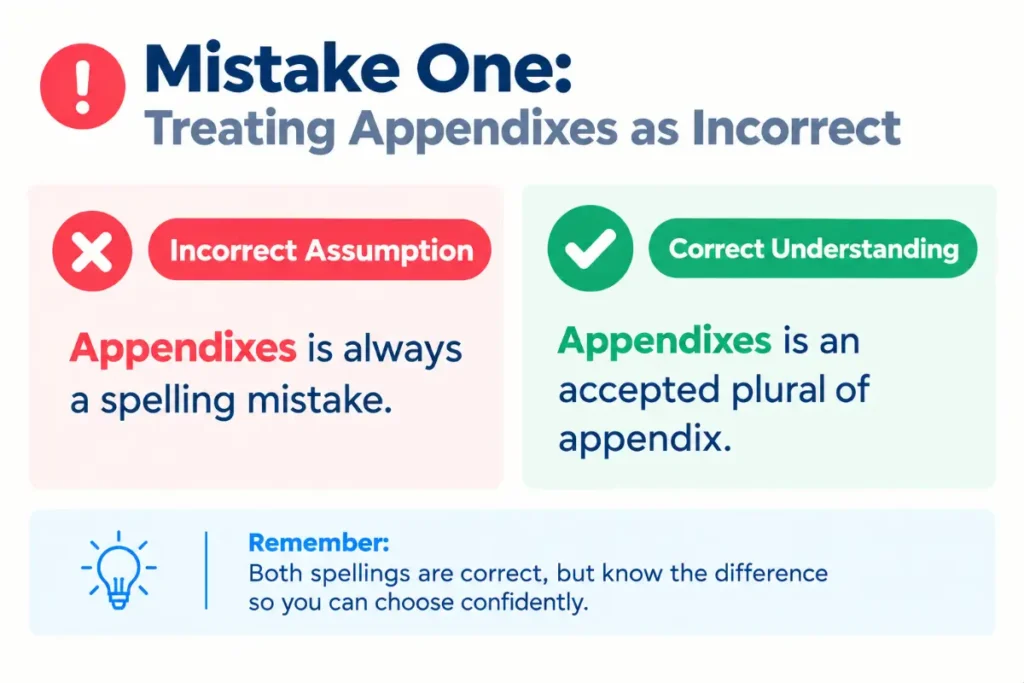
1. Treating appendixes as incorrect. Some writers assume that only appendices is correct because it looks more traditional. Both are accepted plural forms, so do not mark the regular English form as an error without checking the applicable style rules.
2. Using appendix for several sections without a reason. The singular form refers to one section, while the plural forms refer to more than one. Write, “The appendix contains the survey,” for one section and “The appendices contain the surveys” for several.
3. Writing appendicies. This spelling adds an extra i and is incorrect in standard English. The accepted form is appendices, with the letters c and e following the d.
4. Writing appendixs. This form applies the plural ending incorrectly. Use appendices or appendixes instead. Remember that the singular word already ends in x, so its regular English plural spelling uses es.
5. Switching forms without a clear reason. A report that uses appendices in one heading and appendixes in another may look poorly edited. Although both are correct, choose one form for the document and apply it consistently.
A practical way to prevent these mistakes is to search your document for both spellings during proofreading. If you find both, confirm that the change is intentional or standardize the wording.
Pronunciation Guide
The two forms have different endings, so pronunciation can help you distinguish them.
Appendices
IPA
/əˈpɛn.dɪ.siːz/
Say it as uh PEN dih seez. The stress falls on the second syllable.
Learn the difference in Headcount or Head Count Which Is Correct.
Appendixes
IPA
/əˈpɛn.dɪk.sɪz/
Say it as uh PEN dik siz. The stress also falls on the second syllable.
Syllable Breakdown
Appendices has four syllables: ap, pen, di, and ces. The final syllable sounds like the ending in pieces.
Appendixes also has four syllables: ap, pen, dix, and es. Its ending retains the sound of the singular word appendix, followed by the plural sound.
The first syllable is usually unstressed, and the second syllable carries the main stress. Avoid placing the strongest emphasis on the final syllable.
Common Pronunciation Errors
A common mistake is to pronounce both forms exactly alike. They are related, but their endings differ. Another mistake is to stress the last syllable instead of the second.
Practice each form in a short sentence. Saying the words aloud while reading them can help you connect the spelling to the sound and remember the distinction.
Etymology and Word Origin
The word appendix comes from Latin. It is related to the Latin verb appendere, meaning to hang something on or attach it. The general idea of something attached or added explains why English uses appendix for supplementary material placed after the main text.
Appendix entered English through the history of learned Latin vocabulary. Like many borrowed words, it retained features of its original language, including a traditional plural pattern. Appendices reflects that pattern.
Appendixes developed through ordinary English plural formation. English speakers often add s or es to form plural nouns, and this regular pattern gives the language a familiar alternative to inherited Latin endings.
Both forms remain part of modern English because the language allows some borrowed words to keep traditional plurals while also accepting regular English forms. Similar variation appears in other words of Latin origin, although the accepted forms differ from word to word.
The history explains the spelling difference, but it does not make one form more correct in every situation. Modern usage accepts both.
Regional Usage
American English
Both spellings are accepted in the United States. American writers may encounter appendices in academic writing, research reports, and formal documents. Appendixes is also a valid choice in general and professional writing.
If you are submitting a school assignment, check the instructor’s guidelines. A university may have its own preferred spelling for thesis sections and supporting materials. In workplace writing, the organization’s style guide takes priority over personal preference.
British English
British English also accepts both plural forms. The choice may depend on the publisher, dictionary, or institution. There is no universal British rule that makes appendices correct and appendixes incorrect.
British writers should follow the spelling conventions of the publication or organization they are writing for, particularly in formal academic work.
Australian English
Australian English follows the same broad principle. Both forms are recognized, and local publishers or institutions may prefer one for consistency. Writers should use the spelling specified by their assignment instructions or workplace style guide.
Canadian English
Canadian English also permits both forms. A Canadian organization may adopt a particular dictionary or editorial standard, but that preference does not make the other standard plural form wrong in all contexts.
The practical lesson is simple. Regional English does not create a strict division between these spellings. The rules of your particular document matter more than assumptions about nationality.
Grammar Rules and Part of Speech
Singular and Plural Forms
Appendix is a singular noun. Appendices and appendixes are plural nouns. Use the singular when referring to one item and either plural form when referring to multiple items.
- The appendix contains a detailed diagram.
- The appendices contain detailed diagrams.
- The appendixes contain detailed diagrams.
The verb must agree with the noun. A singular subject takes a singular verb, while a plural subject takes a plural verb.
For example, write “The appendix is complete” and “The appendices are complete.” The same agreement rule applies to the alternative plural form.
Using the Word in a Sentence
The noun can appear as a subject, a direct object, or the object of a preposition.
As a subject, it can begin a sentence: “Appendices provide additional information for readers.” As a direct object, it can follow a verb: “The editor reviewed the appendixes.” After a preposition, it can appear in a phrase such as “in the appendices.”
The word also appears in headings and labels. A report might use Appendix A for its first supplementary section and Appendix B for its second. If several sections are listed together, a heading such as Appendices may be suitable.
Using Articles and Numbers
Use a when referring to one appendix, as in “an appendix to the report.” Use the plural form when discussing multiple sections, as in “three appendices.”
The phrase “three appendix” is grammatically incorrect because the noun must be plural after a number greater than one in this context. The same rule applies to other countable nouns in English.
Punctuation and Document Structure
When you label supplementary sections, follow the required formatting rules for your document. Many reports use letters or numbers to distinguish individual appendices. The plural heading usually refers to the collection as a whole.
For example, a report might include Appendix A for survey questions and Appendix B for detailed calculations. Both sections together can be described as the appendices.
Do not add an apostrophe to form the plural. Appendices and appendixes are ordinary plural nouns, not possessives. Use an apostrophe only when the sentence expresses possession, such as “the appendix’s title.”
Real Life Usage Examples
The following situations show how the word appears naturally in different kinds of communication.
Daily Conversation
- “Did you read the appendices at the end of the report?” This question asks someone to review the extra sections.
- “I put the appendixes in a separate file so they would be easier to find.” This sentence describes a practical way to organize supplementary material.
Email and Workplace Communication
- “Please review the appendices before our meeting on Friday.” This is a clear request for colleagues to examine supporting information.
- “The revised proposal includes two appendixes with updated cost estimates.” This sentence explains what changed in a business document.
Academic Writing
- “The appendices provide the full questionnaire and additional data tables.” This sentence explains the role of supporting material in a research paper.
- “See Appendix B for the complete list of interview questions.” This example shows how writers refer to one section within a larger document.
News and Journalism
- “The report includes appendices containing background information on the investigation.” This sentence describes supporting material in a published report.
- “Readers can consult the appendixes for additional figures and detailed explanations.” This example directs readers to supplementary information without interrupting the main discussion.
Literature and Storytelling
- “The author added appendices explaining the historical events mentioned in the novel.” This sentence describes extra material that helps readers understand the story.
- “At the back of the book, the appendixes offered notes about the characters and their setting.” This example shows how supplementary sections can provide context for a literary work.
These situations demonstrate that both plural forms fit ordinary sentences. The key is to use the right grammatical number and maintain a consistent spelling choice.
Related and Confused Terms
Several words appear alongside this term in academic writing, publishing, and document organization. Understanding their meanings can help you choose the right word for each situation.
1. Appendix
Appendix is the singular form. Use it when referring to one supplementary section or one anatomical structure. For example, “The appendix contains the full survey.”
2. Attachment
An attachment is a file or item added to an email, message, or document. It may contain an appendix, but the terms are not interchangeable in every situation. A PDF attached to an email is an attachment, while a section inside a report may be an appendix.
3. Supplement
A supplement is additional material that expands or supports something else. It may be a separate publication, a document section, or extra information. An appendix is one possible type of supplementary material.
4. Annex
An annex is an additional section attached to a document, often in legal, administrative, or formal technical writing. Some organizations distinguish an annex from an appendix based on the type of material or the document’s structure. Follow the relevant editorial rules when both terms are used.
5. Addendum
An addendum is additional material added to a document after its main content has been prepared. It may correct, update, or expand the original information. An appendix usually provides supporting material, while an addendum often supplies a later addition.
6. Exhibit
An exhibit is an item presented as evidence or for examination. Legal documents may use exhibits for records, photographs, or other evidence. An appendix usually contains supplementary information, so the two terms serve different purposes.
7. Footnote
A footnote is a note placed at the bottom of a page. It provides a source, explanation, or brief comment related to the main text. An appendix appears as a separate section, usually near the end of a document.
8. Bibliography
A bibliography lists sources consulted or cited in a piece of writing, depending on the required style. An appendix provides additional supporting material. A document may contain both, but a bibliography is not simply another name for an appendix.
Expert Editor Insight
An experienced editor treats both plural forms as acceptable and focuses on consistency, audience, and house style. The confusion often arises because appendices looks less familiar to readers who expect regular English plurals, while appendixes may look unusual to those accustomed to traditional Latin forms. Spelling tools may favor one version or flag the other based on their dictionaries and settings. Before changing a flagged word, confirm the intended meaning and check the applicable style guide. A consistent, grammatically correct document matters more than choosing a form simply because it looks more familiar.
Key Takeaways
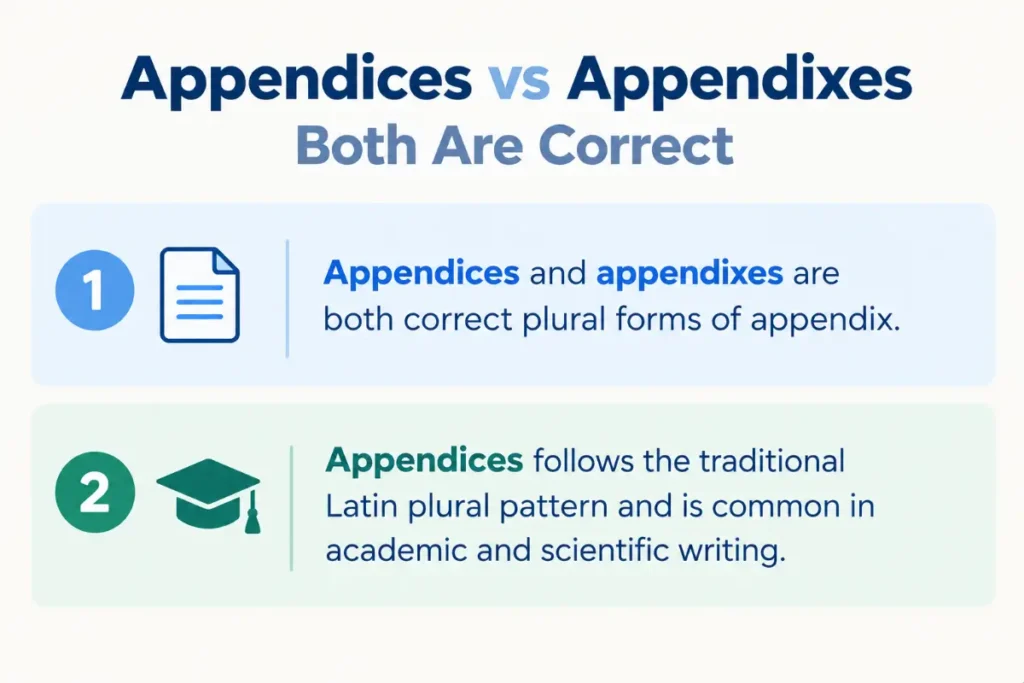
1. Appendices and appendixes are both correct plural forms of appendix.
2. Appendices follows the traditional Latin plural pattern and is common in academic and scientific writing.
3. Appendixes follows a regular English plural pattern and is also accepted in formal and informal contexts.
4. American and British English recognize both spellings.
5. Use appendix for one section and either plural form for two or more sections.
Still confused? Compare Wack or Whack Which Word Is Correct? (2026).
Conclusion
Appendices vs appendixes comes down to two accepted plural forms of the same word. Both are correct in standard English, and both can describe supplementary sections in reports, books, and research papers. Appendices follows the traditional Latin pattern, while appendixes uses the regular English plural ending. Neither spelling is automatically better in every situation. For professional writing, check your style guide and follow its preferred form.
If no specific rule applies, choose the spelling you find most suitable and keep it consistent throughout your document. A simple editing tip is to search for both forms before submitting your work so you can catch unintended changes.
FAQs
Is Appendixes a Real Word?
Yes. Appendixes is a standard English plural form of appendix. It follows the regular English pattern of adding es to a noun ending in x. You can use it for supplementary sections in a report or for multiple anatomical structures. It is not automatically incorrect just because another writer prefers appendices.
What Does Appendices Mean?
Appendices is the plural of appendix. In a document, it refers to supplementary sections that provide extra details, supporting data, charts, questionnaires, or technical information. The word can also refer to multiple anatomical appendices. The sentence usually makes the intended meaning clear, so readers can understand the word from its context.
Which Is Correct Appendices or Appendixes?
Both are correct. Appendices follows a traditional Latin plural pattern, while appendixes follows the regular English plural pattern. Neither form is universally superior. If you are writing a school paper, a formal report, or a book, follow the style guide or editorial rules that apply to your work. Otherwise, choose one and use it consistently.
How Do You Pronounce Appendices?
Appendices is pronounced with four syllables and the main stress on the second syllable. Its ending sounds similar to the ending of pieces. The final sound distinguishes it from appendixes, which retains the sound of the singular noun appendix before adding a plural ending. Practicing the two forms aloud can help you remember their different spellings.
Can Appendices Start a Sentence?
Yes. Appendices can start a sentence because it is a plural noun. For example, “Appendices provide readers with additional research details.” The word does not need to appear after an introductory phrase or another noun. Just make sure the rest of the sentence follows normal grammar rules and uses a plural verb when needed.
What Is a Synonym for Appendix?
The best alternative depends on the context. Supplement, annex, addendum, and attachment may work in some situations, but they do not always mean exactly the same thing. An appendix usually contains supporting information at the end of a document. Choose a replacement only when it accurately describes the material and matches the document’s conventions.
Why Do People Confuse These Spellings?
People confuse the two forms because English uses both traditional plurals borrowed from Latin and regular plurals formed with English endings. Appendix can follow either pattern, creating two accepted spellings. Familiarity also plays a role. Readers who usually see one form may assume the other is a mistake, even though both are standard.
Is Appendices Appropriate for Formal Writing?
Yes. Appendices is appropriate for formal writing, including academic papers, research reports, business documents, and books. Appendixes is also acceptable. The best choice depends on the relevant style guide or the preferences of your institution or publisher. In formal work, consistency and compliance with the required editorial rules are more important than personal preference.