
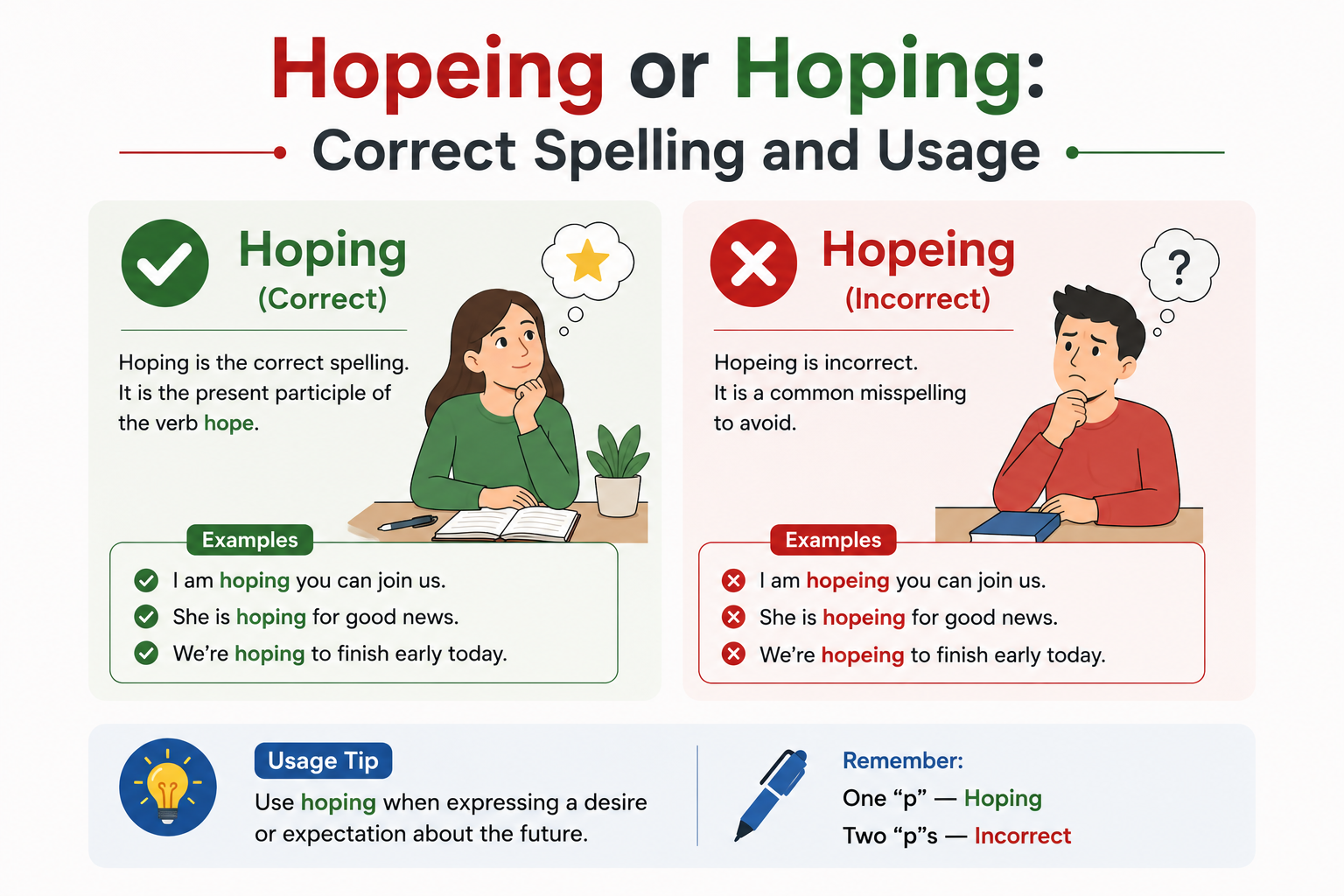
If you’ve ever paused while writing the word hoping, you’re not alone. The spelling question hoping or hopeing comes up because the verb hope ends with a silent e, and English spelling rules can make that final letter confusing when you add an ending. The correct spelling is hoping. The form hopeing is a common misspelling in standard English.
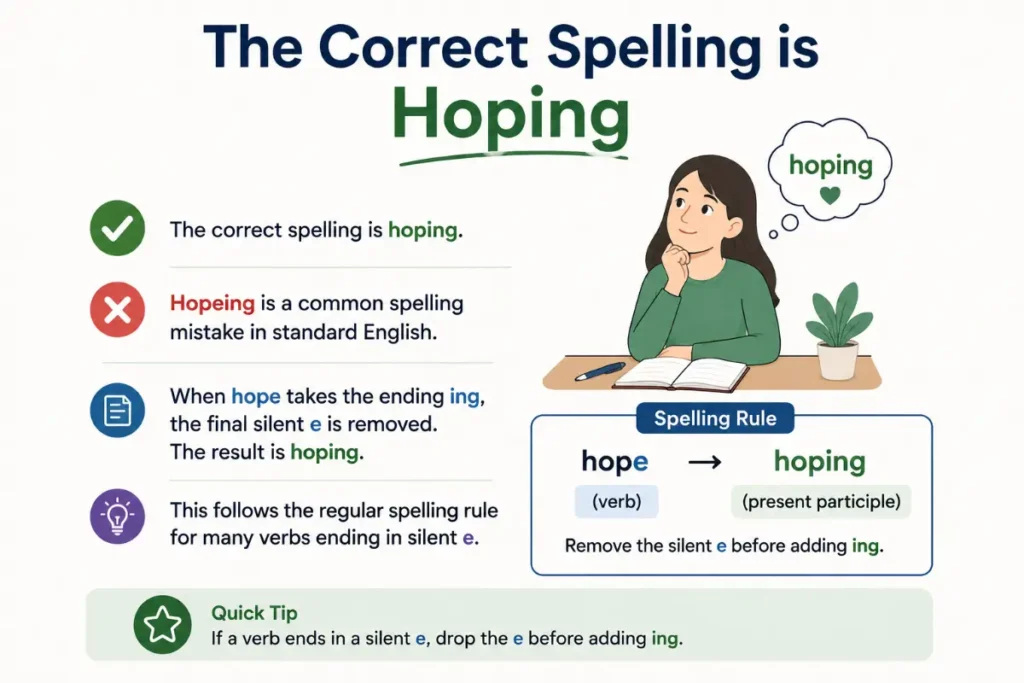
The rule is straightforward once you understand the pattern. When a verb ends in a silent e, you usually drop that e before adding ing. For example, hope becomes hoping, smile becomes smiling, and bake becomes baking. The final e disappears, but the word keeps its original meaning.
This small spelling change matters in school assignments, workplace emails, text messages, and formal writing. A single extra letter can make an otherwise clear sentence look unpolished. Fortunately, you don’t need to memorize dozens of unrelated spellings to get this one right. You only need to recognize the verb’s ending and apply the standard spelling rule.
Many readers also check Skeptical vs Sceptical Which Spelling Is Correct.
Quick Answer.
Hoping is the correct spelling. It is the ing form of the verb hope, meaning to want something to happen or to expect a good result. The spelling hopeing is incorrect in standard English because the final silent e is dropped before adding ing. Remember the pattern: hope becomes hoping, not hopeing.
Meaning and Definition.
What Does Hoping Mean.
Hoping is the present participle of the verb hope. It describes the act of wanting something to happen, wishing for a good result, or expecting a positive outcome. It can also appear in continuous verb forms to describe an action or feeling that is ongoing.
For example, in the sentence, “I am hoping for good news,” the speaker wants a positive result and is waiting for it. In “She left hoping to find a better job,” the word describes the feeling or expectation she had when she left.
The word can express anything from a small wish to a strong desire for a better future. You might hope for sunny weather, hope to pass an exam, or hope that a friend feels better soon. The meaning depends on the situation, but the basic idea remains the same.
Is Hopeing a Real Word.
Hopeing is a common spelling mistake rather than a standard English word. In ordinary writing, it should be corrected to hoping. The error often occurs because writers keep the final e from the base verb before adding ing.
The mistake is understandable. Many English words retain their final e when you add certain endings. For instance, hope becomes hopeful, and care becomes careful. However, the spelling pattern changes when you add ing to a verb ending in a silent e.
The form hopeing might appear in a draft, an informal online post, or a learner’s writing. Its appearance does not make it an accepted spelling. In schoolwork, professional communication, published writing, and standard edited English, use hoping.
What Does Hope Mean.
Hope is the base verb from which hoping is formed. As a verb, it means to want something to happen or to expect a desired result. It can also function as a noun, describing a feeling of expectation or a belief that something good may happen.
Consider these examples.
- “I hope you enjoy the movie.” Here, hope is a verb that expresses a wish.
- “We hope to visit California next summer.” The verb introduces an action the speakers want to take.
- “She gave us hope.” Here, hope is a noun that names a positive feeling or expectation.
The spelling rule in this article applies to the verb when it takes the ing ending. The noun hope does not become hoping simply because you add letters to the end. The grammatical role and sentence structure determine how you use the word.
Comparison Table for the Two Spellings.
| Feature | Hoping | Hopeing |
|---|---|---|
| Spelling status | Correct standard spelling | Common misspelling |
| Meaning | Wanting or expecting a desired result | Intended to mean the same as hoping |
| Part of speech | Present participle or gerund | Not a standard form |
| Base word | Hope | Intended base word is hope |
| Grammar | Follows the silent e rule | Retains an e that should be dropped |
| Pronunciation | Usually /ˈhoʊpɪŋ/ in American English | Intended pronunciation is generally the same |
| Formality | Appropriate in all standard contexts | Should be corrected |
| Common contexts | Conversation, school, work, and literature | Typing errors and spelling confusion |
| Example | I am hoping for a quick reply. | I am hopeing for a quick reply. |
The difference is spelling, not meaning. Readers can often understand the intended message when they see the incorrect form, but that does not make it suitable for standard written English.
Key Differences Explained.
Spelling.
The main difference is the treatment of the final e. The base verb hope ends with a silent e. When you add ing, you remove that e and attach the ending directly to the remaining letters.
The correct pattern is:
- Hope + ing = hoping.
- Smile + ing = smiling.
- Write + ing = writing.
- Drive + ing = driving.
- Dance + ing = dancing.
These examples show a common spelling pattern. Keeping the e in the finished word is the mistake to avoid.
Meaning.
There is no standard difference in meaning between the two forms because only one is accepted in ordinary English. Writers who use hopeing almost always intend the meaning of hoping.
For example, “I am hoping to see you soon” expresses a wish or expectation. Changing the spelling to hopeing does not create a new meaning. It simply introduces a spelling error.
Grammar.
Hoping can perform different grammatical roles depending on the sentence. It can form part of a continuous verb phrase, describe the circumstances of an action, or act as a gerund.
- Continuous verb phrase. “They are hoping for better results.”
- Descriptive participle. “Hoping for a quick answer, Mia checked her email.”
- Gerund. “Hoping for the best can help people stay positive.”
In each example, the spelling remains the same. The surrounding words show how the form functions in the sentence.
Pronunciation.
In standard American English, hoping is pronounced with two syllables. The first syllable contains the long o sound, and the second contains the ing ending.
The final e in hope is silent. Dropping it before ing does not change the basic pronunciation of the word. The incorrect spelling may look different, but writers generally intend the same spoken word.
Formality and Context.
Hoping is appropriate in casual and formal writing. You can use it in a text message, an email to a manager, a school essay, or a published article.
Hopeing is not an accepted alternative for informal situations. A reader might understand it in a casual message, but it can still look careless. Use the standard spelling whenever you want your writing to appear clear and polished.
Regional Usage.
American, British, Canadian, and Australian English all use hoping. There is no established regional spelling difference that makes hopeing correct in one variety of English and incorrect in another.
The spelling rule remains the same across these varieties. If you write for an international audience, hoping is the safe and standard choice.
Which Form Is Correct.
Hoping is correct because English generally drops the silent e at the end of a verb before adding ing. This spelling convention appears in many common verbs, including make, take, smile, and move.
The rule helps preserve a consistent relationship between a verb’s base form and its ing form. You write hope when no ending requires a change, but you write hoping when the ing ending is added.
Compare these sentences.
- “I hope to hear from you soon.”
- “I am hoping to hear from you soon.”
Both sentences are grammatically correct. The first uses the base verb hope. The second uses hoping in a continuous verb phrase. Neither sentence needs an extra e before ing.
English has exceptions and other spelling patterns, so it is wise to learn the rule through examples rather than assume every verb behaves identically. Still, for this particular word, the rule is clear. Write hoping in every standard context.
Sentence Examples.
The following examples show how to use the correct form naturally in different situations.
- I am hoping the weather stays sunny for our picnic.
- She is hoping to hear back from the college by Friday.
- We are hoping for a positive response from the client.
- He kept hoping that his favorite team would win.
- I am hoping you can help me finish this project.
- They spent the afternoon hoping for a chance to speak with the director.
- Hoping to save money, Olivia started cooking at home more often.
- The researchers are hoping their results will lead to better treatments.
- I sent a message hoping to clear up the misunderstanding.
- Even after several setbacks, Marcus continued hoping for a fresh start.
Notice that the spelling does not change based on the sentence’s tone or purpose. The word works in everyday conversation, academic writing, professional communication, and storytelling.
Common Mistakes and Misspellings.
Several spelling errors can occur when writers add endings to verbs. Understanding the reason behind each mistake makes the correct form easier to remember.
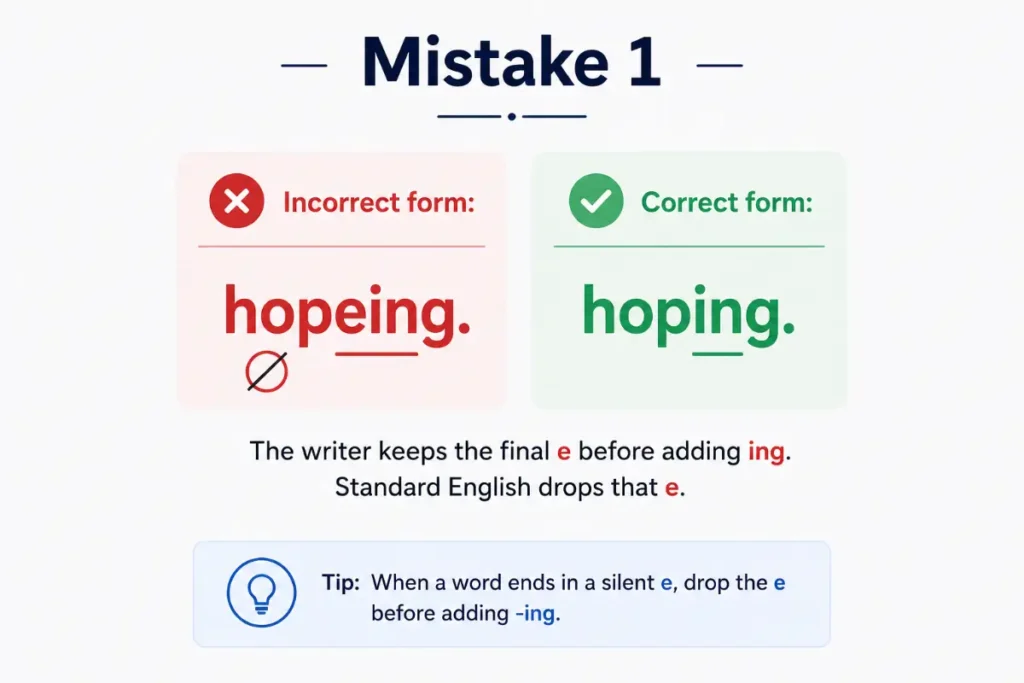
Mistake One: Keeping the Final E.
Incorrect: I am hopeing for a reply.
Correct: I am hoping for a reply.
The error occurs because the writer keeps the final e from the base verb. For most verbs that end in a silent e, remove that letter before adding ing.
Mistake Two: Adding an Unnecessary Extra Letter.
Incorrect: I am hoppping for a better result.
Correct: I am hoping for a better result.
The base verb hope does not require the final consonant to be doubled. The spelling pattern for a short vowel followed by a consonant applies to some verbs, such as run becoming running. It does not apply to hope in this way.
Mistake Three: Confusing Hoping With Hopping.
Incorrect for the intended meaning: I am hopping that you arrive soon.
Correct: I am hoping that you arrive soon.
Hoping comes from hope and expresses a wish or expectation. Hopping comes from hop and describes jumping on one foot or making short jumps. The words differ in both spelling and meaning.
Mistake Four: Using the Wrong Verb Form.
Incorrect: She is hope for good news.
Correct: She is hoping for good news.
A continuous verb phrase generally uses a form of be followed by a present participle. In this sentence, is must be followed by hoping. The base form hope does not fit the same grammatical pattern.
Mistake Five: Changing the Spelling in Formal Writing.
Incorrect: We are hopeing to complete the project soon.
Correct: We are hoping to complete the project soon.
Writers sometimes overlook this error during quick typing or proofreading. Reading the sentence aloud will not always reveal the problem because the two spellings are usually intended to sound alike. A spelling checker and a careful visual review can help catch it.
A related grammar guide is Dis and Mis Prefixes Explained With Examples.
Pronunciation Guide.
Hoping has two syllables and is pronounced /ˈhoʊpɪŋ/ in standard American English.
- Syllable count. Two syllables.
- First syllable. The sound begins with the h consonant and includes the long o diphthong.
- Second syllable. The ending sounds like ing, with a short vowel.
- Stress pattern. The first syllable receives the main stress.
The word sounds like HOH ping when represented with a simple English pronunciation guide. This guide is only an approximation, but it can help learners recognize the sound.
The silent e in the base verb hope does not have its own sound. The spelling change before ing does not create an extra syllable. You should not pronounce hoping as three syllables.
A related word worth learning is hopping. It is pronounced with a short o sound and a doubled p in its spelling. Hoping and hopping are different words, even though they look and sound similar to some learners.
Etymology and Word Origin.
The verb hope has a long history in English. It developed from the Old English word hopian, which expressed the idea of hoping or expecting something. The word has remained part of English for centuries, and its core meaning still centers on a desired outcome or positive expectation.
The modern spelling follows familiar English patterns. Hope is the base form, and hoping is created by adding the present participle ending ing after dropping the final silent e. This spelling change reflects a broader convention in English rather than a special rule created for this single word.
The ending ing also has a long history in English grammar. Today, it appears in present participles and gerunds, allowing writers to describe ongoing actions or use an action as the subject or object of a sentence.
For example, “Hoping for success takes patience” uses hoping as a gerund. In “She is hoping for success,” it forms part of a continuous verb phrase. The word’s role changes with the sentence, but its spelling stays the same.
Regional Usage.
American English.
Hoping is the standard spelling in American English. It appears in everyday conversation, school assignments, news writing, business communication, and formal documents. Writers in the United States should drop the final e before adding ing.
For example, “We are hoping to finish the work today” is correct. The form hopeing is a spelling mistake, not an American alternative.
British English.
British English also uses hoping. The spelling rule is the same as in American English, and the incorrect form does not become acceptable simply because the writer follows British conventions.
Some English words have different spellings across the two varieties, such as color and colour. This word is not one of them.
Australian English.
Australian English follows the same standard spelling. You should write hoping in schoolwork, professional emails, publications, and everyday messages.
Canadian English.
Canadian English also uses hoping. Although Canadian spelling sometimes follows British patterns and sometimes American patterns, this verb takes the same form across both systems.
The practical lesson is simple. You do not need to choose a regional spelling for this word. Use hoping in all four varieties of English.
Grammar Rules and Part of Speech.
Understanding the grammar behind the word helps you use it confidently. Hoping comes from the verb hope, but its function depends on the sentence around it.
Hoping as a Present Participle.
A present participle is a verb form ending in ing. It can help form continuous tenses or describe an action connected to another event.
For example, “I am hoping for a quick answer” uses the present continuous tense. The verb am combines with hoping to describe a current feeling or expectation.
You can also place the participle at the start of a sentence to explain the reason or circumstances behind an action. In “Hoping to avoid traffic, we left early,” the opening phrase explains why the speakers left early.
Hoping as a Gerund.
A gerund is an ing form that functions as a noun. The same spelling can therefore serve a different grammatical purpose.
Consider these examples.
- “Hoping keeps her focused on the future.”
- “He never gave up hoping for a better outcome.”
- “Their hoping for a quick solution proved unrealistic.”
In each example, hoping acts like a noun in the sentence. You can identify its role by looking at how it relates to the other words.
Common Grammatical Patterns.
Hoping appears in several useful sentence patterns.
| Pattern | Example | Purpose |
|---|---|---|
| Be + hoping | I am hoping for good news. | Describes an ongoing hope. |
| Hoping + to + verb | She is hoping to travel soon. | Expresses a desired action. |
| Hoping + that clause | We are hoping that the plan works. | Introduces an expected result. |
| Hoping at the start of a sentence | Hoping to learn more, he joined the class. | Gives context for an action. |
| Keep + hoping | They kept hoping for a change. | Describes continued hope. |
| Give up + hoping | She gave up hoping for an apology. | Describes the end of an expectation. |
These patterns help you build clear sentences without changing the spelling.
Tense and Sentence Structure.
Hoping does not usually stand alone as the main verb of a standard continuous tense. It normally appears with a form of be, such as am, is, are, was, or were.
For example, “She is hoping for a promotion” is correct. “She hoping for a promotion” is incomplete in standard English because the required helping verb is missing.
However, hoping can begin a participial phrase without a helping verb. In “Hoping for a promotion, she took on extra work,” the opening phrase describes the circumstances behind the main action.
Punctuation and Sentence Position.
You can place hoping at the beginning, middle, or end of a sentence, depending on the structure.
- Beginning. “Hoping to catch the early train, Daniel left before sunrise.”
- Middle. “The team is hoping to finish the report by noon.”
- End. “She continued working, hoping for a better result.”
When a participial phrase begins a sentence, a comma often separates it from the main clause. A phrase placed at the end may also need a comma to show its relationship to the main clause. Punctuation depends on the sentence structure, not on the word itself.
Real Life Usage Examples.
Daily Conversation.
People often use hoping to express wishes, plans, and expectations in casual speech. The word can sound friendly and positive without making a promise.
- “I’m hoping we can get together this weekend.”
- “We’re hoping the rain stops before the game.”
In these sentences, the speakers express a desire without claiming that the result is certain.
Email and Workplace Communication.
In professional messages, hoping can communicate a polite expectation. It works well when you want to sound positive without being too forceful.
- “I’m hoping to receive your feedback by Thursday so I can finalize the report.”
- “Our team is hoping to schedule the meeting for early next week.”
These examples are appropriate for many workplace settings. However, if you need to make a firm commitment or request, direct language may work better than a statement of hope.
Academic Writing.
Hoping can appear in academic work when a writer describes intentions or expectations. It is less common in formal research claims, which usually require precise language about aims, evidence, and results.
- “The students are hoping to improve their reading skills through regular practice.”
- “Researchers are hoping that future trials will provide clearer evidence.”
In a research paper, avoid using hope as a substitute for evidence. A desired outcome is not the same as a proven result.
News and Journalism.
News writing may use hoping when reporting what a person or group wants to achieve. The word helps distinguish a goal from a confirmed outcome.
- “Local officials are hoping to reopen the bridge by Monday.”
- “The charity is hoping to raise enough money to expand its services.”
These sentences report expectations. They do not claim that the bridge will definitely reopen or that the fundraising goal has already been reached.
Literature and Storytelling.
In fiction, hoping can reveal a character’s thoughts, fears, or desires. It can add emotional depth without requiring a long explanation.
- “Hoping that her brother would return, Maya watched the road each evening.”
- “He walked into the room, hoping no one had noticed his mistake.”
In both examples, the opening phrase gives readers a glimpse of the character’s state of mind.
Related and Confused Terms.
Several words connect to hope or cause spelling confusion. Learning their differences will help you choose the right expression.
Hope.
Hope is the base verb and can also be a noun. Use it to express a wish or expectation, as in “I hope you feel better soon.” Use hoping when the sentence requires the ing form, as in “I am hoping you feel better soon.”
Hoped.
Hoped is the simple past tense and past participle of hope. The final e remains before the d ending. For example, “I hoped you would call” describes an expectation in the past.
Hopeful.
Hopeful is an adjective that describes someone who feels hope or expects a positive result. You might say, “She is hopeful about her exam results.” Unlike the ing form, this ending does not require dropping the final e.
Hopefully.
Hopefully is an adverb. It can describe the manner in which someone acts with hope, as in “He waited hopefully.” In everyday American English, it is also widely used to mean that the speaker wants a result to occur, as in “Hopefully, the package will arrive today.”
Hopping.
Hopping is the ing form of hop. It describes jumping or moving with short jumps. For example, “The rabbit was hopping across the grass.” The extra p distinguishes this form from hoping, which expresses expectation or desire.
Hopeless.
Hopeless is an adjective that describes a situation with little or no chance of success, or a person who feels that nothing will improve. For example, “The team felt hopeless after losing several games.” The word has a different meaning from hopeful.
Wish.
Wish is a verb or noun related to hope. It often expresses a desire for something that may be unlikely, unreal, or outside a person’s control. For example, “I wish I could stay longer.” Hope often suggests that a desired outcome may realistically happen, though the difference depends on context.
Expect.
Expect means to think something is likely to happen. Hope and expect can overlap, but they are not identical. You might hope for good news because you want it, while expecting good news suggests you believe it is likely.
Expert Editor Insight.
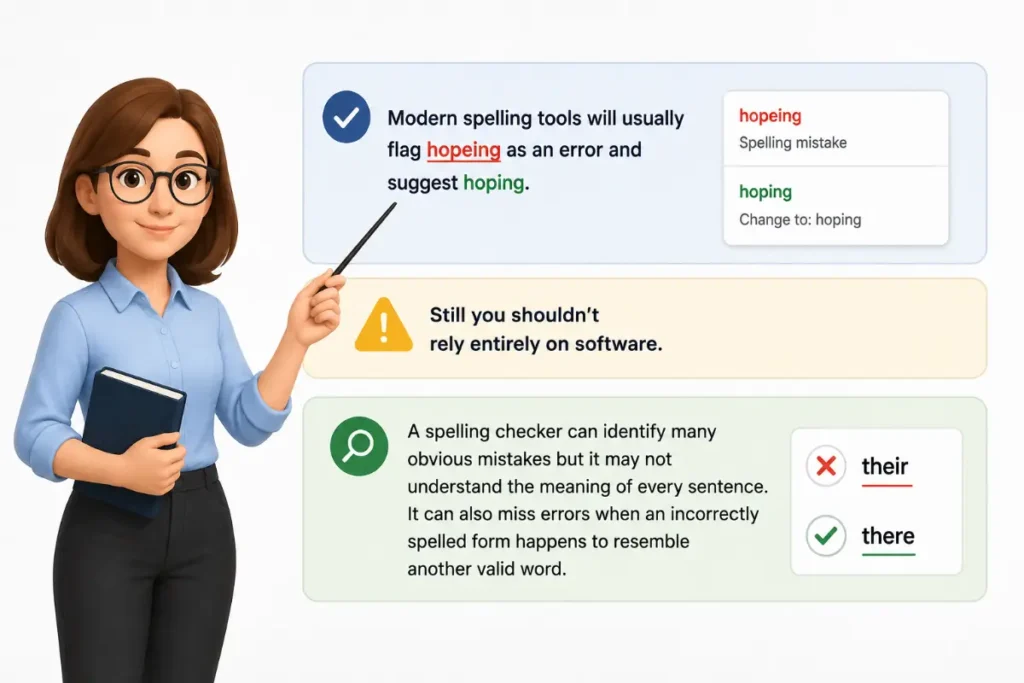
An experienced editor will correct hopeing to hoping because the spelling rule is well established and consistent across standard English. The confusion happens because the final e appears in the base verb and remains in some related forms, such as hopeful. During proofreading, check the base verb before adding an ending. Most spelling tools flag the incorrect form, but automated checks can miss errors when a typo resembles another accepted word. A quick review of the word’s structure is often more reliable than trusting a spell checker alone.
A related grammar guide is shoyu vs tonkotsu Which Ramen Should You Choose.
Conclusion.
The spelling question hoping or hopeing has a clear answer. Hoping is correct, while hopeing is a common misspelling. The reason is simple. English generally drops the final silent e from a verb before adding ing. The same pattern appears in words such as smiling, writing, and baking. Remember the base verb hope, remove its final e, and then add ing. This small spelling habit will help you write more confidently in everyday messages, school assignments, and professional documents. When proofreading, check the final letters of verbs before adding an ending. That quick check can prevent many common spelling errors.
FAQs.
Is Hoping or Hopeing Correct?
Hoping is the correct spelling in standard English. The word comes from the verb hope, which loses its final silent e before the ing ending is added. Hopeing is a common spelling mistake, not an accepted alternative. Use hoping in school assignments, workplace emails, personal messages, and formal writing.
Is Hopeing a Real Word?
Hopeing is not a standard English spelling of the ing form of hope. People may type it by mistake because they keep the final e from the base verb. In edited English, the correct form is hoping. If a spelling checker flags hopeing, replace it with hoping unless you are intentionally discussing the misspelling itself.
What Does Hoping Mean?
Hoping means wanting something to happen or expecting a desired result. For example, “I am hoping to pass my exam” means the speaker wants to pass and expects a positive outcome. The word can describe an ongoing feeling, form part of a continuous verb phrase, or function as a gerund that acts like a noun.
Why Is the E Dropped in Hoping?
English generally drops the final silent e from a verb before adding ing. This prevents an unnecessary letter from remaining in the new form. The same pattern appears in words such as make, smile, write, and dance. You write making, smiling, writing, and dancing, just as you write hoping.
How Do You Pronounce Hoping?
Hoping is pronounced with two syllables and is represented by the IPA transcription /ˈhoʊpɪŋ/ in standard American English. The stress falls on the first syllable. The word begins with the long o sound found in hope, followed by the ing ending. The final e in the base verb is silent and does not create another syllable.
Can Hoping Start a Sentence?
Yes. Hoping can begin a sentence as part of a participial phrase. For example, “Hoping to arrive before sunset, we left early.” The opening phrase explains the reason for leaving early. When the phrase introduces the main clause, a comma usually separates it from the rest of the sentence.
What Is a Synonym for Hoping?
Useful alternatives include wishing, anticipating, expecting, and looking forward to. These expressions have slightly different meanings. Wishing emphasizes desire, while expecting often suggests that a result seems likely. Looking forward to usually expresses positive anticipation about a future event. Choose the alternative that best matches your intended meaning and the sentence’s tone.
Is Hoping Appropriate in Formal Writing?
Yes. Hoping is a standard English word and is appropriate in formal writing when it expresses the intended meaning. You can use it in professional correspondence, academic discussions, reports, and other edited documents. However, formal writing should distinguish personal expectations from established facts. For example, describe a desired research outcome as an aim rather than presenting it as a proven result.