
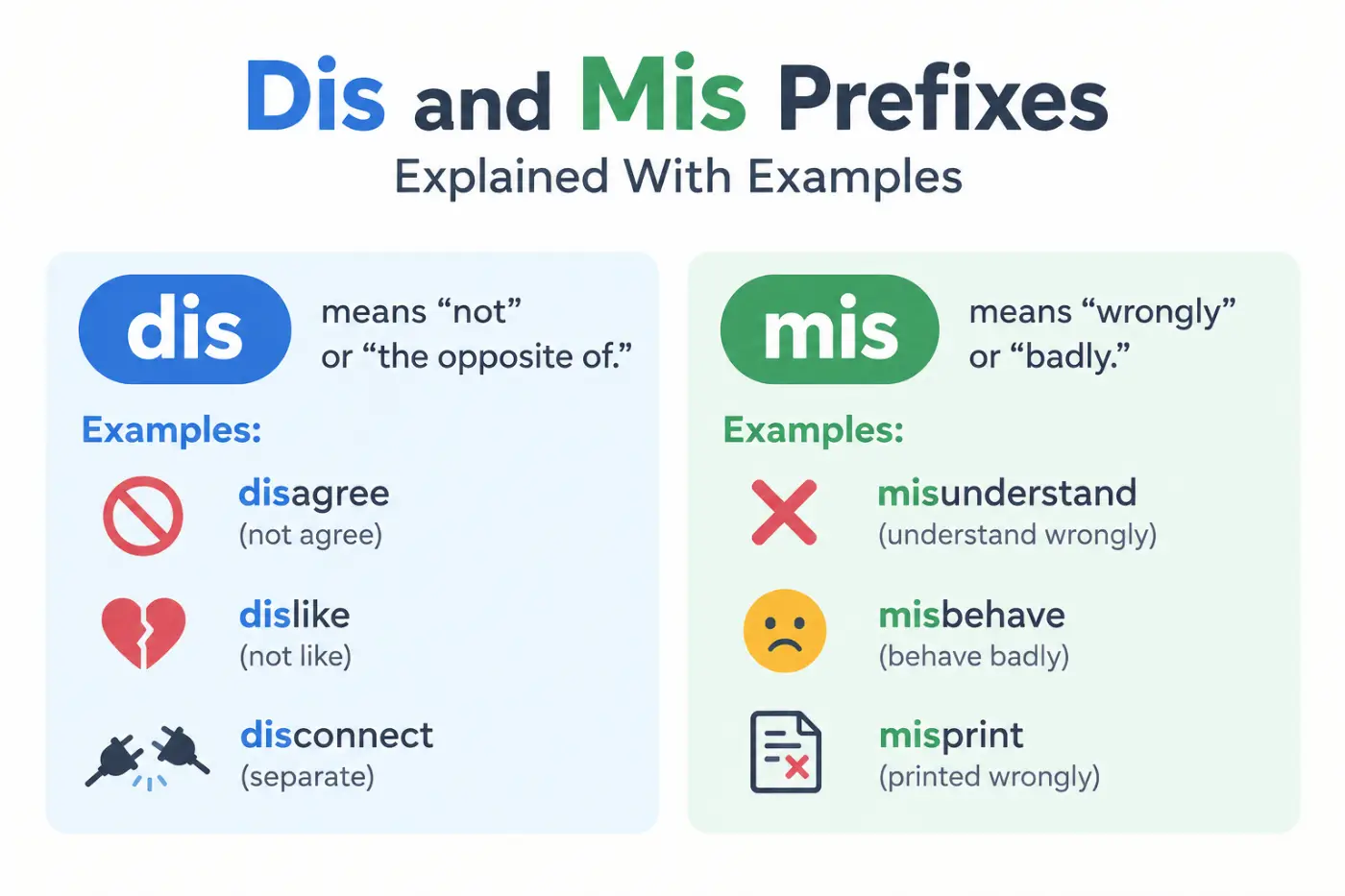
The prefixes dis and mis can look similar because both appear at the beginning of English words and change their meanings. However, they don’t usually express the same idea. Dis often shows opposition, separation, reversal, or a lack of something. Mis usually points to a mistake, an incorrect action, or a faulty understanding.
Think about the difference between dislike and misunderstand. If you dislike a movie, you don’t enjoy it. If you misunderstand a movie, you interpret its meaning incorrectly. One word expresses a negative feeling, while the other describes an error in understanding. The small difference between these prefixes can change the meaning of a sentence in a big way.
Learning these word parts can help you understand unfamiliar vocabulary, improve your spelling, and make more accurate word choices. You’ll also begin to recognize patterns in words such as disconnect, dishonest, misplace, mislead, and misjudge. Although these patterns are useful, English has exceptions, so the meaning and history of each word still matter. The key is to learn the general rule and apply it carefully.
Need another quick comparison? Read yesterdays or yesterday’s Correct Spelling And Usage.
Quick Answer
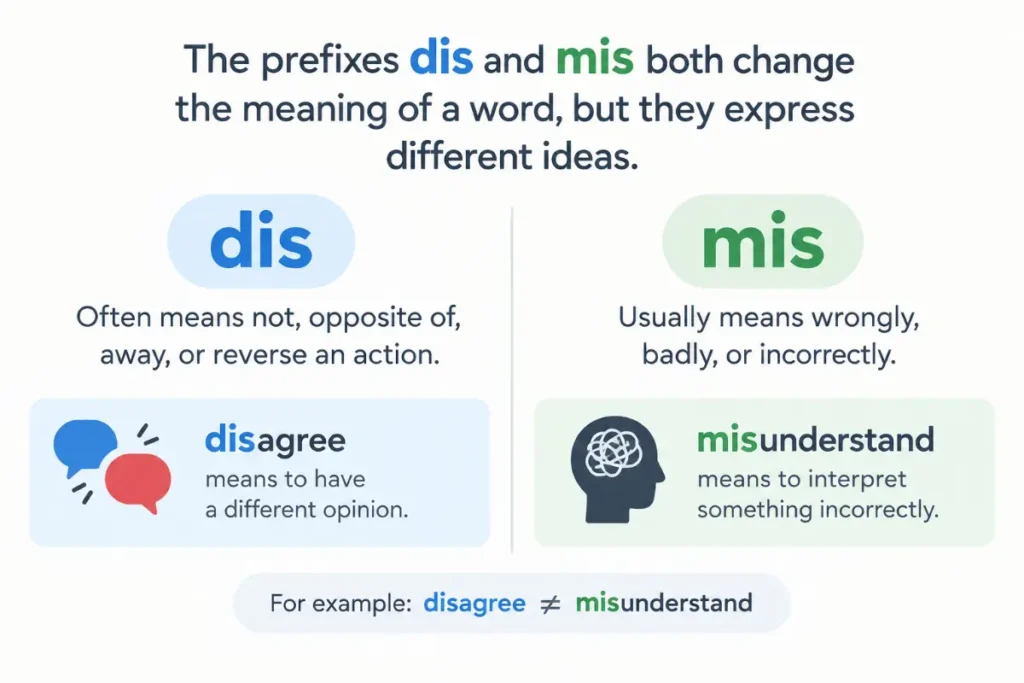
The prefixes dis and mis both change the meaning of a word, but they express different ideas. Dis often means not, opposite of, away, or reverse an action. Mis usually means wrongly, badly, or incorrectly. For example, disagree means to have a different opinion, while misunderstand means to interpret something incorrectly.
What Are Prefixes in English
A prefix is a group of letters added to the beginning of a word to change its meaning. The original word is called the base word or root, depending on its structure. Adding a prefix can create a new word with a related meaning.
For example, the word happy describes a positive feeling. Add the prefix un and you get unhappy, which expresses the opposite feeling. Similarly, agree means to share an opinion, while disagree means to hold a different opinion or express opposition.
Prefixes are common in English. Some express negation, others show time, place, number, repetition, or errors in an action. Learning them helps you recognize how words are built instead of memorizing every word as a separate item.
Here are a few familiar examples.
- Unhappy: not happy.
- Rewrite: write again.
- Preview: view before something happens or is released.
- Misplace: put something in the wrong place.
- Disconnect: separate something that was connected.
The meaning of a prefixed word usually relates to its base word, but it isn’t always possible to work out the full definition from the parts alone. Some words have developed special meanings over time.
What Does the Prefix Dis Mean
The prefix dis has several related meanings. It can express negation, opposition, separation, reversal, or removal. The exact meaning depends on the word it joins.
Dis Meaning Not or Opposite Of
In many words, dis expresses a negative meaning or an opposite action.
For example, dishonest means not honest. Disagree means to hold a different opinion or not agree. Disloyal describes someone who isn’t loyal.
Consider these sentences.
1. The witness gave a dishonest answer.
The prefix changes honest into dishonest, meaning the answer wasn’t truthful.
2. My sister and I disagree about the best route.
Disagree expresses a difference of opinion.
3. The employee was accused of disloyal behavior.
Disloyal describes behavior that goes against loyalty.
In these examples, dis changes the meaning of the base word by introducing opposition or negation.
Dis Meaning Reverse or Undo
The prefix can also suggest reversing an action or undoing a result.
For example, disconnect means to break a connection. Disassemble means to take something apart. Disarm means to remove weapons from someone or something, or to make a threat less dangerous in certain contexts.
Examples include the following.
1. Please disconnect the printer before moving it.
Disconnect means to break the existing connection.
2. The mechanic had to disassemble the engine.
Disassemble means to take the engine apart.
3. The technician disconnected the cable from the computer.
The action reversed the existing connection between the cable and the computer.
The idea of reversal is especially useful when the base word describes an action or a state that can be undone.
Dis Meaning Separation or Removal
Some words with dis express separation or removal.
For example, disembark means to leave a ship, aircraft, or other vehicle. Disengage means to withdraw from involvement or release something from engagement. Dislodge means to move something from its position.
Consider these examples.
1. Passengers began to disembark after the plane landed.
They left the aircraft.
2. The driver disengaged the parking brake.
The driver released the brake mechanism.
3. The wind dislodged a loose tile from the roof.
The tile was moved from its original position.
These meanings show why dis can’t always be translated as simply not. In some words, the prefix describes an action rather than a negative state.
What Does the Prefix Mis Mean
The prefix mis usually means wrongly, badly, incorrectly, or in an unsuitable way. It often appears in words describing mistakes, poor decisions, or incorrect actions.
For example, misunderstand means to understand something incorrectly. Misplace means to put something somewhere and then be unable to find it, or to place it in the wrong location. Misjudge means to form an incorrect opinion or estimate.
Mis Meaning Wrongly or Incorrectly
Many words beginning with mis describe an error.
Examples include misread, miscalculate, misinterpret, misjudge, and misspell.
1. I misread the meeting time.
The speaker read the time incorrectly.
2. She miscalculated the total cost.
She made an error in her calculation.
3. The audience misinterpreted his joke.
The audience understood the joke in a way he didn’t intend.
4. He misspelled the customer’s last name.
He wrote the name incorrectly.
In each example, the prefix signals that an action or result was wrong.
Mis Meaning Badly or Inappropriately
Mis can also describe an action performed badly or in a way that causes problems.
For example, mismanage means to manage something poorly. Misuse means to use something incorrectly or for an unsuitable purpose. Mistreat means to treat someone or something badly.
Examples include these sentences.
1. The company mismanaged its budget.
The company handled its money poorly.
2. Never misuse prescription medication.
Misuse means using medication in a way that isn’t intended or appropriate.
3. The owner was fined for mistreating the animals.
Mistreating means treating the animals badly.
The prefix doesn’t always mean that someone made an innocent mistake. A word such as misuse or mistreat can describe deliberate behavior.
Mis Meaning Faulty Understanding or Judgment
Mis frequently appears in words connected with thinking, communication, and decision making.
For example, misunderstand, misjudge, misinterpret, and misinform all involve incorrect information, understanding, or judgment.
1. I misunderstood your instructions.
I understood them incorrectly.
2. The reporter misinformed the public about the results.
The reporter provided incorrect information.
3. We misjudged how long the trip would take.
We estimated the travel time incorrectly.
These words are useful because they identify the kind of error involved. Misunderstanding concerns comprehension, misjudgment concerns evaluation, and misinformation concerns incorrect information.
The Main Difference Between Dis and Mis Prefixes
The central difference is the idea each prefix adds to the base word.
Dis often expresses opposition, negation, separation, or reversal. Mis usually expresses an error, incorrect action, or poor handling.
| Feature | Dis | Mis |
|---|---|---|
| Main meanings | Not, opposite, separation, reversal | Wrongly, incorrectly, badly |
| Common function | Shows opposition or a change in state | Shows an error or faulty action |
| Example | Disagree | Misunderstand |
| Meaning of example | Have a different opinion | Understand incorrectly |
| Another example | Disconnect | Misplace |
| Meaning of example | Break a connection | Put something in the wrong place |
| Common contexts | Feelings, relationships, states, actions | Thinking, communication, decisions, handling |
| Part of speech | Forms words in several parts of speech | Forms words in several parts of speech |
These are general patterns rather than strict rules for every word. English contains established words whose meanings aren’t fully predictable from their prefixes.
A Simple Way to Tell Them Apart
Ask yourself what kind of meaning the word needs.
If the idea involves opposition, lack, separation, or reversal, dis may fit.
If the idea involves doing something wrongly or understanding something incorrectly, mis may fit.
For example, disapprove means to have an unfavorable opinion of something. Misapprove isn’t the normal standard word for this meaning.
Similarly, miscalculate means to calculate incorrectly. Discalculate isn’t the standard form.
The correct choice depends on the established word, not simply on which prefix seems to fit the sentence.
Dis and Mis Prefixes in Common Words
The easiest way to learn these prefixes is to study familiar examples in context.
Common Words With Dis
- Disagree: to have a different opinion.
- Dislike: to feel negatively about someone or something.
- Dishonest: not honest or truthful.
- Disconnect: to break a connection.
- Disapprove: to consider something wrong or unacceptable.
- Disobey: to fail or refuse to follow an order or rule.
- Disloyal: not faithful or supportive.
- Discontinue: to stop doing or providing something.
- Discomfort: a feeling of physical or emotional unease.
- Disorder: a lack of order or an abnormal condition.
Notice that the meanings aren’t all identical. Dislike expresses a negative feeling, disconnect describes separation, and discontinue means to stop an activity or service.
Common Words With Mis
- Misunderstand: to understand incorrectly.
- Misplace: to put something in the wrong place or lose track of its location.
- Mislead: to cause someone to believe something incorrect.
- Misjudge: to judge incorrectly.
- Misuse: to use something wrongly or inappropriately.
- Mismanage: to manage something poorly.
- Misread: to read something incorrectly.
- Miscalculate: to calculate incorrectly.
- Misinterpret: to explain or understand something incorrectly.
- Misspell: to spell a word incorrectly.
These words share a common pattern. The base word identifies the action or idea, and the prefix signals that something has gone wrong or isn’t being done properly.
Which Prefix Is Correct
Neither prefix is universally better or more correct than the other. The correct choice depends on the word you want to form and the meaning you intend to express.
For example, use disagree when people hold different opinions. Use misunderstand when someone interprets information incorrectly. Both words are standard English, but they describe different situations.
Similarly, disapprove means to regard something unfavorably, while misuse means to use something improperly. Replacing one prefix with the other would change the meaning or create a nonstandard word.
The best approach is to learn established word forms instead of trying to attach either prefix to any base word. Dictionaries and standard usage provide the clearest guide when a word is unfamiliar.
Ten Example Sentences
The following sentences show how these prefixes work in everyday and professional English.
1. I disagree with your suggestion because it would cost too much.
Disagree means the speaker holds a different opinion.
2. She misunderstood the directions and turned left too early.
Misunderstood shows that she interpreted the instructions incorrectly.
3. Please disconnect the charger before cleaning the device.
Disconnect means to break the existing electrical connection.
4. The manager disapproved of the employee’s rude behavior.
Disapproved means the manager viewed the behavior negatively.
5. I misplaced my keys and spent twenty minutes looking for them.
Misplaced means the speaker put the keys somewhere and couldn’t find them.
6. The article misrepresented the results of the study.
Misrepresented means the article presented the results inaccurately.
7. The company decided to discontinue the old product next year.
Discontinue means to stop offering the product.
8. He misjudged the distance and missed the basketball hoop.
Misjudged means he estimated the distance incorrectly.
9. The student received a lower grade because she misspelled several words.
Misspelled means she wrote the words with incorrect spelling.
10. The technician discovered that the machine had been misused.
Misused means the machine had been operated or handled improperly.
These examples also show that the prefixes can appear in different verb forms. Disagree becomes disagreed, while misunderstand becomes misunderstood. The prefix remains part of the word even as the verb changes tense.
You may also want to read Currier vs courier Which Word Is Correct.
Common Mistakes With These Prefixes
Writers often make mistakes when they assume that dis and mis can replace each other. Other errors happen when people misunderstand the meaning of a word or its spelling.
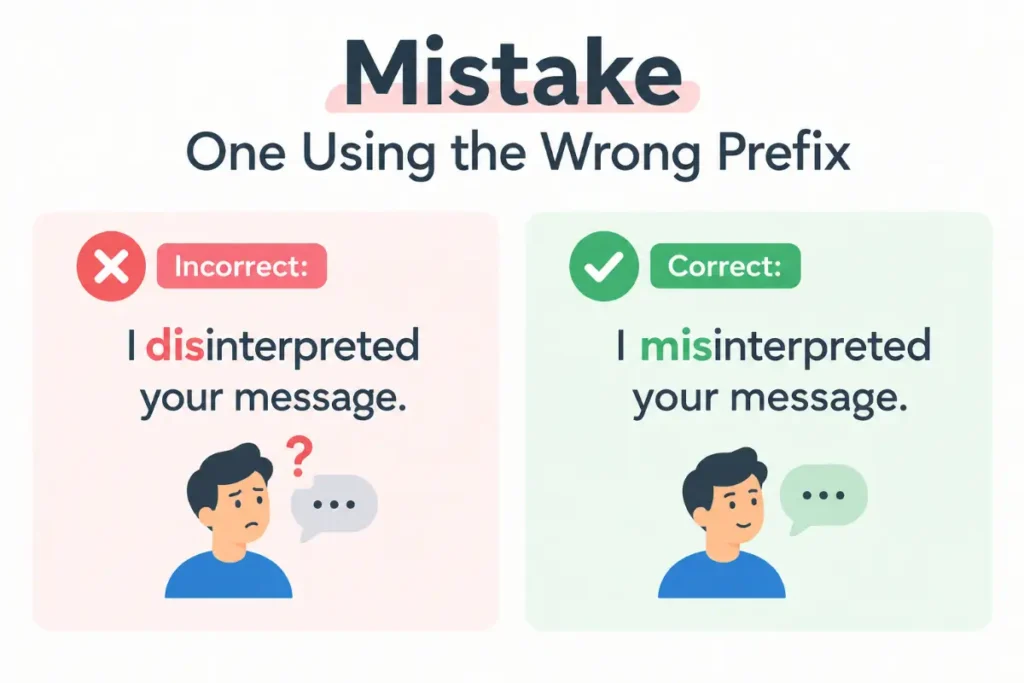
Mistake One Using the Wrong Prefix
Incorrect: I disinterpreted your message.
Correct: I misinterpreted your message.
Misinterpret is the established word for understanding or explaining something incorrectly. Disinterpret isn’t the standard form for this meaning.
Mistake Two Confusing Dislike With Mislike
Incorrect in ordinary modern English: I mislike this movie.
Preferred: I dislike this movie.
Mislike has appeared historically and can occur in some less common or literary usage. However, dislike is the standard choice in modern everyday American English.
Mistake Three Writing Misagree Instead of Disagree
Incorrect: I misagree with the decision.
Correct: I disagree with the decision.
Disagree is the established word for expressing a different opinion. Misagree isn’t the standard modern form.
Mistake Four Using Dis Instead of Mis
Incorrect: I discalculated the total.
Correct: I miscalculated the total.
Miscalculate means to calculate incorrectly. Discalculate isn’t the standard word for this meaning.
Mistake Five Assuming Every Prefix Has One Meaning
A common error is to memorize dis as not and mis as wrong, then apply those meanings mechanically.
For example, disconnect doesn’t simply mean not connected in every context. It often describes the action of breaking a connection. Likewise, mislead doesn’t mean not lead. It means to lead someone toward a false belief or incorrect understanding.
Learning words in context is more reliable than applying a single definition to every word.
Pronunciation Guide
The prefixes have clear pronunciation patterns, although the sound of the full word can vary.
How to Pronounce Dis
The prefix dis is commonly pronounced /dɪs/ in words such as disagree, dislike, and disconnect.
An easy guide is diss.
Examples.
- Disagree: dis + a + gree.
- Dislike: dis + like.
- Disconnect: dis + con + nect.
The pronunciation of the full word depends on its syllables and stress pattern. In disagree, the main stress usually falls on the final syllable.
How to Pronounce Mis
The prefix mis is commonly pronounced /mɪs/ in words such as misplace, misread, and misjudge.
An easy guide is miss.
Examples.
- Misplace: mis + place.
- Misread: mis + read.
- Misjudge: mis + judge.
The word misread needs special attention because its pronunciation changes with tense. In the present tense, read is pronounced like reed. In the past tense, read is pronounced like red. The spelling remains the same.
Common Pronunciation Errors
Some learners confuse the short vowel sounds in dis and mis. Both usually contain the short /ɪ/ sound, as in sit. Neither prefix normally uses the long vowel sound found in see.
Listening to complete words can help you recognize the pattern. Pay attention to the pronunciation of the base word too, since adding a prefix doesn’t always make every syllable equally clear or equally stressed.
Etymology and Word Origin
Both prefixes have historical roots in older languages, which helps explain their modern meanings.
Origin of Dis
English dis comes through Latin and French forms associated with separation, reversal, or negation. It appears in many words that entered English through French or Latin, including forms related to disagreement, separation, and removal.
Over time, English speakers also used dis to form new words from existing English bases. This helped create familiar combinations such as disconnect and disapprove.
Origin of Mis
Mis developed from forms found in Old English and related Germanic languages. Its historical meanings were connected with wrongness, error, or an unfavorable action. It became a productive prefix in English, meaning speakers could use it to create words that describe mistakes or poor actions.
Words such as misread and misjudge make this meaning easy to see. The prefix changes the base word by indicating that the action wasn’t performed or understood correctly.
Although the histories differ, both prefixes became important parts of English word formation. Their modern meanings overlap in a few areas, but they aren’t interchangeable.
Regional Usage
The general meanings of these prefixes remain stable across major English varieties. American, British, Canadian, and Australian English all use words such as disagree, disconnect, misunderstand, and misplace.
American English
In the United States, both prefixes are common in everyday conversation, workplace communication, education, and formal writing.
Examples include disagree with a decision, disconnect a device, misread a message, and mismanage a budget. These are standard forms in American English.
British English
British English uses the same basic patterns. There isn’t a major regional difference in the meanings of dis and mis.
Some individual words may differ in frequency or context, but the prefix rules are broadly shared.
Canadian and Australian English
Canadian and Australian English also use these prefixes in the same general way. Writers can use standard forms such as disapprove, misinterpret, and miscalculate without needing a regional alternative.
The main lesson is that the distinction depends on meaning rather than nationality.
Grammar Rules and Word Formation
Understanding how prefixes interact with grammar can make your writing more accurate.
Prefixes Usually Stay Attached to the Word
In standard English, dis and mis are usually written directly before the base word without a space.
Correct forms include disagree, disconnect, misplace, and misunderstand.
Incorrect forms for ordinary usage include dis agree and mis place.
Some specialized expressions and historical forms may differ, but common prefixed words are generally written as one word.
Prefixes Can Form Different Parts of Speech
These prefixes don’t only create verbs. They also appear in adjectives and nouns.
For example, dishonest is an adjective, disagreement is a noun, misleading can be an adjective or a verb form, and misuse can be a noun or a verb.
Consider these sentences.
1. The employee gave a dishonest answer.
Dishonest is an adjective describing the answer.
2. Their disagreement lasted for an hour.
Disagreement is a noun describing a difference of opinion.
3. The advertisement was misleading.
Misleading is an adjective describing the advertisement.
4. The misuse of company funds caused serious problems.
Misuse is a noun describing improper use.
The prefix changes meaning, while the complete word determines its grammatical role.
Verb Tenses Can Change the Base Form
When a prefixed word is a verb, normal tense rules usually apply.
Disagree becomes disagreed and disagreeing.
Misjudge becomes misjudged and misjudging.
Misunderstand becomes misunderstood and misunderstanding.
Notice that misunderstand has an irregular past tense because the base verb understand is irregular. The prefix doesn’t remove that pattern.
Don’t Add a Prefix Just Because It Seems Logical
English word formation isn’t completely predictable. A prefix may fit the general meaning you want, but the resulting combination may not be an established word.
For example, misagree might seem logical if someone understands the idea of mis as wrong. However, disagree is the standard word for expressing a different opinion.
When you aren’t sure, check the whole word rather than relying only on the meaning of its parts.
Real Life Usage Examples
These prefixes appear in ordinary conversations, workplace messages, academic writing, news reports, and stories.
Daily Conversation
1. I misunderstood what you meant, so I’m sorry.
2. I disagree, but I understand your point.
The first sentence describes a communication error. The second expresses a different opinion without suggesting that anyone made a mistake.
Workplace Communication
1. The supervisor asked the staff not to misuse company equipment.
2. Please disconnect your computer before the maintenance team arrives.
Misuse describes improper handling. Disconnect describes breaking an existing connection.
Academic Writing
1. The researcher warned that readers could misinterpret the results.
2. The report identified several reasons for disagreement among the experts.
Misinterpret concerns incorrect understanding, while disagreement concerns differences in opinion.
News and Journalism
1. Officials said the public had been misinformed about the new policy.
2. The company will discontinue the service at the end of the year.
Misinformed means given incorrect information. Discontinue means to stop providing something.
Literature and Storytelling
1. The hero discovered that his closest friend had misled him.
2. The villagers disobeyed the king’s order.
Misled suggests that the hero was led toward a false belief. Disobeyed means the villagers failed or refused to follow the order.
These examples show that the prefixes often carry a strong clue about the action, but the complete word still provides the precise meaning.
Related Prefixes and Confused Terms
Other prefixes can express ideas similar to those of dis and mis. Learning the differences helps you choose words more precisely.
Un
Un often expresses negation or the opposite of a quality.
For example, unhappy means not happy, and unfair means not fair. Unlike mis, un doesn’t usually suggest that someone made a mistake.
In
In can mean not when used in words such as inactive or incorrect. Its form may change to im, il, or ir depending on the following sound, as in impossible, illegal, and irregular.
Non
Non usually means not or lacking a particular feature. For example, nonessential means not essential, and nonfiction refers to writing presented as factual rather than invented.
Re
Re often means again or back. Rewrite means to write again, while reconnect means to connect again.
De
De can express removal, reversal, or reduction in words such as deactivate and defrost. Its meaning depends on the word and context.
Mal
Mal often expresses something bad or faulty. Malfunction means to fail to work properly, while malnutrition refers to poor or inadequate nutrition.
Anti
Anti usually means against or opposed to something. Antisocial can have different meanings depending on context, while antiwar describes opposition to war.
Over and Under
Over often means too much or above a usual amount, as in overcook. Under can mean too little or below a normal level, as in undercook.
These prefixes don’t all serve the same purpose. They offer different ways to express negation, repetition, opposition, mistakes, excess, or shortage.
Expert Editor Insight
An experienced editor looks at meaning before choosing a prefix. The fact that dis and mis can both create words with negative meanings doesn’t make them interchangeable. Spellcheckers may catch an unrecognized form, but they can’t always tell if a correctly spelled word expresses the intended meaning. For instance, disagree and misinterpret are both valid words, yet they describe different situations. The safest editing habit is to check the complete sentence and ask what the writer intends to say.
You may also want to read Brite vs Bright Which Spelling Should You Use in 2026.
Conclusion
The prefixes dis and mis help you understand how English words express different kinds of negative meaning. Dis often signals opposition, separation, removal, or reversal, while mis usually points to an error, incorrect understanding, or improper action. The distinction becomes clear when you compare words such as disagree and misunderstand or disconnect and misplace.
To choose the right form, focus on the meaning of the complete word rather than guessing from the prefix alone. Learn familiar examples, pay attention to how each word appears in real sentences, and check a dictionary when you’re unsure. A simple memory tip can help: dis often points to opposition or reversal, while mis points to something going wrong.
FAQs
What is the main difference between dis and mis prefixes?
Dis often expresses opposition, negation, separation, or reversal. Mis usually indicates that something was done wrongly, understood incorrectly, or handled badly. For example, disconnect means to break a connection, while misconnect is not the usual word for that action. Learning common words in context is the best way to recognize the distinction.
Does dis always mean not?
No. Dis can mean not or the opposite of something, but it can also suggest separation, removal, or reversal. Disagree expresses a difference of opinion, while disconnect describes breaking a connection. The meaning depends on the complete word, so it’s better to learn the common patterns than to treat dis as having only one meaning.
Does mis always mean a mistake?
Mis often signals an error or incorrect action, but it can also describe poor or inappropriate treatment. Misread means to read incorrectly, while mistreat means to treat someone badly. Some actions may be deliberate rather than accidental. The prefix indicates a problem with the action, but it doesn’t always tell you the person’s intention.
Can dis and mis be used interchangeably?
No. These prefixes form established words with different meanings. Disagree is the standard word for having a different opinion, while misunderstand means to interpret something incorrectly. Replacing one prefix with the other may change the meaning or produce a nonstandard form. Always consider the intended meaning and the accepted spelling of the complete word.
What are five common words with dis?
Five common examples are disagree, dislike, dishonest, disconnect, and disapprove. Disagree means to hold a different opinion. Dislike expresses a negative feeling. Dishonest means not truthful, disconnect means to break a connection, and disapprove means to regard something unfavorably. These examples show that the prefix can express several related ideas.
What are five common words with mis?
Five common examples are misunderstand, misplace, mislead, misjudge, and misuse. Misunderstand means to interpret something incorrectly. Misplace means to put something in the wrong location or lose track of it. Mislead means to cause a false belief, misjudge means to judge incorrectly, and misuse means to use something improperly.
How do you pronounce dis and mis?
Dis is commonly pronounced /dɪs/, with the short vowel sound heard in sit. Mis is commonly pronounced /mɪs/, with the same short vowel sound. Both usually remain attached to the base word without a space. The stress pattern depends on the complete word, so listening to examples such as disagree and misunderstand can help.
Are these prefixes used the same way in American and British English?
Yes. The main meanings and word formation patterns are broadly the same in American and British English. Both varieties use standard words such as disagree, disconnect, misread, and miscalculate. There may be differences in how often particular expressions appear, but there is no major regional difference in the core distinction between the two prefixes.