
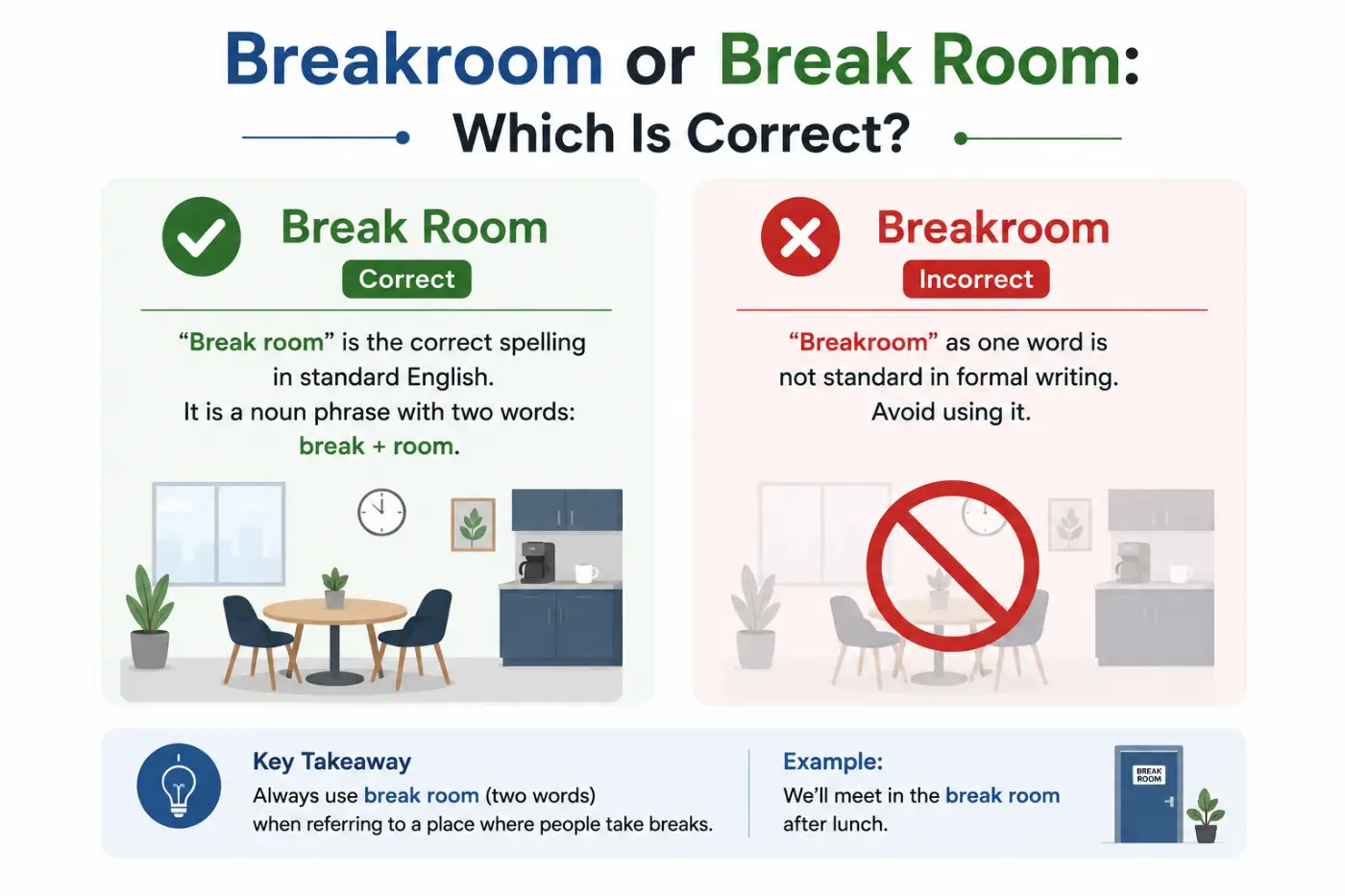
If you’re unsure about breakroom or break room, both spellings are acceptable in English. The phrase refers to a shared space where employees can relax, eat, drink coffee, or take a short rest during the workday. In American English, break room is a clear and widely used choice, especially in general and professional writing.
The confusion comes from a common feature of English. Two words can gradually combine into one without changing their basic meaning. English has many examples of this pattern, including workplace terms and everyday compound words. Dictionaries and style guides may also differ in the forms they prefer.
For most writers, the best approach is simple. Use break room in workplace emails, employee handbooks, business documents, and general writing unless your organization follows a different spelling convention. If your company consistently uses breakroom, you can follow that style instead. Consistency matters more than treating one accepted form as an error.
This guide explains the meaning, spelling, pronunciation, grammar, regional usage, common mistakes, and practical examples so you can choose the right form with confidence.
Need another quick comparison? Read christmases or christmass Correct Spelling and Usage.
Quick Answer
Both breakroom and break room are acceptable spellings of the same workplace term. The two word form is a dependable choice for American English, while the one word form also appears in modern usage. Neither spelling is automatically incorrect. Choose one form and use it consistently throughout your document.
Featured Snippet Definition
A break room is a shared area in a workplace where employees can rest, eat lunch, make coffee, socialize, or take a short break from their duties. The term can appear as two words, break room, or as one word, breakroom. Both forms communicate the same basic meaning.
Comparison Table for Break Room and Breakroom
| Feature | Break room | Breakroom |
|---|---|---|
| Spelling | Two words | One word |
| Meaning | A shared employee rest area | A shared employee rest area |
| Part of speech | Compound noun | Compound noun |
| Grammatical role | Names a place | Names a place |
| American English | Standard and widely used | Also accepted in usage |
| Formal writing | A dependable choice | Suitable when consistent with house style |
| Pronunciation | Same pronunciation | Same pronunciation |
| Typical contexts | Offices, factories, hospitals, schools | Workplace signs, company materials, general writing |
| Example | The break room is upstairs. | The breakroom is upstairs. |
The central distinction is spelling, not meaning. The two forms describe the same type of space, so you don’t need to change your sentence structure when switching between them.
Meaning and Definition
The term describes a designated area where people at work can step away from their duties for a short time. Employees might use the space to eat a meal, heat leftovers, refill a water bottle, prepare tea, or chat with coworkers. Some workplaces provide tables and chairs, while others offer a refrigerator, microwave, coffee machine, or comfortable seating.
The room serves a practical purpose. It gives employees a place to recharge without leaving the workplace or using their main work area for meals and personal breaks.
What Does Break Room Mean
Break room is a compound noun made from the word break and the word room. The first word refers to a pause in an activity, while the second refers to an enclosed or designated space. Together, they name a place where people can take a break.
For example, a nurse might eat lunch in the hospital break room. An office employee might refill a coffee cup there before returning to a meeting. A warehouse worker might sit down during an approved rest period.
The phrase usually refers to a shared workplace area rather than a private office or a public restaurant. However, its exact features depend on the employer and the type of workplace.
What Does Breakroom Mean
Breakroom has the same meaning as break room. It combines the two elements into one written word without changing the pronunciation or grammatical function.
A company might label a room Breakroom on its office map or use the closed form in employee communications. Another company might write Break Room on its door. Both labels tell employees where they can go to rest.
The closed spelling isn’t automatically a typo. It represents a compound noun written as one word. Since English spelling conventions can vary across dictionaries, publications, and organizations, the preferred form may depend on the style a writer follows.
Is Breakroom a Real Word
Yes. Breakroom appears as a closed compound in modern English usage. Its existence doesn’t make the two word form incorrect, and the presence of a space doesn’t make the open compound less legitimate.
English contains many compounds with competing open and closed spellings. Writers may encounter differences in how dictionaries and publishers handle these forms. The key is to check a reliable dictionary or the relevant style guide if a particular document requires a formal standard.
Key Differences Explained
The two spellings share a meaning, but a few practical details help explain how to use them.
Spelling
The most obvious difference is the space between the two elements.
- Break room contains two separate written words.
- Breakroom combines the same elements into one word.
Neither spelling requires a change in capitalization in the middle of a sentence. For example, you can write The break room is closed or The breakroom is closed. Both sentences are grammatically sound.
Meaning
There is no established difference in meaning between the two forms. Both refer to a workplace area intended for rest, meals, or informal interaction.
You don’t need to use one spelling for eating and another for relaxing. The choice doesn’t tell readers anything about the size of the room, the amenities it contains, or the length of an employee’s break.
Grammar
Both forms function as nouns. They can appear as the subject or object of a sentence, and they can follow a preposition.
Consider these examples.
- The break room needs new chairs.
- Employees gathered in the breakroom.
- Please clean the break room after lunch.
- She left her lunch bag in the breakroom.
The grammar stays the same regardless of the spelling.
Pronunciation
Both forms have the same standard pronunciation. The space in the two word version doesn’t create a different sound, and closing the compound doesn’t add a syllable.
Speakers generally pronounce the phrase as two spoken elements, with the main stress on break. Natural speech may connect the sounds closely, which can make the phrase sound like one word.
Formality
Both spellings can appear in professional settings. However, break room is a practical default for formal American English because it clearly separates the two familiar words.
The closed form can also work in professional writing, particularly when a business, publisher, or organization consistently uses it. Avoid changing spellings randomly within the same employee handbook or website.
Regional Usage
The basic meaning remains the same across major varieties of English. American writers commonly use the open form, while the closed form also appears in English language materials. There isn’t a reliable basis for claiming that one spelling belongs exclusively to the United States and the other exclusively to Britain or Australia.
Which Form Is Correct
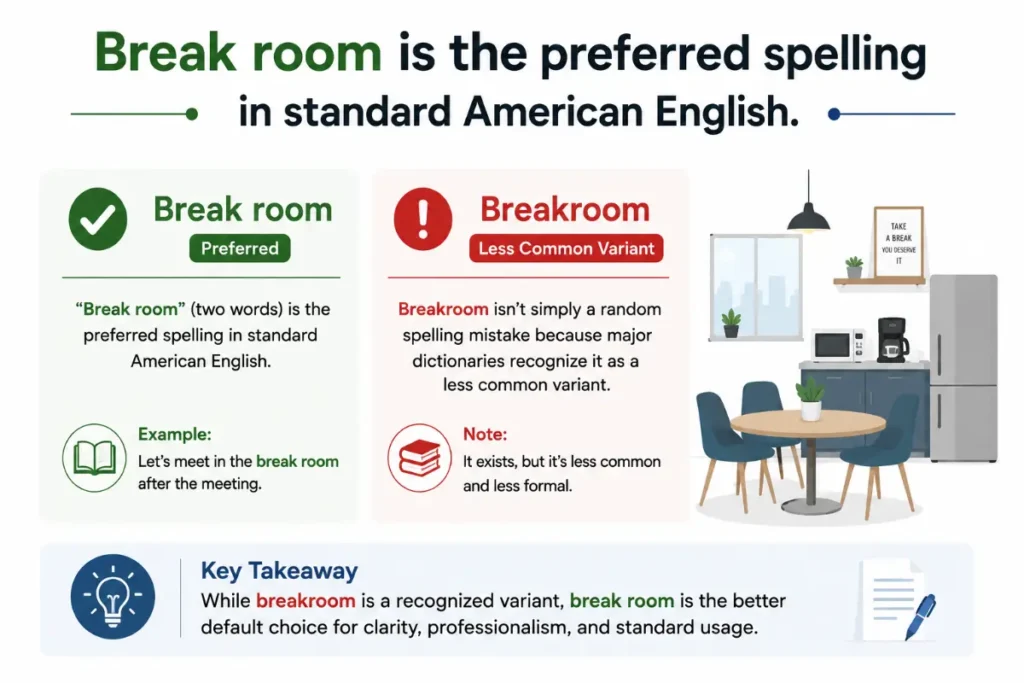
Both forms are acceptable, so you don’t need to correct one simply because it differs from the other. If you need one consistent spelling for a document aimed at American readers, choose break room.
This recommendation reflects a practical editorial choice rather than a claim that the closed spelling is wrong. Standard English contains open, closed, and hyphenated compounds, and usage conventions vary from term to term. A familiar compound doesn’t always follow the same pattern as another compound with similar parts.
How Dictionaries Help
Dictionaries record established usage and identify preferred spellings when a clear preference exists. Some entries include alternative spellings, while others direct readers from one form to another. Their treatment can differ by publisher and edition.
If you are preparing a formal document, consult a current dictionary and your organization’s style guide. Follow the preferred form specified by the source you use. If no source establishes a preference, choose the form that reads clearly and apply it throughout.
How to Choose for Workplace Writing
Use these practical rules when editing business content.
- For a general American audience, use break room as your default.
- For company materials, follow the spelling used in the employee handbook, internal templates, and workplace signs.
- For a publication, follow its house style rather than introducing a new convention.
- For a document that already uses breakroom consistently, don’t change every instance unless an editor or style guide requires it.
- For signs and labels, prioritize clarity and match the wording used in the rest of the building.
These rules prevent unnecessary corrections and keep your writing consistent.
Sentence Examples
The following examples show how the preferred two word spelling works in everyday and professional English.
- I’ll meet you in the break room after lunch.
- The break room has a new refrigerator and microwave.
- Please wipe the table after eating in the break room.
- Our manager asked the team to keep the break room clean.
- I left my water bottle on the break room counter.
- The break room is closed while the maintenance crew repairs the sink.
- Employees can store their lunches in the break room refrigerator.
- The company added comfortable chairs to the break room last month.
- During orientation, new employees learned where to find the break room.
- The updated office map shows the break room beside the conference area.
Each sentence uses the same grammatical pattern that would apply to the closed spelling. You can replace break room with breakroom in these examples without changing their meaning.
Common Mistakes and Misspellings
Most errors involving this term come from inconsistent spacing, confusion about compound nouns, or accidental changes in capitalization. Here are five issues to watch for.
1. Switching spellings within one document. Writing break room in one paragraph and breakroom in the next can look careless. Choose a preferred form and apply it consistently unless you are quoting a source that uses another spelling.
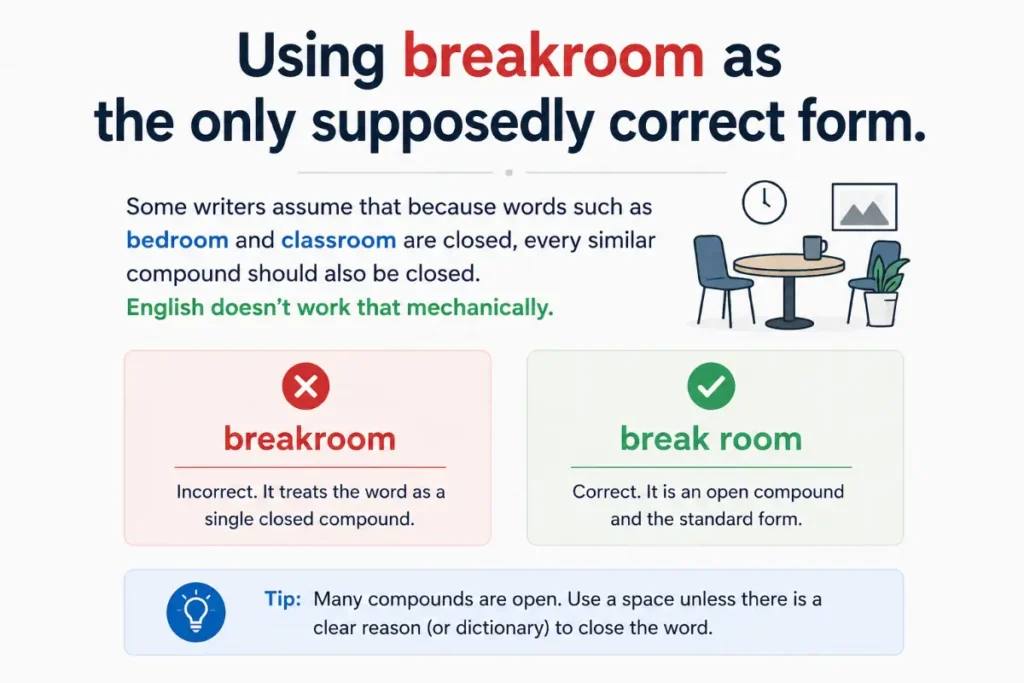
2. Treating the closed form as a definite misspelling. Some writers assume that every compound must remain two words. English doesn’t follow that rule. Since the closed form also appears in established usage, avoid correcting it automatically.
3. Adding an unnecessary hyphen. The spelling break-room is generally unnecessary in ordinary American workplace writing. Use break room or breakroom instead, unless a specific publication or house style directs otherwise.
4. Confusing the noun with a verb phrase. In a sentence such as We need a break room, the phrase names a place. In Take a break in the room, the word break is a noun and room is part of a separate phrase. The meaning and sentence structure differ.
5. Capitalizing the phrase in the middle of a sentence. Ordinary references generally use lowercase letters. Write Please meet me in the break room rather than Please meet me in the Break Room, unless the words form an official label or appear in a title.
A quick spelling check can catch spacing and capitalization problems. Still, automated tools may flag a valid alternative because their dictionaries or language settings prefer another form.
Need another quick comparison? Read Home Made Or Homemade Which One Is Correct?(2026).
Pronunciation Guide
Both spellings have the same pronunciation in American English. The phrase has two syllables in its main spoken pattern, with the strongest stress on the first element.
American English pronunciation
/ˈbreɪk ˌruːm/
Easy pronunciation: BRAYK room.
Spoken syllables: break + room.
Stress: The strongest stress falls on break.
The IPA transcription represents a common American pronunciation. The second element may receive some secondary stress, depending on the speaker and sentence.
How to Say It Naturally
Start with the long A sound in break, as in day or make. Then move into room, using the vowel sound you hear in common American pronunciations of the word room. Connect the two parts smoothly without inserting a pause simply because the written form contains a space.
The most common pronunciation mistake is to overthink the spelling and try to pronounce breakroom differently from break room. The written space doesn’t change the spoken form. Both spellings represent the same expression.
Etymology and Word Origin
The phrase combines two long established English words. Break has several meanings, including a pause in an activity, while room refers to a space within a building or another designated area. In this compound, the words work together to describe a place used during a pause from work.
The word break developed through earlier forms of English and has roots in older Germanic language history. Room entered English through historical language forms associated with a space or place. Over time, English speakers combined familiar words to name places with specific functions.
The workplace meaning follows a straightforward pattern. People needed a name for a shared area where employees could step away from their tasks, so the words break and room expressed the purpose clearly.
The open and closed spellings reflect different ways of writing a compound. English compounds can remain separate, become one word, or use a hyphen. Their development doesn’t always follow a fixed timeline, and the spelling alone doesn’t prove a difference in meaning.
There is no need to assign a precise date to the first use of either spelling without reliable historical dictionary evidence. For everyday writing, the important point is that both forms communicate the same modern workplace concept.
Regional Usage
The term is easy to understand across English speaking regions. Differences in spelling preference may appear in individual publications and organizations, but the underlying meaning stays stable.
American English
In the United States, break room is a familiar form in offices, schools, hospitals, factories, and other workplaces. It works well in general writing and is a dependable choice for employee handbooks, emails, signs, and business documents.
Breakroom also appears in American usage. Some businesses prefer the closed form for branding or internal consistency. If a company already uses that spelling across its signs and employee materials, there is usually no practical reason to change it without a clear editorial requirement.
British English
British English speakers can understand both forms. The open compound is a clear choice, although individual publishers and workplaces may use the closed form.
The more noticeable difference may be vocabulary for workplace facilities. Some organizations may refer to a staff room, particularly in schools or other institutions. That phrase can overlap with the meaning of a rest area, but local usage and the room’s purpose determine the best term.
Australian English
Australian English also uses familiar workplace terms such as staff room and lunchroom. The best expression depends on the setting. A shared employee area may be called a break room, while a school staff room often serves as a place for teachers to prepare lessons, eat, and meet colleagues.
There is no need to claim that one spelling is uniquely Australian. Follow the wording used by the organization or publication.
Canadian English
Canadian readers generally understand the term in both forms. American and Canadian workplace vocabulary often overlaps, though individual organizations can establish their own conventions.
For a document intended for a Canadian audience, check the relevant workplace terminology and house style. The two spellings still refer to the same basic concept.
Grammar Rules and Part of Speech
Both forms function as compound nouns. They name a place rather than describe an action, so the same basic grammar rules apply.
Using the Phrase as a Noun
A compound noun can act as the subject or object of a sentence.
- The break room is on the second floor.
- Management renovated the breakroom.
- Employees gathered in the break room before the training session.
In each example, the phrase names a physical location.
Using Articles and Prepositions
The phrase usually takes an article when you refer to a particular room for the first time or when the sentence requires one.
- A new break room will open next month.
- The break room is available to all employees.
- Please leave your lunch in the break room refrigerator.
- We talked in the breakroom after the meeting.
Use a or the according to the meaning. Use in when describing an activity that happens inside the space, and use to when describing movement toward it.
For example, I went to the break room describes movement. I ate lunch in the break room describes the location of the activity.
Singular and Plural Forms
For the open spelling, the usual plural is break rooms. For the closed spelling, the usual plural is breakrooms.
Examples include The building has two break rooms and The company operates three breakrooms. The plural doesn’t change the basic meaning or the grammatical role.
Using the Term Before Another Noun
The phrase can also modify another noun, as in break room rules or break room furniture. In these examples, it helps identify the type of rules or furniture being discussed.
English often uses nouns to modify other nouns. You don’t need to add an apostrophe to show possession when the phrase simply identifies the purpose of an item. Break room furniture means furniture intended for that space, not furniture owned by a person named Break.
Capitalization and Punctuation
Use lowercase letters in ordinary sentences. Capitalize the phrase when it starts a sentence or appears in a title that follows title case. For a sign, follow the building’s labeling style.
Avoid inserting a hyphen into the ordinary expression. A hyphen doesn’t normally improve clarity in this case.
Real Life Usage Examples
The term appears in many everyday settings. The following examples show how context affects the sentence while the meaning stays the same.
Daily Conversation
- Can you save me a seat in the break room?
- I’ll grab my lunch from the breakroom and join you.
These examples sound natural in casual conversation. The speaker doesn’t need to explain the term because the context makes the meaning clear.
Email and Workplace Communication
- Please return the coffee supplies to the break room after the staff meeting.
- The breakroom will be unavailable from noon to two while the floor is being repaired.
Workplace messages benefit from direct wording. If a company uses one spelling in its official materials, match that choice in employee emails.
Academic Writing
- The researchers observed how employees used the shared break room during scheduled rest periods.
- The workplace design included a breakroom near the main staff entrance.
In academic writing, use the term only when it accurately describes the facility being studied. If the space serves a different purpose, a more precise term may be better.
News and Journalism
- The company plans to renovate its break room as part of a larger office upgrade.
- Employees gathered in the breakroom after management announced changes to the work schedule.
News writing values clarity and consistency. Editors should follow the publication’s style guide rather than alternate between spellings without reason.
Literature and Storytelling
- Maya slipped into the break room to collect her thoughts before the difficult conversation.
- The old breakroom smelled of fresh coffee and the rain-soaked jackets hanging by the door.
In storytelling, the room can do more than provide a setting. It can give characters a quiet place to reflect, share information, or connect with coworkers away from their main duties.
Related and Confused Terms
Several workplace expressions have a similar meaning, but they don’t all refer to exactly the same kind of space.
1. Staff room. A shared area for employees, especially teachers and staff in schools or institutions. Its use may extend beyond meals and short breaks.
2. Lunchroom. A place where people eat lunch. Some lunchrooms provide tables and food service, while others serve the same basic function as an employee rest area.
3. Employee lounge. A shared area designed for staff to relax. The term can suggest more comfortable seating or a larger space, though this isn’t guaranteed.
4. Lounge. A general term for a place to sit and relax. It may be open to visitors, customers, or the public rather than limited to employees.
5. Cafeteria. A place where people can obtain or eat meals, often with a serving line or food service. A cafeteria usually serves a different purpose from a small staff rest area.
6. Kitchenette. A small kitchen area with basic facilities for preparing food and drinks. It may be part of a break room or a separate space.
7. Rest area. A broad term for a place where people can pause and relax. It may refer to a workplace facility, a public roadside stop, or another setting.
8. Common room. A shared space used by a group, such as students, residents, or employees. It may support socializing and meetings as well as rest.
Choose the term that describes the actual space. A small room with a microwave may be a break room, while a staffed dining facility with a serving line is more accurately described as a cafeteria.
Expert Editor Insight
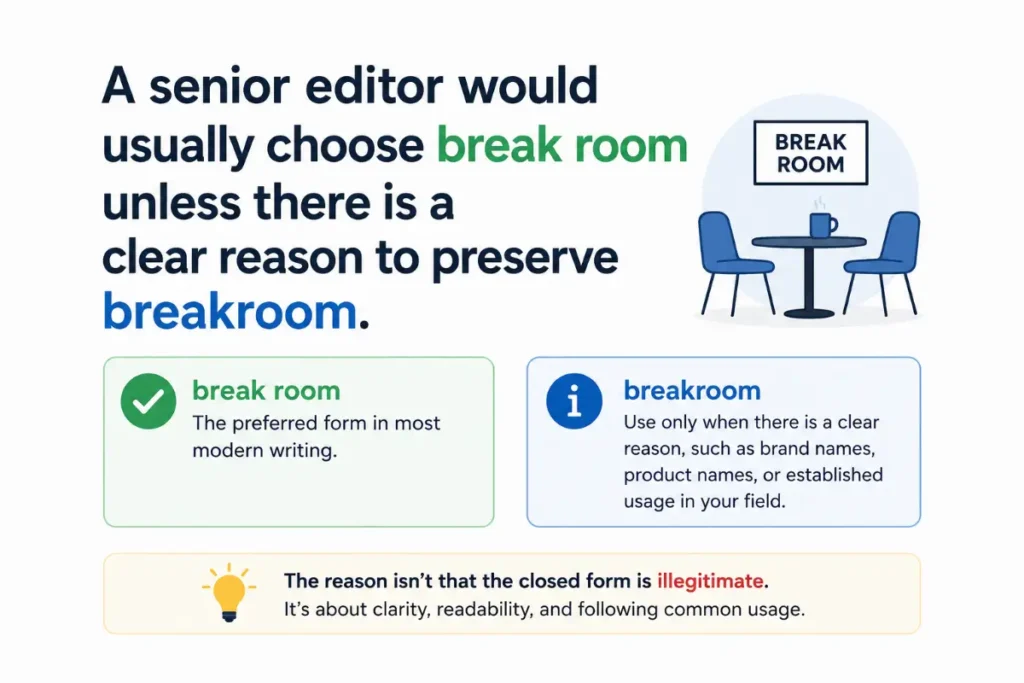
An experienced editor looks at meaning, audience, and consistency before changing a compound noun. The open spelling is a safe choice for general American writing, but the closed form shouldn’t trigger an automatic correction. Spelling tools may favor one version because of their dictionary settings, not because the other form is always wrong. My practical advice is to set a preferred spelling in your style guide, check it during editing, and avoid spending time correcting an accepted alternative that doesn’t affect clarity.
For another common grammar confusion, see Focussing or Focusing Which Spelling Is Correct 2026.
Conclusion
The choice between breakroom or break room comes down to spelling preference rather than meaning. Both forms refer to a shared workplace area where employees can eat, relax, and take a short rest. For American English, break room is a dependable choice for professional documents and everyday writing, while breakroom remains an accepted alternative.
The easiest way to avoid confusion is to follow one simple editing rule. Choose a spelling, check your organization’s style guide, and keep the same form throughout your document. You don’t need to correct every closed compound automatically. Clear writing depends on accurate meaning, consistent spelling, and language that readers understand without effort.
FAQs
Is Breakroom One Word or Two Words?
Both forms are accepted. Break room uses two words, while breakroom combines them into one. They have the same meaning and pronunciation. For general American English, break room is a clear default, particularly in formal workplace documents. If your company or publisher uses the closed form consistently, following that convention is also reasonable.
What Does Break Room Mean?
A break room is a shared workplace space where employees can rest, eat, drink coffee, or spend time away from their regular duties. It may include tables, chairs, a refrigerator, a microwave, or other basic amenities. The room’s exact features depend on the workplace, but its main purpose is to provide employees with a convenient place to take a break.
Is Breakroom a Real Word?
Yes. Breakroom is an established closed compound used in modern English. It isn’t automatically a misspelling of break room. The two forms describe the same type of space, although a particular dictionary, publisher, or employer may prefer one spelling. If you’re editing professional content, follow the relevant style guide instead of treating every difference in spacing as an error.
Which Is Better for American English?
Break room is a reliable choice for American English, especially in employee handbooks, workplace emails, reports, and general business writing. Breakroom also appears in American usage. The best choice for a particular organization depends on its editorial standards. If no standard exists, choose the open form and use it consistently throughout the document.
How Do You Pronounce Break Room?
Both forms are pronounced the same way. In American English, the phrase is commonly represented as /ˈbreɪk ˌruːm/. Say break with the long A sound heard in make, followed by room. The main stress falls on break. The written space doesn’t require a pause, and combining the words in writing doesn’t create a new pronunciation.
Can Break Room Start a Sentence?
Yes. You can begin a sentence with the phrase by using the normal capitalization rules. For example, Break room access is available to all employees. The first word begins with a capital letter because it starts the sentence, not because the expression is a special name. In the middle of a sentence, ordinary references generally use lowercase letters.
What Is Another Word for Break Room?
Useful alternatives include staff room, employee lounge, lunchroom, and common room. The best choice depends on the facility. A lunchroom focuses on eating, while a lounge often suggests a place to relax. A staff room is common in some schools and institutions. These terms overlap in meaning, but they aren’t always interchangeable in every workplace.
Is Break Room Appropriate in Formal Writing?
Yes. Break room is suitable for formal writing because it clearly names a familiar workplace facility. You can use it in reports, policy documents, employee handbooks, and professional correspondence. Keep the spelling consistent and follow your organization’s style guide. You don’t need to replace the term with a more complicated expression to make your writing sound professional.