
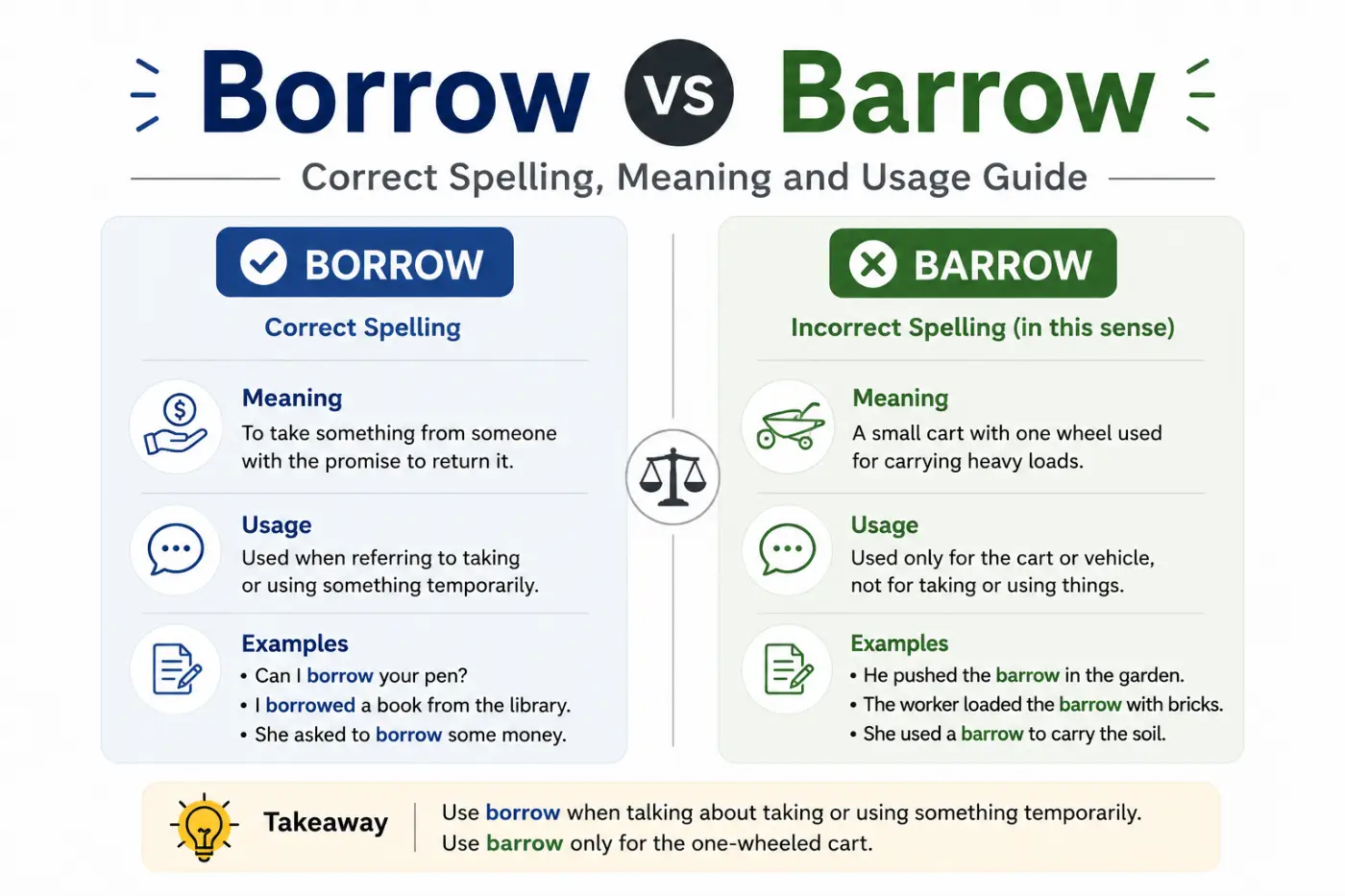
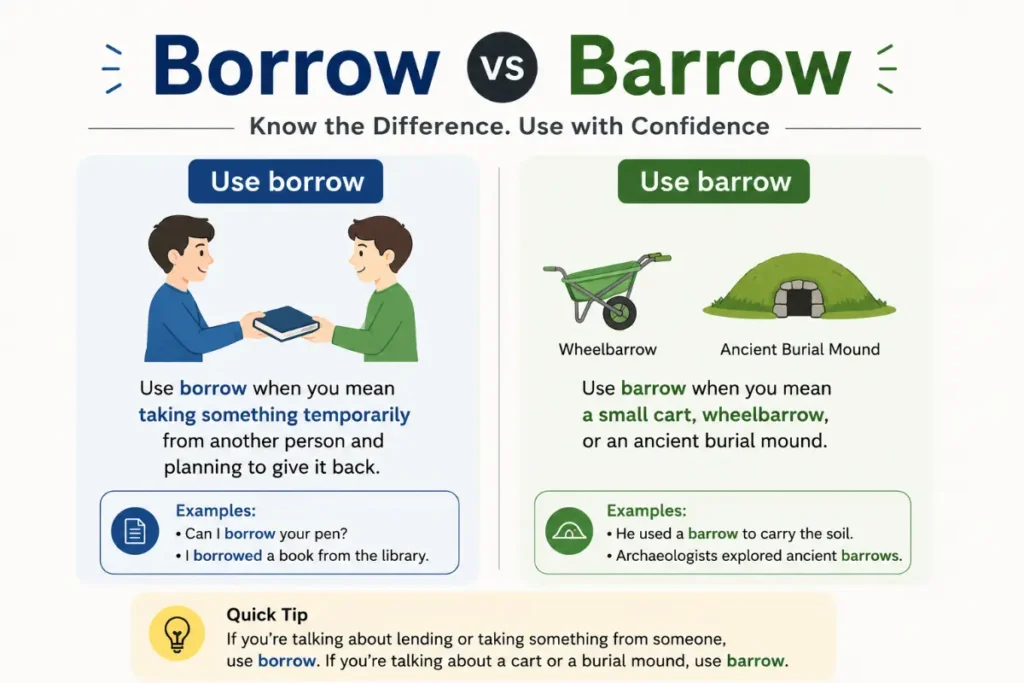
Confusing borrow vs barrow is easy because the two words sound similar in American English. However, they have different meanings and serve different purposes in a sentence. Borrow means to take something from another person with the intention of returning it. A barrow is a type of cart used to carry or move items. The word also has a historical meaning related to an ancient burial mound.
The main difference is simple. You borrow a book from a friend, but you use a barrow to move soil around a garden. Mixing up these words can change the meaning of your sentence and confuse your reader.
Understanding the distinction will help you write more clearly at school, at work, in emails, and in everyday conversations. You’ll also learn how to pronounce both words, recognize common spelling mistakes, understand their grammatical roles, and remember which word belongs in each situation. A few practical examples will make the difference easy to remember.
You may also want to read Accross vs Across Which Spelling Is Correct.
Quick Answer
Borrow is a verb that means to take and use something that belongs to someone else with the intention of returning it. Barrow is a noun that commonly refers to a small cart used for carrying loads, such as a wheelbarrow. Both are legitimate English words, but they aren’t interchangeable.
Comparison Table for Borrow and Barrow
| Feature | Borrow | Barrow |
|---|---|---|
| Main meaning | To take something temporarily and return it later. | A cart used to carry or move loads. |
| Part of speech | Verb. | Noun. |
| Typical context | Lending money, books, tools, or other items. | Gardening, building, farming, and transport. |
| Example | Can I borrow your pen? | He pushed a barrow full of soil. |
| Word forms | Borrow, borrows, borrowed, borrowing. | Barrow, barrows. |
| Pronunciation | BOR oh. | BAR oh. |
| Formality | Standard in casual and formal English. | Standard, with some meanings more common in British English. |
| Common spelling error | Using barrow when the intended meaning is taking something temporarily. | Using borrow when the intended meaning is a cart. |
The easiest way to tell them apart is to focus on the action or object in your sentence. If someone takes an item temporarily, use the verb. If someone moves a load with a cart, use the noun.
Meaning and Definition
What Does Borrow Mean
Borrow means to receive or take something from another person for temporary use, usually with the expectation of returning it. The item still belongs to the original owner unless the arrangement involves a different agreement.
For example, you might borrow a library book, a friend’s jacket, or a neighbor’s ladder. You can also borrow money from a bank or another person. In each case, you receive something for use now and accept an obligation to return it or repay it.
The word can describe physical objects and money. It can also appear in language and education when one language takes a word from another language. In mathematics, borrowing is sometimes used to describe taking a value from a neighboring place in subtraction.
Common examples include the following.
- I need to borrow a pencil for class.
- She borrowed money to repair her car.
- English borrowed many words from French.
- He borrowed a library book for the weekend.
In ordinary conversation, the word usually refers to temporary use. The exact rules depend on the agreement. A borrowed book may need to be returned by Friday, while borrowed money may need to be repaid in monthly installments.
What Does Barrow Mean
A barrow is a noun with several meanings. In common practical use, it refers to a small cart used to move materials from one place to another. A wheelbarrow is a familiar example, especially in gardening, farming, and construction.
Someone might use a barrow to carry soil, bricks, leaves, gravel, or tools. The cart helps move heavy or bulky loads without carrying every item by hand. In some varieties of English, especially British English, people may use barrow as a shorter name for a wheelbarrow or similar cart.
The word also has a historical meaning. A burial barrow is a mound of earth or stones built over a grave. Such mounds appear in archaeological sites and are associated with burial practices in different historical periods.
Examples include the following.
- The gardener loaded the barrow with compost.
- The worker pushed a barrow across the construction site.
- Archaeologists examined an ancient burial barrow.
- The farmer used a barrow to move harvested vegetables.
Context makes the intended meaning clear. In a garden, the word usually points to a cart. In a discussion about archaeology, it may refer to a burial mound.
Is Barrow a Misspelling of Borrow
No. Barrow is a legitimate English word, not a misspelling of the verb borrow. The confusion happens because the words have similar sounds and differ by only one letter in their spelling.
The same principle applies in reverse. Borrow isn’t an incorrect spelling of barrow. Each word has its own meaning and grammatical role. The mistake occurs when a writer selects the wrong word for the intended meaning.
For example, the sentence I borrowed a wheelbarrow is correct because it describes taking a cart for temporary use. The sentence I used a barrow to move sand is also correct because it names the cart used for the task.
Key Differences Explained
Spelling and Meaning
The main spelling difference appears in the middle of each word. Borrow contains an o after the initial b, while barrow contains an a. That small difference changes the word’s meaning.
Borrow describes an action. Barrow names an object or, in a historical setting, a mound. Reading the whole sentence helps you select the correct spelling instead of relying on sound alone.
Compare these examples.
- I will borrow a cart from my neighbor.
- I will push the barrow toward the shed.
The first sentence explains how the speaker will obtain the cart temporarily. The second identifies the cart being pushed.
Grammar and Part of Speech
Borrow is a verb. It tells the reader what someone does. It can appear in several common sentence patterns, including borrow something, borrow something from someone, and borrow something for a period of time.
Barrow is a noun. It names a thing or place. You can use it with articles and describing words, as in a barrow, the old barrow, or a loaded barrow.
This grammatical difference provides a useful editing clue. If the sentence needs an action involving temporary use, borrow is likely the right choice. If it needs the name of a cart or burial mound, barrow may fit.
Pronunciation
In standard American English, both words are usually pronounced with two syllables and the same final sound. Borrow generally sounds like BOR oh, while barrow sounds like BAR oh.
Their similar pronunciation explains why people sometimes confuse them in speech or writing. The vowel in the first syllable differs, but the distinction may be subtle depending on the speaker’s accent.
Listening carefully can help, but meaning is the more dependable guide when you are writing. A sentence about lending a book calls for borrow, even if the speaker’s pronunciation sounds close to barrow.
Formality and Context
Both words are standard English. Borrow appears in casual conversation, business writing, education, finance, and academic discussion. Barrow is also standard, although its everyday use depends more heavily on context and regional vocabulary.
A bank may lend money to a customer, who then borrows it. A gardener may push a barrow through a yard. An archaeologist may describe a burial barrow in a research paper.
Neither word is inherently more formal than the other. The correct choice depends on the meaning you need to express.
Regional Usage
The distinction between these words remains broadly consistent across major varieties of English. American, British, Australian, and Canadian English all use borrow for taking something temporarily.
Barrow also exists across these varieties, but the cart meaning may be more familiar in some British contexts than in everyday American conversation. In the United States, people often say wheelbarrow when referring to the common garden cart.
There is no standard regional spelling rule that changes borrow into barrow. If you are writing for an American audience, use the word that matches the intended meaning and choose wheelbarrow when it offers greater clarity.
Which Form Is Correct
Both forms are correct, but they serve different purposes. Use borrow when someone takes something temporarily from another person. Use barrow when referring to a cart or a historical burial mound.
Established dictionary practice treats them as separate entries because they have distinct meanings and grammatical functions. This is a meaning distinction rather than a case of correct spelling versus incorrect spelling.
Consider these sentences.
- Can I borrow your laptop for an hour?
- The gardener filled the barrow with leaves.
- The museum displayed a model of an ancient burial barrow.
- We borrowed a barrow from the farm to move the tools.
Each sentence uses the word that matches its meaning. In the last example, both words appear correctly because the speaker takes a cart temporarily.
When editing, identify the intended action or object first. That simple step often resolves the confusion faster than memorizing a spelling rule.
Sentence Examples
These ten examples show how the two words work in everyday situations. Notice how the meaning of the sentence determines the spelling.
- Can I borrow your phone to call my mother?
- I borrowed a novel from the public library yesterday.
- The student asked to borrow a calculator before the exam.
- We borrowed some folding chairs for the family gathering.
- She plans to borrow money to cover the cost of her car repair.
- The gardener pushed a barrow full of fresh compost across the yard.
- The construction worker loaded the barrow with bricks.
- Dad asked me to bring the barrow from the garden shed.
- The farmer used a barrow to move bags of feed.
- The history class studied a burial barrow from an ancient settlement.
The first five examples use borrow because someone receives something for temporary use. The remaining examples use barrow as a noun that identifies a cart or a historical structure.
Examples of Incorrect Usage
These examples show common mistakes and how to correct them.
- Incorrect: Can I barrow your pen? Correct: Can I borrow your pen?
- Incorrect: She will barrow money from the bank. Correct: She will borrow money from the bank.
- Incorrect: I need to borrow soil to the garden in a cart. Correct: I need to use a barrow to move soil around the garden.
- Incorrect: The gardener pushed a borrow full of leaves. Correct: The gardener pushed a barrow full of leaves.
- Incorrect: We used a borrow to carry the bricks. Correct: We used a barrow to carry the bricks.
The third example needs more than a spelling change because the original sentence uses an unsuitable structure. Choosing the right word and arranging it naturally are both part of clear writing.
Common Mistakes and Misspellings
People often mix up these words because their spelling and sound are similar. The following mistakes show how to recognize the problem and fix it.
Using Barrow Instead of Borrow
This error happens when someone writes the name of a cart instead of the verb for taking something temporarily.
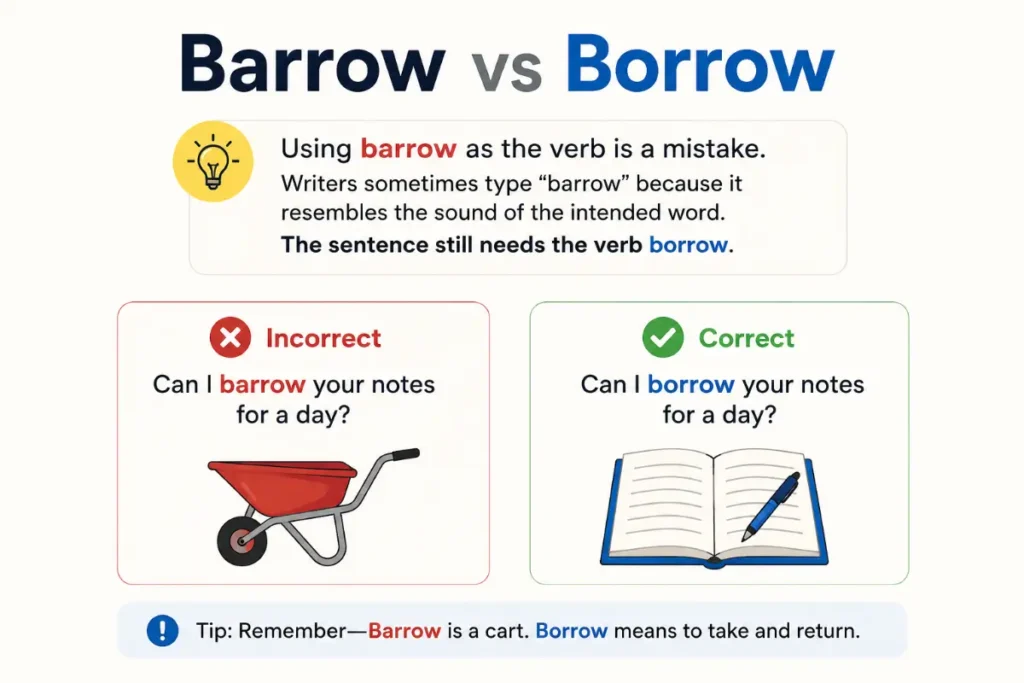
Incorrect: May I barrow your notebook?
Correct: May I borrow your notebook?
The sentence describes receiving a notebook for temporary use, so the verb is required.
Using Borrow Instead of Barrow
This mistake occurs when the sentence refers to a cart but uses the verb instead.
Incorrect: The gardener filled the borrow with soil.
Correct: The gardener filled the barrow with soil.
The sentence needs a noun that identifies the container or cart being filled.
Confusing the Words in Money Related Sentences
Money related sentences commonly use borrow because people receive money and agree to repay it. Barrow doesn’t express this financial action.
Incorrect: He plans to barrow money for college.
Correct: He plans to borrow money for college.
A useful check is to ask if the sentence describes receiving money temporarily under an agreement. If it does, borrow is the appropriate verb.
Misspelling Borrow as Barrow in Digital Messages
Fast typing can cause spelling errors, especially when a writer knows both words but doesn’t check the sentence. Spellcheck may not catch the mistake because barrow is a valid English word.
Incorrect: Can I barrow your charger?
Correct: Can I borrow your charger?
Read the full sentence before sending a message. A quick meaning check can catch errors that an ordinary spellchecker misses.
Treating Both Words as Verbs
Borrow is a verb, but barrow is normally a noun in its common cart meaning. Using barrow as if it means taking something from another person creates a grammatical and semantic error.
Incorrect: I will barrow the book until Monday.
Correct: I will borrow the book until Monday.
Remember that the action belongs to borrow. The object used for carrying a load is a barrow.
Pronunciation Guide
The words are close in sound, but their first vowels distinguish them in careful speech.
You may also want to read Affect vs Effect: Meaning and Correct Usage.
Borrow
/ˈbɑːroʊ/
Easy pronunciation: BOR oh.
Two syllables. The first syllable carries the main stress.
Example: I will borrow a book.
Barrow
/ˈbæroʊ/
Easy pronunciation: BAR oh.
Two syllables. The first syllable carries the main stress.
Example: Move the barrow outside.
The IPA symbols above represent common American English pronunciations. Actual vowel sounds can vary by accent. In particular, the vowel in borrow may sound different across regions of the United States.
How to Pronounce Them Clearly
Start with the first syllable and pay attention to the vowel. In many American accents, borrow has the vowel sound heard in words such as father, while barrow has the short vowel sound heard in cat.
Next, say the unstressed second syllable. Both words end with a sound similar to oh. Keep the main stress on the first syllable instead of giving both syllables equal force.
Common Pronunciation Mistakes
- Giving both words exactly the same first vowel when speaking carefully.
- Placing the main stress on the second syllable.
- Assuming that similar pronunciation means the words have the same meaning.
- Depending on sound alone when choosing the spelling in written communication.
Pronunciation can help you notice the difference, but sentence meaning remains the best way to choose the right word.
Etymology and Word Origin
The two words have separate histories. Their similar modern forms do not mean they developed from the same word or share the same meaning.
Origin of Borrow
Borrow comes from Old English forms related to borrowing or obtaining something temporarily. Its history is connected with the idea of receiving something under an arrangement that creates an obligation to return it.
The word developed into the modern verb used for money, objects, and other kinds of temporary use. Over time, its meaning also expanded into specialized contexts, such as borrowing words from another language and borrowing in mathematical subtraction.
Its core idea remains familiar today. Someone receives or uses something that they don’t permanently own, often with a duty to return or repay it.
Origin of Barrow
Barrow has a different history. The cart meaning is associated with older English vocabulary for carrying loads. The word appears in compounds such as wheelbarrow, which describes a cart with a wheel used to move materials.
Another historical meaning refers to a mound, especially one raised over a burial place. This meaning appears in archaeological and historical writing, where burial mounds help researchers study past communities and their customs.
The shared spelling pattern between borrow and barrow can make the words look related to a modern reader. Their histories and meanings, however, need to be understood separately.
Regional Usage
The meanings of these words remain stable across major English speaking regions. Differences mainly involve how often people use the word barrow for a cart and which more specific term they prefer.
American English
Borrow is the usual verb for taking something temporarily. Americans use it in everyday speech, business settings, education, and financial discussions.
For the cart meaning, wheelbarrow is often the clearer and more familiar term. Barrow remains valid English, but a reader may need context to know the exact type of cart being described. In historical writing, burial barrow is a recognized term.
Examples.
- I borrowed a ladder from my neighbor.
- She pushed the wheelbarrow toward the flower bed.
British English
Borrow has the same central meaning in British English. People use it to describe temporarily receiving objects, money, and other things.
Barrow can be more familiar in British usage for a cart or a hand pushed vehicle. The word also appears in historical and archaeological contexts, including descriptions of burial mounds.
Examples.
- Could I borrow your garden tools?
- He wheeled the barrow across the yard.
Australian English
Australian English uses borrow for temporary use in the same way as American and British English. Barrow is also understood, particularly in agricultural, gardening, and practical settings, although wheelbarrow is a familiar term for the common garden cart.
There is no general Australian spelling change that makes the two words interchangeable. The writer still needs to select the form that matches the meaning.
Canadian English
Canadian English follows the same basic distinction. Borrow describes receiving something temporarily, while barrow can refer to a cart or a burial mound.
Wheelbarrow is a clear choice when writing about the common garden tool. For general audiences, choosing the more specific word can prevent confusion without changing the underlying meaning.
Grammar Rules and Part of Speech
Understanding the grammatical role of each word makes the distinction easier to apply. One describes an action, and the other names an object or structure.
How to Use Borrow as a Verb
Borrow is a regular verb. Its main forms are borrow, borrows, borrowed, and borrowing.
Use the base form after modal verbs such as can, could, may, and will.
- I can borrow your notes.
- She will borrow a car tomorrow.
Use borrows with a third person singular subject in the present tense.
- He borrows books from the library.
- My sister often borrows my headphones.
Use borrowed for the simple past and the past participle.
- We borrowed a tent last weekend.
- I have borrowed this book before.
Use borrowing as a participle or gerund.
- He is borrowing a laptop for the presentation.
- Borrowing money can create a repayment obligation.
Common Sentence Patterns With Borrow
Borrow often appears in three patterns.
- Borrow something. Example: I borrowed a book.
- Borrow something from someone. Example: She borrowed a jacket from Mia.
- Borrow something for a period of time. Example: He borrowed the car for two hours.
The person who provides the item is the lender. The person who receives it is the borrower. The act itself is borrowing.
How to Use Barrow as a Noun
Barrow normally functions as a countable noun in its cart meaning. This means you can use it with a number or an article.
- The farmer owns a barrow.
- Two barrows stood beside the shed.
- She pushed the heavy barrow carefully.
The plural is barrows. You can also use descriptive words to explain its condition or contents, as in an old barrow or a barrow filled with gravel.
When referring to a burial mound, barrow remains a noun.
Example: The archaeologists mapped the ancient barrow before beginning their excavation.
Punctuation and Formal Writing
Neither word needs special punctuation. Both follow ordinary English capitalization and sentence rules.
Use a capital letter when a word begins a sentence. Otherwise, write borrow and barrow in lowercase unless one appears in a proper name or title.
Both words are appropriate in formal writing when used correctly. The verb borrow is suitable for financial reports, school assignments, and professional emails. Barrow is suitable for practical descriptions, historical studies, and archaeological writing.
Real Life Usage Examples
A word becomes easier to remember when you see how people use it in different situations. These examples show how the distinction works beyond basic spelling exercises.
Daily Conversation
In everyday speech, borrow usually appears when someone asks to use another person’s belongings. Barrow comes up when people talk about moving materials or working outdoors.
- Could I borrow your umbrella? I’ll bring it back this evening.
- The barrow is near the fence. Please bring it over so we can move the plants.
Both sentences sound natural because each word matches the action or object being discussed.
Email and Workplace Communication
Professional communication often involves borrowing equipment, sharing resources, or moving materials. Choosing the correct word keeps instructions clear and prevents misunderstandings.
- Hello Sam. May I borrow the projector for tomorrow’s meeting? I’ll return it to your office afterward.
- Please leave the barrow beside the storage area so the maintenance team can collect the building supplies.
The first example makes a polite request. The second gives a direct workplace instruction.
Academic Writing
In academic work, borrow may describe obtaining resources temporarily or using ideas and terms from another source. Barrow can appear in history, archaeology, and research about ancient burial practices.
- The student borrowed three reference books to complete the research assignment.
- The researchers examined the burial barrow to learn more about the area’s early inhabitants.
Academic writing benefits from precise vocabulary because the reader needs to understand the subject without guessing the intended meaning.
News and Journalism
Journalists may use borrow when reporting on loans, public spending, or financial decisions. Barrow may appear in local reporting about gardening projects, construction work, or archaeological discoveries.
- The small business borrowed funds to purchase new equipment and expand its operations.
- Archaeologists discovered a burial barrow during a survey of the proposed development site.
The subject of the report makes the intended meaning clear. A financial report uses the verb, while a report about an ancient site may use the historical noun.
Literature and Storytelling
Writers use both words to build clear scenes. Borrow can show a character asking for help or using something that belongs to another person. Barrow can help readers picture physical work or a historical landscape.
- Maya borrowed her brother’s coat before walking into the cold evening air.
- The old gardener pushed his wooden barrow along the narrow path toward the orchard.
These examples show how the words serve different purposes in storytelling. One describes an action, while the other gives the reader a concrete object to imagine.
Related and Confused Terms
Several words belong to the same topic or appear in similar situations. Knowing their meanings can help you choose the most precise expression.
1. Lend. To let another person use something temporarily. If you borrow a book from a friend, your friend lends it to you. Borrow describes receiving the item, while lend describes providing it.
2. Loan. Something given temporarily, often money, with an agreement about repayment. Loan is commonly a noun, as in a bank loan. It can also function as a verb in standard English.
3. Lendable. An adjective describing something that can be lent. For example, a lendable tool is one that its owner can allow another person to use.
4. Borrower. A person or organization that receives something temporarily or takes out a loan. A bank customer who receives a loan is the borrower.
5. Lender. A person or organization that provides money or an item for temporary use. Banks and credit unions act as lenders when they issue loans.
6. Wheelbarrow. A small cart with a wheel that people use to move loads. This is often the clearest term for a garden or construction cart in American English.
7. Handcart. A cart moved by hand, usually with two or more wheels. It can carry boxes, tools, or supplies. Unlike a typical wheelbarrow, many handcarts have two wheels and handles that the user pulls or pushes.
8. Burial mound. A raised area of earth or stones built over a grave. This expression helps explain the historical meaning of barrow and is often easier for general readers to understand.
These related terms clarify the roles of the people, actions, and objects involved. They also show why a single spelling correction may not be enough if the sentence uses the wrong word for its meaning.
Expert Editor Insight
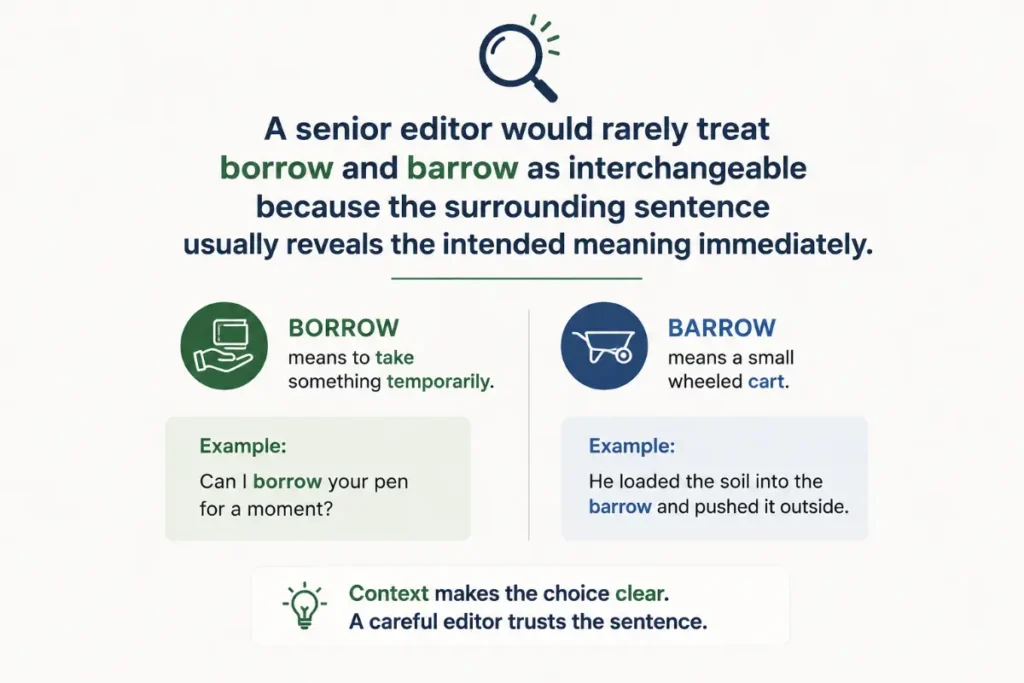
An experienced editor checks meaning before correcting spelling. Because both words are legitimate English, a spellchecker may accept the wrong choice without warning the writer. I look at the surrounding words first. A person borrows something from someone, while a barrow carries a load or refers to a burial mound. My practical tip is to replace the questionable word with a short explanation. If the sentence means taking something temporarily, use borrow. If it names a cart or mound, use barrow. This meaning based check catches errors that a spelling tool can miss.
A related grammar guide is Moral vs Morale Meaning and Usage Explained.
Conclusion
The difference between borrow vs barrow comes down to meaning and grammar. Borrow is a verb that describes taking something temporarily with the intention of returning it. Barrow is a noun that usually refers to a cart used to carry loads or a mound associated with an ancient burial site. Both words are correct English, but they cannot replace each other in ordinary usage.
Remember this simple rule. You borrow a tool, but you use a barrow to move soil. Before choosing either word, check what your sentence describes. This quick habit will help you avoid spelling mistakes, write more clearly, and choose the right word with confidence.
FAQs
Is Barrow a Real Word?
Yes. Barrow is a standard English noun. It commonly refers to a cart used for carrying materials and can also describe a mound built over an ancient burial place. The word is not a misspelling of borrow. Its correct use depends on the subject of the sentence and the meaning you want to communicate.
What Does Borrow Mean in Simple English?
Borrow means to take or receive something for temporary use, usually with the intention of returning it. For example, you might borrow a book from a friend or borrow money from a bank. The person who gives you the item is the lender, and you are the borrower.
Which Is Correct for Taking Money From a Bank?
Borrow is correct when describing receiving money from a bank with an agreement to repay it. You borrow money, and the bank lends it to you. Barrow does not have this financial meaning. For example, write I plan to borrow money for college, not I plan to barrow money for college.
How Do You Pronounce Borrow and Barrow?
Both words usually have two syllables and stress on the first syllable. In a common American pronunciation, borrow sounds like BOR oh, while barrow sounds like BAR oh. Their first vowel sounds differ, although regional accents can affect how clearly listeners hear the distinction. Meaning is the safest guide when spelling either word.
Can Borrow Start a Sentence?
Yes. Borrow can begin a sentence when the grammar supports it. For example, Borrow the ladder only after asking the owner for permission. You can also begin a sentence with a question such as Can I borrow your notebook? Starting a sentence with this verb doesn’t change its meaning or spelling.
What Is a Synonym for Borrow?
The best alternative depends on the sentence. Take temporarily can explain the meaning in plain English, while obtain on loan is more formal. In a sentence about money, receive a loan may work well. Lend is related but describes the opposite side of the action, so it cannot replace borrow in every sentence.
Why Do People Confuse These Words?
People confuse the two because their spellings are similar and their pronunciations are close in many accents. Fast typing and reliance on spellcheck can also allow errors to pass unnoticed. Since both forms are valid English words, a spelling tool may not recognize that the writer selected the wrong word for the sentence.
Is Barrow Appropriate in Formal Writing?
Yes. Barrow is suitable in formal writing when you mean a cart or a burial mound. In American writing, wheelbarrow may be more familiar when describing a garden cart. In historical or archaeological work, burial barrow can be an accurate term. The key is to choose the word that fits your subject and audience.