

Have you ever wondered if girlie or girly is the correct spelling? Both forms are used in English, and neither is automatically wrong. The main difference lies in usage, tone, and context. Although the two words often describe the same feminine style or quality, they can carry slightly different associations.
In everyday American English, girly is a reliable choice when you want to describe something traditionally associated with girls or women. You might call a pink bedroom girly, describe a dress as girly, or say that someone enjoys girly activities. The spelling girlie is also established, particularly in casual expressions and certain traditional uses. However, it can sometimes sound playful, old fashioned, or suggestive, depending on the context.
Understanding these differences helps you choose the right word for a text message, a product description, a social media caption, or a professional piece of writing. It also prevents you from treating a legitimate spelling variation as a mistake. The best choice depends on the meaning you want to express and the impression you want to create.
Many readers also check Accept vs Except: Meaning and Usage Explained.
Quick Answer
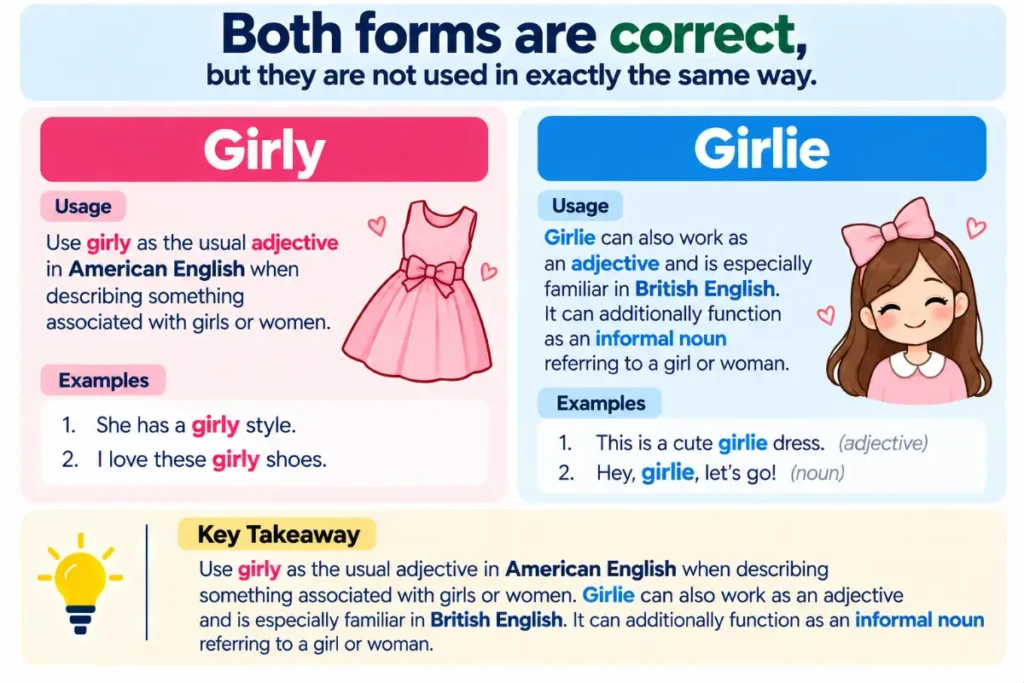
Both girly and girlie are correct English spellings. Girly is the usual choice for a general adjective describing something traditionally feminine, while girlie appears in informal expressions and some specialized uses. The words overlap in meaning, so context and tone help determine which spelling works best.
Comparison Table
| Feature | Girly | Girlie |
|---|---|---|
| Correct spelling | Yes | Yes |
| Main grammatical use | Adjective | Adjective and noun in some contexts |
| Common meaning | Traditionally feminine in style or character | Often feminine in style or character |
| Tone | Casual and descriptive | Casual, playful, old fashioned, or suggestive in some uses |
| American English | A straightforward general choice | Accepted but more context dependent |
| British English | Recognized | Recognized |
| Typical contexts | Clothing, colors, hobbies, decor, personal style | Informal descriptions, familiar expressions, certain entertainment or advertising contexts |
| Example | She likes girly clothes. | She prefers a girlie style. |
The table shows the general pattern rather than a strict rule. The meanings overlap, and writers sometimes use the spellings interchangeably. A particular expression or industry may also favor one form.
Meaning and Definition
What Does Girly Mean
Girly is an adjective that describes something associated with girls or with qualities that a culture traditionally considers feminine. It can refer to appearance, clothing, colors, hobbies, decorations, mannerisms, or personal preferences.
For example, a room filled with pink cushions, floral patterns, soft colors, and decorative accessories might be described as girly. Someone who enjoys dresses, glitter, makeup, or romantic fashion might also describe their personal style that way.
The word does not have to carry a negative meaning. A person can proudly call their style girly because they enjoy feminine fashion and decoration. Another person might use the same word to suggest that something is too delicate or feminine for their taste. The surrounding words and the speaker’s attitude make a difference.
The adjective can also describe behavior or interests, although those uses deserve some care. There is no single way that girls or women must act. Calling an activity girly reflects a social idea about gender rather than a universal fact about who enjoys it.
What Does Girlie Mean
Girlie can describe something associated with girls or feminine qualities, much like girly. For example, someone might use it to describe a playful fashion style or a collection of traditionally feminine accessories.
However, this spelling has some additional associations. In certain expressions, girlie can sound playful, familiar, or old fashioned. In other settings, particularly those involving sexualized images of women, the word can carry a suggestive meaning.
The noun use is also worth knowing. In some contexts, girlie refers informally to a girl or woman, although this can sound dated or disrespectful depending on the situation. The plural girlies may appear as a casual form of address among friends, but it is not appropriate for every audience.
Consider the difference between describing a floral dress as girlie and using the noun to refer to an adult woman you do not know. The first may sound lighthearted. The second may come across as patronizing. Context matters more than the spelling alone.
Are the Two Words Interchangeable
Often, yes. Both forms can describe a feminine look, a style of clothing, or an interest associated with girls and women. A writer might describe the same pink dress as girly or girlie without changing the basic meaning.
Still, they are not interchangeable in every sentence. The noun use of girlie cannot normally be replaced by the adjective girly without changing the grammar. Certain established expressions also favor one spelling.
When you need a neutral and widely understood adjective, girly is usually the easiest choice. Use girlie when it suits the expression, tone, or intended meaning.
Key Differences Explained
The differences become clearer when you look at spelling, grammar, tone, and context separately.
Spelling and Word Formation
Both spellings are established in English. The final letters differ, but that difference does not make one a misspelling of the other.
English has many words with different endings that remain valid forms. In this case, both spellings have developed established uses. You should choose according to meaning and context rather than assuming that every word ending in ie is incorrect.
A useful practical rule is to use girly as your default adjective in ordinary American English. This keeps your writing simple and reduces the chance that a reader will associate the word with a more specialized or suggestive meaning.
Meaning and Tone
The basic meaning overlaps, but the tone can differ.
- Girly often works as a direct description of a feminine style. A girly bedroom might have pastel colors, decorative pillows, and floral details.
- Girlie can express a similar idea but may sound more playful, familiar, or dated. Its meaning can shift in settings connected with adult entertainment or sexualized images.
- Both forms depend on context. Neither spelling guarantees that the speaker intends a compliment or an insult.
For example, a friend might say that a new handbag looks girly and mean that it has a cute, feminine style. Another person might call the same handbag girlie to sound playful. The intended message comes from the full conversation.
Grammar and Part of Speech
Girly is mainly an adjective. It describes a noun or follows a linking verb to describe a subject.
- The store sells girly accessories.
- Her style is girly.
- They decorated the room with girly colors.
Girlie can also work as an adjective, but it has noun uses in some informal expressions.
- She likes girlie fashion.
- The old magazine featured girlie pictures.
- The friends called themselves the girlies.
The final example uses the plural noun form. It is casual and may sound natural among close friends, but it would not suit every professional or formal setting.
Pronunciation
In common American English usage, both spellings are generally pronounced the same way. They rhyme with early in many American accents.
The spelling difference does not normally create a difference in spoken meaning. Listeners rely on context to understand which word a speaker means.
This is one reason people confuse the two spellings. Someone can use either form in speech without revealing the spelling they have in mind. The distinction becomes visible mainly in writing.
Formality and Context
Both words are informal in tone when they describe style or behavior. They are common in everyday conversation, fashion discussions, social media, and product descriptions.
In formal writing, the choice depends on the purpose. An academic paper about fashion might use girly when discussing how a product is marketed or how a style is perceived. A professional report might use a more precise phrase such as traditionally feminine if the original word sounds too casual.
For example, a product description might say, The design has a girly look. A research paper might instead say, The design uses colors and patterns commonly associated with feminine fashion.
The second sentence explains the idea more precisely and avoids treating cultural associations as universal truths.
Which Form Is Correct
Both forms are correct. The main question is which one best suits your sentence.
Use girly when you need a familiar adjective for a feminine appearance, style, interest, or design. It is a practical default for general American English because the meaning is clear in everyday descriptions.
Use girlie when you want that spelling for a particular expression, an established title, a playful tone, or a context in which the word has a specific meaning. Remember that some uses carry suggestive or dated associations.
Dictionaries recognize both forms, though definitions and usage labels can vary by dictionary. A dictionary may list one spelling as a variant of the other or give additional meanings for the form ending in ie. That does not make the alternative spelling universally wrong.
A professional writer should look beyond a simple right or wrong label. The more useful questions are these. Does the word express the intended meaning? Does it fit the audience? Could it create an unintended association? If the answer to those questions is clear, the spelling decision becomes much easier.
Sentence Examples
The following examples show how the words work in everyday situations. The first ten focus on common descriptive uses.
Ten Examples With Girly
- She chose a girly pink dress for the birthday party.
- My sister loves girly accessories such as bows and floral hair clips.
- The bedroom has a soft and girly look.
- I want a girly phone case with flowers and pastel colors.
- Her style is girly, but she also enjoys wearing jeans and sneakers.
- The store created a girly collection for customers who like bright colors and playful patterns.
- He bought a girly notebook for his friend because she loves cute designs.
- The fashion article described the outfit as girly rather than formal.
- Our group chose a girly theme for the party decorations.
- The designer wanted a feminine look without making the collection feel overly girly.
These examples show that the adjective can describe objects, clothing, decoration, and style. It can also appear in a sentence that questions or limits the meaning, as in the final example.
Examples With Girlie
The following examples illustrate situations in which the alternative spelling may appear naturally.
- She prefers a girlie style with floral prints and soft colors.
- The friends jokingly called their group the girlies.
- The old advertisement used the term girlie to describe its playful fashion theme.
- The magazine’s girlie imagery reflected the advertising style of its time.
- The phrase sounded too girlie for the serious tone of the campaign.
These examples do not mean that the two forms always create different meanings. They show how the spelling ending in ie may fit informal, historical, or context specific uses.
Common Mistakes and Misspellings
Confusion between these words usually comes from their similar sound and overlapping meanings. Here are five mistakes to avoid.
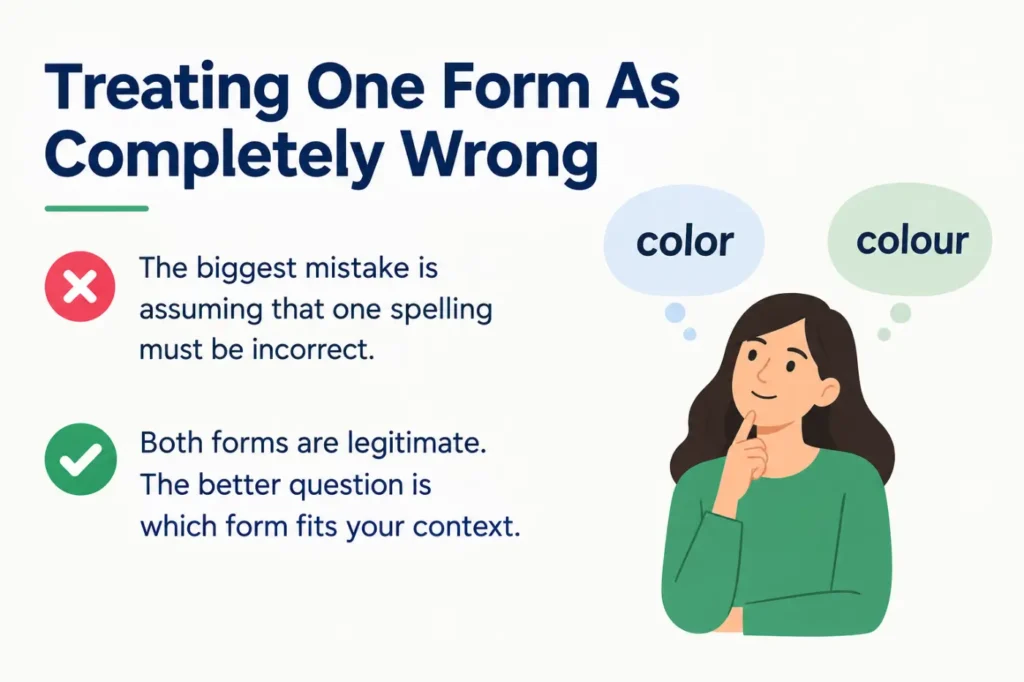
Mistake One Assuming Girlie Is Always Wrong
Incorrect assumption: Girlie is always a spelling error.
Correct understanding: Both forms are accepted English words. The spelling ending in ie may be less suitable in some general descriptive contexts, but that does not make it universally incorrect.
For example, girlie fashion can be a valid phrase. If you want a more neutral everyday description, girly fashion is often the simpler choice.
Mistake Two Assuming Girly Is Always Better
Incorrect assumption: Every sentence must use girly.
Correct understanding: The right spelling depends on the intended meaning and grammatical role. In some informal expressions, girlie serves as a noun. Replacing it with girly can change the sentence.
For example, a group might call themselves the girlies. The word is being used as a noun rather than an adjective.
Mistake Three Confusing Style With Identity
Incorrect usage: Assuming that every girl likes girly clothes.
Better usage: She enjoys traditionally feminine clothing.
The problem here is not spelling. It is the assumption that a style belongs naturally to every member of a group. People have different tastes, and the adjective should describe a style or preference rather than define someone’s identity.
Mistake Four Using the Word in the Wrong Tone
A casual term can sound out of place in a formal report or a serious conversation. In addition, some uses of girlie carry suggestive associations.
For example, a professional report may be clearer if it describes a product as having a traditionally feminine design instead of calling it girlie.
Mistake Five Treating the Spoken Word as a Spelling Guide
Because the two forms are usually pronounced alike, hearing the word does not tell you which spelling the speaker intended.
If you are writing an article or editing a document, check the sentence and the intended meaning. For a general adjective, choose girly unless a particular expression or style guide calls for the other form.
Pronunciation Guide
Both words usually share the same pronunciation in American English.
Many readers also check Emigrate vs Immigrate and How to Use Each Word.
Girly
IPA: /ˈɡɝːli/
Girlie
IPA: /ˈɡɝːli/
Syllables: gir + ly or gir + lie.
Stress: First syllable.
Easy pronunciation: GUR lee.
The first syllable carries the main stress. The second syllable sounds like the ending in happy or early for many American speakers. The vowel in the first syllable varies slightly across English accents.
A common mistake is to assume that the spelling ending in ie must have a different pronunciation. In this case, the two forms normally sound alike. You can hear the intended meaning from the sentence, but you cannot reliably identify the spelling from sound alone.
Etymology and Word Origin
Both words come from girl, a word with a long history in English. The modern meaning of girl refers to a female child or young woman, although its historical use was broader.
The endings y and ie appear in many English words and can help form familiar or descriptive expressions. English uses these endings in informal language, affectionate names, and words that describe qualities or appearances.
The adjective girly developed as a way to describe something associated with girls or qualities traditionally considered feminine. The spelling girlie developed alongside it and gained additional uses in informal language and particular cultural settings.
The history of these forms does not support the idea that one is simply a typo for the other. Both have established uses in modern English. Their meanings overlap, but different contexts have shaped their tone and associations.
For present day writing, the practical lesson is more useful than memorizing every stage of their history. Treat both as legitimate forms and select the one that fits the sentence.
Regional Usage
American English
In the United States, girly is a clear everyday choice for describing a feminine style, look, or interest. You might hear it in conversations about fashion, makeup, interior design, gifts, or hobbies.
The spelling girlie also appears in American English. Its tone depends on the setting. It may sound playful in casual conversation, dated in some descriptions, or suggestive in certain entertainment contexts.
For general writing aimed at an American audience, girly is a safe default when you need the adjective.
British English
Both spellings are understood in British English. The basic meanings remain similar to those in American English, and neither spelling represents a simple American versus British spelling difference.
Individual expressions may favor one form, and a British writer may choose different words to suit the audience. However, there is no broad regional rule that makes girly American and girlie British, or the other way around.
Australian English
Australian English also recognizes both spellings. Their use follows the same general distinction between a feminine descriptive adjective and the additional informal or context specific uses of the alternative spelling.
Local tone and personal preference can influence the choice. There is no need to treat either form as an exclusively Australian spelling.
Canadian English
Canadian English generally follows the same pattern. Both forms are recognized, and girly works well as a general adjective. Writers should consider the intended meaning and audience rather than assume a national spelling rule determines the answer.
Across these English varieties, the difference is mainly one of usage and tone rather than regional spelling standards.
Grammar Rules and Part of Speech
Understanding how each word functions in a sentence is the easiest way to avoid awkward usage.
Using Girly as an Adjective
An adjective describes a person, place, object, or idea. The word can appear before a noun or after a linking verb.
- Before a noun: She bought a girly handbag.
- After a linking verb: The room looks girly.
- With an intensifier: The outfit looks very girly.
- In a comparison: This design is girlier than the previous one.
- In the superlative form: That is the girliest dress in the store.
The comparative and superlative forms follow the usual pattern for many short adjectives ending in y. Change the final y to i before adding er or est.
Using Girlie as an Adjective
The word can also describe a noun.
- She bought a girlie card for her friend.
- The collection has a girlie feel.
- The campaign used a playful girlie theme.
These sentences are grammatically possible. However, the word may sound less neutral than girly in some contexts. A writer should consider the audience and the associations the word might create.
Using Girlie as a Noun
In informal language, girlie can refer to a girl or woman. Its tone varies, and some people may find it patronizing, especially when a speaker uses it for an adult woman without knowing her preferences.
The plural form girlies can also serve as a casual term among friends. For example, a group might say, We are having a night out with the girlies. This sounds informal and friendly in some social circles, but it is not suitable for every situation.
Punctuation and Sentence Structure
Neither word needs special punctuation. Use normal sentence capitalization and punctuation.
- The dress is girly.
- She likes girly clothes, but her sister prefers a simple style.
- The girlie theme worked well for the party.
Capitalize either word only when it begins a sentence or appears in a proper name or title that requires capitalization. Do not capitalize the word simply because it describes a particular gender or style.
Real Life Usage Examples
The same word can feel natural in one setting and unsuitable in another. These examples show how the choice changes with purpose and audience.
Daily Conversation
- I like the girly look of those floral sneakers.
- That shade of pink is too girly for my taste.
Both sentences are natural in casual conversation. The first expresses a preference, while the second gives a personal opinion. Neither statement establishes a rule about what people should wear.
Email and Workplace Communication
- The client requested a softer design with a more traditionally feminine look.
- We can use floral details and pastel colors to create the style the customer described.
These examples avoid casual labels and explain the design choices more precisely. In a professional email, specific details often communicate more than a broad adjective.
Academic Writing
- The study examined how marketing connects pastel colors with feminine identity.
- The researchers discussed how gender expectations can shape the way consumers describe clothing.
In academic writing, a writer should explain the cultural meaning rather than treat it as a universal truth. The word girly may still be useful when the study directly examines that term or reports how participants used it.
News and Journalism
- The designer rejected the idea that bright colors automatically create a girly look.
- The article explored how fashion brands market traditionally feminine styles to different age groups.
Journalists often benefit from precise wording. If the term comes from an interview or a direct statement, the writer should preserve the speaker’s intended meaning while giving readers enough context to understand it.
Literature and Storytelling
- Her room was girly, with pink curtains, flowered wallpaper, and shelves of tiny glass animals.
- He teased his friend about her girlie notebook, but she loved every glittering page.
The first example uses a familiar descriptive adjective. The second uses the alternative spelling to suggest a playful tone. In fiction, the choice can help convey a character’s voice, attitude, or social setting.
Related and Confused Terms
These eight terms can help you describe feminine style and gender related ideas more accurately.
1. Girlish. This adjective can describe qualities associated with a girl, especially youthfulness or a youthful manner. It can sound more focused on age or behavior than girly.
2. Feminine. This is a broader and often more neutral term for qualities culturally associated with women. It suits professional writing when you want a more measured description.
3. Womanly. This usually suggests qualities associated with adult women. It may refer to appearance, maturity, or behavior, depending on the sentence.
4. Cute. This describes something appealing, charming, or attractive. A design can be cute without being feminine, so the words are not exact synonyms.
5. Pink. This names a color. Pink can be part of a girly design, but the color itself does not define a person’s style or identity.
6. Tomboyish. This informal adjective traditionally describes a girl or woman whose clothing or activities do not match conventional feminine expectations. Its meaning is shaped by cultural ideas about gender.
7. Gender neutral. This describes something that is not specifically associated with one gender. Gender neutral clothing, for example, is designed without relying strongly on traditional masculine or feminine styles.
8. Girlie girl. This informal expression usually describes a girl or woman who enjoys traditionally feminine clothing, beauty products, or activities. It can sound affectionate or stereotypical depending on how someone uses it.
These terms do not all mean the same thing. Choose the one that describes the actual feature you have in mind rather than using a broad label for every style or preference.
Expert Editor Insight
An experienced English editor would usually choose girly for a general description of feminine fashion, decor, or personal style. The main challenge is that both spellings sound alike and share much of the same meaning. Grammar tools may accept both, so a spell checker alone cannot always identify the best choice. Editors look at the sentence, the audience, and the tone. They also consider if a word might sound dated, overly familiar, or suggestive. My practical editing tip is simple. Read the whole sentence aloud, identify the meaning you intend, and choose the spelling that communicates it clearly.
Learn the difference in complement vs compliment Explained With Examples.
Conclusion
The choice between girlie or girly comes down to context rather than a simple spelling rule. Both forms are accepted English words, and both can describe a traditionally feminine style. However, girly is usually the clearest default for everyday American English, while girlie has additional informal and context specific uses.
Neither spelling should be labeled incorrect without considering its role in the sentence. When editing, check the intended meaning, the audience, and the tone. Remember this simple tip. Use girly for a general description, and choose girlie when a particular expression or context calls for it.
FAQs
Is Girlie a Real Word?
Yes. Girlie is an established English word, not simply a misspelling of girly. It can work as an adjective describing a traditionally feminine style, and it also has informal noun uses. Its tone depends on context. Some uses sound playful or familiar, while others may feel dated or suggestive. For a neutral everyday description, girly is often the easier choice.
What Does Girly Mean?
Girly describes something associated with girls or qualities that a culture traditionally considers feminine. It often refers to clothing, colors, accessories, hobbies, or personal style. For example, a dress with floral prints and pastel colors might be described as girly. The word can express a positive preference or a critical opinion, so the surrounding sentence helps readers understand the speaker’s attitude.
Which Is Correct Girlie or Girly?
Both spellings are correct English words. Girly is generally the more straightforward choice when describing a feminine look, design, or interest in American English. Girlie can express a similar idea, but it also appears in informal expressions and has additional associations in certain settings. Choose the form that best fits your intended meaning, audience, and tone instead of treating one as universally wrong.
How Do You Pronounce Girly and Girlie?
Both words are usually pronounced the same way in American English. They have two syllables, with the main stress on the first syllable. Their pronunciation rhymes with early in many American accents. Since the spoken forms sound alike, you cannot reliably determine the intended spelling by listening alone. Look at the sentence and its meaning to choose the correct written form.
Can Girly Start a Sentence?
Yes. An adjective can begin a sentence when it forms part of a natural sentence structure. For example, you could write, Girly designs often use soft colors and playful patterns. The word follows ordinary capitalization rules, so its first letter becomes uppercase at the start of a sentence. You do not need special punctuation simply because the adjective appears first.
What Is a Synonym for Girly?
Useful alternatives include feminine, girlish, cute, and traditionally feminine. The best synonym depends on the meaning you want to express. Feminine often works well in professional writing, while cute focuses on charm or appeal rather than gender. Girlish can suggest youthfulness. If precision matters, describe the actual features, such as floral prints, pastel colors, or delicate details.
Why Do People Confuse Girlie and Girly?
People confuse these spellings because they sound alike and have overlapping meanings. English also contains many words that use both y and ie endings, so writers may be unsure which form suits a particular sentence. The confusion becomes easier to resolve when you remember that both are accepted words. For general descriptive writing, girly is a useful default, while girlie suits certain informal or established uses.
Is Girly Appropriate for Formal Writing?
The word is grammatically correct, but it may sound too casual for some formal documents. In a professional report or academic paper, feminine, traditionally feminine, or a precise description of the design may communicate the idea more clearly. However, girly can be appropriate when discussing everyday language, fashion marketing, or a person’s own description of their style. Choose the wording that fits your audience and purpose.