
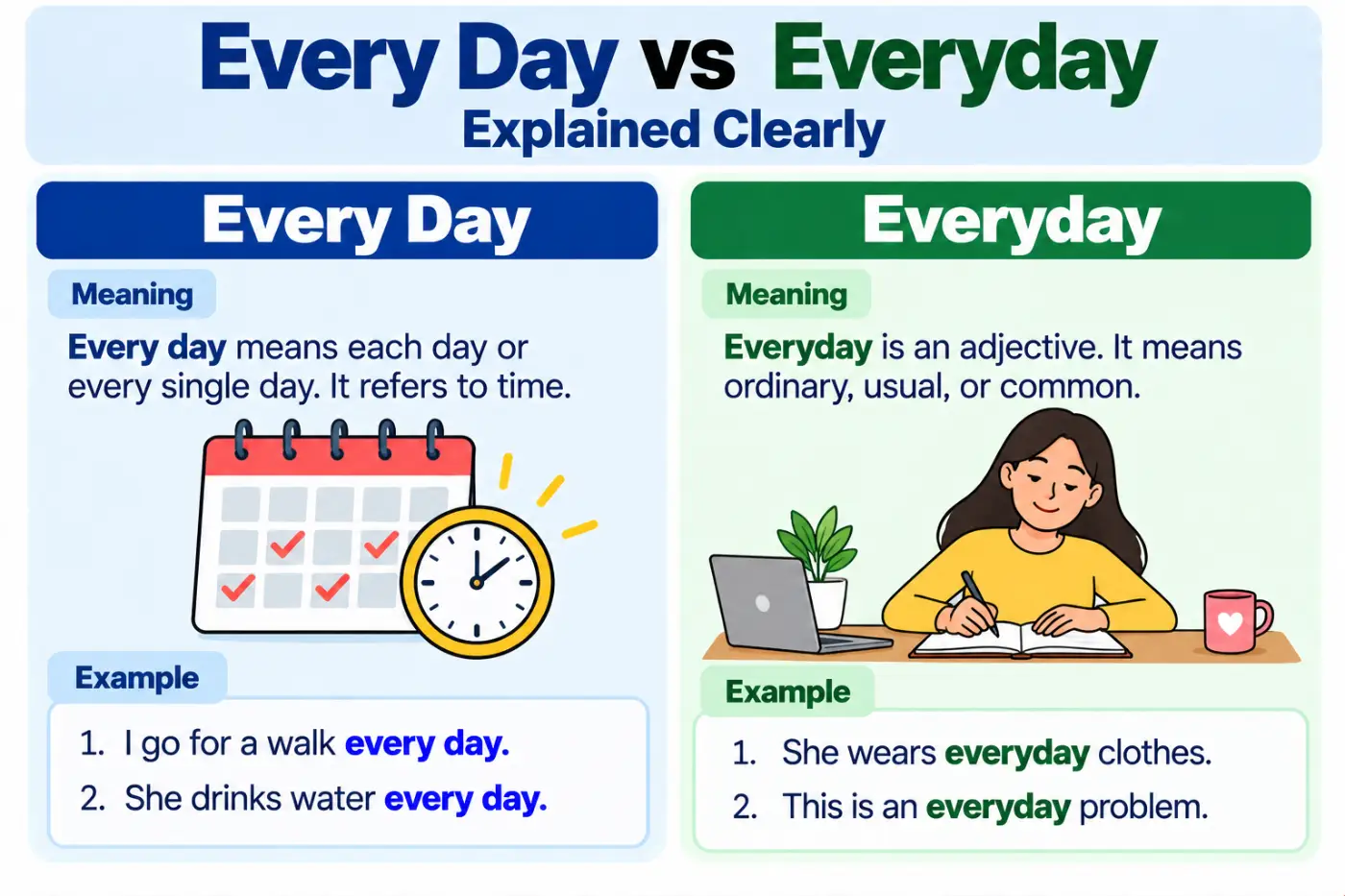
The difference between every day vs everyday comes down to meaning and grammar. Every day means each day, while everyday describes something ordinary or commonly used. Both forms are correct, but you can’t always swap one for the other.
For example, you might say, I walk my dog every day. You could also say, Walking is part of my everyday routine. The first sentence tells you how often something happens. The second describes a regular part of life.
The confusion makes sense because both forms contain the same words and sound almost identical in American English. However, the space between them changes how they work in a sentence. That small difference matters in school assignments, workplace emails, social media posts, and professional writing.
Once you understand the basic rule, choosing the right form becomes much easier. You’ll learn how each expression works, how to spot common mistakes, and how to use both forms naturally without second guessing your spelling.
For another common grammar confusion, see According to Alternatives for Clearer Writing.
Short Answer
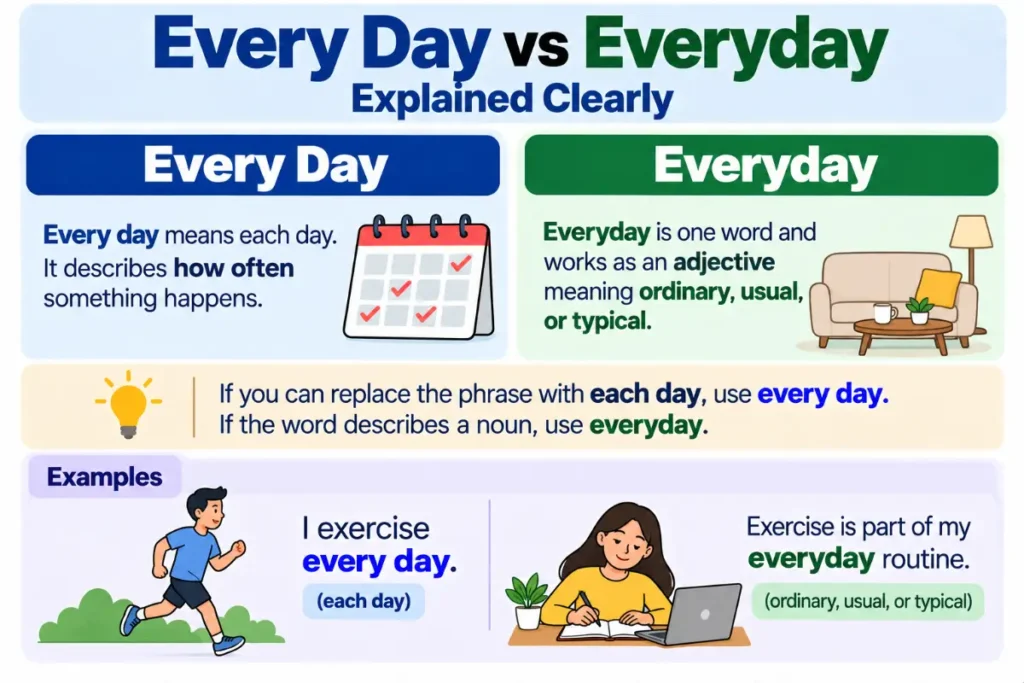
Every day means each day and usually answers the question how often. Everyday is an adjective that describes something ordinary, familiar, or typical. Write I exercise every day to describe frequency and This is my everyday exercise routine to describe a regular activity. The space depends on the word’s function in the sentence.
Comparison Table
| Feature | Every day | Everyday |
|---|---|---|
| Meaning | Each day | Ordinary or typical |
| Part of speech | Adverbial phrase | Adjective |
| Spelling | Two separate words | One word |
| Main purpose | Shows frequency | Describes a noun |
| Common question | How often? | What kind? |
| Example | I read every day. | I enjoy everyday activities. |
| Formality | Standard in all types of writing | Standard in all types of writing |
| Common contexts | Habits and schedules | Routines and ordinary things |
Meaning and Definition
What Does Every Day Mean?
Every day means each day or on each day. It refers to something that happens daily or is repeated from one day to the next.
For example, if you study English every day, you study on each day of the period you’re talking about. You might study for ten minutes or two hours. The expression tells the reader how often you study rather than how long each session lasts.
In grammar, every day is a phrase made up of two words. The word every acts as a determiner that refers to each member of a group. The word day is a noun that names a period of time.
Together, these words often form an adverbial phrase. That means the phrase adds information about an action or event.
Consider these examples.
- My brother calls our parents every day.
- The store opens at eight every day.
- We practice speaking English every day.
- She checks her email every day.
In each sentence, the phrase tells you how often an action happens. You can often replace it with daily without changing the main idea.
For instance, She checks her email every day means much the same as She checks her email daily. However, the two expressions may feel slightly different in tone. Every day often sounds more conversational, while daily can sound more formal or compact.
What Does Everyday Mean?
Everyday is a compound adjective that describes something ordinary, familiar, typical, or commonly encountered. It often appears before a noun and tells the reader what kind of thing that noun is.
For example, everyday clothes are clothes you wear during normal activities rather than special occasions. Everyday language is the kind of language people use in ordinary conversation instead of technical or highly formal speech.
Here are a few natural examples.
- These shoes are comfortable enough for everyday use.
- Good communication is an everyday part of her job.
- He writes about everyday problems that affect families.
- I prefer everyday English to complicated technical terms.
Notice that the word doesn’t tell you how often an action occurs. Instead, it describes the nature of a thing, activity, or experience.
You can think of it as a label for ordinary life. Everyday clothes are meant for regular use. Everyday conversations are normal conversations. Everyday challenges are the common problems people face as they go about their lives.
The word can also describe experiences that seem unremarkable but matter to people. An author might write about the beauty of everyday life or the small joys found in everyday moments.
Is Everyday a Real Word?
Yes. Everyday is a standard English word, not a spelling mistake. It appears in established dictionaries and is widely used in American English and other major varieties of English.
The important point is its grammatical role. Everyday normally works as an adjective, so it describes a noun. It isn’t a substitute for the two word expression when you want to say that something happens each day.
For example, I go running everyday is incorrect in standard edited English if you mean that you run each day. The correct sentence is I go running every day.
However, I need a good pair of everyday running shoes is correct. Here, everyday describes the shoes and means they are suitable for ordinary or regular use.
Key Differences Explained
The main difference isn’t pronunciation. It’s the job each form performs in a sentence.
Spelling and Meaning
Every day has a space because it functions as a two word expression. It means each day.
Everyday has no space because it functions as a single adjective. It means ordinary or typical.
Compare these sentences.
- I wear these boots every day.
- These are my everyday boots.
The first sentence tells you how often you wear the boots. The second describes the boots as suitable for regular use.
Both sentences can describe the same pair of boots. The difference lies in what the speaker wants to communicate.
Grammar and Part of Speech
Every day commonly functions as an adverbial phrase. It modifies a verb or an entire clause by showing frequency.
For example, in They walk to school every day, the phrase explains how often they walk to school.
Everyday is an adjective. It modifies a noun by describing its type or nature.
In They wear everyday shoes to school, the adjective describes the shoes.
This grammatical distinction is the most reliable way to choose the correct spelling. Instead of guessing based on appearance, look at the role the expression plays in your sentence.
Sentence Position
Everyday usually comes before the noun it describes.
Examples include everyday tasks, everyday language, everyday expenses, and everyday habits. In each case, the adjective appears directly before a noun.
Every day has more flexibility. It can appear at the end of a sentence or sometimes near the beginning for emphasis.
For example, I practice the piano every day sounds natural. So does Every day, I practice the piano before dinner. The second version places more emphasis on the daily routine.
When the phrase begins a sentence as an introductory element, a comma may help separate it from the main clause. The comma is a matter of sentence structure rather than a special rule for this expression.
Pronunciation
In standard American English, everyday and every day are generally pronounced the same way when used naturally in a sentence. The space changes the grammatical meaning rather than the basic sound.
This similarity explains why people sometimes make the wrong choice while typing. Spellcheck may catch some mistakes, but it can miss the problem because both forms are legitimate words.
You need to consider the meaning of the whole sentence rather than rely on sound alone.
Formality and Context
Both forms work in formal and informal writing. Neither is automatically more professional than the other.
Use every day when describing a daily action in a report, email, essay, or casual message. Use everyday when describing ordinary experiences, common objects, or routine activities.
For example, a workplace report might say, Employees must record their hours every day. Another might describe everyday tasks handled by the support team.
Both are clear and professional. The correct choice depends on meaning.
Regional Usage
The distinction is standard in American English, British English, Canadian English, and Australian English. There is no major regional spelling difference that changes the central rule.
Writers across these varieties generally use every day for each day and everyday for ordinary or typical things. Local style preferences can affect the surrounding sentence, but they don’t remove the grammatical distinction between the two forms.
Which Form Is Correct?
Both forms are correct. You need to choose the one that matches your intended meaning.
Use every day when you mean each day. Use everyday when you mean ordinary, familiar, or typical.
The easiest test is to replace the expression with a similar phrase and see if the sentence still makes sense.
The Each Day Test
If you can replace the expression with each day, write every day as two words.
For example, She reads before bed every day can become She reads before bed each day. The sentence keeps the same basic meaning.
This test works because every day describes frequency. It tells you how often an action takes place.
The Ordinary Test
If you can replace the word with ordinary or typical, write everyday as one word.
For example, These are my everyday shoes can become These are my ordinary shoes. The second version sounds a little less natural in some contexts, but the meaning remains close enough to show the adjective’s function.
You can also use regular use as a clue. An everyday item is often something intended for common or routine use.
Why Grammar Matters More Than Appearance
The two forms share the same basic elements, so it may seem that the space is a minor detail. In edited English, however, the space signals a difference in grammatical function.
The same principle appears in other English expressions. A compound adjective can have a different role from a phrase containing the same words. Recognizing that role helps you write clearly and avoid mistakes that spellcheck may not catch.
Sentence Examples
These ten examples show how to use both forms naturally in different situations.
- Daily conversation. I drink a glass of water every day before breakfast.
- Family life. We try to eat dinner together every day.
- Text messages. I could get used to this everyday routine.
- Workplace communication. Please review your assigned tasks every day before leaving the office.
- School. Students should practice their reading skills every day.
- Academic writing. Everyday language often differs from the specialized terms used in academic research.
- Formal writing. The program aims to improve access to services that support everyday needs.
- Social situations. She finds it easy to start conversations with people she sees every day.
- Online communication. The creator shares tips for managing everyday expenses.
- Personal habits. Walking every day has become part of my normal routine.
Notice how the two forms work in different ways. In the first, second, fourth, fifth, eighth, and tenth examples, every day shows frequency. In the remaining examples, everyday describes a noun or noun phrase.
Five Common Incorrect Examples
The following sentences show a frequent error. In each case, the writer intends to say each day, so the two word form is needed.
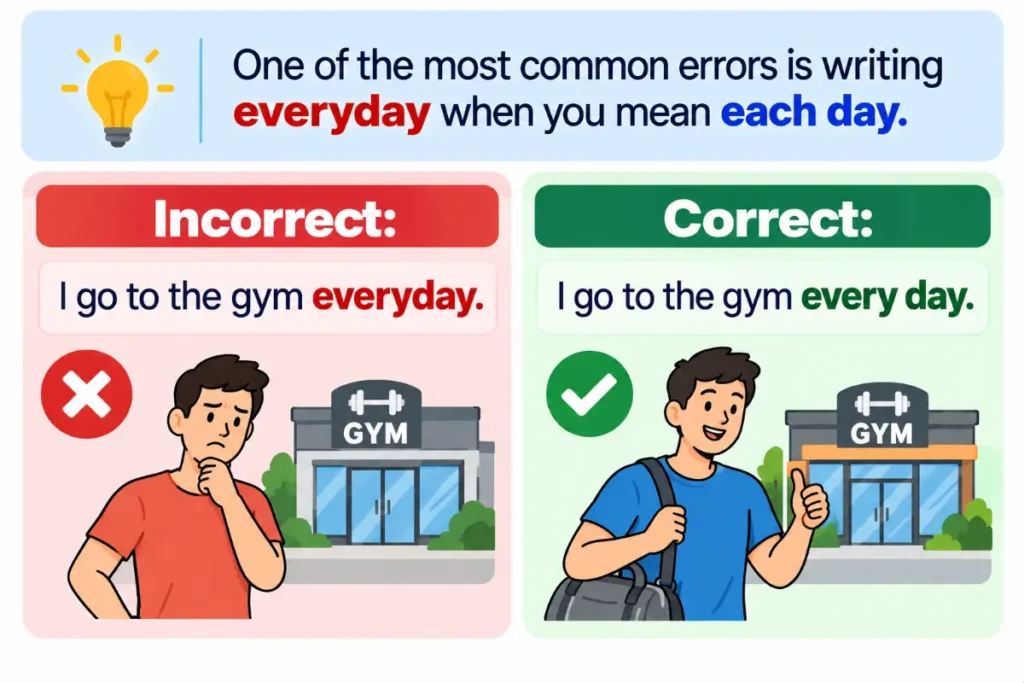
1. Incorrect: I go to the gym everyday.
Correct: I go to the gym every day.
2. Incorrect: She calls her grandmother everyday.
Correct: She calls her grandmother every day.
3. Incorrect: We practice spelling everyday.
Correct: We practice spelling every day.
4. Incorrect: He takes his medication everyday.
Correct: He takes his medication every day.
5. Incorrect: I check the weather forecast everyday.
Correct: I check the weather forecast every day.
The mistake in each example is the same. The writer uses an adjective where an adverbial phrase is needed to express frequency.
Common Mistakes and Misspellings
Writers often confuse these forms because they sound alike and appear in similar contexts. The following mistakes are easy to correct once you focus on the intended meaning.
Using Everyday to Mean Each Day
Incorrect: I walk my dog everyday.
Correct: I walk my dog every day.
The sentence describes how often the speaker walks the dog. Since each day can replace the intended expression, the two word form is correct.
Using Every Day Before a Noun
Incorrect: She bought every day shoes for work.
Correct: She bought everyday shoes for work.
The writer wants to describe the kind of shoes she bought. Everyday acts as an adjective and modifies shoes.
Assuming the One Word Form Is Always Wrong
Incorrect assumption: Everyday is never correct.
Correct understanding: Everyday is a standard adjective.
The one word form is appropriate in phrases such as everyday life, everyday clothes, and everyday language. Removing the space isn’t always a spelling mistake. It depends on the sentence.
Assuming the Two Word Form Must Refer to a Habit
Incorrect assumption: Every day can only describe a repeated action that has already become a habit.
Correct understanding: Every day expresses daily frequency but doesn’t require a long established habit.
For example, The festival runs every day this week describes a schedule. It doesn’t imply that the festival is a permanent habit or a regular event throughout the year.
Trusting Spellcheck Without Checking Meaning
Incorrect: I need to improve my writing everyday.
Correct: I need to improve my writing every day.
A spelling tool may accept both forms because both exist in English. It may not recognize that the sentence requires a frequency expression.
Always review the sentence’s meaning when a correction tool offers no warning. Grammar depends on context, and a word can be spelled correctly while still being wrong for the sentence.
Pronunciation Guide
Both forms usually sound the same in American English. The difference appears in writing and grammar rather than in the way people pronounce them.
Every day
Two words
IPA: /ˈɛvri deɪ/.
Easy pronunciation: EV ree day.
Syllables: Three spoken syllables in common American pronunciation.
Stress: The first syllable of every receives the main stress in the phrase.
Still confused? Compare Encode Vs Incode Which Word Should You Use 2026.
Everyday
One word
IPA: /ˈɛvriˌdeɪ/.
Easy pronunciation: EV ree day.
Syllables: Three spoken syllables in common American pronunciation.
Stress: The first part carries the main stress. The second part may receive additional emphasis depending on the sentence.
Common Pronunciation Mistakes
- Trying to hear the space. There is usually no reliable sound difference that tells you which spelling to use. Pay attention to the sentence’s meaning instead.
- Pronouncing every as two separate clear syllables in all contexts. In casual American speech, the middle vowel can become less distinct, so the word may sound closer to two quick syllables.
- Treating spelling as a pronunciation guide. The written space doesn’t create a dependable pronunciation difference between the two forms.
For most learners, the best approach is to learn the grammar rule alongside the sound. That way, you can choose the right spelling even when speaking and writing feel closely connected.
Etymology and Word Origin
The two forms share the same historical building blocks. Every developed from older English forms related to the idea of each individual member of a group. Day comes from Old English dæg, which referred to a day or period of daylight.
The phrase every day combines a word that distributes attention across individual items with a noun naming a period of time. Its modern meaning is each day.
Everyday developed as a compound adjective from the same expression. English commonly combines words over time to create a new word with a more specific grammatical role. In this case, the compound came to describe things that belong to ordinary or regular life.
The historical relationship helps explain why the spellings are so similar. However, the modern grammatical distinction is what matters most when writing today.
Regional Usage
American English
In the United States, both forms are standard. Writers use every day to express daily frequency and everyday to describe ordinary things.
For example, I practice guitar every day describes a repeated action. This is my everyday guitar describes a guitar used for regular activities rather than special performances.
British English
British English follows the same main distinction. A British writer might describe everyday life in a newspaper article and use every day in a sentence about a daily routine.
Differences in vocabulary or style between British and American English don’t change this rule.
Australian English
Australian English also uses both forms with the same general meanings. Everyday can describe common activities or objects, while every day expresses frequency.
For instance, She catches the bus every day and These are my everyday shoes follow the same grammatical pattern found in American English.
Canadian English
Canadian English uses the same distinction as well. Writers can use everyday in formal documents and casual messages when they need an adjective. They use every day when the intended meaning is each day.
In short, you don’t need to learn separate regional rules for these expressions. The key distinction remains consistent across these major English varieties.
Grammar Rules and Part of Speech
Understanding how each form works will help you make the right choice in almost any sentence.
How Every Day Works in a Sentence
Every day usually functions as an adverbial phrase. It often appears at the end of a sentence because that position naturally communicates frequency.
Examples include the following.
- We review our goals every day.
- The library receives new requests every day.
- Every day brings another opportunity to learn.
The phrase can also appear at the beginning of a sentence. In that position, it may emphasize repetition or the regular nature of an activity.
For example, Every day, he takes a short walk before work. The comma separates the introductory phrase from the rest of the sentence.
How Everyday Works in a Sentence
Everyday is an adjective that typically appears before a noun.
Examples include everyday language, everyday routines, everyday expenses, and everyday decisions.
It can also appear in longer noun phrases. For instance, The company sells products for everyday household use. Here, the adjective describes the type of household use.
Everyday doesn’t usually function as a standard adverb meaning each day. If you want to describe the frequency of an action, use the two word expression.
Can Everyday Appear After a Verb?
Everyday generally works as an attributive adjective, meaning it appears before the noun it modifies. It doesn’t normally follow a linking verb as a standalone adjective in standard English.
For example, These clothes are everyday clothes is grammatical because the noun clothes follows the adjective in the predicate.
By contrast, These clothes are everyday sounds unnatural in standard usage when the intended meaning is ordinary clothing. A clearer sentence would be These clothes are for everyday use.
This pattern is useful when editing. If the word appears after a verb, check if the sentence needs a noun or a different adjective.
Punctuation and Capitalization
Neither form requires special capitalization in the middle of a sentence. Capitalize the first word only when it begins a sentence or appears in a title according to the style you follow.
Punctuation depends on the sentence rather than the expression itself. You don’t need a hyphen in everyday because it is already written as one compound word. You don’t need a hyphen between every and day because they remain separate words.
Real Life Usage Examples
The same distinction appears across different types of writing. Seeing it in context makes the rule easier to remember.
Daily Conversation
People often use every day when talking about habits, schedules, and repeated actions.
- I listen to music every day on my way to work.
- We see the same neighbors every day when we walk outside.
Everyday often describes familiar experiences or common objects.
- I like simple food that I can cook with everyday ingredients.
- These are everyday problems that most families understand.
Email and Workplace Communication
Workplace writing often uses both forms. The correct choice helps keep instructions and descriptions clear.
- Please update the shared report every day before the end of your shift.
- The manager reviews the team’s progress every day.
Everyday describes routine duties or common needs.
- The new software helps employees manage everyday tasks.
- We designed the guide to answer everyday questions from customers.
Academic Writing
In academic writing, every day can describe how often a study activity occurs. Everyday can describe ordinary speech, behavior, or experience.
- Participants recorded their sleep patterns every day during the study period.
- Students practiced the new vocabulary every day for two weeks.
For an adjective, consider these examples.
- The paper examines how children learn language through everyday interactions.
- Researchers explored the role of everyday experiences in early learning.
These sentences show that both forms can appear in serious academic writing. The choice depends on meaning, not formality.
News and Journalism
Journalists use every day to describe events or actions that occur daily. They use everyday to describe common experiences that affect the public.
- Local volunteers distribute meals every day at the community center.
- The transit agency publishes service updates every day.
Examples with the adjective include the following.
- Rising prices have changed everyday spending habits for many families.
- The report examines the effect of new rules on everyday life.
Literature and Storytelling
Writers use these expressions to describe routines, characters, and the details of ordinary life.
- Every day, Mara walked past the old house on her way to school.
- He wrote in his notebook every day until the pages were full.
The adjective can help make an ordinary scene feel vivid.
- The story finds beauty in everyday moments that others overlook.
- Her everyday life changed after she discovered the letters in the attic.
Related and Confused Terms
Several related expressions can help you understand the difference more clearly.
- Daily. This word means happening or done each day. It can function as an adjective or an adverb. For example, daily exercise and I exercise daily.
- Each day. This phrase is a close substitute for every day. It emphasizes individual days within a period.
- Ordinary. This adjective describes something normal or not unusual. It can often replace everyday, depending on the sentence.
- Regular. This word describes something that follows a pattern or occurs at expected times. It overlaps with everyday in some contexts but can emphasize consistency rather than ordinariness.
- Routine. This word refers to a usual way of doing things. A routine can include everyday activities, but routine can also describe the repeated process itself.
- Every week. This phrase means each week. It follows a similar pattern to every day and remains two words.
- Every morning. This phrase means each morning. Like every day, it describes frequency and should be written as two words.
- Day to day. This expression often refers to ordinary activities or changes that happen as part of daily life. When used as an adjective before a noun, it is commonly hyphenated in American English, as in day to day operations when used informally or day to day work. In carefully edited writing, the standard compound adjective is often written as day to day or day to day work depending on the style guide, so check the relevant house style.
These expressions aren’t perfect substitutes in every sentence. Still, they help you see how English uses separate words for frequency and adjectives for description.
Expert Editor Insight
An experienced editor looks at meaning before changing the spelling. If a sentence describes how often something happens, every day is usually the right choice. If the word describes an ordinary object or activity, everyday fits. Grammar tools may accept both forms because both are valid English words. That’s why a final human review still matters. A useful editing habit is to replace every day with each day and everyday with ordinary. If the sentence keeps its intended meaning, you’ve likely found the right form.
Key Takeaways
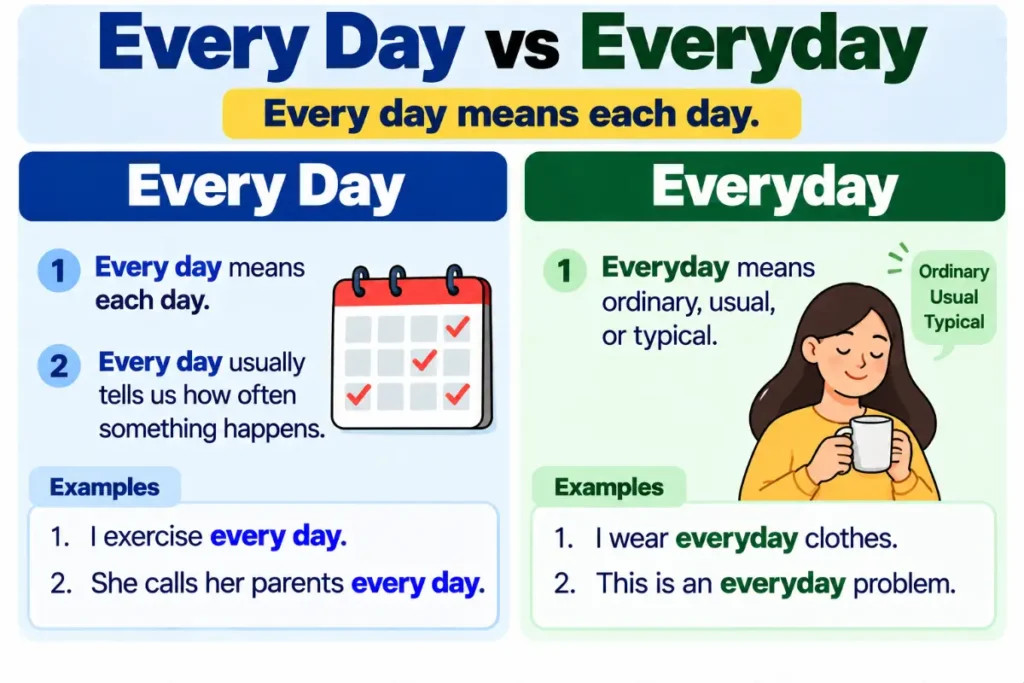
- Every day means each day.
- Everyday means ordinary usual or typical.
- Every day usually tells us how often something happens.
- Everyday usually describes a noun.
- Use the each day test when you’re unsure.
- I study every day means I study each day.
- Everyday English means ordinary English.
- Everyday does not necessarily mean something happens daily.
- The distinction applies in both American and British English.
- Both forms are standard English but they aren’t interchangeable.
Many readers also check publically or publicly: Correct Spelling and Usage Guide.
Conclusion
The difference between every day vs everyday is simple once you focus on meaning. Every day means each day and describes frequency. Everyday means ordinary or typical and functions as an adjective. Both forms are correct in standard English, but they aren’t interchangeable.
Remember one practical rule. If you can replace the expression with each day, write two words. If you can replace it with ordinary, write one word. This quick test works in emails, essays, social posts, and everyday conversations. Pay attention to the job the word performs in your sentence, and you’ll make the right choice with confidence.
FAQs
Is Everyday One Word or Two Words?
Everyday is one word when it describes something ordinary or typical. For example, everyday clothes are clothes intended for regular use. When you mean each day, write every day as two words. For example, I wear these clothes every day describes frequency. Both forms are correct, but they serve different grammatical purposes.
What Does Everyday Mean in Simple English?
Everyday means ordinary, common, or typical. It describes things that are part of normal life rather than rare or special events. Everyday language is the language people use in normal conversations. Everyday activities include cooking, shopping, and getting ready for work. The word works as an adjective and usually appears before a noun.
Which Is Correct for a Daily Habit?
Use every day when describing a daily habit or repeated action. For example, I read every day means you read each day. You could also write I read daily without changing the basic meaning. Everyday doesn’t work in the same way because it describes something ordinary rather than telling the reader how often an action happens.
How Do You Pronounce Everyday and Every Day?
Both forms usually have the same pronunciation in American English. They sound like EV ree day in ordinary speech. The difference is grammatical rather than clearly audible. Since pronunciation won’t reliably help you choose the spelling, focus on the meaning. If you mean each day, use two words. If you mean ordinary, use one.
Can Every Day Start a Sentence?
Yes. Every day can begin a sentence when you want to emphasize a daily action or routine. For example, Every day, I take a short walk before breakfast. The comma after the introductory phrase helps the reader follow the sentence. The expression keeps its meaning of each day even when it appears at the beginning.
What Is a Synonym for Everyday?
Useful synonyms for everyday include ordinary, common, typical, and usual. The best choice depends on the sentence. Everyday clothes might be called casual clothes, while everyday problems could be described as common problems. These words don’t always have identical meanings, so check the context before replacing one with another.
Why Do People Confuse These Two Forms?
People confuse the two forms because they contain the same words and usually sound identical. Spellcheck may not flag the error because both spellings are valid English. The mistake often comes from focusing on sound instead of grammar. Learning to distinguish frequency from description makes the correct choice much easier.
Is Everyday Appropriate in Formal Writing?
Yes. Everyday is standard English and works well in formal writing when it describes ordinary things or experiences. You might use everyday needs in a report or everyday language in an academic discussion. However, if you mean that something happens each day, use every day. Professional writing depends on choosing the form that expresses your intended meaning.