
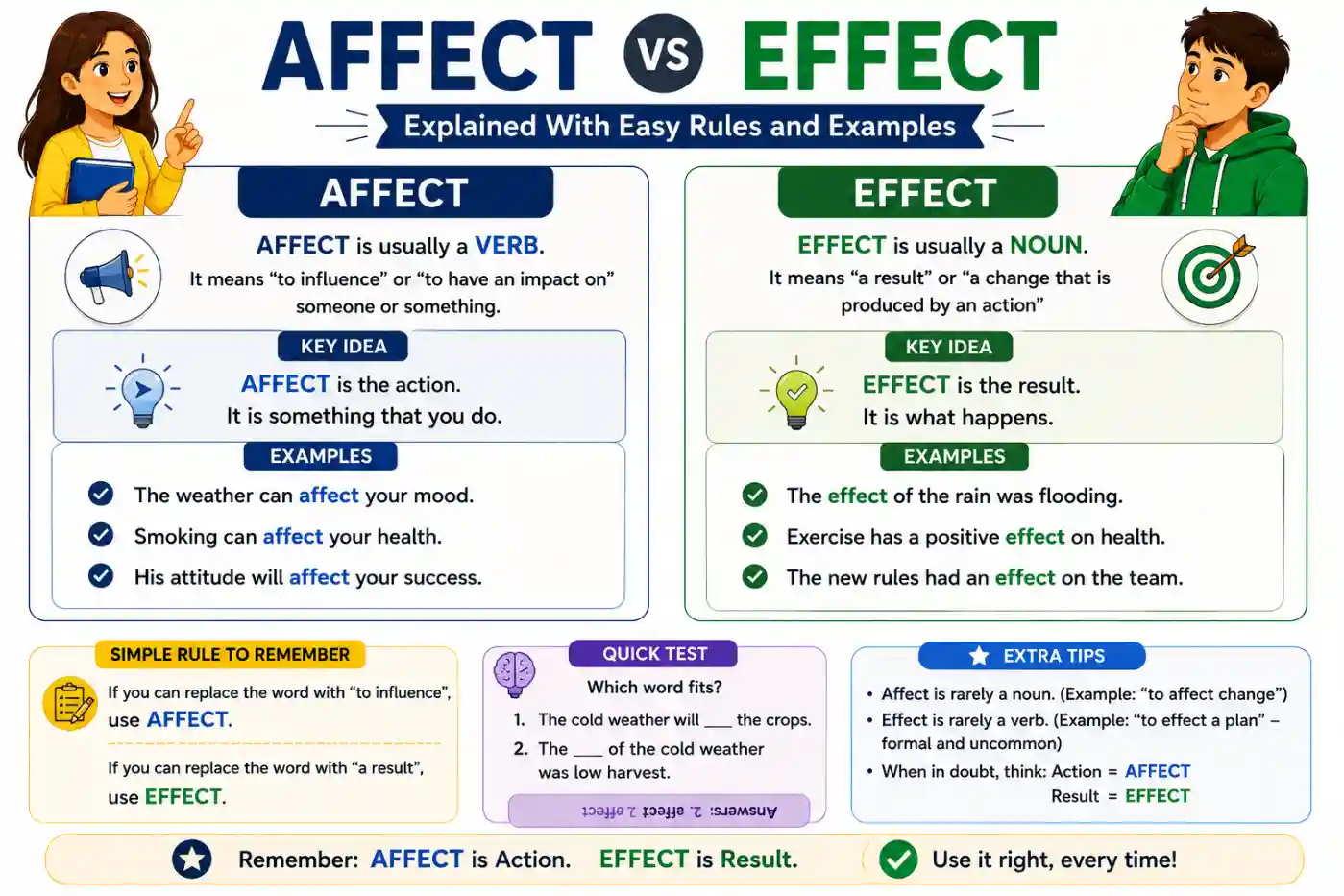
Affect vs effect confuse many English writers because the words look almost identical and often appear in the same sentence. Both relate to change, influence, and results, but they perform different jobs in most everyday writing. The simplest rule is to use affect for the action of influencing something and effect for the result of that action.
For example, heavy rain can affect your travel plans. The effect might be a delayed flight or a canceled outdoor event. Once you recognize this relationship between an action and its result, choosing the correct word becomes much easier. You can apply the same rule to conversations, school assignments, emails, business reports, and academic writing.
There are exceptions to the basic rule. Affect can be a noun in psychology, while effect can be a verb meaning to bring about or accomplish something. These uses are less common in everyday conversation, but they matter in formal and specialized writing. Understanding the main rule and its exceptions will help you write accurately without second guessing every sentence.
Need another quick comparison? Read Inconsolable or Unconsolable Correct Spelling and Meaning.
Short Answer
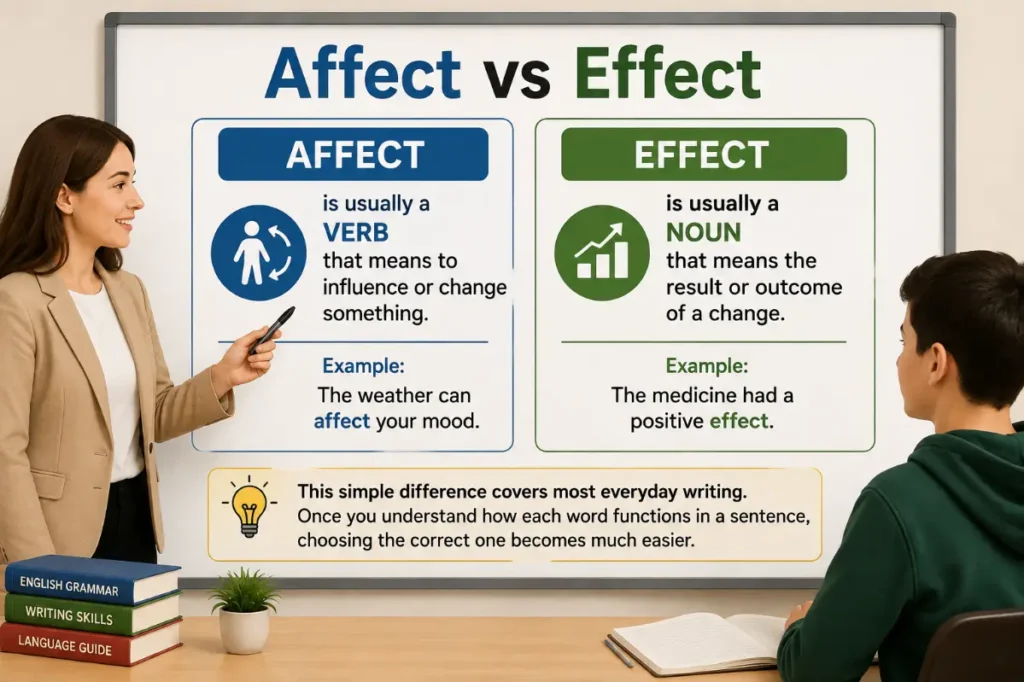
Affect is usually a verb meaning to influence or change something. Effect is usually a noun meaning a result or outcome. For example, lack of sleep can affect your mood, and the effect may be poor concentration. Both words are correct English. The right choice depends on the meaning and grammatical role in your sentence.
What Is the Difference Between Affect and Effect
The main difference comes down to influence and outcome. Affect usually describes an action that changes or influences something. Effect usually names the result produced by that action.
Consider this sentence.
Loud music affected my concentration, and the effect lasted for an hour.
The first word describes what the music did. The second names the result.
Here is another example.
The new schedule will affect employees, but its full effect won’t be clear until next month.
In the first part, the schedule influences employees. In the second, effect refers to the outcome of that influence.
The distinction works in many situations, including health, education, relationships, business, weather, technology, and public policy. You do not need to memorize separate rules for every subject. Instead, identify the role the word plays in the sentence.
If it describes influencing or changing something, affect is usually right. If it names a result, effect is usually right.
Comparison Table for Affect and Effect
| Feature | Affect | Effect |
|---|---|---|
| Usual part of speech | Verb | Noun |
| Main meaning | To influence or change | A result or outcome |
| Main question | What does something influence? | What result does something produce? |
| Example | Stress can affect sleep. | Stress can have an effect on sleep. |
| Common forms | Affects, affected, affecting | Effects, effected, effecting |
| Common phrases | Affect performance, affect mood | Cause an effect, have an effect |
| Formality | Standard in all types of writing | Standard in all types of writing |
| Common exception | Noun in psychology | Verb meaning to bring about |
Both spellings are correct. Neither is a misspelling of the other. They have different meanings and grammatical functions, so replacing one with the other can change a sentence or make it grammatically incorrect.
What Does Affect Mean
Affect is most often a verb meaning to influence, change, or have an impact on something. It describes an action or process rather than the result itself.
For example, a stressful week can affect your sleep. A teacher’s feedback can affect a student’s confidence. A price increase can affect how much a family spends on groceries.
In each sentence, something influences another thing. The result may be positive, negative, or neutral.
Affect Can Describe Positive Changes
The word does not always describe harm or trouble. It can refer to helpful changes as well.
- Regular exercise can affect your energy levels in a positive way.
- A kind message affected her mood and helped her feel better.
- Better lighting can affect how clearly students read.
- A new study method affected his grades for the better.
- The manager’s support affected employee morale positively.
These examples show that the word simply describes influence. The surrounding sentence tells you if that influence is good or bad.
Affect Can Describe Negative Changes
The verb often appears in sentences about problems, risks, or unwanted outcomes.
- The storm affected several neighborhoods.
- A lack of sleep can affect your judgment.
- The software problem affected the entire team.
- Rising food prices affect household budgets.
- The injury affected her ability to run.
In each case, the subject produces a change in something else.
Common Grammar Patterns With Affect
The verb often follows a subject and takes a direct object.
Subject + affect + object
Examples include:
- Noise affects concentration.
- Weather affects traffic.
- Stress affects memory.
- Exercise affects mood.
- The decision affected everyone.
You can also use different verb forms.
The policy affects local businesses.
The policy affected local businesses last year.
The tense changes, but the core meaning stays the same.
What Does Effect Mean
Effect is most often a noun meaning a result, consequence, or outcome. It names what happens because of an action, event, condition, or decision.
For example, a power outage may have several effects. It might stop production, interrupt internet service, and spoil food in a refrigerator.
The outage is the event. The results are its effects.
Effect as a Result
Here are examples from everyday life.
- The medicine had a calming effect.
- The new rule had little effect on attendance.
- The storm’s effects lasted several days.
- One missed payment can have an effect on a credit history.
- The change had a positive effect on team morale.
The word identifies an outcome rather than the action that produces it.
Common Grammar Patterns With Effect
The noun often appears in these patterns.
Have an effect on something
The weather had an effect on our travel plans.
The effect of something
The effect of the delay was easy to see.
A positive or negative effect
The new routine had a positive effect on my sleep.
Side effects
The medicine may cause side effects.
Cause and effect
The lesson explained the relationship between a cause and its result.
These expressions are common in American English. Learning them as complete phrases can help you choose the right word naturally.
Singular and Plural Forms
The singular noun is effect. The plural is effects.
For example:
- The change had an unexpected effect.
- The changes had several unexpected effects.
The verb affect also changes form, but its endings follow normal verb patterns.
- The noise affects me.
- The noise affected me yesterday.
- The noise is affecting me now.
Pay attention to the sentence structure. An ending such as s does not automatically tell you which word you need.
Which Form Is Correct in Your Sentence
Both words are correct. Your intended meaning determines which one belongs in the sentence.
Use affect when you mean influence or change.
Use effect when you mean result or outcome.
Compare these sentences.
Correct: The new policy will affect workers.
The policy will influence workers in some way.
Correct: The new policy will have an effect on workers.
The sentence refers to the influence as a result or consequence.
Both sentences can communicate a similar idea, but their grammar differs. The first uses a verb. The second uses a noun.
A Simple Editing Test
When you are unsure, try replacing the word with a familiar alternative.
If influence fits naturally as a verb, affect is probably the right choice.
The weather may affect our plans.
The weather may influence our plans.
Both sentences work.
If result fits naturally as a noun, effect is probably correct.
The effect was unexpected.
The result was unexpected.
Both sentences work.
This test is useful, but it is not perfect. English has specialized expressions and less common meanings, so always consider the full sentence.
When Effect Is a Verb
The usual rule has an important exception. Effect can be a verb meaning to bring about, accomplish, or cause something to happen.
This use is more formal than the everyday noun.
For example:
- The committee hopes to effect meaningful change.
- The new director wants to effect improvements across the company.
- The agreement helped effect a peaceful resolution.
- The organization plans to effect major reforms.
In these sentences, the word does not mean that something influences an existing situation. It means that someone brings a change into existence.
Compare the two meanings.
The new law affected the system.
The law influenced the system.
The new law effected a change in the system.
The law brought about a change.
The difference is subtle but meaningful. Affect a system means influence it. Effect a change means bring the change about.
In everyday American writing, you can often avoid confusion by using a more direct phrase such as make a change, bring about a change, or produce a result. Still, the verb effect is correct in formal contexts.
When Affect Is a Noun
Affect can also function as a noun, especially in psychology and psychiatry. In this setting, it refers to the observable expression of emotion, such as facial expression, voice, and outward emotional behavior.
For example:
The clinician noted that the patient had a flat affect.
In this sentence, affect does not mean influence. It describes the outward expression of emotion.
A flat affect generally refers to a marked lack of visible emotional expression. The term is used in clinical descriptions and should not be treated as a casual label for someone’s personality.
This specialized meaning is less common than the verb affect. Most everyday readers will encounter it mainly in clinical, psychological, or academic writing.
The context helps distinguish the noun from the more familiar verb. If the sentence discusses emotional expression during an assessment, the noun may be intended. If it discusses how one thing changes another, the verb is usually correct.
Affect vs Effect in Everyday Situations
Many writers understand the rule but become confused in real sentences. Looking at common situations makes the difference much clearer.
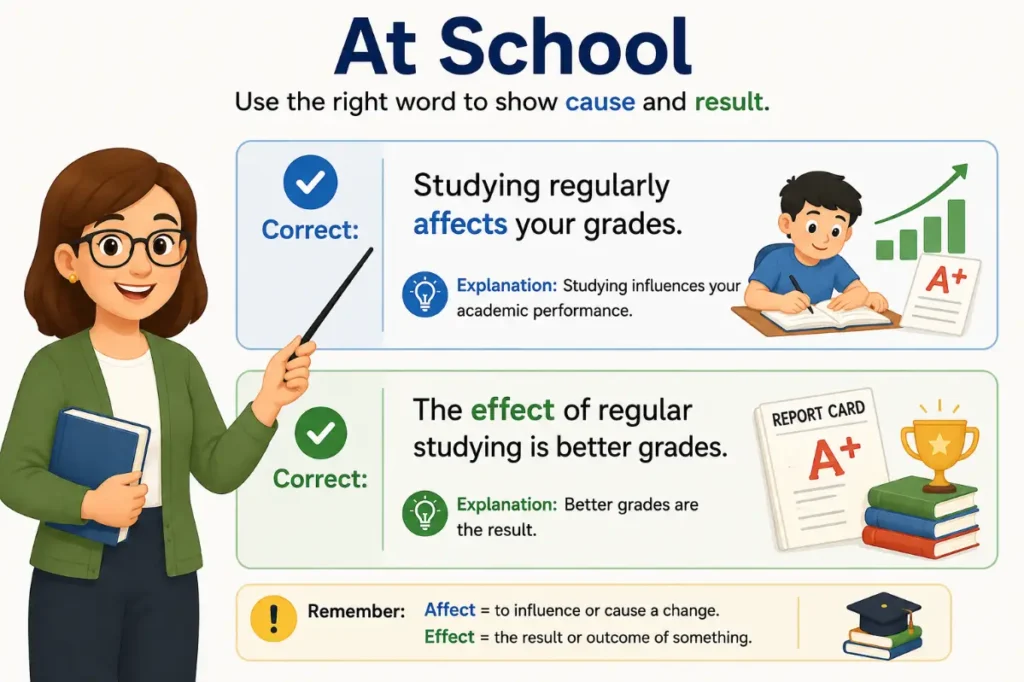
At School
Correct:
Studying regularly affects your grades.
Explanation: Studying influences your academic performance.
Correct:
The effect of regular studying is better grades.
Explanation: Better grades are the result.
At Work
Correct:
Poor communication affects teamwork.
Explanation: Communication influences how people work together.
Correct:
One effect of poor communication is lower productivity.
Explanation: Lower productivity is the outcome.
A related grammar guide is Its vs It’s: Meaning and Correct Usage Explained.
Common Mistakes With These Words
Many errors happen because writers remember the basic rule but fail to check the sentence structure. Others come from phrases that sound similar when spoken.
Using Effect When You Mean Influence
Incorrect: The rain will effect our travel plans.
Correct: The rain will affect our travel plans.
The sentence describes how the rain may influence travel plans. The verb affect fits the meaning.
Using Affect When You Mean Result
Incorrect: The affect of the new rule was immediate.
Correct: The effect of the new rule was immediate.
The sentence names a result. It needs the noun effect.
Confusing Effect With Effective
Incorrect: The treatment was affect.
Correct: The treatment was effective.
Effective is an adjective meaning successful in producing a desired result. Affect is usually a verb, so it does not fit after was in this sentence.
Forgetting the Phrase Have an Effect On
Incorrect: Exercise can have a good affect on mood.
Correct: Exercise can have a good effect on mood.
The phrase have an effect on uses the noun. The adjective good also helps signal that a noun should follow.
Confusing Effect With Affect in Formal Writing
Incorrect: The team hopes to affect a compromise.
Correct: The team hopes to effect a compromise.
If the intended meaning is to bring a compromise about, the verb effect is the more accurate choice. If the team hopes to influence an existing compromise, the sentence would need a different meaning and structure.
Ten Natural Sentence Examples
These examples show how the two words work in everyday and professional contexts.
1. Everyday conversation: Lack of sleep can affect your mood. The verb describes how poor sleep influences emotions.
2. Text message: The traffic might affect when I get there. The speaker means that traffic could change the arrival time.
3. Workplace: The updated schedule will affect the whole team. The schedule may change the team’s working arrangements.
4. School: Too much noise can affect a student’s concentration. The noise influences the student’s ability to focus.
5. Academic writing: Researchers studied the effect of screen time on sleep. The noun names the result being examined.
6. Formal writing: The policy had a significant effect on costs. The sentence identifies a consequence of the policy.
7. Social situation: Her apology had a positive effect on their friendship. The apology helped improve the relationship.
8. Health: The doctor explained the possible effects of the medication. The plural noun refers to the results the medicine may produce.
9. News reporting: The power outage affected thousands of residents. The verb describes how the outage influenced people’s lives.
10. Business planning: The company hopes to effect lasting change. The formal verb means that the company intends to bring about change.
Pronunciation Guide
The two words sound similar, but they are not pronounced exactly the same in standard American English.
| Word | American IPA | Easy guide | Main stress |
|---|---|---|---|
| Affect | /əˈfɛkt/ | uh FEKT | Second syllable |
| Effect | /ɪˈfɛkt/ | ih FEKT | Second syllable |
Both words have two syllables and stress the second syllable. The main sound difference appears in the first vowel.
In affect, the first vowel is a reduced sound, similar to the unstressed vowel in about. In effect, the first vowel is commonly pronounced like the short vowel in it.
Regional accents may change the precise vowel quality. The distinction can still be useful, but pronunciation alone is not always enough to identify the intended word. Sentence meaning remains the most reliable guide.
Practice the words in short phrases.
- Affect mood.
- Affect performance.
- An effect.
- A lasting effect.
- The effects of stress.
Reading these expressions aloud helps you connect each spelling with its common grammatical pattern.
Etymology and Word Origin
The two words share historical connections to Latin, which helps explain their similar spelling.
Affect comes through Latin afficere, meaning to act on or influence. Its modern English verb meaning developed around the idea of having an influence on someone or something.
Effect comes through Latin effectus, connected with doing, accomplishing, or bringing about a result. English developed the noun meaning an outcome and the formal verb meaning to bring something about.
Their histories help explain the modern difference. One word usually emphasizes influence or action, while the other usually emphasizes the result. However, the historical origins do not replace the practical grammar rule. For everyday writing, the sentence’s meaning and structure remain the best guides.
Regional Usage
The basic distinction stays the same across major English varieties. American, British, Canadian, and Australian English all use affect as a common verb meaning influence and effect as a common noun meaning result.
American English
In the United States, the usual rule applies in conversation, education, journalism, and business writing.
Examples include:
The weather affected the game.
The weather had an effect on attendance.
The formal verb effect also appears in American English, especially in phrases such as effect change and effect reforms.
British English
British English uses the same main distinction. The spelling and grammatical roles do not change simply because the writer is in the United Kingdom.
For example:
The decision affected local residents.
The decision had an effect on local residents.
Canadian English
Canadian English also follows the same rule. Writers use affect for influence and effect for a result, with the same formal exceptions.
Australian English
Australian English follows the same standard pattern. There is no general regional spelling difference that changes the central rule.
In all four varieties, context determines the correct word. You do not need to learn separate national rules for this pair.
Grammar Rules and Sentence Patterns
Understanding the parts of speech makes word choice easier.
Affect as a Verb
The verb usually takes a direct object.
The weather affects traffic.
The new rule affects students.
The noise affected my sleep.
In these examples, the word after the verb identifies what experiences the influence.
The verb can appear in different tenses.
Present: The change affects everyone.
Past: The change affected everyone.
Future: The change will affect everyone.
Progressive: The change is affecting everyone.
Effect as a Noun
The noun can be singular or plural.
The effect was clear.
The effects were clear.
It often follows articles and adjectives.
An effect.
The main effect.
A positive effect.
Several effects.
The phrase effect on is also common.
The decision had an effect on the budget.
The phrase identifies the result and the thing influenced by that result.
Effect as a Verb
When the word means bring about, it takes an object describing the change or result.
The new manager hopes to effect reform.
The group worked to effect a peaceful settlement.
This use is more formal and less common than the noun. Do not choose it simply because the sentence sounds formal. Choose it only when you mean to bring something about.
Affect as a Noun
In psychological and clinical contexts, affect can name the outward expression of emotion.
The report described the patient’s affect as restricted.
This specialized noun has a different meaning from the everyday verb. It is best understood from the clinical context.
Real Life Usage Examples
Daily Conversation
“My work schedule affects my sleep.”
The schedule influences when the speaker sleeps and possibly how rested they feel.
“The effect of the late night lasted all morning.”
The sentence identifies the result of staying up late.
Email and Workplace Communication
“The deadline may affect our delivery date.”
This sentence warns that the deadline could influence the planned delivery.
“The change had an unexpected effect on our budget.”
Here effect names the financial outcome of the change.
Academic Writing
“The study examined how exercise affects memory.”
The verb describes the relationship being studied.
“The researchers measured the effects of exercise on memory.”
The noun refers to the outcomes the researchers measured.
Both sentence structures are suitable for academic writing. The choice depends on how the writer frames the idea.
News and Journalism
“The storm affected transportation across the region.”
The verb communicates that the storm influenced transportation services.
“The effects of the storm included road closures and power outages.”
The noun introduces specific consequences.
Literature and Storytelling
“His decision affected everyone in the village.”
The decision influenced the characters’ lives.
“The effect of his decision became clear years later.”
The noun emphasizes the outcome that emerged over time.
Related Words
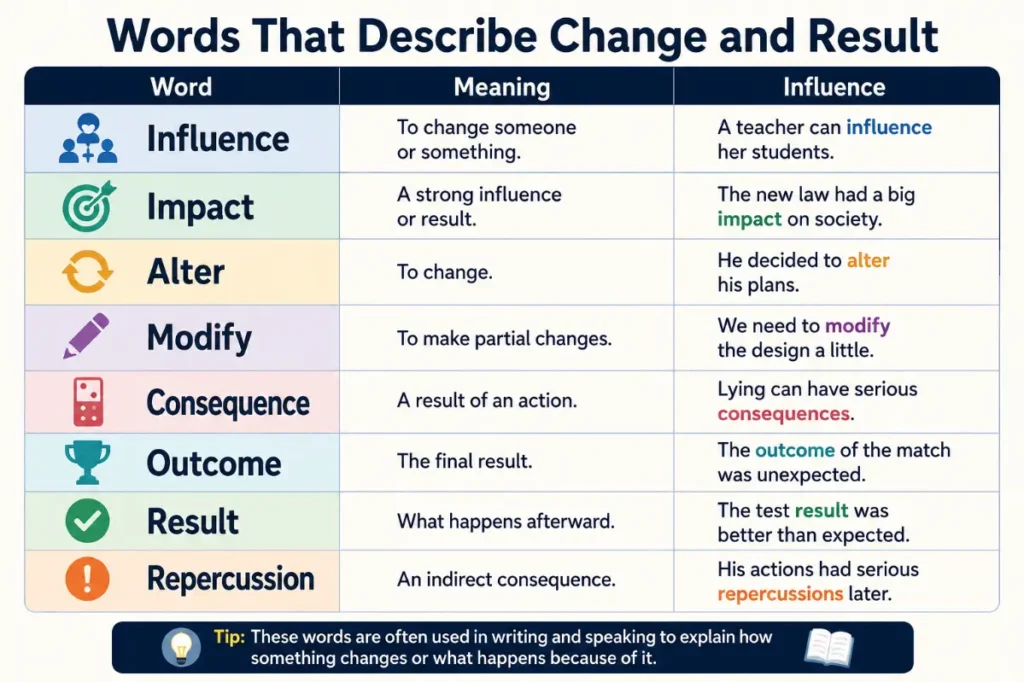
These related words can help you express influence and results more precisely.
1. Influence. As a verb, influence is close in meaning to affect. As a noun, it can describe the power to shape someone or something. For example, Friends can influence your choices.
2. Impact. Impact can be a noun or a verb. It often describes a strong or noticeable effect. For example, The decision had a major impact on sales.
3. Result. A result is something that happens because of an action or situation. It is often a useful alternative to effect. For example, The result was better than expected.
4. Consequence. A consequence is an outcome of an action or event. It often suggests an important or sometimes unwanted result. For example, Missing the deadline had serious consequences.
5. Outcome. An outcome is the final result of a process, event, or decision. For example, The outcome of the meeting was positive.
6. Effective. Effective is an adjective meaning successful in producing a desired result. For example, The new method is effective.
7. Effectiveness. Effectiveness is the quality of producing the intended result. For example, The team measured the effectiveness of the training.
8. Side effect. A side effect is an additional result of a treatment or action, often one that is not the main intended result. For example, The medicine caused a mild side effect.
These words overlap in meaning, but they are not perfect substitutes in every sentence. Choose the word that matches the idea you want to express.
Expert Editor Insight
Experienced editors look at meaning and sentence structure before correcting either word. A spell checker may accept both because both are standard English, and grammar tools can miss a mistake if the sentence remains grammatically possible. The fastest check is to identify the part of speech. If the sentence needs a verb meaning influence, use affect. If it needs a noun meaning result, use effect. Then check for the less common expressions effect change and the clinical noun affect.
Many readers also check Who’s vs Whose Meaning and Correct Usage.
Conclusion
The difference between affect and effect becomes clear when you focus on grammar and meaning. Affect usually means to influence or change something, while effect usually means a result or outcome. Both words are correct, and each has less common uses that matter in formal or specialized writing.
For everyday sentences, remember the simple pattern: actions affect things, and effects are results. If you’re unsure, replace affect with influence or effect with result to see which one fits. Then check the sentence’s grammar before making your final choice. This small editing habit can prevent a common mistake in schoolwork, emails, reports, and professional writing.
FAQs
Is affect or effect correct?
Both are correct words, but they serve different purposes. Affect is usually a verb meaning to influence or change something. Effect is usually a noun meaning a result. For example, Stress can affect sleep, and the effect may be tiredness. Always choose the word that matches the meaning and grammar of your sentence.
What is an easy way to remember the difference?
Remember that affect usually means an action, while effect usually means an end result. You can think of the first as what happens to something and the second as what comes out of it. For example, Noise can affect your focus, and poor focus can be an effect of noise.
Can effect be used as a verb?
Yes. As a verb, effect means to bring about or accomplish something. The phrase effect change means to make change happen. This use is more formal than the common noun. For example, The organization hopes to effect meaningful reform. The word means more than simply influencing an existing situation.
Can affect be used as a noun?
Yes. In psychology and clinical writing, affect refers to the outward expression of emotion. A clinician might describe a person’s affect as flat or restricted. This meaning differs from the usual verb meaning to influence. In ordinary conversation, the verb is much more common, so context is essential.
What is the difference between affect and impact
Affect is usually a verb meaning to influence or change something. Impact can function as a noun or verb and often suggests a noticeable or strong influence. For example, The delay affected our plans. The delay had a major impact on our plans. Both are correct, but their grammar differs.
How do you pronounce affect and effect?
Both words have two syllables, and both receive stress on the second syllable in standard American English. Affect begins with an unstressed vowel sound similar to the first sound in about. Effect begins with a short vowel sound similar to the vowel in it. The final syllables sound alike.
Do American and British English use these words differently?
No major difference changes the basic rule. American and British English use affect for influence and effect for a result. Both varieties also recognize the formal verb effect, meaning to bring about, and the specialized noun affect used in psychology.
Is effect change or affect change correct?
Effect change is correct when you mean to bring about change. Affect change means to influence change or have an impact on it, though it is less common in ordinary writing. For example, The new policy will effect change means the policy will bring change about. The wording depends on the intended meaning.