
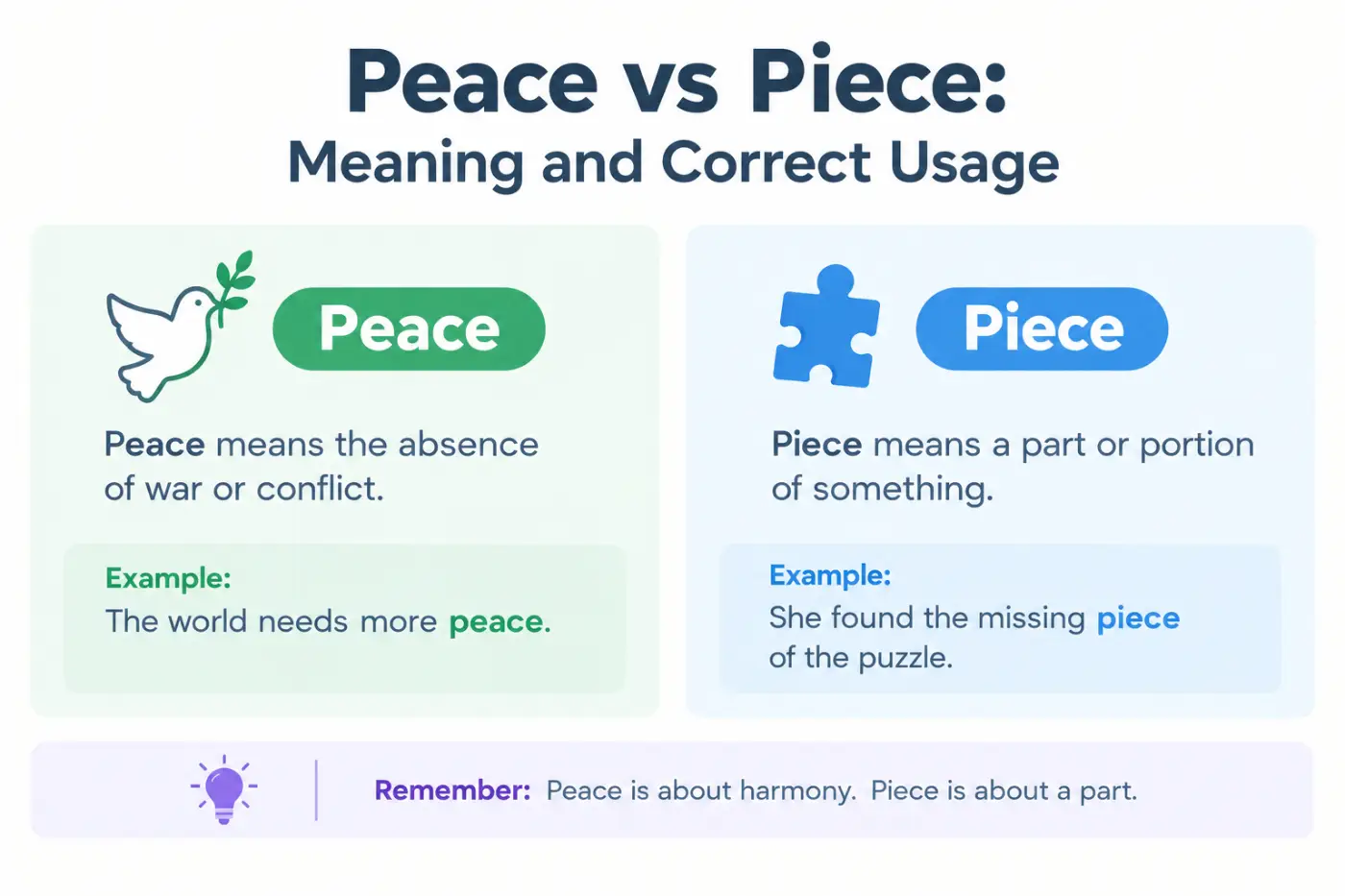
Have you ever stopped while writing a sentence because you couldn’t remember if you needed peace vs piece? You’re not alone. These two words sound exactly alike in standard American English, but their meanings are completely different. Choosing the wrong one can change your sentence from a message about harmony into a reference to an object or part of something.
The easiest way to remember the difference is to connect peace with calm and harmony, while piece refers to a part, portion, or individual item. You can enjoy peace at home, make peace with a friend, or work toward world peace. You can also eat a piece of pizza, solve a piece of a puzzle, or write a piece of music. The spelling depends on the idea you want to express.
Understanding these words will help you write more clearly in emails, school assignments, text messages, essays, and professional documents. You’ll learn their meanings, grammar rules, pronunciation, common expressions, and frequent mistakes. You’ll also discover a few simple memory tricks that make the correct spelling easier to recall whenever you need it.
A related grammar guide is complaint vs complain Meaning Difference And Correct Usage.
Quick Answer
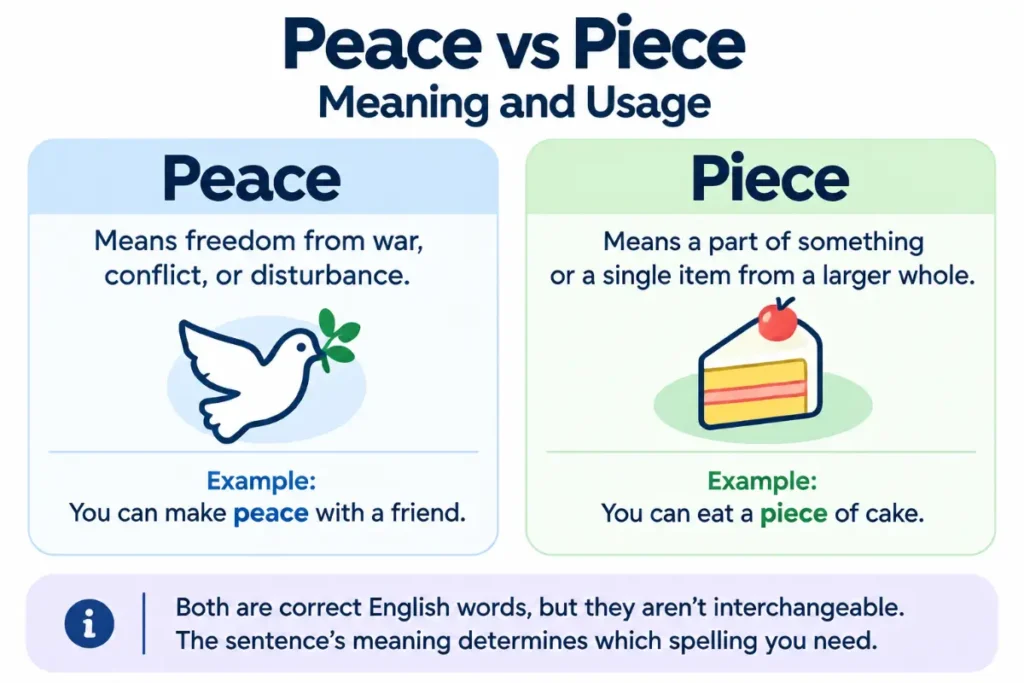
Peace means freedom from war, conflict, or disturbance. Piece means a part of something or a single item from a larger whole. Both are correct English words, but they aren’t interchangeable. For example, you can make peace with a friend or eat a piece of cake. The sentence’s meaning determines which spelling you need.
What Is the Difference Between Peace and Piece?
The main difference lies in meaning and grammatical use. Peace is a noun that describes a state of calm, harmony, or freedom from conflict. Piece is a noun that usually describes a portion of something or an individual item.
Although both words share the same pronunciation, they represent different ideas. One concerns harmony or the absence of conflict. The other concerns parts, portions, and individual objects.
| Feature | Peace | Piece |
|---|---|---|
| Meaning | Calm, harmony, or freedom from conflict | A part, portion, or individual item |
| Part of speech | Noun | Noun |
| Pronunciation | /piːs/ | /piːs/ |
| Main idea | Harmony and quiet | A part of a whole |
| Common expressions | Peace of mind, world peace, keep the peace | A piece of cake, a piece of paper, a piece of advice |
| Example | The neighbors finally made peace. | She ate a piece of cake. |
| Spelling clue | Ends with ace | Ends with iece |
Neither spelling is more correct than the other. The right choice depends entirely on the meaning of your sentence.
Meaning and Definition of Peace
Peace is a noun that describes a condition in which people, groups, or countries live without war or serious conflict. It can also describe a feeling of calm, quiet, and freedom from worry.
The word appears in personal, social, political, and emotional contexts. Its meaning depends on the situation, but the central idea is harmony or the absence of disturbance.
Peace as Freedom From Conflict
One common meaning refers to the absence of fighting or hostility. People often use this sense when discussing relationships, communities, and international affairs.
For example:
1. The two countries signed an agreement to restore peace.
The sentence describes an effort to end conflict between nations.
2. The neighbors finally made peace after their disagreement.
Here, peace means that two people stopped arguing and resolved their differences.
3. The community hopes for lasting peace.
The sentence expresses a desire for a future without violence or serious conflict.
Peace doesn’t always mean that everyone agrees about everything. People can hold different opinions and still maintain peaceful relationships. The word focuses on the absence of serious conflict rather than complete agreement.
Peace as Calm and Quiet
Peace can also describe a calm environment or a state of emotional comfort. This meaning often appears in everyday conversation.
For example:
1. I enjoy the peace of the countryside.
The speaker appreciates the quiet and calm surroundings.
2. She finally found peace after a stressful week.
Here, peace describes emotional relief after a difficult period.
3. Please let me work in peace.
The speaker wants to work without interruptions or disturbances.
In these examples, the word doesn’t refer to a formal agreement or the end of a war. It describes a peaceful experience or condition.
Peace as Inner Comfort
People also use peace to describe emotional balance, acceptance, or relief from worry. This meaning appears in conversations about personal growth, family relationships, difficult decisions, and loss.
Consider these sentences.
1. He made peace with his past.
This means he accepted earlier experiences and stopped struggling with them emotionally.
2. Spending time with family gives her peace of mind.
The expression describes a feeling of reassurance and reduced worry.
3. She felt at peace with her decision.
This means she felt comfortable and satisfied with the choice she had made.
These expressions are common because people often use the idea of peace to describe more than a quiet place. It can also describe a calm state of mind.
Meaning and Definition of Piece
Piece is a noun that usually refers to a part of something larger. It can describe a physical portion, an individual object, or a creative work.
The word appears in countless everyday situations. You might use it when talking about food, clothing, furniture, writing, music, art, or tasks.
Piece as a Part of Something
The most familiar meaning is a portion separated from a larger object or substance.
For example:
1. She cut a piece of bread for her son.
The word identifies one portion of a larger loaf.
2. I found a piece of glass on the floor.
Here, piece refers to a fragment of glass.
3. He tore a piece of paper from his notebook.
The word describes a portion removed from a larger sheet.
A piece doesn’t have to be small. It can describe a large section of something, too. For example, a piece of land might cover several acres, depending on the context.
Piece as an Individual Item
Piece can also refer to one item within a collection or group.
For example:
1. The furniture store delivered three pieces of furniture.
Each piece is an individual item, such as a chair, table, or cabinet.
2. She bought a new piece of jewelry.
The expression identifies one item of jewelry.
3. The museum displayed an ancient piece of pottery.
Here, piece refers to an individual object in the museum’s collection.
This meaning is useful when the object doesn’t have a specific name or when the speaker wants to describe it generally.
Piece as a Creative Work
In art and entertainment, piece can refer to a complete work rather than a physical fragment.
For example:
1. The orchestra performed a beautiful piece of music.
Piece refers to a musical composition.
2. She wrote a short piece for the school newspaper.
The word means an article or written work.
3. The gallery displayed a striking piece of art.
Here, piece refers to an artwork.
The important point is that piece doesn’t always mean a broken or incomplete part. It can describe a complete item or creation.
When to Use Each Word
The simplest way to choose is to identify the idea behind your sentence.
Use peace when you mean harmony, calm, quiet, or freedom from conflict. Use piece when you mean a portion, fragment, individual object, or creative work.
Here are some common expressions that show the difference.
| Expression | Meaning |
|---|---|
| World peace | A world without war or widespread conflict |
| Peace of mind | A feeling of reassurance and calm |
| Keep the peace | Prevent conflict or maintain harmony |
| At peace | Calm or emotionally settled |
| A piece of cake | A portion of cake or an easy task, depending on context |
| A piece of paper | One sheet or portion of paper |
| A piece of advice | One helpful suggestion |
| A piece of music | A musical composition |
| A piece of furniture | One item of furniture |
| A piece of evidence | One item or part of evidence |
Notice that some expressions have figurative meanings. A piece of cake can literally be food, but the phrase can also describe a task that’s easy to complete.
Peace also appears in figurative expressions. Making peace with a decision, for example, means accepting it rather than fighting against it emotionally.
Learning common phrases is often more effective than memorizing isolated definitions because you’ll recognize how native speakers use the words in real sentences.
Ten Natural Sentence Examples
The following examples show how each word works in everyday American English.
Examples Using Peace
1. The children played quietly while their parents enjoyed some peace and quiet.
The word refers to a calm environment without noise or interruptions.
2. After a long argument, the brothers finally made peace.
Peace means they resolved their disagreement and restored their relationship.
3. I need a few minutes of peace before my next meeting.
The speaker wants a short break from noise or demands.
4. The leaders met to discuss a plan for peace.
Here, peace refers to the goal of ending conflict between groups or nations.
5. She felt at peace after talking honestly with her friend.
The word describes emotional relief and calm.
Examples Using Piece
6. Could you give me a piece of paper?
Piece refers to one sheet or portion of paper.
7. He saved the last piece of pizza for his sister.
The word identifies one portion of the pizza.
8. The student wrote a thoughtful piece about climate change.
Piece refers to a written article or composition.
9. We need one more piece of furniture for the living room.
The word identifies one additional item.
10. The technician replaced a broken piece of equipment.
Piece refers to one component or item within a larger system.
These examples illustrate the central distinction. Peace describes a condition or state, while piece identifies an item, portion, or work.
Common Mistakes and Misspellings
Because the two words sound alike, writers sometimes choose the wrong spelling without noticing. Spellcheck may not catch the error because both forms are legitimate English words.
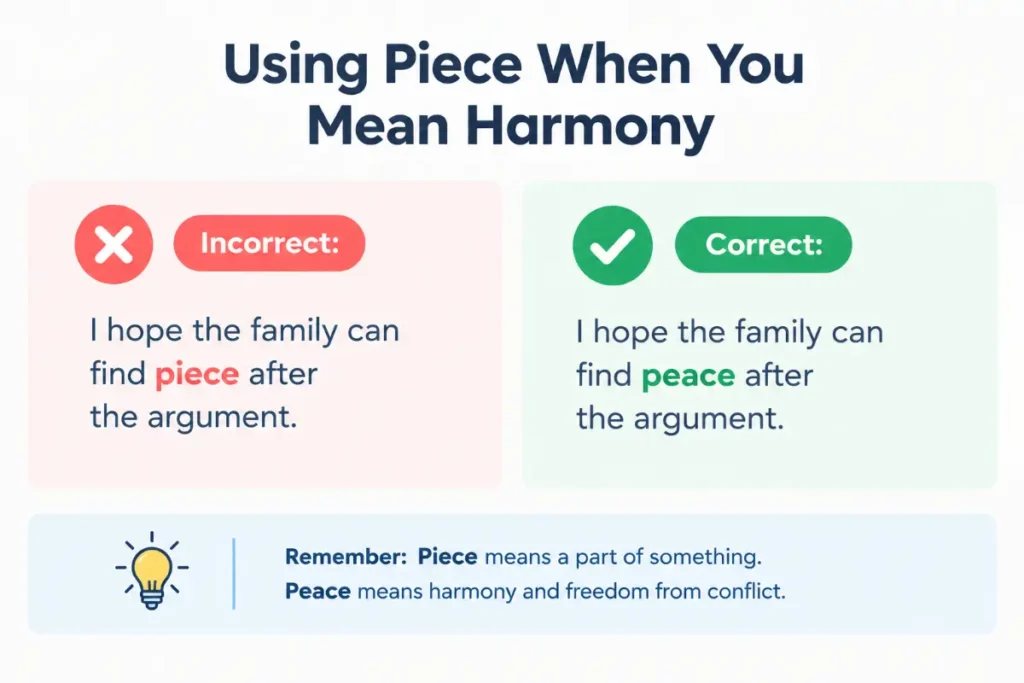
Using Piece When You Mean Harmony
Incorrect: I hope the family can find piece after the argument.
Correct: I hope the family can find peace after the argument.
The sentence refers to emotional harmony, not a physical portion. Peace is the correct choice.
Using Peace When You Mean a Portion
Incorrect: Would you like a peace of cake?
Correct: Would you like a piece of cake?
The sentence refers to a serving of food. Piece is the correct noun.
Confusing Peace of Mind With Piece of Mind
These expressions have different meanings.
Peace of mind means a feeling of calm or reassurance.
Piece of mind appears in the idiom give someone a piece of your mind. This expression means speaking angrily or frankly to someone about something they did wrong.
For example:
1. Knowing the doors are locked gives me peace of mind.
2. The customer gave the manager a piece of her mind.
The first sentence describes reassurance. The second describes a strong verbal complaint.
Misspelling Common Expressions
Writers sometimes type the wrong word in familiar phrases because they rely on sound instead of meaning.
Incorrect: The teacher asked for a peace of evidence.
Correct: The teacher asked for a piece of evidence.
Evidence is being treated as one item or element, so piece is appropriate.
Incorrect: Everyone deserves a little piece and quiet.
Correct: Everyone deserves a little peace and quiet.
The phrase refers to calm and freedom from disturbance.
Trusting Spellcheck Without Reading the Sentence
A spelling checker may accept both words because both are spelled correctly in isolation. The problem is contextual rather than purely orthographic.
For example, a writing tool may not flag the sentence I need a peace of paper because peace is a valid word. A careful reread reveals that the sentence needs piece.
The best fix is to check the meaning of the whole sentence rather than relying only on red underlines or automatic corrections.
Pronunciation Guide
Both words have the same pronunciation in standard American English. Each is pronounced /piːs/, with one syllable and a long vowel sound.
A simple pronunciation guide is pees. The final sound is /s/, as in sun or sit.
The spelling doesn’t change the pronunciation. You cannot reliably distinguish the words by listening alone. Instead, you need to use context.
For example, if someone says, I need a piece of paper, the surrounding words show that they mean a physical item. If someone says, I need peace and quiet, the phrase reveals that they want calm and freedom from interruptions.
Both words have one syllable, so there is no separate syllable stress to learn. The vowel sound stays the same in both.
Learn the difference in Immerse Vs Emerse Which Word Should You Use in 2026.
Etymology and Word Origin
The words have different histories, even though their modern pronunciations are identical.
The Origin of Peace
Peace entered English through Anglo French and Old French forms related to the Latin word pax, meaning peace or an agreement to end conflict. Over time, English developed several connected uses, including freedom from war, harmony between people, quiet, and emotional calm.
These meanings remain closely related. A peace agreement may end a conflict between groups, while peace of mind describes a state of personal reassurance.
The Origin of Piece
Piece entered English through Anglo French and Old French forms related to a word meaning a part or portion. Its history connects it with the idea of an individual section separated from or belonging to a larger whole.
Modern English has expanded this meaning into many areas. A piece may be a portion of food, an item of furniture, a musical composition, an article, or a component of a larger object.
Their different histories help explain why the words have different spellings and meanings despite sounding alike today.
Regional Usage in English
The distinction between the two words remains the same across major varieties of English. American, British, Canadian, and Australian English use peace for harmony or freedom from conflict and piece for a portion or individual item.
American English
Both spellings are standard in the United States. Common expressions include peace of mind, peace and quiet, a piece of cake, a piece of paper, and a piece of advice.
The words are pronounced alike in standard American English.
British English
British English uses the same spellings and meanings. There is no general British spelling rule that changes peace into piece or the reverse.
The distinction depends on meaning and grammar, just as it does in American English.
Canadian and Australian English
Canadian and Australian English also maintain the same distinction. Writers in these regions use peace for calm and harmony and piece for a portion or item.
Regional accents may differ in other aspects of speech, but these two words remain homophones in standard usage.
Grammar Rules and Parts of Speech
Both peace and piece are nouns. Their grammatical role is similar, but the meanings they express are different.
Peace as a Noun
Peace is generally an uncountable noun when it refers to a state of calm or freedom from conflict.
For example:
1. Peace is essential for a stable community.
2. The agreement brought peace to the region.
3. She values peace and quiet.
In these sentences, peace describes a general condition. Writers don’t usually say one peace or two peaces when referring to harmony.
However, the word can appear in specialized or literary contexts with more specific meanings. For ordinary writing, treat peace as an uncountable noun when discussing calm or freedom from conflict.
Piece as a Countable Noun
Piece is a countable noun. You can use it with a, one, two, several, or other words that identify quantity.
For example:
1. I ate a piece of fruit.
2. She collected three pieces of pottery.
3. We need several pieces of information before making a decision.
The word often follows a number or an article because it identifies a countable item or portion.
Common Grammatical Patterns
Peace commonly appears in phrases such as:
1. Peace with someone.
2. Peace of mind.
3. Peace and quiet.
4. At peace.
5. Make peace.
Piece commonly appears in patterns such as:
1. A piece of something.
2. Two pieces of something.
3. A piece of advice.
4. A piece of work.
5. Piece by piece.
These patterns help you recognize the correct word before you finish writing a sentence.
Real Life Usage Examples
The words appear in many settings. Looking at realistic examples can help you understand how context determines the correct spelling.
Daily Conversation
1. I just want some peace and quiet after work.
The speaker wants to relax without noise or interruptions.
2. Can you save me a piece of chocolate?
The speaker wants one portion of chocolate.
Workplace Communication
1. The team reached a peaceful agreement after discussing the problem.
This sentence uses peaceful, an adjective related to peace, to describe an agreement reached without conflict.
2. Please attach a piece of supporting evidence to your report.
Piece refers to one item of evidence.
Academic Writing
1. The essay examines the role of peace agreements in resolving international conflicts.
Peace refers to the absence of conflict and the agreements intended to support it.
2. The researcher published a piece about language learning.
Piece means a written article or work.
News Reporting
1. Community leaders called for peace after several days of unrest.
Peace refers to the goal of ending violence or conflict.
2. Investigators recovered a piece of equipment from the site.
Piece identifies one item recovered during the investigation.
Literature and Storytelling
1. After years of anger, the character finally found peace within himself.
Peace describes emotional acceptance and calm.
2. A missing piece of the map revealed the location of the hidden treasure.
Piece refers to a fragment needed to complete the map.
These examples show why meaning matters more than sound. The surrounding sentence provides the clues that guide the spelling.
Eight Related and Confused Terms
Several English words and expressions are closely related to these two terms. Understanding them can help you choose more precise language.
1. Piece of Mind
The expression give someone a piece of your mind means telling someone directly and often angrily what you think about their behavior.
Example: The coach gave the referee a piece of his mind after the disputed call.
This expression uses piece rather than peace because it refers figuratively to expressing one’s thoughts.
2. Peace of Mind
Peace of mind means a feeling of calm, security, or freedom from worry.
Example: Keeping a backup of my files gives me peace of mind.
The expression refers to reassurance rather than a physical object.
3. Peaceful
Peaceful is an adjective that describes something calm or free from conflict.
Example: The family spent a peaceful afternoon by the lake.
It describes the atmosphere rather than naming the state itself.
4. Piecework
Piecework is a system of work in which someone is paid according to the number of items produced or tasks completed rather than simply by time worked.
Example: The factory once paid some workers through piecework.
The word connects piece with individual units of production.
5. Peacekeeper
A peacekeeper is a person or member of a group who helps maintain peace or prevent conflict.
Example: The peacekeepers helped protect civilians in the region.
The word is commonly associated with conflict prevention and peacekeeping operations.
6. Piece by Piece
Piece by piece means gradually, one part at a time.
Example: She rebuilt the model piece by piece.
The expression emphasizes a process that happens in small stages.
7. Peace Treaty
A peace treaty is a formal agreement intended to end a state of war or establish peace between parties.
Example: The countries signed a peace treaty after months of negotiations.
The expression is common in history, diplomacy, and international relations.
8. Masterpiece
A masterpiece is an outstanding work of art, literature, music, or another creative field.
Example: Critics called the painting a masterpiece.
The word contains piece, but its meaning has developed beyond a literal portion. It refers to a work considered exceptional.
Expert Editor Insight
An experienced editor checks meaning rather than sound when reviewing these words. Because both spellings are legitimate and pronounced alike, basic spellcheck may miss a contextual error. The fastest test is to replace the word mentally with harmony or portion. If harmony fits, use peace. If portion or item fits, use piece. Editors also pay attention to fixed expressions, especially peace of mind and give someone a piece of your mind, because a single letter change can alter the entire meaning.
Memory Tips for Choosing the Correct Spelling
A simple memory trick can help you make the right choice without stopping to think for too long.
Connect Peace With Calm
Think of peace as the opposite of conflict. It describes harmony, quiet, and emotional comfort.
Remember these expressions:
1. World peace.
2. Peace of mind.
3. Peace and quiet.
4. Make peace.
Each phrase refers to calm, harmony, or the end of conflict.
Connect Piece With a Portion
Think of a piece of something you can count or identify. It might be a piece of pizza, a piece of paper, or a piece of furniture.
Remember these expressions:
1. A piece of cake.
2. A piece of advice.
3. A piece of music.
4. A piece of evidence.
Each phrase identifies an item, portion, or work.
Use a Quick Sentence Test
Before choosing the spelling, ask yourself what you mean.
If you’re talking about calm, harmony, or freedom from conflict, choose peace.
If you’re talking about an item, portion, or part of something, choose piece.
You can also memorize this sentence: Peace brings calm, while a piece is part of something.
The contrast is short enough to remember and broad enough to work in most everyday situations.
Key Takeaways
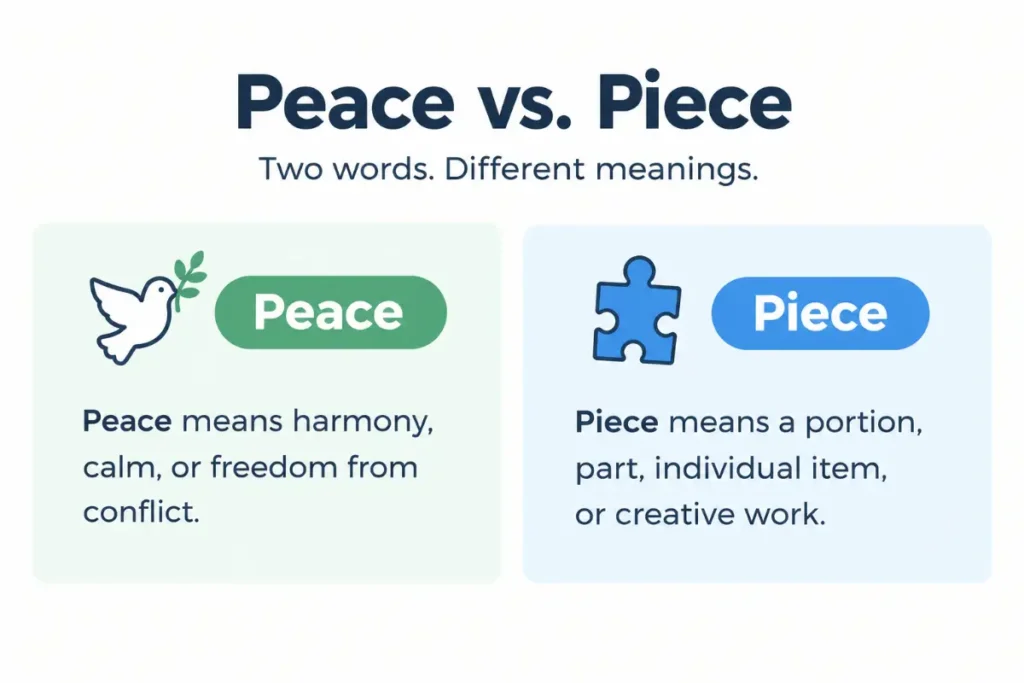
1. Peace means harmony, calm, or freedom from conflict.
2. Piece means a portion, part, individual item, or creative work.
3. Both words are nouns in their common uses.
4. Both words have the same pronunciation in standard American English.
5. Peace of mind means reassurance and calm.
6. Give someone a piece of your mind means speaking frankly or angrily.
7. American, British, Canadian, and Australian English use the same basic distinction.
8. Spellcheck may miss a mistake because both words are valid.
9. Use context to determine the correct spelling.
10. Remember the simple rule: peace brings calm, while a piece is part of something.
Learn the difference in begun or began The Simple Grammar Rule 2026.
Conclusion
Peace and piece sound the same, but their meanings make them easy to distinguish once you know what to look for. Peace refers to harmony, calm, or freedom from conflict. Piece refers to a portion, individual item, or creative work. Both are correct spellings, so the challenge isn’t choosing a universally correct form.
It’s matching the word to your meaning. Remember that peace is connected to calm, while a piece is part of something. Before sending an email, submitting an assignment, or publishing a document, read the sentence once for meaning. That small habit can prevent a common spelling mistake and make your writing clearer.
Frequently Asked Questions
Is peace or piece the correct spelling?
Both are correct English spellings. Peace refers to harmony, calm, or freedom from conflict. Piece refers to a portion of something or an individual item. You should choose the word that matches the intended meaning. Neither is a misspelling of the other, but substituting one for the other can make a sentence incorrect.
What does peace mean?
Peace means a state of calm, harmony, or freedom from conflict. It can describe relationships between people, conditions between countries, a quiet environment, or emotional relief. For example, peace of mind refers to feeling reassured and free from worry. The exact meaning depends on the context, but the central idea is calm or the absence of conflict.
What does piece mean?
Piece usually means a part, portion, or individual item. You can have a piece of cake, a piece of paper, or a piece of furniture. It can also refer to a complete creative work, such as a piece of music or a piece of writing. The word is a countable noun in its common uses.
Do peace and piece sound the same?
Yes. In standard American English, both words are pronounced /piːs/. They are homophones, meaning they sound alike but have different meanings and spellings. You generally cannot tell which word someone means from pronunciation alone. The surrounding words and the situation help you understand the intended meaning.
Is peace of mind or piece of mind correct?
Peace of mind is correct when you mean a feeling of calm or reassurance. Piece of mind appears in the expression give someone a piece of your mind, which means speaking frankly or angrily to someone. For example, a secure home can give you peace of mind, while an upset customer might give a manager a piece of her mind.
Can peace and piece start a sentence?
Yes. Both words can start a sentence when the grammar and meaning support them. For example, Peace is essential for a healthy community uses peace as the subject. Piece by piece, she rebuilt the model uses piece in a common expression that describes gradual progress. Neither word has a special restriction against appearing at the beginning of a sentence.
Why do people confuse these two words?
People confuse them because they have identical pronunciation in standard English and similar spelling patterns. When someone writes quickly, they may choose the wrong word without noticing. Spellcheck may not flag the mistake because both forms exist in the dictionary. Thinking about the sentence’s meaning is the most reliable way to choose correctly.
Are peace and piece used differently in British and American English?
Their meanings and standard spellings are the same in American and British English. Peace refers to harmony or freedom from conflict, while piece refers to a portion or item. There is no general regional rule that switches one spelling for the other. The main challenge is choosing the word that fits the intended meaning.