
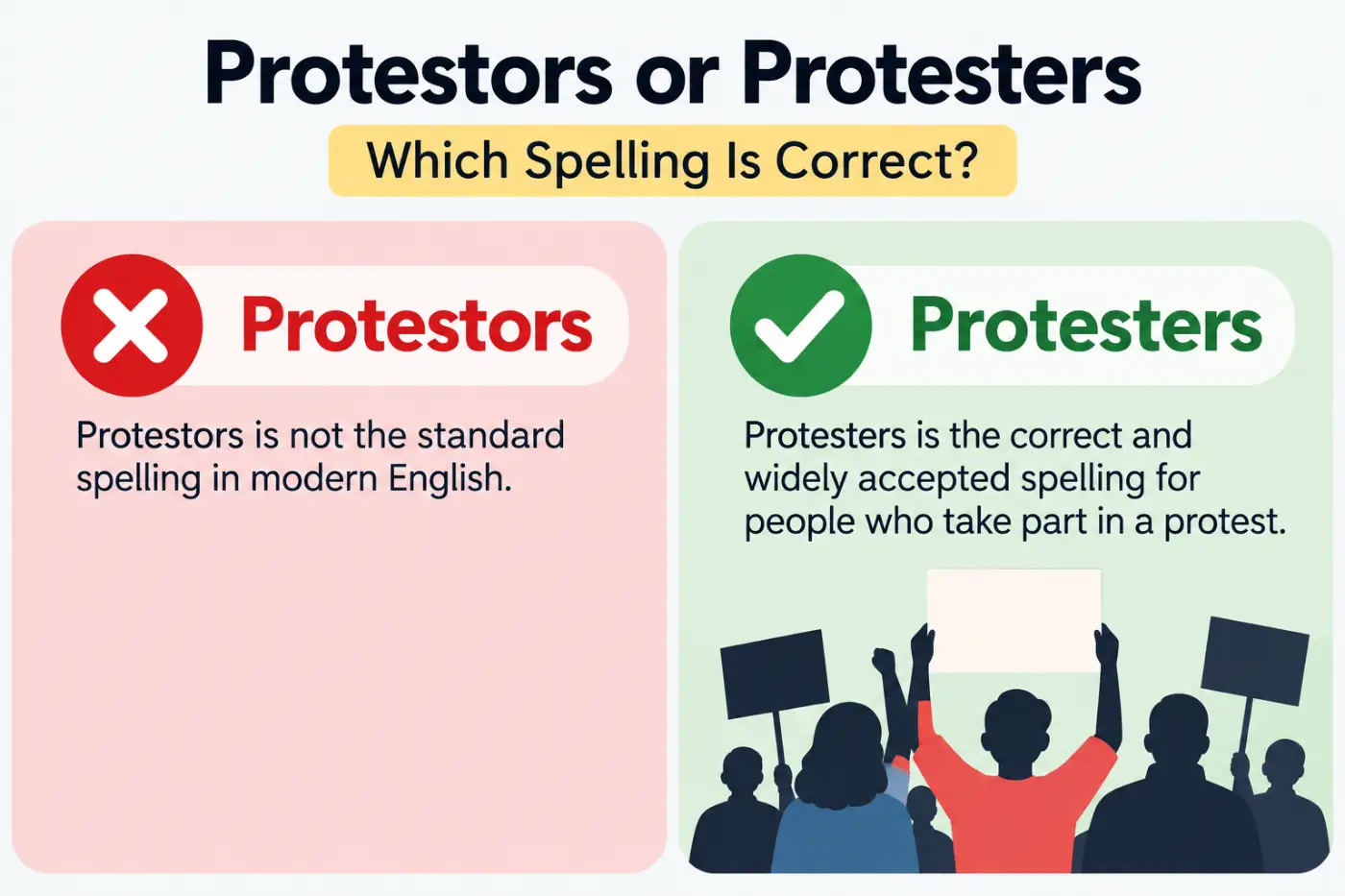
Choosing between protestors and protesters can be confusing because both spellings look reasonable. You might see one form in a news headline and the other in an article about the same event. That can leave you wondering if one is a spelling mistake or if the words have different meanings.
The answer is simple. Both spellings are accepted, and neither changes the basic meaning of the word. Each refers to people who take part in a protest, such as a public demonstration against a law, government decision, company policy, or social issue. The main difference is spelling preference, not meaning.
For American writers, protesters is generally the better default because it is the more widely used modern spelling. Still, protestors isn’t automatically wrong. You may encounter it in journalism, public statements, historical writing, and other published material. Understanding why both forms exist will help you choose the right one for your audience and keep your writing consistent.
A related grammar guide is Cryer vs Crier Which Spelling Is Correct 2026.
Quick Answer
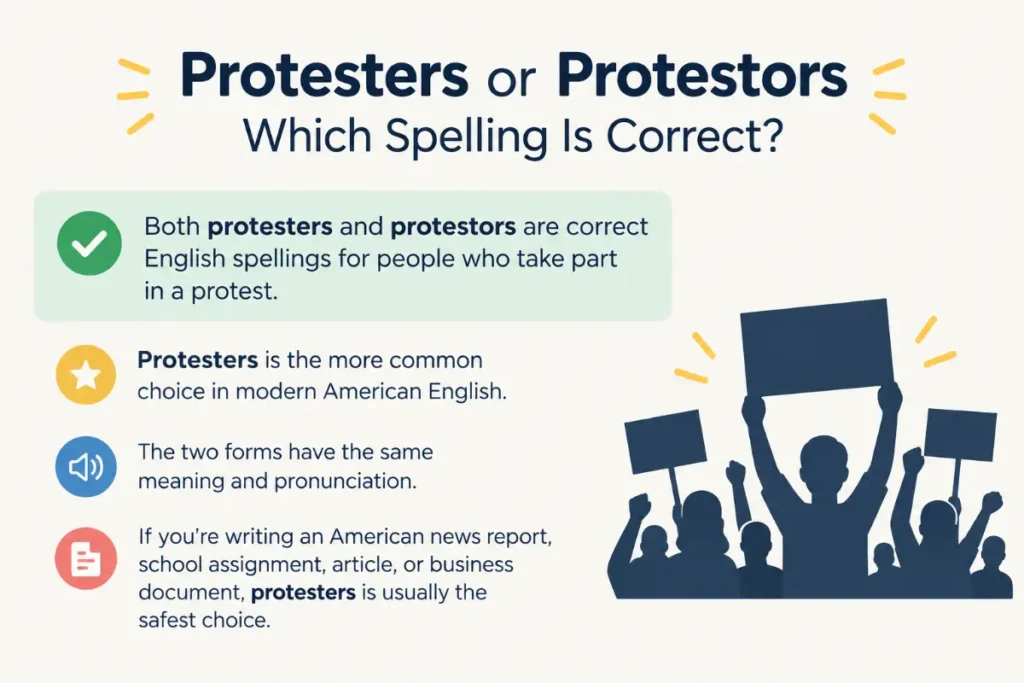
Both protesters and protestors are correct English spellings for people who take part in a protest. However, protesters is the more common choice in modern American English. The two forms have the same meaning and pronunciation. If you’re writing an American news report, school assignment, article, or business document, protesters is usually the safest choice.
What Does the Word Mean
A protester is a person who expresses opposition to something, often through a public demonstration, march, rally, or organized gathering. Protestors has the same meaning. Both forms can describe people who gather peacefully to express their views or participate in demonstrations that involve different kinds of conduct.
For example, people might protest a proposed tax increase, a change in school rules, a company’s business practices, or a government policy. The people taking part can be called protesters or protestors. The spelling doesn’t tell readers what they believe, why they’re demonstrating, or how they behave.
The noun comes from the verb protest. As a verb, protest means to express strong disagreement or objection. As a noun, a protest can be an act of objection, a public demonstration, or a formal statement of disagreement.
Consider these examples.
- The protesters gathered outside city hall.This sentence describes people who assembled to express opposition to something.
- Several protestors carried signs during the march.This sentence communicates the same idea with the alternate spelling.
- Students organized a protest against the new school policy.Here protest is a noun that names the demonstration itself.
- Residents protested the planned construction project.Here protested is a verb that describes the residents’ action.
The central meaning stays the same across these forms. The spelling choice doesn’t change the purpose or nature of the demonstration.
The Main Difference Between the Two Spellings
The difference comes from the noun ending. English often forms nouns for people who perform an action by adding the suffix er or or to a verb. Both endings appear in standard English, but their use depends on the word and its history.
The verb protest commonly forms the noun protester. The spelling protestor is also established as a variant. Both forms identify someone who protests.
The two words don’t have separate dictionary meanings. You don’t use one for peaceful demonstrations and the other for violent ones. You don’t use one for political protests and the other for workplace disputes. The context determines what the people are protesting, not the final letter pattern.
| Feature | Protesters | Protestors |
|---|---|---|
| Meaning | People who take part in a protest | People who take part in a protest |
| Part of speech | Plural noun | Plural noun |
| Singular form | Protester | Protestor |
| Spelling status | Standard and widely preferred | Accepted variant |
| American usage | More common choice | Less common alternative |
| British usage | Standard and widely used | Also encountered |
| Pronunciation | Same as the alternate spelling | Same as the preferred spelling |
| Typical contexts | News, reports, essays, everyday writing | News, reports, essays, everyday writing |
| Best general recommendation | Use for most American writing | Use when following an established spelling choice |
The most useful point is that both forms are legitimate. If you see protestors in a published article, you shouldn’t automatically assume the writer made a mistake. However, if you’re starting a new piece of American English content, protesters is usually the more practical option.
Which Spelling Should You Use
Use protesters in most modern American English writing. It’s the more common form and will look familiar to a broad range of readers. The choice works well in school assignments, news stories, academic papers, workplace documents, and online articles.
For example, an American newspaper might write that protesters gathered near the state capitol. A student might describe protesters marching for changes to an education policy. A researcher might discuss public opinion and the actions of protesters during a historical event.
Protestors remains acceptable. You can use it if a publication, organization, or established style guide prefers that spelling. The key is to follow one form consistently throughout the same document.
Imagine you’re editing a report that uses protesters in the opening section and protestors in the conclusion. Both words are individually acceptable, but switching between them without a reason can make the writing look careless. Choose one spelling and use it throughout.
The same advice applies to websites and publications that produce many articles. A consistent spelling policy makes editing easier and gives readers a more polished experience.
Meaning and Grammar
Both spellings are plural nouns. Their singular forms are protester and protestor.
The singular form refers to one person who takes part in a protest. The plural form refers to two or more people. You can use either form as the subject or object of a sentence.
Here are the basic patterns.
- Singular subject: The protester held a sign.
- Plural subject: The protesters held signs.
- Singular object: The reporter interviewed a protestor.
- Plural object: The reporter interviewed several protestors.
The noun can also appear after a descriptive word.
- Peaceful protesters gathered in the square.
- Local protestors organized a march.
- Young protesters spoke at the meeting.
- Hundreds of protesters filled the street.
Words such as peaceful, local, young, and hundreds help describe the people or their number. They don’t affect which spelling is correct.
The noun can also appear in possessive forms.
- The protester’s sign displayed a clear message.
- The protesters’ signs displayed different messages.
In the first example, the apostrophe comes before the final s because the sentence refers to one protester. In the second, the apostrophe comes after the s because the sentence refers to multiple protesters.
This punctuation rule applies to both spelling variants.
Pronunciation Guide
Both forms have the same standard pronunciation in English. The spelling difference doesn’t create a separate sound.
The singular word protester is commonly pronounced /ˈproʊ.tes.tɚ/ in American English. The alternate form protestor is pronounced the same way.
You can think of the word as three syllables.
pro + test + er
The strongest stress falls on the first syllable. The beginning sounds like the word pro, and the middle syllable sounds like test. The final syllable has an unstressed ending.
The plural form adds an /z/ sound at the end because the word ends in a voiced sound before the plural ending.
For example, protesters is pronounced approximately like proh TES ters, with the strongest stress at the beginning rather than on the middle syllable. The precise final sound varies with accent.
A common mistake is to assume that protestors must sound different because it has an o before the final r. In ordinary modern English usage, the two spellings represent the same word and are pronounced alike.
If you’re unsure how to spell the word while speaking, remember that pronunciation won’t help you choose between the variants. You need to rely on spelling preference and context instead.
Why Both Spellings Exist
English uses several endings to form nouns that describe people who perform actions. The endings er and or both appear in familiar words, but they don’t follow one simple rule that works for every verb.
For example, English has teacher, writer, runner, actor, editor, and inventor. These words refer to people who teach, write, run, act, edit, or invent. Their endings reflect established word forms and historical patterns.
The verb protest commonly takes the ending er to form protester. The alternate form protestor also developed and became established in use. English spelling includes many such variations because words enter the language through different periods, language influences, and patterns of word formation.
That doesn’t mean writers can freely replace er with or in every word. You can’t normally choose between teachor and teacher or between writor and writer. Standard spelling depends on the form accepted for each particular word.
The useful lesson is to learn the established form of the word rather than trying to apply one ending rule to every verb. In this case, both forms are recognized, but protesters is the more common choice for general American writing.
Etymology and Word Origin
The word protest has roots in Latin. It developed through French and entered English with the sense of declaring or expressing an objection, disagreement, or formal statement.
The English verb protest can refer to speaking against something, objecting to an action, or taking part in a public demonstration. Over time, its meaning developed across legal, political, social, and everyday contexts.
The noun protester follows a common English pattern in which er identifies a person who performs an action. A protester is someone who protests, just as a teacher is someone who teaches.
The variant protestor uses the alternate or ending. English has many nouns ending in or, particularly words that came through Latin or French. However, that broader pattern doesn’t establish a universal rule that makes protestor more correct.
Both spellings are part of modern English usage. The difference is best understood as a variation in word formation and spelling preference rather than a difference in meaning.
Many readers also check Realist vs Realest Dictionary Meaning and Usage 2026.
Regional Usage
American English
In the United States, protesters is the usual recommendation for general writing. It appears naturally in news coverage, school writing, academic discussion, public statements, and everyday communication.
Protestors is also used in American English. Readers will generally understand it without difficulty, but it is less common than the spelling with er. If you’re writing for a broad American audience, choosing protesters helps align your text with common usage.
For example, an American report might say that protesters gathered outside a courthouse. A school essay might describe protesters asking lawmakers to change a policy. Both uses are natural with the preferred spelling.
British English
British English also uses protesters as a standard form. Protestors can appear in British publications as well, so the distinction isn’t a strict division between American and British spelling.
Unlike pairs such as color and colour, this isn’t a major regional spelling contrast. The difference mainly concerns preference and frequency.
Australian English
Australian English recognizes protesters as a normal spelling. Protestors may also occur in published material. There isn’t a separate meaning attached to either spelling in Australian usage.
Canadian English
Canadian English uses protesters and may also use protestors. Writers should follow their publication’s preferred spelling and keep the form consistent.
Across these varieties, the main meaning remains stable. Neither form is restricted to a particular country, and neither identifies a different type of demonstration.
Ten Natural Sentence Examples
These examples show how the preferred spelling works in different situations. Each sentence uses protesters naturally and demonstrates a different context.
- Everyday conversation: The protesters blocked the road for several hours.This sentence describes a public demonstration that affected traffic.
- Text message: I heard that protesters are gathering downtown tonight.The sentence shares information about a planned or developing event.
- Workplace communication: Our office will remain open, but employees should avoid the area where protesters are gathering.The word refers to people taking part in a demonstration near the workplace.
- School assignment: The protesters asked the city council to reconsider its decision.This example shows how to use the noun in a clear academic sentence.
- News reporting: Police directed traffic as protesters moved through the city center.The sentence describes the relationship between a demonstration and traffic management.
- Formal writing: Researchers examined how protesters used public spaces to express their concerns.The word appears in a formal discussion of public behavior.
- Social situation: Several protesters spoke with residents who watched the march.The sentence describes an interaction between demonstrators and other members of the public.
- Online communication: Photos showed protesters carrying banners outside the building.This example describes information shared through digital media.
- Historical writing: Protesters gathered in the square to demand political reform.The sentence can describe a demonstration from the past.
- Community news: Local protesters organized a peaceful march through the neighborhood.The adjective local identifies the people as members of the surrounding community.
These examples also show that the word works with a wide range of verbs, including gathered, asked, moved, used, spoke, organized, and demanded. The spelling stays the same regardless of the action.
Common Spelling Mistakes
The two accepted forms are easy to mix up, but other errors can appear when people type quickly or apply an incorrect spelling pattern.
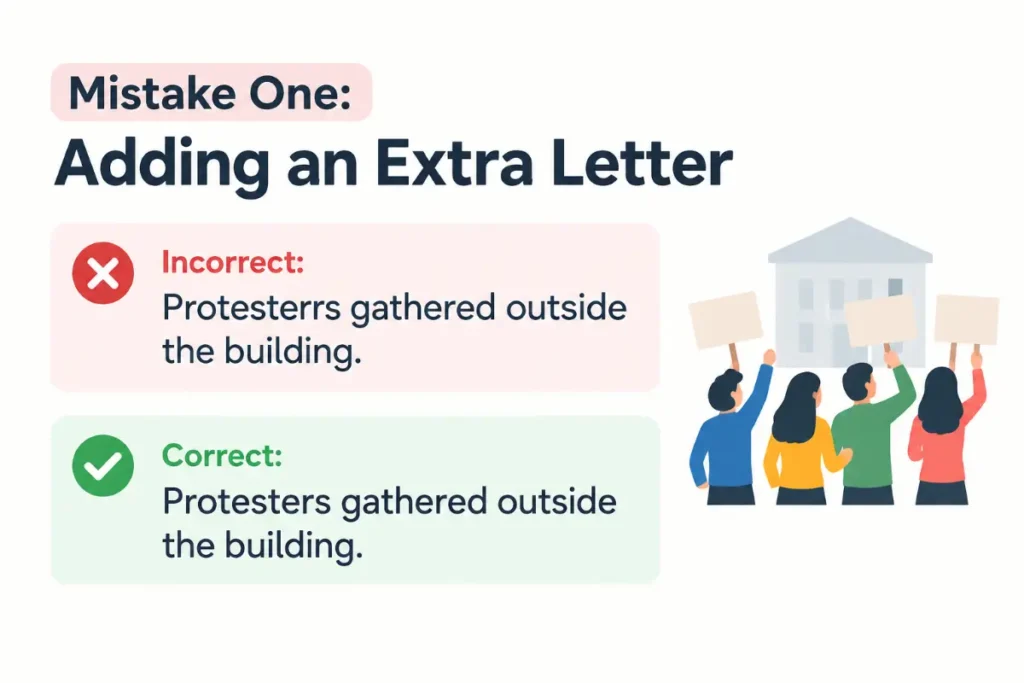
Mistake One: Adding an Extra Letter
Incorrect: Protesterrs gathered outside the building.
Correct: Protesters gathered outside the building.
The extra r is a typing error. The standard plural form contains one r before the ending.
Mistake Two: Leaving Out a Letter
Incorrect: Protestes gathered in the square.
Correct: Protesters gathered in the square.
The incorrect version leaves out part of the established spelling. Remember the base word protest followed by the ending er.
Mistake Three: Using the Verb Form as a Noun
Incorrect: The protest gathered outside the courthouse.
Correct: The protesters gathered outside the courthouse.
In the incorrect sentence, protest is a noun that refers to the demonstration itself. It doesn’t identify the people taking part. Use protesters when you mean the individuals.
Mistake Four: Treating the Alternate Form as Always Wrong
Incorrect claim: Protestors is never a real English word.
Correct explanation: Protestors is an accepted spelling variant, although protesters is more common in American English.
The mistake here isn’t necessarily spelling. It’s making an overly broad claim about standard usage. A good editor distinguishes between a less common form and an incorrect form.
Mistake Five: Switching Between Forms Without a Reason
Inconsistent: The protesters arrived early. Later, the protestors spoke to reporters.
Consistent: The protesters arrived early. Later, the protesters spoke to reporters.
Both spellings can be correct, but switching between them in one article can distract readers. Unless a quotation or specific source requires the alternate spelling, choose one form and stick with it.
Grammar Rules and Practical Usage
The spelling choice doesn’t change the grammatical rules. Both words follow the normal patterns for plural nouns in English.
Use the singular form when referring to one person.
The protester held a banner.
Use the plural form when referring to more than one person.
The protesters held banners.
You can place an adjective before either noun.
Several young protesters spoke at the meeting.
A group of local protestors arrived before noon.
You can also use the noun after a preposition.
The reporter spoke with the protesters.
The city prepared for the arrival of protestors.
Both forms can appear in possessive constructions, and both can be modified by quantity words such as several, many, dozens of, or hundreds of.
For professional writing, clarity matters more than trying to make the spelling sound more formal. Protestors isn’t automatically more sophisticated because it ends in or. Protesters isn’t informal simply because it ends in er.
Choose the form that fits your preferred spelling standard, then focus on accurate grammar, clear meaning, and fair description of the people involved.
Real Life Usage in Different Settings
Daily Conversation
People generally choose the spelling they recognize or have seen most often. In speech, there is no practical spelling distinction because both forms sound alike.
For example, someone might say, The protesters are outside the library. Another person might write about the same event using protestors. Both understand the noun to mean people taking part in the demonstration.
Email and Workplace Communication
In workplace writing, protesters is a clear default. If you’re preparing a notice about road closures, a safety message, or a meeting affected by a demonstration, use the common form and keep the tone neutral.
For example, Employees should allow extra time for travel because protesters are expected near the main entrance.
This sentence identifies the situation without making assumptions about the demonstrators’ motives or behavior.
Academic Writing
Academic writing benefits from consistent spelling and precise descriptions. If a research paper discusses protest movements, public demonstrations, or social change, protesters is a sensible choice for an American audience.
For example, The researchers interviewed protesters to learn how participants understood the goals of the demonstration.
The word identifies the participants without suggesting that they all held identical views.
News and Journalism
News writing often uses protesters to identify people involved in a public demonstration. Journalists may also use more specific terms, such as demonstrators, marchers, activists, or participants, when those terms better fit the facts.
For example, Protesters gathered outside the council building before the vote.
A news editor should avoid assuming that every person at an event has the same role or motivation. The exact label should match the available information.
Literature and Storytelling
In fiction, either spelling can appear in narration, though protesters will usually be the more familiar choice for a broad American readership.
For example, The protesters filled the street while shopkeepers watched from their doors.
The sentence creates a scene without adding unnecessary details about the crowd.
Related Words and Expressions
Several words are closely related to this term. Some are useful alternatives, but they don’t always mean exactly the same thing.
Demonstrators
Demonstrators are people who take part in a public demonstration. This is one of the closest alternatives and often works in news reporting.
Activists
Activists work to bring about social, political, environmental, or other changes. An activist may take part in a protest, but activism can also involve research, public education, organizing, and other activities.
Marchers
Marchers are people who take part in a march. The word describes the activity rather than necessarily stating the reason for it.
Campaigners
Campaigners work to promote a cause or achieve a particular change. They may organize demonstrations, but they can also use other methods.
Participants
Participants are people who take part in an event or activity. This word is broader and doesn’t necessarily imply disagreement or public opposition.
Petitioners
Petitioners submit or support a petition. Some may also take part in a demonstration, but the terms describe different actions.
Dissenters
Dissenters express disagreement with a position, decision, or authority. The word can refer to people who oppose a view without joining a public protest.
Rally Attendees
Rally attendees are people who attend a rally. The term is neutral about their exact role or beliefs and may include speakers, observers, supporters, and demonstrators.
Choose the alternative that best describes the people and the event. A person may be an activist who attends a rally and joins a protest, but those terms highlight different aspects of that person’s involvement.
How to Choose the Best Word for Your Sentence
The best word depends on what you want to communicate. If you mean people who are expressing opposition, protesters is usually clear and accurate. If you want to emphasize the public event, demonstrators may be a useful alternative. If you mean people who work for long term change, activists may be more precise.
Consider these differences.
- Protesters objected to the proposed policy.This emphasizes opposition.
- Demonstrators marched through the downtown area.This emphasizes participation in a public demonstration.
- Activists organized a campaign to change the law.This emphasizes efforts to bring about change.
- Rally attendees listened to several speakers.This emphasizes attendance at an event.
These terms overlap in many real situations, but they aren’t perfect substitutes. Use the most accurate description rather than choosing a word only for variety.
Expert Editor Insight
An experienced editor will usually choose protesters for general American English content because it’s familiar, widely used, and easy to read. The alternate spelling isn’t automatically an error, so a careful editor won’t mark it wrong without checking the relevant style requirements. The main priorities are accuracy and consistency. Spelling tools may accept both forms, but they may not explain which one best fits a particular publication. A dictionary can confirm that a form exists, while a house style guide helps determine which form to use. When editing a long article, search for both spellings and standardize them unless a direct quotation or proper name requires a different form.
Learn the difference in Skeptical vs Sceptical Which Spelling Is Correct.
Conclusion
Both protesters and protestors are accepted English spellings for people who take part in a protest. The main difference is usage preference, not meaning, pronunciation, or grammar. For American English writing, protesters is generally the better default because it’s more common and familiar to readers.
The alternate form remains valid, so there’s no need to label it a misspelling. Remember one simple rule: choose protesters for most general writing, follow your publication’s style guide when one exists, and keep the spelling consistent throughout your document. That approach will help you write clearly without getting caught up in a spelling difference that doesn’t change the meaning.
FAQs
Is protestors a real word?
Yes. Protestors is a recognized spelling variant of protesters. It refers to people who take part in a protest or public demonstration. However, protesters is the more common choice in modern American English. You can use either form, but choosing one spelling and applying it consistently will make your writing clearer.
Which is correct protesters or protestors?
Both are correct. Protesters is generally preferred for everyday American English writing because it is more widely used. Protestors is a legitimate alternative rather than a simple misspelling. If you’re writing an article, essay, report, or workplace document for an American audience, protesters is usually the most practical choice.
What does protesters mean?
Protesters are people who express opposition to something. They may join a public demonstration, march, rally, or other organized action to object to a policy, decision, practice, or social issue. The word doesn’t automatically describe the protesters’ behavior or beliefs. It simply identifies their participation in an act of protest.
How do you pronounce protesters?
In American English, protesters is pronounced with three syllables and stress on the first syllable. The singular form is commonly transcribed as /ˈproʊ.tes.tɚ/. Protesters and protestors are pronounced alike, so you cannot hear which spelling someone intends. You need to determine the written form from context or the publication’s style.
Is protesters more common in American English?
Yes. Protesters is the more common spelling choice in American English and is a safe default for general writing. Protestors also appears in American publications and other forms of writing. The difference is mainly one of usage frequency and preference, not meaning or grammatical correctness.
Can protestors be used in formal writing?
Yes. Protestors can appear in formal writing because it is an accepted spelling variant. However, formal writing benefits from consistent spelling, so follow the style guide used by your organization or publication. If no guide specifies a preference, protesters is generally the more familiar option for an American audience.
What is another word for protesters?
Demonstrators is a close alternative when referring to people taking part in a public demonstration. Activists may be appropriate for people working toward social or political change. Marchers describes people taking part in a march, while participants is broader. Choose the word that most accurately describes the people and their actions.
Why do people confuse the two spellings?
People confuse these forms because English uses both er and or to form nouns that identify people who perform actions. The verb protest commonly produces protester, while protestor is also an established variant. Since both forms look reasonable and have the same pronunciation and meaning, writers may encounter both and wonder which one to choose.