
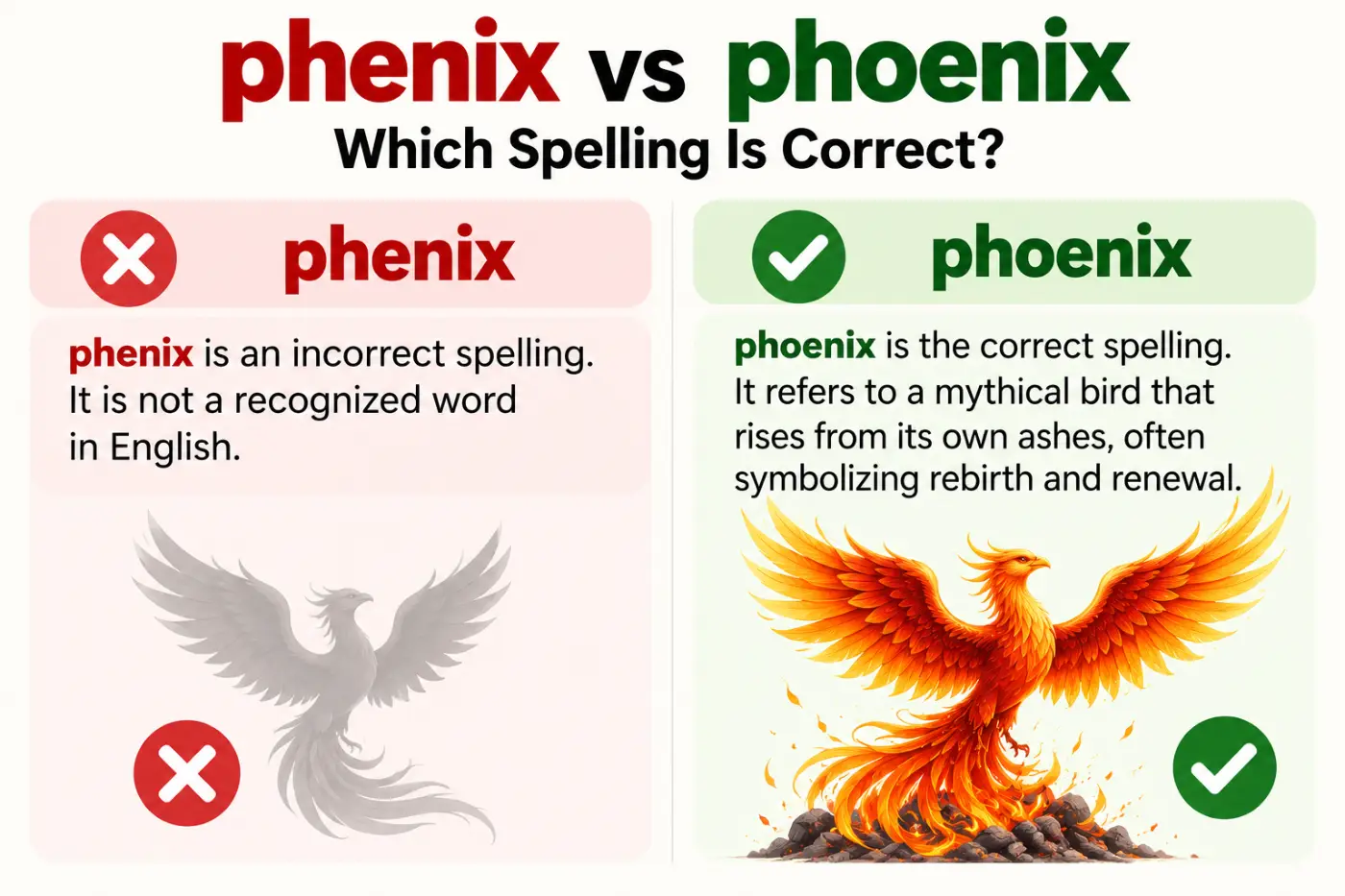
If you’ve seen both phenix vs phoenix, you may wonder if one is simply a spelling mistake. The standard spelling in modern American English is phoenix, especially when you’re writing about the legendary bird associated with fire rebirth and renewal. However phenix isn’t just a random error. It’s a recognized variant that can appear in older texts historical writing and certain proper names.
The confusion makes sense because English spelling has changed over time. Older forms of the word included spellings that look different from the form most readers know today. As a result you may still come across phenix in dictionaries historical sources or names even though phoenix is far more familiar in modern writing.
In this guide you’ll learn the difference between the two spellings their meanings pronunciation history and proper usage. You’ll also see practical examples that show when to use phoenix and when preserving phenix makes sense.
Learn the difference in Shinning or Shining Which Is Correct in 2026?.
Quick Answer
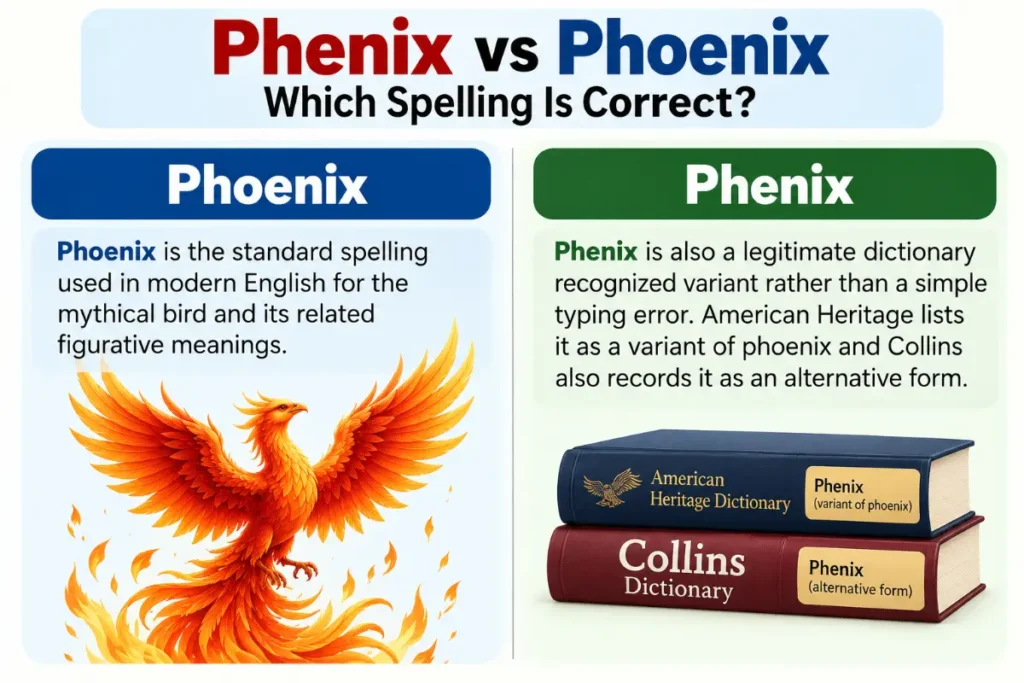
Phoenix is the standard spelling used in modern English for the mythical bird and its related figurative meanings. Phenix is also a legitimate dictionary recognized variant rather than a simple typing error. American Heritage lists it as a variant of phoenix and Collins also records it as an alternative form.
For everyday American English formal writing schoolwork business writing and most published content use phoenix. You may encounter phenix in older texts historical material or specific names such as Phenix City.
The Correct Form In Modern English
If you’re writing a normal sentence today the safest choice is phoenix.
The word refers to a legendary bird associated with death renewal and rebirth. In traditional stories the bird burns itself and later rises again from its ashes. Because of that story the word also developed a figurative meaning for a person organization place or idea that returns after serious trouble or destruction.
For example:
The company rose like a phoenix after years of financial trouble.
That sentence uses the standard modern spelling.
The important point is that phenix isn’t automatically an error. Major dictionary sources recognize it as a variant. American Heritage specifically identifies phenix as a variant of phoenix. Collins also gives phenix as an alternative form.
Still the two spellings aren’t equally useful for a modern writer. If your goal is clear American English use phoenix unless you’re preserving an original spelling or referring to a proper name.
Phenix And Phoenix Compared
| Form | Meaning | Part of Speech | Origin | Modern Usage | Formality | Common Contexts | Example |
|---|---|---|---|---|---|---|---|
| phoenix | A legendary bird associated with rebirth and renewal | Noun | Greek through Latin and earlier English forms | Standard and preferred | Neutral to formal | Mythology literature figurative writing astronomy names | The phoenix rose from the ashes. |
| phenix | Variant form of phoenix | Noun | Historical spelling connected with the same word family | Less common | Historical or variant usage | Older texts dictionaries and some proper names | The old text used phenix instead of phoenix. |
The distinction is mainly about modern preference rather than meaning.
Both forms can refer to the same legendary bird. Both can carry the idea of renewal. The spelling with oe is the form most readers expect to see today.
What Phoenix Means
Phoenix is primarily a noun.
Its oldest familiar sense refers to the legendary bird that dies through fire and rises again. The story made the bird a powerful symbol of renewal and immortality. Modern dictionaries also recognize figurative uses for something that returns after destruction or serious difficulty.
The word can appear in several related contexts.
- Mythology. The phoenix is the legendary bird that rises again after being destroyed by fire.
- Figurative language. A person or organization can be called a phoenix when it makes a remarkable recovery.
- Literature. Writers often use the bird as a symbol of rebirth hope renewal or transformation.
- Astronomy. Phoenix is also the name of a constellation in the southern sky.
- Geography. Phoenix is the name of the capital city of Arizona. In that context it is a proper noun and must begin with a capital letter.
The figurative meaning is especially useful in modern writing.
You might say:
After the company nearly collapsed it became a phoenix of the industry.
The sentence doesn’t claim that the company is literally a mythical bird. Instead it uses the familiar image of rising again after destruction.
What Phenix Means
Phenix has the same basic meaning as phoenix.
The important difference is its status in modern usage. It is a recognized variant rather than a completely separate word with a different definition. American Heritage lists phenix as a variant of phoenix. Etymonline describes phenix as an old alternative form.
That historical detail explains why you may see the spelling in older material.
A modern reader might expect:
The phoenix rose from the ashes.
An older text may instead contain:
The phenix rose from the ashes.
The second sentence can look like a spelling mistake to a modern reader. Yet it isn’t necessarily an error. The spelling has genuine historical support.
That distinction matters for editors.
A professional editor shouldn’t automatically change every occurrence of phenix without checking the context. If the text is modern American prose the standard form will usually be phoenix. If the text is historical or intentionally preserves an older spelling the original form may need to remain.
Why The Two Spellings Exist
The spelling history explains much of the confusion.
The word has traveled through several languages before reaching its modern English form. Etymonline traces phoenix through Old English and Old French forms to Medieval Latin phenix and Latin phoenix with an origin in Greek phoinix.
English spelling wasn’t always as fixed as it is today.
Older writers used forms such as fenix. Later English developed the spelling with ph. The spelling became more closely aligned with its Greek source over time. Etymonline notes that forms beginning with ph appeared in English late in the fifteenth century and that the spelling was assimilated to Greek in the sixteenth century.
So the unusual spelling isn’t random.
The modern form preserves a connection to the historical Greek and Latin forms. The variant with the simpler vowel sequence also survived in some English usage.
This is a good example of why spelling comparisons aren’t always as simple as right versus wrong.
English has many words with older variants that survive in dictionaries long after one form becomes dominant.
Which Form Should You Use
For modern American English choose phoenix.
That recommendation works well for most situations.
- Use phoenix in school assignments.
- Use phoenix in professional writing.
- Use phoenix in website content.
- Use phoenix in academic writing unless you’re discussing a historical spelling.
- Use phoenix in emails and everyday communication.
- Use phoenix in general nonfiction.
- Use phoenix when writing about the mythical bird.
- Use phoenix when using the word figuratively.
The main exception involves proper names and historical material.
For example Phenix City is the established name of a city in Alabama. That spelling is part of the proper name and should not be silently changed to Phoenix City. Dictionary.com records Phenix City as the name of the Alabama city.
That is an important editorial rule.
A spelling that looks unusual can still be correct when it belongs to a specific name.
Is Phenix A Misspelling
Not always.
Calling phenix a misspelling without context would be too broad.
Major dictionary sources recognize it as a variant. American Heritage directly labels phenix as a variant of phoenix. Collins also lists phenix as an alternative form.
At the same time most modern readers will expect phoenix.
That creates an important difference between recognized and preferred.
A word can be legitimate but uncommon.
Think of it like an older road that still exists but isn’t the route most people take. You can find it on the map but the main road is more familiar.
That is a useful way to understand phenix.
If someone writes phenix in a modern article about mythology the spelling may look unusual. A spelling checker may also flag it depending on its dictionary. That doesn’t automatically prove the writer has made a linguistic error.
An editor should look at context before making the correction.
Pronunciation Guide
Both forms are pronounced the same way in standard English.
Cambridge gives the pronunciation as /ˈfiː.nɪks/. Collins gives the American pronunciation as /ˈfi.nɪks/ and the British pronunciation as /ˈfiː.nɪks/.
For an American English reader the pronunciation can be thought of as:
FEE niks
The word has two syllables.
The first syllable carries the main stress.
The spelling can look difficult because the letters phoe don’t behave the way many learners expect. The pronunciation becomes much easier once you recognize the familiar sound pattern.
The variant spelling does not create a major pronunciation difference.
That means the main issue in this comparison is spelling and usage rather than speech.
Grammar And Part Of Speech
Phoenix is normally used as a noun.
You can use it as a common noun when referring to the mythical bird.
The phoenix rose from the ashes.
You can also use it figuratively.
The small company became a phoenix after its recovery.
When referring to the city in Arizona use the capitalized proper noun Phoenix.
Phoenix is the capital of Arizona.
The same spelling also appears in astronomy as the name of a constellation. Context tells the reader which meaning you intend.
The plural form is phoenixes. Dictionary.com lists phoenixes as the plural form.
For example:
Several phoenixes appeared in the artwork.
The plural doesn’t require an apostrophe.
That is a useful point for writers who aren’t sure how to pluralize the word.
Ten Natural Sentence Examples
Here are examples showing how the standard spelling works in real writing.
- The phoenix rose from the ashes and began a new life.
- The author used the phoenix as a symbol of hope and renewal.
- After years of setbacks the business returned like a phoenix.
- The story follows a young hero who discovers a mysterious phoenix.
- Her career became a phoenix story after a difficult period.
- The museum displayed a beautiful painting of a golden phoenix.
- The students studied the phoenix as part of their mythology lesson.
- The city rebuilt its downtown area and emerged like a phoenix from the ruins.
- The novel uses the phoenix to represent personal transformation.
- Phoenix is one of the best known cities in Arizona.
These examples show why context matters.
The same word can describe a mythological creature a symbolic idea a literary image a constellation or a place name.
Examples Of The Variant Form
The variant can appear in contexts where the spelling itself matters.
- The historical document used phenix instead of the spelling used today.
- The editor preserved the original phenix spelling in the quotation.
- The dictionary identifies phenix as a variant of the more familiar form.
- The researcher found phenix in an older English text.
- The manuscript consistently used phenix throughout the passage.
These examples aren’t meant to suggest that modern writers should replace phoenix with phenix.
They show how the variant can appear legitimately when you’re discussing historical spelling or preserving an original text.
Common Spelling Mistakes
The word creates several predictable mistakes.
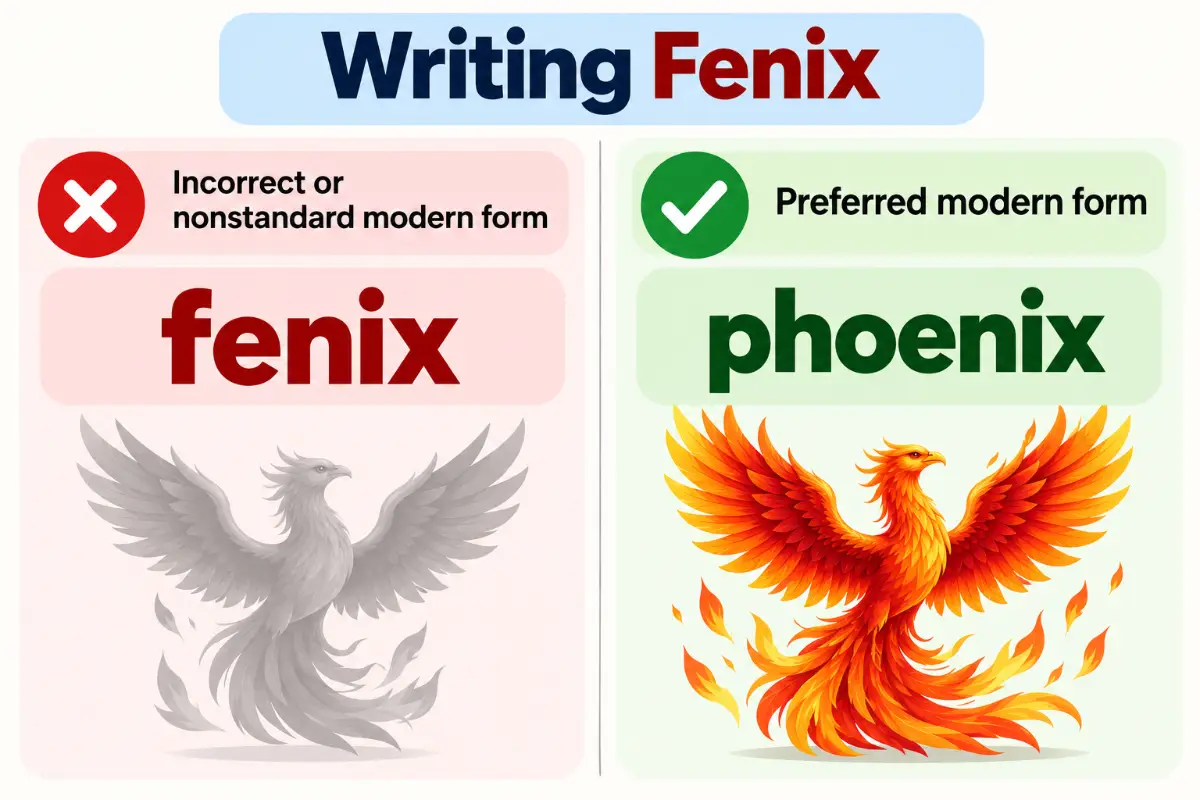
Writing Fenix
Incorrect or nonstandard modern form: fenix.
Preferred modern form: phoenix.
Fenix is historically connected to older forms of the word, so the mistake isn’t completely mysterious. Older English used forms related to fenix before the modern spelling developed.
For ordinary modern writing use phoenix.
Writing Phoenex
Incorrect: phoenex.
Correct: phoenix.
This mistake often comes from remembering the first part of the word but guessing the ending.
The final sound is easy to hear but the spelling doesn’t follow the most obvious English pattern.
Writing Phoinix In English Prose
English standard form: phoenix.
Phoinix is associated with the Greek source of the word. It isn’t the normal spelling to use in an English sentence about the mythical bird. Etymonline traces the English word back to Greek phoinix.
Changing A Proper Name
A writer may see Phenix City and assume it should be changed.
That would be an editing mistake.
Phenix City is the established name of an Alabama city.
Proper names need to be checked as names rather than corrected according to a general spelling rule.
Treating Every Variant As An Error
This is the biggest editorial mistake.
A less familiar spelling isn’t automatically wrong.
In this case dictionaries recognize phenix as a variant.
The better approach is to identify the context first.
For another common grammar confusion, see Troubleshooted or Troubleshot Correct Usage Guide.
Etymology And Word Origin
The history of phoenix reaches far beyond modern English.
Etymonline traces the word through Old English and Old French fenix to Medieval Latin phenix and Latin phoenix. The Latin form ultimately connects with Greek phoinix.
The Greek word had several historical associations. Etymonline notes meanings connected with the mythical bird as well as other senses involving color and the date palm. The relationship among these ancient meanings is complex and isn’t something modern writers need to memorize.
What matters for spelling is the path the word took into English.
Early English forms were not identical to the spelling most readers know today. Over time the spelling with ph became established. The connection to Greek helped shape the modern written form.
That history also explains why phenix can still appear in dictionaries.
It isn’t a random modern invention. It represents an older alternative spelling that survived in English usage.
The word’s figurative meaning also has a long history. Etymonline dates the sense of something rising from destruction to the 1590s.
So when someone says a company has risen like a phoenix they are using a metaphor with centuries of history behind it.
Regional Usage
The basic meaning stays stable across major varieties of English.
American English
American English strongly favors phoenix in normal modern writing.
American Heritage lists phenix as a variant while giving the main entry for phoenix. Dictionary.com also presents phoenix as the main form and notes phenix as another form.
For a US audience use phoenix unless a proper name or historical source calls for something else.
The capitalized form Phoenix is also used for the Arizona city.
British English
British English also uses phoenix as the normal form.
Collins records the British pronunciation and also notes phenix as a US variant in its British English entry.
The spelling difference therefore isn’t a major British versus American spelling split like color and colour.
It is better understood as a standard form plus a less common variant.
Australian English
Australian English generally follows the broader modern English preference for phoenix.
There is no major Australian spelling distinction that requires writers to choose phenix.
Canadian English
Canadian writers can normally use phoenix as well.
The same practical rule works here: use the familiar standard form unless you’re dealing with a historical spelling or an established proper name.
Real Life Usage
The word appears naturally in several types of writing.
Daily Conversation
People often use phoenix figuratively when talking about recovery.
She came back like a phoenix after losing everything.
That team has become a phoenix after a terrible season.
The expression is vivid because most readers already know the basic story behind the mythical bird.
Workplace Writing
The word can work well in professional writing when used with restraint.
The company rebuilt its reputation and returned like a phoenix.
The project team recovered after a major setback.
In formal business writing you don’t need to force the metaphor into every discussion of recovery. A simple phrase such as recovered or rebuilt may be clearer.
Academic Writing
Academic writing can discuss the phoenix as a mythological symbol cultural idea or literary image.
The phoenix represents renewal in many literary interpretations.
The researcher examines the phoenix as a symbol of transformation.
If you’re writing about the history of English spelling you might also mention the variant form directly.
News And Journalism
Journalists sometimes use phoenix as a metaphor for a city organization team or institution that has recovered.
The neighborhood rose like a phoenix after the fire.
The club returned like a phoenix after years outside the top division.
The metaphor is common because it communicates recovery quickly.
Literature And Storytelling
Writers often use the phoenix because the image carries several ideas at once.
It can suggest death followed by rebirth.
It can suggest failure followed by success.
It can suggest transformation after hardship.
It can also suggest hope after destruction.
That gives the word more emotional weight than a plain word such as recovery.
Related Words And Expressions
Understanding related terms can make the meaning easier to remember.
- Rebirth. This refers to being born again or experiencing a new beginning.
- Renewal. This focuses on making something fresh or restoring it.
- Revival. This describes a return to activity strength or popularity.
- Resurrection. This often carries a stronger religious or dramatic sense of returning from death.
- Rejuvenation. This suggests renewed energy youth or freshness.
- Recovery. This focuses on returning to a normal or healthy state after difficulty.
- Rebirth from the ashes. This expresses the same broad idea as the famous phoenix image.
- Rise from the ashes. This is a common expression for recovering after destruction or failure.
These terms overlap but aren’t interchangeable in every sentence.
For example recovery is usually more neutral than phoenix. Phoenix creates a stronger image. It suggests not just returning but emerging from serious destruction in a striking new form.
Phoenix As A Symbol
The phoenix has become one of the strongest symbols of renewal in English language and culture.
Its power comes from a simple image.
Something is destroyed.
Then something new rises.
That makes the word useful when ordinary language feels too flat.
If a company simply improves after a difficult period you can say it recovered. If you want to emphasize dramatic transformation you might describe it as a phoenix.
The metaphor works for people too.
Someone who rebuilds a career after a major setback can be described as rising like a phoenix.
A community can also be described this way after a disaster.
The comparison works because the reader doesn’t need a long explanation. The image does much of the work.
Phoenix As A Place Name
One important source of confusion comes from the capitalized word Phoenix.
Phoenix is the capital of Arizona.
That is a proper noun so the first letter must be capitalized when you mean the city.
For example:
I moved to Phoenix last year.
The conference will take place in Phoenix.
Phoenix has a hot desert climate.
This meaning is completely different from the mythical bird even though the spelling is identical.
Dictionary.com and Cambridge both list Phoenix as the city in Arizona.
The city’s name also connects to the broader idea behind the mythical bird. Etymonline explains that the Arizona city was named Phoenix because it was founded on the site of an earlier settlement.
The capital letter therefore gives readers an important clue about meaning.
Phoenix In Astronomy
Phoenix also names a constellation in the southern sky.
In that context the word is capitalized because constellation names are proper names.
For example:
Phoenix is visible in the southern sky.
The constellation Phoenix is not the mythical bird itself. The name comes from the cultural image associated with the bird.
Dictionary sources list Phoenix as a southern constellation.
This is another reason context matters when editing the word.
How Editors Handle Phenix
An experienced editor looks at more than spelling.
If a writer submits a modern US article and repeatedly writes phenix when discussing the mythical bird an editor will probably change it to phoenix for consistency and reader expectations.
That doesn’t mean the original form is meaningless or illegitimate.
The editor may leave it alone in several situations.
- The text deliberately reproduces an older source.
- The spelling appears inside a historical quotation.
- The form belongs to an established proper name.
- The article discusses historical English spelling.
- The writer is analyzing dictionary variants.
This approach protects both accuracy and context.
Professional editing isn’t simply about changing unfamiliar words into familiar ones. Good editing preserves meaning while improving clarity.
That is especially important with words that have genuine historical variants.
Why Spell Checkers Can Be Confusing
Modern spelling tools don’t always treat dictionary variants equally.
A spell checker may recognize phoenix immediately while treating phenix as unusual. Another tool may accept both forms.
That difference doesn’t settle the linguistic question.
Software dictionaries are designed for practical text processing. They may prioritize the most common spelling rather than display every historical or variant form.
So if a tool flags phenix don’t assume that the tool has discovered an absolute rule.
Check the context.
A modern article should normally use phoenix. A historical document containing phenix may need to keep the original spelling.
The same principle applies to many other English words.
Dictionary status and editorial preference aren’t always identical.
Memory Trick For The Spelling
If you keep forgetting the spelling think of the middle letters as a small historical clue.
phoenix contains oe before the final n.
The easiest memory method is to learn the whole word rather than trying to rebuild it letter by letter.
Think:
phoenix equals the standard modern form.
Then remember that phenix is a recognized variant.
You don’t need to treat the variant as an enemy. You simply need to know which form your audience expects.
For modern American readers that form is phoenix.
When To Use Each Form
The choice becomes easy once you connect the spelling to the context.
- Modern general writing. Use phoenix.
- School assignments. Use phoenix.
- Professional writing. Use phoenix.
- Academic writing. Use phoenix unless discussing a historical variant.
- Modern websites. Use phoenix.
- Mythology discussions. Use phoenix.
- Figurative writing. Use phoenix.
- Historical texts. Preserve phenix when the original spelling matters.
- Dictionary discussions. Use phenix when explaining the variant.
- Established proper names. Preserve the official spelling.
This approach gives you both accuracy and flexibility.
Expert Editor Insight
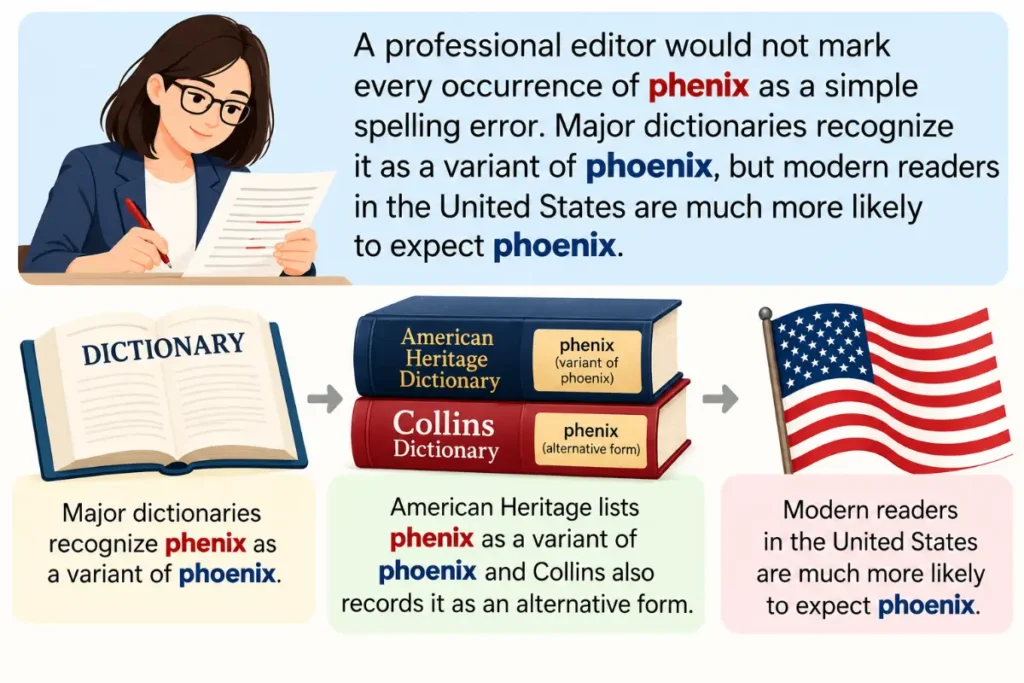
A professional editor would not mark every occurrence of phenix as a simple spelling error. Major dictionaries recognize it as a variant of phoenix, but modern readers in the United States are much more likely to expect phoenix. The practical editing rule is to use phoenix in normal modern prose while preserving phenix when history context or a proper name requires it. Always check the intended meaning before making an automatic correction.
Many readers also check The Ballot Or The Bullet Meaning And Why It Still Matters in 2026.
Conclusion
The safest choice for modern American English is phoenix. It is the standard spelling for the mythical bird and its figurative meanings and it also appears in proper names such as Phoenix the Arizona capital.
Phenix is not simply a meaningless typo. Dictionaries recognize it as a legitimate variant and historical sources can contain it.
The easiest rule is simple: use phoenix in normal modern writing and keep phenix when history context or a specific name calls for it. When editing unfamiliar spellings don’t correct them on sight. Check the context first. That small habit can prevent a real historical or proper name from being changed into something inaccurate.
FAQs
Is Phenix A Real Word?
Yes. Phenix is a recognized variant of phoenix. American Heritage lists it as a variant and Etymonline describes it as an old alternative form. It isn’t simply an invented spelling. Still modern American readers generally expect phoenix so that is the better choice for ordinary contemporary writing.
What Does Phoenix Mean?
Phoenix refers to a legendary bird associated with fire death and rebirth. The bird is traditionally said to rise again from its ashes. The word also has a figurative meaning for a person thing or organization that returns after destruction or serious difficulty.
Which Is Correct Phenix Or Phoenix?
Phoenix is the standard modern spelling and the best choice for most American English writing. Phenix is also a legitimate variant. The two forms generally have the same meaning and pronunciation. Use phenix mainly when preserving historical spelling discussing the variant itself or referring to an established name that uses that spelling.
How Do You Pronounce Phoenix?
Phoenix is pronounced with two syllables and stress on the first syllable. Cambridge gives the pronunciation as /ˈfiː.nɪks/. Collins gives an American pronunciation represented as /ˈfi.nɪks/. The variant phenix has essentially the same pronunciation.
Can Phoenix Start A Sentence?
Yes. Phoenix can begin a sentence normally when you mean the mythical bird. It can also begin a sentence when you mean the city in Arizona. If you mean the city the word should remain capitalized because Phoenix is a proper noun. The grammar doesn’t change simply because the word appears at the beginning of a sentence.
What Is A Synonym For Phoenix?
The best synonym depends on the meaning. For the mythical bird there isn’t a perfect everyday synonym. In figurative writing related words include rebirth renewal revival recovery and resurrection. These words overlap with the idea of a phoenix but each carries its own shade of meaning.
Why Do People Confuse Phenix And Phoenix?
The confusion comes from the unusual spelling and the word’s long history. Older forms included fenix and the spelling history passed through Latin and Greek forms. Phenix also survives as a recognized variant. Because modern English strongly favors phoenix many readers assume phenix must always be a typo even though dictionaries recognize it.
Is Phoenix Appropriate In Formal Writing?
Yes. Phoenix is fully appropriate in formal writing when you mean the mythical bird the figurative concept the constellation or the Arizona city. In fact phoenix is the preferred choice for modern formal English. Phenix can also be appropriate when historical spelling or a proper name makes it necessary.