
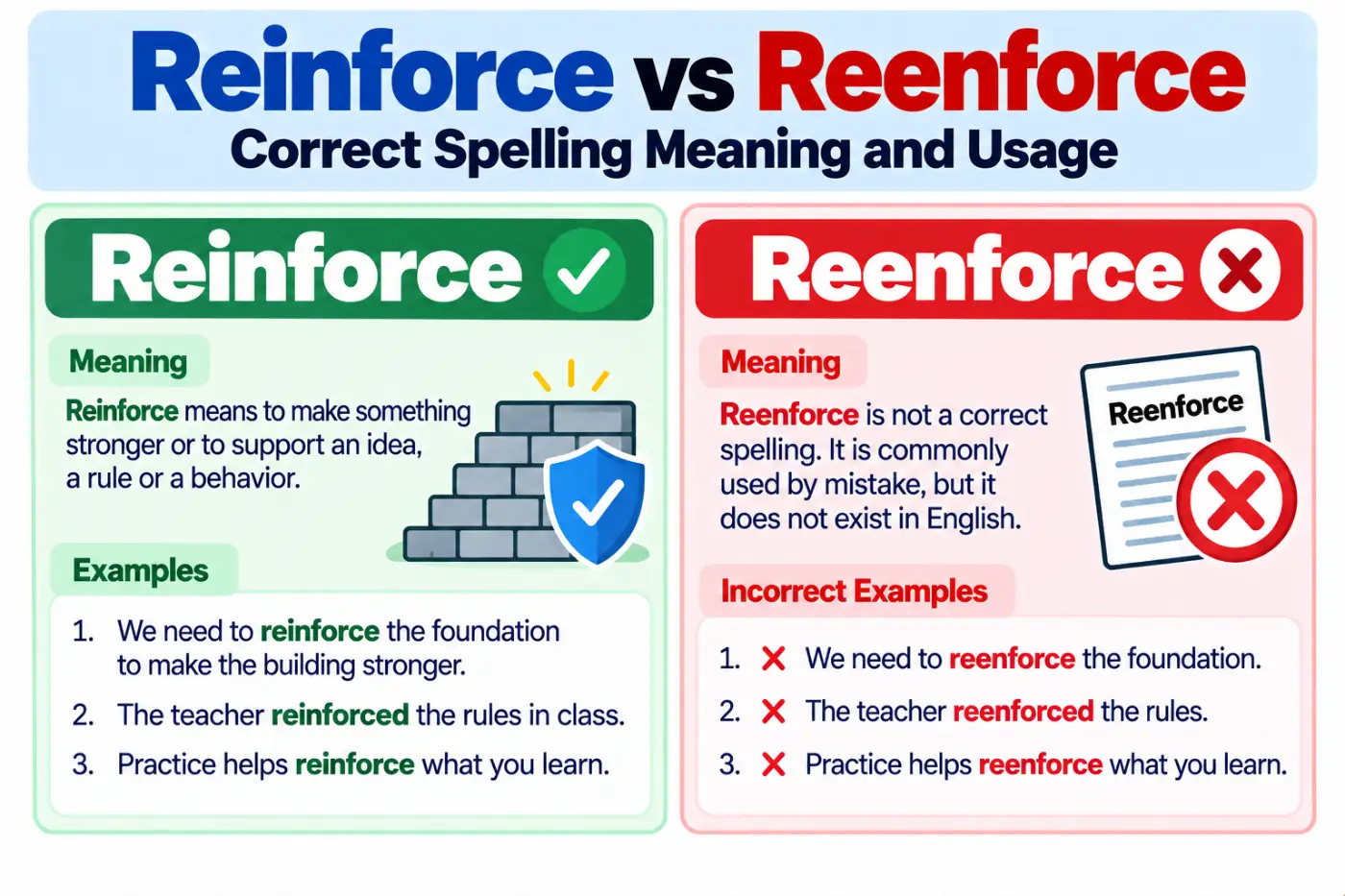
reinforce vs reenforce can be confusing because both forms look logical and are pronounced the same way in ordinary English. The standard spelling is reinforce. The form reenforce does exist in some dictionaries as a less common variant, but modern writers generally use reinforce.
The confusion makes sense. English often uses the prefix re to create words that describe doing something again. Words such as redo, rewrite, and reopen follow that pattern. Since enforce is already a familiar word, it’s easy to assume that adding re should produce reenforce. That spelling looks reasonable at first glance, but standard modern usage strongly favors reinforce for the meaning to make something stronger or provide additional support.
This guide explains the distinction clearly. You’ll learn what each form means, how the spelling developed, how to pronounce the word, how native speakers use it, and which form works best in professional and academic writing. You’ll also see practical examples and a simple memory trick that can keep this spelling problem from coming back.
You may also want to read Tweek vs Tweak Which Spelling Is Correct?.
Featured Snippet Quick Definition
Reinforce is the standard and widely preferred spelling for the verb meaning to make something stronger or provide additional support. Reenforce is recorded as a less common variant in some dictionaries. For modern American English and most professional writing, reinforce is the form readers expect and the safest choice.
Quick Answer
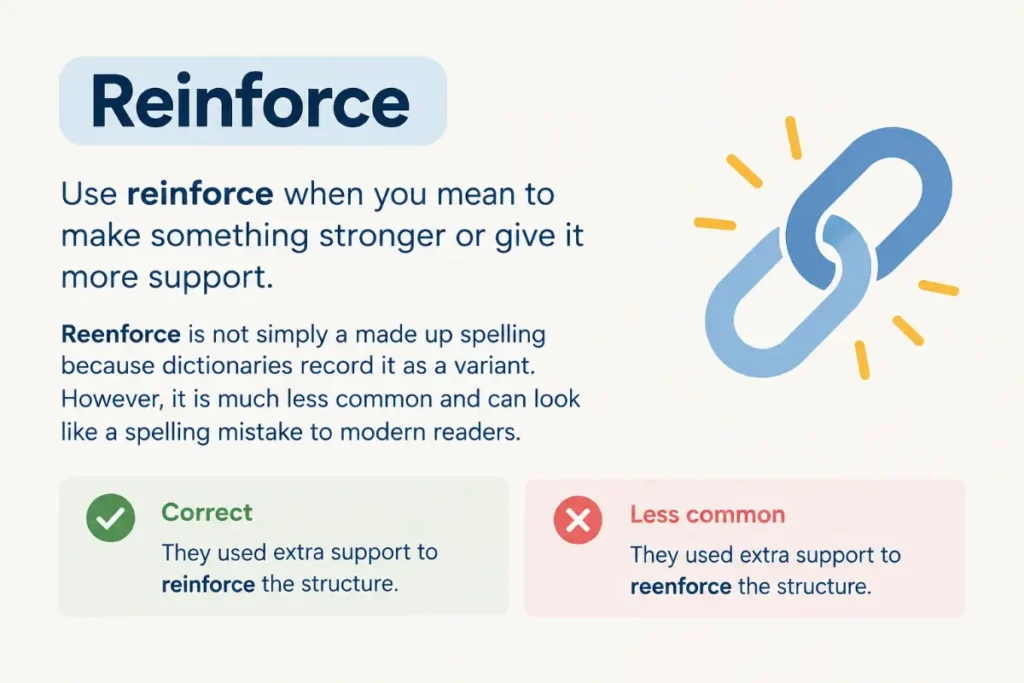
Use reinforce when you mean to make something stronger or give it more support. Reenforce is not simply a made up spelling because dictionaries record it as a variant. However, it is much less common and can look like a spelling mistake to modern readers.
For everyday writing, school assignments, business communication, academic work, and published content, choose reinforce. It is the standard form used across modern English varieties.
Comparison Table reinforce vs reenforce
| Form | Meaning | Part of Speech | Origin | Usage Frequency | Formality | Common Contexts | Example |
|---|---|---|---|---|---|---|---|
| Reinforce | To make stronger or provide additional support | Verb | English word family connected with force and historical French forms | Very common | Neutral and formal | Construction, education, arguments, habits, security, military contexts | The steel beams reinforce the bridge. |
| Reenforce | Variant form of reinforce | Verb | Historical variant of the same word family | Rare | Less common and dated in modern use | Older texts and occasional modern usage | The new evidence may reenforce the earlier conclusion. |
The key point is simple. Both forms have appeared in English, but they don’t have equal status in modern usage. Reinforce is the normal spelling that readers and editors expect.
Meaning and Definition
Meaning of Reenforce
Reenforce is a recognized variant spelling of reinforce. Dictionary.com lists it as a variant and provides historical examples showing that the spelling has appeared in published English. Collins also records reenforce in American English and connects it directly with reinforce.
That detail matters because calling reenforce a completely nonexistent word would be too broad. It has a documented history. At the same time, historical recognition doesn’t mean that modern writers should treat both spellings as equally natural.
If you write reenforce today, many readers will probably understand you immediately. Still, they may see the spelling as unusual or assume you made a typo. That reaction is one reason professional editors normally choose reinforce.
The form also creates a visual problem. Because enforce is a familiar word, readers may interpret reenforce as re plus enforce. That seems logical but doesn’t reflect the spelling convention that became standard.
Meaning of Reinforce
Reinforce is a transitive verb. Its central meaning is to make something stronger by adding support, material, evidence, people, or another strengthening factor.
You can reinforce a physical object.
The engineers reinforced the wall with steel.
You can also reinforce an idea or argument.
The new evidence reinforced her conclusion.
The word works for habits and behavior too.
Positive feedback can reinforce good study habits.
It can also refer to adding people or resources to a group or force.
The company sent more staff to reinforce the customer service team.
Cambridge defines the word around the idea of making something stronger. It also recognizes uses involving ideas, opinions, armies, and other forms of support.
That broad meaning explains why the word appears in many fields. Construction workers reinforce structures. Teachers reinforce lessons. Researchers reinforce conclusions with evidence. Writers reinforce arguments with facts.
The basic idea stays the same. Something becomes stronger because additional support has been added.
Key Differences Explained
Spelling
The standard modern spelling is reinforce. Reenforce is a recorded variant but is much less common.
The difference is easy to miss because both forms contain the same letters except for the placement of the vowel sequence. That small visual difference can make proofreading tricky.
Meaning
In ordinary modern usage, both forms can refer to strengthening something. Reenforce therefore isn’t best described as a completely different word with an unrelated meaning.
The major distinction is standard usage and frequency rather than a major difference in meaning.
Grammar
Both forms function as verbs. They can take a direct object.
The teacher reinforced the lesson.
The teacher reenforced the lesson.
The first sentence uses the standard modern form. The second uses a rare variant that many editors would change.
Pronunciation
The two forms are normally pronounced alike. Cambridge gives the American pronunciation of reinforce as /ˌriː.ɪnˈfɔːrs/. Its pronunciation entry for reenforce gives the same basic sound pattern.
That shared pronunciation is one reason the spelling confusion survives.
Formality
Reinforce works comfortably in formal and informal writing. Reenforce is understandable but can feel dated or unusual.
If your goal is clear professional communication, reinforce is the better practical choice.
Context
Reinforce appears in construction, education, psychology, business, military writing, journalism, academic research, and everyday conversation.
Reenforce appears far less often and is more likely to show up in older material or as a variant spelling.
Regional Usage
There isn’t a useful American versus British spelling split here. Reinforce is the standard form in both varieties.
Which Form Should You Use?
Use reinforce in modern standard English.
The reason isn’t simply that one spelling looks more familiar. Dictionary evidence supports reinforce as the principal form, while reenforce is treated as a variant. Dictionary.com lists reenforce as a variant of reinforce. Collins likewise records the variant while directing readers to the main word.
Historical dictionary evidence also shows that older English spelling practices were less fixed. An 1828 Webster dictionary entry noted that the word could be written in another form but identified reinforce as the more common spelling even at that time.
That history gives us a useful lesson. English spelling isn’t always governed by a neat mathematical rule. Sometimes one form simply becomes dominant through long usage. Once that happens, the dominant spelling becomes the form expected in ordinary writing.
For a modern reader, reinforce is clear, familiar, and standard. Reenforce may still be understood, but it creates an unnecessary moment of doubt.
Why Reenforce Looks So Logical
The spelling problem has a very understandable cause.
English uses re as a productive prefix. It can suggest repetition or returning to an action. Think about rewrite, rebuild, reread, reopen, and reconsider.
Then there is the familiar verb enforce.
It’s natural for your brain to make this connection:
re + enforce = reenforce.
That kind of pattern matching is normal. In fact, it’s one of the ways people process unfamiliar words. Your brain sees a known piece and tries to build a predictable larger structure from it.
The trouble is that the spelling history of reinforce doesn’t give modern writers a reason to replace it with the visually tempting reenforce.
This is also a useful example of why pronunciation alone cannot settle English spelling. If you only hear the word, you cannot tell which written form someone intends. You need familiarity with the standard written form.
Sentence Examples
Here are natural examples using the standard spelling.
- The engineers reinforced the bridge before allowing heavy trucks to cross it.
- The teacher used several examples to reinforce the main lesson.
- New evidence reinforced the researchers’ original conclusion.
- Regular practice can reinforce good study habits.
- The company hired more staff to reinforce its customer support team.
- Steel bars were added to reinforce the damaged wall.
- Her calm response reinforced the idea that preparation matters.
- The coach repeated the instructions to reinforce the team’s strategy.
- The report provides additional facts that reinforce the central argument.
- Positive feedback can reinforce behavior that helps students learn.
These examples show why the word is so useful. It can describe physical strength, intellectual support, behavior, teamwork, and evidence without changing its basic grammatical role.
Examples With the Less Common Form
You may encounter the variant in historical or less common writing.
- The additional evidence appeared to reenforce the earlier conclusion.
- The workers were asked to reenforce the damaged structure.
- The experience seemed to reenforce his existing belief.
- The commander requested more troops to reenforce the position.
- The new policy could reenforce existing patterns of behavior.
These sentences are understandable because reenforce is a documented variant. Still, in modern edited writing, replacing it with reinforce will usually make the sentence look more familiar and conventional.
Common Mistakes and Misspellings
Using Reenforce in Formal Writing
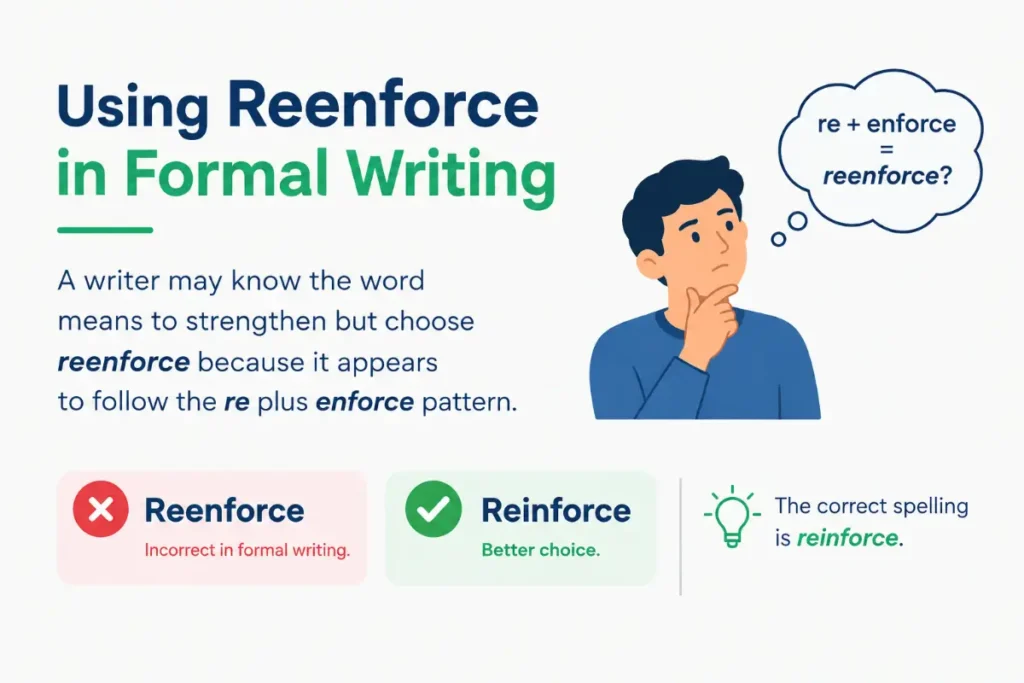
A writer may know the word means to strengthen but choose reenforce because it appears to follow the re plus enforce pattern.
Better choice: reinforce.
Example: The evidence reinforces the argument.
Treating Reenforce as Completely Impossible
The opposite mistake is also worth avoiding. Reenforce has historical and dictionary support as a variant. Calling it pure nonsense ignores actual English usage.
The more accurate explanation is that it is a rare variant and reinforce is the standard modern choice.
Confusing Reinforce With Enforce
These words are related in appearance but don’t mean the same thing.
Enforce means to make people obey a law rule or requirement.
Reinforce means to make something stronger or provide additional support.
For example:
The city enforced the parking rules.
The new evidence reinforced the argument.
Assuming Every Re Word Follows the Same Pattern
English prefixes don’t always produce predictable spelling. A writer may know that reenter and rewrite are standard forms and then assume every word involving re follows the same construction.
Vocabulary has to be learned word by word when historical spelling prevents a simple rule.
Relying Only on Pronunciation
Because reinforce and reenforce sound the same, listening won’t help you choose the written form.
That is a common source of spelling errors. When two forms share pronunciation, visual memory and dictionary familiarity become more useful than sound.
Still confused? Compare enrol or enroll: The Truth About These Two Spellings (2026).
Pronunciation Guide
The standard pronunciation of reinforce in American English is approximately:
IPA: /ˌriː.ɪnˈfɔːrs/
A simple pronunciation guide is:
ree in FORS
The strongest stress falls on the final part of the word.
You can think of the word in three sound groups:
ree + in + force
The first part is light. The main emphasis falls on force.
Cambridge gives /ˌriː.ɪnˈfɔːrs/ for American English and /ˌriː.ɪnˈfɔːs/ for British English. The final sound differs mainly because of the pronunciation of r in the two varieties.
Reenforce has essentially the same pronunciation. Cambridge lists the American pronunciation as /ˌriː.ɪnˈfɔːrs/.
That shared sound explains why people often need to see the word written before they can confidently identify the spelling.
Etymology and Word Origin
The history of reinforce helps explain why its spelling doesn’t need to follow the simple modern pattern of re plus enforce.
Historical word sources connect reinforce with French forms related to strengthening and with the broader word family built around force. English spelling developed through contact with French and other languages, and the modern form became established through long usage.
There is an interesting complication in the history. Older dictionaries sometimes analyzed the word in relation to re and enforce. The 1828 Webster entry explicitly connected the word with those elements and also noted an alternative spelling.
Modern dictionaries are more useful for deciding what you should write today. They recognize reinforce as the main form and record reenforce as a variant. Dictionary.com and Collins both support that distinction.
The history also shows why spelling debates can become messy. A word may have more than one historical form while only one becomes dominant in modern edited English.
That is exactly what happened here.
Regional Usage
American English
Reinforce is the normal spelling in American English. It appears in everyday speech, professional writing, academic work, journalism, construction, education, business, and many other fields.
Cambridge’s American Dictionary entry defines it as a verb meaning to make something stronger and also covers its use for strengthening an idea or providing additional military support.
Reenforce exists as a recorded American variant but is much less familiar to modern readers.
British English
British English also uses reinforce as the standard form. The pronunciation has a slightly different treatment of the final r sound, but the spelling remains the same.
British usage does not require writers to switch to reenforce.
Australian English
Australian English follows the same general standard spelling. Reinforce is the familiar form used in education, professional writing, journalism, and everyday communication.
There is no useful Australian spelling rule that makes reenforce preferable.
Canadian English
Canadian English also uses reinforce as the normal modern form. Its meaning and grammatical function remain the same.
The spelling does not follow a special Canadian variation in this case.
Grammar Rules and Part of Speech
Reinforce is a transitive verb. That means it normally takes an object that receives the action.
For example:
The steel bars reinforce the wall.
Here steel bars perform the action and the wall receives it.
The word can also take an abstract object.
The evidence reinforced her opinion.
The feedback reinforced his confidence.
The verb is especially flexible because the thing being strengthened can be physical or abstract.
Physical Strength
Use the word for structures and materials.
Workers reinforced the roof with additional supports.
Ideas and Arguments
Use it when evidence or reasoning gives an idea more support.
The new data reinforced the original theory.
Behavior
Use it for actions or habits that become stronger because of a response.
Praise can reinforce positive behavior.
Groups and Forces
Use it when additional people or resources strengthen a group.
The company reinforced the support team during the holiday season.
The sentence position is flexible. The verb normally appears after the subject and before the object.
The evidence reinforced the argument.
You can also use different verb forms.
Present: reinforce.
Past: reinforced.
Present participle: reinforcing.
Third person singular: reinforces.
The noun form is reinforcement. Cambridge defines reinforcement as the act of making something stronger or something added to provide strength or support.
Real Life Usage Examples
Daily Conversation
In everyday speech the word often describes an idea becoming stronger.
I think that experience reinforced what I already believed.
Her reaction reinforced my decision to wait.
These uses sound natural because people often talk about experiences that strengthen opinions feelings or decisions.
Email and Workplace Communication
The word is common in professional communication because teams often discuss evidence support training and processes.
The latest results reinforce the need for better customer training.
We added another review step to reinforce quality standards.
These sentences sound professional without being overly formal.
Academic Writing
Academic writers often use reinforce when evidence supports a conclusion.
The findings reinforce the study’s original hypothesis.
The second experiment reinforced the pattern observed in the first test.
The word works well in academic writing because it describes added support without overstating the evidence.
News and Journalism
News writing often uses the word when new developments support an existing claim.
The latest figures reinforced concerns about rising costs.
The announcement reinforced expectations that the project would continue.
The meaning stays clear because new information adds strength to an existing position.
Literature and Storytelling
Writers can use reinforce to describe feelings impressions and themes.
The silence reinforced the sense of isolation in the room.
His actions reinforced her suspicion that something was wrong.
In storytelling the word can quietly show how one event makes another feeling or idea stronger.
Related and Confused Terms
Strengthen
Strengthen is the closest everyday synonym. It can describe physical objects, arguments, relationships, skills, or abilities.
Support
Support means helping something remain strong or successful. It can overlap with reinforce when evidence or assistance is involved.
Fortify
Fortify often suggests making something stronger against danger or attack. It is common in physical and defensive contexts.
Bolster
Bolster means to strengthen or support. It often appears in formal writing about arguments confidence systems or organizations.
Confirm
Confirm means to establish that something is true or accurate. It can overlap with reinforce when new evidence strengthens an existing conclusion.
Encourage
Encourage relates to giving someone confidence or motivation. It can reinforce behavior when repeated encouragement makes that behavior more likely.
Validate
Validate means to provide support for the correctness or legitimacy of something. It often appears in academic technical and professional contexts.
Enforce
Enforce is one of the most easily confused words. It means to make sure a rule law or requirement is followed. It does not simply mean to make something stronger.
Consider the difference:
The evidence reinforced her argument.
The police enforced the law.
That distinction is worth remembering because it prevents both spelling and meaning errors.
Reinforce in Formal Writing
Reinforce is completely appropriate in formal writing. It works naturally in research papers, business reports, professional emails, technical documents, academic essays, and journalism.
The key is to use it for the right relationship. If evidence gives an argument more support, reinforce works well. If a material structure receives additional strength, it works well and If an organization adds staff to increase its capacity, it can work there too.
The word is useful because it is precise without sounding unnecessarily complicated.
For example:
The additional evidence reinforces the study’s conclusion.
That sentence is direct and professional. There is no need to replace reinforce with a more elaborate expression.
Expert Editor Insight
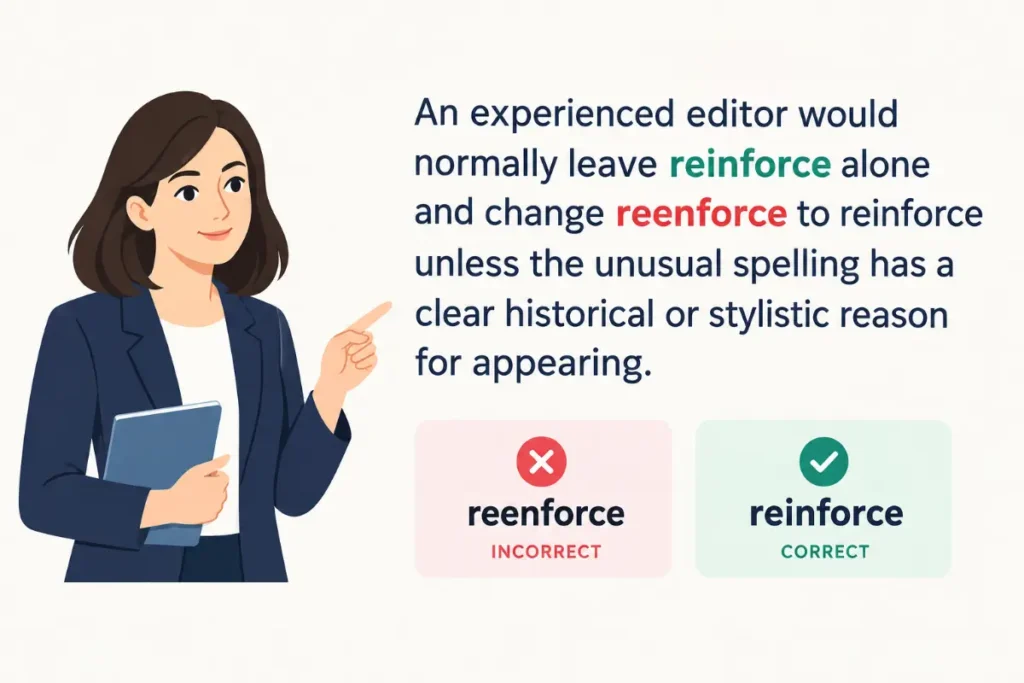
An experienced editor would normally leave reinforce alone and change reenforce to reinforce unless the unusual spelling has a clear historical or stylistic reason for appearing. The confusion is easy to understand because enforce is a familiar word and re is a productive English prefix. Spelling tools may flag the less common form or suggest the standard spelling because modern written English strongly favors reinforce. The practical editing habit is simple: if your sentence means make stronger or provide support, use reinforce.
A related grammar guide is dealt vs delt Correct Spelling Meaning and Usage.
Conclusion
reinforce vs reenforce has a clear practical answer. Use reinforce as the standard modern spelling when you mean to make something stronger or provide additional support. Reenforce is a documented variant, but it is much less common and may look like a spelling error to many modern readers.
The confusion comes from a reasonable pattern. Since enforce is a familiar word and re often means again, reenforce can seem like the obvious construction. Yet established English usage favors reinforce, and major dictionaries treat it as the principal form.
For an easy memory trick, connect reinforce with the idea of adding force. If you’re writing for school, work, publication, or everyday communication, choose reinforce. It’s the familiar form that keeps your meaning clear and your spelling on solid ground.
FAQs
Is reenforce a real word?
Yes. Reenforce is a documented variant of reinforce and appears in some dictionaries. That doesn’t mean both forms are equally common in modern writing. Reinforce is the standard form most readers expect today. If you’re writing an essay, report, email, article, or professional document, reinforce is the safer and more familiar choice.
What does reinforce mean?
Reinforce means to make something stronger or provide additional support. You can reinforce a physical structure with extra material, reinforce an argument with evidence, or reinforce a behavior through repeated feedback. The word is a transitive verb, so it commonly appears with an object, as in The evidence reinforced her conclusion.
Which spelling should I use in modern English?
Use reinforce in modern standard English. Reenforce is recorded as a less common variant, so it isn’t accurate to call it completely nonexistent. However, reinforce is far more familiar and is the form readers normally expect. For school, business, academic, and professional writing, choosing reinforce avoids unnecessary distraction and follows common modern usage.
How do you pronounce reinforce?
In American English, reinforce is pronounced approximately /ˌriː.ɪnˈfɔːrs/. A simple guide is ree in FORS, with the strongest stress on the final part. The word has three main sound groups and the final sound resembles force. Reenforce is normally pronounced the same way, which explains why hearing the word doesn’t solve the spelling problem.
Can reinforce describe an idea?
Yes. Reinforce can describe an idea, belief, opinion, argument, or conclusion becoming stronger because of additional support. For example, The new evidence reinforced her argument means that the evidence gave her argument more support. This abstract use is very common in academic, professional, and everyday English. The word isn’t limited to physical structures such as walls, bridges, or buildings.
What is a good synonym for reinforce?
Common synonyms include strengthen, support, bolster, fortify, confirm, encourage, and validate. The best choice depends on the context. Strengthen is the broadest everyday alternative. Bolster often sounds more formal. Fortify can suggest protection against danger. Confirm focuses on establishing something as true. Reinforce is useful when additional support makes an existing thing stronger.
Why do people spell reinforce as reenforce?
The mistake is understandable because enforce is already a familiar English word and re often works as a prefix meaning again. That can make reenforce look like a logical combination of re and enforce. The spelling also sounds exactly the same when spoken. In reality, reinforce is the established standard form, while reenforce survives as a less common variant.
Is reinforce appropriate in formal writing?
Yes. Reinforce is fully suitable for formal writing and appears naturally in academic papers, technical reports, business communication, journalism, and professional documents. It can describe physical strengthening, supporting evidence, stronger beliefs, reinforced habits, or additional personnel. In polished writing, reinforce is preferable to the much less common variant because it matches the spelling most readers recognize immediately.