
Many readers also check felicitation meaning and correct usage.
Introduction
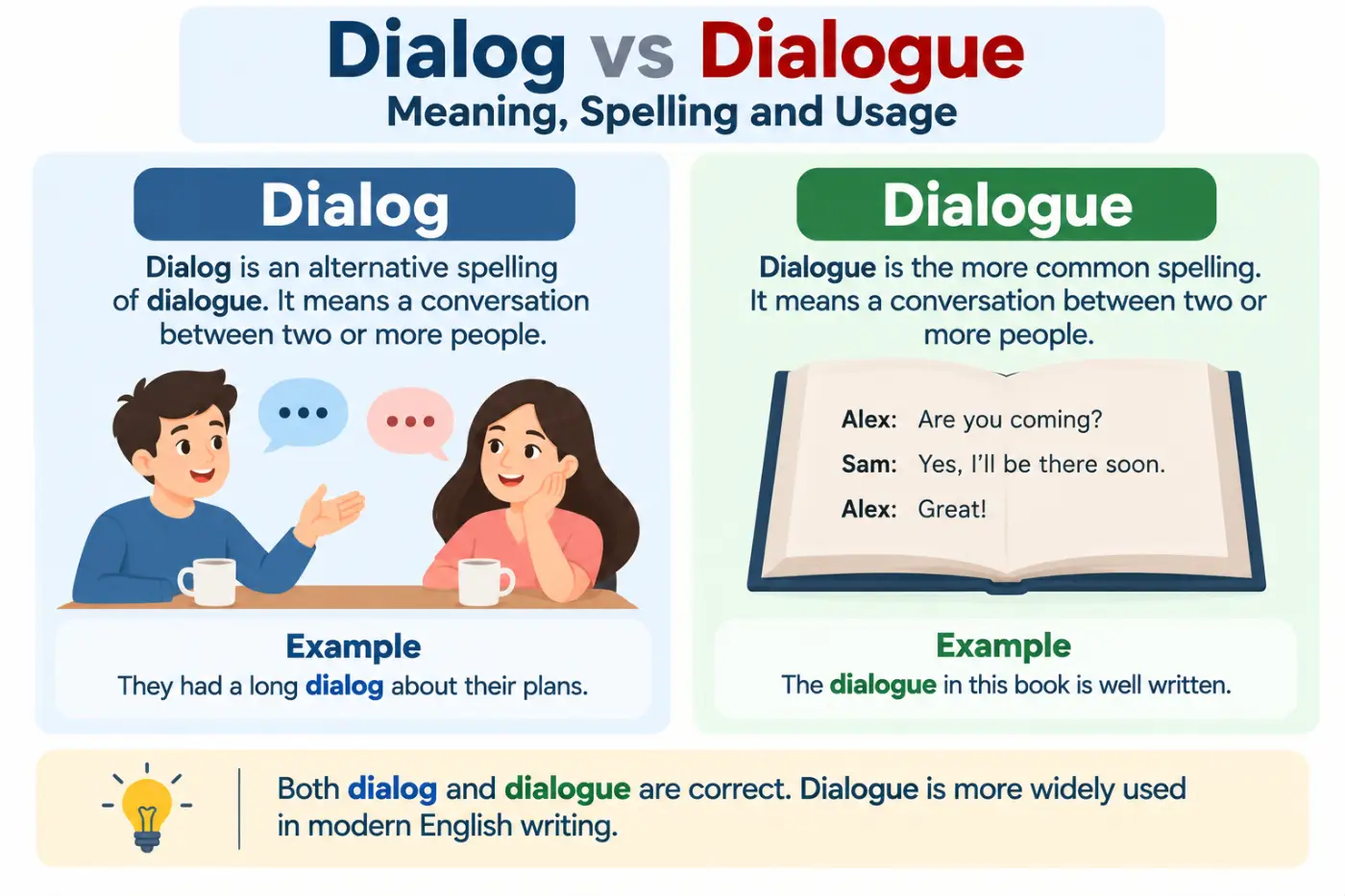
dialog vs dialogue is a common English usage question because the two forms look almost identical and often carry the same basic meaning. Both words are legitimate English forms. The main difference is regional preference and context rather than correctness. In American English dialogue is the usual spelling for spoken conversation while dialog is also accepted and has a particularly strong presence in computing and software terminology.
The confusion often starts when writers see dialog in a computer program and dialogue in a book or article. That difference can make the words seem like separate concepts when they are often simply two spelling forms of the same underlying word. British English generally favors dialogue while American English uses both forms depending on context.
The good news is that you don’t need to memorize a complicated rule. This guide explains the meaning of each form its pronunciation grammatical role historical background regional usage and common contexts. You’ll also see practical examples that show why a writer might choose one form over the other and how software terminology has helped make dialog especially familiar in American English.
Quick Definition
Dialog and dialogue are both accepted spellings connected with conversation or an exchange of speech. Dialogue is the more traditional and widely used spelling in general English. Dialog is also standard in American English and is especially common in computing where it refers to a window or interface that asks a user to provide information or make a choice.

Quick Answer
Both forms are correct. Dialogue is the traditional spelling and remains the most common choice for conversation in general writing. Dialog is an accepted American English variant and is especially common in computer science and software terminology.
For a novel you would normally write:
The dialogue between the two characters felt natural.
For software you may write:
Close the dialog box before continuing.
The difference is mainly about convention and context rather than a difference in basic meaning.
Comparison Table
| Form | Meaning | Part of Speech | Origin | Usage Frequency | Formality | Common Contexts | Example |
|---|---|---|---|---|---|---|---|
| Dialogue | Conversation or exchange of spoken words | Noun | From Greek dialogos through Latin and French | Very common | Neutral to formal | Literature, film, conversation, journalism, academic writing | The dialogue between the characters was realistic. |
| Dialog | Conversation or exchange of spoken words; also a software interface window | Noun | Shortened spelling that developed in English usage | Common especially in American English and computing | Neutral | Software, computing, technical writing, American English | The dialog asks you to confirm the action. |
The important point is that dialog isn’t simply a misspelling. It has established usage and appears regularly in American English. Its meaning becomes especially specific in technical contexts.
Meaning And Definition
Meaning Of Dialogue
Dialogue is a noun that generally means an exchange of spoken words between two or more people.
You might hear dialogue in a conversation between friends.
The dialogue between the neighbors lasted for an hour.
The word is also strongly associated with literature theater television and film. In those settings dialogue refers to the words spoken by characters.
The movie has sharp and funny dialogue.
Dialogue can also describe communication between groups or organizations.
The two sides opened a dialogue about the proposed agreement.
Here the word doesn’t necessarily refer to a casual conversation. It can describe a serious process of communication where people exchange ideas opinions or information.
The word also appears in academic and philosophical contexts. Writers may discuss dialogue as a form of communication or as an interaction between different viewpoints.
So dialogue has a broad meaning. It can describe actual spoken conversation written speech between characters or a wider process of communication.
Meaning Of Dialog
Dialog has the same basic linguistic meaning as dialogue when it refers to conversation. It is a recognized spelling rather than a random typo.
In American English dialog can appear in general writing although dialogue remains more common for ordinary conversation.
The two leaders entered into a dialog about the problem.
The spelling becomes especially familiar in computing.
A dialog box is a graphical interface element that appears on a screen and asks the user to respond. It may ask for confirmation collect information or present available choices.
For example:
The dialog box asks you to save the document.
In technical writing you may also see terms such as dialog window dialog control dialog component and dialog manager.
This technical usage has helped make the shorter spelling particularly common in software development.
The Main Difference
The central distinction is not that one word means conversation and the other means something completely different. Instead the difference comes from spelling preference context and established terminology.
- Dialogue is the traditional general spelling. It is widely used for conversation in books articles films academic writing and everyday formal prose.
- Dialog is an accepted variant. American English recognizes the shorter form and it appears often in technical contexts.
- Computing strongly favors dialog. Software documentation commonly uses the shorter spelling in phrases such as dialog box and dialog window.
- British English generally favors dialogue. The longer spelling is the normal choice in general British English.
- American English allows both. Writers often use dialogue for ordinary conversation and dialog for computing.
- Pronunciation is essentially the same. The spelling difference doesn’t normally create a different pronunciation.
- Neither form is automatically wrong. The right choice depends on the style and field in which you are writing.
This distinction is useful because it prevents a common mistake. Seeing dialog in software documentation doesn’t mean the writer forgot the final letters. The shorter spelling has a long and established place in technical American English.
Which Form Should You Use?
For general English writing dialogue is usually the safest choice.
If you’re writing a story essay article report or general discussion about conversation you can use dialogue.
For example:
The dialogue in the novel reveals the character’s fear.
If you’re writing about software or user interfaces dialog is often the more natural technical term.
For example:
The application opens a dialog when the user selects the settings option.
American technical writing frequently uses the shorter form because it is established terminology within computing.
The best rule is therefore simple.
Use dialogue for general conversation and literary speech. Use dialog when following established American technical terminology.
You don’t need to treat one as correct and the other as incorrect. Context matters more than the number of letters.
Why Does English Have Both Forms?
English has a long history of accepting spelling variations. Words can develop shorter forms through everyday use and specialized fields can reinforce those forms.
Dialog is a good example. The shorter spelling became established in American English and gained particular strength in computing.
Technical fields often develop their own preferred vocabulary. Once a term becomes widely used in manuals software documentation programming discussions and interface design it can become a normal part of professional language.
That is what happened with dialog.
This also explains why dictionaries and style references may list both forms. A word doesn’t have to be the most common spelling to be legitimate. English contains many pairs of variants that differ in frequency or regional preference.
The important question is not simply which spelling has more letters. The better question is which form fits your audience and context.
Grammar And Part Of Speech
Both dialog and dialogue are primarily nouns.
They can refer to a conversation or an exchange of speech.
For example:
The dialogue was difficult to follow.
The dialog was difficult to follow.
Both sentences can describe a conversation. Dialogue is more conventional in general writing.
The words can also appear in compound expressions.
Dialogue examples include:
Dialogue writing.
Dialogue scene.
Dialogue between characters.
Dialog examples include:
Dialog box.
Dialog window.
Dialog component.
Dialog interface.
In these technical expressions the shorter spelling is strongly established in American computing.
Neither form is normally used as a regular verb in standard modern English. Writers who need the verbal idea usually choose expressions such as talk discuss communicate or enter into dialogue.
For example:
The teams discussed the issue.
The teams entered into dialogue.
These forms are more natural than trying to force the noun into a new verbal construction.
Dialogue In Literature
Dialogue has a special role in storytelling.
When a character speaks directly to another character the spoken words form dialogue.
For example:
Maria looked at John and said that she was ready.
The actual spoken part would be dialogue.
Good dialogue can reveal personality emotion conflict and relationships without requiring the writer to explain everything directly.
Compare these approaches.
John was angry because he thought Maria had ignored him.
John said he was tired of being ignored.
The second example uses dialogue to show the character’s feelings directly.
Writers also use dialogue to control the pace of a story. Short exchanges can make a scene feel quick and tense. Longer speeches can slow the pace and allow a character to explain an idea.
In fiction writing dialogue is generally the preferred spelling in American publishing as well as British English.
Dialog In Computing
Computing gives the shorter form a special role.
A dialog is a graphical interface element that appears when software needs information from the user.
You may see a dialog when you try to delete a file.
The program might display:
Are you sure you want to delete this file?
The user can then choose an option such as cancel or confirm.
A dialog can contain buttons text fields checkboxes menus and other controls. It may appear as a small window over the main application.
Common technical expressions include dialog box dialog window modal dialog and dialog control.
This usage is one of the biggest reasons American readers encounter dialog frequently.
For a software developer technical writer or user interface designer the shorter form may feel more natural because it matches established computing vocabulary.
Dialog Box Or Dialogue Box
If you’re writing about software a common question is which phrase to use.
Dialog box is the standard technical expression in American computing.
For example:
A dialog box appears when you click the delete button.
The term refers to a graphical interface window that presents information or requests user input.
You may occasionally encounter dialogue box especially in British contexts or general English writing. However dialog box is deeply established in American software terminology.
If your article is about programming user interfaces or application design following the terminology used by the software community can make your writing clearer and more natural.
Still confused? Compare Puddy or Putty Which Spelling Is Correct in 2026.
Sentence Examples
Here are examples showing how both forms work naturally.
- The dialogue between the two characters felt realistic.
- The director wanted more dialogue in the final scene.
- Their dialogue revealed a major disagreement.
- The book contains several memorable pieces of dialogue.
- The two groups began a dialogue about the proposed changes.
- The application opened a dialog asking me to confirm the deletion.
- Close the dialog before you return to the main screen.
- The developer redesigned the settings dialog.
- The dialog lets users choose a preferred language.
- The software displays a dialog when the file cannot be opened.
These examples show the practical pattern. General conversation and storytelling usually favor dialogue. Software contexts often favor dialog.
Common Mistakes
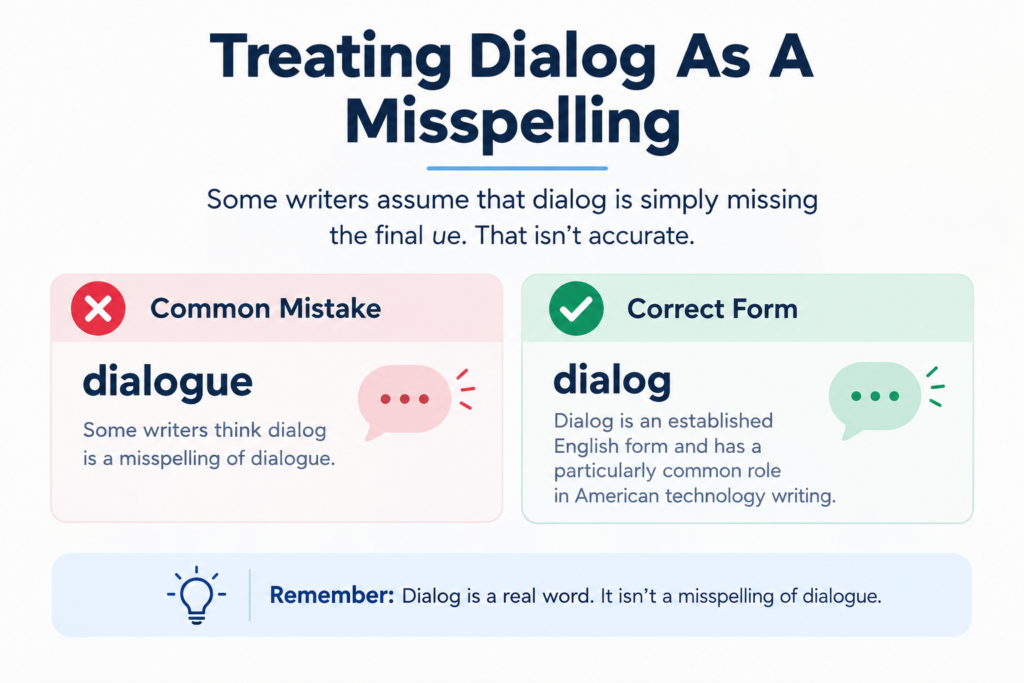
Treating Dialog As A Spelling Error
One of the most common mistakes is assuming that dialog is always wrong.
That isn’t accurate. Dialog is a legitimate spelling in English and has established American usage.
The better approach is to check the context.
Using Dialogue Box In American Technical Writing
Dialogue box is understandable but dialog box is the standard technical expression commonly used in American software terminology.
If you’re writing documentation for a US audience you should normally follow the established technical form.
Assuming The Two Words Have Completely Different Meanings
The words overlap heavily. Their difference is mainly contextual and conventional.
Dialogue can refer to conversation in general. Dialog can also refer to conversation but has a strong technical meaning in computing.
Changing Spelling Inside A Technical Term
If a software framework or programming environment uses a particular term such as dialog box it’s usually better to preserve that established terminology.
Technical consistency helps readers recognize the concept immediately.
Assuming British And American English Use The Same Pattern
Regional preference matters. Dialogue is more strongly preferred in British general English while American English comfortably uses both forms.
Pronunciation Guide
Dialogue is commonly pronounced /ˈdaɪəˌlɔːɡ/ in American English.
A simple pronunciation guide is:
DYE uh log.
The first syllable carries the strongest stress.
Dialog is normally pronounced the same way.
The spelling difference therefore doesn’t usually create a meaningful pronunciation difference.
The first part sounds like dye. The middle has a light uh sound. The final part sounds like log.
One common mistake is trying to pronounce every letter separately. English spelling often contains historical letters that don’t map neatly onto individual sounds.
Learning the spoken form as a whole is more useful than trying to sound out every character.
Etymology And Word Origin
The history of these words reaches back to ancient Greek.
The English word comes from Greek dialogos which was connected with conversation and the exchange of ideas. The word passed through Latin and French before becoming established in English.
The Greek elements are associated with the idea of speaking or reasoning through an exchange.
Over time English developed the spelling dialogue. American English later developed and accepted the shorter spelling dialog.
The shorter form became particularly useful in computing. As graphical interfaces became common the term dialog became associated with a window that allows the user and software to exchange information.
That technical meaning fits the original conversational idea surprisingly well. A dialog box presents information and waits for a response. In a simple sense the software is communicating with the user.
The spelling is therefore not a random invention. It developed as part of established English usage and became especially strong in American technical language.
Regional Usage
American English
American English accepts both forms.
Dialogue remains the familiar choice for general conversation literary writing journalism and many academic contexts.
Dialog is especially common in computing and software terminology. American technical writers frequently use phrases such as dialog box and dialog window.
For general American prose dialogue is usually the safer default if you aren’t writing about technology.
British English
British English generally favors dialogue.
The longer spelling is common in literature journalism academic writing and general discussion.
British computing terminology may also use dialog in technical contexts. Specialized fields can develop conventions that differ from ordinary prose.
The important point is that British readers understand both forms even though dialogue remains the traditional general spelling.
Australian English
Australian English generally follows the broader Commonwealth preference for dialogue in general writing.
The shorter form can still appear in computing and technical material because software terminology often crosses regional boundaries.
There isn’t a need to treat the two forms as separate words in ordinary Australian usage.
Canadian English
Canadian English can use both forms. General writing commonly uses dialogue while American influenced technical terminology may use dialog.
The choice often depends more on the field and house style than on a strict Canadian grammar rule.
If you’re writing for a Canadian publication or organization it’s sensible to follow its established style guide when one exists.
Formal And Informal Usage
Dialogue works comfortably in formal and informal contexts.
You can use it in a novel.
You can use it in a school essay.
You can use it in a business report.
You can use it in a news article.
Dialog also works in formal writing when the context supports it. Technical documentation is the clearest example.
The important distinction is not formality alone. Context plays a bigger role.
Consider these sentences:
The dialogue between the witnesses was recorded.
The dialog box appeared after the user clicked submit.
The first sentence discusses spoken communication. The second discusses software.
Trying to replace one with the other can make the writing feel unusual even though the general meaning may remain understandable.
Real Life Usage Examples
Daily Conversation
You might say:
The dialogue between the parents and their children was honest and open.
The movie had some funny dialogue.
In ordinary conversation dialogue is usually the natural choice when you’re talking about spoken exchanges.
Workplace Communication
A workplace report might say:
The meeting created an opportunity for dialogue between the two departments.
The software then opened a dialog requesting additional information.
These examples show how context controls the preferred spelling.
Academic Writing
An academic paper might discuss:
Political dialogue can help groups understand competing viewpoints.
The novel uses dialogue to reveal changes in the main character.
In technical academic writing you might also see dialog when the subject is software or interface design.
News Writing
A news article might say:
The leaders called for dialogue after weeks of disagreement.
The new application includes a dialog that allows users to adjust privacy settings.
The appropriate form follows the subject being discussed.
Literature And Storytelling
A novelist might write:
The dialogue between the two sisters becomes more tense as the story develops.
The writer revised the dialogue to make each character sound distinct.
In literary discussion dialogue is overwhelmingly the familiar choice.
Related And Confused Terms
Conversation
Conversation is a general word for an exchange of spoken communication. It is often more natural in everyday speech than dialogue.
Discussion
A discussion involves people talking about a subject or issue. It can be informal or structured.
Debate
A debate usually involves opposing positions. It is more specific than dialogue.
Monologue
A monologue is an extended speech by one person rather than an exchange between speakers.
Speech
Speech can mean spoken language generally or a formal address delivered to an audience.
Communication
Communication is broader than dialogue. It can include speech writing gestures images and digital messages.
Negotiation
Negotiation involves communication aimed at reaching an agreement. It is more specific than dialogue.
Conversation Box
This phrase can describe an interface in some contexts but it isn’t the standard general technical term. Dialog box is the established computing expression.
These terms overlap but they aren’t interchangeable in every sentence. Choosing the most precise word makes your writing easier to understand.
Why Technical Writing Uses Dialog
The computing sense deserves special attention because it can look strange to people who learned dialogue as the standard spelling.
Software interfaces often need a way to present information and collect a response. A dialog box does exactly that.
For example a program may ask:
Save changes before closing?
The user can select an option. The interface has effectively created a short exchange between the system and the user.
Technical communities adopted the shorter spelling and made it part of standard computing vocabulary.
This pattern appears in many fields. Specialized communities often develop preferred terms that become familiar within that field.
Once you understand that pattern the spelling difference stops looking like an error.
How To Choose The Right Form
Use the context as your guide.
- Writing about characters speaking. Choose dialogue.
- Writing about conversation between people. Dialogue is usually the natural choice.
- Writing about communication between groups. Dialogue is generally preferred.
- Writing about a software interface window. Use dialog.
- Writing technical documentation for American software users. Follow the terminology established by the software or technical style guide.
- Writing general American English without a technical context. Dialogue is usually the safer choice.
- Writing British English. Dialogue is the usual general form.
- Editing existing technical material. Preserve consistent terminology instead of switching forms without a reason.
This approach is more useful than memorizing that one spelling is correct and the other is wrong.

Expert Editor Insight
An experienced editor would usually leave both forms intact when they fit their context. Dialogue is the natural general choice for conversation and literary speech while dialog has a strong established role in American computing. The most common editing problem isn’t spelling accuracy but inconsistency. A document about software can look careless if it switches randomly between dialog box and dialogue box. A good editor checks the subject the intended audience and the terminology already used throughout the document before making a change.
A related grammar guide is Busing or Bussing Grammar Rules and Usage Guide 2026.
Conclusion
dialog vs dialogue is not a simple case of correct spelling versus incorrect spelling. Both forms are legitimate. Dialogue is the traditional and widely preferred spelling for conversation literary speech and communication in general writing. Dialog is also accepted and has become especially common in American English technical and computing contexts.
The easiest practical rule is to match the word to the subject. Use dialogue when discussing people speaking characters talking or communication between groups. Use dialog for established software terms such as dialog box when your technical context calls for it.
As an editing tip keep your terminology consistent from beginning to end. If a technical document uses dialog box throughout don’t switch randomly to dialogue box. If you’re writing general prose dialogue is usually the natural choice.
FAQs
Is dialog a correct English word?
Yes. Dialog is a legitimate English spelling. It is especially common in American English and has a strong established presence in computing. Dialogue remains the more traditional spelling for ordinary conversation and literary speech. Calling dialog a simple misspelling would therefore be inaccurate. The better choice depends on the context and the style used by your audience or field.
Is dialogue more correct than dialog?
Dialogue is not simply more correct. Both forms are accepted. Dialogue is more traditional and remains widely used for conversation literature journalism and general writing. Dialog is also standard and is particularly common in American technical language. If you are discussing software a shorter form may be the established choice. For general prose dialogue is usually the safer default.
Why do computers use dialog instead of dialogue?
Computing developed a strong preference for the shorter spelling dialog. The term became associated with interface elements that communicate with users and request information or decisions. Phrases such as dialog box and dialog window are now well established in American technical language. This specialized usage is one major reason the shorter form is so familiar to software developers and users.
Is dialog used in British English?
British English generally favors dialogue in ordinary writing. However British technical and computing material can also use dialog because technical terminology often crosses regional boundaries. The shorter spelling is therefore understandable in Britain even though dialogue remains the more familiar general form. Regional preference does not change the basic meaning of the two forms.
Do dialog and dialogue have the same pronunciation?
Yes. In ordinary English they are generally pronounced the same way. A common American pronunciation is represented as /ˈdaɪəˌlɔːɡ/. You can think of it as dye uh log. The spelling difference mainly affects written form and usage convention. It does not normally create a separate spoken word with a different pronunciation.
Should I use dialogue in a novel?
Yes. Dialogue is the natural and widely recognized spelling for spoken exchanges between characters in fiction. It is also common when discussing the speech of characters in film theater and other storytelling forms. Dialog may be understood but can look technical or unusual in literary writing. For a novel dialogue is the straightforward choice.
Should I write dialog box or dialogue box?
For American software and technical writing use dialog box. This is the established technical expression in computing. The term describes a graphical interface window that presents information or asks the user for input. Dialogue box is understandable and may appear in some contexts but dialog box is the conventional technical form for many American audiences.
Can dialog mean a conversation?
Yes. Dialog can refer to a conversation or exchange of ideas just like dialogue. However dialogue is more common for this general meaning. Dialog has a particularly strong association with software and technical terminology. If you are writing about people talking and there is no technical context dialogue will usually sound more natural to most readers.