
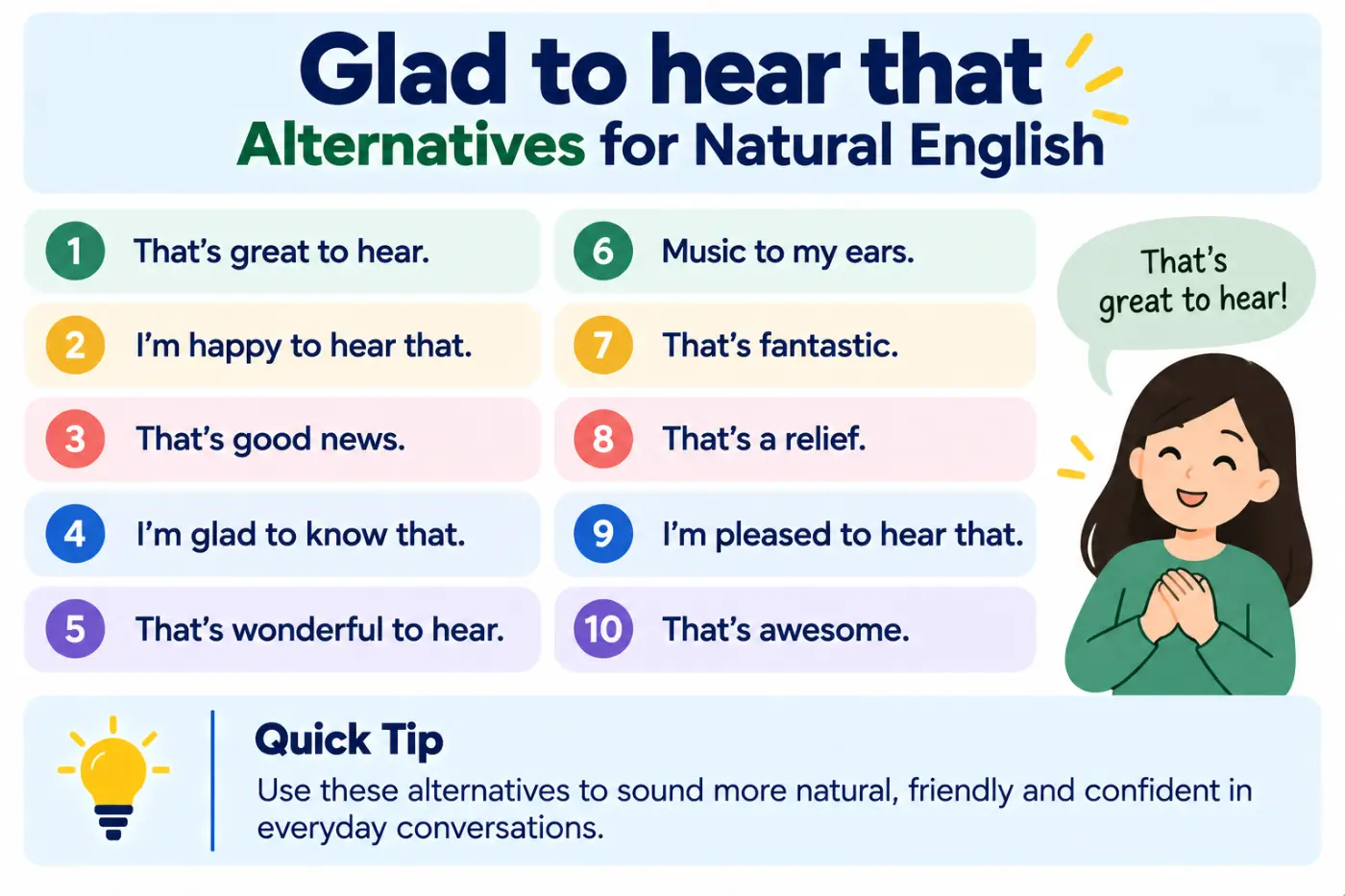
If you keep using the same phrase every time someone shares good news, you may want some fresh ways to respond. Glad to hear that alternatives can help you sound warmer, more professional, more enthusiastic, or simply more natural. The best replacement depends on what the other person has told you and how close you are to them.
The phrase itself is perfectly natural English. It tells someone that you are pleased to receive positive information from them. Still, saying the same thing again and again can make your replies feel predictable. A simple change such as That’s great to hear, I’m happy to hear that, or That’s wonderful news can give your response a different tone without changing the basic message.
In this guide, you’ll find practical alternatives for everyday conversations, texts, work emails, customer communication, formal situations, and supportive messages. You’ll also learn the small differences between similar expressions so you can choose words that actually fit the moment. Some phrases sound warm and personal, while others work better in professional settings.
A related grammar guide is As Well As Alternatives for Clearer English.
Quick Definition
Glad to hear that means I’m pleased to know that or I’m happy to receive that information. Natural alternatives include That’s great to hear, I’m happy to hear that, That’s wonderful news, I’m pleased to hear that, and That’s good news. The best choice depends on your relationship, the situation, and the level of enthusiasm you want to show.
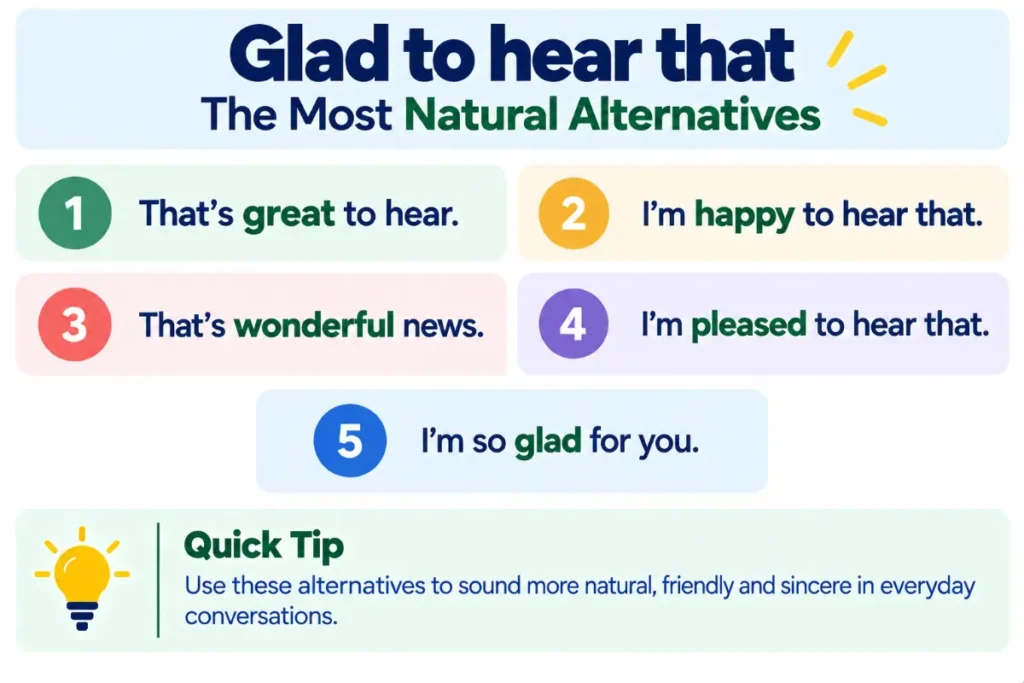
Quick Answer
The most natural alternatives include That’s great to hear, I’m happy to hear that, That’s wonderful news, I’m pleased to hear that, and I’m so glad for you.
For casual conversations, That’s great to hear sounds friendly and natural. For professional communication, I’m pleased to hear that or That’s good news can sound more polished.
What The Phrase Really Means
The phrase expresses a positive reaction to information you have just received. When someone tells you something good, you can use it to show that their news has made you happy.
For example:
I passed my driving test.
That’s great to hear.
The response doesn’t necessarily mean that the speaker experienced the event personally. It simply shows a positive emotional reaction to another person’s news.
The phrase can also show support.
I was worried about the surgery, but everything went well.
I’m glad to hear that.
Here the response communicates relief and concern. The speaker isn’t simply saying the information is interesting. They’re showing that they care about the outcome.
The expression works especially well because it is flexible. You can use it after good personal news, work updates, health updates, successful plans, positive results, or simple everyday improvements.
Best Alternatives For Everyday Conversation
Different situations call for different levels of warmth. You don’t need a complicated phrase. Often, the simplest response sounds the most natural.
- That’s great to hear.
This is one of the easiest replacements. It sounds friendly, positive, and natural in everyday conversation.
I finally got the job.
That’s great to hear.
- That’s good to hear.
This expression is slightly calmer. It works when you want to sound positive without showing a lot of excitement.
The doctor said everything looks fine.
That’s good to hear.
- I’m happy to hear that.
This sounds personal and sincere. It works especially well when someone shares meaningful news.
You can use it with friends, family members, coworkers, or people you know fairly well.
- That’s wonderful news.
This expresses stronger enthusiasm. Use it when the news is genuinely exciting or meaningful.
We’re expecting our first child.
That’s wonderful news.
- That’s fantastic.
This is more energetic and informal. It works well in conversations with friends and coworkers you know comfortably.
- That’s really nice to hear.
This sounds warm without being overly emotional. It can work in casual conversations and friendly professional communication.
- I’m pleased to hear that.
This is a little more formal. It fits professional conversations, emails, and situations where you want to sound polite and composed.
- That’s reassuring to hear.
Use this when the information removes worry or uncertainty.
The test results came back normal.
That’s reassuring to hear.
- I’m so happy for you.
This shifts the focus from the information itself to the person receiving the good news. It works especially well for personal achievements.
- That’s excellent news.
This sounds positive and professional. It works nicely in workplace communication.
Alternatives For Professional Emails
Workplace communication often requires a little more care. A response can be positive without sounding overly casual.
Consider the situation first. If a client tells you that the problem has been resolved, you might say I’m pleased to hear that. If a coworker tells you that a project is moving forward, That’s great news can sound perfectly natural.
Here are useful choices.
- I’m pleased to hear that.
This is one of the safest choices for professional communication. It shows a positive reaction while maintaining a respectful tone.
- That’s good news.
This is simple and direct. It works in many workplace situations.
- That’s great to hear.
This remains professional enough for most friendly workplace conversations. It sounds warmer than I’m pleased to hear that.
- I’m happy to hear that.
This works well when the news directly affects the person or project you’re discussing.
- That’s excellent news.
This is useful when the update represents a meaningful success.
- I’m pleased to know that.
This can sound slightly more formal than I’m pleased to hear that. It works when the information arrives through an email or written update.
- Thank you for the update. That’s great news.
This combines acknowledgment with a positive response. It works especially well in professional email.
- That’s reassuring. Thank you for letting me know.
This is useful when someone has provided an update that resolves a concern.
Alternatives For Text Messages
Text messages usually sound better when they’re short. You don’t need a formal sentence if you’re responding to a friend.
Try expressions such as:
- That’s great.
- Amazing news.
- That’s awesome.
- So happy for you.
- That’s wonderful.
- I’m really happy to hear that.
- That’s such good news.
- Love hearing that.
- That’s fantastic.
- I’m glad things worked out.
The right choice depends on your relationship. A close friend may appreciate something enthusiastic like That’s amazing. A casual coworker may respond better to That’s great to hear.
Alternatives For Showing Strong Emotion
Sometimes good news deserves more than a neutral response. If someone has worked hard for something or gone through a difficult period, a stronger expression can feel more genuine.
That’s fantastic news
This sounds excited and upbeat. It works well for major achievements.
I’m so happy for you
This is personal and emotionally warm. It focuses directly on the person.
That’s wonderful
This is simple but expressive. It works well in both speech and text.
I couldn’t be happier for you
This shows strong support. It is especially natural when someone reaches an important personal goal.
That’s amazing to hear
This expresses surprise and excitement at the same time.
I’m thrilled to hear that
Thrilled is stronger than glad. It suggests a high level of happiness and works best when the news is genuinely exciting.
That makes me really happy
This feels personal and sincere. It can be especially effective when someone tells you something that directly affects your relationship.
Alternatives For Showing Relief
Not every positive update is exciting. Sometimes you feel relieved because something could have gone badly.
In these situations, expressions of reassurance work better than enthusiastic phrases.
- That’s reassuring.
- I’m relieved to hear that.
- That’s a relief.
- I’m glad everything worked out.
- That’s good news.
- It’s good to know everything is okay.
Consider this example.
I was worried that the package had been lost, but it arrived this morning.
That’s a relief.
That response sounds more natural than That’s wonderful news because the main emotion is relief rather than excitement.
Alternatives For Formal Writing
Formal writing needs a slightly different approach. The goal is to express a positive response without sounding overly emotional.
Useful expressions include:
- I’m pleased to hear that.
- I’m pleased to learn that.
- That is encouraging news.
- That is good news to hear.
- I’m encouraged by this update.
- It is reassuring to know that.
- I’m pleased to know that the matter has been resolved.
- Thank you for providing the update. I’m pleased to hear that the issue has been resolved.
Notice that formal English often focuses on the information or outcome rather than personal excitement. That difference can make a message sound more professional.
Comparison Table
| Expression | Tone | Best Context | Strength | Example |
|---|---|---|---|---|
| That’s great to hear | Friendly | Everyday conversation and work | Moderate | That’s great to hear. |
| That’s good to hear | Calm and positive | General conversation | Mild | That’s good to hear. |
| I’m happy to hear that | Warm | Personal and professional | Moderate | I’m happy to hear that you’re feeling better. |
| That’s wonderful news | Enthusiastic | Personal news | Strong | That’s wonderful news about your new home. |
| I’m pleased to hear that | Polite and formal | Work and formal communication | Moderate | I’m pleased to hear that the issue was resolved. |
| That’s reassuring | Calm and supportive | Updates after concern | Moderate | That’s reassuring to hear. |
| I’m so happy for you | Personal and warm | Achievements and milestones | Strong | I’m so happy for you. |
| That’s excellent news | Professional and positive | Work and formal settings | Strong | That’s excellent news for the team. |
| I’m relieved to hear that | Supportive | Difficult or uncertain situations | Strong | I’m relieved to hear that everything is okay. |
| That’s fantastic news | Energetic | Casual and friendly settings | Strong | That’s fantastic news about your promotion. |
Still confused? Compare First Come First Serve Alternatives For Clear Writing.
Key Differences Between Common Alternatives
The expressions may look interchangeable, but small differences matter.
- That’s good to hear is calm and neutral. It shows approval without strong emotion.
- That’s great to hear sounds warmer and more enthusiastic. It is one of the most flexible choices.
- I’m happy to hear that makes the response more personal. It directly states your emotional reaction.
- I’m pleased to hear that sounds more formal and controlled. It works particularly well in professional settings.
- That’s wonderful news expresses stronger enthusiasm. It fits major positive events.
- I’m relieved to hear that focuses on relief rather than happiness. Use it after worrying or uncertain situations.
- I’m so happy for you focuses on the person. It works especially well when someone has achieved something meaningful.
- That’s reassuring suggests that the new information has reduced concern or doubt.
Choosing the right phrase is less about grammar and more about emotional accuracy. You want your words to match the feeling behind your response.
Grammar And Sentence Structure
The basic construction uses glad as an adjective.
I’m glad to hear that.
Here I’m is a form of the verb be and glad describes the speaker’s emotional state. The phrase to hear that explains the reason for that feeling.
You can also change the structure slightly.
I’m glad you told me.
I’m glad to know that.
The word that often refers back to information the other person has just shared.
For example:
I got the job.
I’m glad to hear that.
In this exchange, that refers to the fact that the person got the job.
The phrase can appear after several kinds of positive statements.
The results are better than expected.
That’s great to hear.
We finally solved the issue.
I’m pleased to hear that.
The project is moving ahead.
That’s excellent news.
The grammar stays simple because the expression functions as a conversational response rather than a complex sentence structure.
Pronunciation And Natural Speech
The word glad is pronounced /ɡlæd/. Hear is commonly pronounced /hɪr/ in American English. The full phrase sounds natural when spoken as a connected unit rather than as separate carefully pronounced words.
In everyday speech, native speakers often reduce unstressed sounds. You may hear the phrase spoken quickly with the words flowing together.
The most useful pronunciation tip is to avoid stressing every word equally. In normal conversation the emotional meaning usually comes from the main content words.
For example:
I’m GLAD to HEAR that.
The exact stress changes with context. If someone has shared especially good news, the speaker may put more energy into glad. If the speaker wants to emphasize the information, hear or that may receive more stress.
Common Mistakes
Several mistakes can make a positive response sound unnatural even when the grammar is technically correct.
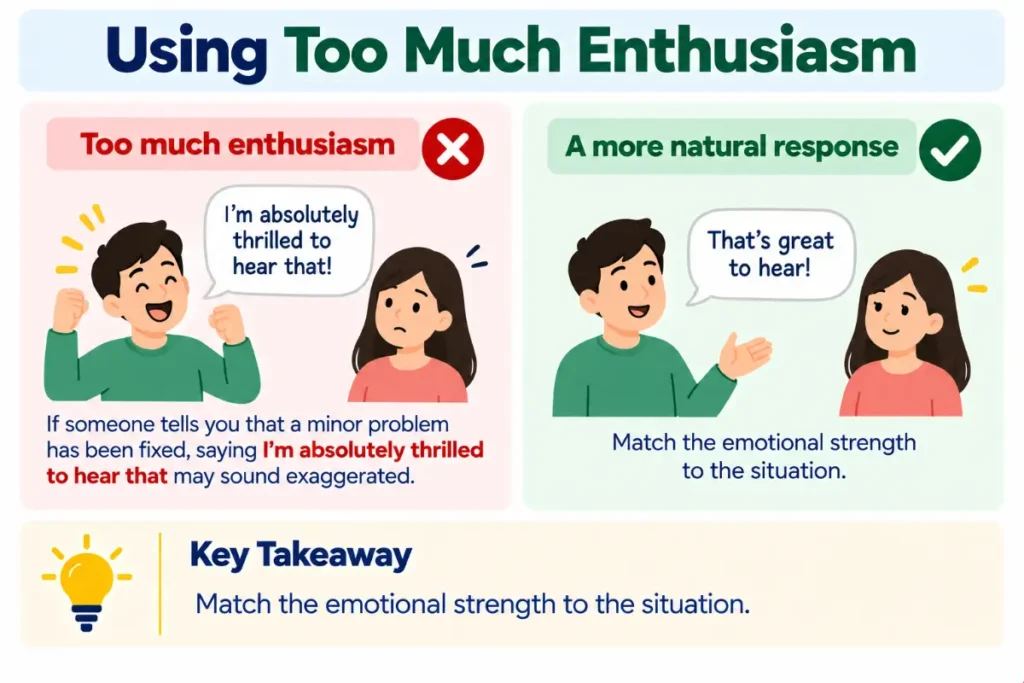
Using Too Much Enthusiasm
If someone tells you that a minor problem has been fixed, saying I’m absolutely thrilled to hear that may sound exaggerated.
Match the emotional strength to the situation.
Using A Formal Phrase With Close Friends
I am pleased to receive this information sounds stiff in a casual conversation with a close friend.
A simple That’s great to hear would sound more natural.
Repeating The Same Phrase
Using the same response every time can make your messages feel automatic.
Instead, keep a small group of natural alternatives and choose one based on the situation.
Confusing Relief With Excitement
If someone tells you that a serious problem is finally under control, That’s a relief may fit better than That’s fantastic.
The distinction matters because emotions carry meaning.
Adding Unnecessary Words
Sometimes people turn a short response into a long sentence.
I am very happy and extremely pleased to hear that the situation has now become better.
That sounds unnatural. A native speaker would usually say I’m really glad things worked out.
Common Situations And The Best Style
The same basic message can sound very different depending on the situation.
A Friend Got A New Job
That’s amazing. I’m so happy for you.
This feels personal and enthusiastic.
A Coworker Finished A Difficult Project
That’s great to hear. Nice work.
This is friendly without becoming too personal.
A Client Says An Issue Was Resolved
I’m pleased to hear that. Thank you for the update.
This sounds professional and polite.
A Family Member Shares Good News
That’s wonderful news. I’m really happy for you.
The response shows emotional closeness.
Someone Says Their Test Results Were Normal
That’s such a relief. I’m glad everything is okay.
This response matches the emotional context.
Real Life Usage Examples
Daily Conversation
I finally found my wallet.
That’s great to hear. I know you were looking everywhere.
My sister got accepted into college.
That’s wonderful news. She must be so excited.
Workplace Communication
The client approved the revised proposal.
That’s excellent news. We can move ahead with the next step.
The technical issue has been fixed.
I’m pleased to hear that. Thanks for keeping me updated.
Academic Communication
The professor approved my research topic.
That’s great to hear. Your idea sounded strong from the beginning.
I received a higher grade than I expected.
I’m happy to hear that. Your hard work paid off.
News And Journalism
The local team announced that the project will continue after receiving additional funding.
That’s encouraging news for everyone involved.
Officials confirmed that the missing equipment had been recovered.
That’s reassuring to hear after several days of uncertainty.
Storytelling
When she finally heard that her family was safe, she let out a long breath.
It was the news he had been waiting for, and he was relieved to hear it at last.
These examples show why context matters. The most natural expression isn’t always the most enthusiastic one.
Related Expressions And Synonyms
Several expressions can communicate a similar idea, but each carries a slightly different shade of meaning.
- I’m happy to hear that. This directly expresses happiness.
- That’s good news. This is simple and neutral.
- That’s great news. This adds more enthusiasm.
- That’s wonderful news. This expresses stronger positive emotion.
- I’m pleased to hear that. This sounds polished and professional.
- That’s reassuring. This emphasizes relief and reduced concern.
- I’m so happy for you. This focuses on the other person rather than the information.
- That’s fantastic. This is energetic and informal.
These expressions are related but not identical. Think of them as different colors on the same emotional palette. Your job is to choose the shade that fits the moment.
American And British English
American and British English both use this expression naturally. There is no major regional difference that changes the basic meaning.
American speakers commonly use That’s great to hear and I’m happy to hear that in everyday conversations and workplace communication. British speakers also use these forms naturally.
The differences you may notice are more likely to involve personal style, formality, or conversational habits than grammar.
Canadian and Australian English also use the same general patterns. Speakers across these varieties can understand the expressions without difficulty.
So you don’t need a different phrase simply because your audience comes from another major English speaking region. Focus on the situation and relationship instead.
How To Choose The Right Alternative
When you’re unsure which expression to use, think about three things.
- How close are you to the person?
A close friend may appreciate I’m so happy for you. A client may prefer I’m pleased to hear that.
- How important is the news?
For major news, That’s wonderful news or That’s fantastic can work well. For a small positive update, That’s good to hear may be enough.
- What emotion do you actually want to show?
If you feel excited, use an enthusiastic expression. If you feel relieved, use That’s a relief or I’m relieved to hear that.
This approach helps your response sound genuine instead of selected from a memorized list.
Expert Editor Insight
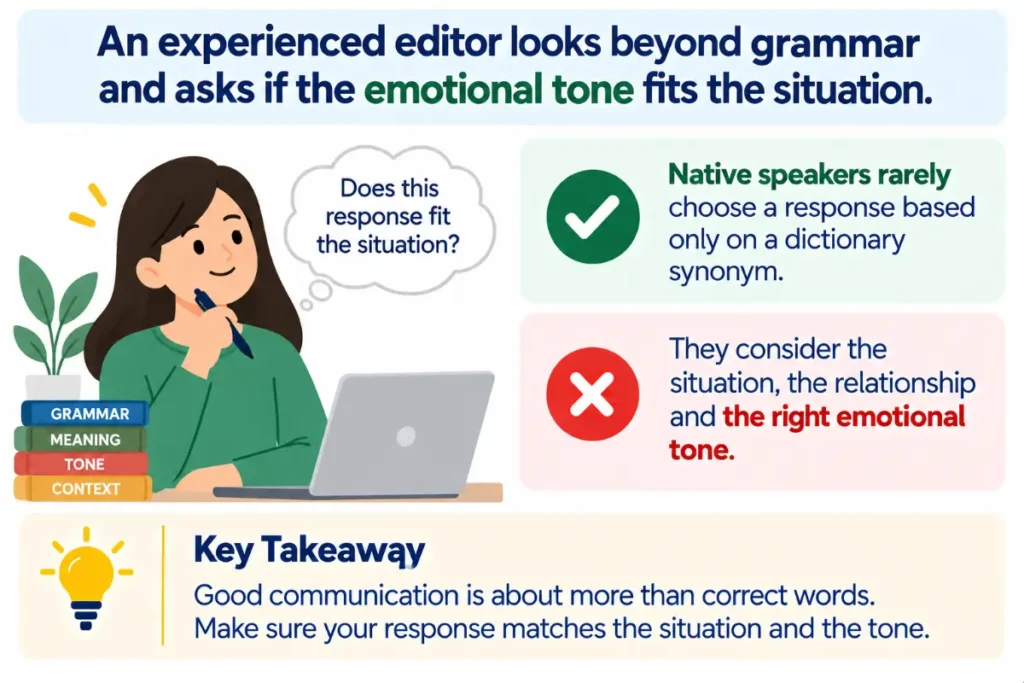
An experienced editor looks beyond grammar and asks if the emotional tone fits the situation. Native speakers rarely choose a response based only on a dictionary synonym. They consider the relationship, the seriousness of the news, and the feeling they want to communicate. That’s why That’s great to hear can sound perfect in one situation but too casual or too enthusiastic in another. A useful editing trick is to read your response aloud before sending it. If you wouldn’t naturally say it to the person standing in front of you, simplify it.
A related grammar guide is email closings instead of sincerely: Better Options.
Conclusion
Glad to hear that alternatives give you more ways to respond naturally when someone shares positive news. The best option depends on the situation and the emotion you want to express. That’s great to hear works well for everyday conversation, while I’m pleased to hear that fits professional settings. I’m so happy for you adds a personal touch, and I’m relieved to hear that works better when the main feeling is relief.
You don’t need a long or complicated response to sound natural. A short phrase can show warmth, support, excitement, or reassurance when you choose it carefully. Think about the person, the news, and the tone before you reply.
The easiest editing tip is to say your response aloud before sending it. If it sounds like something you’d genuinely say in person, you’re probably on the right track. Keep a few expressions ready, but let the situation guide your final choice.
FAQs
What are the most natural alternatives to glad to hear that?
Some of the most natural choices are That’s great to hear, That’s good to hear, I’m happy to hear that, That’s wonderful news, and I’m pleased to hear that. Choose based on tone. Great sounds friendly, pleased sounds more formal, and wonderful news shows stronger enthusiasm. For supportive situations, That’s reassuring or I’m relieved to hear that may fit better.
Is glad to hear that grammatically correct?
Yes. I’m glad to hear that is a standard and natural English construction. Glad is an adjective describing the speaker’s feeling, while to hear that explains the reason for the feeling. The phrase works in casual conversation, workplace communication, emails, and many other situations. You can also use related structures such as I’m glad you told me.
Is That’s great to hear more casual than I’m pleased to hear that?
Yes. That’s great to hear generally sounds friendlier and more conversational, while I’m pleased to hear that sounds more polished and formal. Neither expression is grammatically better. The choice depends on the relationship and setting. Use the friendlier form for everyday communication and the more formal form for professional situations where a measured tone fits.
Can I use glad to hear that in a professional email?
Yes. The phrase works well in many professional emails, especially when you have a friendly relationship with the recipient. For example, I’m glad to hear that the issue has been resolved sounds natural. In a more formal message, I’m pleased to hear that may sound more appropriate. Both are correct, so tone should guide your choice.
What can I say instead of glad to hear that in a text?
For a text message, you can keep your response short and natural. Try That’s great, That’s awesome, Amazing news, So happy for you, That’s wonderful, or I’m really happy to hear that. Your relationship with the person matters more than strict formality. A close friend will usually respond well to a relaxed expression.
What is the difference between That’s good to hear and That’s great to hear?
Both expressions show a positive reaction, but great usually sounds more enthusiastic than good. That’s good to hear can work for calm or routine updates, while That’s great to hear adds more warmth and excitement. For example, a small improvement may call for That’s good to hear, while a major success may naturally invite That’s great to hear.
What should I say when someone shares serious good news?
Choose an expression that matches the emotional weight of the news. For major personal achievements, I’m so happy for you works well. If the news removes worry, I’m relieved to hear that or That’s reassuring may be better. If the news is exciting, That’s wonderful news or That’s fantastic news can communicate stronger enthusiasm.
Is I’m pleased to hear that too formal for everyday English?
It can sound more formal than ordinary conversation, but it isn’t unnatural or incorrect. Friends can use it, although they may choose warmer expressions such as That’s great to hear or I’m happy to hear that. In professional conversations, I’m pleased to hear that often fits comfortably because it sounds positive while keeping the tone measured and respectful.