
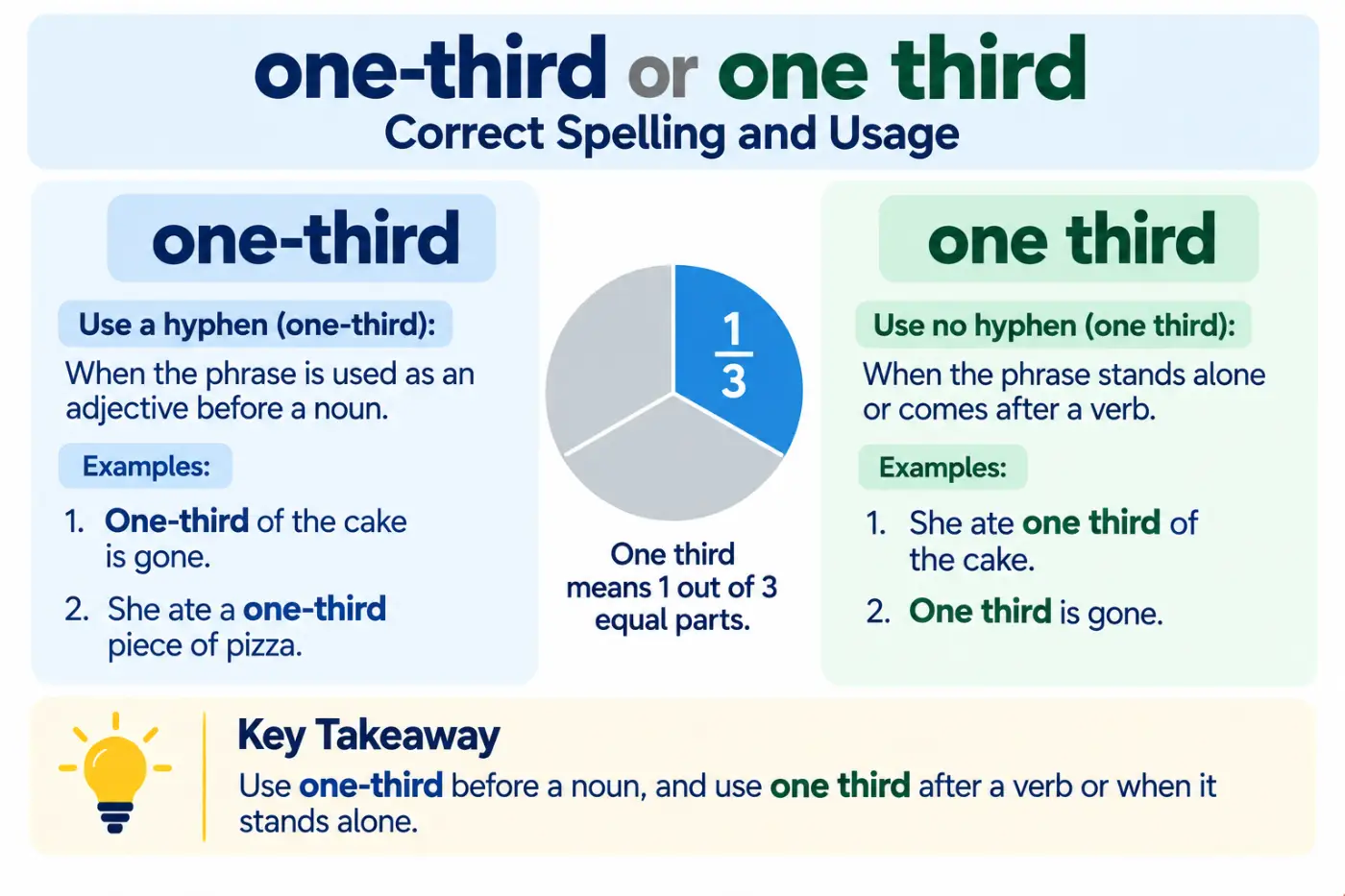
Many writers hesitate when they see one-third or one third in a sentence and aren’t sure which form to use. The basic rule is simple. The fraction is usually written as two separate words when it stands alone or appears in a phrase such as one third of the class. A hyphen can be useful when the fraction works as part of a compound modifier before a noun.
The confusion often comes from seeing fractions written in different forms. English uses hyphens in some compound expressions but not in every fraction. So the correct form depends on how the fraction functions in the sentence. The meaning stays the same, but the punctuation can change based on its grammatical role.
In this guide, you’ll learn how to write this fraction naturally in American English. You’ll see when to use separate words, when a hyphen can help, how to use fractions with numbers, and how to handle them in formal writing. You’ll also find practical examples that make the rule easy to remember.
Need another quick comparison? Read Excited or Exited Correct Spelling Meaning and Usage.
Quick Answer
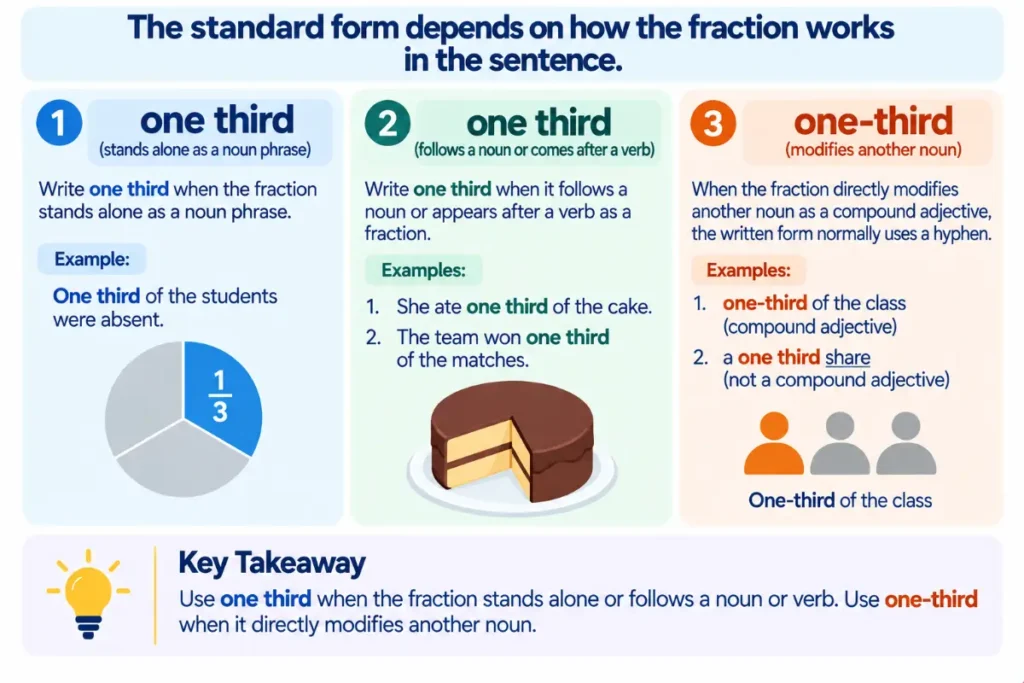
The standard form depends on how the fraction works in the sentence. Write one third when the fraction stands alone as a noun phrase. Write one third when it follows a noun or appears after a verb as a fraction. When the fraction directly modifies another noun as a compound adjective, the written form normally uses a hyphen: one third of the class but a one third share.
Featured Snippet Definition
One third means one part out of three equal parts. In ordinary prose, the fraction is usually written as separate words when it stands alone or follows a noun. A hyphen can appear when the fraction works as a compound modifier directly before another noun, such as a one third share.
Meaning and Definition
The fraction represents one part of something divided into three equal parts. In mathematical notation, it is written as 1/3. In words, the numerator one identifies the number of parts being considered, while the denominator third tells us that the whole has been divided into three equal sections.
For example, if a pizza is divided into three equal pieces and you eat one piece, you have eaten one third of the pizza.
The same idea applies to time, money, distance, quantities, groups, and measurements.
You can say that one third of the students passed the test. You can also say that one third of the cake remains. In both cases, the phrase represents one out of three equal portions.
The expression is also common in more abstract contexts.
One third of the budget was spent on equipment.
One third of the population supported the proposal.
The meaning remains mathematical even when the subject is not something that can be physically divided.
The Basic Spelling Rule
In normal prose, the words in a simple fraction are usually written separately.
Examples include:
- one third
- two thirds
- one half
- three quarters
- one fifth
- two fifths
The denominator changes form depending on the number above it. With one part, we normally use the singular form third. With two or more parts, we use thirds.
Compare these sentences.
One third of the students were absent.
Two thirds of the students were absent.
The basic fraction remains easy to recognize because the numerator tells you how many parts you have and the denominator tells you the size of each part.
The most important point is that the fraction itself does not automatically need a hyphen.
When a Hyphen Is Needed
A hyphen can be used when a fraction acts as a compound adjective before a noun. In that position, the words work together to describe the noun that follows.
Consider this example.
She owns a one third share of the company.
Here one third works together as a modifier for share. The hyphen helps readers see that the fraction belongs together as one descriptive unit.
You may also encounter examples such as:
- A one third portion remained.
- He received a one third interest in the property.
- The recipe requires a one third cup of sugar.
However, style guides can differ in how they handle fractions used before nouns. Some editors prefer a hyphenated compound when the fraction clearly functions as a unit modifier. Others use the fraction without a hyphen in certain constructions because the meaning remains clear.
For most everyday writing, the safest approach is to focus on the grammatical structure rather than memorizing one punctuation rule for every possible sentence.
When the fraction follows the noun it describes or follows the verb as a normal noun phrase, you generally do not need a hyphen.
The company sold one third of its shares.
The bottle is one third full.
She completed one third of the assignment.
Comparison Table
| Form | Function | Meaning | Grammar Role | Typical Context | Example |
|---|---|---|---|---|---|
| one third | Fraction written in words | One part out of three | Noun phrase or complement | General writing | One third of the class was absent. |
| 1/3 | Numerical fraction | One part out of three | Mathematical notation | Math and measurements | The recipe needs 1/3 cup of milk. |
| one third | Fraction after a noun or verb | One part out of three | Noun phrase or complement | Everyday and formal writing | The tank is one third full. |
| one third share | Fraction modifying a noun | A share equal to one part of three | Compound modifier | Business and property writing | He owns a one third share. |
| one third of | Fraction followed by an of phrase | One part from a larger whole | Determiner phrase | Academic and general writing | One third of the group agreed. |
How Fractions Work in English
Fractions have their own grammatical pattern in English. The top number is the numerator. The bottom number is the denominator.
In 1/3, one is the numerator and three is the denominator. When we write the fraction in words, three changes to third because third identifies one of three equal portions.
With a numerator greater than one, the denominator normally becomes plural.
One third.
Two thirds.
Three thirds.
The same pattern applies to many other fractions.
One fourth.
Two fourths.
One fifth.
Three fifths.
One sixth.
Five sixths.
This pattern matters because some learners incorrectly write two third when they mean two thirds. The denominator needs a plural form when the numerator is greater than one.
Subject Verb Agreement With Fractions
Fractions can create questions about singular and plural verbs. The answer usually depends on the noun that follows the fraction.
Consider this sentence.
One third of the cake is gone.
Cake is singular and uncountable in this context, so is works naturally.
Now compare:
One third of the students are absent.
Students is plural, so are is appropriate.
The fraction itself doesn’t automatically determine the verb. The noun after of usually controls agreement.
Here are more examples.
One third of the water is missing.
One third of the employees are working remotely.
Two thirds of the money was spent.
Two thirds of the houses were damaged.
This rule becomes especially useful in academic and professional writing because incorrect agreement can make an otherwise clear sentence sound awkward.
Fractions With Countable Nouns
When you use a fraction with a countable plural noun, the noun normally appears in the plural form.
One third of the students.
One third of the workers.
You wouldn’t normally write one third of the student when you mean one part of a larger group of students.
The same structure works with numbers.
One third of the participants completed the survey.
One third of the applicants reached the final stage.
These examples show how naturally fractions fit into ordinary English.
Fractions With Uncountable Nouns
Fractions can also describe uncountable nouns. In these cases, the noun remains singular.
One third of the water.
One third of the equipment.
For example:
One third of the water was used.
One third of the money has already been spent.
This distinction is useful because it connects fraction grammar with the larger English rule for countable and uncountable nouns.
Numbers and Written Fractions
In mathematical work, recipes, measurements, statistics, and technical material, numerical notation is often more efficient.
You might write:
1/3 cup of flour.
1/3 of the total.
In ordinary prose, spelling out simple fractions can make the sentence easier to read.
One third of the class attended the meeting.
Academic and professional style can vary. If you’re following a specific style guide, use its rules for numbers and fractions consistently.
The key is consistency. Switching randomly between written fractions and numerical fractions can make a document look poorly edited.
Sentence Examples
Here are natural examples showing how the expression works in different settings.
- One third of the students arrived early.
- I ate one third of the sandwich.
- The project is one third complete.
- She spent one third of her savings on the car.
- About one third of the team works from home.
- The recipe calls for one third cup of milk.
- One third of the seats were already occupied.
- He donated one third of his earnings to the organization.
- The tank is one third full.
- One third of the road needs repairs.
These examples show that the phrase can work in everyday conversation, formal writing, measurements, and descriptions of progress.
Common Mistakes
Several errors appear repeatedly when people write fractions.
- Writing one-third everywhere.
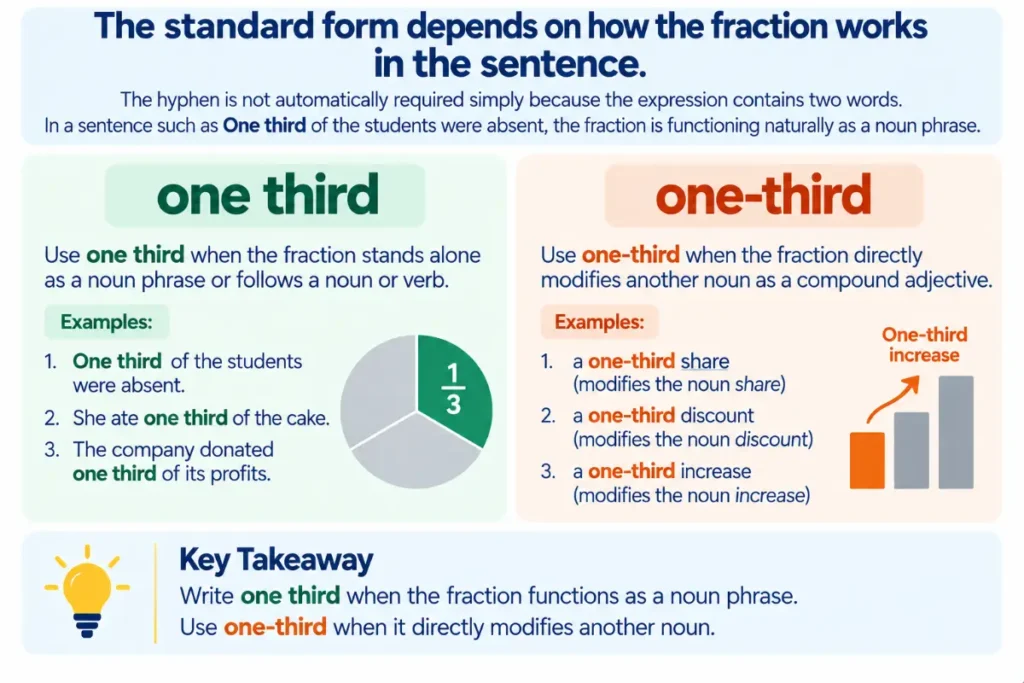
The hyphen is not automatically required simply because the expression contains two words. In a sentence such as One third of the students were absent, the fraction is functioning naturally as a noun phrase.
- Writing onethird.
This is incorrect. The words should remain separate when the fraction stands alone.
- Writing one thirds.
The denominator is singular after one. The correct form is one third.
- Writing two third.
When the numerator is greater than one, the denominator normally becomes plural. The correct form is two thirds.
- Using the wrong verb.
Writers sometimes focus on the fraction and forget about the noun after of. In One third of the students are absent, students is plural, so are is the natural choice.
Why Writers Get Confused
The confusion often comes from the difference between spelling and grammatical function. People may learn that compound adjectives often use hyphens and then apply that rule to every occurrence of a fraction.
That approach is too broad.
English punctuation depends heavily on sentence structure. A word group can be written differently when it performs a different grammatical job.
Compare these sentences.
One third of the class passed.
She owns a one third share.
The first sentence uses the fraction as part of a noun phrase. The second uses it to describe the noun share.
This distinction explains why you may see both forms in edited English.
Another source of confusion is the difference between written language and mathematical notation. A student may see 1/3 in math class and then wonder how to convert it into words in an essay. The answer is usually straightforward: write one third when the fraction stands alone in ordinary prose.
Pronunciation Guide
The phrase is pronounced naturally as:
one third
The word one sounds like the number one. The word third begins with the voiced th sound found in words such as this and the.
The IPA pronunciation is commonly represented as:
/wʌn θɝːd/ in American English.
The main pronunciation challenge is third. The th sound requires the tongue to come lightly between or near the teeth while air passes through.
A common learner error is replacing the th sound with a simple t or d sound. That can produce a pronunciation that sounds like terd or tird.
You don’t need to exaggerate the sound. Say one and then move naturally into third.
Still confused? Compare Macaroon vs Macaron: Meaning and Culinary Differences 2026.
Etymology and Word Origin
The word third comes from an old Germanic word family connected with the idea of being the third item in an order. Its modern form developed through the history of Old English and Middle English.
The word one also has very old Germanic roots. The modern English form developed from earlier forms that referred to a single unit.
The phrase combines these two ideas. One identifies a single part while third describes the division into three equal parts.
The mathematical concept is ancient but the English expression follows the ordinary development of English number words and ordinal forms.
The distinction between cardinal numbers and ordinal numbers helps explain the grammar. One is a cardinal number because it counts quantity. Third is an ordinal form because it identifies position or division into three parts.
American English
American English normally writes simple fractions in words when they appear in ordinary prose.
For example:
One third of the class was absent.
The same fraction can appear as 1/3 in mathematical or measurement contexts.
American style also uses hyphens in compound modifiers when they help connect words that work together before a noun. However, writers shouldn’t add hyphens mechanically to every fraction.
Context determines the punctuation.
British English
British English follows essentially the same basic fraction rules. The spelling and mathematical meaning do not change simply because the writing is British.
You can write:
One third of the population.
You may also see compound modifiers involving fractions. The broader British punctuation system can differ slightly by publisher or style guide, but the basic grammatical principle remains the same.
Australian English
Australian English also uses the same standard fraction structure. Simple fractions are commonly written as separate words in ordinary prose.
The main difference you may encounter comes from the preferred style guide or publication rather than from the fraction itself.
For school, work, and general communication, clear sentence structure matters more than trying to force a regional punctuation difference.
Canadian English
Canadian English generally follows the same pattern. Writers use written fractions in ordinary prose and numerical fractions in mathematical or measurement contexts.
A Canadian document can therefore use:
One third of the population.
And:
1/3 cup of water.
The choice depends on context and the style requirements of the document.
Grammar Rules and Part of Speech
A fraction such as one third functions as a noun phrase when it identifies a portion of a whole.
For example:
One third is missing.
Here the phrase stands alone as the subject.
It can also appear with of.
One third of the cake is missing.
In this sentence, the fraction identifies the quantity while of the cake identifies the whole.
The expression can also work as a subject complement.
The amount remaining is one third.
It can describe a state.
The bottle is one third full.
In that sentence, one third describes the degree to which the bottle is full.
Fractions also work naturally with measurements.
The board is one third of an inch thick.
The journey is one third complete.
The main grammar lesson is simple. Look at what the fraction is doing in the sentence before deciding how to punctuate it.
Punctuation and Hyphenation
Hyphenation is one of the most confusing parts of fraction writing because different contexts call for different treatment.
When the fraction is part of an ordinary noun phrase, separate words are generally appropriate.
One third of the money was missing.
When the expression directly modifies a noun, a hyphen can clarify that the entire phrase functions as a unit.
A one third share was transferred.
The hyphen links the words that work together before share.
However, not every publication follows exactly the same house style. If you’re writing for a school, company, newspaper, or academic journal, follow its stated style guide.
If no specific style guide applies, choose the form that makes the grammatical relationship easiest to understand.
Real Life Usage Examples
Daily Conversation
You’ll hear fractions in ordinary conversation when people discuss food, time, money, distance, or progress.
I only ate one third of the pizza.
We’re about one third of the way there.
These sentences sound natural because the fraction describes a portion of a larger whole.
Email and Workplace Communication
Fractions can appear in workplace updates and practical messages.
One third of the requested documents have been reviewed.
The project is now one third complete.
In professional writing, clarity matters more than complicated wording. A simple fraction can communicate progress quickly.
Academic Writing
Academic writing uses fractions when discussing proportions and measured results.
One third of the participants reported similar results.
Approximately one third of the sample belonged to this group.
In formal academic work, numerical data may be preferred depending on the style guide. Follow the requirements of the publication or institution.
News Writing
News reports often use fractions to describe proportions.
One third of the affected homes lost power.
Officials said one third of the funding had already been allocated.
News writing favors clear language because readers need to understand the information quickly.
Literature and Storytelling
Writers can use fractions in stories when describing physical quantities or symbolic proportions.
He had eaten only one third of the meal.
She spent one third of her life in that small town.
In literary writing, the fraction can be purely practical or part of a larger description.
Related and Confused Terms
Several expressions are closely connected with fractions and proportions.
- One half. This represents one part out of two equal parts.
- One quarter. This represents one part out of four equal parts.
- Two thirds. This represents two parts out of three equal parts.
- A third. This is a shorter form that often works naturally in everyday English.
- One third of. This structure identifies one part of a larger whole.
- One out of three. This expresses the same basic proportion in a more conversational form.
- 33 percent. This expresses a similar proportion using percentage notation, although one third is mathematically equal to approximately 33.333 percent rather than exactly 33 percent.
- A proportion. This is a broader mathematical and statistical term describing a part compared with a whole.
The phrase a third is especially common in conversation.
A third of the students left early.
This has the same basic meaning as one third of the students.
One Third Compared With A Third
One third and a third usually communicate the same fraction. The main difference is style and context.
A third often sounds more natural in casual conversation.
I ate a third of the cake.
One third can sound slightly more deliberate or precise.
One third of the participants chose option A.
Neither expression changes the underlying mathematical value.
The choice often depends on the sentence and the writer’s preferred style.
One Third Compared With 33 Percent
One third and 33 percent are close but not mathematically identical.
Thirty three percent is slightly less than one third.
In everyday communication, people may use 33 percent as a rounded approximation. In precise mathematical or scientific work, the distinction can matter.
For example, if a report needs exact proportional data, the writer should use the value that accurately represents the measurement rather than casually substituting a rounded percentage.
One Third in Formal Writing
The expression is perfectly acceptable in formal English. You can use it in essays, reports, professional documents, academic writing, and research discussions.
The main concern is consistency.
If you spell out simple fractions in one section, avoid switching randomly to numerical forms without a reason.
For example, this looks consistent:
One third of the participants completed the first task. Two thirds completed the second task.
In a technical report, numerical notation may be more suitable:
1/3 of the participants completed the first task.
The right choice depends on the document’s style requirements.
One Third in Recipes and Measurements
Recipes often use numerical fractions because they are quick to read.
You may see:
1/3 cup of sugar.
1/3 cup of milk.
When written in full, the same measurements become:
one third cup of sugar.
one third cup of milk.
In a recipe, clarity is the priority. Numerical notation is often easier to scan while cooking.
One Third in Academic and Scientific Contexts
Academic writing often treats fractions as data. Writers may choose numerical notation when precision and compact presentation matter.
For example:
The treatment group received 1/3 of the total allocation.
In ordinary explanatory prose, spelling the fraction out can make the sentence feel smoother.
One third of the participants completed the second test.
A style guide may give specific rules for numbers and fractions. If you’re submitting academic work, follow your instructor’s or publication’s requirements first.
Expert Editor Insight
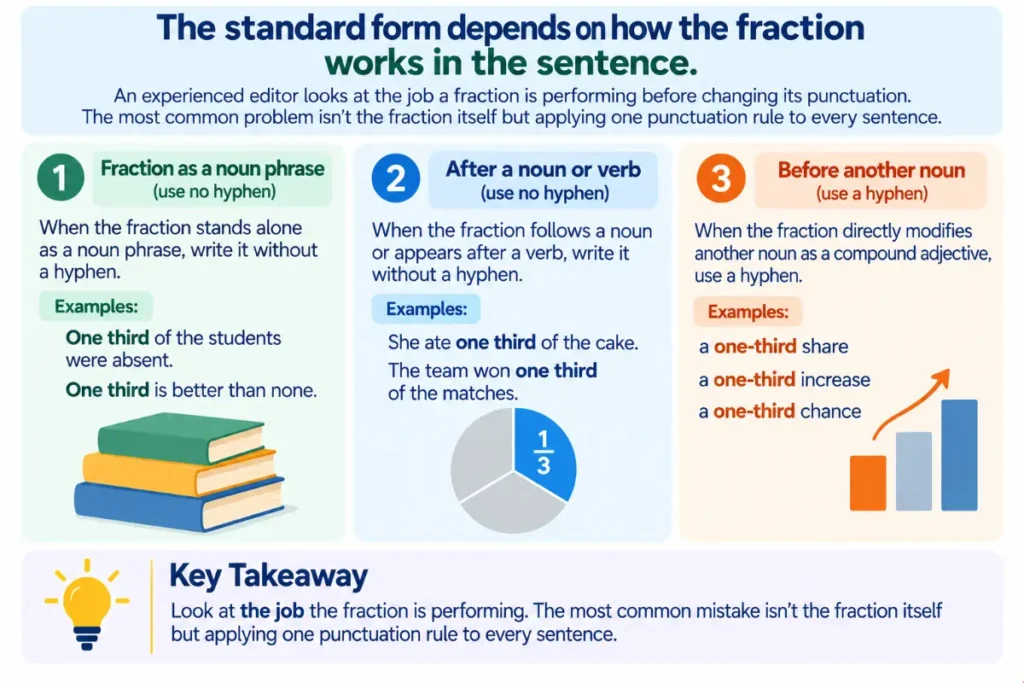
An experienced editor looks at the job a fraction is performing before changing its punctuation. The most common problem isn’t the fraction itself but applying one punctuation rule to every sentence. Editors also check subject verb agreement, consistency between written and numerical fractions, and unnecessary hyphenation. Spelling tools can catch obvious errors, but they can’t always judge the intended grammatical structure. That’s why reading the complete sentence remains one of the best editing checks.
Need another quick comparison? Read Leary or Leery Which Word Is Correct in 2026.
Conclusion
The phrase one third represents one part of three equal parts and is normally written as separate words when it functions as an ordinary fraction in a sentence. You can also use 1/3 in mathematical, measurement, recipe, and technical contexts. A hyphen can appear when the fraction works as part of a compound modifier before a noun.
The key is to pay attention to grammar rather than memorizing a single punctuation rule. One third of the students were absent uses the fraction as part of a noun phrase. A one third share uses it as a modifier before share. The structure tells you how to handle the expression.
A useful editing trick is to read the whole sentence before adding or removing a hyphen. Ask what job the fraction is doing. That small check will help you write fractions clearly and naturally in school, work, academic writing, and everyday English.
FAQs
Is one third written as one word?
No. In ordinary English, one third is normally written as two separate words when the fraction stands alone or appears in a phrase such as one third of the class. Do not combine the words into onethird. In numerical writing, you can use 1/3 instead. The correct choice depends on the context and the style requirements.
Should I write one third or 1/3?
Both forms are correct. Use one third in ordinary prose when spelling out a simple fraction makes the sentence easy to read. Use 1/3 in mathematics, recipes, measurements, tables, or technical contexts where numerical notation is more efficient. If a school or publication provides a style guide, follow its rules for numbers and fractions.
Does one third need a hyphen?
Not automatically. When the fraction works as a normal noun phrase, it is generally written as separate words. A hyphen can be useful when the fraction functions as part of a compound modifier before a noun, such as a one third share. Always consider the grammatical structure and the style guide being used.
What is the difference between one third and a third?
The two expressions normally have the same mathematical meaning. A third means one part of three equal parts. One third means the same thing. A third often sounds more natural in casual conversation, while one third can sound more deliberate in formal or explanatory writing. The choice is usually stylistic rather than a difference in mathematical value.
Is one third of the students singular or plural?
The noun after of usually determines the verb. In one third of the students are absent, students is plural, so are is correct. In one third of the water is gone, water is treated as uncountable and singular, so is is correct. The fraction itself doesn’t automatically decide the verb.
Is one third equal to 33 percent?
One third equals approximately 33.333 percent. So 33 percent is a rounded value and is slightly smaller than one third. In casual communication, people may treat them as roughly equivalent. In mathematics, science, finance, or other precise contexts, keep the distinction clear and use the exact value or an appropriate level of precision.
Can I use one third in formal writing?
Yes. The expression is standard and appropriate in formal English. It can appear in academic essays, reports, workplace documents, research writing, and professional communication. The main issue is consistency. If your school, employer, journal, or publication has a specific style guide for numbers and fractions, follow those rules throughout the document.
Why do people confuse fraction spelling and hyphenation?
The confusion comes from two different grammar patterns. A fraction can stand as a normal noun phrase, or it can work as part of a compound modifier before another noun. Writers sometimes apply the hyphen rule from the second pattern to every situation. Looking at the fraction’s position in the sentence usually makes the correct punctuation much easier to determine.