
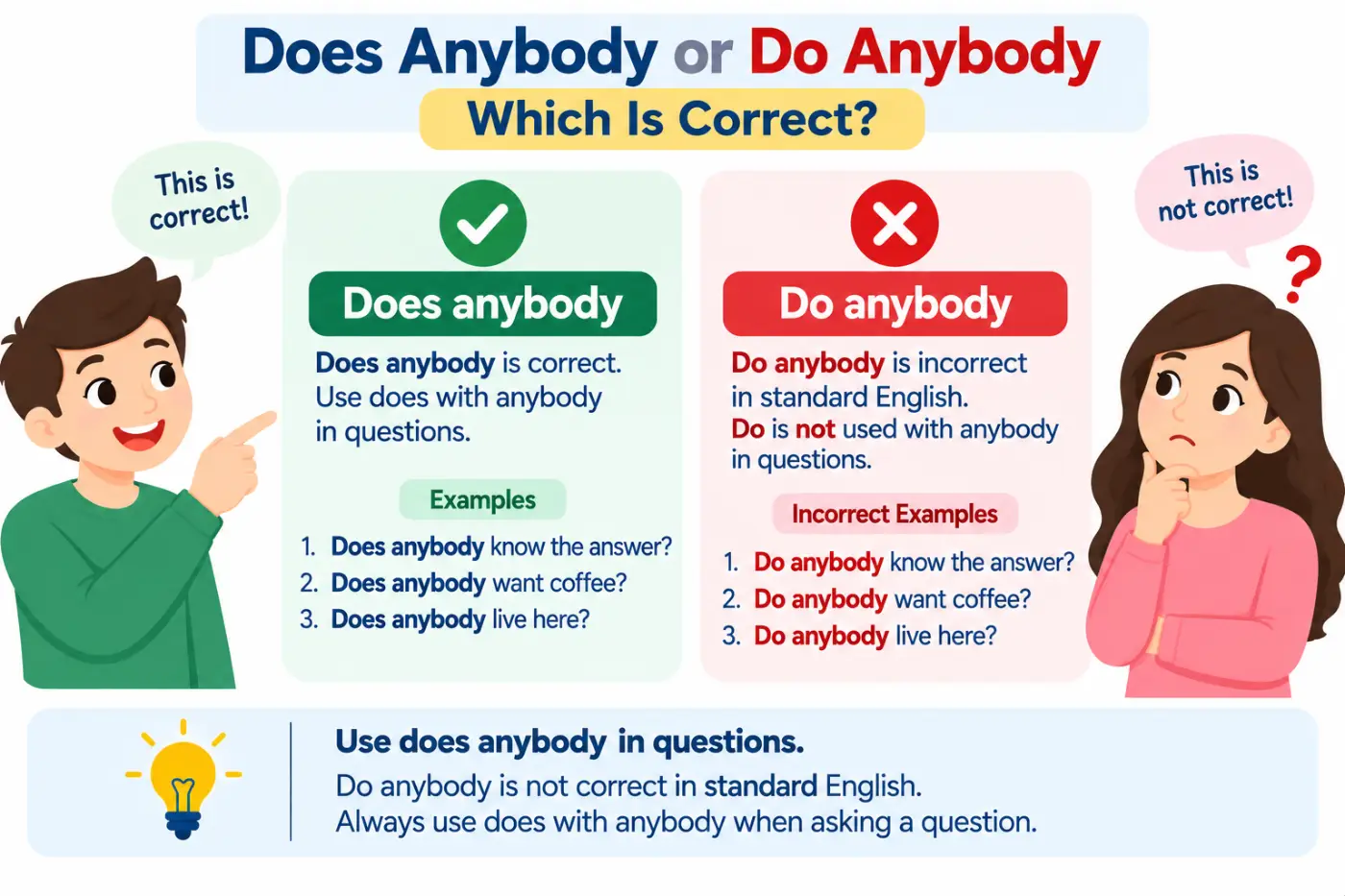
Does anybody or do anybody can cause confusion because anybody refers to people in a general sense. The correct form is does anybody. In standard English grammar anybody is treated as a singular indefinite pronoun so it takes does rather than do when it forms a question.
The confusion makes sense because anybody can refer to many possible people. You may think that a word connected with several people should take a plural verb. English grammar works differently here. The grammatical number of the pronoun matters more than the number of people it might describe. That same pattern appears with anyone someone and everyone.
Once you understand this rule you can use the expression naturally in questions such as Does anybody know the answer? You’ll also see how anybody works with has is and was along with common mistakes and examples from conversation school work emails and formal writing.
Many readers also check all-time vs all time Meaning and Correct Usage.
Quick Definition
Does anybody is the standard grammatical form because anybody is a singular indefinite pronoun. Use does with anybody when forming a present tense question. For example Does anybody know where my phone is? Do anybody is incorrect in standard English because do does not agree with the singular pronoun anybody.
Quick Answer
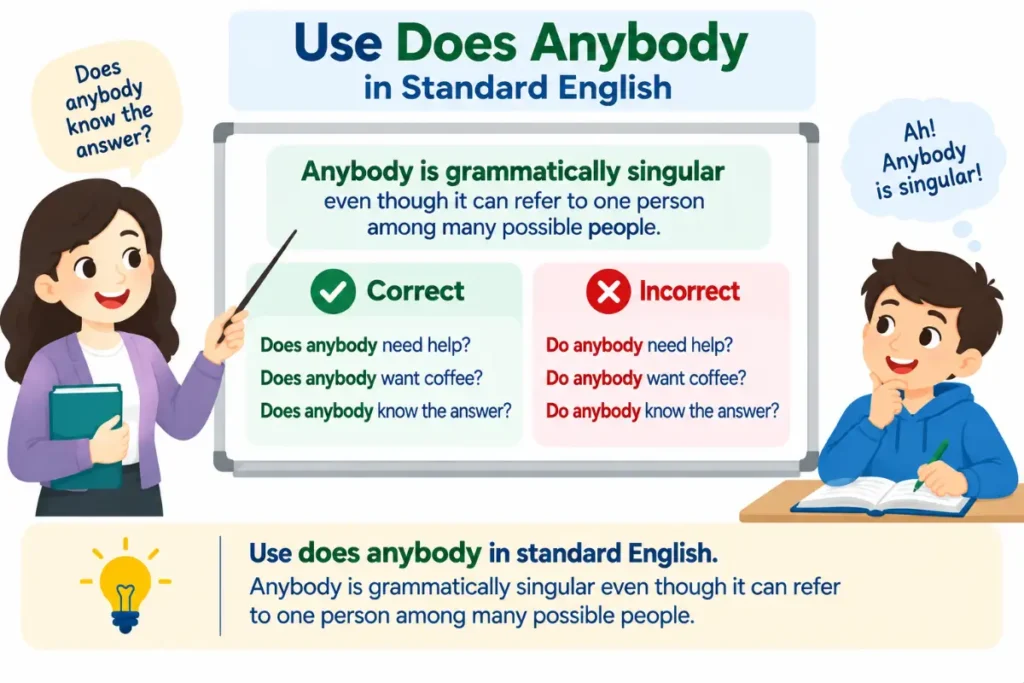
The correct form is does anybody. The pronoun anybody is grammatically singular even though it can refer to any person within a group. Therefore it takes the singular auxiliary verb does in present tense questions.
For example say Does anybody want coffee? Do not say Do anybody want coffee? The same rule applies to anyone someone everyone and no one.
Comparison Table
| Form | Grammatical Status | Meaning | Verb Agreement | Common Context | Formality | Example | Standard Usage |
|---|---|---|---|---|---|---|---|
| Does anybody | Correct | Is there any person who | Singular auxiliary does | Questions and conversation | Neutral | Does anybody know the answer? | Standard |
| Do anybody | Incorrect in standard English | Intended to mean is there any person who | Plural do does not agree with anybody | Usually a grammar mistake | Nonstandard | Do anybody know the answer? | Avoid |
Meaning and Definition
Meaning of Anybody
Anybody is an indefinite pronoun. It refers to any person without identifying a particular individual.
For example:
Anybody can learn this skill.
Here anybody means any person at all. The statement does not identify one specific person. It makes a general statement about people.
Anybody can also appear in questions.
Does anybody have a pen?
In this sentence the speaker wants to know if there is at least one person with a pen. Even though the possible answer could involve several people the grammar still treats anybody as singular.
This distinction between meaning and grammatical number causes much of the confusion. The word can refer to a large group of possible people while still requiring a singular verb.
Meaning of Does
Does is the third person singular present form of do. It works as an auxiliary verb in questions and negative statements with singular subjects such as he she it someone anyone and anybody.
For example:
Does she understand?
Does anybody live here?
The auxiliary does carries the present tense and supports the main verb. After does the main verb stays in its base form.
Correct:
Does anybody know the answer?
Incorrect:
Does anybody knows the answer?
The first sentence uses does plus the base verb know. The second incorrectly adds s to the main verb.
Meaning of Do
Do is the present tense form used with I you we and they. It also appears with plural nouns.
Examples include:
Do you understand?
Do can also function as a main verb.
I do my homework every evening.
However the key issue in this comparison is its use as an auxiliary verb. With anybody the standard form is does.
Key Differences Explained
- Subject agreement. Anybody is grammatically singular. That is why it pairs with does.
- Verb form. Does belongs with third person singular subjects. Do belongs with I you we they and plural subjects.
- Meaning. Both forms may be intended to ask about any person. Only the first follows standard subject verb agreement.
- Question structure. After does use the base form of the main verb. Say Does anybody know? not Does anybody knows?
- Formality. Does anybody is appropriate in casual conversation academic writing workplace communication and formal writing.
- Pronunciation. The difference is easy to hear in careful speech. Does usually sounds like duhz while do usually sounds like doo.
- Related pronouns. The same singular pattern applies to anyone someone everyone and no one.
- Regional usage. Standard American British Canadian and Australian English all treat anybody as singular for this purpose.
The central rule is simple. Focus on the grammatical form of anybody rather than the number of people who might be included in its meaning.
Why Anybody Takes a Singular Verb
Indefinite pronouns can behave differently from ordinary nouns. Anybody belongs to a group of indefinite pronouns that grammar treats as singular.
Consider the difference between these sentences:
Does anybody want to leave?
Do the students want to leave?
The first subject is anybody. The second subject is students. Students is clearly plural so it takes do. Anybody is grammatically singular so it takes does.
This pattern may feel strange at first because anybody can refer to several people. Imagine a teacher asking a classroom Does anybody have a question? Several students could raise their hands. Still the question uses does because the subject is anybody.
The same idea appears in a statement such as Anybody is welcome.
The speaker may mean every person in the possible group. Yet anybody remains singular in grammatical structure.
This is a useful lesson in English grammar. Meaning and grammatical number do not always line up perfectly.
Which Form Is Correct?
Does anybody is the correct form in standard English. Do anybody does not follow normal subject verb agreement because anybody is a singular indefinite pronoun.
The grammar becomes clearer when you replace anybody with a familiar singular pronoun.
Does he know?
Does anybody know?
All three sentences use does.
Now compare the plural structure:
Do they know?
Do the students know?
The verb changes because the subject changes.
Traditional grammar descriptions and standard English usage treat indefinite pronouns such as anybody as singular. Modern grammar also recognizes that pronoun systems can interact with meaning in complex ways. However that broader discussion does not change the standard pattern in a sentence such as Does anybody know?
Sentence Examples
Here are natural examples showing how the correct structure works in everyday English.
- Does anybody know where the meeting is?
- Does anybody want another slice of pizza?
- Does anybody have a charger I can borrow?
- Does anybody remember what time the movie starts?
- Does anybody live in that old house?
- Does anybody need help with the assignment?
- Does anybody know how to fix this printer?
- Does anybody have an answer to this question?
- Does anybody want to join us for dinner?
- Does anybody understand what the teacher explained?
These examples show that the main verb remains in its base form after does.
Notice the difference between these two sentences:
Does anybody know the answer?
Does anybody knows the answer?
The first is correct. The second is incorrect because does already carries the third person singular verb marking. The main verb does not need another s ending.
Common Mistakes
Several errors tend to appear around this grammar pattern.
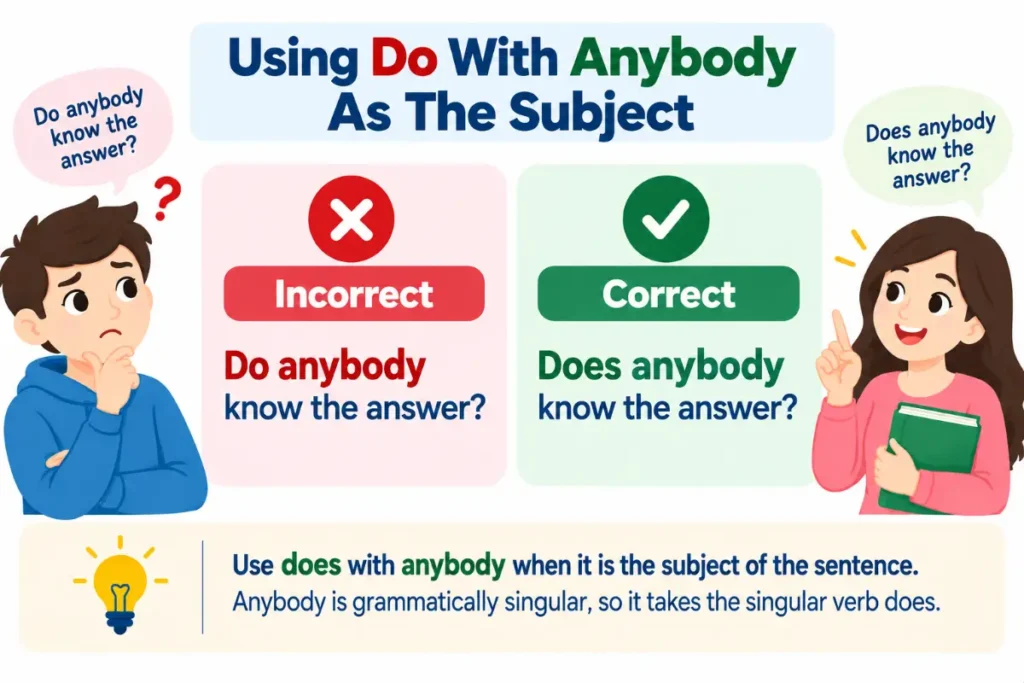
- Do anybody know the answer?
The correct version is Does anybody know the answer? The mistake happens because people may focus on the possible number of people instead of the grammatical number of the pronoun.
- Does anybody knows the answer?
The correct version is Does anybody know the answer? After the auxiliary does the main verb stays in its base form.
- Does anybody have any questions?
This sentence is correct. Some writers mistakenly change have to has because anybody is singular. The auxiliary does already handles the agreement so the main verb remains have.
- Does anybody wants coffee?
The correct version is Does anybody want coffee? The same base verb rule applies.
- Do anybody has a suggestion?
The correct version is Does anybody have a suggestion? Two separate agreement problems appear in the incorrect version.
These mistakes often come from a mental pattern that tries to make every word in the sentence carry the same grammatical marking. English auxiliary verbs prevent that from happening. Once does appears the following main verb returns to its base form.
Pronunciation Guide
The phrase does anybody is usually spoken naturally as a connected phrase rather than as three separate words.
In American English does commonly sounds like duhz. Anybody is usually pronounced /ˈɛniˌbɑdi/ with primary stress near the beginning.
A simple pronunciation guide is:
Duhz en ee bah dee.
The exact vowel quality can vary among speakers and regional accents. The important point is that does and do sound different in ordinary speech.
Do usually has the sound /duː/.
Does commonly has the sound /dʌz/.
This difference can help learners notice the grammatical choice when listening to native speakers.
One common pronunciation mistake is to pronounce does as if it rhymed with goes. It does not. The vowel sound is different.
Grammar Rules and Part of Speech
Anybody is an indefinite pronoun. It does not identify a particular person.
Does is an auxiliary verb when it helps form a question.
The basic structure is:
Does + anybody + base verb?
Examples include:
Does anybody know?
Does anybody understand?
The main verb always stays in its base form after does.
This rule applies to many verbs.
Correct:
Does anybody like music?
Correct:
Does anybody speak Spanish?
Correct:
Does anybody remember me?
Incorrect:
Does anybody likes music?
Incorrect:
Does anybody speaks Spanish?
Incorrect:
Does anybody remembers me?
The reason is straightforward. The third person singular marking has already moved onto does. Adding another s ending to the main verb creates an agreement error.
Negative Questions and Statements
Anybody also appears in negative structures.
Doesn’t anybody know the answer?
Doesn’t anybody want to help?
Here doesn’t is the contracted form of does not. It still takes the base form of the main verb.
You can also use anybody in negative statements.
I don’t know anybody here.
She doesn’t know anybody in the neighborhood.
The auxiliary changes according to the subject. In the second sentence she takes doesn’t. Anybody is the object of know rather than the subject.
This distinction matters because writers sometimes see anybody in a sentence and automatically choose does. Grammar depends on the word’s role in the sentence.
Anybody as a Subject
When anybody acts as the subject you normally use a singular verb.
Anybody can make a mistake.
Anybody has the right to ask a question.
In questions the same principle produces:
Does anybody know?
Does anybody remember?
Anybody as an Object
When anybody acts as an object the subject controls the auxiliary verb.
Do you know anybody here?
Does she know anybody here?
They don’t know anybody here.
In the first sentence you controls do. In the second she controls does. Anybody itself does not control the auxiliary because it is the object.
That distinction helps prevent overgeneralization.
Sentence Position and Punctuation
Does anybody normally begins a question because English questions with auxiliary verbs often place the auxiliary before the subject.
The pattern looks like this:
Does + subject + main verb?
For example:
Does anybody understand the instructions?
A question mark belongs at the end because the sentence asks a direct question.
If the phrase appears inside a larger sentence it can follow the punctuation required by the larger structure.
The word anybody itself does not require a comma.
Correct:
Does anybody know the answer?
Incorrect:
Does anybody, know the answer?
A comma between anybody and know would interrupt the normal subject and verb relationship.
Learn the difference in Retract vs Redact Meaning and Usage.
Real Life Usage Examples
Daily Conversation
Does anybody want some coffee?
Does anybody know where Sarah went?
These questions sound natural in ordinary American conversation. Speakers use them when addressing a group without naming a specific person.
Workplace Communication
Does anybody have the updated schedule?
Does anybody know when the client is arriving?
These sentences work well in meetings chats and workplace discussions. For a more formal email you may choose a more specific request when you know who should respond.
Academic Writing
Does anybody refer to one person or many people?
Does anybody have a role in shaping the final outcome?
The phrase is grammatically correct in academic writing but academic authors often prefer precise wording when the identity of the people matters.
News and Journalism
Does anybody know how the fire started?
Does anybody remember seeing the vehicle before the incident?
Journalistic writing may use this form when reporting questions raised by witnesses or members of the public.
Literature and Storytelling
Does anybody live beyond those mountains?
Does anybody know what happened that night?
In storytelling the expression can create a natural sense of uncertainty curiosity or urgency.
Related and Confused Terms
Several pronouns follow the same basic singular agreement pattern.
- Anyone. Anyone means any person. Use does when anyone is the subject of a present tense question. Does anyone know the answer?
- Someone. Someone refers to an unspecified person. Use does with someone when it acts as the subject. Does someone need help?
- Everyone. Everyone refers to all members of a group but remains grammatically singular. Does everyone understand?
- No one. No one means not a single person. It normally takes a singular verb. Does no one know the answer?
- Nobody. Nobody also refers to not one person. Nobody is singular in standard agreement. Nobody knows the answer.
- Somebody. Somebody means some person or an unspecified person. Somebody is grammatically singular. Does somebody want tea?
- People. People is a plural noun so it takes do. Do people understand the rule?
- They. They is plural in traditional agreement and takes do. Do they know the answer? They can also be used as a singular pronoun in many modern contexts when referring to a person whose gender is unknown or unspecified. That use does not change the fact that anybody itself takes singular agreement in standard constructions.
Anybody and Anyone
Anybody and anyone are very close in meaning. In many everyday sentences you can replace one with the other without changing the basic message.
Does anybody know the answer?
Does anyone know the answer?
Both are standard.
American English uses both forms naturally. The choice often depends on personal style and sentence rhythm rather than a major difference in meaning.
The same grammar applies to both:
Does anyone want coffee?
Does anybody want coffee?
Not:
Do anyone want coffee?
Not:
Do anybody want coffee?
The important point is that the indefinite pronoun remains grammatically singular.
Why The Mistake Happens
The phrase can feel plural because anybody represents an open group of people. If ten people could answer a question then it may seem logical to use do.
English grammar does not calculate the number of possible people behind the pronoun. Instead it follows the grammatical number assigned to the pronoun itself.
Think about the sentence Everybody is here.
Everybody can represent twenty people in a room. Yet the verb is is rather than are.
The same principle applies to anybody.
Does anybody know?
The sentence is asking for any one person who knows. Several people may know the answer but the pronoun still takes singular agreement.
Another source of confusion comes from speech. In fast conversation the difference between auxiliary forms may be less noticeable to learners. Writers who learned English through listening may reproduce a structure that sounds familiar without consciously analyzing subject verb agreement.
Language transfer can contribute too. Learners whose first language handles indefinite pronouns differently may naturally apply their own grammatical pattern to English.
An Easy Memory Trick
Use this simple substitution test.
Replace anybody with he or she in your mind.
Does he know?
Does she know?
Now replace the pronoun with anybody.
Does anybody know?
The structure remains the same.
You can use the same test with anyone someone and everyone.
Does anyone know?
Does everyone know?
This trick works because all of these pronouns take singular agreement in standard English.
Another useful test is to remember the pair:
Does anybody?
Do they?
If the subject is anybody use does. If the subject is they use do.
The meaning may involve a group in both cases but the grammatical subjects have different numbers.
Formal and Informal Usage
Does anybody is standard in both informal and formal English. You can use it in conversation text messages emails school assignments and professional communication.
Still the level of formality depends on the entire sentence rather than this phrase alone.
For example:
Does anybody have a minute?
This sounds casual and friendly.
Could someone please confirm receipt of the document?
This sounds more formal and specific.
Both can be grammatically correct. The choice depends on your audience and purpose.
In academic writing you may sometimes replace anybody with a more precise noun phrase. For example instead of Does anybody agree with this conclusion? a researcher might write Do the participants agree with this conclusion?
That change improves precision rather than fixing a grammar problem.
American English
American English treats anybody as a singular indefinite pronoun in standard subject verb agreement. Does anybody know? is a normal question across everyday conversation workplace communication education and published writing.
The same pattern applies to anyone someone somebody everyone everybody no one and nobody. Regional speech can contain nonstandard forms but those do not establish do anybody as the standard grammatical construction.
British English
British English follows the same basic rule. Does anybody know? is standard and natural.
There is no major British English grammar rule that changes anybody into a plural subject. The surrounding vocabulary may differ in some contexts but the agreement pattern remains the same.
Australian English
Australian English also uses singular agreement with anybody in standard usage. Speakers may use either anybody or anyone depending on the sentence and personal style.
The question Does anybody know? follows the same grammatical structure used in American and British English.
Canadian English
Canadian English follows the same standard agreement pattern. Does anybody know? is grammatical and natural.
No special Canadian rule changes the verb to do simply because anybody can refer to multiple possible people.
Expert Editor Insight
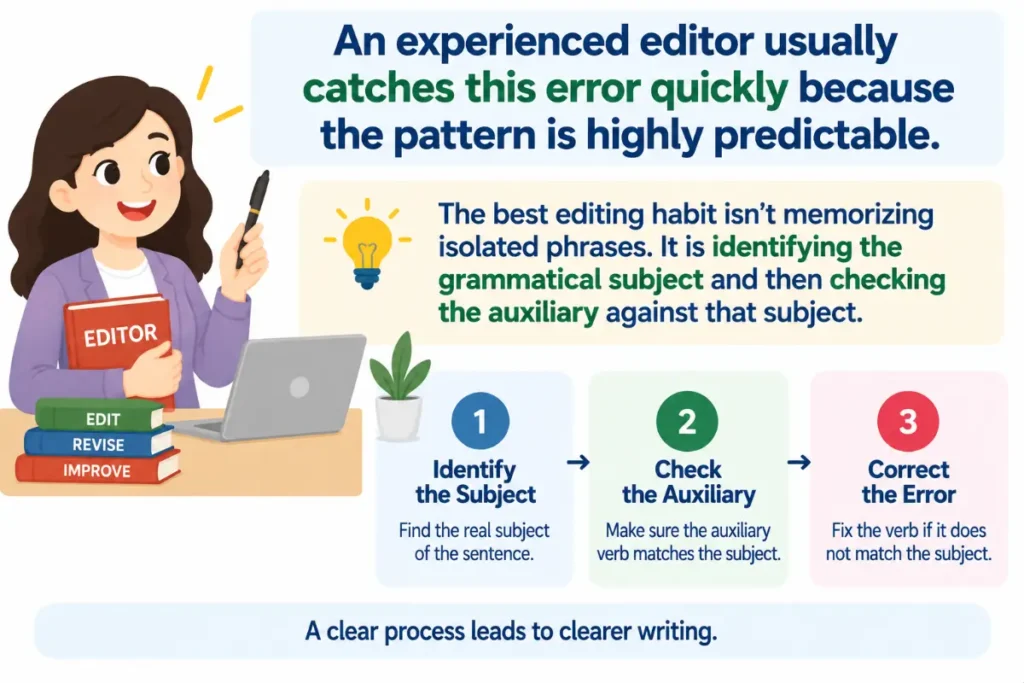
An experienced editor usually catches this mistake by checking the subject first rather than the number of people implied by the sentence. If anybody is the subject use does in a present tense question and keep the main verb in its base form. Grammar checkers often flag do anybody because it conflicts with standard subject verb agreement. They may also flag does anybody knows because the main verb incorrectly carries an extra singular ending. The most reliable editing habit is to identify the subject and then choose the auxiliary.
Need another quick comparison? Read Tie vs Tye Correct Spelling and Usage.
Conclusion
Does anybody or do anybody has a clear grammatical answer. Does anybody is the standard form because anybody is a singular indefinite pronoun. Even though the word can refer to any person within a large group it still takes the singular auxiliary does in a present tense question.
The main verb after does stays in its base form. That gives you patterns such as Does anybody know? Does anybody have a question? and Does anybody want coffee? The same agreement rule applies to anyone someone somebody everyone everybody no one and nobody.
A simple editing trick can save you from the mistake. Replace anybody with he or she in your mind and check the auxiliary. If you would say Does he know? then you should say Does anybody know? That small habit makes the correct structure much easier to remember.
FAQs
Is anybody singular or plural?
Anybody is grammatically singular in standard English. It can refer to any person within a larger group but it still takes singular verb agreement when it acts as the subject. That is why we say Anybody is welcome and Does anybody know the answer? The possible number of people does not change the grammatical number of the pronoun.
Why do we say does anybody instead of do anybody?
We use does because anybody is a singular indefinite pronoun. Does is the third person singular form of the auxiliary verb do. In a question such as Does anybody know? the auxiliary agrees with anybody. The main verb then stays in its base form. This creates the standard English pattern for the construction.
Is do anybody ever correct?
Do anybody is not the standard form when anybody is the subject of a present tense question. You may encounter it in nonstandard speech writing or language influenced by another grammatical system. In standard English use does anybody. For example say Does anybody need help? rather than Do anybody need help?
Is does anybody know correct?
Yes. Does anybody know? is completely grammatical. Anybody is the singular subject and does is the appropriate auxiliary. The verb know remains in its base form because does already carries the grammatical marking. You can expand the sentence naturally as Does anybody know where the meeting is? This structure is common in both conversation and formal communication.
Does anybody take has or have?
It depends on the grammatical role and structure of the sentence. When anybody is the subject you normally use has in a simple present statement. Anybody has the right to speak. In a question formed with does the main verb returns to its base form. Therefore say Does anybody have a question? not Does anybody has a question?
Does anybody sound natural in American English?
Yes. Does anybody sounds completely natural in American English. Speakers use it in casual questions such as Does anybody want lunch? They also use it in workplace and educational settings. The phrase is not limited to informal speech. Its level of formality depends on the complete sentence and context rather than the pronoun itself.
What is the difference between does anybody and does anyone?
There is very little difference in meaning. Anybody and anyone can both refer to any person and both normally take singular agreement. You can say Does anybody know? or Does anyone know? Both are standard. The choice usually comes down to personal preference sentence rhythm and context. Neither form requires a plural auxiliary simply because it can refer to many people.
Is does anybody appropriate in formal writing?
Yes. Does anybody is grammatically correct in formal writing. However professional or academic writers sometimes choose more precise wording when they know the specific group involved. For example Do the researchers agree? may be clearer than Does anybody agree? The original expression is still correct. Formality affects word choice and precision rather than changing the subject verb agreement rule.