
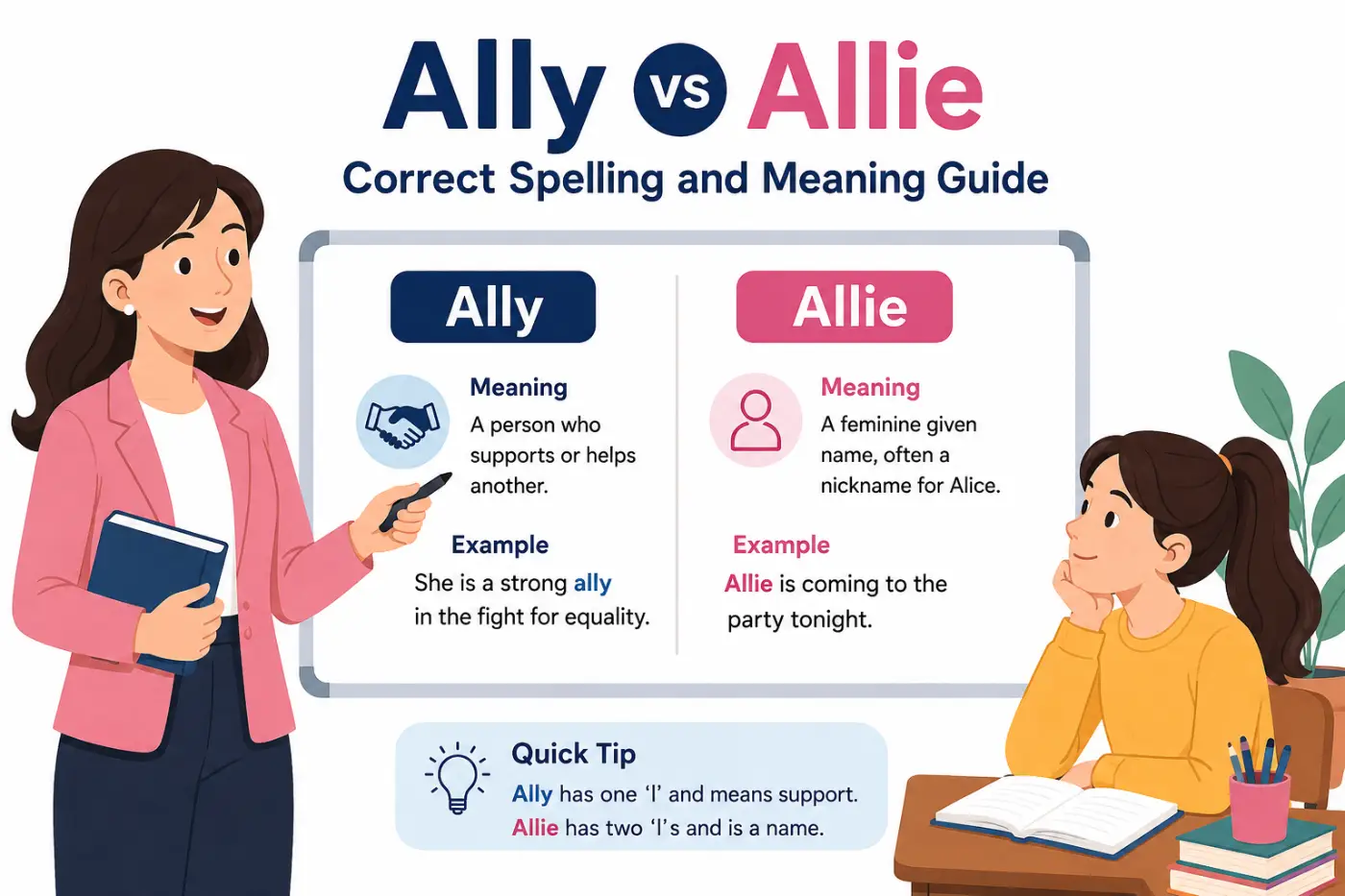
If you’re unsure about ally vs allie you’re dealing with two forms that can look and sound surprisingly close. The correct choice depends on what you mean. Ally is a standard English word for a person or group that supports another person or group. Allie is most commonly a personal name or nickname and should be capitalized when it refers to a person.
The confusion often starts with pronunciation. In American English the noun ally usually sounds like AL eye while Allie as a name usually sounds like AL lee. In fast speech or unfamiliar contexts those sounds can be easy to mishear. Spelling also creates confusion because both forms begin with the same letters and appear frequently in everyday communication.
Once you know the difference the choice becomes simple. This guide explains the meaning grammar pronunciation capitalization origin regional usage and practical context of both forms. You’ll also see natural sentence examples common mistakes related words and an editor’s advice for choosing the right form without second guessing yourself.
Learn the difference in share me vs share with me Which Is Correct.
Quick Definition
Ally is a standard English noun and verb. As a noun it means a person group or country that supports another. As a verb it means to join or connect with someone or something for a shared purpose. Allie is usually a personal name or nickname and is not the standard spelling of the common English word.
Quick Answer
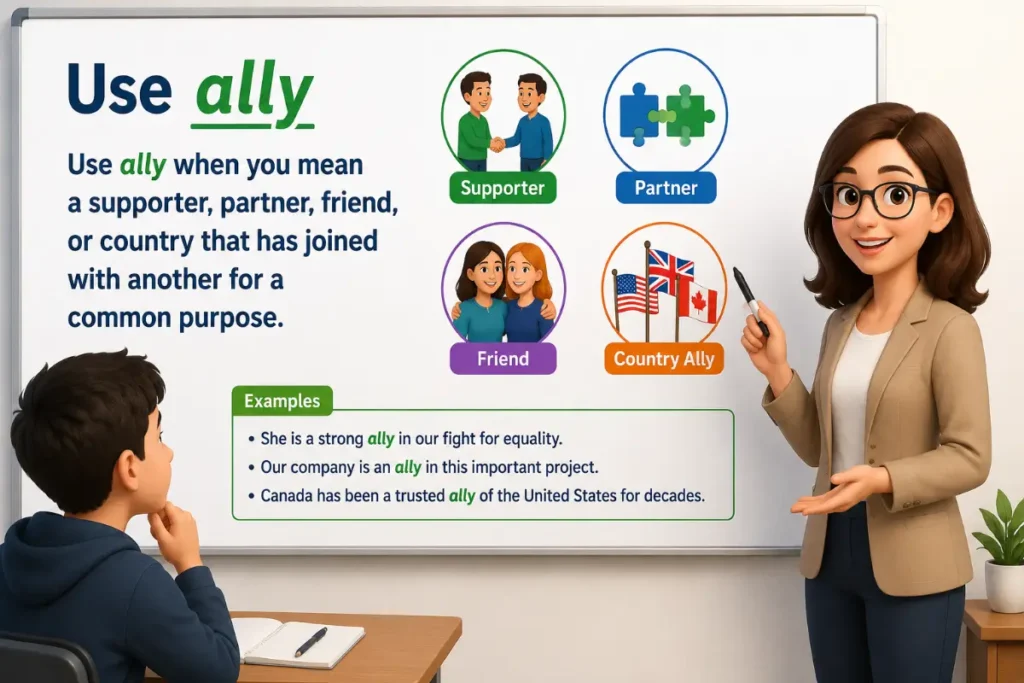
Use ally when you mean a supporter partner or friend who stands with another person group or country. Use Allie when you mean someone whose name is Allie.
The two forms aren’t interchangeable. Ally is a regular English word and can also function as a verb. Allie is normally a proper noun so it begins with a capital letter.
Comparison Table
| Form | Meaning | Part of Speech | Origin | Usage Frequency | Formality | Common Contexts | Example |
|---|---|---|---|---|---|---|---|
| Ally | A supporter or partner | Noun and verb | From Latin alligare through French and English | Very common | Neutral and formal | Friendship politics diplomacy teamwork business | She became a strong ally. |
| Allie | A personal name or nickname | Proper noun | Commonly used as a given name or nickname | Common as a name | Neutral | Names family friends school work social settings | Allie called me after work. |
Meaning and Definition
Meaning of Ally
Ally has two main grammatical uses.
As a noun it refers to someone who supports another person group organization or country. The relationship usually involves shared interests goals or values.
For example:
My sister has always been my strongest ally.
Here ally means a person who supports the speaker.
The word can describe relationships between individuals.
He became an ally during a difficult time.
It can also describe relationships between organizations.
The two companies became allies on the project.
And it can describe countries or political groups.
The country worked closely with its allies.
The central idea remains support and cooperation.
Ally can also function as a verb. In that form it means to join with another person group or organization for a particular purpose.
The two organizations allied to improve access to education.
The verb can appear in several grammatical forms including allied and allying.
The noun is especially common in phrases such as political ally military ally trusted ally close ally natural ally and valuable ally.
The word doesn’t always imply complete agreement. Two people or groups can be allies while disagreeing about certain issues. The important point is that they share enough common ground to support or cooperate with one another.
Meaning of Allie
Allie is most commonly a personal name.
It can be a given name in its own right or a nickname associated with names such as Allison or Alexandra depending on the individual and family tradition. People who use Allie as their name may spell it in several ways including Ally or other forms.
That distinction matters because personal names don’t follow the same rules as ordinary vocabulary.
If someone’s name is Allie then you should write:
Allie works at the library.
You shouldn’t change the spelling to Ally simply because the forms look similar.
Likewise if a person’s name is Ally you should respect that spelling.
Names belong to individuals. Standard spelling rules can tell you how to write the common noun ally but they can’t dictate how someone chooses to spell their personal name.
Allie can therefore be perfectly correct when it refers to a person whose name is Allie. It becomes incorrect only if someone uses it as an ordinary replacement for the English noun ally.
For example:
Correct: She is my ally.
Incorrect in standard English: She is my allie.
The second sentence is trying to use a personal name spelling as the common noun. That isn’t standard usage.
Key Differences Explained
Spelling
Ally is the standard spelling of the English word for a supporter or partner.
Allie is generally a personal name.
The final letters create the visual difference. Ally ends in y while Allie ends in ie.
Meaning
Ally has a clear dictionary meaning connected with support partnership and cooperation.
Allie normally identifies a particular person.
One describes a relationship or role. The other identifies an individual.
Grammar
Ally can work as both a noun and a verb.
Allie normally works as a proper noun.
That grammatical distinction is one of the fastest ways to identify the right form.
Capitalization
The common noun ally is lowercase unless it begins a sentence.
Allie is capitalized because personal names are proper nouns.
Compare these sentences:
She is my ally.
Allie is my friend.
The capitalization gives you an immediate clue.
Pronunciation
The common noun ally is generally pronounced AL eye.
The name Allie is generally pronounced AL lee.
However personal names can have individual pronunciations. If you’re writing about a specific person always follow that person’s preferred pronunciation.
Formality
Ally works in casual conversation and formal writing.
Allie is neutral as a name. Its level of formality depends on the person and setting rather than the spelling itself.
Context
Use ally for relationships involving support cooperation or shared interests.
Use Allie when referring to a person with that name.
Regional Usage
The distinction remains broadly stable across major varieties of English. American British Canadian and Australian English all recognize ally as a standard word. Allie is used as a personal name across English speaking communities.
Which Form Is Correct?
Both forms can be correct but they aren’t correct in the same situation.
Ally is correct when you mean a supporter partner or person who cooperates with someone else. It can also be used as a verb.
Allie is correct when it is the chosen spelling of someone’s name.
This is an important distinction because it would be misleading to call Allie a simple misspelling in every situation. If a woman named Allie introduces herself that way then Allie is exactly the right spelling for her.
The same principle applies to names such as Ally. A person can legally or personally use Ally as a given name. Context tells you if the word is functioning as a common noun or as a name.
Dictionary logic helps with the ordinary vocabulary question. Standard dictionaries recognize ally as an English word. A personal name doesn’t need to appear as a common dictionary headword to be valid because names belong to a different category of language.
A useful test is to ask yourself one question.
Am I describing a supporter or naming a person?
If you’re describing a supporter use ally.
If you’re naming a person use that person’s actual name spelling.
Sentence Examples
Here are ten examples showing how the standard word works.
- She has always been a loyal ally during difficult times.
- The senator gained an important ally in the debate.
- Good leaders know that trust can turn a colleague into a powerful ally.
- The two countries became close allies after signing the agreement.
- He decided to ally himself with the local community.
- Our team needs an ally who understands the challenges we face.
- The organization found an unexpected ally in a local business owner.
- Her experience made her a valuable ally in the workplace.
- The two groups allied to protect the historic building.
- A true ally will support you while still giving you honest advice.
Now look at examples where Allie is a personal name.
- Allie is meeting us for lunch tomorrow.
- I sent Allie the updated schedule.
- Allie helped me understand the assignment.
- My friend Allie moved to Chicago last year.
- Allie called after the meeting ended.
These examples show why context matters. The first group uses a common English word. The second group uses a personal name.
Examples of the Common Error
When someone intends to use the common noun or verb the following forms are incorrect in standard English.
- She has always been my allie.
- The country needs a strong allie.
- They decided to allie with another group.
- He became an important allie during the campaign.
- We need to allie ourselves with reliable partners.
The standard forms are ally or allied depending on the grammar of the sentence.
For example:
She has always been my ally.
The country needs a strong ally.
They decided to ally with another group.
He became an important ally during the campaign.
We need to ally ourselves with reliable partners.
Common Mistakes and Misspellings
Using Allie as the Common Noun
Incorrect: She is my allie.
Correct: She is my ally.
The problem comes from treating a personal name spelling as a variation of the common noun. The noun has a fixed standard spelling.
Using Ally for Someone Named Allie
This mistake can be more subtle.
If someone’s name is Allie then changing it to Ally is simply misspelling their name.
Names deserve the same care as any other identifying detail. If you’re writing an email school assignment story or professional document use the person’s preferred spelling.
Writing Allie With a Lowercase Letter
Incorrect: allie is coming to dinner.
Correct: Allie is coming to dinner.
A personal name is a proper noun and should normally begin with a capital letter.
Confusing the Verb With the Noun
The verb ally can be confused with the noun ally because they share the same spelling.
Consider:
The two countries became allies.
The two countries decided to ally.
The first example uses the plural noun allies. The second uses the verb ally.
Knowing the sentence structure helps you identify the grammatical role.
Assuming Similar Sound Means Similar Meaning
Words that sound alike or nearly alike can create spelling confusion. But pronunciation alone doesn’t tell you what a word means.
A good example is the difference between the noun ally and the personal name Allie. You need both sound and context to make the right choice.
Pronunciation Guide
Ally as a Noun
The noun ally is commonly pronounced /ˈælaɪ/ in American English.
A simple pronunciation guide is:
AL eye.
The stress falls on the first syllable.
The word has two syllables:
AL eye
The final sound resembles the word eye.
For example:
She is my ally.
The noun therefore doesn’t normally sound like Allie.
Ally as a Verb
The verb ally is also commonly pronounced /əˈlaɪ/ when used in forms such as ally with or ally oneself with. The stress pattern can shift because English often changes stress depending on grammatical form and sentence position.
You may hear:
uh LIE
For example:
They decided to ally with the larger group.
This distinction between the noun and verb is useful for learners because the same spelling can have related but slightly different pronunciation patterns.
Allie as a Name
Allie is commonly pronounced /ˈæli/.
An easy guide is:
AL lee.
The first syllable carries the main stress.
The important sound difference is at the end.
Ally: AL eye.
Allie: AL lee.
Still pronunciation can vary with personal names. If a person introduces themselves as Allie and gives you a specific pronunciation follow their preference.
Etymology and Word Origin
The English word ally has a long history connected with the idea of joining or binding together.
Its deeper root can be traced to Latin alligare meaning to bind or tie to. The word passed through French before developing into English.
This history fits the modern meaning quite well. An ally is someone who is joined to another person group or country through a relationship of support or cooperation.
The word became established in English as a noun referring to someone connected through a shared interest or cause. It later developed a related verb use meaning to join or associate with another party.
The spelling has remained closely connected to this historical development.
Allie is different because it belongs primarily to the world of personal names. Names often develop through family traditions nickname patterns and cultural preferences. A name can have a history of its own without functioning as an ordinary vocabulary word.
This is why the two forms should not be treated as simple spelling variants. They belong to different language categories.
You may also want to read Skeptical vs Sceptical Which Spelling Is Correct.
Regional Usage
American English
American English uses ally as a standard noun and verb. It is common in personal relationships workplace communication politics diplomacy business and discussions about social causes.
The name Allie is also familiar in the United States. It may function as a given name or nickname depending on the individual.
The pronunciation usually makes the distinction clear in careful speech.
British English
British English uses ally in the same basic ways. It can refer to an individual supporter or to a country that cooperates with another country.
Allie is also used as a personal name. The basic distinction between the common noun and proper name remains the same.
There is no standard British spelling rule that changes ally into allie when the common word is intended.
Australian English
Australian English follows the same general distinction. Ally is the standard English word while Allie can be used as a personal name.
The meaning of ally remains tied to support cooperation and partnership. The personal name depends on the individual who uses it.
Canadian English
Canadian English also uses ally as the standard noun and verb. Allie can appear as a personal name in the same way it does in other English speaking communities.
There is no major Canadian spelling difference that makes allie an accepted alternative for the common noun.
Grammar Rules and Part of Speech
Ally as a Noun
As a noun ally refers to a person group or country that supports another.
You can use it as a singular count noun.
She is an ally.
You can make it plural by adding the standard plural ending.
They are allies.
Notice that the plural form changes the spelling from ally to allies.
The noun can appear after articles and possessive words.
She is an ally.
He became my ally.
They found a powerful ally.
It can also appear in phrases that describe the kind of relationship.
A trusted ally.
A political ally.
A military ally.
A close ally.
A natural ally.
Ally as a Verb
As a verb ally means to join or associate with another person or group.
It is often followed by with.
The company allied with a local charity.
It can also appear in the reflexive construction ally oneself with.
She allied herself with the reform movement.
The past tense and past participle are allied.
The organizations allied to support the community.
The present participle is allying.
The groups are allying to oppose the proposal.
These forms can look more complicated than the noun because English spelling changes the final y before certain endings.
Allie as a Proper Noun
Allie is normally a proper noun when it is a personal name.
That means it receives a capital letter.
Allie is coming tonight.
I spoke with Allie yesterday.
The grammatical behavior is therefore different from the common noun ally.
You don’t normally pluralize a person’s name simply because more than one person shares it. Instead you use a phrase such as two people named Allie when needed.
Punctuation
Neither form has special punctuation rules simply because of its spelling.
If ally appears as an introductory word or phrase the punctuation depends on the larger sentence.
If Allie is a name used in direct address a comma may separate the name from the rest of the sentence.
Allie, can you send me the file?
The comma belongs to the grammar of direct address rather than to the name itself.
Real Life Usage Examples
Daily Conversation
In everyday speech ally usually refers to someone who supports you.
I’m glad you’re on my side. I need an ally right now.
She became a close ally after we worked together for several months.
Allie may simply identify a friend.
Allie is coming over after work.
I haven’t heard from Allie today.
Email and Workplace Communication
The noun can sound perfectly natural in professional communication.
The new department has become an important ally in our project.
We appreciate having such a reliable ally on the team.
If Allie is a coworker the name is used normally.
Hi Allie, could you send me the updated report?
I’ll ask Allie to review the document.
Academic Writing
Ally can appear in history political science international relations sociology and other fields.
The country sought a powerful ally during the conflict.
The movement gained an important ally among local organizations.
Allie would normally appear in academic writing only when it is someone’s name.
For example:
Allie conducted interviews with local residents.
The researcher interviewed Allie about the project.
News and Journalism
News writing frequently uses ally when describing political or international relationships.
The president met with a longtime ally during the summit.
The two nations have remained close allies for decades.
A person named Allie would simply be identified by that name.
Allie said the decision would affect local businesses.
The reporter later spoke with Allie about the event.
Literature and Storytelling
Ally is useful when describing a character who supports another character.
The young traveler found an unexpected ally in the village.
By the final chapter her former rival had become an ally.
Allie can appear naturally as a character name.
Allie walked toward the old house just before sunset.
When Allie heard the noise she turned toward the window.
Related and Confused Terms
Friend
A friend is someone with whom you have a personal relationship. An ally may support you without being a close friend.
A coworker can be your ally even if you rarely socialize outside work.
Supporter
A supporter backs a person cause team or idea. This meaning overlaps with ally but supporter can describe a more one sided relationship.
Partner
A partner works with another person toward a shared goal. The word can describe business relationships personal relationships or other forms of cooperation.
Accomplice
An accomplice is someone who helps another person commit a wrongdoing. This word is not a neutral synonym for ally because it usually carries a negative meaning.
Advocate
An advocate publicly supports a person cause or idea. An ally can also advocate for someone but the words emphasize different aspects of support.
Collaborator
A collaborator works with others on a shared project or activity. Collaboration focuses on working together rather than simply providing support.
Opponent
An opponent is someone who competes against or resists another person or group. It is close to the opposite side of the meaning associated with ally.
Adversary
An adversary is an opponent or enemy. The contrast with ally is often strong because allies cooperate while adversaries oppose.
Understanding these related terms helps clarify the core meaning. An ally is not simply anyone you know. The word suggests a meaningful relationship of support cooperation or shared interest.
Why The Confusion Happens
The confusion between these forms is partly visual.
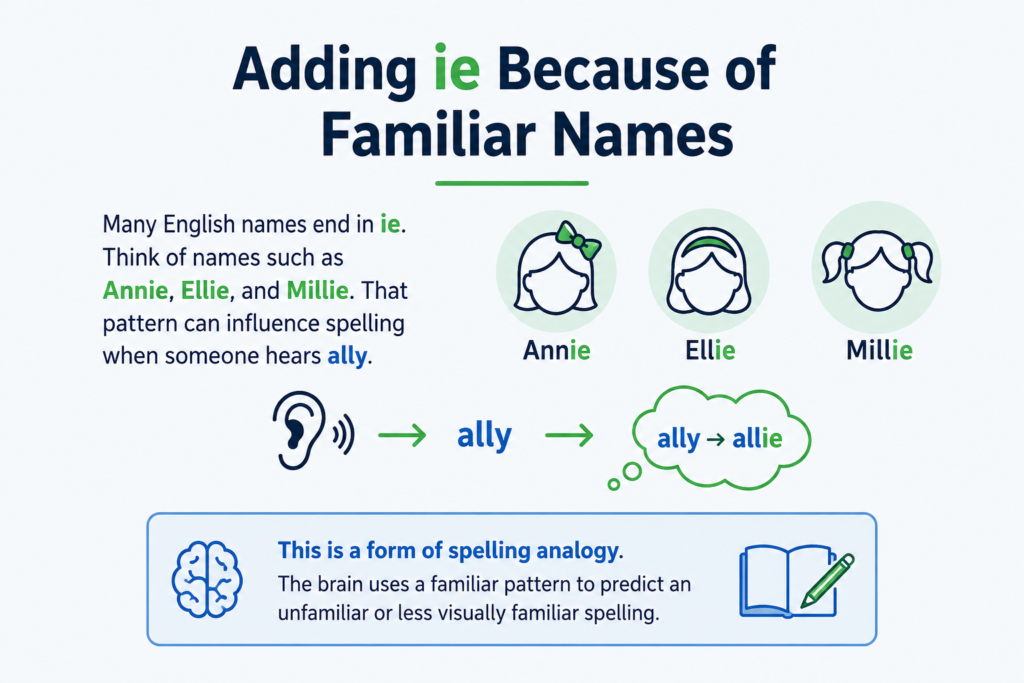
Both begin with all and both can be used in names or ordinary communication. A person typing quickly may remember the sound but not the exact spelling.
Pronunciation can make the problem more interesting. Ally and Allie are commonly pronounced differently in American English but unfamiliar listeners may not always catch the distinction. A noisy conversation or fast speech can blur the final sound.
Names create another layer of difficulty. English allows personal names to use spellings that resemble ordinary words. Someone named Ally can exist alongside the common noun ally. Someone named Allie can also exist alongside both.
This means context is more reliable than appearance alone.
Consider:
She is my ally.
Allie is my friend.
The first sentence describes a relationship. The second identifies a person.
That simple difference resolves most questions.
Language processing systems can also infer intended meaning from surrounding words. If a sentence contains She is my allie a spelling system may recognize that ally was probably intended. If the sentence says Allie called yesterday the capitalization and grammatical context point toward a personal name.
Still you shouldn’t rely on software to make the final decision. Human context matters especially with names.
How To Remember The Difference
A simple memory trick can save you a lot of second guessing.
Think about ally as a role.
An ally is someone who is on your side.
Think about Allie as a person.
Allie is someone’s name.
You can also use the pronunciation as a clue.
Ally: AL eye.
Allie: AL lee.
The spelling follows the sound in a useful way here but personal names can always vary.
Another helpful trick is to look at capitalization. If the word is naming a person and the person spells their name Allie then use a capital A and keep the ie ending.
If you mean a supporter then use the common noun ally.
Ally In Formal Writing
Ally is fully suitable for formal writing. You can find it naturally in academic essays reports professional documents journalism diplomatic writing and historical discussions.
For example:
The organization gained an influential ally during the negotiations.
The country relied on its allies during the crisis.
The word doesn’t sound overly casual or overly technical. It is a flexible part of everyday English.
In formal writing precision still matters. Don’t use ally simply because it sounds sophisticated. If you mean supporter then ally can be a strong choice. If you mean coworker friend partner advocate or collaborator one of those words may be more precise depending on the relationship.
Good editing isn’t about choosing the fanciest word. It’s about choosing the word that says exactly what you mean.
Allie In Personal Writing
Allie is appropriate whenever it is someone’s actual name or preferred spelling.
This can include text messages emails school work social media posts stories and professional communication.
For example:
Hi Allie, are you free after lunch?
Allie will send the documents this afternoon.
If the person spells their name Allie you shouldn’t change it to Ally just because the latter is also a valid spelling.
This is one place where standard dictionary spelling and personal spelling rules differ. Common words follow established language conventions. Personal names belong to the people who use them.
Expert Editor Insight
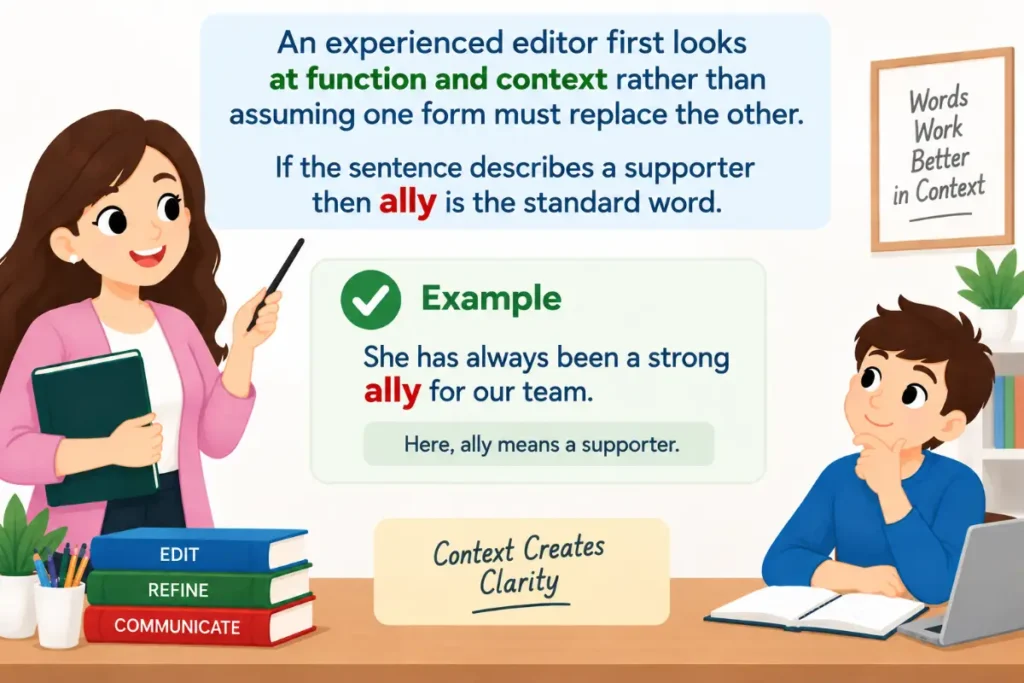
An experienced editor first looks at function and context rather than assuming one form must replace the other. If the sentence describes a supporter then ally is the standard word. If it identifies a person named Allie then the capitalized name is correct. Editors also check names carefully because changing a person’s chosen spelling is an avoidable error. Spelling software may flag allie when it appears where a common noun is expected but it can’t always know that Allie is someone’s name. My practical tip is to ask whether the word describes a role or identifies a person. That quick test usually settles the choice.
For another common grammar confusion, see Cryer vs Crier Which Spelling Is Correct 2026.
Conclusion
Ally vs allie becomes easy once you separate the common English word from the personal name. Ally is the standard word for a supporter partner or cooperating person group or country. Allie is usually a name and should be capitalized when it identifies a person. Both forms can therefore be correct but they serve different purposes.
The pronunciation can also help. The common noun ally is generally pronounced AL eye while the name Allie is commonly pronounced AL lee. Still personal names can have individual pronunciations and spellings so the person’s preference always comes first.
For a quick editing check ask yourself if you’re describing someone’s role or naming someone. A supporter is an ally. A person named Allie is Allie. That simple distinction will keep your spelling clear and accurate.
FAQs
Is Allie a correct spelling of ally?
Allie can be correct when it is a person’s name. It is not the standard spelling of the common English noun that means a supporter or partner. If you mean someone who supports you use ally. If you’re referring to a person whose name is Allie then use Allie with a capital letter and preserve that person’s preferred spelling.
What does ally mean?
Ally means a person group or country that supports or cooperates with another. It can also function as a verb meaning to join or associate with someone for a shared purpose. The word can describe personal relationships workplace partnerships political cooperation or relationships between countries. The exact meaning depends on context but support and cooperation remain central ideas.
Is ally a name too?
Yes. Ally can also be used as a personal name. That means context matters when you see the word. As a lowercase common noun ally means a supporter or partner. As a capitalized personal name Ally identifies an individual. If you’re writing about someone named Ally you should preserve their chosen spelling rather than changing it to another form.
How do you pronounce ally?
The common noun ally is generally pronounced /ˈælaɪ/ in American English. A simple pronunciation guide is AL eye. The word has two syllables and the first syllable receives the main stress. The personal name Allie is commonly pronounced AL lee. Names can have individual pronunciations so follow the pronunciation given by the person who uses the name.
How do you pronounce Allie?
Allie is commonly pronounced /ˈæli/ in American English. You can think of it as AL lee with the strongest stress on the first syllable. This differs from the common noun ally which usually sounds like AL eye. Because Allie is a personal name pronunciation can vary from person to person. The individual’s own pronunciation should always take priority.
Can Allie be a nickname?
Yes. Allie can be used as a nickname or shortened form of certain personal names. It can also be someone’s full given name. The exact relationship between Allie and another name depends on the individual and family tradition. Some people may also choose Ally as their nickname. Since personal naming practices vary there isn’t one rule that applies to every person.
Which is correct in the sentence She is my ally?
The correct form is ally. The sentence describes a person who supports the speaker so the common noun is needed. Writing She is my Allie would change the meaning and suggest that Allie is the person’s name. Writing She is my allie would be a spelling error in standard English. Context and grammatical function make the correct choice clear.
Is ally appropriate in formal writing?
Yes. Ally is a standard word that works well in formal writing. It appears naturally in academic work professional documents journalism historical writing and discussions of international relations. The word can describe a supporter or cooperating party without sounding informal. As with any vocabulary choice use it only when the relationship involves meaningful support or cooperation rather than simply choosing it as a more polished substitute for friend.