
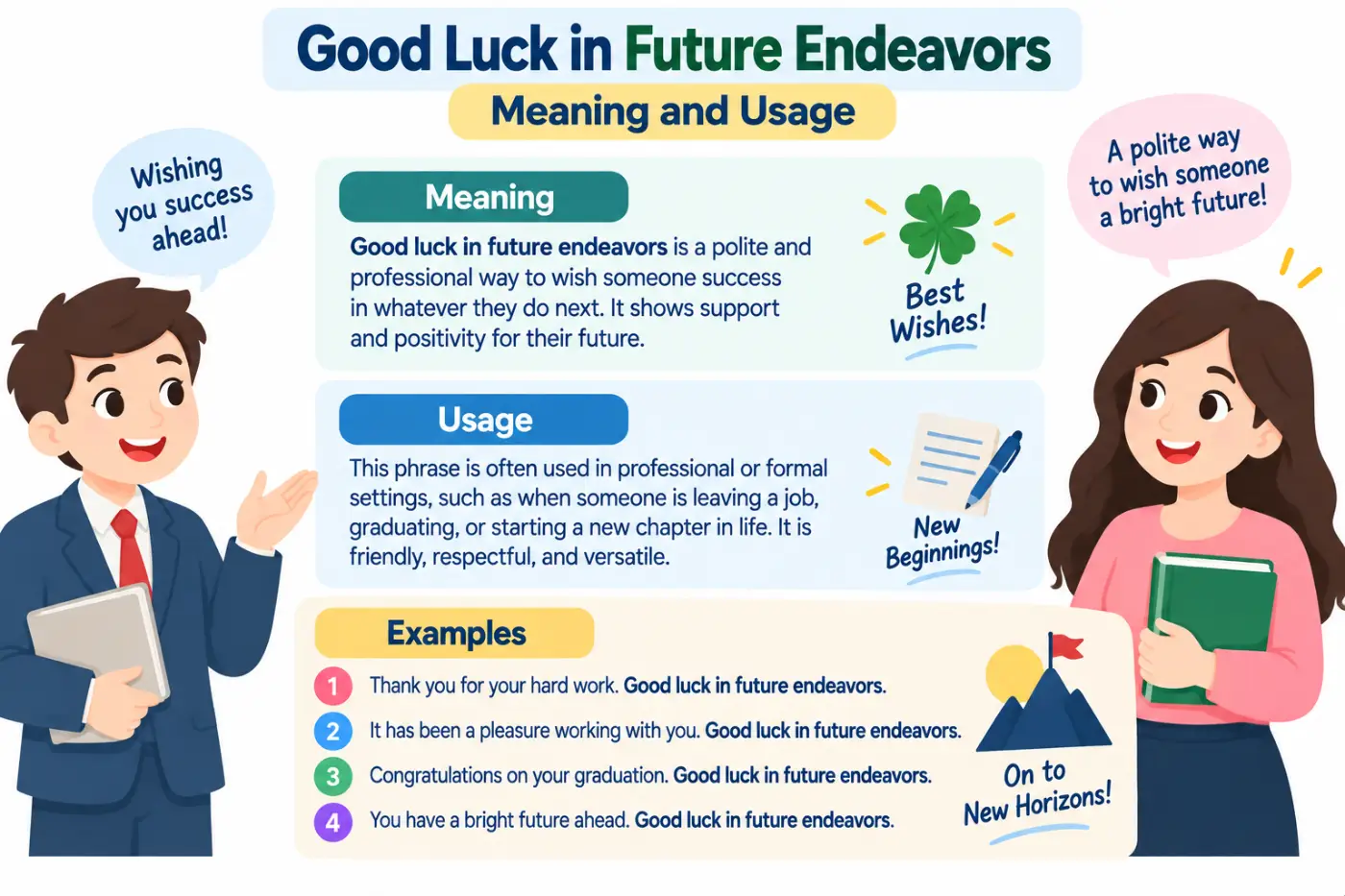
Good luck in future endeavors is a polite way to wish someone success as they move toward a new stage in life or work. It usually carries the meaning of I hope your future efforts go well and you achieve what you’re aiming for. The phrase is grammatically correct and widely understood in American English.
You’ll often see this expression in farewell emails graduation messages retirement notes workplace announcements and personal cards. It can sound warm and sincere when the relationship and situation fit. At the same time it can feel somewhat formal or impersonal if used in a casual conversation with a close friend.
The word endeavors refers to efforts or activities that require work and determination. That gives the phrase a broader meaning than simply saying good luck with your next job. It can refer to a career change education a business project personal goals or almost any meaningful pursuit. This guide explains the meaning tone grammar punctuation natural alternatives and real life situations where the phrase works best.
Many readers also check Mentioned Vs Mentionned Which Spelling Is Correct (2026).
Quick Definition
Good luck in future endeavors is a polite farewell expression used to wish someone success in their upcoming efforts or activities. It commonly appears when someone is leaving a job finishing school starting a new career or entering another stage of life. The phrase is positive and respectful but can sound formal in casual conversation.
Quick Answer
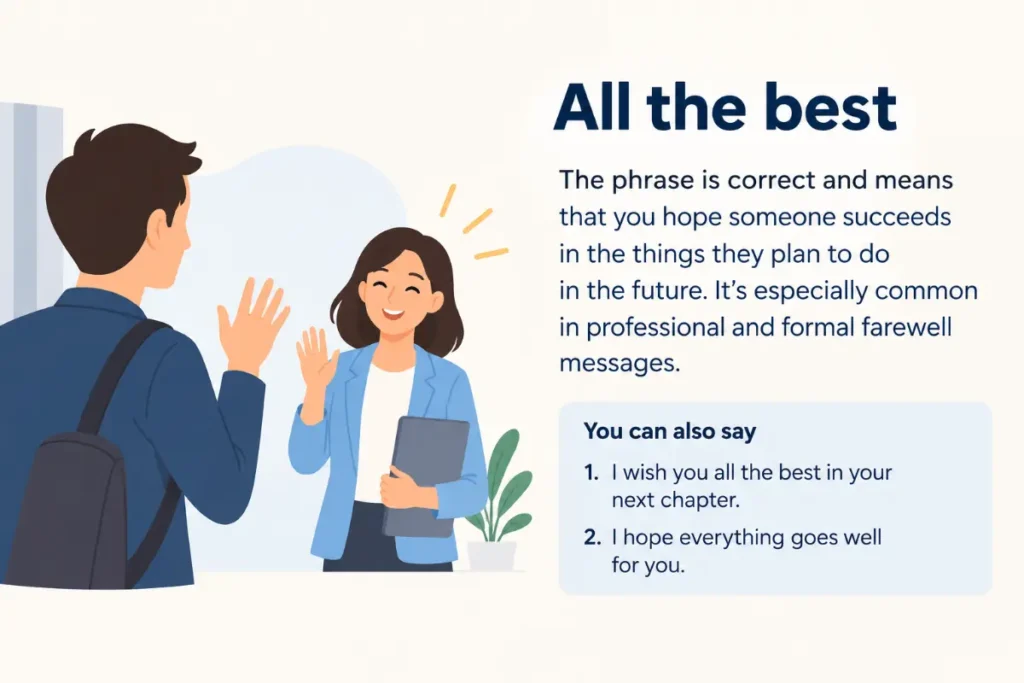
The phrase is correct and means that you hope someone succeeds in the things they plan to do in the future. It’s especially common in professional and formal farewell messages. For a warmer and more personal tone you can say I wish you all the best in your next chapter or I hope everything goes well for you.
Meaning and Definition
What The Phrase Means
The expression combines a simple wish with a broad noun that covers many kinds of future activity.
Good luck expresses a wish for success or positive results. Future points to things that will happen later. Endeavors means serious efforts or activities that require time energy or determination.
Put together the message is essentially this.
I hope your future efforts are successful.
That’s why the expression works in many situations. You don’t need to know exactly what the person will do next. Their next endeavor might be a new job a business venture a degree a creative project or a personal goal.
Imagine a coworker leaving after five years with your company. You might write that expression in a farewell card because you don’t know every detail of the person’s next plan. You simply want to wish them success.
The phrase therefore has a useful balance. It says something positive without making assumptions about the person’s future.
What Endeavors Means
Endeavor is a noun meaning an effort or an attempt to accomplish something. It can also refer to a serious activity or undertaking.
For example:
Starting a small business can be a challenging endeavor.
Writing a book is a major endeavor.
Her academic endeavors required years of dedication.
The plural form endeavors refers to multiple efforts activities or pursuits.
That plural form is especially useful in farewell expressions because a person may have many goals ahead. They might change jobs study something new travel start a business or pursue personal ambitions.
The word also carries a slightly formal tone. You probably wouldn’t use endeavor in every casual conversation.
A friend might say I’m starting a new project.
A formal message might say I wish you success in your future endeavors.
Both communicate a similar basic idea but the second sounds more polished and ceremonial.
The Meaning In A Farewell
The phrase often appears when a relationship or period of work is coming to an end.
A manager might write it to an employee who is leaving.
A teacher might use it in a graduation message.
A colleague might include it in a farewell card.
A university might use similar language when addressing graduates.
In these situations the expression works as a closing wish. It doesn’t necessarily suggest that something went wrong. It can simply mark a transition.
That distinction matters because some people associate formal farewell language with resignation or dismissal. The phrase itself doesn’t communicate anger or criticism. The surrounding message determines the emotional meaning.
Is The Phrase Formal Or Casual?
The expression is generally formal to moderately formal.
It sounds natural in professional emails letters speeches cards and public messages. It can also work in personal writing when the occasion has a serious or ceremonial tone.
In everyday conversation between close friends it may sound a little stiff.
For example:
Good luck in your future endeavors.
This sounds polished and respectful.
A close friend would more naturally say:
Good luck with whatever comes next.
Or:
I hope everything works out for you.
The difference isn’t correctness. It’s tone.
Good writing matches the language to the relationship. A phrase can be perfectly grammatical and still feel slightly distant in a particular situation.
Good Luck In Future Endeavors Compared With Similar Phrases
Several expressions can communicate the same basic idea but create different impressions.
| Expression | General Meaning | Tone | Best Context | Example |
|---|---|---|---|---|
| Good luck in future endeavors | Wish someone success in future efforts | Formal and polite | Professional farewells | Good luck in future endeavors. |
| Best wishes for the future | Hope the person has a positive future | Warm and neutral | Cards and farewell notes | Best wishes for the future. |
| I wish you all the best | Hope things go well | Warm and personal | Friends and coworkers | I wish you all the best. |
| Good luck with your next chapter | Wish success in the next stage of life | Warm and modern | Personal and professional messages | Good luck with your next chapter. |
| I hope everything goes well | Hope the person’s plans succeed | Friendly and natural | Everyday communication | I hope everything goes well. |
| Wishing you continued success | Hope the person keeps succeeding | Professional | Work and business messages | Wishing you continued success. |
| Best of luck with what comes next | Wish success in upcoming activities | Friendly | Farewells and casual notes | Best of luck with what comes next. |
| Take care and good luck | Goodbye plus a good wish | Casual and warm | Friends and acquaintances | Take care and good luck. |
The best choice depends on the relationship.
If you’re writing to a former coworker you didn’t know well the more formal expression can fit nicely. If you’re saying goodbye to a close friend it may sound better to choose something more personal.
Good Luck In Future Endeavors Grammar Explained
The phrase is grammatically sound.
Good luck functions as a fixed expression that communicates a wish for success. In this context luck is a noun and good describes it.
In future endeavors contains a preposition followed by an adjective and a plural noun.
The structure can be understood like this:
Good luck expresses the wish.
In introduces the area or circumstances connected with the wish.
Future identifies the time.
Endeavors identifies the efforts or activities.
The word future is an adjective here because it describes endeavors.
The word endeavors is a plural noun.
The phrase doesn’t require a verb because it is commonly used as a shortened farewell wish. Similar expressions include good luck and best wishes.
If you want a complete sentence you can write:
I wish you good luck in your future endeavors.
That version includes the subject I and the verb wish. It sounds slightly more complete and can feel more personal.
You can also write:
We wish you good luck in your future endeavors.
This works well when a group or organization is sending the message.
Should You Say In Future Endeavors Or With Future Endeavors?
The preposition in is natural in the established expression.
Good luck in future endeavors.
You may hear people say good luck with your future endeavors. That version is also understandable and grammatically acceptable. In fact it can sound more conversational because English commonly uses with after good luck.
For example:
Good luck with your new job.
When endeavor is used in the broader farewell expression in is a familiar formal construction.
The two versions can carry a slightly different feel.
Good luck in future endeavors sounds more formal and general.
Good luck with your future endeavors sounds slightly more direct and conversational.
Neither creates a serious grammar problem. The choice mainly depends on tone and style.
Is Future Endeavors Redundant?
Not necessarily.
Some readers may wonder if future is unnecessary because an endeavor naturally refers to something someone is doing or plans to do. In this expression future adds a clear time reference.
It tells the reader that the wish concerns activities that lie ahead.
Compare these examples:
I wish you success in your endeavors.
I wish you success in your future endeavors.
The first is broader. It could refer to current or upcoming efforts.
The second specifically points toward what comes next.
That makes future useful in a farewell context.
Still you don’t need it every time. If you’re writing a short personal message you may prefer a simpler expression.
I wish you success in everything ahead.
That sounds less formal while keeping the basic message.
Is It Better To Say Your Future Endeavors?
Adding your often makes the sentence feel more personal.
Compare:
Good luck in future endeavors.
Good luck in your future endeavors.
The second version directly addresses the person and clearly connects the upcoming efforts to them.
In a personal message I’d usually favor the version with your.
For example:
I wish you good luck in your future endeavors.
This feels complete and directed toward the reader.
The shorter version can work as a card message or formal closing because the person is already understood from the context.
Sentence Examples
Here are natural examples showing how the expression and its variations work.
- I wish you good luck in your future endeavors as you begin this exciting new chapter.
- Thank you for everything you’ve done for our team, and I wish you success in your future endeavors.
- We’re sorry to see you leave and wish you all the best in the years ahead.
- Congratulations on your graduation. I hope your next adventure brings you plenty of success.
- It was a pleasure working with you, and I wish you the very best in whatever comes next.
- Thank you for your dedication to the company. We wish you continued success in your career.
- Good luck with your new position. I’m sure you’ll do a great job.
- As you move into this next stage of your career, I hope you find success and fulfillment.
- Congratulations on your new opportunity. I’m excited to see where it takes you.
- Thank you for being such a wonderful colleague. I wish you nothing but success in the future.
Notice that not every farewell needs the formal expression. Sometimes a simpler sentence feels more genuine.
Common Mistakes And Awkward Uses
Using The Phrase With A Negative Tone
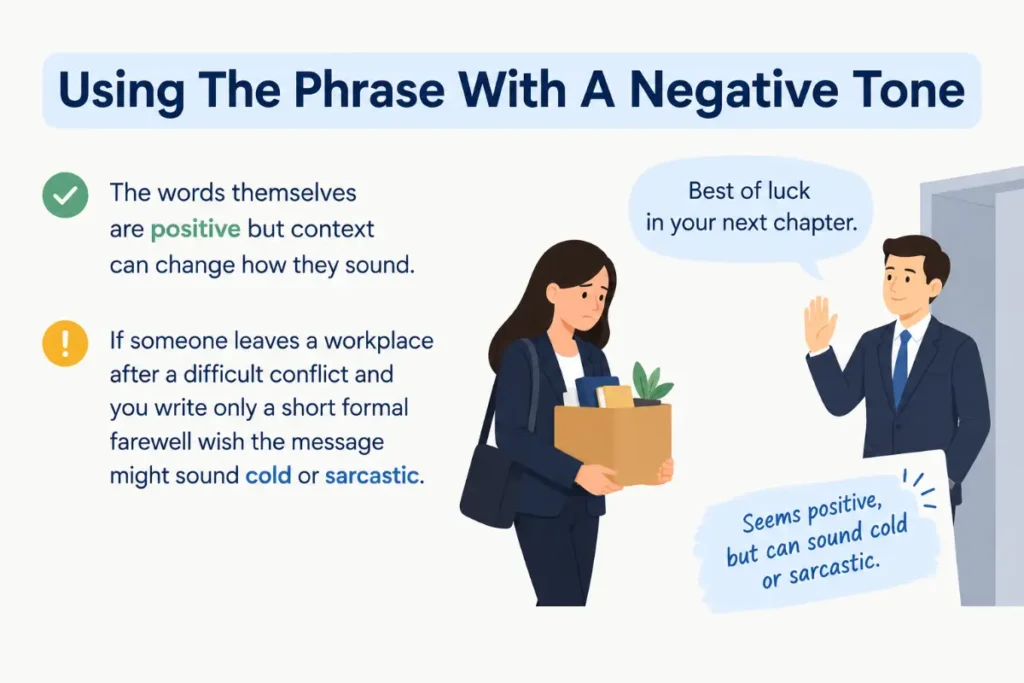
The words themselves are positive but context can change how they sound.
If someone leaves a workplace after a difficult conflict and you write only a short formal farewell wish the message might sound cold or sarcastic.
A warmer message can prevent that impression.
Thank you for your contributions during your time here. I wish you success in whatever comes next.
The extra sentence gives the closing a more human touch.
Using It With Close Friends
There’s nothing grammatically wrong with using the phrase with a close friend. The issue is style.
A friend might expect something like:
I’m going to miss you. Good luck with everything ahead.
That feels more personal than a formal farewell expression.
Overusing The Word Endeavor
Endeavor is useful but it can sound formal if it appears repeatedly.
You don’t need to write:
I wish you success in all your future endeavors and hope your future endeavors bring many rewards.
That sounds repetitive.
Instead say:
I wish you success in everything ahead.
Clear writing usually beats elaborate writing.
Forgetting The Possessive Determiner
The phrase can work without your but adding it can make the message feel more direct.
Less personal:
I wish you success in future endeavors.
More personal:
I wish you success in your future endeavors.
Neither is grammatically wrong. The second simply speaks more directly to the person.
Making The Message Too Generic
A formal phrase can become forgettable if it’s the entire message.
Compare:
Good luck in your future endeavors.
With:
It was great working with you. Thank you for always being willing to help the team. I wish you success in your next chapter.
The second message gives the reader something personal to remember.
Punctuation And Capitalization
The expression doesn’t require unusual punctuation.
At the end of a sentence you can simply write:
I wish you good luck in your future endeavors.
If you use it as a standalone farewell you can write:
Good luck in your future endeavors.
A period works well in ordinary writing.
You may also see it with an exclamation point:
Good luck in your future endeavors!
That version sounds more enthusiastic.
In a formal workplace email a period often feels more restrained and professional.
Capitalization depends on where the expression appears. If it begins a sentence capitalize Good. If it appears in the middle of a sentence use lowercase.
For example:
I want to wish you good luck in your future endeavors.
The phrase itself doesn’t need title style capitalization in ordinary prose.
Learn the difference in enrol or enroll: The Truth About These Two Spellings (2026).
Pronunciation Guide
The pronunciation is straightforward for most American English speakers.
A useful approximate pronunciation is:
good luck in FYOO chur en DEV erz
The word endeavor is commonly pronounced with the main stress on the second syllable.
IPA can vary slightly by speaker and dictionary system but an American pronunciation can be represented approximately as:
/ɪnˈdɛvər/ for endeavor.
The plural endeavors adds the plural ending.
The phrase as a whole is spoken naturally rather than word by word. In fast conversation some unstressed words become less prominent.
The strongest stress usually falls on the meaningful content words such as luck future and endeavors.
Because the expression is often used in formal writing people may encounter it in print more often than in everyday conversation. That can make pronunciation less familiar to some learners.
Etymology Of Endeavor
The history of endeavor is interesting because the word developed from an older expression connected with putting effort into something.
The modern English verb endeavor means to try hard to accomplish something. The noun endeavor refers to an effort or undertaking.
Its historical development is linked to the idea of being active in attempting something. Over time the word became a standard way to describe a serious effort or undertaking.
The word carries a formal flavor partly because it isn’t among the simplest everyday terms for effort. In casual American English people are often more likely to say effort project goal or work.
That doesn’t make endeavor old fashioned or incorrect. It simply gives the word a more polished tone.
This explains why the expression sounds natural in professional farewell messages. The vocabulary matches situations where people are marking a transition and wishing someone success.
Regional Usage
American English
The phrase is understood and accepted in American English. It appears most often in professional communication formal farewells graduation messages retirement notes and ceremonial writing.
American speakers may use simpler alternatives in casual conversation. Saying I wish you all the best often sounds more personal between friends.
The noun endeavor is also standard American English. The US spelling is endeavor with one u after the o.
British English
British English also recognizes endeavor as a standard word. However British spelling commonly uses endeavour with an additional u.
The underlying meaning remains the same.
A British writer might therefore use:
Good luck in your future endeavours.
The difference is a spelling convention rather than a difference in meaning.
Australian English
Australian English commonly follows British spelling conventions and may therefore use endeavours.
The expression itself remains understandable and natural in formal contexts. Casual speakers may still prefer simpler farewell language depending on the relationship.
Canadian English
Canadian English can show influence from both American and British spelling practices. The word may appear as endeavor or endeavour depending on the style being followed.
The meaning of the phrase doesn’t change.
For an audience that expects US English use endeavor. For a publication or organization following a specific Canadian style guide follow that guide consistently.
When To Use The Phrase
This expression works especially well in situations involving transition.
Leaving A Job
A departing employee may receive a message such as:
It was a pleasure working with you. I wish you success in your future endeavors.
This is polite professional and respectful.
Graduation
A teacher or mentor might write:
Congratulations on your graduation. I wish you success in your future endeavors.
The phrase fits because graduation marks the beginning of a new stage.
Retirement
A retirement message could say:
Thank you for your years of service. We wish you happiness and success in the years ahead.
Here a warmer alternative may work better because retirement is about more than professional goals.
Career Change
Someone starting a new position might receive:
Congratulations on the new opportunity. I wish you the best in your career.
This is often more natural than using a highly formal expression in a close relationship.
Business Or Professional Networking
The phrase can also work when ending a professional relationship.
Thank you for your time and support. I wish you continued success.
This keeps the message positive without sounding overly ceremonial.
When A Different Phrase Is Better
Good communication isn’t about choosing the most impressive phrase. It’s about choosing the phrase that sounds right for the person and moment.
If you’re writing to a close friend a formal expression may create unnecessary distance.
Instead try:
- I’m going to miss you. Good luck with everything ahead.
- I hope this next chapter is amazing for you.
- I’m excited to see what you do next.
- I wish you all the best.
- Take care and good luck with your next adventure.
For a professional relationship these alternatives can also work.
- Wishing you continued success.
- Best wishes for your next chapter.
- I hope your new role goes wonderfully.
- Thank you for your contributions and best wishes for the future.
- I wish you every success in your next position.
The more specific the message the more personal it usually feels.
Formal Writing And Workplace Communication
The phrase is particularly common in workplace settings because it avoids making assumptions about someone’s next move.
Suppose a colleague leaves your company but hasn’t shared detailed plans. You may not know if they’re joining another company starting a business taking time off or returning to school.
A broad farewell wish solves that problem.
You’re saying that you hope their next efforts succeed without pretending to know exactly what those efforts will be.
Still the phrase can feel generic when used alone. A strong professional farewell often combines it with one specific observation.
For example:
Thank you for your thoughtful work on the project. Your attention to detail made a real difference to the team. I wish you success in everything ahead.
That message sounds more sincere because it gives a reason for the good wishes.
Is The Phrase Appropriate In An Email?
Yes. It’s appropriate in many professional emails.
The key is the relationship between the sender and recipient.
A manager writing to a departing employee can use it comfortably. A coworker can use it too. A client or business partner may also receive this type of closing when a professional relationship changes.
For a casual email to someone you know well it may sound more formal than necessary.
Consider the difference:
Formal:
I appreciate your contributions to the project and wish you success in your future endeavors.
Friendly:
It’s been great working with you. Good luck with the next step.
Both are good. The second simply sounds more personal.
Is It Sincere Or Cliché?
It can be either.
The phrase itself is not inherently insincere. It has a clear positive meaning and can be genuinely appropriate.
However formal expressions can lose emotional impact when people use them automatically.
Imagine receiving a farewell message that says only:
Good luck in your future endeavors.
It’s polite but doesn’t tell you much about the relationship.
Now compare:
I’ve really enjoyed working with you over the past three years. Thanks for always helping the team when deadlines got tight. I’ll miss having you around and wish you the very best in what comes next.
The second message feels more personal because it contains specific human detail.
The lesson is simple. Don’t rely on a formal phrase to carry the entire emotional weight of your message.
Related And Confused Expressions
Best Wishes
Best wishes is one of the safest alternatives. It works in professional and personal communication and doesn’t sound overly formal.
All The Best
All the best is warmer and more conversational. It works particularly well in emails and farewell notes.
Good Luck
Good luck is shorter and more direct. It works in almost any setting but provides less information about the future.
Wishing You Success
Wishing you success has a professional tone and focuses directly on achievement.
Continued Success
Continued success suggests that the person has already achieved something and you hope that success carries forward.
Next Chapter
Next chapter is a figurative expression for a new stage in life. It sounds modern and personal.
What Comes Next
What comes next is conversational and flexible. It works well when you don’t know the person’s exact plans.
Best Of Luck
Best of luck is another friendly way to express a positive wish. It often sounds less formal than the longer expression.
These alternatives let you control the tone instead of using one farewell phrase for every situation.
How To Make The Message More Personal
A small amount of personalization can make a major difference.
Start by mentioning something specific about the person.
Thank you for always making new team members feel welcome.
Then mention the transition.
I’m sorry to see you leave the company.
Finish with a natural good wish.
I hope your next role brings you plenty of opportunities to grow.
This structure works because it combines appreciation with a personal observation and a future wish.
You don’t need a long message. Two or three sincere sentences can be stronger than a paragraph filled with formal language.
Think of a farewell message as a handshake in written form. It should fit the relationship.
Expert Editor Insight
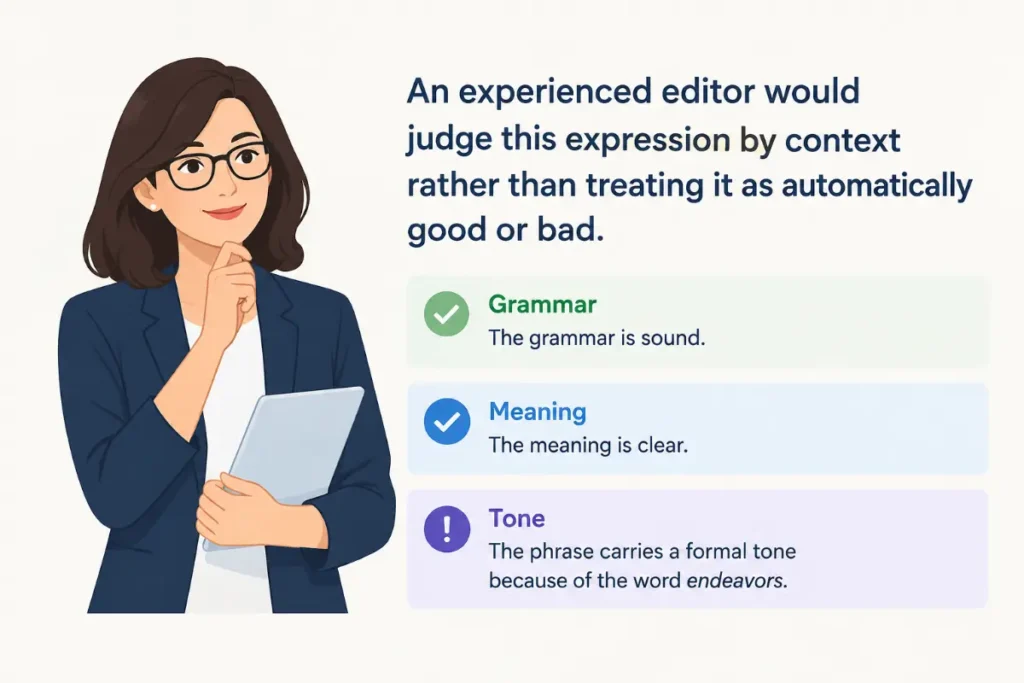
An experienced editor would judge this expression by context rather than treating it as automatically good or bad. The grammar is sound and the meaning is clear but the phrase carries a formal tone because of the word endeavors. In professional writing that can be an advantage. In a personal message it may feel distant unless you add something specific about the person. My practical editing tip is to read the sentence aloud and ask whether you would actually say it to that person. If the answer is no then choose a simpler expression that sounds more like your natural voice.
Many readers also check Bearable vs Bareable Which Is Correct? 2026.
Conclusion
Good luck in future endeavors is a correct and meaningful farewell expression that wishes someone success in the efforts and opportunities ahead. It works especially well in professional settings graduation messages formal cards and respectful farewells. The phrase is clear but its use of endeavors gives it a more formal tone than everyday alternatives.
For a close friend you may prefer something warmer such as I wish you all the best or I hope everything goes well. In professional writing the expression can fit naturally but it becomes stronger when paired with a personal sentence about the person’s work or character.
The best practical tip is to match the wording to the relationship. If the phrase sounds like something you’d naturally say to that person it’s probably a good choice. If it feels stiff choose simpler words that carry the same sincere good wishes.
FAQs
What does good luck in future endeavors mean?
The phrase expresses a wish for success in someone’s upcoming efforts activities or goals. It’s commonly used when someone is leaving a job graduating starting a new career or entering another stage of life. The word endeavors gives the message a broad meaning because it can refer to professional personal academic or creative pursuits.
Is good luck in future endeavors grammatically correct?
Yes. The expression is grammatically acceptable and widely understood. Good luck functions as a conventional expression of goodwill while future endeavors refers to the efforts or activities someone will pursue later. Adding your can make the message feel more personal. For example I wish you good luck in your future endeavors is a complete and natural sentence.
Does good luck in future endeavors sound formal?
Yes. It generally sounds formal or moderately formal. The word endeavors contributes to that tone because it is more polished than everyday words such as work plans or projects. The expression fits professional farewells graduation messages and formal cards. For close friends you may prefer a warmer phrase such as I wish you all the best.
Is it better to say good luck in or good luck with future endeavors?
Both constructions can be understood and used correctly. Good luck in future endeavors has a more established formal farewell feel. Good luck with your future endeavors sounds somewhat more conversational and direct. In a professional message either can work. Choose based on the tone you want rather than treating one as the only grammatically acceptable option.
What is a more natural alternative to the phrase?
I wish you all the best is one of the most natural alternatives. Other options include wishing you continued success I hope everything goes well for you and good luck with what comes next. If the relationship is close a specific message about the person’s plans often sounds more sincere than a standard farewell expression.
Can I use this phrase in a professional email?
Yes. It works well in professional emails especially when someone is leaving a company changing roles graduating or beginning a new career stage. It can serve as a polite closing wish. To make the message warmer add a sentence that recognizes the person’s contribution or explains why you appreciated working with them.
Is future endeavors redundant?
No. The word future adds a useful time reference. An endeavor can refer to an effort someone is making now or plans to make later. Adding future clearly directs the good wish toward what lies ahead. Still it isn’t always necessary. In casual communication you may prefer a simpler phrase such as I wish you success in everything ahead.
Why does the phrase sound so formal?
The main reason is vocabulary and context. Endeavor is a relatively formal word for an effort activity or undertaking. The expression also appears often in professional farewell messages graduation statements and other ceremonial settings. Repeated use in those contexts gives it a polished tone. If you want a relaxed voice use simpler words such as plans goals work or what comes next.