
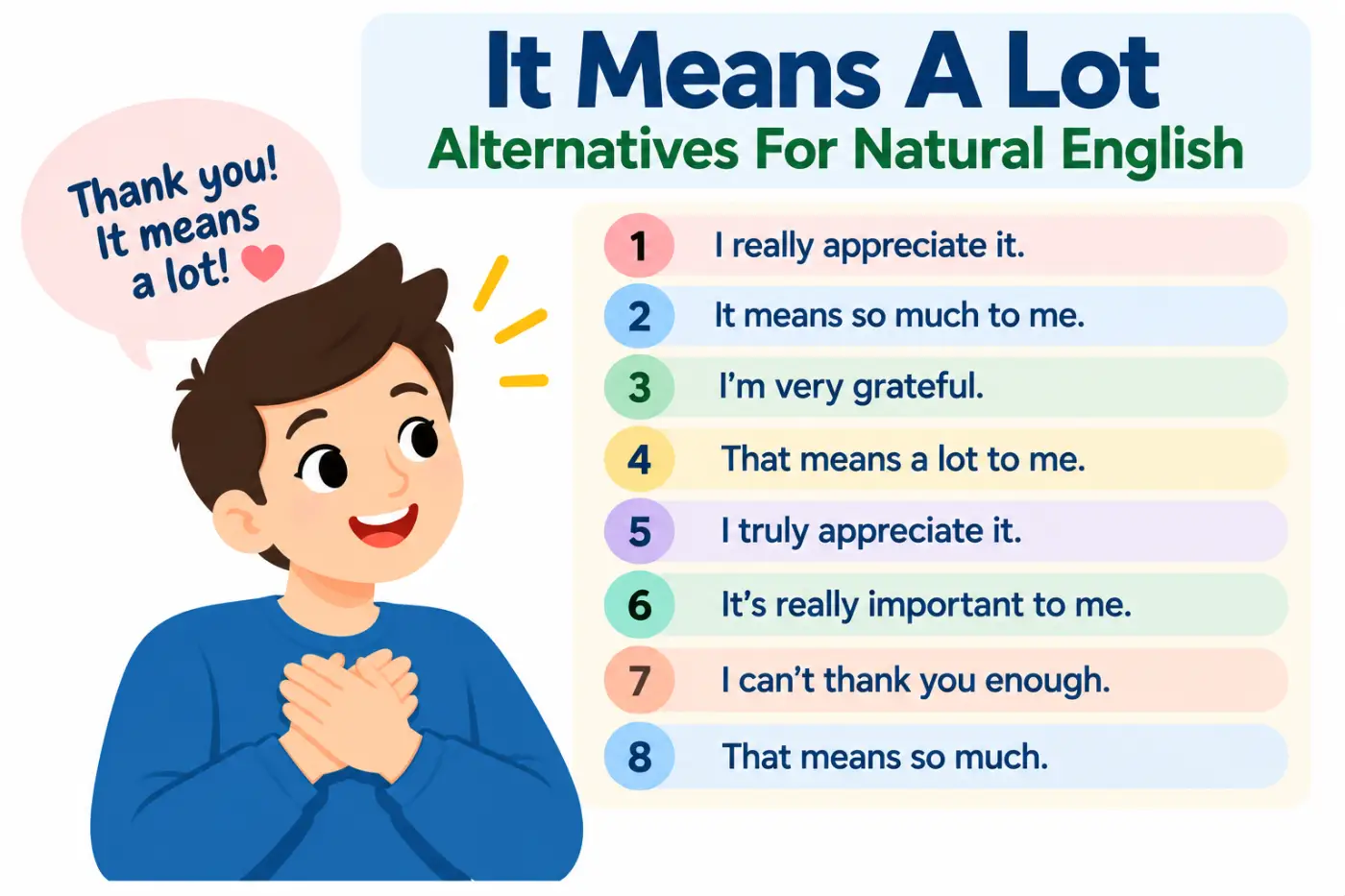
it means a lot alternatives can be useful when you want to express genuine appreciation without repeating the same phrase. The expression itself is completely natural English and often works beautifully. Still you may want something warmer for a personal message stronger for a heartfelt thank you or more professional for a workplace email. The best alternative depends on the relationship and the emotion behind your words.
English gives you many ways to communicate appreciation. You can say that you’re grateful. You can explain that someone’s kindness mattered to you. Each option carries a slightly different feeling. Some sound casual and friendly while others feel sincere and deeply personal.
This guide gives you practical alternatives with clear explanations and natural examples. You’ll learn which expressions work best in conversations texts professional messages academic settings cards and emotional moments. You’ll also see which phrases sound closest to the original and which ones add a stronger sense of gratitude or affection.
For another common grammar confusion, see Professional Apology Alternatives For Better Communication.
Quick Definition
Good alternatives include I really appreciate it, I’m very grateful, that means so much to me, I truly appreciate your kindness, I can’t thank you enough, I’m touched by your kindness, and I’m deeply grateful. The best choice depends on how strong the emotion is and how formal the situation feels.
Quick Answer
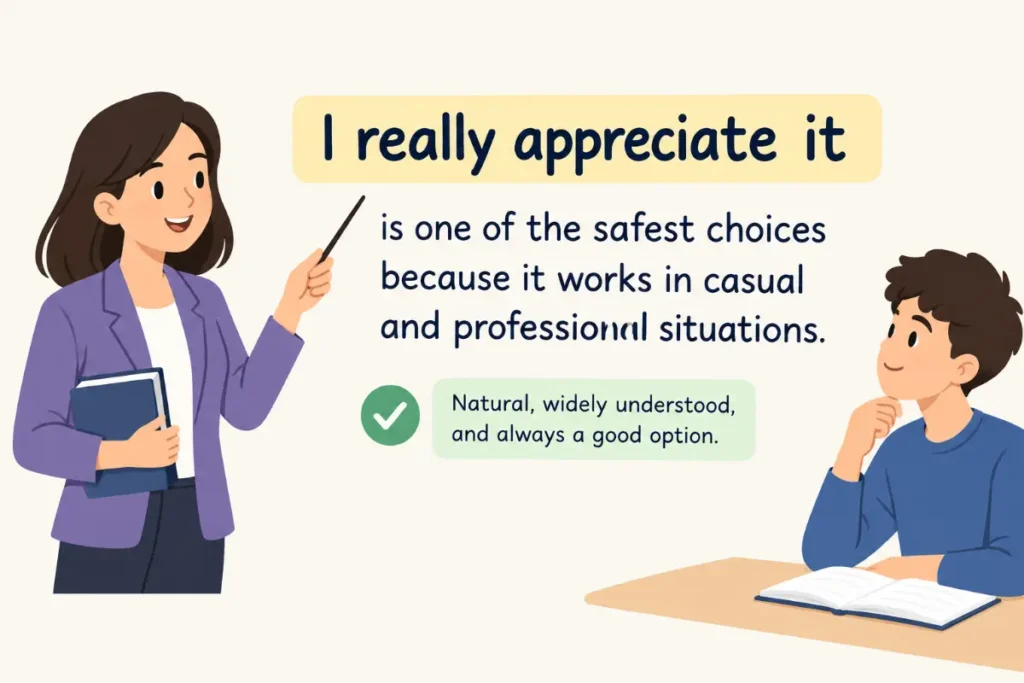
The phrase is natural and widely understood. If you want a fresh alternative, I really appreciate it is one of the safest choices because it works in casual and professional situations.
For a warmer message, that means so much to me sounds personal and sincere. For a stronger expression of gratitude, I’m deeply grateful or I can’t thank you enough can communicate more emotion.
Comparison Table
| Expression | Main Meaning | Tone | Formality | Best Context | Emotional Strength | Example | Naturalness |
|---|---|---|---|---|---|---|---|
| I really appreciate it | Strong gratitude | Warm | Neutral | Daily talk and work | Medium | I really appreciate your help. | Very natural |
| I’m very grateful | Strong thankfulness | Sincere | Neutral to formal | Personal and professional | Medium to strong | I’m very grateful for your support. | Very natural |
| That means so much to me | Personal importance | Heartfelt | Informal to neutral | Friends family and personal messages | Strong | Your kind words mean so much to me. | Very natural |
| I truly appreciate it | Genuine gratitude | Polished | Neutral to formal | Emails and conversations | Medium | I truly appreciate your patience. | Very natural |
| I can’t thank you enough | Deep gratitude | Emotional | Informal to neutral | Personal favors and major help | Strong | I can’t thank you enough for being there. | Very natural |
| I’m deeply grateful | Profound appreciation | Sincere | Formal to personal | Serious or meaningful situations | Very strong | I’m deeply grateful for your support. | Natural |
| I’m touched by your kindness | Emotional appreciation | Warm | Neutral | Personal messages | Strong | I’m touched by your kindness. | Natural |
| You have no idea how much I appreciate this | Very strong gratitude | Emotional | Informal | Close relationships | Very strong | You have no idea how much I appreciate this. | Natural |
Meaning and Definition
What the original expression means
The phrase means that something has significant personal or emotional value to you. It often responds to an act of kindness support compliment gift favor or thoughtful gesture.
For example:
Thank you for checking on me. It means a lot.
The speaker isn’t simply saying thank you. They’re adding emotional weight. The kindness mattered.
That distinction explains why the expression appears so often in personal communication. A simple thank you acknowledges an action. This phrase tells the other person that their action had a deeper effect.
It can also describe something that matters for reasons beyond emotion.
Your support means a lot to the team.
Here the speaker is saying that the support has real importance to the group.
Why people look for alternatives
Repeating the same expression can make your writing feel predictable. Sometimes you also need a phrase that matches a specific emotional level.
If someone holds a door open for you then I appreciate it may be enough. If someone supports you during a difficult period then I’m deeply grateful for everything you’ve done may fit better.
Context does the heavy lifting.
A strong writer doesn’t simply replace one phrase with another. They choose wording that matches the relationship the situation and the feeling.
The grammar behind the expression
The phrase normally uses the pronoun it to refer to an action event gesture or situation.
Your help means a lot.
Your message means a lot to me.
This opportunity means a lot to me.
The structure is simple.
Subject + means + a lot + optional to me.
The word means is a verb here. It describes significance or importance.
The phrase can also appear in the past tense.
Your support meant a lot to me.
This form works especially well when thanking someone for something that happened earlier.
Key Differences Between Common Alternatives
- I really appreciate it. This focuses directly on gratitude. It’s one of the most flexible choices because it sounds natural in a quick conversation and a professional email.
- I’m very grateful. This sounds slightly more serious. It works well when someone has done something meaningful for you.
- That means so much to me. This carries more emotional warmth. It’s especially useful when the other person has said or done something thoughtful.
- I truly appreciate it. This sounds polished and sincere. It fits professional communication without feeling stiff.
- I can’t thank you enough. This suggests that ordinary thanks don’t feel strong enough to match your gratitude.
- I’m deeply grateful. This is stronger and more serious. Use it for major support or meaningful moments rather than small everyday favors.
- I’m touched by your kindness. This emphasizes the emotional effect of someone’s action.
- You have no idea how much I appreciate this. This is highly expressive and usually works best with someone you know well.
Which Alternative Should You Choose?
The safest general replacement is I really appreciate it. It sounds natural and doesn’t force a particular level of emotion.
If you’re writing to a close friend then that means so much to me can feel more personal.
If someone went far beyond what you expected then I can’t thank you enough gives the message more weight.
The key is to match the wording to the situation. A casual favor doesn’t need an emotional speech. A major act of kindness deserves more than a flat thank you.
Sentence Examples
Here are natural examples you can use in real communication.
- I really appreciate everything you did for me.
- I’m very grateful for your support during the project.
- That means so much to me. Thank you for remembering.
- I truly appreciate you taking the time to help.
- I can’t thank you enough for coming to my graduation.
- I’m deeply grateful for everything you’ve done.
- Your kind message really touched me.
- I’m so thankful that you were there when I needed someone.
- Your support has made a bigger difference than you realize.
- I’m incredibly thankful for your thoughtfulness.
These expressions don’t all have exactly the same emotional color. That’s a good thing. You can choose the one that sounds most like you.
Natural Alternatives for Different Situations
For everyday conversation
In everyday speech you usually want something short and effortless.
I really appreciate it.
Thanks. I really appreciate your help.
That means a lot.
I’m so grateful.
Thanks for doing that. I really appreciate you.
These phrases sound natural because they don’t overstate the emotion. They’re warm without becoming dramatic.
For a text message
Text messages allow more emotional flexibility.
That means so much to me ❤️
I really appreciate you being there.
You honestly have no idea how much this means to me.
I’m so grateful for you.
Thank you. I needed that more than you know.
The best text depends heavily on your relationship with the recipient. With a close friend you can be more expressive. With someone you barely know a simpler expression usually feels more comfortable.
For a professional email
Professional communication benefits from clarity and restraint.
I really appreciate your assistance.
Thank you for your support. I truly appreciate it.
I’m very grateful for your time and consideration.
I sincerely appreciate your help with this matter.
Thank you for taking the time to review the document. I greatly appreciate your feedback.
These options communicate gratitude without sounding overly emotional.
For a friend
Friendship allows warmer language.
That means so much to me.
I’m so grateful you were there for me.
I honestly can’t thank you enough.
You have no idea how much I appreciate you.
I’m lucky to have a friend like you.
For a romantic partner
A romantic message can carry more emotional depth.
Your support means more to me than I can explain.
I’m so grateful to have you in my life.
Your kindness always touches my heart.
I appreciate everything you do for me.
I don’t take your love or support for granted.
The strongest messages usually sound personal rather than polished. Specific details often make them more meaningful.
Alternatives for Formal Writing
Formal writing needs a slightly different approach. You generally want to avoid overly emotional expressions unless the subject itself is personal.
Useful choices include:
- I sincerely appreciate your assistance.
- I greatly appreciate your consideration.
- I’m grateful for your support.
- Your assistance is greatly appreciated.
- I’m thankful for your time and attention.
- I appreciate your continued support.
- I’m grateful for your contribution.
- Your support has been invaluable.
The phrase your support has been invaluable is particularly useful in formal communication. It communicates strong appreciation without sounding overly sentimental.
For example:
Your guidance throughout the project has been invaluable.
That sentence works well in a professional thank you message.
Alternatives for Deep Emotional Gratitude
Sometimes a simple appreciation phrase doesn’t feel strong enough. You may be thanking someone who helped you through grief illness hardship a major transition or another life changing event.
In those moments you can say:
I’m deeply grateful for everything you’ve done.
I’ll always be grateful for your kindness.
Your support meant more to me than I can put into words.
I’ll never forget what you did for me.
Your kindness made a difficult time easier.
I’m incredibly thankful that you were there.
I don’t have the words to express how grateful I am.
These expressions work because they focus on emotional impact rather than simply acknowledging the favor.
Alternatives for Thanking Someone for a Gift
A gift usually deserves a response that recognizes both the item and the thought behind it.
You could say:
Thank you so much. I absolutely love it.
That was incredibly thoughtful of you.
I’m so grateful for the gift.
You picked the perfect gift for me.
It was so kind of you to think of me.
I really appreciate the thought behind this.
Your gift made my day.
The thoughtfulness behind the gift means so much to me.
Notice the difference between thanking someone for an object and thanking them for the thought behind it. The second approach often sounds more personal.
Still confused? Compare email closings instead of sincerely: Better Options.
Alternatives for Someone Who Helped You
When someone gives practical help you can make your gratitude specific.
I really appreciate you taking the time to help me.
Thank you for stepping in when I needed help.
I’m so grateful you were available.
Your help made everything much easier.
I couldn’t have done this without your help.
Thanks for going out of your way for me.
I really appreciate everything you did.
Your support made a real difference.
Specific gratitude usually sounds more genuine than a generic compliment. Instead of simply saying you appreciate someone say what they did and explain the effect.
Common Mistakes
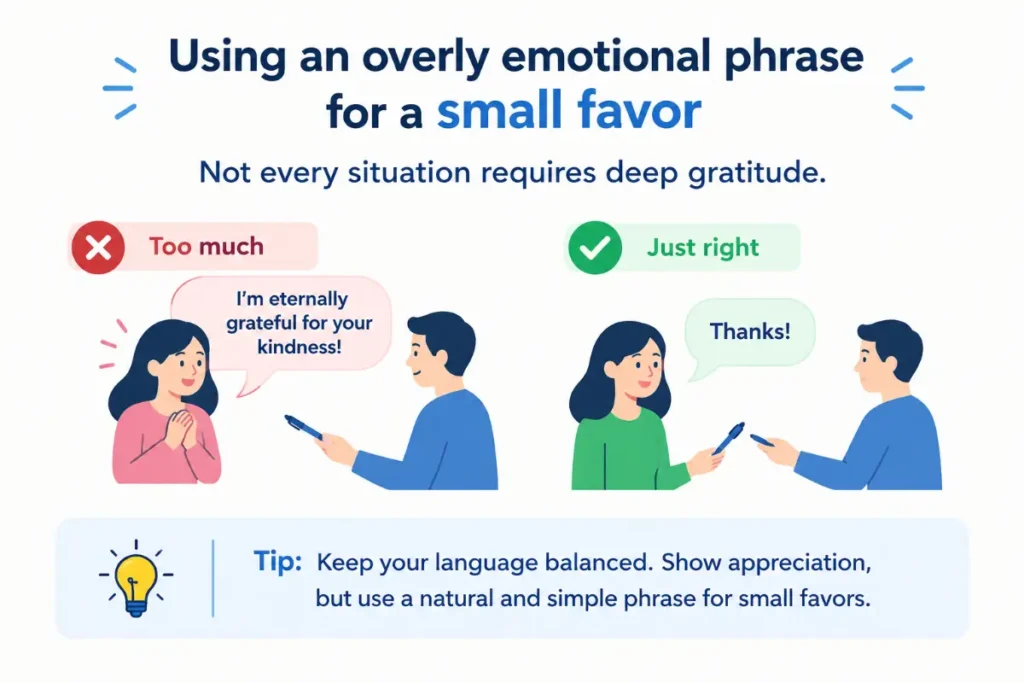
Using an overly emotional phrase for a small favor
Not every situation requires deep gratitude.
If someone passes you a pen you probably don’t need to say I’m eternally grateful for your kindness.
A simple thanks or I appreciate it sounds more natural.
Using formal language with close friends
Saying I sincerely appreciate your assistance to your best friend can sound strangely official.
Language should fit the relationship.
Repeating the same expression
If every thank you message contains the same phrase your writing can start to sound mechanical.
Try changing the wording based on the situation.
Confusing appreciation with agreement
Appreciating something doesn’t mean you agree with it.
I appreciate your opinion means you recognize the value of someone sharing their thoughts. It doesn’t necessarily mean you share the same view.
Making gratitude vague
A specific message often has more impact.
Instead of saying I appreciate everything you’ve done you might say I really appreciate you staying late to help me finish the presentation.
The second version gives the recipient something concrete to remember.
Pronunciation Guide
The main expressions in this topic are generally easy to pronounce because they use familiar everyday words.
Appreciate is commonly pronounced /əˈpriːʃiˌeɪt/.
A simple approximation is uh PREE shee ayt.
The stress falls mainly on the second syllable.
Grateful is pronounced /ˈɡreɪtfəl/.
You can think of it as GRAYT full.
Sincere is commonly pronounced /sɪnˈsɪr/ in American English.
You can think of it as sin SEER.
Appreciation is commonly pronounced /əˌpriːʃiˈeɪʃən/.
You can think of it as uh PREE shee AY shun.
A common pronunciation mistake is trying to pronounce every letter too strongly. Natural American English often reduces unstressed vowels. Listening to the rhythm of the entire phrase can help you sound more natural.
Etymology and Word Origin
The word appreciate has an interesting connection to value. It comes through French from Latin roots associated with setting a price or estimating value.
Over time English expanded the meaning beyond financial value. Today appreciate can refer to recognizing the worth importance beauty quality or kindness of something.
That development explains why the word works so naturally in expressions of gratitude. When you say you appreciate someone’s help you’re saying that you recognize its value.
The word gratitude has a different history. It comes from Latin gratus which means pleasing thankful or grateful. The same root is connected to words related to grace and thankfulness.
These historical connections reveal something useful about modern English. Words that once described value or pleasantness can develop into everyday expressions of emotional appreciation.
Regional Usage
American English
American English commonly uses appreciate and grateful in both casual and professional communication. I really appreciate it is especially common in everyday speech. Americans also frequently use that means a lot to me in personal conversations and messages.
The expressions sound natural across age groups and social settings. The main difference usually comes from context rather than geography.
British English
British English uses the same core expressions. I really appreciate it and I’m grateful are both standard and natural.
You may notice differences in conversational style or preferred wording from person to person but there’s no major regional rule that changes the meaning of these expressions.
Australian English
Australian English also uses these expressions naturally. Casual communication may favor shorter phrases such as really appreciate it or thanks so much.
Formal Australian writing can use appreciate and grateful in much the same way as American and British English.
Canadian English
Canadian English follows the same general pattern. Appreciate and grateful are common in personal and professional communication.
The choice usually depends on the level of formality and emotional intensity rather than a Canadian spelling or grammar difference.
Grammar Rules and Part of Speech
The expression usually contains a verb phrase built around mean.
Consider this sentence:
Your support means a lot to me.
The subject is your support. The verb is means. The phrase a lot functions as the measure of importance. The words to me identify the person who feels that importance.
You can change the tense.
Your support means a lot to me.
Your support has meant a lot to me.
The basic meaning stays connected to personal significance.
You can also change the subject.
Your message means a lot to me.
This opportunity means a lot to me.
Her friendship means a lot to me.
That gesture meant a lot to him.
The construction works with people too.
You mean a lot to me.
This sentence has a slightly different structure because you are directly telling someone about their importance to you.
It can sound deeply affectionate depending on the relationship. Friends family members and romantic partners may all use it.
Punctuation
When the expression appears inside a normal sentence you don’t need special punctuation.
Your support means a lot to me.
If it starts a sentence after a short introductory phrase you can use standard punctuation based on the sentence structure.
Thank you. It means a lot to me.
The two short sentences create a natural conversational rhythm.
Real Life Usage Examples
Daily Conversation
Example one
Thanks for picking me up. I really appreciate it.
This sounds natural because the favor is practical and the gratitude is direct.
Example two
You remembered my birthday. That means so much to me.
The second sentence adds emotional warmth because remembering the birthday shows thoughtfulness.
Email and Workplace Communication
Example one
Thank you for reviewing my proposal. I really appreciate your feedback.
This is friendly but still professional.
Example two
I’m very grateful for your guidance throughout the project.
This works well when someone has provided meaningful professional support.
Academic Writing
Example one
The researchers expressed their appreciation for the participants’ time and cooperation.
This version is more appropriate for academic prose because it avoids conversational language.
Example two
The authors acknowledge the assistance provided by the research team.
Academic writing often prefers concise and objective wording instead of emotional expressions.
News and Journalism
Example one
The mayor thanked volunteers for their efforts during the emergency.
News writing generally reports appreciation rather than reproducing casual personal language.
Example two
The organization expressed gratitude to donors who supported the relief effort.
This sounds appropriate for a formal report or news story.
Literature and Storytelling
Example one
She looked at him and told him that his kindness had meant more to her than he could know.
The wording creates emotional depth without sounding like ordinary workplace language.
Example two
He never forgot the people who had stood beside him during those difficult years.
This expresses lasting gratitude indirectly. Good storytelling often lets actions carry the emotion.
Related and Confused Terms
Appreciation
Appreciation means recognizing the value or importance of something. It can describe gratitude but can also refer to understanding or admiration.
Gratitude
Gratitude is a strong feeling of thankfulness. It often sounds deeper and more formal than a simple expression of appreciation.
Thankfulness
Thankfulness describes the feeling of being thankful. It’s common in personal and reflective writing.
Recognition
Recognition focuses on acknowledging someone’s contribution achievement or effort. It doesn’t always carry the same emotional warmth as gratitude.
Respect
Respect means having regard for someone’s qualities abilities or character. You can respect someone without feeling grateful to them.
Admiration
Admiration means strong approval or appreciation of someone or something. It can exist without a favor or act of kindness.
Appreciation for your help
This is a useful workplace expression because it clearly identifies the reason for the gratitude.
I’m grateful for your support
This is a strong general expression that works in both personal and professional contexts.
How to Make Your Gratitude Sound More Genuine
The strongest thank you messages usually contain a specific detail.
Compare these two messages.
Thanks for your help.
Thank you for staying late and helping me finish the presentation. I really appreciate it.
Both are correct. The second feels more personal because it tells the recipient exactly what you noticed.
Specificity creates sincerity.
You can also mention the effect of the person’s action.
Your advice helped me feel much more confident.
Your support helped me get through a stressful week.
This approach works especially well in professional communication because it shows that you noticed the person’s contribution.
Another useful technique is to avoid exaggeration. Strong words lose their effect when you use them for every small favor. Save deeply emotional expressions for moments that truly deserve them.
Expert Editor Insight
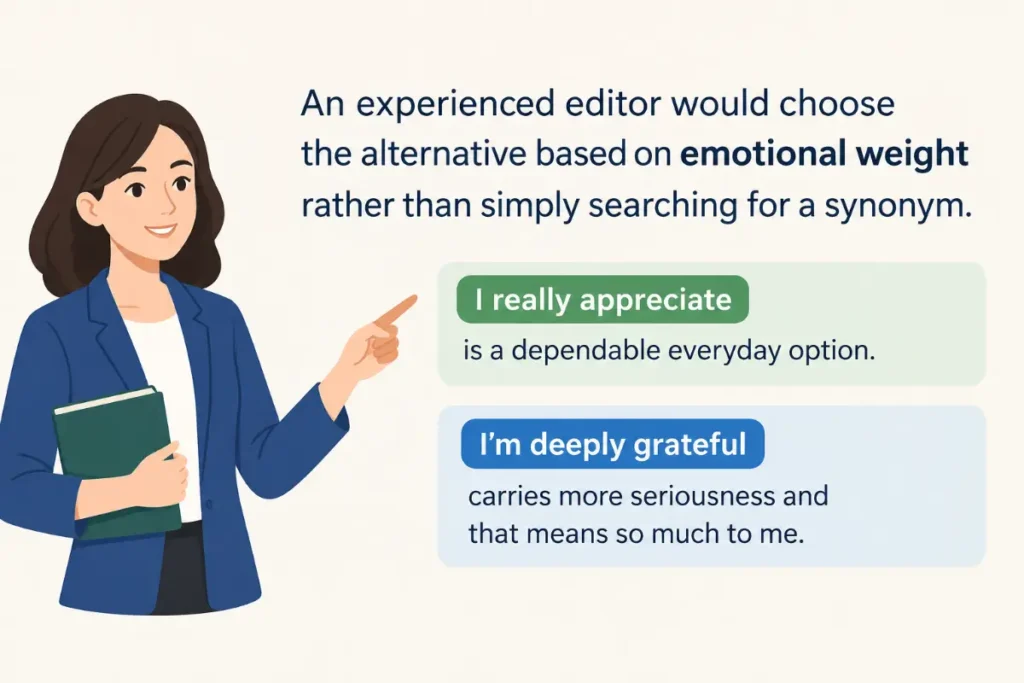
An experienced editor would choose the alternative based on emotional weight rather than simply searching for a synonym. I really appreciate it is a dependable everyday option while I’m deeply grateful carries more seriousness and that means so much to me feels more personal. Editors also watch for repetition and mismatch. A polished professional email usually benefits from calm direct language while a message to a close friend can sound warmer and more expressive. Grammar tools may identify awkward phrasing but they can’t always judge the emotional fit between a sentence and its situation. That judgment comes from context.
Need another quick comparison? Read Are You Free Alternatives for Natural English used in 2026.
Conclusion
it means a lot alternatives give you plenty of ways to express genuine gratitude without sounding repetitive. The safest everyday choice is I really appreciate it while that means so much to me adds a warmer and more personal feeling. For serious situations I’m deeply grateful or I can’t thank you enough can communicate stronger emotion.
The best expression depends on the person you’re speaking to and the reason for your gratitude. A quick favor may need only a simple thank you. A meaningful act of support deserves more thoughtful wording. Professional messages usually benefit from calm and specific language while personal messages can be warmer.
One practical editing tip is to name what the person actually did. Instead of simply saying you appreciate them explain how their help affected you. Specific gratitude feels more genuine and gives your words a human touch.
FAQs
What is another way to say it means a lot to me?
Good alternatives include that means so much to me, I really appreciate it, I’m very grateful, I truly appreciate your kindness, and I’m deeply grateful. The best choice depends on the situation. That means so much to me sounds personal while I really appreciate it works across many everyday and professional situations.
What is the most natural way to express gratitude?
I really appreciate it is one of the most natural choices in American English. It works after a favor a helpful comment professional assistance or a thoughtful gesture. For stronger emotion you can say I’m deeply grateful or I can’t thank you enough. Specific wording often sounds more sincere than a general thank you.
Can I use these alternatives in a professional email?
Yes. Professional emails often use phrases such as I really appreciate your assistance, I sincerely appreciate your time, I’m grateful for your support, and thank you for your consideration. Avoid overly emotional wording when the relationship is formal. A short specific expression usually sounds more polished than an exaggerated statement.
What is a stronger way to express gratitude?
For strong gratitude you can say I’m deeply grateful, I can’t thank you enough, your support has meant so much to me, or I’ll always be grateful for your kindness. These expressions carry more emotional weight than a basic thank you. Choose them for meaningful favors major support or moments that had a lasting effect.
Is that means so much to me grammatically correct?
Yes. That means so much to me is a standard and natural English sentence. That functions as the subject while means is the verb. The phrase a lot or so much expresses the degree of importance and to me identifies the person experiencing that importance. The sentence is especially common in personal conversations.
What is the difference between appreciate and grateful?
Appreciate is a verb while grateful is an adjective. You can say I appreciate your help or I’m grateful for your help. Both express thankfulness but they have slightly different grammatical structures. Appreciate can also mean recognizing value or quality while grateful more directly describes a feeling of thankfulness.
How can I sound sincere without sounding overly emotional?
Be specific about what you appreciate. Instead of using very strong emotional language for every situation explain what the person did and why it helped. For example I really appreciate you taking the time to explain that sounds sincere without becoming dramatic. Matching your wording to the situation also makes gratitude feel more authentic.
Is this kind of expression appropriate in formal writing?
The underlying idea is appropriate in formal writing but the exact wording depends on the document. Academic and business writing often favors expressions such as appreciation gratitude acknowledgment or recognition. Personal letters and speeches can use warmer language. In formal contexts keep the message clear and purposeful rather than overly emotional.