
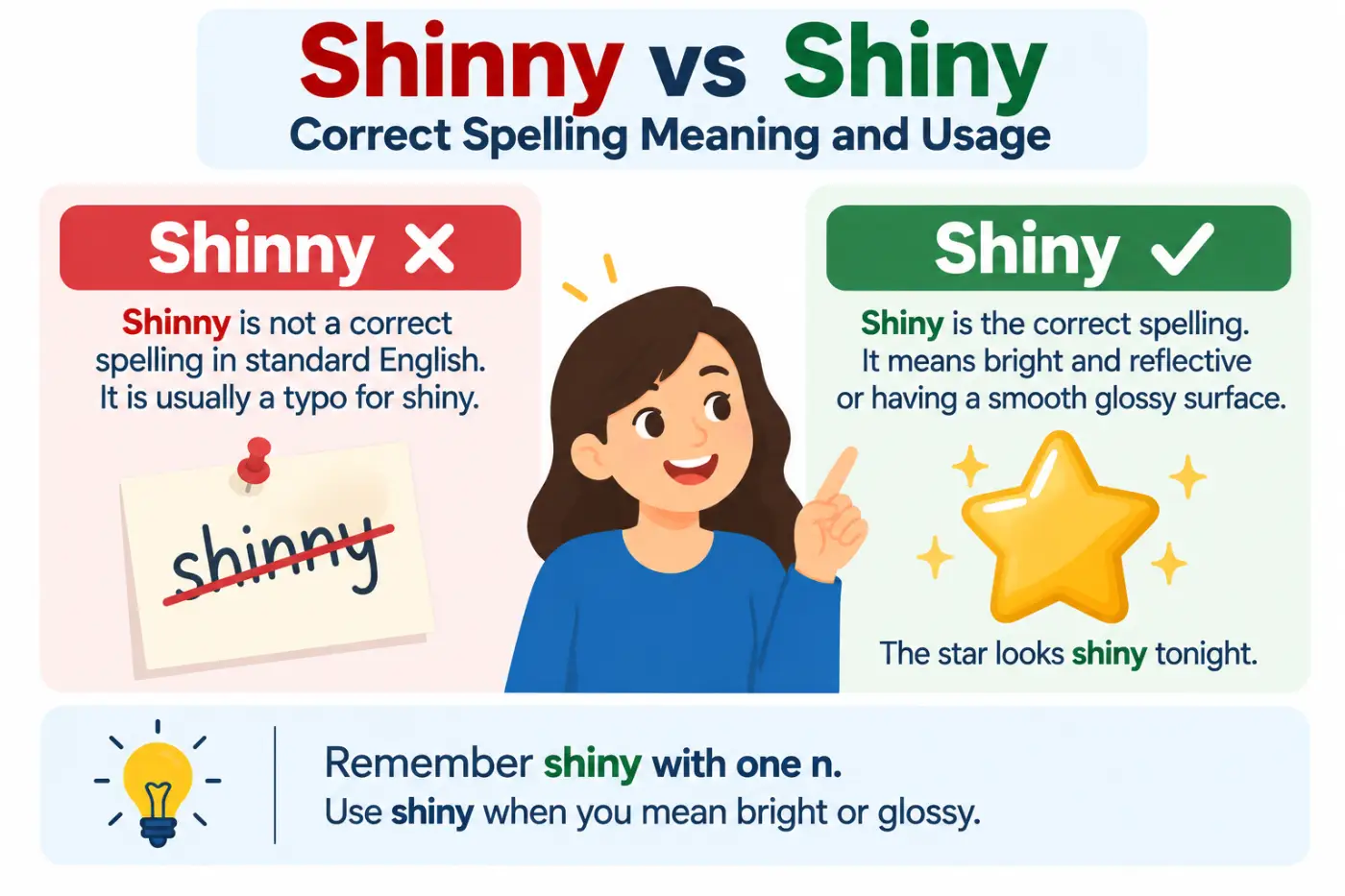
shinny vs shiny can be confusing because the words look almost identical and differ by only one letter. Both are real English words but they describe very different ideas. Shiny is the word you need when you mean something that reflects light or has a bright polished appearance. Shinny is a different word with a much less common meaning.
The confusion usually comes from the way the two forms look on the page. If you see a sentence about a bright car a polished table or glossy shoes then shiny is almost certainly the intended word. Shinny appears mainly in specific contexts connected with a type of informal hockey game and can also function as a verb in that context.
That small spelling difference changes the meaning completely. This guide explains both words in plain English so you can choose the right one without guessing. You’ll learn their definitions pronunciation grammar history regional use common mistakes and natural examples. You’ll also see why adding one letter can turn an everyday description into a completely different word.
Learn the difference in hall vs haul: Correct Spelling, Meaning and Usage.
Quick Definition
Shiny is an adjective meaning bright smooth polished or reflective. Shinny is a legitimate but uncommon word that refers to an informal form of hockey or a game played with a stick and ball or puck. They sound similar in some varieties of English but have different meanings and uses.
Quick Answer
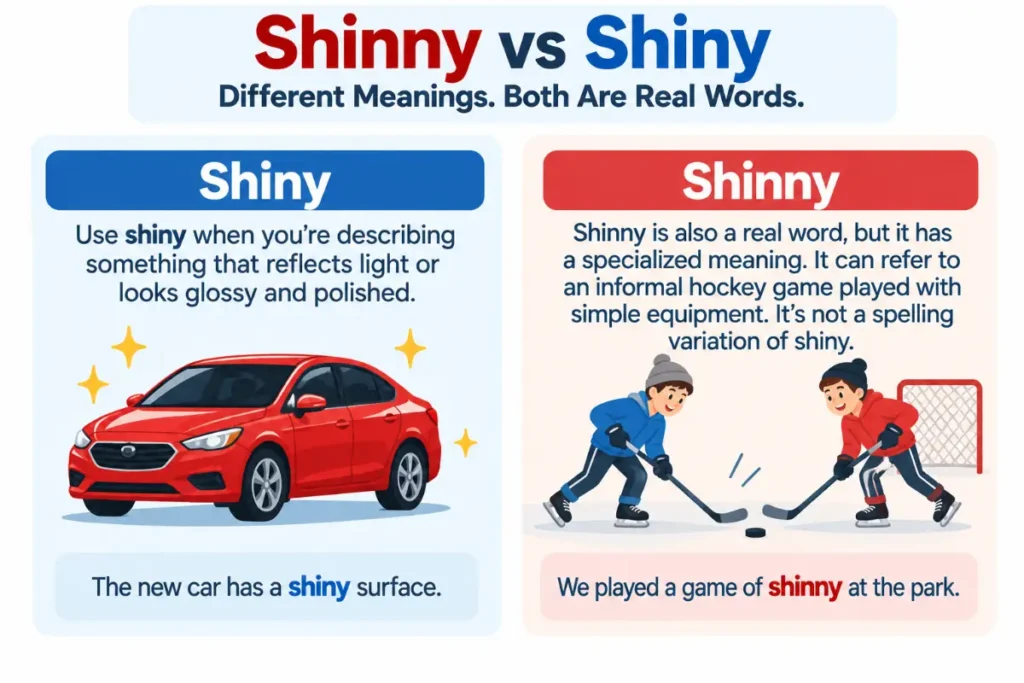
Use shiny when you’re describing something that reflects light or looks glossy and polished. For example you can say The new car has a shiny surface. Shinny is also a real word but it has a specialized meaning. It can refer to an informal hockey game played with simple equipment. It’s not a spelling variation of shiny.
Comparison Table
| Form | Meaning | Part of Speech | Origin | Usage Frequency | Formality | Common Contexts | Example |
|---|---|---|---|---|---|---|---|
| Shiny | Reflecting light or having a bright polished surface | Adjective | From shine with the adjective ending y | Very common | Neutral | Clothing metal hair cars surfaces objects | Her shoes look shiny after polishing. |
| Shinny | An informal hockey game or a game played with a stick and ball or puck | Noun and verb | Connected with older English and Scots usage related to informal stick games | Uncommon | Informal or specialized | Hockey history regional speech sports writing | The children played shinny on the frozen pond. |
Meaning and Definition
Meaning of Shiny
Shiny is an adjective. It describes something that reflects light strongly from its surface.
A shiny object can look bright glossy smooth or polished. The surface might be naturally reflective or it might have been cleaned polished coated or treated to create that appearance.
You might describe a new car as shiny. You might also talk about shiny shoes a shiny floor shiny hair or shiny metal.
The word comes from shine. The basic relationship is easy to see.
Shine is the action or quality connected with giving off or reflecting light.
Shiny describes something that has that visual quality.
For example:
The floor is shiny after it was cleaned.
Her new shoes are shiny.
The silver spoon has a shiny surface.
Shiny doesn’t always mean perfectly smooth. A surface can have some texture and still reflect enough light to appear bright or glossy. The central idea is visual brightness or reflectiveness.
The word can also describe hair or skin. In those cases it may suggest a surface that reflects light because of oil moisture or natural texture.
For example:
His hair looked shiny in the sunlight.
The word can sometimes have a negative meaning depending on context. A person might describe an overly oily face as shiny. The meaning still comes from the same basic idea of reflected light.
Meaning of Shinny
Shinny is a legitimate English word but it’s far less common than shiny.
As a noun it refers to an informal form of hockey. Traditional forms of shinny have often been played with basic equipment rather than the formal equipment used in organized hockey. The exact rules and equipment can vary by place and tradition.
The word can also be used as a verb. To shinny means to play this informal game.
For example:
The kids went outside to play shinny.
They were shinnying on the pond.
This word appears most often in discussions of hockey history regional sports traditions and informal games. You’re unlikely to use it in ordinary conversation unless the context specifically involves that type of game.
That difference matters because some readers assume the extra n is simply a spelling mistake. It isn’t. Shinny has its own meaning and history.
The Key Difference Between The Words
The easiest way to separate these terms is to think about the subject of the sentence.
If you’re describing an object that reflects light use shiny.
If you’re talking about an informal hockey game use shinny.
Consider these two sentences:
The car is shiny.
The children played shinny.
The first sentence describes appearance. The second describes a sport or game.
The spelling difference is small but the semantic difference is large. This is a classic example of how English can use closely related letter patterns for unrelated meanings.
Here are the main distinctions.
- Meaning. Shiny describes appearance. Shinny refers mainly to an informal hockey game or the act of playing it.
- Part of speech. Shiny is an adjective. Shinny is mainly a noun and can also work as a verb.
- Frequency. Shiny is common in everyday English. Shinny is comparatively uncommon and tends to appear in specific sports or regional contexts.
- Context. Shiny belongs in descriptions of surfaces objects hair eyes materials and appearances. Shinny belongs mainly in discussions of informal hockey.
- Pronunciation. The words are similar in sound but the middle consonant pattern differs. Shiny normally has the sound associated with shine. Shinny has the shorter vowel sound found in words such as thin.
- Spelling. Shiny contains one n. Shinny contains two n letters.
- Formality. Shiny is neutral and works in casual and formal writing. Shinny is informal or specialized because its meaning is tied to a particular type of game.
The key lesson is simple. Don’t choose between the forms based only on appearance. Choose the word based on meaning.
Which Form Should You Use?
Neither word is automatically wrong. The right choice depends on what you’re trying to say.
Use shiny when the subject has a bright reflective or glossy appearance.
Use shinny when you mean the informal hockey game or the activity associated with it.
This distinction follows normal dictionary practice. Dictionaries treat these as separate lexical items rather than alternate spellings of one word. That matters because the two words have different meanings parts of speech and histories.
If you’re writing about a polished table then shinny would be incorrect.
The table has a shiny surface.
If you’re writing about children playing an informal hockey game then shiny would change the meaning.
The children played shinny.
A useful editing test is to replace the word with a simple definition. If you can replace it with bright or glossy then shiny is probably right. If you can replace it with informal hockey then shinny is the better choice.
Sentence Examples With Shiny
The adjective appears naturally in many areas of everyday English.
- The new kitchen floor looks shiny after a good cleaning.
- She wore shiny black shoes to the event.
- Sunlight bounced off the shiny surface of the car.
- His hair looked shiny after he washed it.
- I bought a shiny silver notebook for school.
- The children were fascinated by the shiny shells on the beach.
- The table became shiny after Dad polished it.
- Her new phone has a smooth shiny finish.
- The bright lights made the wet road look shiny.
- He chose a shiny ribbon to wrap the gift.
Notice how each example deals with appearance. The word describes something that catches or reflects light.
Sentence Examples With Shinny
The less common noun and verb appear mainly in sports related contexts.
- The children played shinny on the frozen pond.
- We learned about shinny while studying the history of hockey.
- The neighbors organized a casual shinny game during winter.
- They spent the afternoon shinnying on the outdoor rink.
- Local families still enjoy shinny when the pond freezes.
These sentences make the meaning clear because the surrounding words establish a sports context.
Common Mistakes And Misspellings
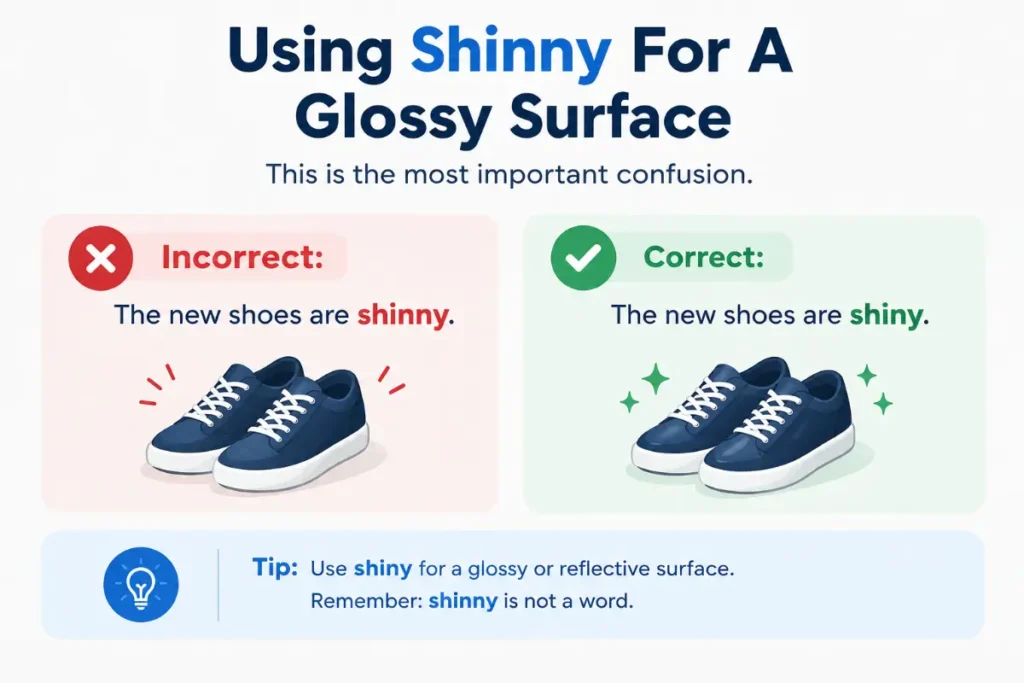
Using Shinny For A Glossy Surface
This is the most important confusion.
Incorrect:
The new shoes are shinny.
Correct:
The new shoes are shiny.
The writer probably intends to describe the appearance of the shoes. The extra n changes the word into a different term.
Using Shiny For Informal Hockey
The reverse mistake can happen when someone has heard the sports term but doesn’t know its spelling.
Incorrect:
The children played shiny on the pond.
Correct:
The children played shinny on the pond.
The context involves a game so the sports term is needed.
Confusing The Vowel Sound
The words have similar spelling patterns but their vowels differ in common pronunciation.
Shiny is connected to shine and normally has the long i sound.
Shinny normally has the short i sound found in words such as win and thin.
Listening carefully can help you distinguish them.
Adding An Extra N To Shiny
People sometimes write shinny because English contains many words with doubled consonants. That pattern is real but it doesn’t apply here.
The adjective comes from shine and is spelled shiny.
Treating Shinny As A Typo
This mistake is less obvious. If you see shinny in a sports context you shouldn’t automatically correct it.
The word is legitimate.
A professional editor checks meaning before changing an unfamiliar word. That habit prevents real vocabulary from being incorrectly removed.
Pronunciation Guide
The two words are close in spelling but their vowel sounds help distinguish them.
Pronouncing Shiny
Shiny is commonly pronounced /ˈʃaɪni/.
You can think of the sound as:
SHY nee.
The first syllable receives the main stress.
The vowel in the first syllable is the long i sound found in words such as sky and bright.
The final part sounds like nee.
A common mistake is to pronounce the first part with a short i sound. That makes the word sound closer to shinny.
Pronouncing Shinny
Shinny is commonly pronounced /ˈʃɪni/.
A simple pronunciation guide is:
SHIH nee.
The first syllable has the short i sound found in words such as ship and thin.
Again the first syllable carries the main stress.
The difference between /aɪ/ and /ɪ/ is useful here.
Shiny has the sound in shine.
Shinny has the sound in shin.
That gives you a helpful memory trick. Think shine for the adjective and shin for the sports word.
Still confused? Compare totaled or totalled Correct Spelling and Usage.
Etymology And Word Origin
The history of shiny is closely tied to the much older word shine.
Shine has Germanic roots and has existed in English for many centuries. The word has long been connected with brightness light and reflection. Shiny developed naturally as an adjective describing something that shines or reflects light.
The structure is straightforward.
Shine becomes shiny.
The spelling changes slightly because the final e in the base word is removed before the adjective ending y is added.
Shinny has a different history. It is associated with informal forms of hockey and stick games. Historical usage connects the term with regional forms of English and Scots as well as older sporting traditions.
The exact form of the game has varied. In different communities people have used different equipment rules and playing surfaces.
That history explains why shinny feels unusual to many modern American readers. The word belongs to a specialized vocabulary area rather than ordinary everyday description.
The two words therefore look similar for accidental spelling reasons. They don’t come from the same modern word formation process.
Regional Usage
American English
American English uses shiny very frequently. You’ll hear and read it in ordinary descriptions of cars clothing shoes surfaces hair metal and many other things.
Shinny is much less common. When Americans use it they’re generally talking about an informal form of hockey or a related regional sporting tradition. Many readers may recognize the word only from sports writing or historical discussions.
British English
British English uses shiny in the same basic way. The adjective describes something bright reflective or polished.
Shinny can also refer to informal hockey or older stick games. Its use tends to be specialized rather than part of everyday vocabulary for most speakers.
Australian English
Australian English uses shiny as a normal adjective for describing reflective or glossy things.
Shinny is not a common everyday word in Australian English. When it appears the surrounding context normally makes the sporting meaning clear.
Canadian English
Canadian English provides an especially useful context for shinny because informal forms of hockey have a long cultural connection with outdoor winter play. The word can refer to casual hockey played outside a formal league structure.
Shiny remains the normal adjective for something that reflects light.
So regional differences don’t change the central distinction. Shiny describes appearance while shinny belongs mainly to sports vocabulary.
Grammar Rules And Part Of Speech
Shiny is an adjective.
An adjective describes a noun or gives information about it.
You can say:
A shiny car.
A shiny floor.
Shiny shoes.
A shiny surface.
In each phrase the adjective tells you something about the noun.
Shiny can also appear after a linking verb.
The floor looks shiny.
Her shoes are shiny.
The metal became shiny after polishing.
The word can describe a temporary condition or a lasting quality.
Shinny works mainly as a noun and can also function as a verb.
As a noun:
They played shinny after school.
As a verb:
The children were shinnying on the pond.
Because the noun and verb are less common you should rely heavily on context.
Punctuation doesn’t create a special rule for either word. Neither requires special punctuation simply because of its meaning.
The most important grammar rule is choosing the correct part of speech. You can’t replace an adjective with a noun and expect the sentence to keep the same meaning.
For example:
The car is shiny.
This sentence needs an adjective because shiny describes the car.
The children played shinny.
This sentence uses shinny as the name of an activity.
Real Life Usage Examples
Daily Conversation
Shiny is common in everyday speech because people often describe how things look.
That new bike is really shiny.
Your shoes look shiny after you cleaned them.
Shinny is much less likely to appear unless the conversation involves hockey.
The kids are playing shinny outside.
We used to play shinny on the pond.
Email And Workplace Communication
The adjective can appear naturally in professional communication when someone discusses design products materials or presentation.
The new display has a shiny finish that catches the light.
Please compare the matte version with the shiny version before we place the order.
Shinny would be unusual in ordinary workplace communication unless the email discusses sports or a local event.
Academic Writing
Academic writing may use shiny when discussing physical properties visual appearance materials or design.
The sample developed a shiny surface after treatment.
The researchers observed a shiny coating on the material.
Shinny could appear in historical or cultural research involving hockey traditions.
The article examines the role of shinny in Canadian winter culture.
News And Journalism
News writers commonly use shiny when describing vehicles buildings objects or surfaces.
The newly restored car rolled onto the stage with a shiny finish.
Rain left the streets shiny under the evening lights.
Shinny may appear in sports journalism or community reporting.
Residents gathered for a weekend shinny game.
The community rink remains popular for casual shinny during winter.
Literature And Storytelling
Writers often use shiny because it creates a quick visual image.
Moonlight reflected from the shiny surface of the lake.
She noticed a shiny key beneath the old wooden table.
Shinny can help establish a particular sports setting or regional atmosphere.
The boys hurried toward the pond for a game of shinny.
They talked about old winters when shinny brought the whole neighborhood together.
Related And Confused Terms
Understanding nearby words can make the distinction even easier.
- Glossy. This describes a surface with a smooth reflective finish. It is often close in meaning to shiny.
- Polished. This can describe something made smooth or bright through cleaning or treatment. A polished surface may become shiny.
- Reflective. This describes something that reflects light or another image. It is more precise than shiny in some technical contexts.
- Bright. This is broader than shiny. Something can be bright because of color or light without having a reflective surface.
- Matte. This is an opposite or contrasting surface quality. A matte finish reflects less direct light and usually lacks a glossy appearance.
- Gloss. This is a noun describing a smooth bright surface quality or the visible shine produced by such a finish.
- Sheen. This refers to a soft or subtle surface shine. It often sounds more descriptive and less strong than shiny.
- Hockey. This is the broader sports term connected with the activity represented by shinny. Not every hockey game is shinny and not every use of hockey refers to informal play.
These related terms show why context matters. English has many words for visual appearance and many words connected with sports. A single extra letter can move a word from one semantic group to another.
How To Remember The Difference
A simple memory trick can save you from this mistake.
Think about shine.
Shiny comes from shine.
The spelling keeps the idea of light and brightness.
Now think about shin.
Shinny begins with shin and has the short i sound. It belongs to a completely different word family associated with an informal stick game.
You can also remember the vowel pattern.
Shiny sounds like shy.
Shinny sounds like shin.
Try saying these pairs aloud:
Shine and shiny.
Shin and shinny.
The connection becomes much easier to hear.
Another useful trick is to picture the meaning before spelling the word. If you see a polished car in your mind then choose the adjective connected with shine. If you picture people playing casual hockey then choose the sports term.
Meaning first. Spelling second.
That approach works well with many confusing English words.
Why The Confusion Is So Common
English spelling contains many pairs where a small letter change creates a completely different word. Readers often focus on the first and last parts of a word and process the middle quickly. That can make closely related visual patterns seem interchangeable.
The two forms also share the same beginning and ending. Both start with shin and end with y. Only the vowel pattern and number of n letters separate them.
Pronunciation adds another layer. If someone has never heard the sports term aloud they may assume shinny is simply another spelling of shiny. On the other hand someone who has only encountered the word in writing may not recognize its specialized meaning.
Typing can make the problem worse. When people write quickly they may rely on familiar spelling patterns rather than checking the word against its meaning.
This is where context becomes powerful.
A sentence about polished shoes gives you a strong clue.
A sentence about hockey gives you another.
Good readers don’t treat every unfamiliar word as an error. They look at the surrounding sentence first.
Standard Usage In Formal Writing
Shiny is perfectly acceptable in formal writing when its meaning fits the subject. It isn’t slang and it doesn’t carry an inherently casual tone.
For example:
The material developed a shiny surface after exposure to heat.
That sentence could appear in a technical report.
You can also use the word in professional descriptions.
The product has a shiny exterior and a smooth interior finish.
Shinny is also a legitimate word but its specialized nature means you should use it only when its meaning fits the subject. In a general business document it may seem unusual unless the topic involves hockey or regional culture.
Professional writing rewards precision. A familiar word isn’t always the best word and an uncommon word isn’t automatically wrong. The real test is meaning.
Expert Editor Insight
An experienced editor would not automatically change shinny to shiny. That would be a classic context error. If the sentence describes a surface then the adjective is clearly the intended form. If the sentence describes informal hockey then the less common sports term may be exactly right. Spellcheck tools can help catch accidental letter patterns but they can’t replace semantic judgment. My practical editing tip is to read the whole sentence before correcting an unfamiliar word. Meaning should guide the correction.
You may also want to read fulfilment or fulfillment Correct Spelling and Usage.
Conclusion
shinny vs shiny has a straightforward answer once you focus on meaning. Shiny is the adjective you use for something bright glossy polished or reflective. Shinny is a real but much less common word connected mainly with informal hockey and similar stick games. The extra n isn’t simply a spelling variation because it creates a different word.
The easiest way to remember the distinction is to connect shiny with shine and shinny with shin. If you’re describing a polished car or bright surface choose the form related to shine. If you’re talking about an informal hockey game use the sports term.
When proofreading look at the sentence before correcting the spelling. Context is your best guide and it helps you avoid changing a legitimate word into the wrong one.
FAQs
Is shinny a real word?
Yes. Shinny is a legitimate English word. It commonly refers to an informal form of hockey or a similar stick game played outside formal organized competition. The word can also function as a verb describing the activity. It is much less common than shiny in everyday English so readers may mistake it for a spelling error.
What does shiny mean?
Shiny is an adjective that describes something that reflects light or has a bright glossy appearance. You can use it for surfaces such as metal floors cars and shoes. It can also describe hair or other features that reflect light. The word comes from shine and expresses the visual quality associated with brightness or reflection.
Which spelling should I use for a reflective surface?
Use shiny when you’re describing something that reflects light or looks glossy. For example you can say The floor looks shiny after cleaning. The form shinny has a different meaning and usually refers to an informal hockey game. Choosing the correct form depends on the meaning you want rather than simply how familiar the spelling looks.
How do you pronounce shiny?
Shiny is commonly pronounced /ˈʃaɪni/. You can think of it as SHY nee. The first syllable carries the main stress and contains the long i sound found in shine. This pronunciation differs from shinny which normally uses the short i sound found in shin. Hearing the vowel difference can help you keep the two words separate.
How do you pronounce shinny?
Shinny is commonly pronounced /ˈʃɪni/. A simple guide is SHIH nee. The first syllable uses the short i sound found in words such as shin and ship. The word is normally associated with informal hockey or related stick games. Learning the pronunciation alongside the meaning can make the unusual spelling much easier to remember.
Is shiny appropriate in formal writing?
Yes. Shiny is a standard adjective and works in formal academic professional and technical writing when the context calls for it. It can describe the appearance of materials objects surfaces and other things that reflect light. The word isn’t limited to casual speech. Its suitability depends mainly on the subject and the level of detail required.
Why do people confuse these two words?
The words look very similar and share the same beginning and ending. The main visual difference is the extra n in shinny while the main sound difference involves the vowel. People who know only one of the terms may assume the other is simply a spelling mistake. Context usually makes the intended meaning clear once you know both words.
Is shinny only related to hockey?
Shinny is strongly associated with informal hockey and related stick games. The exact form of the activity can vary by region and tradition. It may involve simple equipment and informal rules rather than organized competition. Because the term is specialized it doesn’t appear often in ordinary conversation. When you encounter it in sports or cultural writing the meaning is usually clear from context.