
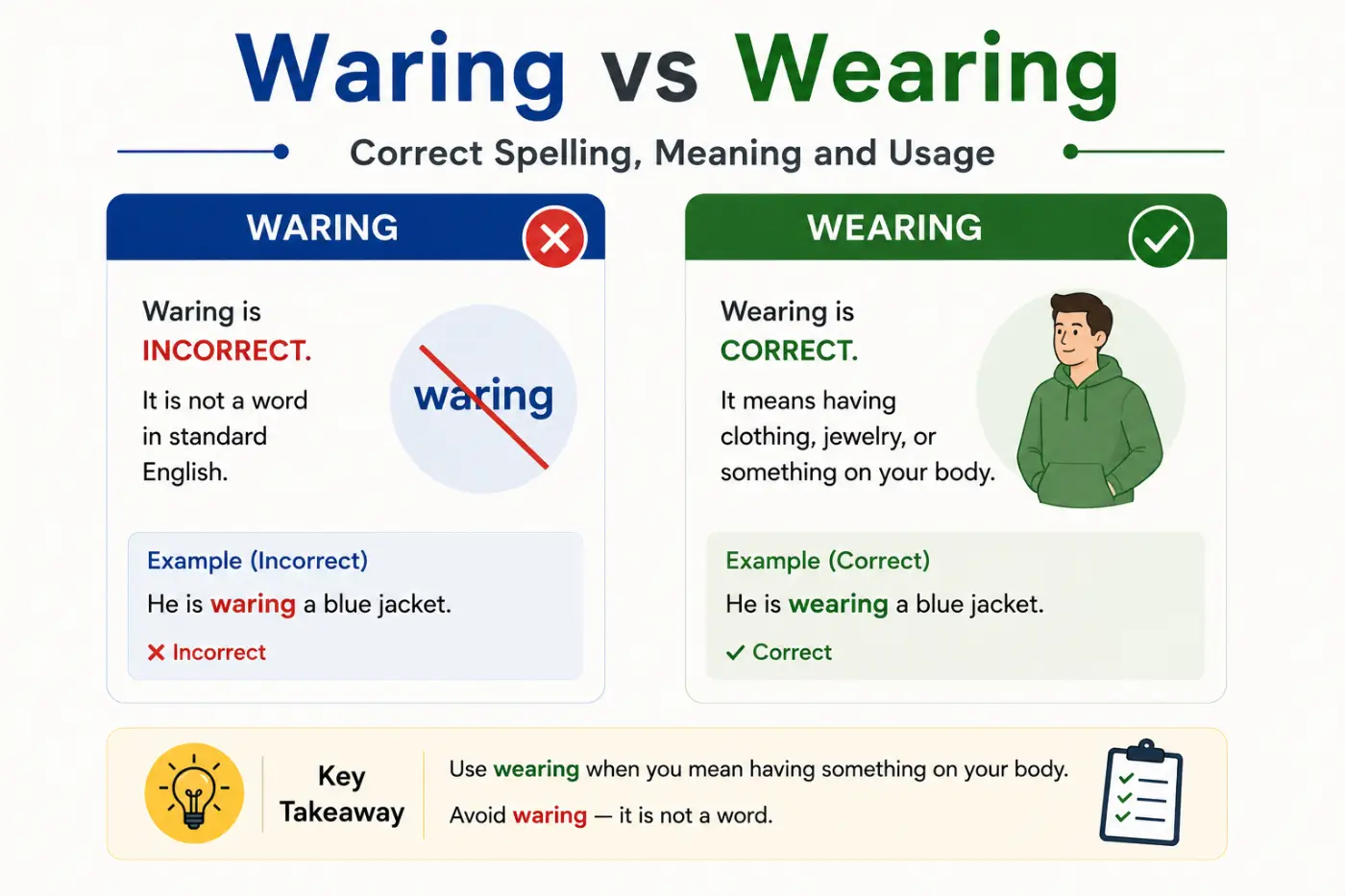
If you searched for waring vs wearing because you weren’t sure which spelling belongs in a sentence you’re not alone. These two forms look almost identical and sound very similar in fast speech. The difference comes down to one important letter and the meaning you intend.
Wearing is the standard English word when you mean having clothes jewelry glasses shoes or another item on your body. It can also describe gradual damage caused by continued use. For example you can say that someone is wearing a blue shirt or that the carpet is wearing thin.
Waring is generally not the standard spelling for this meaning. It may appear as a surname or in a proper name but it isn’t the normal spelling of the everyday word. This guide explains the difference clearly so you can recognize the correct form quickly and use it with confidence.
You may also want to read Maintained vs Maintenancede Grammar and Examples 2026.
Quick Answer
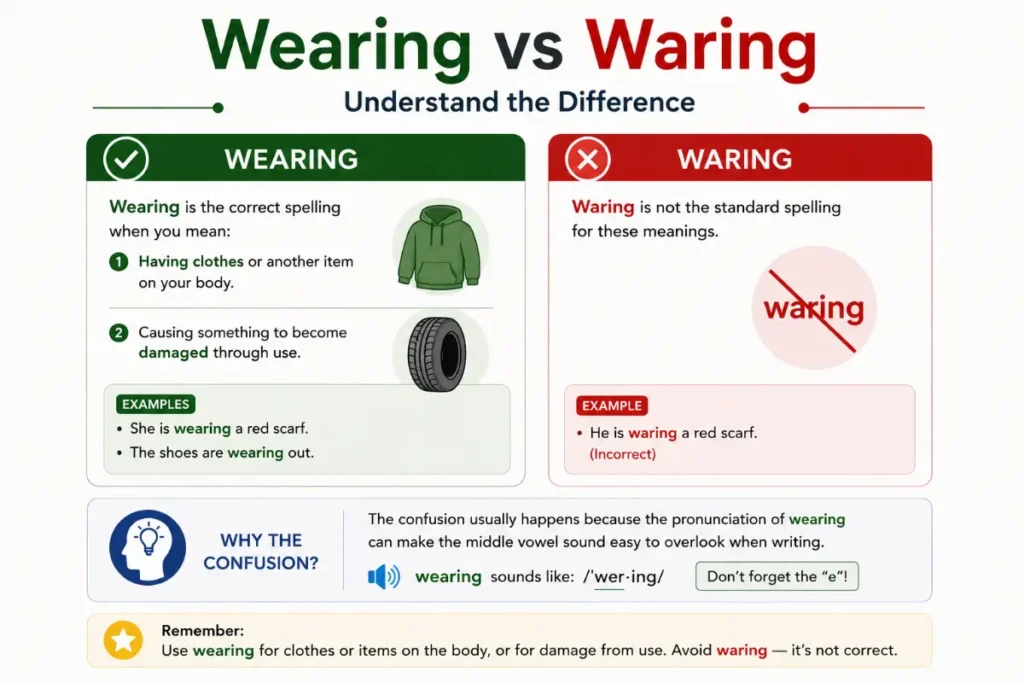
Wearing is the correct spelling when you mean having clothes or another item on your body or causing something to become damaged through use. Waring is not the standard spelling for these meanings. The confusion usually happens because the pronunciation of wearing can make the middle vowel sound easy to overlook when writing.
Comparison Table
| Form | Meaning | Part of Speech | Origin | Usage Frequency | Formality | Common Contexts | Example |
|---|---|---|---|---|---|---|---|
| Wearing | Having something on the body or gradually using something down | Verb form and adjective | From Old English wearian | Very common | Standard | Clothing fashion equipment materials | She is wearing a green jacket. |
| Waring | Usually a surname or proper name rather than the everyday verb form | Proper noun when used as a name | Family name usage | Rare in ordinary vocabulary | Context dependent | Names and proper nouns | Mr. Waring spoke at the meeting. |
What Wearing Means
Wearing is the present participle and gerund form of the verb wear. The most familiar meaning relates to clothing and personal items. When you wear something you have it on your body. You can wear a shirt a coat a hat a watch glasses shoes or jewelry.
For example:
- Maria is wearing a black dress.
- I was wearing my new shoes at the party.
- He always wears glasses when he reads.
- They were wearing matching jackets.
The word can also describe the gradual damage that happens through use. A tire wears down. A floor wears out. A machine part can wear away after repeated friction.
For example:
- The soles of these shoes are wearing thin.
- The old carpet is wearing out.
- The constant friction is wearing the surface away.
This second meaning is easy to miss because many people first learn wear as a word connected with clothing. In reality the verb has a much wider range of uses.
Is Waring A Correct English Word
In ordinary English waring is not the standard spelling of the word used for clothing. You may still encounter Waring in English because it can function as a proper name. A surname is not the same thing as an ordinary vocabulary word. Names can have spellings that don’t follow the spelling patterns you expect from common English words. This distinction matters when you see the form in a document or online. If someone writes Waring as part of a person’s name then changing it to wearing would be incorrect because proper names need to retain their established spelling. However if you are writing about clothes and you type waring then you almost certainly need wearing. The easiest test is simple. Ask yourself what the word is doing in the sentence. If you mean having something on your body then the standard form is wearing.
Why People Confuse These Spellings
The confusion comes mainly from pronunciation and spelling patterns. The base verb is wear. When English adds the ending ing the written form becomes wearing. The spelling keeps the original letters of wear before the ending is added.
The problem is that English pronunciation doesn’t always give you a clear visual map of spelling. The word wear has the vowel sound /ɛə/ in many British pronunciations and is commonly pronounced /wer/ in American English. Wearing is commonly pronounced /ˈwerɪŋ/ in American English. Because the sound is smooth and the word is often spoken quickly the middle part can be easy to miss. Someone may hear the word as a simple sequence of sounds and reproduce it as waring. This is a classic spelling problem. Your brain recognizes the sound correctly but doesn’t always retrieve the correct written pattern immediately. Another reason is the common spelling pattern in English where a silent letter or unusual vowel combination represents a familiar sound. The letters in wear don’t behave exactly as a learner might expect from their appearance.
The Grammar Behind Wearing
Understanding the grammar of wearing makes the spelling easier to remember. Wearing comes from the verb wear. The form can serve several grammatical roles.
Wearing As A Present Participle
The present participle appears with forms of the verb be to create progressive tenses.
For example:
- She is wearing a red coat.
- They were wearing uniforms.
- I am wearing my favorite sweater.
- He has been wearing those shoes all week.
In these sentences wearing describes an action or state connected with the subject.
Wearing As A Gerund
A gerund has the form of a present participle but functions like a noun.
For example:
- Wearing a helmet can protect your head.
- Wearing comfortable shoes makes long walks easier.
- Wearing formal clothes isn’t necessary for this event.
Here wearing refers to the activity itself.
Wearing As An Adjective
The form can also appear in adjective like constructions.
For example:
- She looked at the wearing of the fabric over time.
This use is less common in ordinary conversation. In many contexts English speakers prefer another structure that sounds more natural.
The important point is that all these forms come from wear. The spelling does not change to waring.
The Basic Spelling Rule
The simplest rule is to start with the base verb.
The base verb is wear.
Add ing.
The result is wearing.
The process looks like this:
- Wear.
- Add ing.
- Wearing.
You don’t remove the letters in the middle of the base word. The spelling stays connected to the original verb.
Compare this pattern with other common verbs:
- Hear becomes hearing.
- Bear becomes bearing.
- Tear becomes tearing.
- Wear becomes wearing.
Seeing these words together can make the pattern easier to remember. The spelling reflects the base forms hear bear tear and wear.
Which Form Is Correct
Use wearing when you mean having clothing or another item on your body. Use wearing when you mean gradually damaging or consuming something through continued use. Choose Waring only when it belongs to a proper name or another specific name based context. For ordinary English writing the choice is straightforward. If you want to say that someone has a shirt on you should write:
She is wearing a shirt.
You should not write:
She is waring a shirt.
The second form changes the spelling of the word and is considered an error in standard English.
Sentence Examples With Wearing
Natural examples help turn a spelling rule into something you can actually use.
- She is wearing a blue jacket today.
- I was wearing comfortable shoes during the trip.
- Are you wearing your glasses?
- He keeps wearing the same black sweater to work.
- The children were wearing school uniforms.
- She loves wearing bright colors in summer.
- I’m wearing a new pair of shoes tonight.
- The workers were wearing protective clothing.
- The fabric is wearing thin after years of use.
- The old steps are wearing down from constant traffic.
These examples show that the word isn’t limited to fashion. It works in casual conversation professional settings descriptions and technical contexts.
Examples Of The Common Spelling Error
When the intended meaning relates to clothing the following form is incorrect:
Waring
For example:
- Incorrect: She is waring a red dress.
- Correct: She is wearing a red dress.
- Incorrect: He was waring his new shoes.
- Correct: He was wearing his new shoes.
- Incorrect: They are waring uniforms today.
- Correct: They are wearing uniforms today.
The mistake doesn’t change the intended meaning in most cases. A reader will usually understand the sentence from context. Still the spelling should be corrected in schoolwork professional writing applications and published content.
Common Mistakes With This Word
Several spelling mistakes can appear around this word. Most happen because writers rely on sound instead of the base spelling.
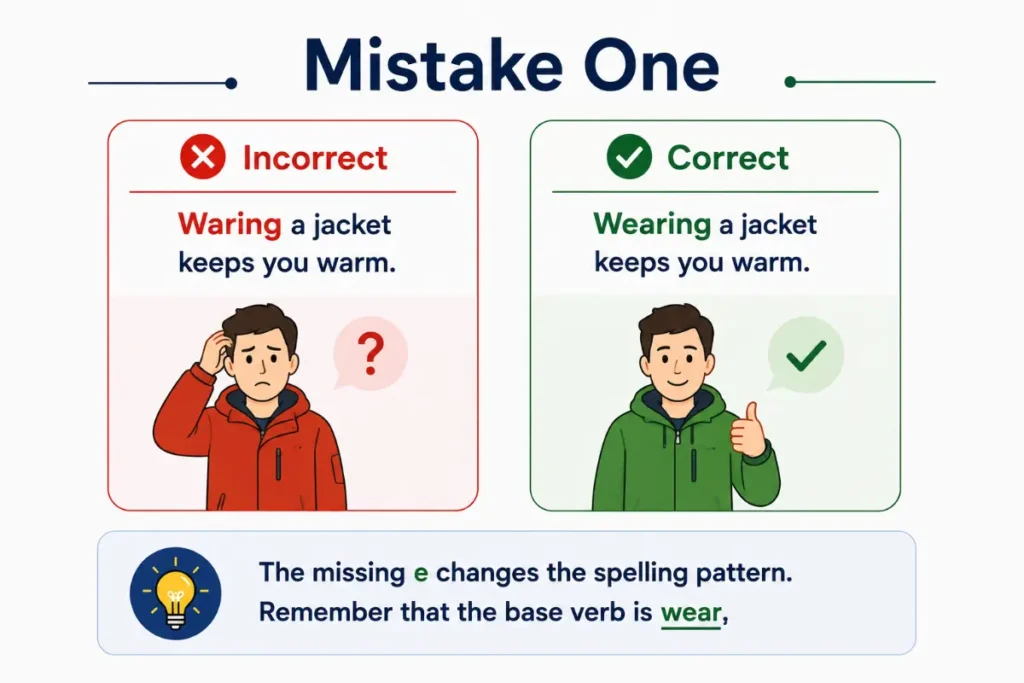
Mistake One
Incorrect: Waring a jacket keeps you warm.
Correct: Wearing a jacket keeps you warm.
The missing e changes the spelling pattern. Remember that the base verb is wear.
Mistake Two
Incorrect: She is wareing a coat.
Correct: She is wearing a coat.
Some writers insert an extra vowel because they try to represent the pronunciation visually. The correct form simply adds ing to wear.
Mistake Three
Incorrect: He is wearring a hat.
Correct: He is wearing a hat.
The extra r doesn’t belong in the word. The base form already ends with r.
Mistake Four
Incorrect: She was weiring a dress.
Correct: She was wearing a dress.
This error comes from trying to spell the sound rather than remembering the original word.
Mistake Five
Incorrect: I am wareing my new shoes.
Correct: I am wearing my new shoes.
The correct spelling preserves the base verb wear before adding ing.
Pronunciation Guide
In American English wearing is commonly pronounced /ˈwerɪŋ/. You can think of it as two syllables: wear ing The first syllable carries the main stress. A simple pronunciation guide is: WAIR ing The beginning sounds like the word wear. The ending sounds like ing. The word waring doesn’t normally function as the everyday verb form that people intend when discussing clothes. That means you shouldn’t use pronunciation as the main test for deciding the spelling. The better approach is to identify the base word. If you mean the action connected to wear then keep the spelling connected to wear. This is a useful editing habit. When a spelling feels uncertain ask yourself what the base word is. That question often solves the problem faster than sounding out every letter.
Etymology And Word Origin
The verb wear has a long history in English. It comes from Old English werian and is related to older Germanic words associated with clothing and having something on the body. Over time the word developed into the modern English verb wear. Its meanings expanded beyond clothing and came to include ideas connected with use damage endurance and gradual reduction. The modern form wearing simply combines the established verb wear with the present participle ending ing. This history also explains why the spelling doesn’t look exactly like the pronunciation. English inherited many words from earlier stages of the language and retained spelling patterns even as pronunciation changed. That pattern appears throughout English. The written form often preserves historical information that modern speech no longer makes obvious.
American English Usage
In American English wearing is the normal spelling and is extremely common.
You will see it in everyday speech writing workplace communication school assignments product descriptions fashion writing and news reporting.
For example:
- What are you wearing tonight?
- She was wearing a business suit.
- He isn’t wearing his glasses.
- The paint is wearing away.
There is no special American spelling that changes wearing into waring.
If you are writing for an American audience the standard choice remains wearing.
British English Usage
British English also uses wearing for the same ordinary meanings.
There is no major British spelling difference that turns wearing into waring.
For example:
- She is wearing a jumper.
- He was wearing his coat.
- The carpet is wearing badly.
The vocabulary surrounding clothing can differ between American and British English. Americans may say sweater while British speakers often say jumper. Americans may say sneakers while British speakers commonly say trainers. The spelling of wearing itself does not change.
Australian English Usage
Australian English also uses wearing as the standard form.
The same basic grammar applies. A person wears clothing and objects can wear down after repeated use.
For example:
- She’s wearing a jacket today.
- Those boots are wearing out.
There is no standard Australian spelling rule that changes wearing to waring.
A related grammar guide is Precede vs Proceed: Meaning and Correct Usage.
Canadian English Usage
Canadian English follows the same standard spelling for this word.
You can write:
- He is wearing a winter coat.
- She was wearing boots.
- The tires are wearing down.
Canadian English contains features from both American and British English but this particular spelling does not create a meaningful regional distinction.
Wearing In Formal Writing
Wearing is completely appropriate in formal English when the meaning calls for it. You can use it in academic writing professional reports business communication and formal descriptions. For example: Employees must wear appropriate protective equipment in designated areas. You could also write: The study examined how wearing protective equipment affected worker comfort. The word itself isn’t informal. Its suitability depends on the sentence and the context. The same applies to many ordinary verbs. A common word can still belong in formal writing when it expresses the exact idea clearly.
Wearing In Informal Conversation
In everyday conversation wearing is one of the most natural words you can use.
People regularly ask:
- What are you wearing?
- Are you wearing a jacket?
- Why are you wearing those shoes?
- Is she wearing makeup?
These sentences sound ordinary and natural to American English speakers. You don’t need a more complicated synonym. In fact replacing wearing with a less common expression can make a simple sentence sound stiff. Clear writing often means choosing the familiar word that says exactly what you mean.
Wearing And Wear
A useful way to avoid the spelling error is to understand the relationship between wear and wearing. Wear is the base form. Wearing is the ing form.
Compare these sentences:
- I wear glasses every day.
- I am wearing glasses now.
- She wears a uniform at work.
- She is wearing her uniform today.
The first sentence in each pair describes a general habit. The second describes something happening or existing around the current time. The spelling stays connected to the same base verb. This connection is your strongest memory tool.
Wearing And Worn
Another related form is worn.
Wear has several forms:
- Wear.
- Wears.
- Wearing.
- Wore.
- Worn.
These forms don’t all follow the same spelling pattern because wear is an irregular verb.
For example:
- I wear these shoes often.
- She wears a uniform.
- They are wearing coats.
- He wore a blue shirt yesterday.
- The shoes are worn.
Knowing these forms helps you recognize the word family. If you can connect wearing with wear then the spelling becomes much easier to remember.
Wearing And Putting On
Wearing and putting on aren’t identical. Putting on describes the action of placing clothing on your body. Wearing describes having the clothing on your body.
Compare:
She is putting on her coat.
This means she is in the process of getting the coat onto her body.
She is wearing her coat.
This means the coat is already on her body.
The difference is small but useful. It shows why choosing the right word depends on the exact action you want to describe.
Related And Confused Terms
Several words belong to the same semantic group as wearing.
Wear
Wear is the base verb. It can describe having clothing on the body or gradually damaging something through use.
Wears
Wears is the third person singular present form of wear.
Example:
She wears glasses every day.
Wore
Wore is the simple past form.
Example:
He wore a black suit yesterday.
Worn
Worn is the past participle.
Example:
The carpet looks worn.
Dressing
Dressing can refer to putting on clothes or choosing clothes for a particular purpose.
Example:
She is dressing for the ceremony.
Clothing
Clothing is a noun that refers to garments collectively.
Example:
The store sells clothing for all seasons.
Outfit
An outfit is a set of clothes worn together.
Example:
Her outfit looked perfect for the event.
Attire
Attire is a more formal noun for clothing.
Example:
Formal attire is required for the ceremony.
These words overlap in meaning but they aren’t interchangeable in every sentence. Good word choice depends on the action and context.
Real Life Usage Examples
Daily Conversation
In casual speech people use wearing constantly.
- What are you wearing to dinner?
- I’m wearing jeans and a sweater.
These sentences are simple and natural. They don’t need formal alternatives.
Workplace Communication
The word also appears in workplace instructions.
- Employees must wear identification badges while on site.
- Staff members are required to wear protective equipment in restricted areas.
The grammar remains simple even though the setting is formal.
Academic Writing
Academic writing can use wearing when discussing behavior clothing materials or physical effects.
- Wearing protective equipment can reduce exposure to workplace hazards.
- Researchers examined the effects of wearing specialized clothing during physical activity.
The word works well because it communicates the action directly.
News And Journalism
News writing may use the word when describing people or events.
- The athlete was wearing a team jacket during the interview.
- The witness said the person was wearing a dark coat.
The form remains the same. Context determines the meaning.
Storytelling
Wearing is also common in descriptive writing.
- She entered the room wearing a bright yellow dress.
- The traveler arrived wearing a dusty coat after the long journey.
This structure is especially useful because it gives readers a quick visual detail without adding unnecessary words.
How Editors Catch This Error
Professional editors don’t usually correct this mistake by relying on pronunciation alone. They look at the sentence and identify the intended base word. If a sentence says that someone has clothing on the body the editor checks for the word wear. That immediately points to wearing. This method works because English spelling often becomes easier when you trace an inflected form back to its base form.
For example:
- Wearing comes from wear.
- Hearing comes from hear.
- Bearing comes from bear.
- Tearing comes from tear.
The spelling becomes easier to verify when you stop treating the word as an isolated group of letters.
A Simple Memory Trick
Think of the phrase: Wear plus ing equals wearing. The word wear is sitting right inside the answer. If you can remember the base verb you can usually rebuild the correct form. Another useful mental image is clothing. Imagine a person putting on a jacket. Say the sentence in your head: She is wearing a jacket. The visual connection between the action and the spelling can make the correct form easier to recall. Don’t try to memorize the incorrect form. Every time you see it simply connect the intended meaning back to the base verb wear.
Why Spelling Tools May Flag Waring
A spelling checker may flag waring in a sentence about clothing because the software recognizes that the intended standard word is likely wearing. Context aware grammar tools can sometimes detect more than simple spelling errors. They may use surrounding words to determine what a writer probably intended. For example:
She is waring a coat. The words she is and a coat strongly suggest that the missing form is wearing. Still no software should replace basic language knowledge. A spell checker can miss errors or suggest a change that doesn’t fit the context. The final decision belongs to the writer or editor. The safest approach is to understand the word family and then use the spelling that matches the intended meaning.
Does Waring Ever Need A Capital Letter
Yes when Waring is used as a proper name it normally begins with a capital letter. For example: Mr. Waring attended the meeting. Here Waring isn’t the ordinary verb form. It is a surname. This is an important distinction because a spelling checker may not always understand names correctly. A proper name can look like a misspelled common word while still being perfectly correct in context. So don’t automatically change every instance of Waring. First identify what the word represents. If it is someone’s established surname keep the name as written. If it describes clothing use wearing.
What Native Speakers Usually Write
Native English speakers use wearing for the everyday meaning connected with clothes.
A sentence such as:
She is wearing a red coat.
feels completely normal. A sentence such as:
She is waring a red coat.
looks like a spelling mistake. The difference is immediately visible to experienced readers because wearing is a common word. This is why getting the spelling right matters in professional and academic writing. Even a small error can interrupt the reader’s flow. The good news is that the fix is simple. Connect the form to the base verb wear.
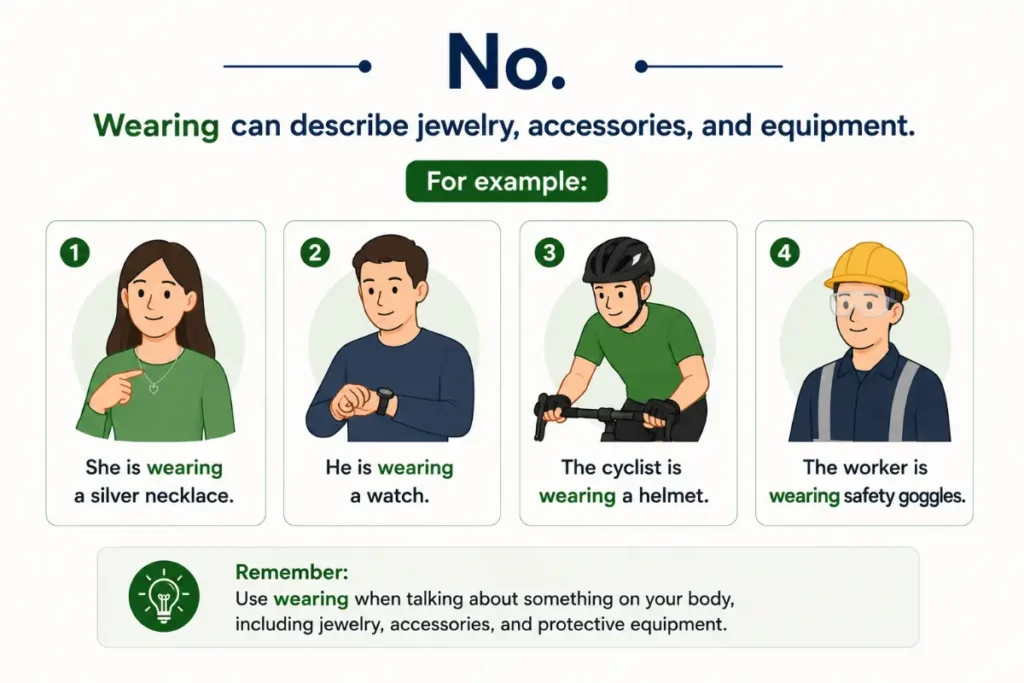
Is Wearing Always About Clothes
No.
Wearing can describe jewelry accessories and equipment.
For example:
- She is wearing a silver necklace.
- He is wearing a watch.
- The cyclist is wearing a helmet.
- The worker is wearing safety goggles.
It can also describe damage.
For example:
- The tires are wearing down.
- The paint is wearing away.
- The fabric is wearing thin.
This broader meaning comes from the verb wear itself. The common idea is continued contact use or presence over time.
Expert Editor Insight
An experienced editor usually solves this spelling problem by tracing the word back to its base form. If the sentence means that someone has clothes or another item on the body the base verb is wear and the correct form is wearing. Editors also check context before changing a word because Waring can be a legitimate surname. That small habit prevents two opposite mistakes: leaving a common spelling error untouched and incorrectly changing a proper name.
For another common grammar confusion, see Diddo or Ditto Correct Spelling and Meaning.
Final Takeaway
The difference between waring vs wearing is simple once you connect the word to its base form. Wearing is the standard English form for having clothing or another item on your body and for describing something that is gradually being damaged through use.
Waring isn’t the standard spelling for those meanings. It can still appear as a proper name such as a surname. The best editing trick is to ask what base word you need. If the answer is wear then adding ing gives you wearing. Remember that small connection and this common spelling problem becomes much easier to catch before it reaches your final draft.
Common Questions About The Spelling
Is Waring A Misspelling Of Wearing?
In ordinary writing about clothes waring is a misspelling of wearing. The standard form is wearing because it comes from the base verb wear plus the ending ing. Waring can appear legitimately as a surname or proper name but that is a different use and should not be confused with the everyday verb form.
What Does Wearing Mean?
Wearing usually means having clothing jewelry accessories glasses or another item on your body. It can also mean gradually becoming damaged through continued use. For example someone can be wearing a jacket while a tire can be wearing down after many miles of use.
Which Is Correct Waring Or Wearing?
Wearing is correct when you mean having something on your body or becoming damaged through use. Waring isn’t the standard spelling for these meanings. If Waring appears as someone’s surname then it can be correct as a proper name. Context determines which form belongs in the sentence.
How Do You Pronounce Wearing?
In American English wearing is commonly pronounced /ˈwerɪŋ/. It has two syllables with the main stress on the first syllable. An easy guide is to think of it as wear followed by ing. The pronunciation can make the spelling harder to remember so checking the base verb is more reliable.
Can Wearing Start A Sentence?
Yes. Wearing can begin a sentence when it functions as a gerund or participial phrase. For example: Wearing comfortable shoes can make a long walk easier. The word can also begin a descriptive phrase such as Wearing a dark coat she walked toward the station.
What Is A Synonym For Wearing?
The best alternative depends on the meaning. For having clothes on your body you might use dressed in or have on. For gradual damage you might use wearing down eroding or deteriorating. These alternatives aren’t exact replacements in every sentence so the original context matters.
Why Do People Misspell Wearing?
People often misspell wearing because English spelling doesn’t always match pronunciation closely. The vowel pattern in wear isn’t obvious from the sound alone and the word is commonly spoken quickly. Writers may therefore omit the e or change the vowel sequence. Remembering the base verb wear provides a reliable spelling shortcut.
Is Wearing Appropriate In Formal Writing?
Yes. Wearing is a standard English word and works perfectly well in formal writing when the meaning fits the sentence. You can use it in academic papers workplace documents reports and professional communication. Formal writing doesn’t require replacing ordinary accurate words with complicated alternatives.