
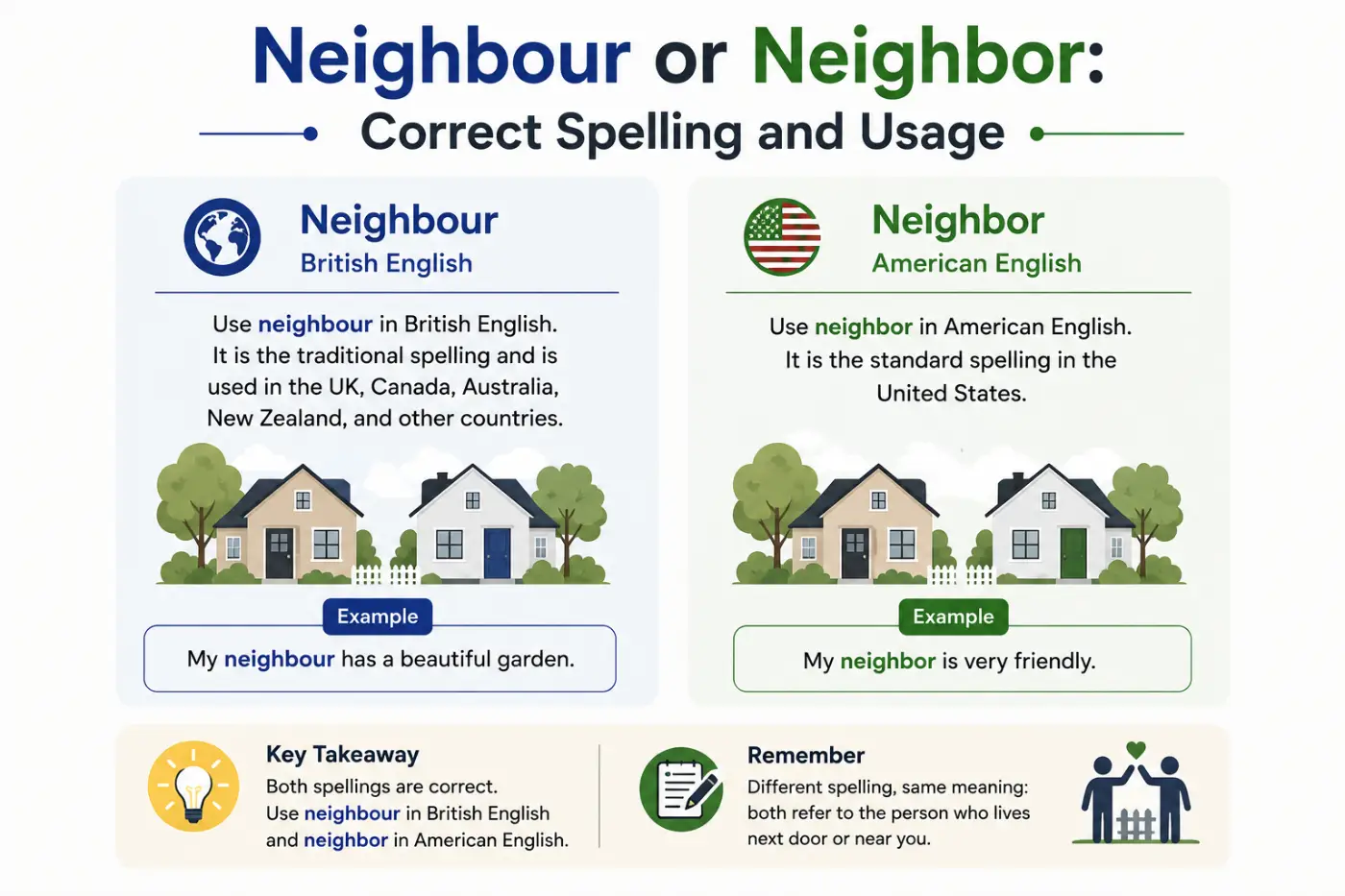
If you’ve ever stopped while writing and wondered if neighbour or neighbor is correct, you’re dealing with a regional spelling difference rather than a simple right or wrong spelling problem. Both forms are correct standard English. American English normally uses neighbor while British English normally uses neighbour.
The two words have the same meaning, the same pronunciation, the same grammatical role, and the same history. The only major difference is the spelling convention used by different English speaking communities. That small difference can still cause confusion because American and British English follow different patterns for several words that contain the letter combination our.
This guide explains the difference clearly. You’ll learn what each form means, where each spelling belongs, how to pronounce it, why the spellings developed differently, which form to use in formal writing, and how to avoid switching between regional styles by accident.
Need another quick comparison? Read counselor vs councilor: Meaning and Correct Usage.
Quick Answer
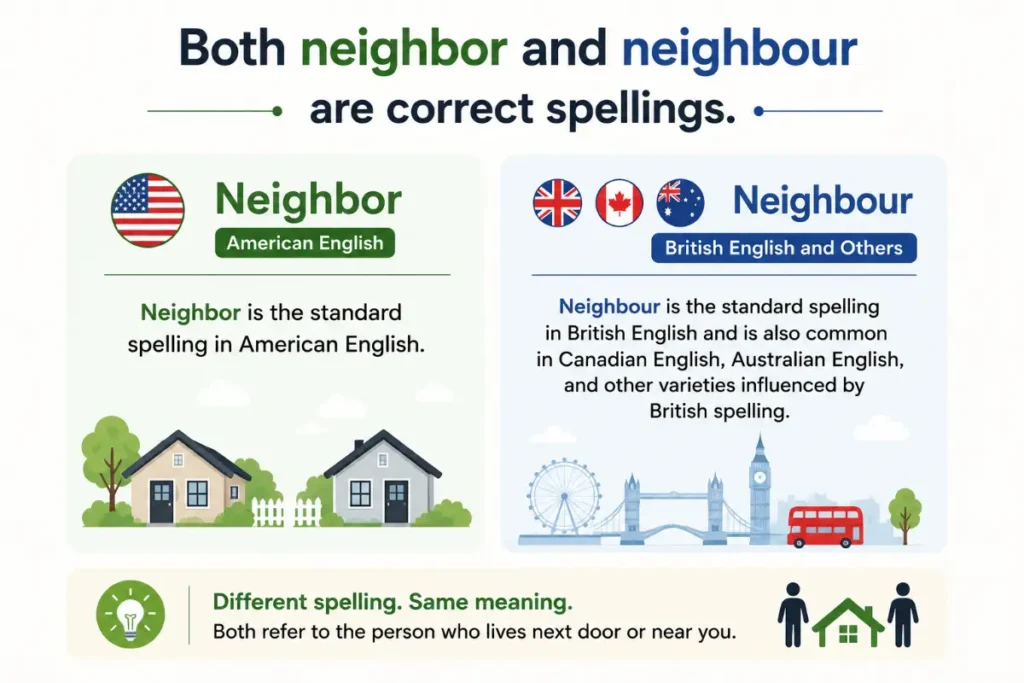
Both neighbor and neighbour are correct spellings. Neighbor is the standard spelling in American English. Neighbour is the standard spelling in British English and is also common in Canadian English, Australian English, and other varieties influenced by British spelling.
The meaning does not change. If you’re writing for a US audience, use neighbor. If you’re following British spelling conventions, use neighbour.
Comparison Table
| Form | Meaning | Part of Speech | Origin | Usage Frequency | Formality | Common Contexts | Example |
|---|---|---|---|---|---|---|---|
| neighbor | A person who lives nearby or something located nearby | Noun and verb | Old English | Very common in American English | Standard | US writing and conversation | My neighbor lives next door. |
| neighbour | A person who lives nearby or something located nearby | Noun and verb | Old English | Very common in British English | Standard | British and other British influenced varieties | My neighbour lives next door. |
The two forms are not different words in meaning. They are regional spelling variants of the same English word.
Meaning and Definition
A neighbor or neighbour is generally a person who lives close to you. The word can describe someone in the house next door, someone living on the same street, or a person who lives in the same local area. The word can also have a broader meaning. It can describe something located close to another thing. In that sense, the word doesn’t have to refer to a person. For example, you might say that one town is a neighbor of another town. You might also describe a neighboring country or a neighboring property. The word works as both a noun and a verb. As a noun, it refers to a person or thing that is nearby. My neighbor has a new car. As a verb, it means to be located next to or near something. Our farm neighbors the river. The noun is much more common in everyday conversation. The verb is correct but tends to appear more often in formal or descriptive writing.
Meaning of Neighbor
In American English, neighbor is the usual spelling. It can refer to someone who lives next door or nearby. It can also refer to someone who belongs to the same local community. The word can carry a friendly social meaning too. A neighbor isn’t simply a person who happens to live nearby. In many contexts, the word suggests some level of connection through location and community. For example, someone might say that their neighbors helped them after a storm. The word describes people who share the same local environment.
Meaning of Neighbour
In British English, neighbour carries exactly the same meaning. The extra u doesn’t create a different definition. It simply reflects a different spelling tradition. You’ll see this spelling in British newspapers, books, school materials, government writing, and everyday communication. It also appears in other English varieties that generally follow British spelling conventions.
Key Differences Explained
The easiest way to understand the difference is to stop treating the two spellings as separate vocabulary words.
They represent the same word.
- Spelling
The American form is neighbor.
The British form is neighbour.
The difference is the letter u before the r.
- Meaning
There is no meaningful difference in definition. Both forms describe a person or thing that is nearby.
- Grammar
Both forms function as nouns and verbs.
The grammatical rules stay the same. Only the spelling changes.
- Pronunciation
Both forms are normally pronounced the same way in standard English.
- Formality
Neither spelling is more formal than the other. The appropriate form depends on the English variety you’re using.
- Regional usage
American English generally uses neighbor.
British English generally uses neighbour.
Canadian English commonly uses neighbour. Australian English also generally follows the spelling with u.
- Standard usage
Both forms are standard. Calling one spelling wrong without considering regional English would give readers misleading advice.
Which Form Is Correct?
Both forms are correct. The best choice depends on your target variety of English. Use neighbor when writing in American English. Use neighbour when writing in British English. This distinction matters most in professional and academic writing because consistency is part of good editing. A US writer who uses American spelling throughout a document should normally choose neighbor. A British writer following British conventions should normally choose neighbour. The same principle applies to many other spelling pairs. American English uses color while British English uses colour. American English uses honor while British English uses honour. The pattern is not random. American spelling often removes the u found in several traditional British forms.
Why American English Uses Neighbor
The spelling difference developed from broader changes in English spelling. American English developed its own spelling preferences over time. Noah Webster played an important role in promoting simpler and more distinctly American spelling conventions in the United States. Words ending in our became one area where American spelling often dropped the u. That gave American forms such as color, honor, favor, and labor. The same pattern explains neighbor. British English retained the traditional spelling with the u. American English generally adopted the shorter form. This does not mean American English changed the meaning of the word. It changed the spelling convention.
Sentence Examples
The following examples show how the two regional forms work in ordinary sentences.
- My neighbor brought over some fresh bread.
- Our new neighbor introduced herself yesterday.
- I asked my neighbor to watch the house while I was away.
- The neighbors often gather in the park on weekends.
- His neighbor helped him carry the boxes inside.
- We have friendly neighbors who always look out for each other.
- The house next door has a new neighbor.
- Good neighbors can make a community feel safer and more welcoming.
- Our neighbor’s dog likes to sit by the fence.
- She became close friends with her neighbors after moving to the area.
If you’re writing in British English, simply use neighbour and neighbours in the same sentence patterns. My neighbour brought over some fresh bread. Our new neighbour introduced herself yesterday. The grammar remains unchanged.
Common Mistakes and Misspellings
Regional spelling differences create several predictable mistakes.
Mixing Regional Spellings
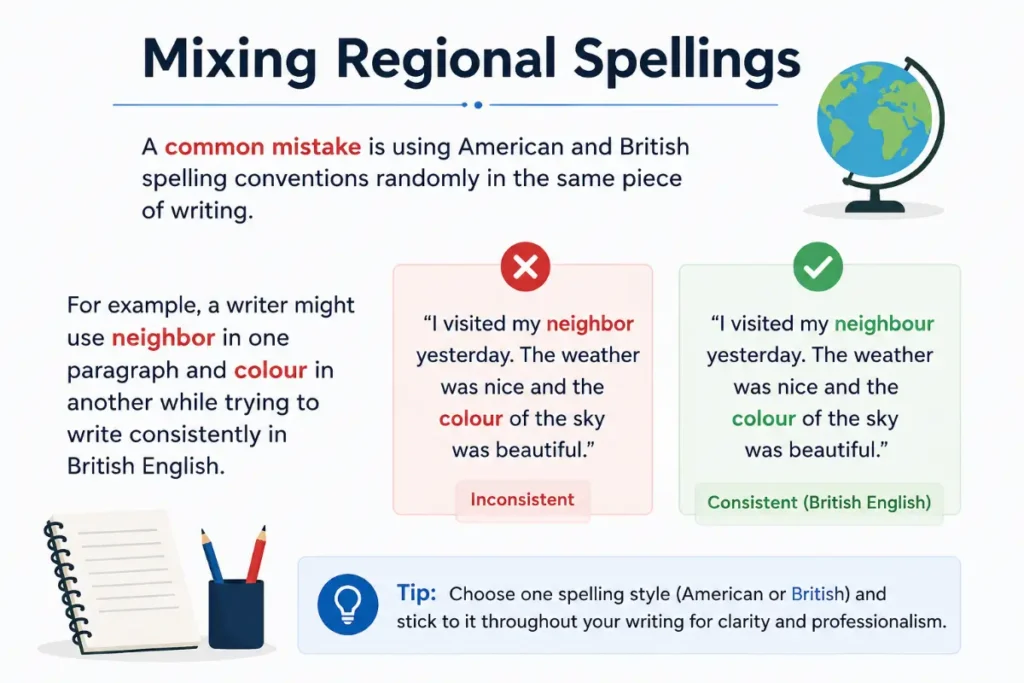
A common mistake is using American and British spelling conventions randomly in the same piece of writing. For example, a writer might use neighbor in one paragraph and colour in another while trying to write consistently in British English. The individual words may still be correct. The problem is inconsistency. Choose one spelling system and stay with it.
Adding The Wrong Ending
Some writers produce unusual forms such as neighboor or neighber because they are spelling the word from memory. These forms are not standard English spellings. The safest approach is to remember the familiar pattern rather than trying to reproduce the sound letter by letter.
Confusing Spelling With Pronunciation
The extra u in neighbour can make learners wonder if the pronunciation changes. It doesn’t normally change the pronunciation. The two standard forms are pronounced alike in ordinary speech.
Treating Neighbour as Incorrect in American English
A reader may see neighbour in an American context and assume it is simply misspelled. That conclusion isn’t accurate. The form is standard British English. It can appear in American writing when a writer is intentionally following British conventions or discussing a British source.
Treating Neighbor as Incorrect in British English
The opposite mistake also happens. Neighbor is not an invented or incorrect word. It is the standard American spelling. A British editor may prefer neighbour in British English, but that doesn’t make the American spelling linguistically invalid.
Pronunciation Guide
Both forms are normally pronounced the same way. The common pronunciation is represented in the International Phonetic Alphabet as /ˈneɪbər/ in American English and commonly as /ˈneɪbə/ in British English.
The first syllable receives the main stress. A simple pronunciation guide is: NAY ber The first part sounds like nay. The second part is a relaxed sound similar to ber. The spelling can look more complicated than the pronunciation. That’s one reason learners sometimes hesitate when they see the word in writing. The important point is that the u in the British spelling does not create an extra syllable. You don’t pronounce neighbour as if it contained another sound between the b and the r.
Etymology and Word Origin
The word has a long history in English. It comes from Old English neahgebur. The word was built from elements connected with the ideas of near and dwelling or inhabitant. Over time, its form changed as English developed through different historical stages. Middle English forms gradually moved closer to the modern spelling. The modern meaning remains closely connected to the original idea of someone who lives nearby. The historical connection is useful because it explains why the word has remained closely associated with physical proximity and community. English spelling changed considerably over the centuries. Different regional standards eventually developed. British English retained the traditional u in this word while American English adopted the shorter spelling.
Regional Usage
Regional English is the main reason the two forms exist today.
American English
American English normally uses neighbor. You’ll see this spelling in US newspapers, school writing, business communication, books, websites, and everyday messages. For an American audience, this is the natural choice. If you’re writing an article for readers in the United States, neighbor will usually feel familiar and expected.
British English
British English normally uses neighbour. The spelling appears in British educational materials, newspapers, books, official writing, and ordinary conversation. For British readers, the version with u is the familiar standard form.
Australian English
Australian English generally follows British spelling conventions and commonly uses neighbour.
Canadian English
Canadian English commonly uses neighbour. Many Canadian spellings preserve the u in words such as neighbour and colour. That makes Canadian English especially interesting for learners because it doesn’t always match American spelling.
Grammar Rules and Part of Speech
The word can serve as both a noun and a verb.
Neighbor As a Noun
As a noun, the word identifies a person or thing that is nearby. My neighbor has three children. The noun can appear in singular or plural form. Singular: My neighbor is friendly. Plural: My neighbors are friendly. It can also take possessive forms. My neighbor’s car is parked outside. The neighbors’ meeting starts at seven. The apostrophe placement depends on the number of people being described.
Neighbor As a Verb
As a verb, the word means to be located next to something. Our property neighbors a large field. The verb is less common in casual American conversation than the noun. It is still grammatically valid. A writer may choose a more familiar expression such as is next to or is beside when aiming for very simple everyday language.
Adjective Forms
You’ll often see the related adjective neighboring in American English and neighbouring in British English. For example: The neighboring town is about twenty miles away. The neighbouring town is about twenty miles away. Again, the difference follows the same regional spelling pattern.
Real Life Usage Examples
The word appears in many ordinary situations.
Daily Conversation
People often use the word when talking about homes, streets, communities, and local relationships. Our neighbor brought us some cookies. I ran into my neighbor at the grocery store. These examples show the everyday social meaning of the word.
Workplace Communication
The word can also appear in professional writing when location matters. The company opened a new office in a neighboring district. The two businesses serve several neighboring communities. In this context, the word describes proximity rather than a personal relationship.
Academic Writing
Academic writing may use the word when discussing geography, communities, housing, sociology, history, or urban development. Researchers examined how residents interacted with their neighbors. The study compared services available in neighboring communities. The spelling should match the style of English used by the publication or institution.
News Writing
News articles often use the word to describe people living near an event. Neighbors reported hearing a loud noise late at night. Residents from neighboring areas were asked to leave temporarily. The exact spelling again depends on the publication’s regional style.
Literature and Storytelling
Writers often use the word to establish a sense of place or community. Her neighbor always waved from the porch. The two neighbors had known each other for years. In stories, the word can suggest more than physical distance. It can help establish relationships between characters.
A related grammar guide is Missle or Missile Correct Spelling and Meaning.
Related and Confused Terms
Several words are closely related to the idea of a neighbor.
Nearby
Nearby means close in distance. A nearby store may be close to your home.
Next Door
Next door usually describes a place immediately beside another home or building. My friend lives next door.
Resident
A resident is someone who lives in a particular place. The term is more formal than neighbor and doesn’t necessarily imply that the person lives immediately beside you.
Community
A community is a group of people who share a location, interest, identity, or social connection. Neighbors can be part of the same community.
Local
Local describes something connected with a particular area. A local business may serve people from the surrounding neighborhood.
Neighborhood
A neighborhood is an area where people live. Your neighbors are the people who live in or around your neighborhood.
Neighbourhood
Neighbourhood is the British spelling of neighborhood. The meaning stays the same.
Neighboring
Neighboring means located close to something else. The neighboring town is only five miles away. British English normally spells this as neighbouring.
Neighbor and Neighborhood
One useful spelling pattern can make this whole topic easier. American English uses neighbor and neighborhood. British English uses neighbour and neighbourhood. The same regional difference carries through the related words. This matters because writers sometimes switch forms without noticing. For example, an American document might contain neighbor in one section and neighbourhood in another. The individual words may be understandable, but the spelling style is inconsistent. If you’re writing for a US audience, choose the American forms throughout the document. If you’re following British conventions, use the British forms throughout. Consistency makes writing look polished and deliberate.
Neighbor and Neighbour In Formal Writing
Both spellings are appropriate in formal writing when they match the selected variety of English. There is no rule saying that one form is more professional. An American academic paper can correctly use neighbor. A British academic paper can correctly use neighbour. The important issue is consistency. Professional editors often look at the document as a complete system rather than correcting each word in isolation. If a document uses American spelling, changing one word to a British form simply because it looks familiar can actually introduce an error in style consistency. The same principle applies to color and colour, center and centre, and other regional spelling pairs.
Why People Get This Spelling Wrong
The confusion usually comes from exposure to multiple varieties of English. The internet has made this more common. A US reader can easily encounter British books, Canadian websites, Australian news, and international publications. The reader may then see both spellings without realizing they belong to different regional standards. School instruction can also affect spelling habits. Someone who learned British English may instinctively write neighbour even after moving to the United States. Autocorrect and spell checkers can add another layer of confusion. A spelling tool may flag one form based on the selected language setting even though the word itself is perfectly valid. That’s why context matters more than a simple red underline.
How To Remember The Difference
A simple memory trick is to connect the spelling with the English variety. Think of neighbor as the American form. Think of neighbour as the British form. he same pattern appears in several familiar words.
American English:
color
honor
Do Grammar Checkers Understand The Difference
Most modern spelling tools can recognize both forms when the correct language setting is selected. The problem usually appears when the language setting doesn’t match the document. For example, an American English setting may flag neighbour as a spelling variation. A British English setting may prefer neighbour and treat neighbor as a regional alternative.
That doesn’t mean the flagged form is universally wrong. A spelling checker is a tool. It follows the language and regional preferences selected by the user. It doesn’t replace editorial judgment. For important writing, always check the document’s intended audience and style before changing a regional spelling.
Expert Editor Insight
An experienced editor doesn’t automatically mark one spelling as wrong. The first question is which English variety the document follows. If the document is clearly written in American English, neighbor is the consistent choice. If it follows British English, neighbour fits the established style. The best editing decision comes from looking at the whole document rather than treating one isolated spelling as a mistake.
Is The British Form Wrong In American English
No.
The spelling is standard British English. It may look unusual to an American reader because American spelling normally removes the u. That difference doesn’t make the British form an error. However, if you’re writing specifically for a US audience, using the American spelling will usually make your writing more consistent with the expectations of that audience.
Is The American Form Wrong In British English
No. The American spelling is standard American English. A British editor may change it to neighbour when editing a document for British readers. That is a regional style adjustment rather than proof that the original American spelling was grammatically incorrect.
Can The Word Start A Sentence
Yes. The word can begin a sentence just like any other noun. Neighbor is a common noun, so it follows normal capitalization rules when it appears at the beginning of a sentence. For example: Neighborly kindness can make a difficult day easier. The same rule applies to the British spelling. Neighbourly kindness can make a difficult day easier. The related adjective also follows the spelling conventions of the selected English variety.
Can The Word Be Plural
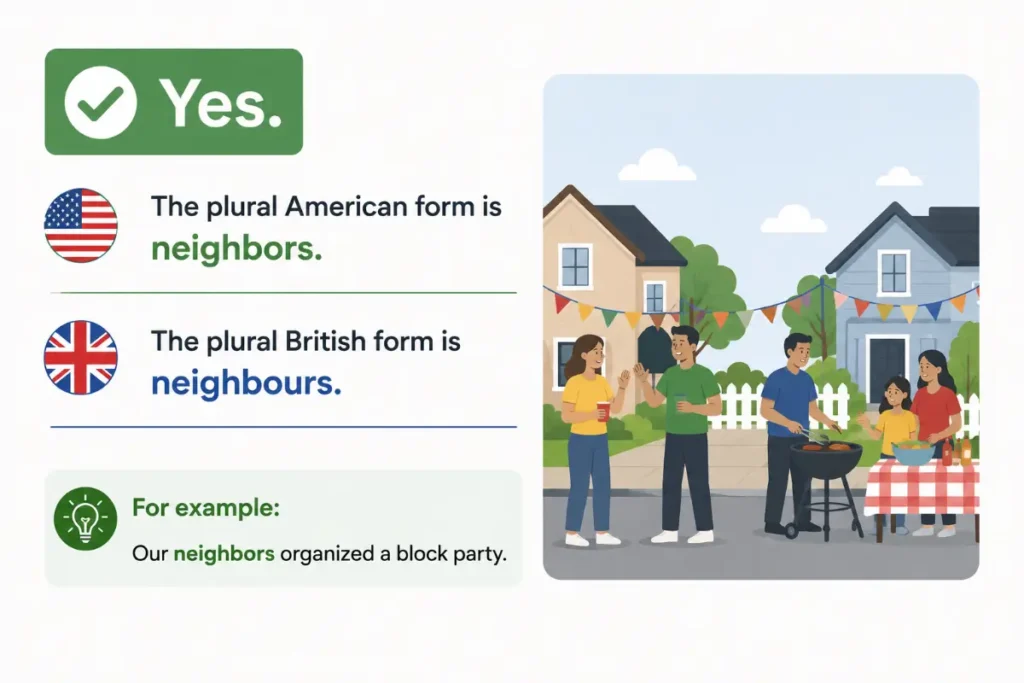
Yes. The plural American form is neighbors. The plural British form is neighbours. For example: Our neighbors organized a block party. Our neighbours organized a block party. The grammatical rule is straightforward. Add s to form the regular plural.
Can The Word Be Used As A Verb
Yes. The word can function as a verb meaning to be located next to something. For example:The property neighbors a public park. This use is grammatically correct but less common in everyday conversation than the noun. Many speakers would naturally say that the property is next to a public park. The British form works in the same way: The property neighbours a public park.
You may also want to read Ninth vs Nineth: Origin, Meaning and Correct Usage (2026).
Final Takeaway
The choice between neighbour or neighbor is simple once you know the regional rule. Both spellings are correct, but neighbor is standard in American English while neighbour is standard in British English and several other varieties. The meaning, grammar, and pronunciation stay essentially the same.
For US writing, choose neighbor and related forms such as neighborhood and neighboring. For British style, use neighbour, neighbourhood, and neighbouring. The best editing habit is to check the regional style of the whole document before correcting an individual word. Consistency is the key. Once you connect the shorter spelling with American English and the u spelling with British English, this common spelling question becomes much easier to remember.
FAQs
Which is correct neighbor or neighbour?
Both are correct. Neighbor is the standard American spelling. Neighbour is the standard British spelling and is also common in several other varieties that follow British spelling conventions. The meaning and pronunciation remain essentially the same. Choose the form that matches the regional English style used in your writing.
Is neighbor American or British English?
Neighbor is the standard American English spelling. British English normally uses neighbour. The difference reflects regional spelling conventions rather than a difference in meaning. If you’re writing for readers in the United States, neighbor is generally the natural choice.
Is neighbour a real word?
Yes. Neighbour is a standard English word. It is the normal spelling in British English and appears in dictionaries, books, newspapers, education, and everyday communication. It is not simply a typo or an informal alternative.
How do you pronounce neighbor?
Neighbor is commonly pronounced /ˈneɪbər/ in American English. It has two syllables with the main stress on the first syllable. The pronunciation is similar to NAY ber. The British spelling neighbour does not normally add another syllable.
Is neighbor appropriate in formal writing?
Yes. Neighbor is completely appropriate in formal American English. It can appear in academic writing, professional documents, journalism, reports, and other formal contexts. The key is to use the spelling consistently with the regional English style of the document.
Why do Americans spell neighbor without u?
American spelling often removes the u from words that traditionally end in our. This pattern appears in words such as color, honor, favor, and labor. Neighbor follows the same general American spelling preference. British English normally retains the u.
What is the plural of neighbor?
The American plural is neighbors. The British plural is neighbours. Both forms follow the normal plural rule for the word. The only difference is the regional spelling convention.
Is neighbor and neighborhood spelled the same way?
The same regional pattern applies to both words. American English uses neighbor and neighborhood. British English uses neighbour and neighbourhood. The meaning remains the same, but the spelling should match the English variety used throughout the document.