
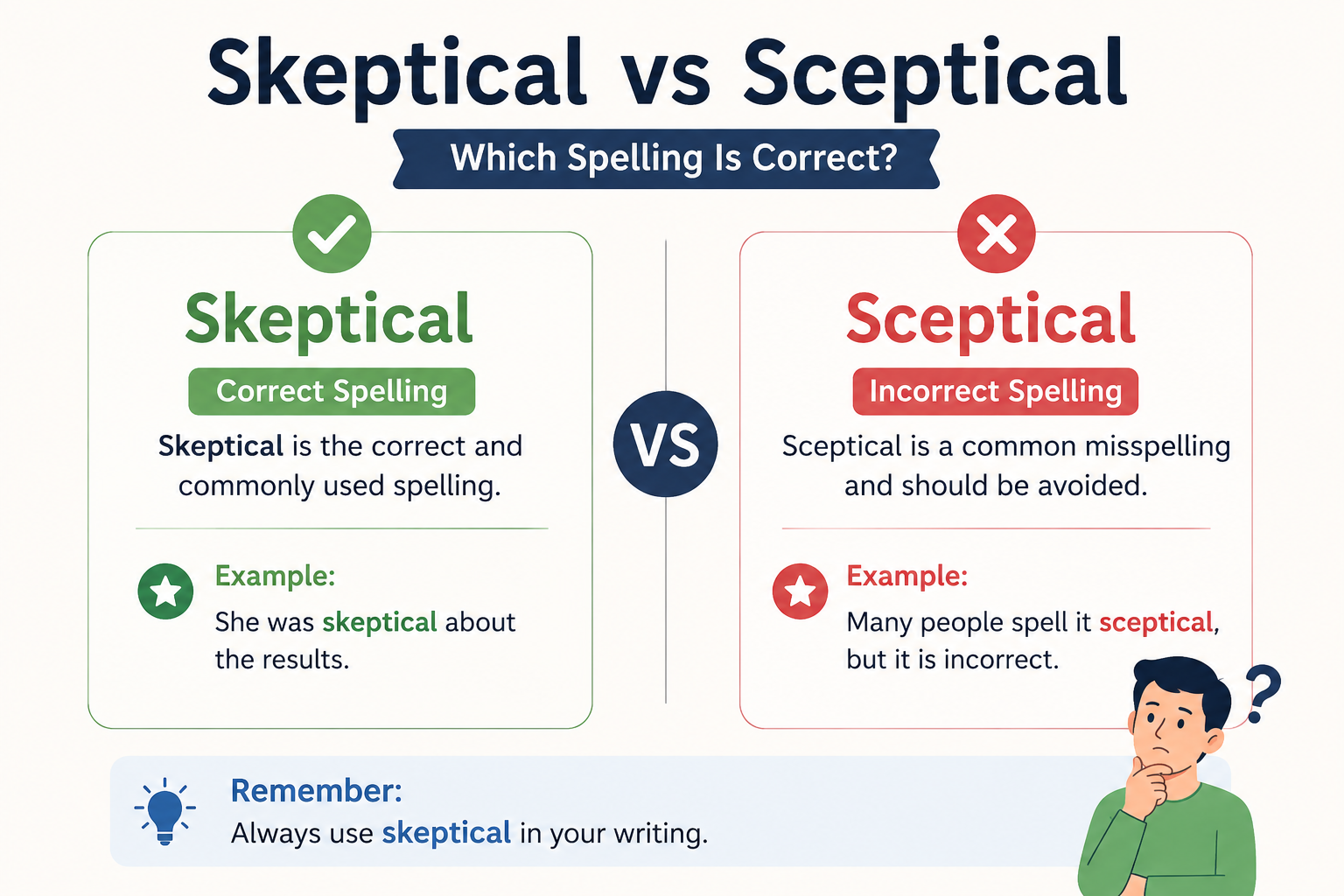
Skeptical vs sceptical can make even confident writers pause because both forms look right and both appear in reputable dictionaries. The good news is that neither spelling is a mistake. The main difference comes down to regional English rather than meaning.
In American English use skeptical. In British English use sceptical. Both words describe someone who has doubts about a claim idea or result. Cambridge lists skeptical as the mainly US form and sceptical as the usual UK form. Oxford follows the same distinction.
The confusion comes from the unusual spelling pattern. The k in skeptical may feel more natural to American readers while the c in sceptical follows the British form. Both versions have a long history in English and trace back to the same Greek root.
In this guide you’ll learn the difference between the two spellings their meanings grammar pronunciation origins regional usage and common mistakes. You’ll also see natural examples that show exactly how native speakers use the word in everyday and formal writing.
You may also want to read Smoothe or Smooth Which Spelling Is Correct?.
Quick Definition
Skeptical and sceptical are two regional spellings of the same adjective. Skeptical is the standard form in American English while sceptical is mainly used in British English. Both mean having doubts about something or not being fully convinced that a claim idea or statement is true.
Quick Answer
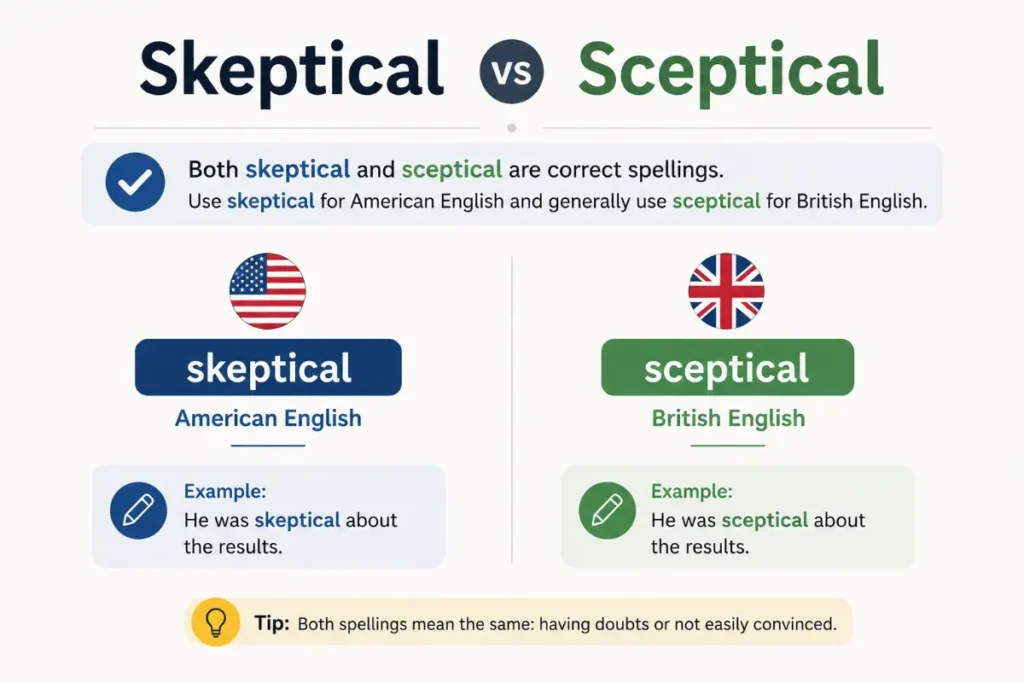
Both skeptical and sceptical are correct spellings. Use skeptical for American English and generally use sceptical for British English.
The meaning and pronunciation stay the same. Only the spelling changes. If you’re writing for a US audience choose skeptical. If your audience follows British English choose sceptical.
Comparison Table
| Correct Form | Meaning | Part of Speech | Origin | Usage Frequency | Formality | Common Contexts | Example |
|---|---|---|---|---|---|---|---|
| skeptical | Having doubts or not being convinced | Adjective | Greek skeptikos through Latin and French | Very common in US English | Standard | American writing business science news conversation | She was skeptical of the claim. |
| sceptical | Having doubts or not being convinced | Adjective | Greek skeptikos through Latin and French | Very common in UK English | Standard | British writing business science news conversation | She was sceptical of the claim. |
Meaning and Definition
Meaning of skeptical
Skeptical is an adjective that describes a person who doubts something or isn’t convinced that a statement claim idea or prediction is true.
You might be skeptical about a new product. You might also feel skeptical when someone makes a claim without offering enough evidence.
The word doesn’t automatically mean that you reject something. A skeptical person may simply want more proof before accepting a conclusion.
For example:
She was skeptical about the advertised results.
This sentence doesn’t say that she knows the results are false. It tells us that she has doubts and isn’t ready to accept the claim without more evidence.
Cambridge defines skeptical as the mainly US spelling and explains that it refers to doubting that something is true or useful.
Meaning of sceptical
Sceptical has exactly the same meaning as skeptical. The difference is spelling.
British English normally uses sceptical. Oxford identifies sceptical as the British English form and skeptical as the North American form.
For example:
The researchers were sceptical about the early results.
A US writer would normally write:
The researchers were skeptical about the early results.
The meaning doesn’t change. The sentence structure doesn’t change. The pronunciation doesn’t change. Only the spelling follows a different regional convention.
Is either form a typo
No. Sceptical isn’t a misspelling of skeptical. Likewise skeptical isn’t a misspelling of sceptical.
The spelling becomes incorrect only when it clashes with the style of English you’re expected to follow. For example an American company that requires US English would normally use skeptical throughout its documents. A British publication would normally choose sceptical.
Consistency matters more than trying to force one spelling into every variety of English.
Key Differences Explained
Spelling
The visible difference is the letter k versus c.
American English uses skeptical.
British English generally uses sceptical.
The same pattern appears in related words. American English commonly uses skeptic and skepticism while British English commonly uses sceptic and scepticism. Merriam Webster describes sceptic sceptical and scepticism as chiefly British spellings of their k forms.
Grammar Role
Both forms are adjectives.
They can describe a person attitude reaction position or approach.
For example:
He was skeptical of the proposal.
She gave me a sceptical look.
The committee remained skeptical.
The journalist took a sceptical view.
The adjective can also appear after linking verbs such as seem feel remain and become.
Meaning
The meaning is the same in both varieties.
Both forms can express doubt caution or a lack of conviction.
A skeptical or sceptical person isn’t necessarily cynical. Skepticism can be healthy. A scientist who asks for stronger evidence is being skeptical without automatically rejecting the research.
Tone
Neither spelling is more formal than the other.
Skeptical doesn’t sound more casual than sceptical. Sceptical doesn’t sound more academic than skeptical.
The tone comes from the sentence and context rather than the spelling.
Context
Your audience determines the better choice.
For a US website use skeptical.
For a British newspaper use sceptical.
In an academic paper follow the required style guide and keep the spelling consistent.
For international content choose the spelling that matches your primary audience.
Which Spelling Is Correct
Both spellings are correct.
If you’re writing American English use skeptical. If you’re writing British English use sceptical. Cambridge explicitly identifies skeptical as mainly US and sceptical as the usual UK spelling.
This isn’t a case where one form is correct and the other is wrong. English has developed different spelling conventions across regions. Many words show similar differences such as color and colour or center and centre.
The dictionary evidence is clear. Oxford lists sceptical as British English and skeptical as North American English. Merriam Webster likewise treats sceptical as a chiefly British variant of skeptical.
That gives you a simple editorial rule. Don’t ask which spelling is universally correct. Ask which English variety you’re writing.
Sentence Examples
Here are natural examples using the American spelling.
- I was skeptical of his explanation.
- The investors remained skeptical about the company’s promises.
- She became skeptical after several predictions failed.
- Many readers are skeptical of dramatic health claims.
- He sounded skeptical when I told him the news.
- The scientist was skeptical about the early findings.
- I’m skeptical that the plan will work without additional funding.
- The customer was skeptical of the unusually low price.
- Her skeptical attitude encouraged the team to examine the evidence again.
- A healthy skeptical approach can prevent careless decisions.
The British spelling works in exactly the same situations.
- I was sceptical of his explanation.
- The investors remained sceptical about the company’s promises.
- She became sceptical after several predictions failed.
- Many readers are sceptical of dramatic health claims.
- He sounded sceptical when I told him the news.
The grammar doesn’t change when you switch the regional spelling.
You may also want to read signalling or signaling Which Spelling Is Correct.
Common Mistakes and Misspellings
Several spelling problems appear around this word because writers remember the sound more easily than the exact letter sequence.
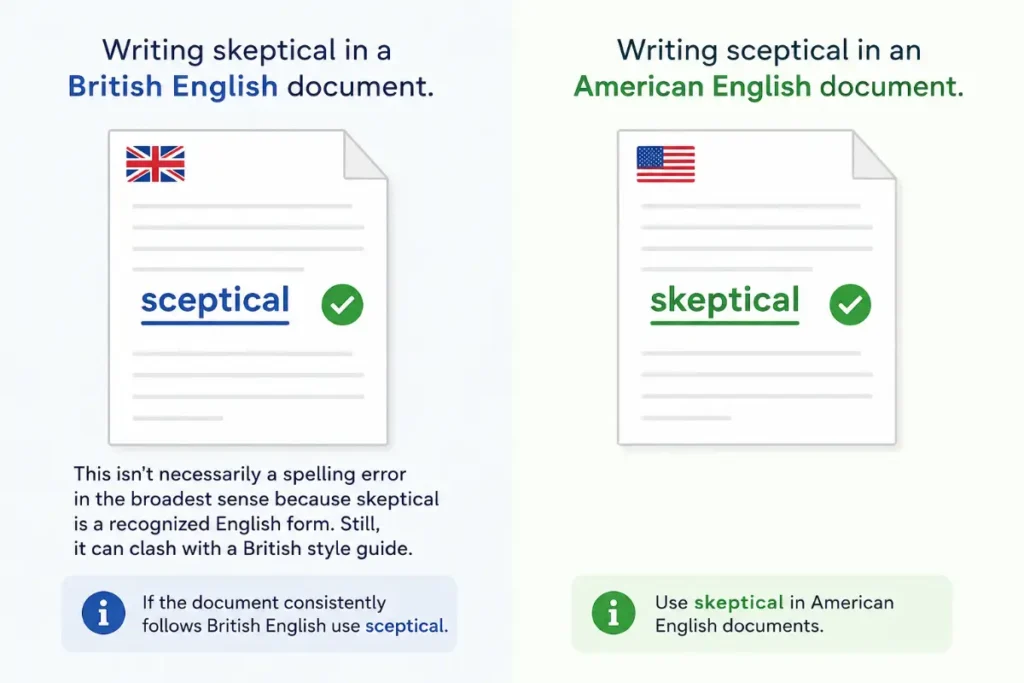
- Writing skeptical in a British English document.
This isn’t necessarily a spelling error in the broadest sense because skeptical is a recognized English form. Still it can clash with a British style guide. If the document consistently follows British English use sceptical.
- Writing sceptical in an American English document.
Again the word is valid but it doesn’t match the normal US convention. American readers will understand it but a US editor may change it to skeptical for consistency.
- Writing scepticall.
Some writers add an unnecessary second l because English contains many words with doubled consonants. The correct adjective is skeptical or sceptical.
- Writing scepticaly or skeptically incorrectly.
The adverb forms need attention. American English uses skeptically. British English uses sceptically.
- Mixing related spellings.
A document can look inconsistent when it uses skeptic in one paragraph and sceptical in another without a deliberate reason. Related words should normally follow the same regional pattern.
Why People Confuse the Spelling
The word creates a useful NLP style confusion because its pronunciation doesn’t tell you whether the middle sound should be represented by k or c.
When you hear skeptical and sceptical aloud you don’t hear a meaningful difference. That means phonetic memory can’t help much with spelling.
Visual memory can also interfere. English contains many words where c appears before e while k appears in other patterns. Writers may remember the word family rather than its exact regional form.
Another source of confusion is exposure. An American reader may see sceptical in British publications. A British reader may see skeptical in American websites. Search engines also bring different English varieties together.
The result is simple. Your brain recognizes both forms as familiar words and then has to decide which spelling fits the context.
Pronunciation Guide
Skeptical and sceptical have the same standard pronunciation.
The IPA pronunciation is approximately /ˈskɛptɪkəl/.
You can divide the word into three spoken parts:
- skep.
- ti.
- cal.
An easy audio style spelling is SKep tih kul.
The first syllable receives the strongest stress. The word begins with the same sk sound found in words such as skill and skin.
The c in sceptical doesn’t create a soft s sound. This point can surprise learners because c before e often produces a soft sound in English. In sceptical the c is part of the spelling inherited through the word’s history and the pronunciation still begins with the hard sk sound.
Cambridge gives the same pronunciation for both regional forms.
A common pronunciation mistake is to let the spelling influence the sound too strongly. Don’t pronounce sceptical as if the first c were a soft s. Say it the same way you would say skeptical.
Etymology and Word Origin
The history of skeptical and sceptical reaches much farther back than modern American and British spelling conventions.
The word ultimately connects to Ancient Greek skeptikos. The term referred to the Skeptics and carried the sense of being thoughtful or reflective. It is related to the Greek verb skeptesthai meaning to reflect look or view.
The word moved through Latin and French before becoming established in English. The noun skeptic entered English in the late sixteenth century while the adjective form developed around the same general period.
The spelling history is especially interesting because the k form has deep roots in English. The modern distinction between skeptical and sceptical isn’t simply the result of one country changing a spelling yesterday. Both forms have a long history.
The k spelling became strongly associated with American English. The c spelling became strongly associated with British English. Etymonline notes that the sk form was an early seventeenth century Greek revival spelling and became preferred in the United States.
That history explains why both spellings look legitimate. They are not random variations created by modern spellcheckers.
Regional Usage
American English
American English normally uses skeptical.
You will also see skeptic as the noun and skepticism as the noun describing the attitude or state of doubt.
Examples include:
The skeptical customer asked for more evidence.
The scientist is a skeptic.
The proposal was met with skepticism.
For a US audience this spelling is the safest and most natural choice.
British English
British English normally uses sceptical.
The related forms are sceptic and scepticism.
For example:
The sceptical customer asked for more evidence.
The scientist is a sceptic.
The proposal was met with scepticism.
Cambridge and Oxford both identify sceptical as the British form.
Australian English
Australian usage has historically leaned toward the British spelling sceptical. However Australian usage can show more variation than a simple British versus American rule suggests.
Some Australian organizations and publications use skeptic and skeptical as part of their names or house style. The Australian National Dictionary Centre has discussed the variation and found both forms in Australian use.
If you’re writing for Australia follow the publication’s preferred style rather than assuming every Australian source uses the same spelling.
Canadian English
Canadian English sits between American and British conventions in many areas. That means you shouldn’t treat Canada as a simple copy of either system.
Canadian government language guidance recommends using a reliable Canadian dictionary and being consistent when choosing among accepted spelling variants.
Both skeptic and sceptic appear in Canadian usage. If your Canadian client school publisher or employer has a style guide use that guide first. Otherwise check a current Canadian dictionary and follow its preferred form.
Grammar Rules and Part of Speech
Skeptical and sceptical are adjectives.
They commonly appear after forms of be.
For example:
She is skeptical of the proposal.
They were sceptical about the results.
The word can also come before a noun.
He gave me a skeptical look.
She adopted a sceptical attitude.
The adjective commonly works with prepositions such as about and of.
You can say:
I am skeptical about his explanation.
I am skeptical of his explanation.
Both structures are natural.
The word can also appear after verbs such as remain seem sound and become.
For example:
The committee remained skeptical.
He sounded skeptical.
She became sceptical after hearing the details.
Sentence Placement
Skeptical can appear at the beginning of a sentence when it functions as an introductory adjective phrase.
For example:
Skeptical of the promise, the customer asked for proof.
It can also appear in the middle of a sentence.
The skeptical customer asked for a refund.
It can appear at the end after a linking verb.
The customer remained skeptical.
Punctuation
The spelling itself doesn’t require special punctuation.
If skeptical begins a sentence as part of an introductory phrase you may need a comma based on the structure of that phrase.
For example:
Skeptical of the claim, she requested the original data.
The comma separates the introductory descriptive phrase from the main clause.
Don’t add punctuation simply because the word is skeptical or sceptical.
Real Life Usage Examples
Daily Talk
- I’m skeptical about that deal.
- She was sceptical when he said he could finish everything in one hour.
These examples show the word in ordinary conversation. It often expresses mild doubt rather than complete disbelief.
- I’m skeptical of the proposed timeline because we still need approval from two departments.
- I remain sceptical about the figures until we receive the final report.
In professional email the word can sound measured and reasonable. It lets you question something without making an unnecessarily aggressive statement.
Academic Writing
- Researchers should remain skeptical of conclusions based on limited evidence.
- The authors were sceptical about the reliability of the original data.
Academic writing often uses the word when discussing evidence assumptions methods and competing explanations.
News Writing
- Analysts remain skeptical about the government’s forecast.
- Several observers were sceptical of the company’s claim.
News writing uses the term to describe doubt held by experts analysts officials or members of the public.
Literature
- His skeptical expression suggested that he had heard the story before.
- She remained sceptical of every promise made at the table.
In literature the word can describe a character’s personality or reaction and can help establish a cautious or questioning tone.
Expert Editor Insight
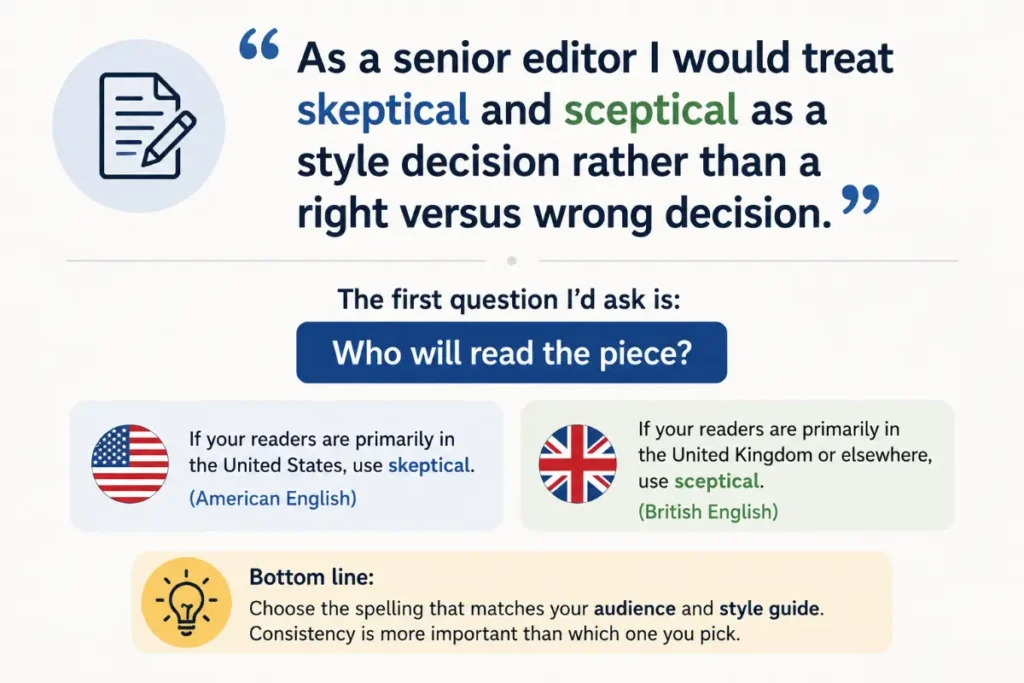
As a senior editor I would treat skeptical and sceptical as a style decision rather than a right versus wrong decision. The first question I’d ask is who will read the piece. For a US audience I would choose skeptical and then carry that choice through skeptic skepticism and skeptically. For a British audience I would use sceptical sceptic scepticism and sceptically. Spellcheckers can help but they don’t always understand your intended regional style. A word can be valid English and still be wrong for the style you’re following. The best editorial habit is to choose your language variety before you start writing and stay consistent.
Expert Tip
Don’t memorize the two spellings as unrelated words. Remember the word family.
American English uses skeptic skeptical skepticism and skeptically.
British English uses sceptic sceptical scepticism and sceptically.
Once you remember the family pattern the spelling becomes much easier.
Many readers also check halfday or half-day: Correct Spelling and Usage.
Conclusion
Skeptical vs sceptical has a simple answer. Both spellings are correct and they have the same meaning. Use skeptical for American English and use sceptical for British English. The difference comes from regional spelling conventions rather than grammar meaning pronunciation or level of formality. Major dictionary sources such as Cambridge Oxford and Merriam Webster recognize the distinction.
The easiest way to remember the difference is to learn the whole word family. American English uses skeptic skeptical skepticism and skeptically. British English uses sceptic sceptical scepticism and sceptically. The same pattern keeps your writing consistent and makes regional editing much easier.
If you’re writing for readers in the United States choose skeptical. If you’re following British English choose sceptical. When you’re unsure about a regional style check the relevant dictionary or house style guide. Consistency is the practical rule that will keep your writing clean accurate and professional.
FAQs
1. Is skeptical or sceptical correct?
Both skeptical and sceptical are correct spellings. Skeptical is the standard American English spelling, while sceptical is mainly used in British English and other varieties that follow British spelling.
2. What is the difference between skeptical and sceptical?
There’s no difference in meaning. Both words describe someone who doubts something or isn’t ready to accept a claim without evidence. The only difference is the spelling used in different varieties of English.
3. Is skeptical American or British English?
Skeptical is the preferred spelling in American English. For example, an American writer would normally write, “She was skeptical about the claim.”
4. Is sceptical British English?
Yes. Sceptical is the standard spelling in British English. It’s also common in countries that generally follow British English spelling conventions, such as Australia and New Zealand.
5. How do you pronounce skeptical and sceptical?
Both words have the same pronunciation. They’re commonly pronounced like SKEP tih kul. The spelling changes, but the pronunciation and meaning remain the same.
6. Can I use skeptical in British English?
Yes, but sceptical is generally preferred in British English. If you’re following British spelling conventions, use sceptical for consistency.
7. Can I use sceptical in American English?
You can, and American readers will understand it, but skeptical is the normal American spelling. Using sceptical in American writing may look unusual.
8. Which spelling should I use?
Use skeptical for American English and sceptical for British English. The choice depends on the variety of English you’re writing in, not on a difference in meaning.