
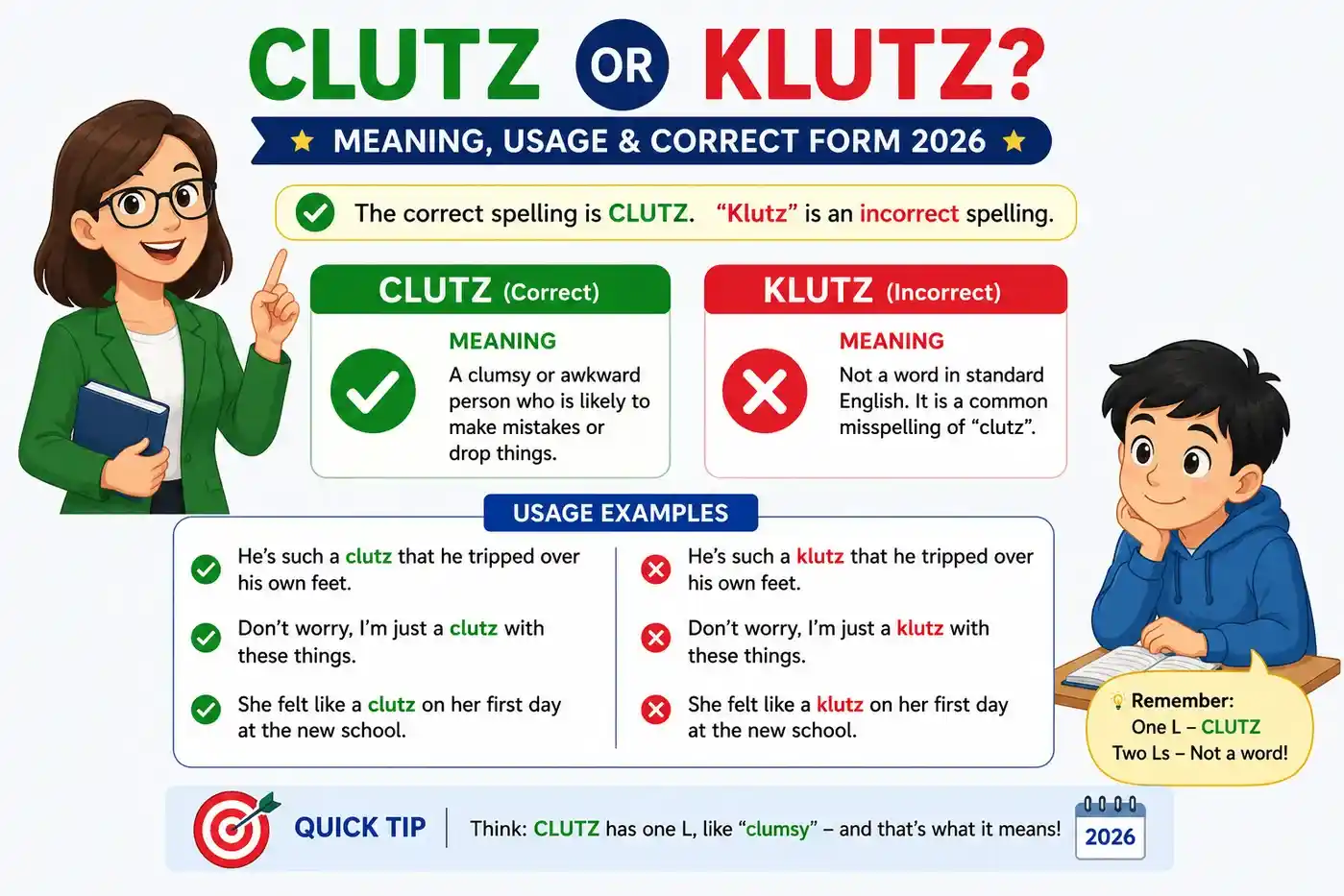
If you’ve ever typed clutz or klutz into a search engine, you’re probably trying to figure out which spelling is correct. Maybe you heard someone jokingly call themselves a clumsy person. Maybe you saw both versions online and wondered if they mean different things.
The confusion is understandable. Unlike many spelling questions where one version is clearly wrong, this one has a bit more history behind it. Both spellings appear in English. However, only one is widely accepted by modern dictionaries and style guides. The short answer is simple. Klutz is the standard and correct spelling. Clutz appears occasionally as a variant spelling, but it is far less common and is generally considered nonstandard.
The reason people get confused is that the words sound exactly alike. Since English contains many words beginning with the letter C, some writers naturally assume clutz follows the same pattern. Others encounter the word in conversation long before seeing it in print, which makes spelling guesswork more likely.
In this guide, you’ll learn the difference between clutz and klutz, their meanings, origins, pronunciation, grammar, examples, common mistakes, regional usage, and how native English speakers actually use the word today.
For another common grammar confusion, see signalling or signaling Which Spelling Is Correct.
Clutz or Klutz Quick Definition
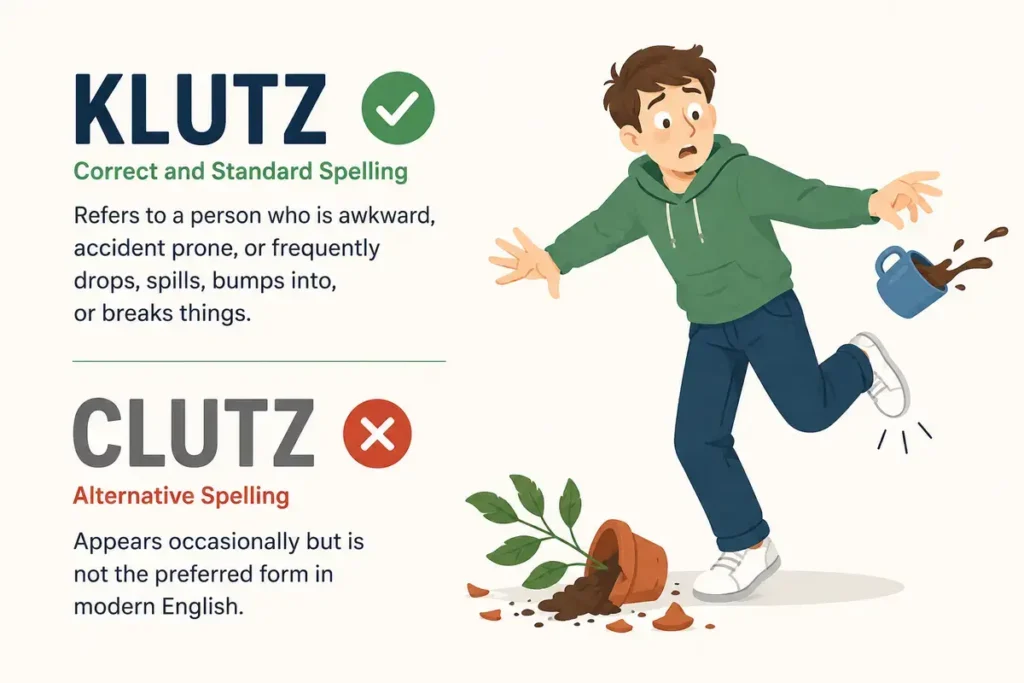
When comparing clutz or klutz, klutz is the correct and standard English spelling. It refers to a person who is awkward, accident prone, or frequently drops, spills, bumps into, or breaks things. Clutz is an alternative spelling that appears occasionally but is not the preferred form in modern English.
Quick Answer
The correct spelling is klutz. Use klutz when describing someone who:
- Frequently trips or falls.
- Often drops objects.
- Has poor coordination.
- Appears physically awkward.
- Accidentally breaks things.
The spelling clutz exists but is uncommon and generally considered a variant rather than the standard form.
Clutz vs Klutz Comparison Table
| Feature | Klutz | Clutz |
|---|---|---|
| Correct standard spelling | Yes | Usually no |
| Dictionary recognition | Yes | Limited |
| Meaning | Awkward or accident prone person | Same meaning |
| Part of speech | Noun | Noun |
| Origin | Yiddish | Variant spelling |
| Usage frequency | Very high | Very low |
| Formality level | Informal | Informal |
| Common in media | Yes | Rare |
| Preferred by editors | Yes | No |
| Common contexts | Casual conversation | Occasional informal writing |
| Pronunciation | Same as clutz | Same as klutz |
| Modern acceptance | Standard | Nonstandard variant |
| Example | I’m such a klutz. | Rare usage |
Meaning Of Klutz
To understand the debate, start with the accepted spelling.
Definition Of Klutz
A klutz is a person who seems physically awkward or frequently has minor accidents.
Examples include someone who:
- Trips over their own feet.
- Knocks over drinks.
- Drops their phone repeatedly.
- Walks into furniture.
- Breaks things accidentally.
The word is usually playful rather than insulting.
Emotional Tone Of Klutz
Most people use the word with humor.
For example:
- I’m such a klutz today.
- He’s a lovable klutz.
- She laughed after acting like a klutz.
In many cases, people use it to describe themselves.
Common Contexts For Klutz
You’ll often hear the word in:
- Daily conversations.
- Movies.
- Television shows.
- Social media posts.
- Informal writing.
- Comedy.
The word rarely appears in highly formal communication.
Meaning Of Clutz
The spelling clutz generally carries the same meaning.However, its status in English differs significantly.
Definition Of Clutz
When used, clutz refers to the same type of awkward or accident prone person described by klutz.
Examples:
- Someone who spills coffee regularly.
- Someone who bumps into doors.
- Someone who trips while walking.
The meaning does not change.
Why Clutz Exists
Most occurrences of clutz result from one of three situations.
- A spelling mistake.
- An alternative spelling choice.
- Lack of familiarity with the standard form.
Because English contains many words beginning with “cl,” some writers assume this spelling is correct.
Modern Usage Of Clutz
While you may occasionally encounter clutz online, dictionaries and professional editors overwhelmingly prefer klutz.That’s why you’ll rarely see clutz in professionally edited publications.
Meaning Differences
One interesting aspect of this comparison is that there is almost no difference in meaning.
Shared Meaning
Both spellings describe:
- Awkwardness.
- Poor coordination.
- Frequent accidents.
- Clumsy behavior.
- Physical inelegance.
The definition remains essentially identical.
Difference In Acceptance
The real difference involves spelling standards.Klutz is accepted.Clutz is generally viewed as a misspelling or nonstandard variant.
Reader Perception
When readers see klutz, they immediately recognize the word.When readers see clutz, many assume it is a spelling mistake.That distinction matters in professional and public writing.
Clutz Or Klutz Tone Differences
Although the meanings are similar, tone can shift slightly because of reader expectations.
Klutz Sounds Natural
Native speakers are accustomed to seeing klutz.
Examples:
- He’s such a klutz.
- I felt like a klutz all day.
The word feels familiar and natural.
Clutz Can Look Incorrect
Many readers pause when they see clutz.Instead of focusing on the message, they notice the spelling.That interruption can weaken the writing.
Humor And Affection
The word klutz often carries a warm or affectionate tone.People frequently use it jokingly among friends and family.It usually describes harmless mistakes rather than serious incompetence.
Grammar Differences
From a grammatical perspective, the words function the same way.
Klutz As A Noun
Examples:
- He is a klutz.
- She’s a klutz around fragile objects.
- Everyone laughed when the klutz dropped the cake.
The word acts as a countable noun.
Clutz As A Noun
When used, clutz functions identically.
Examples:
- He is a clutz.
- She’s a clutz.
However, editors generally replace this spelling with klutz.
Plural Form
The standard plural form is:
- Klutzes.
Examples:
- The movie featured several lovable klutzes.
- We all felt like klutzes during the dance lesson.
The spelling clutzes exists but is uncommon.
Clutz Or Klutz In Slang
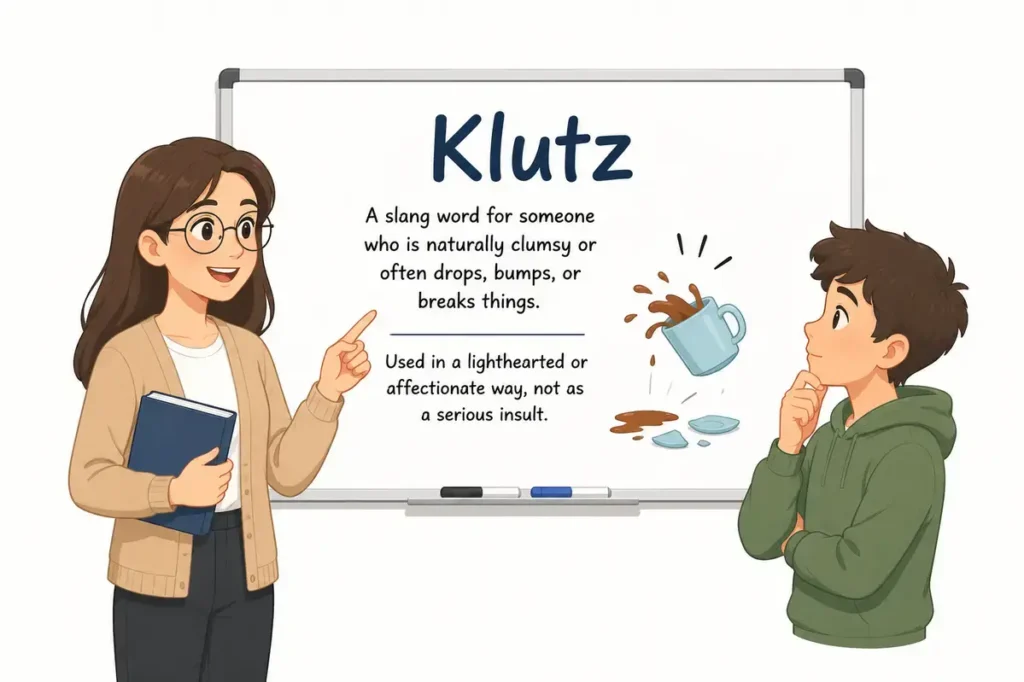
Klutz is a common slang word used to describe someone who is naturally clumsy or frequently drops, bumps, or breaks things. It is usually meant in a lighthearted or affectionate way rather than as a serious insult. Friends and family often use it playfully after someone trips, spills a drink, or has an awkward moment.
Clutz is not the standard spelling in modern English. Dictionaries and style guides recognize klutz as the correct form. If you’re writing in formal or informal English, klutz is the spelling you should use.
Examples include:
- I’m such a klutz. I spilled coffee on my shirt again.
- Don’t worry about dropping the plate. Everyone can be a klutz sometimes.
- My friends always tease me for being a klutz because I trip over everything.
Which One Is Correct In Clutz Or Klutz
The correct answer is klutz.Modern dictionaries, style guides, editors, educators, and publishers recognize klutz as the standard spelling.
Use klutz in:
- Blog posts.
- Articles.
- Books.
- School assignments.
- Emails.
- Social media posts.
- Professional writing.
Avoid clutz unless you’re intentionally reproducing a variant spelling.
Learn the difference in Capital or Capitol Which One Is Correct 2026.
Pronunciation Guide
Pronunciation contributes heavily to the confusion.
IPA Pronunciation
Klutz:
/klʌts/
Clutz:
/klʌts/
Syllable Breakdown
Klutz:
- Klutz
The word contains one syllable.
Common Pronunciation Mistakes
Most people pronounce the word correctly. The challenge is spelling, not pronunciation. Because English speakers hear the initial “kl” sound rather than seeing it written, many guess incorrectly when spelling the word.
Common Mistakes
Several mistakes appear repeatedly.
Assuming Clutz Is The Standard Form
Many writers naturally choose the spelling beginning with C.This assumption is understandable but incorrect.
Thinking Klutz Is A Typo
Some people see klutz and assume the unusual K must be wrong.In reality, the K is part of the traditional spelling.
Using The Word In Formal Evaluations
Calling someone a klutz in professional evaluations or academic assessments can sound overly informal.The word works best in casual contexts.
Confusing Klutz With Clumsy
A klutz is a person.
Clumsy is an adjective.
Examples:
- Correct: He’s a klutz.
- Correct: He’s clumsy.
- Incorrect: He’s a klutzy clumsy person in formal writing.
Both words relate to awkwardness but serve different grammatical roles.
Klutz Synonyms
The best synonym for klutz depends on the situation and the tone you want to use. Common alternatives include clumsy person, bungler, fumbler, butterfingers, goof, blunderer, novice, amateur, inept person, and scatterbrain. Some of these words are playful, while others sound more critical.
In everyday American English, clumsy person is the closest and most neutral synonym. Words like butterfingers are commonly used for someone who frequently drops things, while bungler describes a person who regularly makes mistakes. Choosing the right synonym depends on the context, but klutz remains the most natural word for someone who is awkward or accident prone.
Examples In Sentences
The easiest way to understand how native speakers use this word is to see it in real sentences.
Ten Examples Using Klutz
- I’m such a klutz that I spilled coffee on my shirt before the meeting even started.
- Jake felt like a klutz after dropping his phone for the third time that week.
- Everyone laughed when the lovable klutz tripped over the stage curtain.
- She called herself a klutz after knocking over a stack of books.
- The movie’s main character is an endearing klutz who always finds trouble.
- My brother is a complete klutz around expensive electronics.
- He looked like a klutz trying to learn roller skating for the first time.
- Sarah isn’t a klutz by nature, but she was unusually distracted that day.
- The comedian often plays the role of a cheerful klutz.
- Despite being a klutz, he somehow never gets seriously hurt.
Ten Examples Using Clutz
These examples show how the alternative spelling appears, though it is not the preferred form.
- He described himself as a clutz after dropping his lunch.
- The article referred to the character as a clutz.
- She joked that she was a clutz during dance practice.
- Some online comments used the spelling clutz instead of klutz.
- The writer accidentally typed clutz throughout the blog post.
- A few readers assumed clutz was the correct spelling.
- The character was portrayed as a lovable clutz.
- Several informal forums used clutz interchangeably with klutz.
- The social media caption called him a clutz after the mishap.
- Editors later corrected clutz to klutz in the final version.
These examples highlight an important point. The meaning stays the same, but professional editors almost always favor klutz.

Clutz Or Klutz Etymology And Word Origin
The history behind this word explains why the spelling looks unusual.
Origin Of Klutz
The word klutz comes from Yiddish, a language historically spoken by many Jewish communities in Central and Eastern Europe.In Yiddish, the word originally referred to a clumsy or awkward person.
As Yiddish words entered American English during the late nineteenth and early twentieth centuries, klutz became increasingly popular.Over time, it moved beyond specific communities and became part of mainstream English vocabulary.Today, many English speakers use the word without knowing its Yiddish roots.
How Klutz Entered American English
The growth of urban communities and cultural exchange helped introduce many Yiddish words into everyday English.
Examples include:
- Klutz.
- Schmooze.
- Chutzpah.
- Nosh.
- Bagel.
Among these words, klutz became one of the most widely recognized.
Origin Of Clutz
The spelling clutz developed later.It did not emerge as the original form.Instead, it likely appeared because English speakers heard the word before seeing it written.Since many English words begin with “cl,” people naturally assumed the spelling should follow that pattern.
Over time, the alternative spelling appeared in informal writing, online discussions, and occasional publications.However, it never achieved the same level of acceptance as klutz.
Clutz Or Klutz Regional Usage
Regional differences often affect spelling, but this case is relatively straightforward.
American English
American English strongly favors klutz.The word appears regularly in:
- Newspapers.
- Magazines.
- Books.
- Television scripts.
- Everyday conversation.
Most American dictionaries list klutz as the primary spelling.
British English
British English recognizes the word, though it is less common than in the United States.When used, British publications generally follow the spelling klutz.
Australian English
Australian English also prefers klutz.While Australians may use local terms for awkward people, klutz remains widely understood.
Canadian English
Canadian English follows the same pattern.The standard spelling remains klutz.
Regional Verdict
Across major English speaking countries:
- Klutz is the accepted spelling.
- Clutz appears occasionally but rarely.
- Professional publications overwhelmingly use klutz.
- No major variety of English officially prefers clutz.
Grammar Rules
Understanding grammar helps you use the word naturally.
Klutz As A Countable Noun
The word functions primarily as a noun.
Examples:
- He is a klutz.
- She is a klutz.
- That klutz broke another glass.
The word refers to a person.
Plural Form
The standard plural is klutzes.
Examples:
- We were all klutzes during the beginner dance class.
- The sitcom featured several lovable klutzes.
Possessive Form
Examples:
- The klutz’s phone slipped from his hand.
- The klutzes’ mistakes became part of the comedy routine.
Adjective Form
The adjective form is klutzy.
Examples:
- His klutzy behavior amused everyone.
- She made a klutzy attempt to catch the ball.
Adverb Usage
There is no widely used standard adverb form.
Instead, writers typically use phrases such as:
- In a clumsy way.
- Awkwardly.
- Carelessly.
Formal Alternatives
In formal writing, editors often replace klutz with:
- Clumsy person.
- Accident prone individual.
- Uncoordinated person.
- Awkward individual.
These alternatives fit professional contexts more comfortably.
Real Life Usage Examples
The word appears in many different situations.
Daily Conversation
Examples:
- I’m such a klutz today.
- Don’t hand me that vase. I’m a klutz.
- He laughed after acting like a total klutz.
This is where the word appears most often.
Academic Writing
The term rarely appears in formal academic work.When it does, it is usually part of:
- Linguistic discussions.
- Cultural studies.
- Literary analysis.
- Psychology examples.
Professional Communication
Most professionals avoid the word in formal reports.However, it may appear in casual workplace conversations.
Example:
- I felt like a klutz after spilling coffee during the presentation.
Literature
Authors often use klutz to develop relatable characters.A slightly awkward character often feels more human and approachable.
Examples include:
- Romantic comedies.
- Young adult novels.
- Humor writing.
- Family stories.
Television And Media
The word appears frequently in:
- Sitcoms.
- Comedy films.
- Reality television.
- Entertainment journalism.
Characters described as klutzes often create humorous situations.
Related Words And Confused Terms
Several words overlap with klutz in meaning.
Klutz And Clumsy
These terms are closely related.
Difference:
- Klutz is a noun.
- Clumsy is an adjective.
Examples:
- He is a klutz.
- He is clumsy.
Klutz And Awkward
Awkward can describe physical movement or social behavior.Klutz focuses primarily on physical coordination.
Klutz And Accident Prone
Someone who is accident prone frequently experiences minor mishaps.A klutz often fits that description.
Klutz And Butterfingers
Butterfingers refers specifically to someone who drops things.
A klutz may have butterfingers, but a klutz can also trip, stumble, or bump into objects.
Klutz And Bungler
A bungler makes mistakes because of poor execution.A klutz usually struggles with physical coordination.
Klutz And Goofball
A goofball behaves in a silly or playful way.
A klutz is specifically awkward or accident prone.
Semantic Relatives
Related terms include:
- Clumsy.
- Awkward.
- Ungraceful.
- Accident prone.
- Uncoordinated.
- Butterfingers.
- Bungler.
- Fumbler.

Clutz Or Klutz Expert Language Insight
After years of editing articles, business content, books, and web copy, one pattern stands out.Most people who write clutz are not intentionally choosing a variant spelling.They’re simply spelling the word the way it sounds.That’s completely understandable.
English contains countless words where pronunciation and spelling do not align perfectly.The challenge is that readers judge spelling quickly.When people see klutz, they recognize a familiar word.When they see clutz, many assume a spelling error has slipped through.Professional writers generally avoid creating that distraction.
Another interesting observation involves tone.Native speakers rarely use klutz as a serious insult.In most situations, the word carries humor, affection, or self deprecation.People often call themselves a klutz after dropping a drink or tripping on a staircase.The word feels lighthearted.That’s one reason it has remained popular for generations.
FAQs
Is klutz the correct spelling?
Yes. Klutz is the standard spelling recognized by major dictionaries, editors, publishers, and style guides. It is the preferred form in modern English.
Is clutz a real word?
Clutz appears as a variant spelling, but it is not the standard form. Most professional writers and editors use klutz instead.
What does klutz mean?
A klutz is a person who is physically awkward, accident prone, or frequently drops, spills, bumps into, or breaks things unintentionally.
Why is klutz spelled with a K?
The spelling comes from its Yiddish origin. As the word entered English, it retained the traditional spelling rather than changing to a more familiar English pattern.
Is klutz an insult?
Usually not. The word is often playful, humorous, or affectionate. People frequently use it to describe themselves after making a harmless mistake.
What is the plural of klutz?
The standard plural form is klutzes. Example: The beginner dance class was filled with enthusiastic klutzes.
Can I use klutz in formal writing?
You can, but it may sound informal. In professional or academic contexts, alternatives such as clumsy person or accident prone individual may work better.
Do British people use the word klutz?
Yes. British English recognizes and understands the word, although it is more common in American English. The accepted spelling remains klutz.
For another common grammar confusion, see Fliers vs Flyers Meaning and Difference With Easy Examples 2026.
Clutz Or Klutz Conclusion
The answer to this question is clear. Klutz is the correct and standard English spelling. It refers to someone who is clumsy, awkward, or prone to minor accidents. Clutz occasionally appears as an alternative spelling, but it is far less common and is generally viewed as nonstandard by editors and dictionaries.
The meanings are essentially identical. The real difference lies in spelling and acceptance. If you want your writing to look polished, professional, and accurate, use klutz. A simple rule to remember is this:
If you’re describing someone who trips over their own feet, drops their coffee, or somehow turns a simple task into a comedy scene, the word you’re looking for is klutz.