
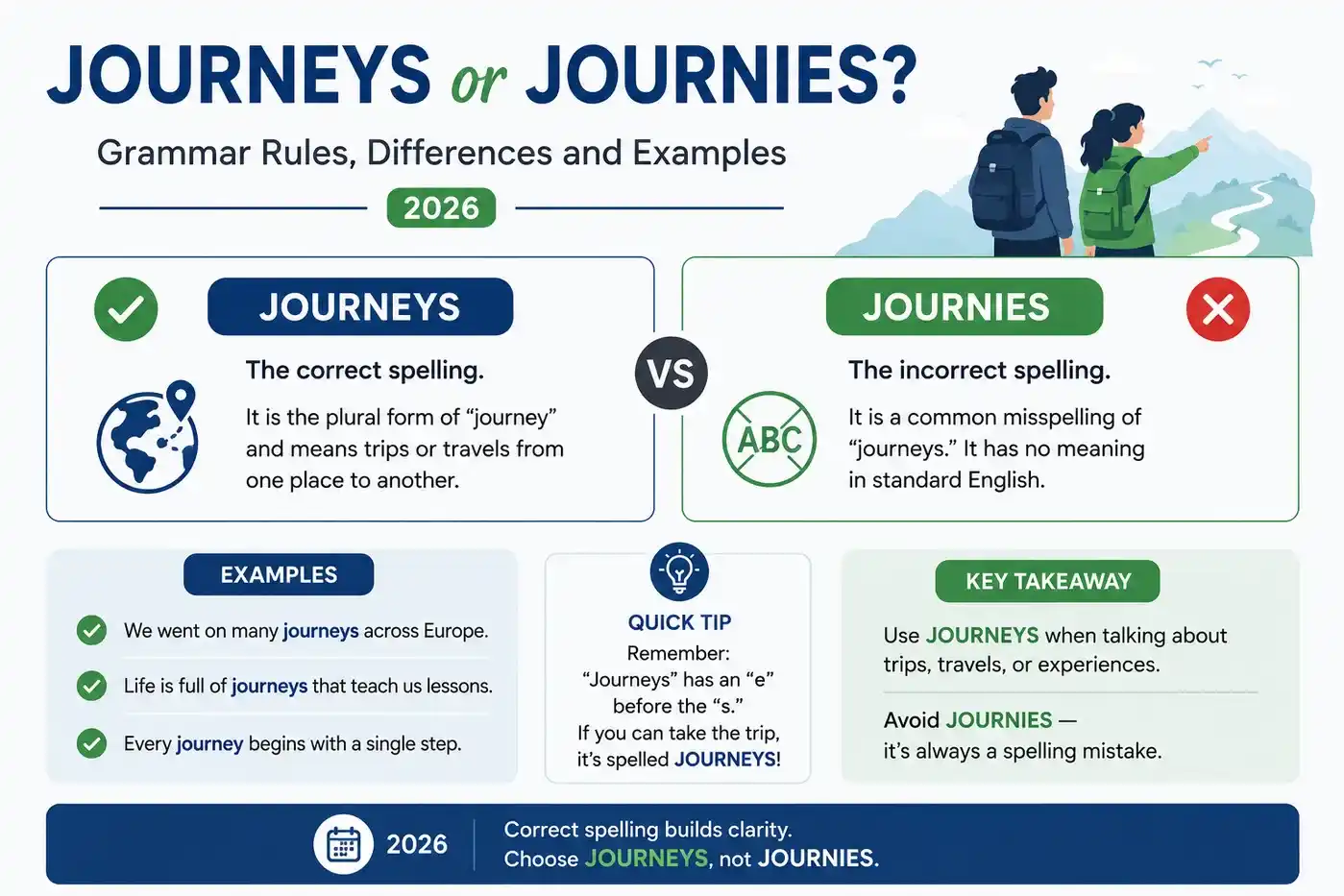
If you’ve searched for journies or journeys, you’re probably trying to figure out which spelling is correct. Maybe you saw both versions online. Perhaps your spell checker flagged one of them. Or maybe you’re writing an article, social media post, school paper, or business document and want to avoid an embarrassing spelling mistake.
The good news is that the answer is straightforward. Only one spelling is considered correct in standard English. The confusion happens because many English words ending in the letter Y follow special pluralization rules. Since English spelling rules are not always intuitive, it’s easy to see why people second guess themselves.
The word journey is common in everyday writing. It can refer to physical travel, personal growth, professional development, emotional experiences, and life changes. Because the term appears so frequently, understanding its correct plural form is important for clear and professional communication. This guide explains the difference between journies and journeys, covers pronunciation, grammar rules, word origins, regional usage, common mistakes, real world examples, and expert language insights. By the end, you’ll know exactly which spelling to use and why.
Need another quick comparison? Read How to Spell Until Correctly and Use It 2026.
Journies Or Journeys Quick Definition
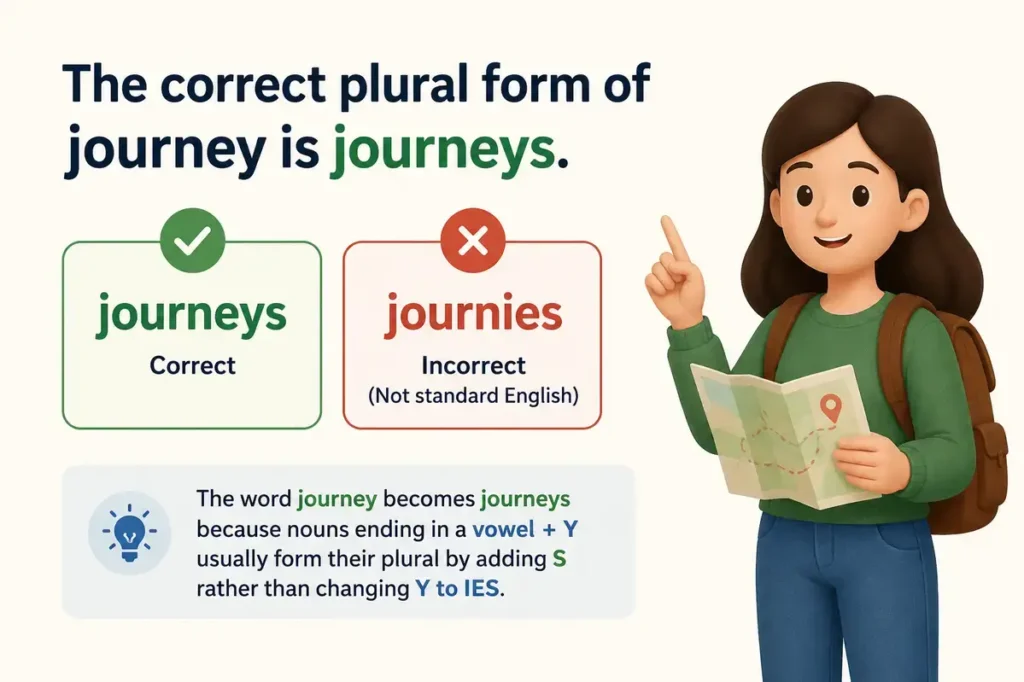
The correct plural form of journey is journeys. The spelling journies is incorrect in modern standard English. The word journey becomes journeys because nouns ending in a vowel plus Y usually form their plural by adding S rather than changing Y to IES.
Quick Answer
Journeys is the correct spelling.
Journies is a misspelling and should not be used in formal or informal writing. The singular word journey becomes journeys in the plural form because the letter Y follows the vowel E.
Journies vs Journeys Comparison Table
| Feature | Journies | Journeys |
|---|---|---|
| Correct Spelling | No | Yes |
| Meaning | Intended plural of journey but incorrect | Plural form of journey |
| Part Of Speech | Not recognized in standard English | Noun |
| Dictionary Status | Misspelling | Accepted dictionary word |
| Usage Frequency | Rare and considered an error | Extremely common |
| Formality Level | Incorrect in all contexts | Suitable in all contexts |
| Common Contexts | Spelling mistakes | Travel, personal growth, business, education |
| Grammar Status | Incorrect plural form | Correct plural form |
| Example | Incorrect spelling | Their journeys changed their lives |
Meaning Of Journies
Definition Of Journies
Journies is commonly seen as an attempted plural form of journey. However, modern English dictionaries do not recognize it as the correct spelling.
Context And Usage
People typically write journies by mistake because they apply the wrong pluralization rule.
For example:
- Incorrect: Their journies across Europe were unforgettable.
- Correct: Their journeys across Europe were unforgettable.
Why People Use Journies
Several factors contribute to the mistake:
- Confusion about Y ending words.
- Similar patterns found in words like cities and stories.
- Lack of familiarity with pluralization rules.
- Typing errors.
- Auto correction issues in some situations.
Meaning Of Journeys
Definition Of Journeys
Journeys is the correct plural form of journey.A journey refers to travel from one place to another. It can also describe personal development, emotional growth, spiritual experiences, educational progress, or professional advancement.
Etymology Of Journeys
The word journey comes from the Old French word journée, meaning a day’s travel or a day’s work. Over time, English speakers broadened the meaning to include trips, adventures, and personal experiences.
Common Contexts For Journeys
- Physical travel.
- Career development.
- Educational progress.
- Spiritual growth.
- Emotional healing.
- Personal transformation.
Examples Of Journeys
- Their journeys across Asia lasted six months.
- The book follows several journeys through history.
- Many successful journeys begin with a single decision.
- The documentary explores migration journeys.
- Our journeys shaped who we became.
Journies Or Journeys Search Intent Analysis
Most people searching for these words want an answer to a spelling question.
The dominant search intent includes:
- Correct spelling verification.
- Grammar guidance.
- Usage examples.
- Understanding pluralization rules.
- Avoiding writing mistakes.
Unlike some word comparisons, this is not a situation where both forms are accepted. One spelling is correct and the other is not.
Which One Is Correct
The correct spelling is journeys.English follows a specific plural rule for words ending in a vowel followed by Y.Journey ends with EY.Because the Y follows a vowel, you simply add S.
Journey → Journeys.
You do not change the Y to IES.That’s why journies is incorrect.
Correct Examples
- Their journeys inspired millions.
- The travelers documented their journeys online.
- Our journeys took us through several countries.
- The book compares different life journeys.
- These journeys changed their perspectives.
Incorrect Examples
- Their journies inspired millions.
- The travelers documented their journies online.
- Our journies took us through several countries.
All of these examples should use journeys.
Grammar Rule Explained
This spelling question becomes easy once you understand the grammar rule.
Rule One
If a noun ends with a consonant plus Y, change Y to IES.
Examples:
- City → Cities.
- Story → Stories.
- Baby → Babies.
- Country → Countries.
- Family → Families.
Rule Two
If a noun ends with a vowel plus Y, simply add S.
Examples:
- Journey → Journeys.
- Key → Keys.
- Toy → Toys.
- Valley → Valleys.
- Monkey → Monkeys.
Journey belongs to this second category.Since E is a vowel, the correct plural is journeys.
Journies vs Journeys Key Differences
The difference is surprisingly simple.
Spelling Difference
- Journies is incorrect.
- Journeys is correct.
Dictionary Difference
- Journies does not appear as a standard accepted spelling.
- Journeys appears in all major dictionaries.
Professional Writing Difference
- Journies creates a spelling error.
- Journeys demonstrates correct grammar.
Academic Writing Difference
- Journies may reduce credibility.
- Journeys follows accepted English standards.
Search Engine Difference
- Journies is usually treated as a misspelling.
- Journeys is recognized as the correct word.
Journies and Journeys In Modern English
Today, journeys appears in nearly every form of English communication.
You’ll find it in:
- Newspapers.
- Books.
- Academic journals.
- Travel blogs.
- Business reports.
- Marketing materials.
- Personal development content.
- Social media posts.
Professional editors automatically correct journies to journeys because the latter is the accepted form.
Examples Of Journies In Sentences
The following examples show incorrect usage.
- Their journies were documented online.
- We compared our journies across Europe.
- The students shared their journies.
- Several journies began in the capital city.
- Their journies inspired readers.
- The magazine featured travel journies.
- Our journies taught us valuable lessons.
- These journies lasted many months.
- Their journies changed their lives.
- The travelers recorded their journies daily.
Each sentence should use journeys instead.
Examples Of Journeys In Sentences
- Their journeys across Europe were unforgettable.
- The travelers shared their journeys online.
- These journeys changed their outlook on life.
- We learned from the journeys of successful entrepreneurs.
- The book explores several spiritual journeys.
- Our journeys often teach lessons that comfort cannot.
- The documentary follows refugee journeys.
- Different journeys can lead to similar destinations.
- Their journeys inspired future generations.
- The students reflected on their educational journeys.
Many readers also check Footnote Before Or After Period Clear Rules Explained 2026.
Common Mistakes
Many writers make the same errors.
Applying The Wrong Plural Rule
The most common mistake involves treating journey like city.
People assume:
Journey → Journies.
But journey follows a different pattern because the Y follows a vowel.
Trusting Visual Memory
Some people rarely write the word and rely on memory. Since stories becomes stories and babies becomes babies, they mistakenly assume journey follows the same pattern.
Ignoring Spell Check Warnings
Modern writing tools usually identify journies as incorrect.Ignoring those warnings often leads to avoidable mistakes.
Copying Incorrect Online Content
The internet contains countless spelling errors. Seeing journies online does not make it correct.
Pronunciation Guide
One reason people misspell journeys is that pronunciation does not clearly reveal the correct spelling. Both journies and journeys would sound the same if spoken aloud.
Journey Pronunciation
IPA:
/ˈdʒɜːrni/
American English IPA:
/ˈdʒɝːni/
Syllable Breakdown
Jour ney
The word contains two syllables.
Journeys Pronunciation
IPA:
/ˈdʒɜːrniz/
American English IPA:
/ˈdʒɝːniz/
Common Pronunciation Mistakes
- Adding an extra syllable.
- Pronouncing the ending as ney ees.
- Overemphasizing the second syllable.
- Mispronouncing the initial J sound.
Native speakers typically place the primary stress on the first syllable.
Etymology And Word Origin
The history of journey stretches back centuries.The modern English word comes from the Old French word journée. Originally, it referred to a day’s travel or work completed in a single day.The French term developed from the Latin word diurnum, meaning daily or relating to a day.As English evolved, the meaning expanded.
Instead of referring only to one day’s travel, journey gradually came to mean:
- A trip from one place to another.
- A process of development.
- Personal growth.
- Spiritual exploration.
- Emotional transformation.
The plural form journeys emerged naturally through standard English pluralization rules. Throughout its history, there has never been widespread acceptance of journies as the correct standard spelling.

Journies Or Journeys In British English
British English uses journeys as the accepted plural form.
Examples:
- Their train journeys were delayed by weather.
- The book explores several historical journeys.
- Many journeys begin with careful planning.
British dictionaries consistently recognize journeys and reject journies.
In American English
American English follows the same spelling rule.
Examples:
- Their journeys across the country were memorable.
- The podcast highlights entrepreneurial journeys.
- These journeys helped shape national history.
American publications, universities, newspapers, and style guides use journeys exclusively.
In Australian English
Australian English also treats journeys as the only correct spelling.
Examples:
- The travelers shared stories about their journeys.
- Their journeys through the Outback were challenging.
- Educational journeys often continue throughout life.
No major Australian style guide accepts journies.
In Canadian English
Canadian English follows the same standard.
Examples:
- The museum documents immigrant journeys.
- Their journeys reflect determination and resilience.
- Different journeys can lead to similar goals.
Across all major English speaking regions, journeys remains the universally accepted spelling.
Journies and Journeys Grammar Rules In Depth
Understanding the underlying grammar helps prevent similar spelling mistakes.
Journey As A Noun
Journey functions primarily as a noun.
Examples:
- The journey took three days.
- Their journey changed everything.
Journeys As A Plural Noun
Journeys refers to more than one journey.
Examples:
- Their journeys inspired others.
- Several journeys began at the same port.
Common Structures
Writers often use journeys in these patterns:
- Life journeys.
- Travel journeys.
- Educational journeys.
- Career journeys.
- Personal journeys.
- Spiritual journeys.
- Customer journeys.
- Learning journeys.
Possessive Forms
Singular possessive:
- The journey’s destination was unclear.
Plural possessive:
- The journeys’ outcomes surprised everyone.
Subject And Object Usage
As a subject:
- Their journeys reveal remarkable courage.
As an object:
- We studied their journeys carefully.
In Real Life Usage
The word journeys extends far beyond travel.
Daily Conversation
People often use journeys metaphorically.
Examples:
- We all have different journeys in life.
- Their journeys were filled with challenges.
- Every journey teaches something valuable.
Academic Writing
Educators frequently discuss learning journeys.
Example:
- Student journeys provide insight into educational development.
Professional Communication
Businesses commonly talk about customer journeys.
Example:
- Understanding customer journeys improves service quality.
Literature
Authors use journeys as both physical adventures and symbolic experiences.
Example:
- The novel follows several journeys of self discovery.
Media And Entertainment
Documentaries and interviews frequently explore personal journeys.
Example:
- The series highlights journeys of athletes overcoming adversity.
Journies vs Journeys Related Words And Confused Terms
Many terms appear alongside journey and can create confusion.
Journey Vs Trip
A trip often refers to travel from one place to another and back again.
A journey focuses more on the travel experience itself.
Journey Vs Voyage
A voyage usually involves long distance travel by sea or air.
A journey can involve any form of travel.
Journey Vs Expedition
An expedition usually has a specific objective such as exploration or research.
A journey may have no formal goal beyond reaching a destination.
Journey Vs Tour
A tour often involves visiting multiple locations according to a planned schedule.
A journey emphasizes movement and experience.
Journey Vs Adventure
An adventure suggests excitement, uncertainty, or risk.
A journey may be adventurous but does not have to be.
Commonly Confused Plurals
The mistake behind journies also appears in other words.
Correct examples include:
- Keys not keies.
- Monkeys not monkies.
- Valleys not vallies.
- Toys not toies.
- Journeys not journies.

Journies Or Journeys Expert Language Insight
As an editor, I see journies appear most often in blog posts, social media content, student writing, and first drafts.The mistake is understandable.English contains many words where Y changes to IES. Writers learn patterns such as city to cities and story to stories early in life. Later, they encounter exceptions involving vowel plus Y endings and naturally become uncertain.
Native speakers almost always write journeys. In fact, many may never notice the spelling rule consciously because they have seen journeys thousands of times in books, articles, websites, and everyday communication.If you remember one simple principle, it will eliminate this mistake permanently:When a word ends in a vowel followed by Y, add S.
Journey becomes journeys.
That rule also works for key, toy, monkey, valley, and many other common nouns.
FAQs
Is Journies A Real Word?
Journies occasionally appears online, but it is considered a misspelling in modern standard English. Dictionaries and style guides recognize journeys as the correct plural form of journey.
Which Is Correct Journies Or Journeys?
Journeys is correct. Journies is incorrect. Since journey ends with a vowel followed by Y, the plural form is created by adding S.
Why Is It Journeys And Not Journies?
The spelling follows a standard grammar rule. Words ending in a vowel plus Y generally form the plural by adding S rather than replacing Y with IES.
Is Journeys Correct In American English?
Yes. Journeys is the accepted plural form in American English. The same spelling is also used in British English, Canadian English, and Australian English.
How Do You Use Journeys In A Sentence?
You can use journeys to describe multiple trips or experiences.
Example:
Their journeys across different cultures broadened their understanding of the world.
Can Journey Be Used Metaphorically?
Yes. Native speakers frequently use journey to describe personal growth, career development, recovery, education, and life experiences.
What Part Of Speech Is Journeys?
Journeys is a plural noun. In some contexts, journey can also function as a verb, but journeys most commonly serves as the plural noun form.
Are There Similar Words That Follow The Same Rule?
Yes. Several words ending in a vowel plus Y follow the same pattern.
Examples include:
- Key to keys.
- Toy to toys.
- Valley to valleys.
- Monkey to monkeys.
- Donkey to donkeys.
Still confused? Compare Space Words That Start With I.
Conclusion
The answer to the this question is clear. Journeys is the correct spelling. Journies is a misspelling and should be avoided in professional writing, academic work, business communication, and everyday content. The reason comes down to a simple grammar rule. When a noun ends with a vowel followed by Y, you form the plural by adding S. Since journey ends with EY, the correct plural becomes journeys.
Remembering this rule will help you avoid similar mistakes with words such as keys, toys, valleys, monkeys, and donkeys.When in doubt, choose journeys. It is the spelling trusted by dictionaries, editors, teachers, publishers, and native English speakers around the world.