
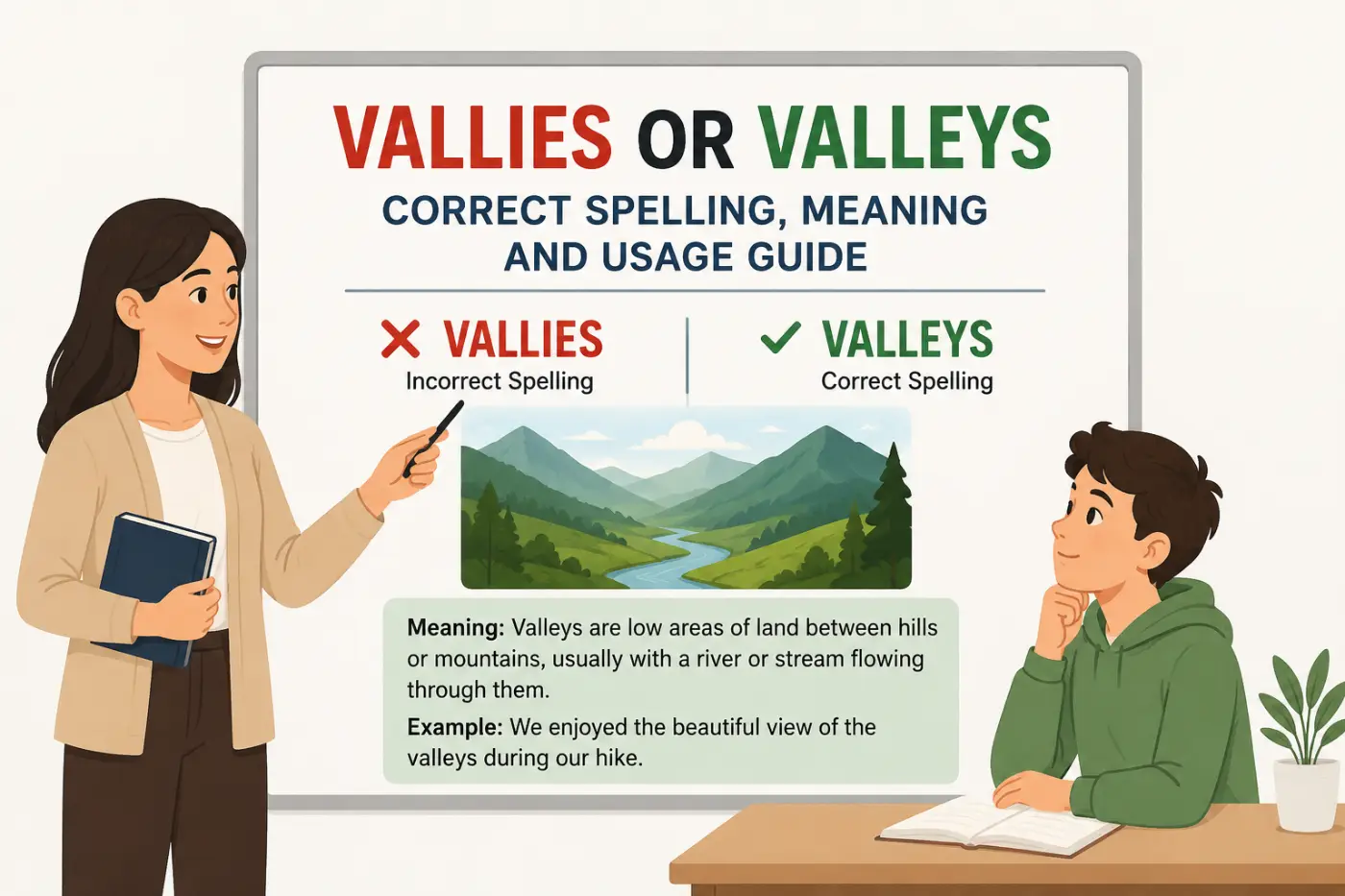
If you’ve ever typed vallies or valleys and stopped to wonder which spelling is correct you’re not alone. This is a common spelling problem because the singular word valley changes its ending when it becomes plural. The correct spelling is valleys. Vallies is not the standard plural form of valley.
The confusion usually comes from a familiar English spelling pattern. Many nouns ending in consonant plus y change the y to ies when they become plural. For example baby becomes babies and city becomes cities. That rule is real but it doesn’t apply to every word ending in y. The key is the letter that comes before the y.
In this guide you’ll learn why valleys is correct how the plural rule works what valley means how to pronounce it and how native English speakers use it. You’ll also see natural examples common spelling mistakes regional usage and answers to the questions people often ask about this word.
A related grammar guide is Placque vs Plaque Which Spelling Is Correct in 2026?.
Quick Definition
Valleys is the correct plural form of valley. A valley is a low area of land between hills or mountains and often contains a river or stream. Vallies is a common spelling mistake and isn’t the standard plural form listed by major English dictionaries.
Quick Answer
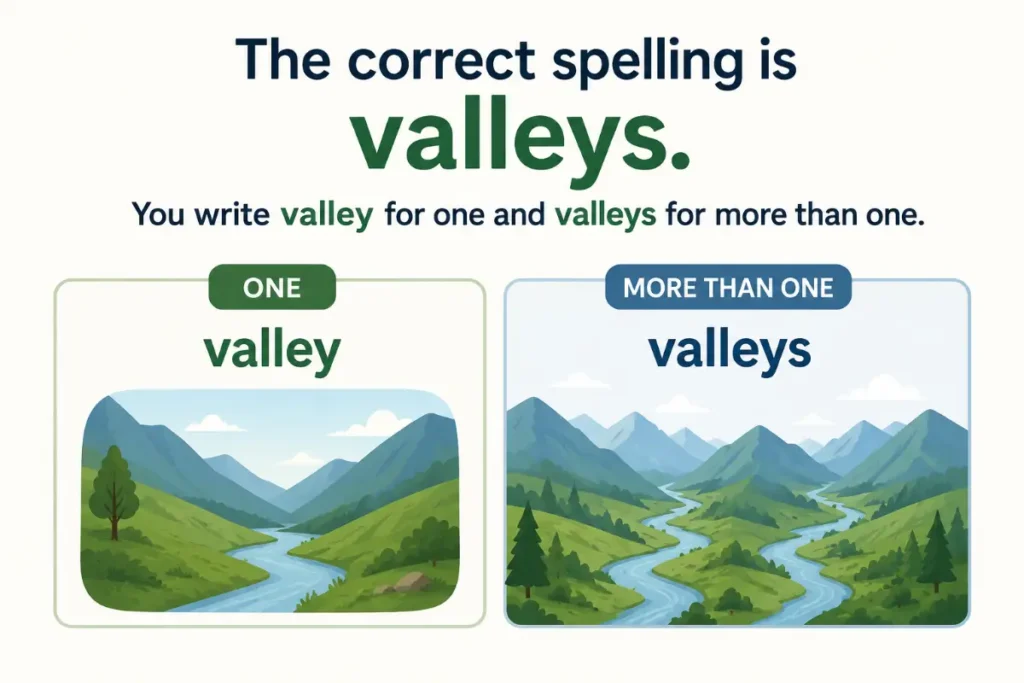
The correct spelling is valleys. You write valley for one and valleys for more than one.
The reason is simple. The letter before the final y is a vowel. When a noun ends in a vowel plus y you normally add s to form the plural. So valley becomes valleys.
Comparison Table For Vallies Or Valleys
| Correct Form | Meaning | Part of Speech | Origin | Usage Frequency | Formality | Common Contexts | Example |
|---|---|---|---|---|---|---|---|
| valleys | More than one valley | Noun plural | Middle English and Anglo French roots | Very common | Standard | Geography travel nature writing news | The valleys were covered with snow. |
| vallies | No standard modern meaning as the plural of valley | Nonstandard spelling | Spelling error based on an incorrect plural pattern | Uncommon | Incorrect | Informal typing learner mistakes | The writer meant valleys. |
Major dictionaries identify valleys as the plural of valley. Merriam Webster explicitly gives the plural as valleys while Cambridge uses valleys naturally in its dictionary examples and corpus material.
Meaning And Definition
Meaning Of Vallies
Vallies is not the standard plural spelling of valley in modern English. If you write something like The vallies are beautiful you should normally change it to The valleys are beautiful.
Why does this mistake happen?
English has several plural spelling patterns. A learner may remember that some words ending in y change y to ies and then apply that pattern too broadly. That can lead to forms such as vallies.
For example:
baby becomes babies.
city becomes cities.
family becomes families.
But valley is different because the letter before y is a vowel.
valley becomes valleys.
The same basic pattern appears in other familiar words.
day becomes days.
boy becomes boys.
key becomes keys.
toy becomes toys.
The spelling may look like a tiny detail but it changes the standard form expected in school writing professional documents edited publications and formal communication.
There is also another reason the error can feel natural. When people say valleys aloud the final sound can make the word seem as if it should follow the same spelling pattern as words such as cities or stories. English spelling does not always follow pronunciation in a perfectly predictable way. That is why looking at the base word and applying the correct spelling rule works better than relying only on sound.
Meaning Of Valleys
A valley is a low area of land between hills or mountains. It often contains a river stream or other watercourse. Cambridge defines valley as an area of low land between hills or mountains often with a river running through it.
The plural valleys refers to two or more such areas.
For example:
The river flows through a narrow valley.
Several valleys surround the mountain range.
The word can also describe a low area in a broader figurative or technical sense. Merriam Webster includes meanings connected with a low point or depression in addition to the geographical meaning.
Most everyday uses refer to geography.
You might read about green valleys in a travel article. A geographer might discuss river valleys. A news report might describe communities located in mountain valleys. A novelist might use a valley as part of a scene.
The word is a standard noun in American English and British English. The plural form remains valleys across major varieties of English.
Key Differences Explained
- Spelling
The standard spelling is valleys. The spelling vallies is incorrect when you mean more than one valley.
- Grammar role
Valley is a singular countable noun. Valleys is its plural form. Vallies does not function as the standard plural noun.
- Meaning
Valley refers to one low area between hills or mountains. Valleys refers to multiple low areas.
- Tone
Valleys is completely neutral and works in casual speech academic writing journalism business communication and creative writing.
- Context
You can use valleys when discussing geography landscapes tourism agriculture rivers mountains weather history or many other subjects connected with landforms.
The difference is therefore not a matter of American versus British spelling. It is not a matter of formal versus informal English either. It is simply a matter of correct spelling.
Which Spelling Is Correct
Valleys is correct.
The linguistic reason comes from the plural spelling rule for nouns ending in y. When a noun ends in a consonant followed by y the y commonly changes to ies.
For example:
city becomes cities.
country becomes countries.
story becomes stories.
When a noun ends in a vowel followed by y the usual plural form adds s.
For example:
day becomes days.
boy becomes boys.
key becomes keys.
Valley belongs to the second group because the letter before y is e. The ending is ey rather than a consonant followed directly by y. Therefore the correct plural is valleys.
Merriam Webster lists valley as a noun and gives valleys as its plural. It also traces the word to Middle English valeye which came through Anglo French from Old French roots connected with Latin.
Cambridge also lists valley as a countable noun and provides examples using the plural form valleys.
That dictionary evidence settles the spelling question. In standard edited English use valleys.
Sentence Examples
Here are natural examples that show how native speakers use the correct plural form.
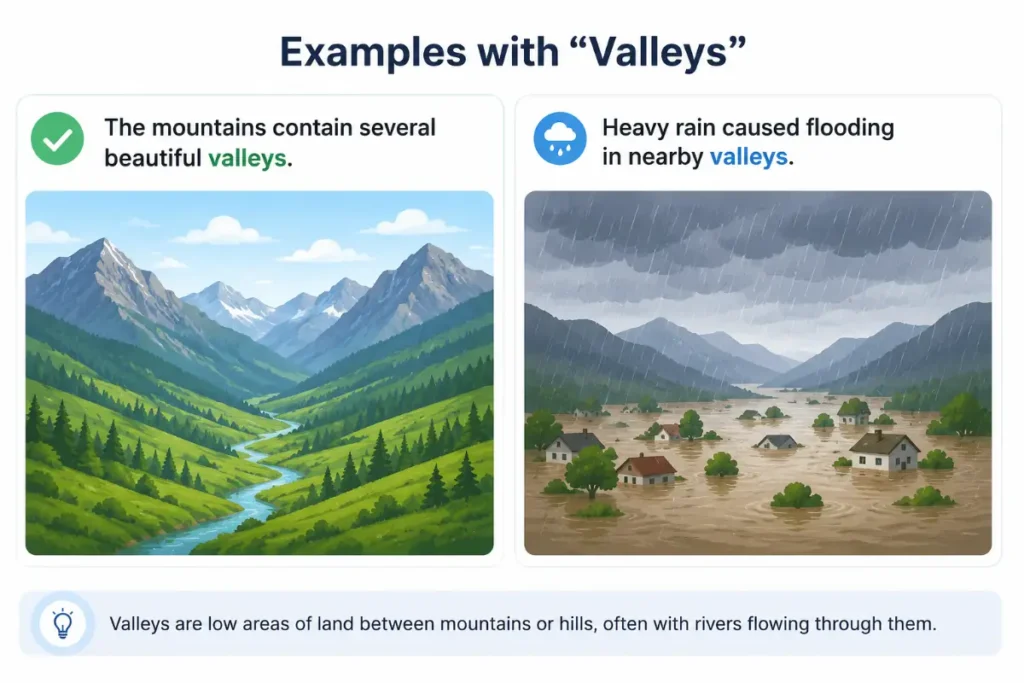
- The mountains contain several beautiful valleys.
- Heavy rain caused flooding in nearby valleys.
- We drove through three valleys before reaching the coast.
- Snow remained on the higher peaks while the valleys stayed green.
- Farmers in the valleys rely on rivers for irrigation.
- The region is known for its deep valleys and forested hills.
- Several small villages are scattered across the valleys.
- The road winds through narrow valleys and steep mountain passes.
- Wildlife thrives in many of the remote valleys.
- The hikers could see two valleys from the top of the ridge.
These sentences show that valleys behaves like any other regular plural noun. It can serve as the subject object or object of a preposition depending on the sentence.
Here are examples showing the common misspelling.
- Incorrect The vallies were surrounded by mountains.
- Correct The valleys were surrounded by mountains.
- Incorrect We traveled through several vallies.
- Correct We traveled through several valleys.
- Incorrect The green vallies looked peaceful from above.
- Correct The green valleys looked peaceful from above.
The incorrect examples may look believable at first glance. That’s exactly why this spelling mistake survives. The mind recognizes a familiar pattern and fills in the ending automatically.
Common Mistakes And Misspellings
- Writing vallies instead of valleys
This is the main mistake. Writers often remember the y to ies pattern but forget to check the letter before the y.
- Treating every final y as a signal to use ies
This is a broader spelling error. Not every noun ending in y changes to ies. The preceding letter matters.
- Confusing pronunciation with spelling
The final sound in valleys can make the spelling feel less obvious. English spelling often requires you to remember the written pattern instead of spelling purely by sound.
- Adding an unnecessary apostrophe
Some writers may write valley’s when they actually mean more than one valley. An apostrophe does not normally create a plural. Valley’s indicates possession or a contraction in a different grammatical structure.
- Using the singular form for multiple places
A sentence such as The valley are beautiful is incorrect when you mean several geographical areas. Use The valleys are beautiful.
There is an NLP angle behind this type of error. When people process familiar words quickly they often rely on learned patterns and sound associations. The spelling pattern for babies cities and stories can become strongly associated with nouns ending in y. That mental shortcut can interfere when the word belongs to a different spelling group.
This is why vallies or valleys can feel like a difficult choice even though the rule itself is straightforward.
Pronunciation Guide
The standard pronunciation of valley is approximately:
IPA US /ˈvæli/
IPA UK /ˈvæli/
Cambridge gives the same basic pronunciation for both its UK and US entries.
You can think of the word as two syllables:
VAL ley
The first syllable receives the main stress.
For the plural:
VAL leys
The plural ending sounds like a light z sound rather than a separate full syllable.
A simple audio style guide is:
VAL ee
Then the plural:
VAL eez
One common pronunciation mistake is to give too much weight to the final spelling. The word does not have three clear syllables in normal speech. It is generally pronounced as two syllables.
Another useful point is that the spelling and pronunciation of valleys can feel more similar to words such as valies when heard quickly. That similarity can contribute to spelling errors. When writing the word you should return to the base form valley and then apply the plural rule.
Etymology And Word Origin
The history of valley explains why its spelling looks the way it does today.
Merriam Webster traces valley to Middle English valeye. The word came through Anglo French from Old French valede and ultimately relates to Latin roots connected with valley. Merriam Webster records its first known English use in the 14th century.
The related word vale has an even clearer connection to Latin vallēs and vallis. Merriam Webster traces vale through Middle English and Anglo French to those Latin forms.
Over centuries English spelling changed as words moved through different languages and writing traditions. Modern English eventually settled on the familiar form valley.
The plural ending developed according to English spelling patterns rather than simply copying the spelling of the Latin ancestor.
That distinction matters. Modern English speakers don’t form the plural based on Latin grammar. They use the modern English noun and its regular plural rule.
So the practical chain is simple:
valley → valleys
Not:
valley → vallies
Understanding the history can make the modern spelling easier to remember. The word has a long journey behind it but the plural rule used today is straightforward.
Regional Usage In US English
American English uses valley for one geographical depression and valleys for more than one. There is no standard American variant called vallies.
The word appears regularly in American geography news travel writing environmental reporting and everyday conversation. Cambridge gives a US pronunciation of /ˈvæli/ and describes the word as a countable noun.
Examples include the Central Valley and other named geographical areas. Writers in the United States should use valleys when referring to multiple areas.
Regional Usage In UK English
British English also uses valley and valleys. The plural spelling does not change.
Cambridge gives the UK pronunciation as /ˈvæli/ and uses examples involving well known British geographical areas such as river valleys.
So you won’t solve the spelling problem by choosing a regional variant. The standard plural remains valleys in British English.
For another common grammar confusion, see training or trainning Correct Spelling Meaning and Usage.
Regional Usage In Australian English
Australian English follows the same standard plural spelling. Writers use valleys for multiple geographical valleys.
The word appears naturally in discussions about landscapes rivers mountains agriculture and regional geography. There is no standard Australian spelling that changes valleys to vallies.
If you’re writing for an Australian audience the safest choice is still valleys.
Regional Usage In Canadian English
Canadian English also uses valleys as the regular plural form.
Canadian writing generally follows the same basic English plural rule used in American and British English for nouns ending in vowel plus y.
The important point is consistency. If you’re writing for a Canadian audience you don’t need a special regional spelling here. Use valley for one and valleys for more than one.
Grammar Rules And Part Of Speech
Valley is a countable noun.
That means you can talk about one valley or several valleys.
Singular:
There is a valley below the mountain.
Plural:
There are several valleys below the mountain.
The plural form can appear in many grammatical positions.
As a subject:
The valleys are covered with trees.
As an object:
We explored the valleys.
After a preposition:
The villages lie between the valleys.
After a determiner:
These valleys are difficult to reach.
The word can also appear in possessive constructions.
The valley’s river flooded after the storm.
Here the apostrophe is correct because the sentence expresses possession.
For multiple valleys you could write:
The valleys’ rivers were affected by heavy rain.
The apostrophe comes after the s because the noun is already plural.
This distinction helps prevent another common mistake. Valleys means more than one valley. Valley’s usually shows possession or represents a contraction. Valleys’ shows possession belonging to multiple valleys.
The word also appears in compound expressions such as river valley mountain valley valley floor and valley system. The exact grammar depends on the sentence but the spelling of the plural remains valleys.
Real Life Usage Examples
Daily Talk
- We passed through several valleys on our trip.
- The valleys look amazing in the morning light.
In everyday speech people usually use the word in a simple geographical sense. There’s no special formal rule to remember.
- The route through the northern valleys may take longer.
- I attached the map showing the main valleys in the area.
In professional email writing valleys works naturally when the subject involves geography travel planning construction agriculture or environmental work.
Academic Writing
- Researchers examined how rivers shaped the surrounding valleys.
- The study compares vegetation patterns across several mountain valleys.
Academic writers may use valleys in geography geology environmental science archaeology and related fields.
News Writing
- Heavy rainfall has affected communities in several valleys.
- Emergency crews reached the remote valleys after the roads reopened.
News writing favors clear standard vocabulary. Valleys fits naturally into reports about weather flooding transportation geography and regional events.
Literature
- Mist settled slowly across the valleys.
- The travelers watched the distant valleys disappear beneath the evening haze.
Creative writers can use valleys literally or symbolically. A valley may represent shelter distance isolation hardship or a transition between higher points.
Related And Confused Terms
- At last
At last often means something happened after a long wait. It can overlap with finally but usually carries a stronger feeling of relief or impatience.
- Eventually
Eventually refers to something that happens after some time or after a series of events. It focuses more on the final outcome of a process.
- Ultimately
Ultimately means in the final result or final analysis. It often sounds more formal than finally.
- At the end
At the end identifies the final point of a period event story or process. It can be more literal than finally.
- Conclusively
Conclusively means in a way that settles an issue or proves something clearly. It is not always a direct substitute for finally.
- In the end
In the end often introduces the final result of a situation. It can describe an outcome after several developments.
- Lastly
Lastly introduces the final item in a sequence. It is useful in structured explanations and lists.
- After all
After all can explain a final reason or remind the reader of an important fact. Its meaning differs from finally but the words can appear in similar contexts.
These terms belong to the same semantic field in some contexts but they aren’t interchangeable in every sentence. Good writing depends on choosing the word that matches the exact meaning.
Expert Editor Insight
As a senior editor I’d treat vallies as a straightforward spelling error rather than a stylistic variation. When I see it in a manuscript I’d correct it to valleys unless the writer is referring to a specific proper name or unusual historical source. Major dictionary evidence supports this approach. Merriam Webster explicitly lists valleys as the plural of valley and Cambridge uses the same form in definitions and authentic corpus examples.
One useful editing trick is to stop staring at the disputed ending. Go back to the singular noun first. Ask yourself what the word is before you make it plural.
valley
Then look at the letter immediately before y.
It is e.
That tells you to add s.
valley → valleys
This approach is more reliable than trying to remember isolated spellings. It turns the correction into a repeatable grammar decision.
Most spell checkers will flag vallies because it doesn’t match the standard plural form. But a good editor shouldn’t rely on software alone. Context still matters. A dictionary confirms the lexical form while grammar explains why that form works.
Why The Spelling Can Feel Confusing
English spelling has plenty of patterns that look simple until two of them collide.
The y rule is a good example.
Consider these words:
city becomes cities.
party becomes parties.
country becomes countries.
But then look at:
day becomes days.
boy becomes boys.
key becomes keys.
Valley belongs with the second group.
The deciding factor is not simply the final y. You need to look at the letter immediately before it.
A consonant before y often leads to ies.
A vowel before y normally leads to s.
That gives you:
valley → valleys.
This small distinction is one of those spelling rules that becomes much easier once you see the pattern. Instead of memorizing every word separately you can make a quick decision based on the letters in front of you.
There are exceptions and more complex cases across English spelling but this rule handles valley correctly.
A Simple Memory Trick
Picture the word valley as two sides of a landscape.
The word has ey at the end.
Keep the y.
Add s.
valley + s = valleys
Don’t let the y trick you into changing it to ies.
You can also remember a simple pair:
city → cities
valley → valleys
The first changes because t is a consonant. The second keeps y because e is a vowel.
If you remember that contrast you’ll have a much easier time choosing the correct form.
When To Use Valley
Use valley when you are talking about one place.
For example:
The valley is surrounded by tall mountains.
A river runs through the valley.
We spent the afternoon exploring the valley.
The singular form works with words such as a and one.
A valley can be wide or narrow. A valley can contain a river. A valley can also be dry forested agricultural or heavily populated.
The word is broad enough to work in everyday conversation and technical writing.
When To Use Valleys
Use valleys when you are talking about two or more places.
For example:
The region contains several valleys.
The valleys are connected by narrow roads.
Snow covered the upper valleys.
You can use numbers or plural determiners with the word.
Two valleys.
Several valleys.
Many valleys.
These valleys.
Those valleys.
The valleys.
The basic grammar stays consistent.
Final Spelling Check
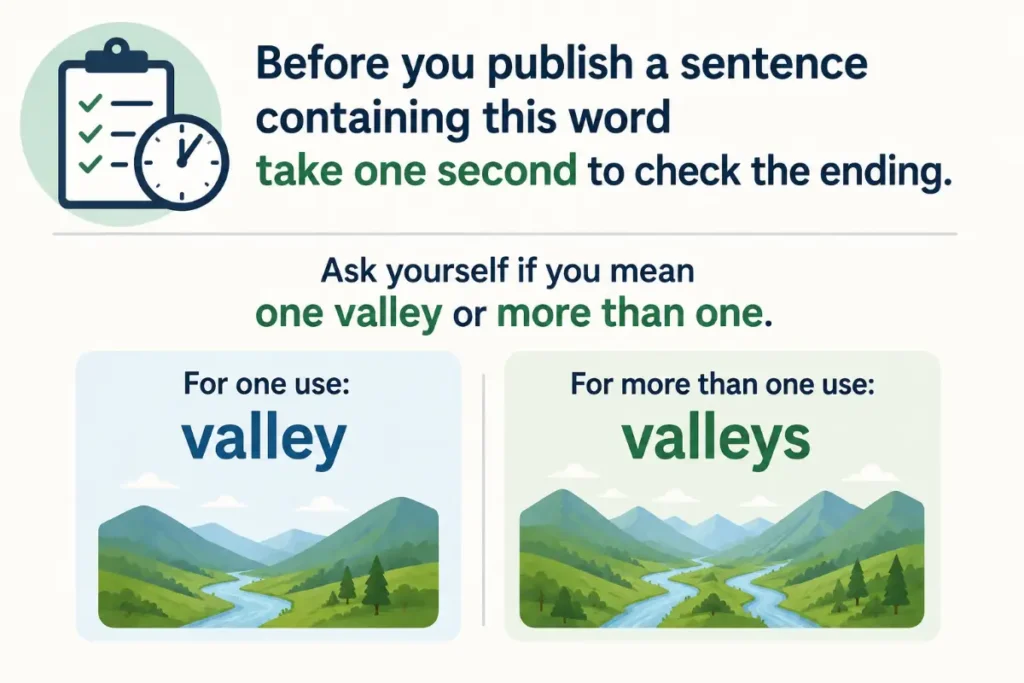
Before you publish a sentence containing this word take one second to check the ending.
Ask yourself if you mean one valley or more than one.
For one use:
valley
For more than one use:
valleys
If you see vallies in your draft and you mean multiple geographical areas replace it with valleys.
That quick check can prevent an otherwise small spelling error from making its way into an article email report essay or professional document.
A related grammar guide is cacoon or cocoon Which Spelling Is Correct.
Conclusion
The correct spelling is valleys when you mean more than one valley. Vallies is not the standard plural form. The spelling becomes easier to remember once you look at the letter before the final y. Valley ends in vowel plus y so you simply add s to form valleys. Major dictionaries support this spelling and use it in standard English.
The best practical tip is to remember the singular first. Start with valley then add s. Don’t automatically change every final y to ies. That small habit will help you avoid this mistake in everyday writing and formal work.s
Frequently Asked Questions
Is Vallies A Real Word?
Vallies is not the standard plural of valley in modern English. If you mean more than one low area between hills or mountains the correct spelling is valleys. Major dictionaries list valleys as the plural form. You may occasionally encounter vallies because someone has made a spelling mistake but that doesn’t make it an accepted standard plural.
Vallies Or Valleys Which Is Correct?
Valleys is correct when you mean more than one valley. Vallies is a spelling mistake in standard English. The reason is that valley ends with a vowel followed by y. Nouns with this pattern normally form their plural by adding s. Therefore valley becomes valleys. You can verify this form in major dictionaries such as Merriam Webster and Cambridge.
How To Pronounce Valleys?
Valleys is pronounced approximately /ˈvæliz/. The singular valley is /ˈvæli/. The plural adds a light z sound at the end. You can think of the pronunciation as VAL eez. The first syllable receives the main stress. Cambridge lists /ˈvæli/ for the singular form in both its UK and US entries.
Why Do People Misspell Valleys?
People often misspell valleys because English has two familiar plural patterns for words ending in y. Words such as city become cities while words such as boy become boys. Writers may remember the first pattern and apply it to valley. The letter before y solves the problem. Because valley has e before y the plural is valleys.
Valleys In Formal Writing?
Valleys is completely appropriate in formal writing. You can use it in academic papers reports professional emails news articles technical documents and other edited material. It is the standard plural form of valley. There is no need to replace it with a more complicated word. Clear writing usually wins when the simple standard word says exactly what you mean.