
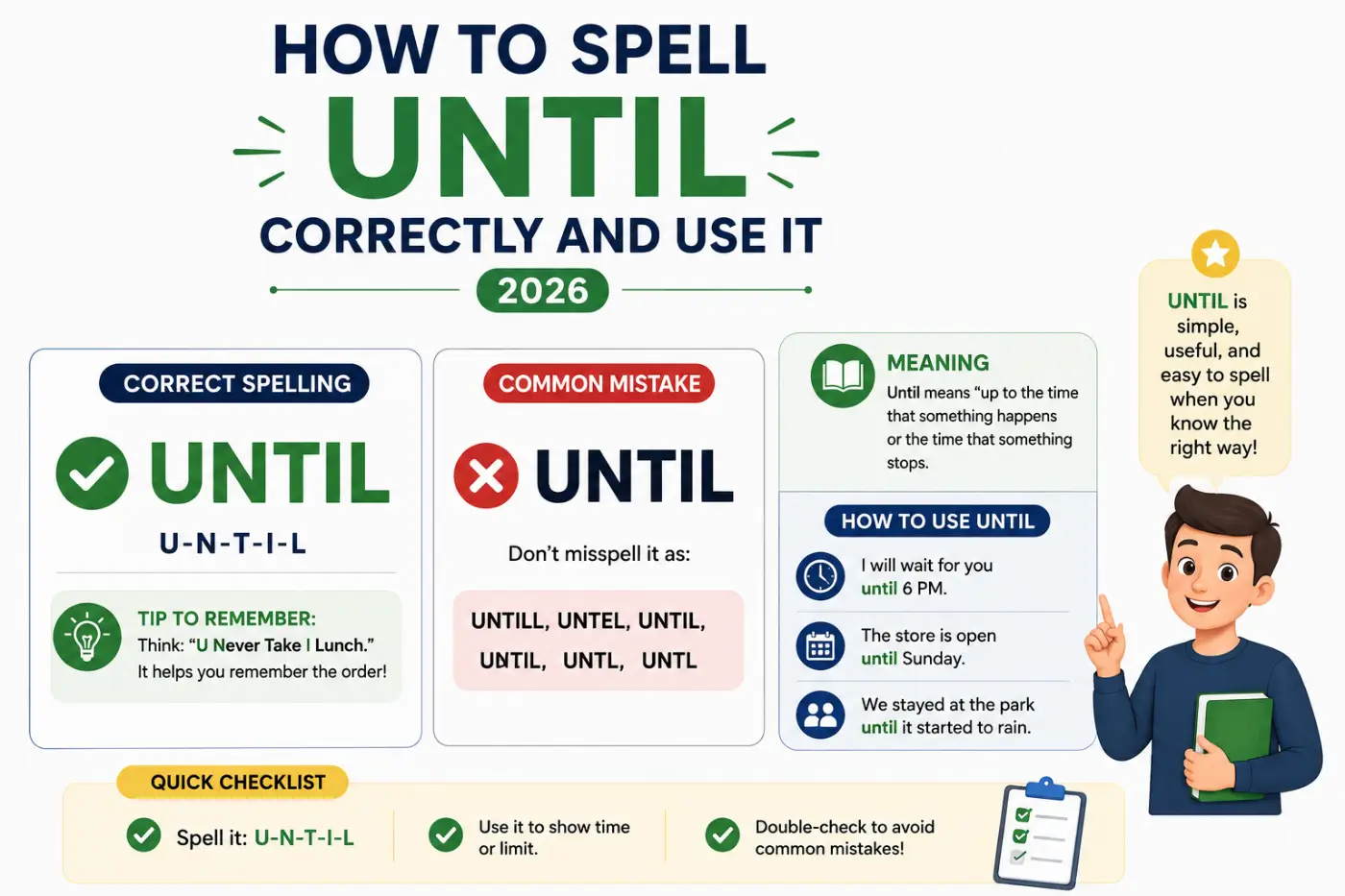
The correct spelling is until. It has one l at the end. The form untill is a spelling error in standard English. Major English dictionaries such as Cambridge and Oxford list until as the standard form. If you searched for how to spell until you probably want a quick answer first. You can write it as u n t i l. Remember the final l is single.
Spelling mistakes often happen with short everyday words because we type them from memory instead of looking closely at each letter. Until is a good example. Many people accidentally write untill because the word sounds as though it might need two l letters at the end.
The confusion usually comes from familiar words that contain double letters. Words such as still and until can also become mixed up in fast typing. Once you know the pattern the correct spelling becomes much easier to remember. This guide explains the spelling meaning pronunciation grammar history common mistakes and practical uses of until. You will also learn how until differs from till and by and why untill is not the standard spelling.
For another common grammar confusion, see Analyzing or Analysing: Which Is Correct? 2026.
Quick Definition
Until is a preposition and conjunction that shows a point in time or an event that marks an ending. It means up to a particular time or event. The correct spelling is until with one l at the end. Untill is a common spelling mistake rather than a standard English word.
Quick Answer
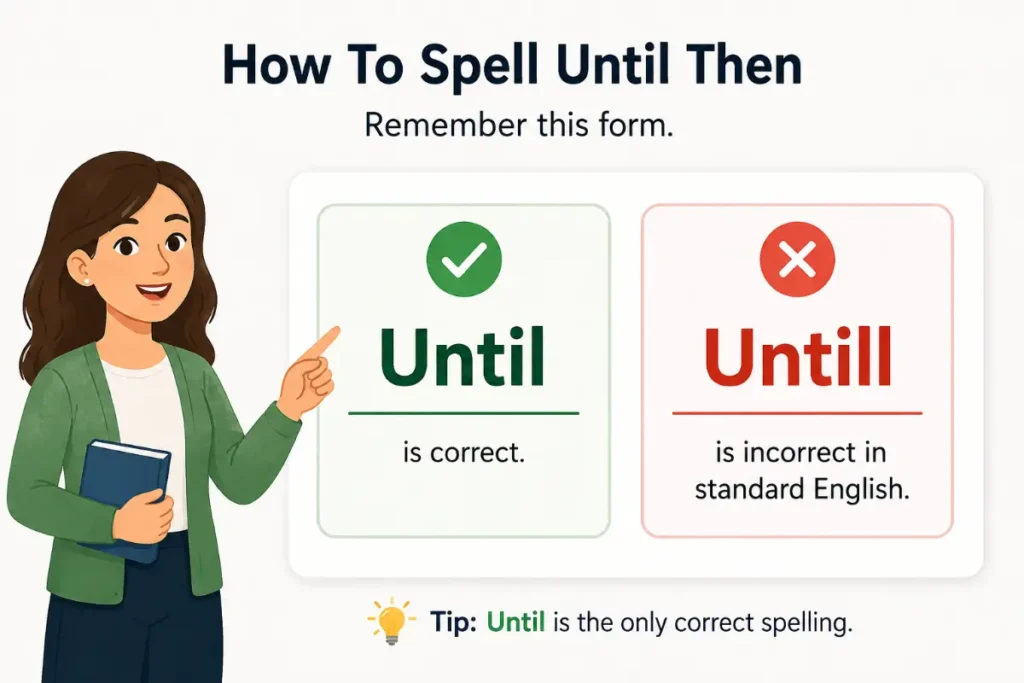
If you want the shortest answer to how to spell until then remember this form.
Until is correct.
Untill is incorrect in standard English.
The easiest memory trick is to think of the ending as il rather than ill. Write un plus til. That gives you until.
Comparison Table for Until and Untill
| Correct Form | Meaning | Part of Speech | Origin | Usage Frequency | Formality | Common Contexts | Example |
|---|---|---|---|---|---|---|---|
| Until | Up to a particular time or event | Preposition and conjunction | Middle English with Old Norse influence | Very common | Standard | Time limits events schedules conditions | We waited until noon. |
| Untill | No standard meaning | Misspelling | Not a standard modern form | Uncommon in edited English | Incorrect | Typing errors spelling mistakes | I will wait until noon. |
The table makes the central point clear. Until is the standard spelling. Untill adds an unnecessary second l.
Cambridge specifically warns learners to spell until with only one l and identifies untill as an error.
Meaning and Definition
Meaning of Untill
Untill is not the standard spelling of an English word meaning up to a certain time. In ordinary modern English it is best treated as a misspelling of until. You may occasionally see untill in old documents or in informal online writing. That does not make it the accepted modern spelling. Standard dictionaries use until.
This distinction matters because a word can appear online without being correct. Search engines can index spelling mistakes. Social media can spread them quickly. A text message can contain a typo that gets repeated by another person. None of those situations changes the standard spelling. When you write an email essay report application or professional message use until.
Meaning of Until
Until means up to a particular time point or event. It can describe something that continues and then stops at that point.
Consider this sentence.
I worked until midnight.
The sentence tells us that the work continued up to midnight.
Until can also introduce an event.
I waited until she arrived.
Here the waiting continued up to the point when she arrived.
Cambridge classifies until as both a preposition and a conjunction. Oxford also lists both grammatical roles.
The word can also describe distance in certain contexts.
We drove until we reached the next town.
The focus remains on the point where an action reaches a limit.
The basic idea is easy to remember. Until creates a boundary. Think of it as a finish line that tells the reader where an action or situation stops.
Key Differences Explained
Spelling
The correct form is until. It contains one l at the end.
The incorrect form is untill. It contains two l letters at the end.
This is the main distinction. There is no change in meaning because untill does not represent a standard alternative spelling.
Grammar Role
Until can work as a preposition.
She stayed until Friday.
Here until comes before a noun that identifies a time.
It can also work as a conjunction.
She stayed until the meeting ended.
Here until introduces a clause containing a subject and verb.
Cambridge identifies both uses.
Meaning
Until expresses a limit in time or an endpoint connected to an event.
It can show the point up to which something continues.
We talked until sunrise.
The talking continued up to sunrise.
Tone
Until is neutral and standard. You can use it in casual conversation academic writing business communication journalism and formal documents. Its shorter alternative till is also standard but generally feels more informal. Oxford notes that till is used less often in writing than until.
Context
Until appears in everyday expressions such as until tomorrow until Friday until noon until now and until the end.
It also appears in more formal sentences.
The policy remains effective until further notice.
The phrase sounds natural in professional writing because until is not restricted to casual speech.
Which Spelling Is Correct
The correct spelling is until.
There is a straightforward linguistic reason. Standard modern English dictionaries record until as the established spelling. Cambridge explicitly states that the word should contain only one l at the end and gives untill as the incorrect form.
Oxford also lists until as a preposition and conjunction. Its word origin information traces the modern form to Middle English and explains that the word developed from Old Norse elements.
That dictionary evidence gives you a reliable editorial rule. When you need the standard form for school writing professional communication publishing or careful everyday English use until.
A useful editor tip is to avoid memorizing the word letter by letter every time. Instead remember the ending. Until ends in il. It does not end in ill.
Sentence Examples
Here are natural examples that show how until works.
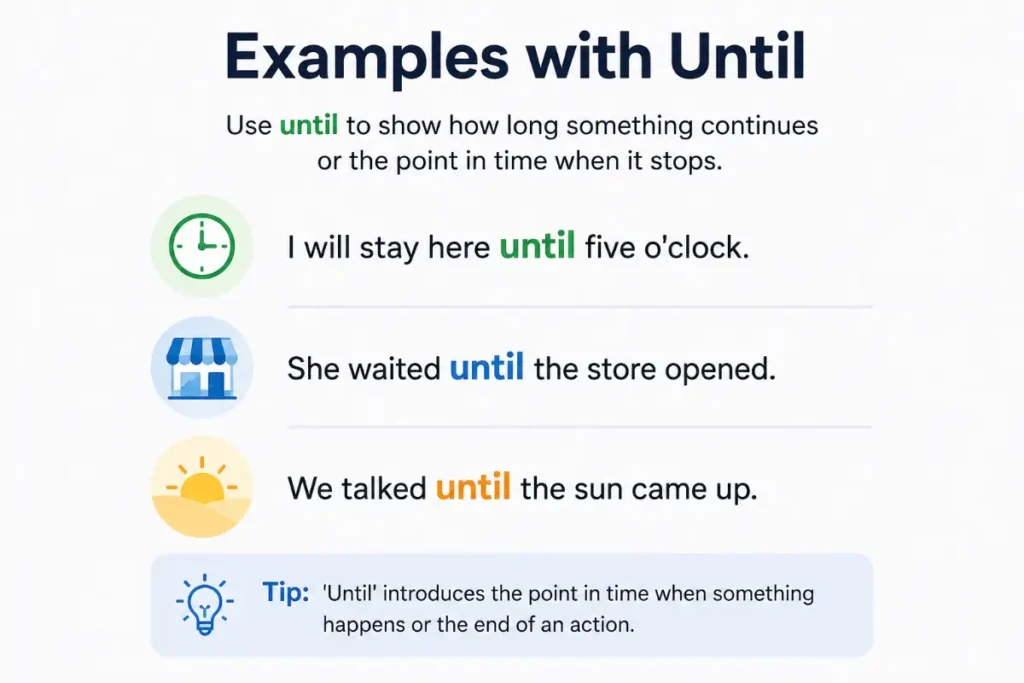
- I will stay here until five o’clock.
- She waited until the store opened.
- We talked until the sun came up.
- Please keep the door closed until everyone arrives.
- He did not understand the problem until his teacher explained it.
- The library is open until eight tonight.
- I had never visited Texas until last summer.
- They worked until the project was finished.
- You can use the room until Friday.
- We did not leave until the rain stopped.
Each sentence uses until to establish a point where an action ends or a new event occurs.
Now compare those correct examples with common spelling mistakes.
- Incorrect: I will stay here untill five o’clock.
- Incorrect: She waited untill the store opened.
- Incorrect: We talked untill sunrise.
- Incorrect: Please wait untill I return.
- Incorrect: He stayed untill the meeting ended.
The problem in every example is the same. The writer has added an extra l.
Common Mistakes and Misspellings
Untill
This is the most common spelling mistake associated with until. Writers often add a second l because several familiar English words use double l letters.
Untilll
Some people type an extra l after already adding the incorrect second l. This usually happens during fast typing rather than because the writer believes the word has three l letters.
Until
This is the correct spelling. It contains one l at the end.
Untilll
This form can appear as a careless typing error. It has no standard role in modern English.
Til
Til can appear as an informal shortened form in some writing. It is not the same spelling issue as untill. Oxford lists till as an informal equivalent of until and also records til and ’til as informal forms.
Why does the brain create the untill error?
NLP research and practical language editing both recognize that familiar letter patterns can influence typing and spelling. When people produce a word quickly they often rely on stored visual patterns rather than consciously checking every character.
The word still may also create interference because it has a double l. Words such as fill and will reinforce that visual pattern. Since until has a similar ending sound the brain can sometimes pull the wrong spelling pattern into the word.
That is why a quick proofread can catch something that looked perfectly normal while you were typing.
Pronunciation Guide
The standard American pronunciation of until can be represented as /ənˈtɪl/ or /ʌnˈtɪl/. Cambridge gives both forms for American English.
A simple syllable breakdown is:
un til
The stress normally falls on the second syllable.
Say it like this.
uhn TIL.
The final sound is l. The word does not end with a separate extra syllable.
One common pronunciation problem happens when learners give the first syllable too much emphasis. In natural American speech the first part is often reduced.
You may hear something close to uhn TIL in everyday conversation.
The pronunciation does not tell you to use two l letters. That is worth remembering because spelling and pronunciation do not always map perfectly onto one another in English.
If you are learning American English you can focus on the stressed second syllable and keep the first syllable light.
Learn the difference in Thank You For Your Concern Meaning And Usage.
Etymology and Word Origin
The history of until is surprisingly interesting because the word contains an old combination of elements. Oxford traces until to Middle English and identifies Old Norse influence. It explains the word as coming from Old Norse und meaning as far as together with till. The resulting sense was essentially a duplicated expression for a limit or endpoint.
That history also helps explain why until is not simply a modern invention based on another familiar English word. Language changes over centuries. Words become shorter in some contexts. Sounds shift. Spellings become standardized through repeated use and written records. Modern dictionaries then document the forms accepted in contemporary English.
Until has survived that long process as the standard form used today.
The historical background does not change the spelling rule. Modern writers should use until with one l.
Regional Usage in the US
American English uses until as a standard preposition and conjunction. Cambridge gives the American pronunciation as /ənˈtɪl/ and /ʌnˈtɪl/. The word is common in everyday American speech and writing.
Americans also use till in informal speech and writing. Until generally sounds more neutral and is a safe choice in professional communication. The spelling remains until. There is no standard American spelling untill.
Regional Usage in the UK
British English also uses until as the standard spelling. Cambridge lists until as both a preposition and conjunction and explains its use for time and events.
Till is common in British English as an informal alternative. The two forms can often replace each other in everyday sentences. The spelling rule stays the same. Use until when you need the standard form.
Regional Usage in Australia
Australian English follows the same standard spelling pattern. Until is the accepted form in edited English. Informal speech may use till just as American and British speakers do. That variation affects word choice and tone rather than the spelling of until.
Untill is not a standard Australian variant.
Regional Usage in Canada
Canadian English also uses until as the standard form. Canadian writers may use till in casual contexts but until remains the straightforward choice for formal and neutral writing. There is no regional rule that changes until to untill.
This is useful for writers who publish for an international audience. You do not need a different spelling of until for US UK Australian or Canadian English.
Grammar Rules and Part of Speech
Until has two main grammatical roles.
Until as a Preposition
Use until before a noun phrase or time expression.
We stayed until noon.
She worked until Friday.
The shop is open until midnight.
In each example until introduces the endpoint.
Until as a Conjunction
Use until to introduce a clause containing a subject and verb.
We waited until the rain stopped.
She stayed until her friend arrived.
I will not leave until you are ready.
Cambridge describes this use as a subordinating conjunction.
Until and Future Time
One useful grammar rule often catches learners off guard. After until you normally use a present form to refer to a future event.
Correct:
I will wait until she arrives.
Incorrect:
I will wait until she will arrive.
Cambridge specifically explains this pattern.
The same idea appears in sentences such as:
We will stay until the store closes.
They will wait until the teacher returns.
I will keep working until the job is finished.
Until and By
Until and by can look similar because both can refer to a time. They do not express the same idea.
Until shows that something continues up to a particular point.
I will work until five.
By shows that something must happen no later than a particular point.
I will finish the report by five.
Cambridge specifically recommends by rather than until when talking about a deadline that requires completion before a stated time.
That distinction is worth learning because it can change the meaning of a sentence.
Until and Before
Until is also different from before.
I will stay until Friday.
This suggests that the stay continues up to Friday.
Please finish the form before Friday.
This sets Friday as a deadline that the action should precede.
Choosing the right word makes the timeline clear.
Until and Quantity
Do not use until for quantities.
The theatre can hold up to five hundred people.
Not:
The theatre can hold until five hundred people.
Cambridge specifically identifies this as a common error.
Until and Distance
Until can sometimes appear with a destination when the meaning involves reaching a point.
We drove until we reached the town.
In other structures English may use as far as for distance.
We drove as far as the town.
The choice depends on the sentence structure and intended meaning. Cambridge notes that until is not normally used to express distance in the same way as as far as.
Real Life Usage Examples
Daily Talk
I cannot leave until my brother gets home.
We can watch another episode until dinner is ready.
These sentences sound natural in ordinary conversation. Until is one of those words native speakers use without thinking about it.
The office will remain closed until Monday.
Please keep the documents until the manager reviews them.
Until works comfortably in workplace communication because it has a neutral tone.
Academic Writing
The study continued until researchers collected enough data.
The theory remained widely accepted until later evidence challenged it.
Academic writers use until to describe time relationships between events.
News Writing
The roads remained closed until authorities completed their inspection.
The agreement will remain in effect until the end of the year.
News writing favors clear time expressions. Until helps readers understand exactly how long a situation lasted.
Literature
She waited until the last light disappeared.
He walked until the road became silent.
Literary writing can use until in a simple way or build a more emotional sense of duration around it. The word itself remains ordinary and neutral.
Related and Confused Terms
At Last
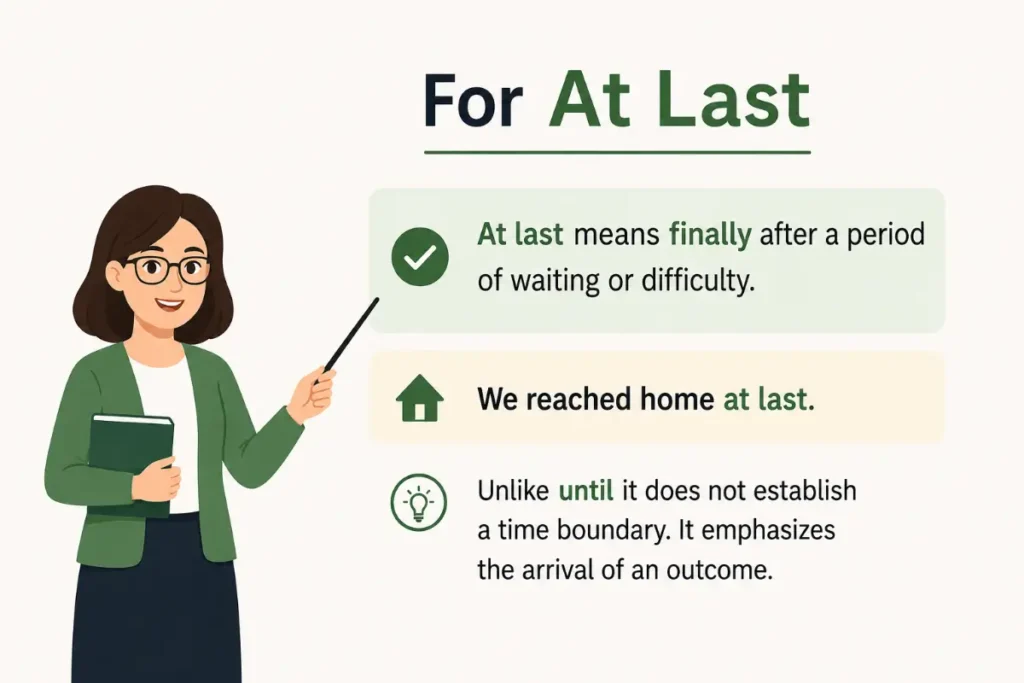
At last means finally after a period of waiting or difficulty.
We reached home at last.
Unlike until it does not establish a time boundary. It emphasizes the arrival of an outcome.
Eventually
Eventually means after some time or after a series of events.
They eventually found the missing book.
It focuses on the result rather than the endpoint of an ongoing action.
Ultimately
Ultimately means in the final result or final analysis.
Ultimately the decision belongs to the board.
It often sounds more analytical than until.
At the End
At the end identifies the final part or point of something.
At the end of the movie everyone applauded.
It can describe location within a sequence rather than an ongoing action that continues up to a time.
Conclusively
Conclusively means in a way that settles an issue or proves something.
The evidence conclusively established the timeline.
This word is much more formal and does not function as a direct replacement for until.
In the End
In the end means finally or after everything has happened.
In the end they chose the smaller house.
It focuses on the final outcome.
Lastly
Lastly introduces the final item in a sequence.
Lastly we need to discuss the budget.
It does not mean up to a time.
Till
Till can mean the same thing as until when used as a preposition or conjunction.
We waited till noon.
Oxford identifies till as an informal equivalent of until and notes that until is usually preferred at the beginning of a sentence.
Expert Editor Insight
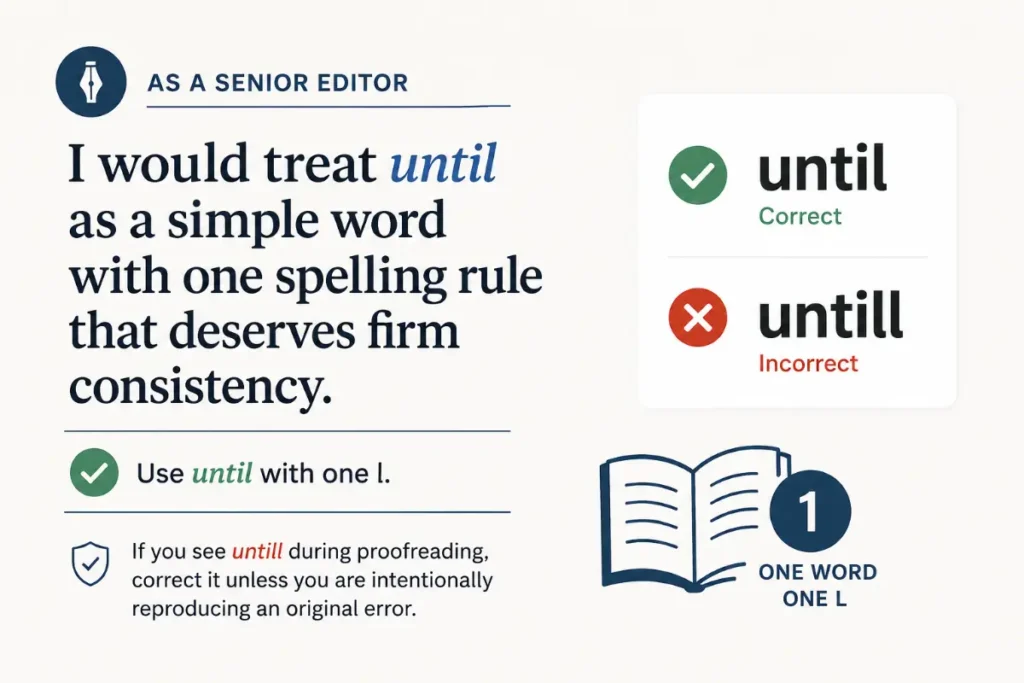
As a senior editor I would treat until as a simple word with one spelling rule that deserves firm consistency. Use until with one l. If you see untill during proofreading correct it unless you are intentionally reproducing an original error. Modern spelling tools usually recognize until immediately and may flag untill as a misspelling.
A dictionary check is the better authority when a spelling question remains uncertain because dictionaries distinguish established words from accidental forms. Cambridge explicitly identifies untill as an error while Oxford records until as the standard modern entry. A practical memory trick is especially useful here. Think of until as un plus til. The ending is til with one l. You do not need to memorize a complicated rule.
For another common grammar confusion, see Thank You For The Information Correct Usage And Meaning.
Conclusion
The correct spelling is until with one l at the end. The form untill is a common spelling mistake and should not be used in standard English. Until works as both a preposition and a conjunction and usually shows the point up to which an action or situation continues. It can appear in casual conversation academic writing professional emails news reports and many other settings.
The easiest memory trick is simple. Think of until as un plus til. The ending has one l. If you remember that small detail you can avoid the most common spelling error. When you need a formal and neutral choice use until rather than the more informal till.
FAQs
Is untill a real word?
Untill is not the standard modern spelling of until. In normal English writing it should be treated as a misspelling. Cambridge specifically warns that until has only one l at the end. If you see untill in an email essay or document you should normally correct it to until.
What does until mean?
Until means up to a particular time or event. It can show that an action continues until a certain point or that something remains true until a change occurs. For example you can say I waited until noon or We stayed until the meeting ended. Cambridge and Oxford both classify until as a preposition and conjunction.
How to spell until correctly?
The correct spelling is until with one l at the end. A useful way to remember it is to divide the word mentally into un and til. Avoid adding a second l. The spelling untill is a common typing mistake but it is not the standard form used in edited English.
How to pronounce until?
Until is commonly pronounced /ənˈtɪl/ or /ʌnˈtɪl/ in American English. The main stress falls on the second syllable. You can think of the sound as uhn TIL. Cambridge lists both American pronunciations while Oxford gives /ənˈtɪl/ as its main pronunciation.
Can until start a sentence?
Yes. Until can begin a sentence when it introduces a clause. For example you can write Until the rain stopped we stayed inside. However the more common order places the main clause first. Cambridge notes that the until clause usually comes after the main clause.
What is a synonym for until?
There is no single synonym that replaces until in every sentence. Till is the closest direct alternative and can often replace it. In some contexts phrases such as up to the time or before can express related ideas. The correct choice depends on the exact meaning and sentence structure. Till is generally more informal than until.
Why do people misspell until?
People often write untill because English contains many familiar words with double l letters. Words such as still and will can reinforce that spelling pattern. Fast typing also encourages people to rely on visual memory instead of checking every letter. The mistake is understandable but the standard spelling remains until with one l.
Is until suitable for formal writing?
Yes. Until is completely appropriate in formal writing. You can use it in academic papers professional emails reports business documents news articles and official communication. Till can also be correct but it generally sounds more informal. If you want a neutral standard choice in formal writing use until. Oxford and Cambridge both recognize until as the standard form.