
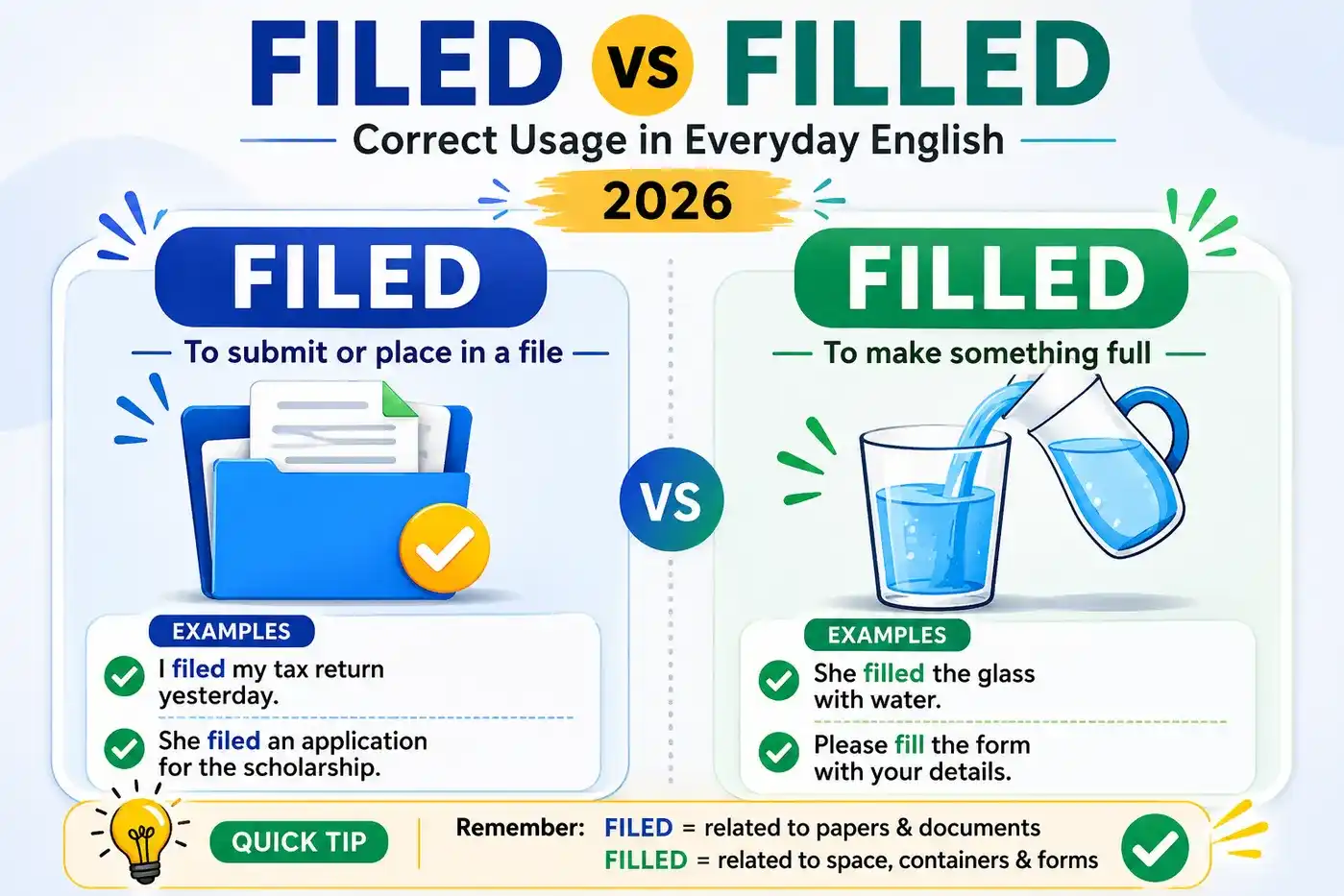
The confusion between filed vs filled is surprisingly common. At first glance, the two words look almost identical. They differ by just one letter, and in fast speech, they can sound very similar. That small difference creates countless mistakes in emails, legal documents, academic papers, business reports, and everyday conversations.
The good news is that filed and filled have completely different meanings. Once you understand those meanings, choosing the correct word becomes much easier.Filed usually relates to submitting, organizing, storing, or officially recording something. You might file taxes, file a complaint, or file documents in a cabinet.
Filled refers to making something full or occupying available space. You can fill a glass with water, fill a room with people, or fill out information on a form. Because both words appear frequently in professional and personal communication, knowing the difference can improve your writing immediately. This guide explains the meaning, pronunciation, grammar, origins, examples, common mistakes, and expert usage tips for filed vs filled so you’ll never confuse them again.
For another common grammar confusion, see withdraw or withdrawal Meaning Difference And Usage.
Filed Vs Filled Quick Definition
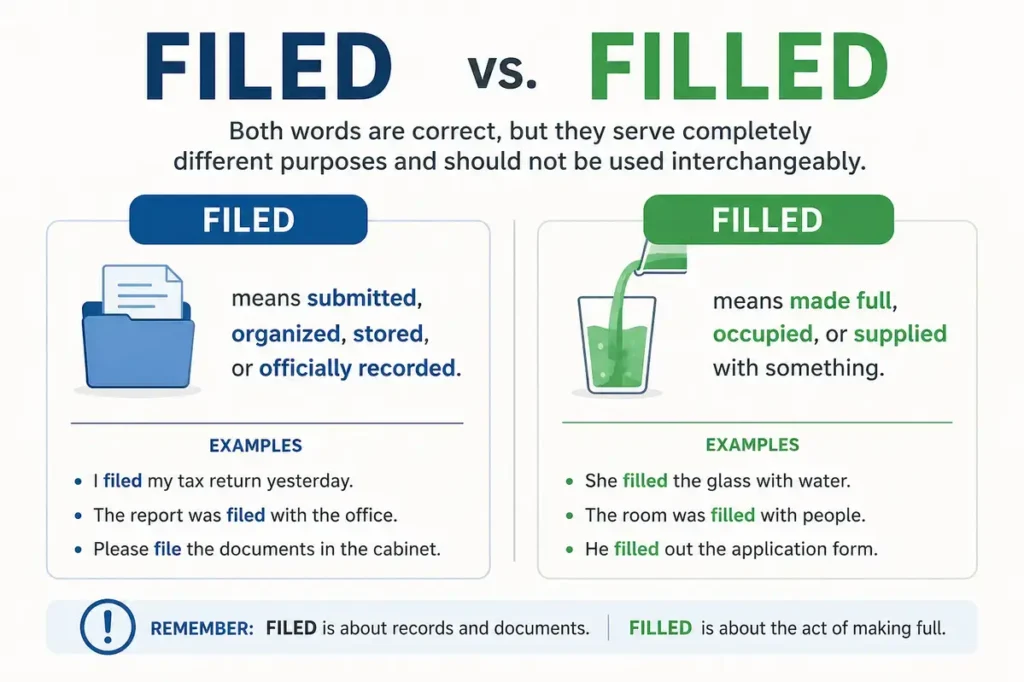
Filed means submitted, organized, stored, or officially recorded. Filled means made full, occupied, or supplied with something. Both words are correct, but they serve completely different purposes and should not be used interchangeably.
Filed Vs Filled Quick Answer
Use filed when referring to submission, documentation, organization, or official records.
Examples:
- She filed her tax return.
- The lawyer filed a motion.
- He filed the paperwork.
Use filled when referring to making something full or occupying space.
Examples:
- She filled the glass with water.
- The room was filled with laughter.
- He filled the container completely.
A simple memory trick helps:
Filed involves records.
Filled involves fullness.
Filed Vs Filled Comparison Table
| Feature | Filed | Filled |
|---|---|---|
| Correct Spelling | Yes | Yes |
| Primary Meaning | Submitted or organized | Made full |
| Part Of Speech | Verb | Verb |
| Root Word | File | Fill |
| Common Usage | Legal, business, administration | Daily life, descriptions, actions |
| Formality Level | Common in professional writing | Common in all writing |
| Typical Context | Documents, records, complaints | Containers, spaces, forms |
| Example | She filed the report. | She filled the report with details. |
| Grammar Function | Past tense and past participle of file | Past tense and past participle of fill |
| Usage Frequency | High | Very high |
Meaning Of Filed Vs Filled
What Does Filed Mean?
Filed is the past tense and past participle form of the verb file. It generally means to submit, organize, classify, record, or officially register something.
Examples:
- The accountant filed the tax documents.
- The employee filed the paperwork.
- The attorney filed a lawsuit.
- She filed the complaint yesterday.
- The records were filed alphabetically.
The word often appears in professional, legal, governmental, and administrative contexts.
What Does Filled Mean?
Filled is the past tense and past participle form of the verb fill.
It means made full, occupied, supplied, or completed.
Examples:
- She filled the bottle with water.
- The stadium was filled with fans.
- The bakery filled the shelves with fresh bread.
- He filled the application form.
- The room was filled with excitement.
Filled appears across almost every type of writing because the concept of making something full is extremely common.
Filed Vs Filled Key Differences
Although the words look similar, their meanings are completely unrelated.
Meaning Difference
Filed involves submission, storage, organization, or documentation. Filled involves fullness, occupancy, or completion.
Examples:
- She filed the report.
- She filled the report with useful information.
Context Difference
Filed often appears in legal, administrative, business, and government settings. Filled appears in everyday conversations and descriptive writing.
Action Difference
Filed focuses on placing, submitting, or recording. Filled focuses on adding enough content or material to make something full.
Usage Difference
Filed is connected with documents and records. Filled is connected with space, volume, quantity, and completion.
Reader Interpretation Difference
When readers see filed, they expect paperwork or official actions. When readers see filled, they expect descriptions involving fullness or completion.
Filed Vs Filled Which One Is Correct?
Both words are correct. The correct choice depends entirely on what you want to say. Use filed when referring to documents, reports, applications, complaints, lawsuits, taxes, or records.
Examples:
- She filed her taxes.
- The lawyer filed the motion.
- The employee filed the report.
Use filled when referring to fullness, completion, or occupancy.
Examples:
- She filled the cup.
- The hall was filled with guests.
- He filled the form with accurate information.
A useful test is simple.
Ask yourself:
Am I talking about submission or record keeping?
Use filed.
Am I talking about making something full?
Use filled.
Filed Vs Filled Examples In Sentences
10 Examples Using Filed
- The company filed its annual report last week.
- She filed a complaint with customer service.
- The attorney filed the necessary documents.
- He filed the records in alphabetical order.
- The employee filed the paperwork before leaving.
- The taxpayer filed an extension request.
- The court officially filed the motion.
- The secretary filed every document carefully.
- They filed the application online.
- The organization filed its financial statements on time.
10 Examples Using Filled
- She filled the glass with lemonade.
- The auditorium was filled with students.
- He filled the basket with fruit.
- The room was filled with music.
- They filled the pool during the summer.
- She filled the notebook with ideas.
- The shelves were filled with books.
- He filled the tank before the trip.
- The restaurant filled quickly after opening.
- The sky was filled with colorful fireworks.
Why Filed Vs Filled Causes Confusion
Several factors contribute to the confusion.
Similar Spelling
Only one letter separates the words.
Filed
Filled
When reading quickly, many people overlook the difference.
Similar Pronunciation
In some accents, the words sound very close to each other. That similarity increases the likelihood of writing errors.
Both Are Common Verbs
Many commonly confused word pairs involve rare words. Filed and filled are different because both appear frequently in everyday English.
Both Can Appear In Professional Writing
Examples:
- The company filed the report.
- The company filled the report with supporting data.
Both sentences are grammatically correct but have different meanings.
Autocorrect Often Misses The Error
Since both words are valid English words, spell check tools rarely flag mistakes. Writers must rely on context and understanding rather than software correction.
Filed Vs Filled Common Mistakes
Because filed and filled differ by only one letter, they are often confused in emails, reports, legal documents, and casual writing. Understanding the most common mistakes can help you avoid embarrassing errors.
Using Filed When You Mean Filled
This is one of the most common mistakes.
Incorrect:
- She filed the glass with water.
- The room was filed with guests.
- He filed the basket with apples.
Correct:
- She filled the glass with water.
- The room was filled with guests.
- He filled the basket with apples.
In these examples, the action involves making something full, so filled is the correct choice.
Using Filled When You Mean Filed
The opposite mistake also occurs frequently.
Incorrect:
- She filled a lawsuit.
- The lawyer filled a motion.
- He filled his taxes yesterday.
Correct:
- She filed a lawsuit.
- The lawyer filed a motion.
- He filed his taxes yesterday.
When the action involves submitting or officially recording something, filed is the correct word.
Confusing Forms And Documents
This area causes a surprising amount of confusion.
Consider these sentences:
- He filed the application.
- He filled the application.
Both can be correct, but they mean different things. Filed means he submitted the application. Filled means he completed the application with information. Context changes the meaning entirely.
Relying On Spell Check
Many writers assume spelling software will catch mistakes. Unfortunately, both words are valid dictionary entries. As a result, grammar tools often miss the error.
Ignoring Context
The best way to avoid confusion is to focus on the action taking place.
Ask yourself:
- Is something being submitted or organized?
- Is something being made full or completed?
The answer usually reveals the correct choice immediately.
Need another quick comparison? Read Fliers vs Flyers Meaning and Difference With Easy Examples 2026.
Filed Vs Filled Pronunciation Guide
Pronunciation contributes significantly to confusion because these words sound somewhat similar.
Pronunciation Of Filed
IPA:
/faɪld/
Syllable Breakdown:
Filed
Pronounced:
FYLED
Examples:
- She filed a complaint.
- He filed the paperwork.
- The company filed taxes.
Pronunciation Of Filled
IPA:
/fɪld/
Syllable Breakdown:
Filled
Pronounced:
FILLED
Examples:
- She filled the container.
- The room filled quickly.
- He filled the form.
Key Pronunciation Difference
The vowel sound changes.
Filed uses a long I sound.
Like:
- Child.
- Wild.
- Mild.
Filled uses a short I sound.
Like:
- Build.
- Skill.
- Hill.
This distinction becomes easier to hear with practice.
Common Pronunciation Mistakes
Many English learners blend the sounds together. Native speakers generally distinguish them clearly because the vowel sounds differ significantly. Listening carefully to the middle vowel sound often prevents mistakes in both speaking and writing.
Filed Vs Filled Etymology And Word Origin
The history of these words explains why they developed such different meanings.
Origin Of Filed
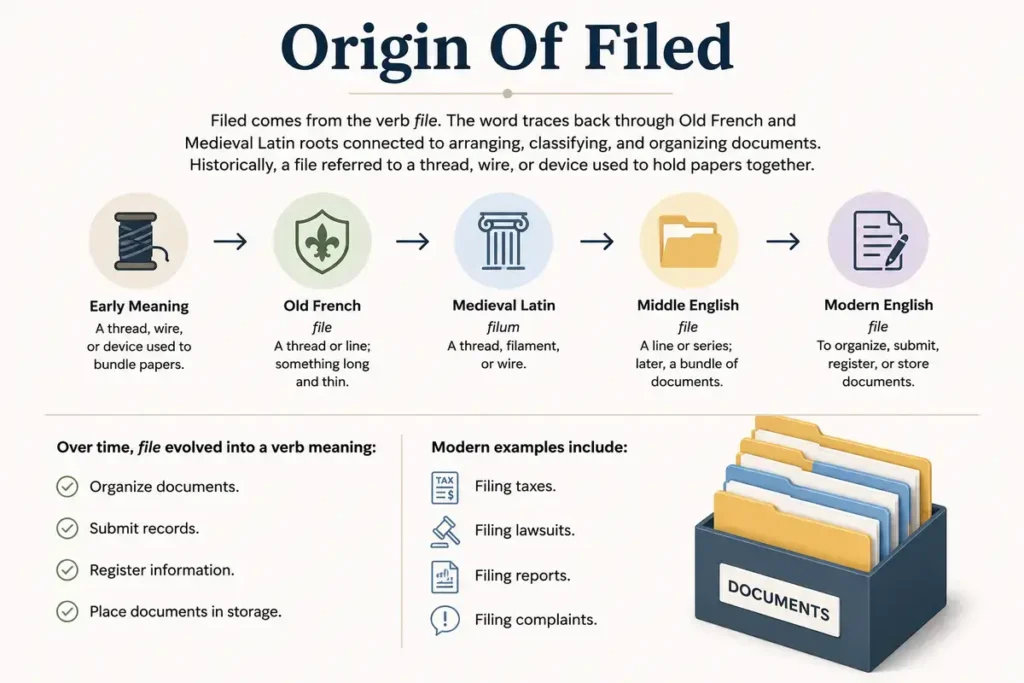
Filed comes from the verb file. The word traces back through Old French and Medieval Latin roots connected to arranging, classifying, and organizing documents. Historically, a file referred to a thread, wire, or device used to hold papers together.
Over time, file evolved into a verb meaning:
- Organize documents.
- Submit records.
- Register information.
- Place documents in storage.
Modern examples include:
- Filing taxes.
- Filing lawsuits.
- Filing reports.
- Filing complaints.
Origin Of Filled
Filled comes from the verb fill. Its roots stretch back to Old English fyllan, meaning to make full. The concept has remained remarkably consistent for centuries. Examples throughout history include:
- Filling containers.
- Filling rooms.
- Filling spaces.
- Filling needs.
Unlike file, the meaning of fill has changed very little over time.
How The Words Diverged
Although filed and filled look similar today, they developed from completely separate root words.
Filed evolved from file.
Filled evolved from fill.
Their similarity is mostly accidental rather than historical.
Filed Vs Filled Regional Usage
Fortunately, the distinction between filed and filled remains consistent across major English speaking countries.
Filed Vs Filled American English
American English clearly separates the meanings.
Examples:
- She filed a complaint.
- She filled the glass.
These uses appear in journalism, education, business writing, and legal communication.
Filed Vs Filled British English
British English follows the same pattern.
Examples:
- The solicitor filed the paperwork.
- The waiter filled the cup.
There is little variation from American usage.
Filed Vs Filled Australian English
Australian English also maintains the distinction.
Examples:
- The company filed its report.
- The stadium filled quickly.
Professional editors apply the same rules.
Filed Vs Filled Canadian English
Canadian English uses filed and filled exactly as American and British English do.
Examples:
- He filed the documents.
- She filled the container.
Filed Vs Filled Global English
Across international English, the meanings remain remarkably stable.
- Filed relates to submission and records.
- Filled relates to fullness and completion.
This consistency makes the words easier to learn and apply correctly.
Filed Vs Filled Grammar Rules
Grammar provides the clearest framework for understanding these words.
Filed As A Verb
Filed is the past tense and past participle of file.
Examples:
Past Tense:
- She filed the report yesterday.
- He filed the paperwork last week.
Past Participle:
- The documents have been filed.
- The complaint was filed properly.
Filled As A Verb
Filled is the past tense and past participle of fill.
Examples:
Past Tense:
- She filled the bottle.
- He filled the tank.
Past Participle:
- The room has been filled.
- The forms were filled correctly.
Active Voice Examples
Filed:
- The lawyer filed the motion.
- The accountant filed the return.
Filled:
- She filled the basket.
- The workers filled the truck.
Passive Voice Examples
Filed:
- The application was filed yesterday.
- The lawsuit was filed on time.
Filled:
- The container was filled completely.
- The hall was filled with visitors.
Common Sentence Structures
Filed:
Subject + Filed + Document
Examples:
- She filed the claim.
- He filed the paperwork.
Filled:
Subject + Filled + Object + With + Content
Examples:
- She filled the jar with candy.
- He filled the page with notes.
Filed Vs Filled Quick Grammar Test
Use filed if the action involves:
- Submitting.
- Registering.
- Recording.
- Organizing.
Use filled if the action involves:
- Completing.
- Occupying.
- Supplying.
- Making full.
This simple rule solves most usage questions immediately.
Filed Vs Filled In Professional Writing
Professional communication uses both words frequently.
Examples involving filed:
- The company filed its annual report.
- The attorney filed the motion.
- The organization filed regulatory documents.
Examples involving filled:
- The survey was filled by participants.
- The warehouse was filled with inventory.
- The report was filled with useful data.
Because both words appear regularly in workplace writing, understanding the distinction improves clarity and credibility.
Filed Vs Filled In Legal And Administrative Contexts
Legal writing overwhelmingly favors filed because official submissions are common.
Examples:
- The plaintiff filed a lawsuit.
- The court filed the records.
- The attorney filed supporting evidence.
- The company filed an appeal.
- The claimant filed a request.
Filled appears less often in legal contexts but still occurs.
Examples:
- The forms were filled accurately.
- The application was filled completely.
- The document was filled with supporting details.
Understanding the difference is especially important in legal and administrative writing because a single incorrect word can change the meaning of a sentence.
Filed Vs Filled Real Life Usage Examples
The easiest way to master filed vs filled is to see how native English speakers use the words in everyday situations.
Daily Conversation
In casual speech, filled appears more often because people frequently talk about objects, containers, rooms, and spaces.
Examples:
- She filled the coffee mug before leaving.
- The parking lot filled quickly.
- He filled the cooler with ice.
- The room filled with laughter.
- They filled every seat in the theater.
Filed appears when discussing paperwork, complaints, taxes, and official actions.
Examples:
- I filed my taxes yesterday.
- She filed a complaint with customer support.
- He filed the insurance claim online.
- They filed the paperwork before the deadline.
- The company filed for bankruptcy.
Academic Writing
Academic writing uses both words, though in different contexts.
Examples with filed:
- The researcher filed the required ethics documents.
- The institution filed the annual report.
- The university filed updated records.
Examples with filled:
- Participants filled out the questionnaire.
- The survey was filled with detailed responses.
- The report was filled with statistical data.
Professional Communication
Business communication regularly includes both terms.
Examples with filed:
- The accounting department filed the tax documents.
- The manager filed the incident report.
- The company filed regulatory paperwork.
Examples with filled:
- The warehouse was filled with inventory.
- The report was filled with useful recommendations.
- The conference room filled quickly.
Literature And Creative Writing
Writers often use filled to create vivid imagery.
Examples:
- The sky was filled with stars.
- The valley filled with morning fog.
- The house was filled with memories.
- Her heart filled with joy.
- The streets filled with celebration.
Filed appears less often in creative writing but still occurs.
Examples:
- He quietly filed the old letters away.
- She filed every memory into a corner of her mind.
- The clerk filed the final document.
News And Media
Journalists frequently use filed in reports involving government, courts, and business.
Examples:
- The company filed a lawsuit.
- The senator filed disclosure forms.
- The agency filed official charges.
Filled is common in descriptive reporting.
Examples:
- The stadium was filled with supporters.
- The streets filled with protesters.
- The shelters filled rapidly during the storm.
Related Words And Confused Terms
Many writers who struggle with filed vs filled also encounter confusion with similar word pairs.
File
The present form of filed.
Examples:
- File the paperwork.
- File the complaint.
- File the report.
Fill
The present form of filled.
Examples:
- Fill the bottle.
- Fill the application.
- Fill the basket.
Filing
The act of submitting or organizing.
Examples:
- Filing taxes.
- Filing records.
- Filing documents.
Filling
The act of making something full.
Examples:
- Filling a glass.
- Filling a tank.
- Filling a form.
Submitted
A close synonym of filed.
Examples:
- She submitted the report.
- He submitted the application.
- They submitted the claim.
Completed
A common synonym of filled in some contexts.
Examples:
- She completed the form.
- He completed the survey.
- They completed the questionnaire.
Organized
Related to filed.
Examples:
- The records were organized.
- The documents were organized.
- The files were organized.
Packed
Related to filled.
Examples:
- The room was packed.
- The stadium was packed.
- The train was packed.
Other Commonly Confused Word Pairs
- Affect vs effect.
- Than vs then.
- Principal vs principle.
- Complement vs compliment.
- Accept vs except.
- Stationary vs stationery.
- Passed vs past.
- Advice vs advise.
Like filed and filled, these pairs require attention to meaning and context.
Filed Vs Filled Expert Language Insight
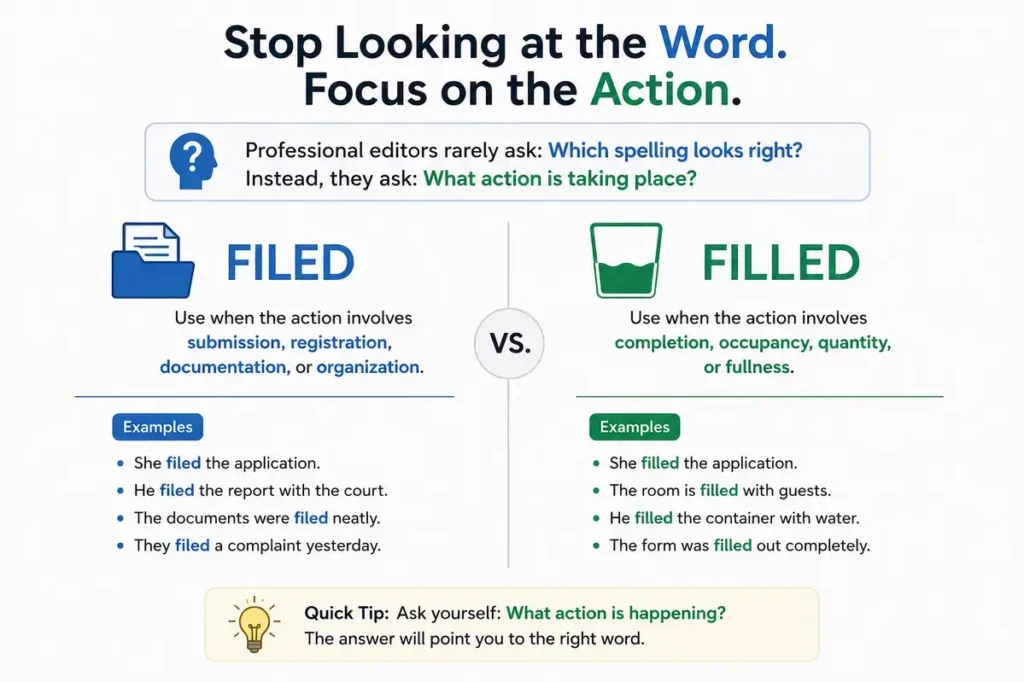
After reviewing thousands of articles, business documents, academic papers, and legal records, one pattern stands out. Most mistakes occur because writers focus on how the words look instead of what the sentence means. Professional editors rarely ask: Which spelling looks right?
Instead, they ask: What action is taking place?
If the action involves submission, registration, documentation, or organization, filed is almost always correct. If the action involves completion, occupancy, quantity, or fullness, filled is usually correct.
Consider these examples:
- She filed the application.
- She filled the application.
Many people assume one sentence must be wrong. In reality, both can be correct. The first means she submitted the application. The second means she completed the application form. This distinction highlights an important lesson.
Grammar is not only about spelling. Meaning matters just as much. Native speakers typically choose the correct word automatically because they understand the action being described. Developing that habit will dramatically improve your writing accuracy. A practical editor’s tip is to remember: Filed handles paperwork. Filled handles space. That simple phrase solves most confusion instantly.
Filed And Filled Frequently Asked Questions
Is Filed A Correct Word?
Yes. Filed is the past tense and past participle of file. It means submitted, recorded, organized, stored, or officially registered. It is commonly used in legal, business, administrative, and government contexts.
Is Filled A Correct Word?
Yes. Filled is the past tense and past participle of fill. It means made full, occupied, supplied, or completed. It appears frequently in both formal and informal English.
What Is The Difference Between Filed And Filled?
Filed relates to submission, registration, documentation, or organization. Filled relates to fullness, completion, or occupancy. Although the words look similar, their meanings are completely different.
Do Filed And Filled Sound The Same?
No. Filed uses a long I sound, while filled uses a short I sound. Native speakers usually pronounce them distinctly, though some accents may make the difference less noticeable.
Is It Filed A Form Or Filled A Form?
Both can be correct depending on meaning. Filled a form means completed it. Filed a form means submitted it to an organization, agency, employer, or government office.
Can I Say Filed Out A Form?
In standard English, people usually say filled out a form when completing it. Filed generally refers to submitting or organizing the completed document after it has been filled out.
Which Word Is More Common?
Filled is generally more common because it applies to countless everyday situations involving containers, rooms, forms, and spaces. Filed appears frequently in professional and administrative contexts.
How Can I Remember The Difference?
Use this memory trick:
Filed handles paperwork.
Filled handles space.
If something is being submitted or organized, use filed. If something is being made full or completed, use filled.
Many readers also check Setup vs Set Up Explained Clearly.
Filed Vs Filled Conclusion
The difference between filed vs filled becomes clear once you focus on the action being described. Filed relates to submitting, recording, organizing, or officially registering something. It commonly appears with taxes, complaints, reports, applications, claims, and legal documents.
Filled relates to making something full, occupying space, supplying content, or completing a task. It commonly appears with containers, rooms, forms, surveys, and physical spaces. Remember these simple examples:
- She filed the application.
- She filled the application.
The first means she submitted it. The second means she completed it. Both words are correct. The key is choosing the one that matches your intended meaning. When in doubt, remember this rule:
Filed handles paperwork.
Filled handles fullness.
Follow that guideline, and you’ll use both words confidently in professional writing, academic work, and everyday communication.