
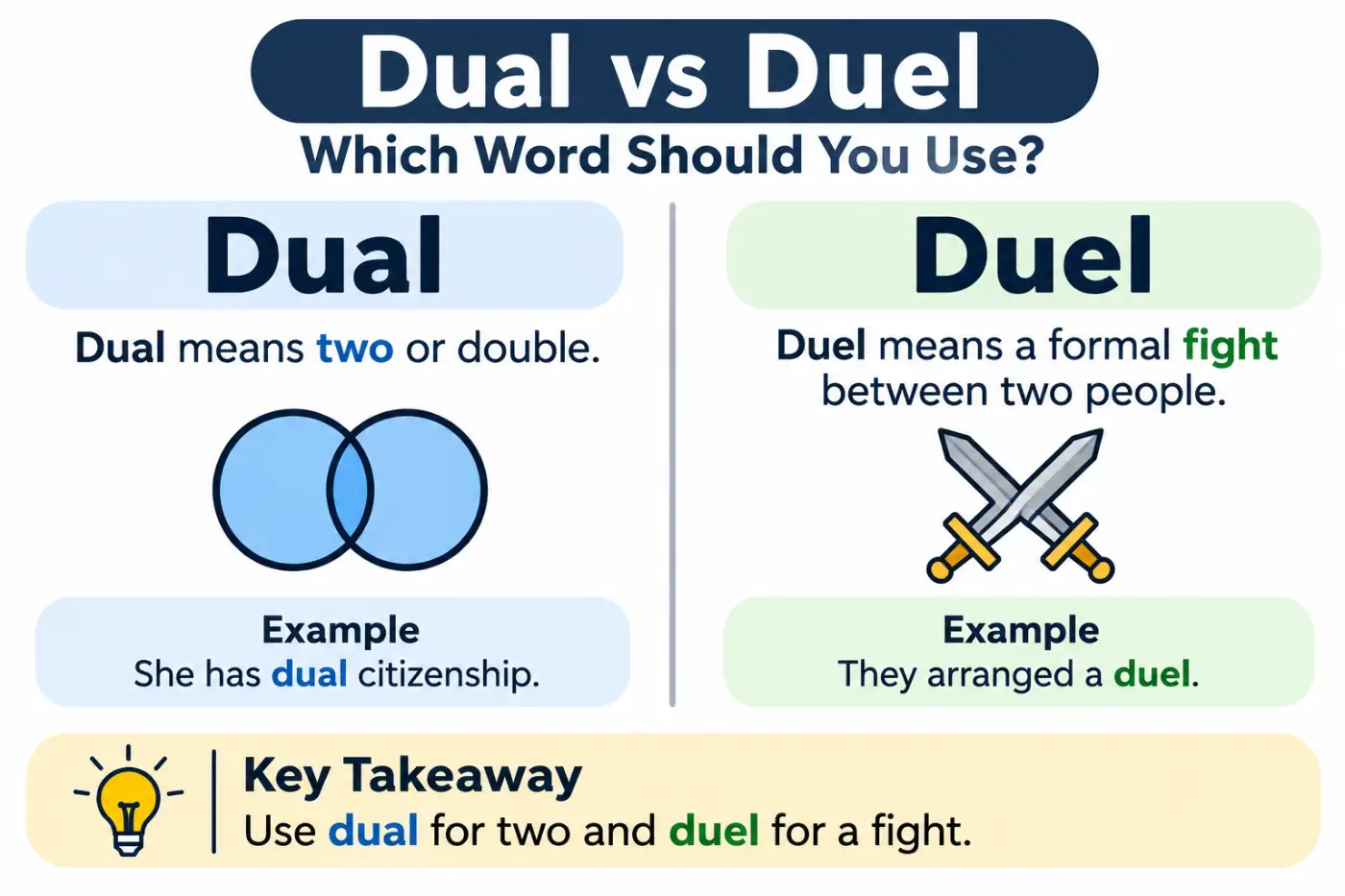
The confusion between dual vs duel is easy to understand because both words sound exactly alike. However, they have very different meanings, and using one in place of the other can change the entire meaning of your sentence. The good news is that both are correct English words. The difference lies in what you want to express.
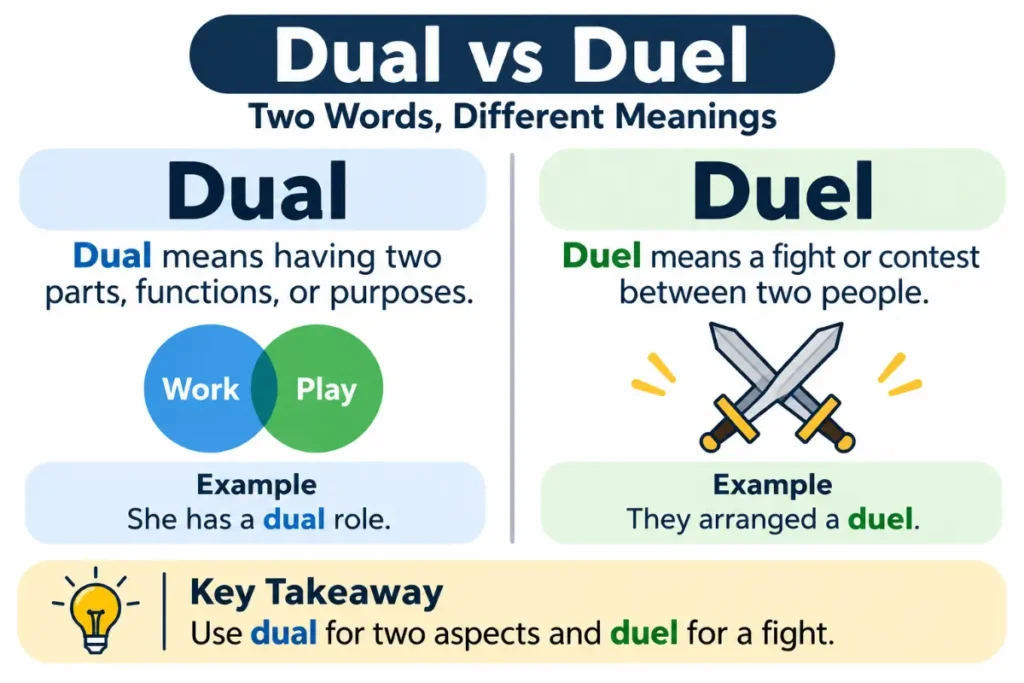
Dual describes something that has two parts, purposes, features, or roles. For example, a dual citizenship arrangement allows a person to hold citizenship in two countries. Duel, on the other hand, refers to a fight or contest between two people, often involving weapons or a formal challenge. You might read about a duel between two historical rivals or watch two characters fight a duel in a movie.
The main challenge comes from their identical pronunciation. Since you cannot hear the spelling difference, you need to understand the meaning before choosing the word. This guide explains both terms, their origins, grammar, pronunciation, common mistakes, and practical examples so you can use each one confidently.
Many readers also check alot or a lot: Correct Spelling Meaning and Usage.
Quick Answer
Dual means having two parts, functions, or purposes. Duel means a fight or contest between two people, traditionally arranged under agreed rules. Both are correct words, but they are not interchangeable. Use dual when describing something with two aspects and duel when referring to a fight or formal contest.
Comparison Table: Dual vs Duel
| Feature | Dual | Duel |
|---|---|---|
| Meaning | Having two parts or functions | A fight or contest between two opponents |
| Part of speech | Adjective | Noun and verb |
| Pronunciation | /ˈduː.əl/ | /ˈduː.əl/ |
| Origin | Latin dualis | Latin duellum, associated with war |
| Main usage | Describing two roles, features, or purposes | Describing a fight, challenge, or contest |
| Formality | Common in everyday and formal English | Common in historical, literary, and general contexts |
| Common contexts | Dual citizenship, dual purpose, dual controls | Sword duel, pistol duel, duel between rivals |
| Example | The device has a dual purpose. | The two rivals agreed to a duel. |
Meaning and Definition
Although these words share the same pronunciation, their meanings are quite different. One describes the presence of two parts or functions, while the other refers to a confrontation between opponents.
What Does Dual Mean?
Dual is an adjective that describes something consisting of two parts, involving two people, or serving two purposes. It often appears before a noun to explain that an object, system, position, or arrangement has two related aspects.
For example:
- The company offers dual benefits to its employees.
- She holds dual citizenship in Canada and the United States.
- The laptop has a dual screen setup.
- He has a dual role as a teacher and a coach.
In each example, the word describes two aspects of something. It does not suggest a fight or disagreement.
The term can also describe two functions that work together. A dual purpose tool, for instance, is designed to perform two different tasks. Similarly, dual controls in a vehicle allow two people to operate certain functions.
Dual is an adjective, so it normally modifies a noun. You can use it before words such as role, purpose, function, citizenship, system, and responsibility.
What Does Duel Mean?
Duel is a noun and a verb. As a noun, it means a fight or contest between two opponents. Traditionally, a duel was a formal fight between two people who agreed to settle a disagreement through combat.
Historically, opponents often used swords or pistols. They followed certain rules and sometimes arranged the confrontation through representatives known as seconds.
For example:
- The two soldiers fought a duel at sunrise.
- The novel describes a duel between two noblemen.
- The rivals challenged each other to a duel.
As a verb, duel means to fight or compete against another person. It can describe a traditional armed confrontation or a figurative contest.
For example:
- The two champions will duel for the title.
- The politicians dueled over their opposing views.
- The chess players dueled for first place.
Modern English also uses the term figuratively. Two athletes might duel for control of a game, or two business leaders might duel over a major contract. In these situations, the word describes strong competition rather than physical combat.
Key Differences Explained
The easiest way to separate these terms is to connect each one with its central meaning. One relates to the number two, while the other relates to a confrontation between opponents.
1. Spelling
The words differ by only one letter near the end.
- Dual ends with the letters A and L.
- Duel ends with the letters E and L.
This small spelling difference matters because the words communicate separate ideas. A dual purpose product has two uses. A duel between two people is a contest or fight.
2. Meaning
The main difference is their meaning.
Dual describes something with two parts, functions, or roles. It focuses on a pair of features or purposes.
Duel describes a confrontation between two opponents. It focuses on competition, conflict, or combat.
Consider these sentences:
- The school has a dual language program.
- The two characters fought a duel.
The first sentence describes a program involving two languages. The second describes a fight between two characters.
3. Grammar
Dual is an adjective. It modifies a noun and gives information about its features or purpose.
Duel can function as both a noun and a verb. As a noun, it identifies a contest. As a verb, it describes the act of fighting or competing.
Examples:
- They installed dual cameras.
- The duel lasted several minutes.
- The athletes will duel tomorrow.
4. Pronunciation
Both words have the same standard pronunciation in English. This makes them homophones, meaning they sound alike but have different spellings and meanings.
You cannot identify the intended word by sound alone. You must use the surrounding sentence to understand the meaning.
5. Context
Dual commonly appears in descriptions of technology, education, work, government, and personal arrangements.
Duel often appears in discussions of history, literature, sports, entertainment, and competition.
For example, a dual degree allows a student to study toward two qualifications. A duel in a historical novel may describe two characters fighting to defend their honor.
6. Formality
Both words are suitable for formal and informal communication.
Dual is common in professional, academic, and technical writing. Expressions such as dual citizenship, dual function, and dual responsibility are widely understood.
Duel is also acceptable in formal writing. It may describe a historical event, a fictional fight, or a competitive struggle. Its exact meaning depends on the context.
7. Standard Usage
Neither word is an incorrect version of the other. Both are established English words with separate definitions.
The mistake happens when writers choose the wrong spelling because they rely on pronunciation instead of meaning.
Which Form Is Correct?
Both forms are correct. The right choice depends on the idea you want to communicate.
Use dual when you describe something that has two parts, functions, roles, or purposes.
Examples:
- The company introduced a dual payment system.
- My brother has dual nationality.
- This room serves a dual purpose.
Use duel when you describe a fight, challenge, or contest between two opponents.
Examples:
- The knights prepared for a duel.
- The two players will duel in the final match.
- The movie ends with a dramatic duel.
A useful editing rule is to replace the word with a simple explanation. If you mean two functions or aspects, use dual. If you mean a fight or contest, use duel.
Sentence Examples
The following examples show how each word works in natural American English.
10 Examples Using Dual
- My new laptop has a dual camera system that makes video calls easier.
- The manager has a dual responsibility for sales and customer service.
- She applied for dual citizenship after living abroad for several years.
- The school introduced a dual language program for young students.
- This machine has a dual function that saves time and energy.
- The company uses dual security systems to protect its office.
- He earned a dual degree in business and computer science.
- The vehicle has dual controls for the driving instructor and student.
- The research examines the dual effects of exercise on physical and mental health.
- Her position gives her a dual role in planning and administration.
10 Examples Using Duel
- The two knights agreed to fight a duel outside the castle.
- The movie features a dramatic duel between two skilled fighters.
- The rivals challenged each other to a duel over an old disagreement.
- The two chess champions will duel for the tournament title.
- The novel describes a duel that changes the lives of its main characters.
- The boxers dueled fiercely during the final round.
- The two politicians dueled over their different views on education.
- The historical drama ends with a sword duel at sunrise.
- The athletes dueled for control of the ball throughout the match.
- The legendary warriors were ready to duel in front of the king.
These examples show that the adjective describes two aspects, while the noun or verb refers to a confrontation or contest.
Common Mistakes and Confusions
Because the two words sound alike, writers sometimes choose the wrong spelling. The best way to avoid these errors is to understand the meaning of the full sentence.
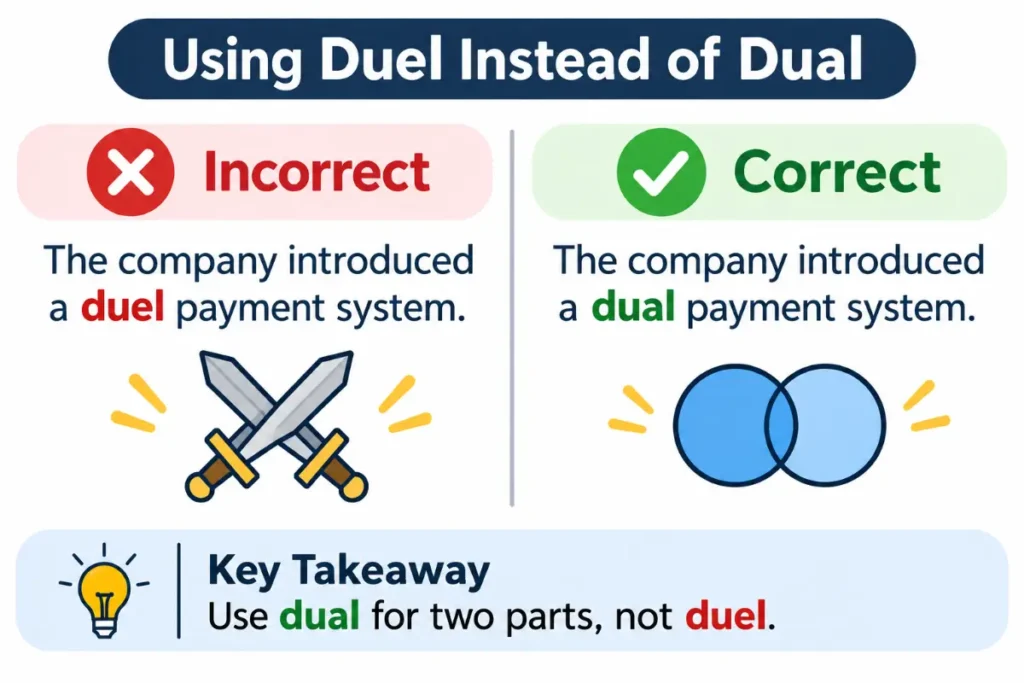
1. Using Duel Instead of Dual
Incorrect: The company introduced a duel payment system.
Correct: The company introduced a dual payment system.
The sentence describes a system with two payment options, not a fight. The adjective dual is the correct choice.
2. Using Dual Instead of Duel
Incorrect: The two warriors prepared for a dual.
Correct: The two warriors prepared for a duel.
The sentence refers to a fight between two opponents. Therefore, the noun duel is needed.
3. Confusing Dual Purpose With Duel Purpose
Incorrect: This tool has a duel purpose.
Correct: This tool has a dual purpose.
The expression dual purpose describes something designed for two uses. Duel purpose is not the standard spelling of this expression.
4. Writing Dual When Describing a Contest
Incorrect: The players will dual for the championship.
Correct: The players will duel for the championship.
Here, duel functions as a verb. It describes the players competing against each other.
5. Treating Both Words as Interchangeable
Incorrect: The country has a duel citizenship policy.
Correct: The country has a dual citizenship policy.
Citizenship can involve two countries, so dual is the appropriate adjective. The word duel has no place in this expression.
Many readers also check Transferred or Transfered Which Spelling Is Correct in 2026.
Pronunciation Guide
Both words are pronounced the same way in standard English. This is why people often confuse their spellings in conversation and writing.
IPA pronunciation: /ˈduː.əl/
Syllable Breakdown
Both words have two syllables:
- Du.
- El.
The first syllable receives the main stress. The pronunciation sounds like DOO uhl.
Easy Pronunciation Guide
You can pronounce both words as:
DOO uhl
Start with the long oo sound, as in moon. Then move into a short, relaxed vowel sound.
The pronunciation is the same for both words in common American English speech. Their spelling and meaning, not their sound, tell them apart.
Common Pronunciation Mistakes
Some speakers may pronounce the second syllable too strongly or separate the sounds unnaturally. In normal speech, the two syllables flow together.
You do not need to pronounce the A in dual differently from the E in duel. Both spellings represent the same spoken form.
Etymology and Word Origin
The histories of these words help explain why they have different meanings despite their similar sounds.
Origin of Dual
Dual comes from the Latin word dualis, meaning twofold or consisting of two. The Latin root duo means two.
The word entered English through French and Latin influence. Over time, it became a common adjective for describing two related parts, features, or functions.
Its meaning remains close to the original idea of twoness. This explains familiar expressions such as dual citizenship, dual purpose, and dual role.
Origin of Duel
Duel has a more complex historical background. It entered English through French and is linked to the Latin word duellum, meaning war or combat. The historical form is associated with the idea of a fight between opponents.
In English, the word became strongly connected with formal combat between two people. Such confrontations were often arranged to settle disputes or defend personal honor.
Today, the meaning extends beyond physical fighting. Writers also use it to describe intense competition, verbal conflict, or a contest between two rivals.
Why Their Origins Matter
The Latin root of dual connects it with the number two. Duel developed around the idea of combat or conflict.
Remembering these different origins can help you understand the difference:
- Dual relates to two parts or purposes.
- Duel relates to a contest or fight between opponents.
Regional Usage
The meanings and spellings of these words remain consistent across major English varieties. There is no standard American or British spelling change that turns one form into the other.
American English
In American English, dual is a common adjective in everyday, business, educational, and technical communication.
Examples include dual citizenship, dual enrollment, and dual purpose.
Duel is also standard. Americans use it for historical fights, fictional combat, and figurative contests. For instance, sports commentators may describe two competitors as dueling for a championship.
British English
British English uses both words with the same basic meanings.
Dual describes two parts, roles, or functions. Duel describes a fight or contest between two opponents.
There is no meaningful spelling difference between American and British English for these terms.
Australian English
Australian English follows the same standard usage. Dual appears in expressions related to education, technology, and government. Duel appears in historical, literary, and competitive contexts.
Canadian English
Canadian English also follows the same distinction. Dual is used in expressions such as dual citizenship and dual language services. Duel refers to a fight or contest.
Is There a Regional Spelling Difference?
No major regional spelling difference separates these words. The same spelling and meaning distinction applies in the United States, the United Kingdom, Australia, and Canada.
The important factor is the intended meaning, not the country where the writer lives.
Grammar Rules and Part of Speech
Understanding the grammatical role of each word makes it easier to use them correctly.
How to Use Dual in a Sentence
Dual is an adjective. It describes a noun by showing that something has two parts, purposes, functions, or roles.
It commonly appears before the noun it modifies.
Examples:
- The company offers dual benefits.
- We need a dual approach to solve the problem.
- She completed a dual degree program.
You can also use it in longer descriptions.
For example:
The organization developed a dual strategy that focuses on education and employment.
Here, dual modifies strategy and explains that the plan has two main parts.
Common Expressions With Dual
Several expressions use this adjective naturally.
- Dual citizenship refers to holding citizenship in two countries.
- Dual purpose describes something designed for two uses.
- Dual role refers to a position involving two responsibilities.
- Dual function describes an object or system with two functions.
- Dual controls are controls that allow two people to operate a system.
- Dual degree describes an academic program involving two degrees.
- Dual identity refers to having two identities or roles in a particular context.
- Dual responsibility means being responsible for two duties or areas.
These combinations appear frequently in professional and everyday English.
How to Use Duel as a Noun
As a noun, duel identifies a fight or contest between two opponents.
It can appear after articles such as a or the.
Examples:
- A duel took place near the old bridge.
- The duel attracted a large crowd.
- The king ordered the duel to stop.
You can also use it with verbs such as fight, challenge, arrange, and win.
For example:
The two rivals arranged a duel to settle their disagreement.
How to Use Duel as a Verb
Duel can also describe the action of fighting or competing against someone.
Examples:
- The two fighters will duel tomorrow.
- The teams dueled for the championship.
- The politicians dueled over the proposed law.
As a regular verb, it forms its past tense and participle with the ending ed.
| Verb Form | Example |
|---|---|
| Base form | Duel |
| Third person singular | Duels |
| Present participle | Dueling |
| Simple past | Dueled |
| Past participle | Dueled |
In American English, the usual spelling is dueling and dueled. British English commonly uses duelling and duelled. This is a regional spelling difference in the verb forms, not in the base word duel.
Punctuation and Sentence Position
Neither word requires special punctuation. Their use follows ordinary English grammar.
Dual usually comes before the noun it describes. Duel can appear in different sentence positions because it works as a noun and a verb.
Compare:
- The company has a dual strategy.
- The two companies will duel for customers.
The first sentence uses an adjective. The second uses a verb.
Real Life Usage Examples
These examples show how both terms appear in different types of communication.
Daily Conversation
In everyday conversation, dual often describes an object or arrangement with two features.
- My phone supports dual SIM cards, so I can use two numbers.
- This jacket has a dual purpose because it keeps me warm and protects me from rain.
Duel may appear in conversations about films, sports, or arguments.
- Did you see the duel between the two characters in the movie?
- The two players seemed to duel for every point.
Email and Workplace Communication
In professional communication, dual is useful for explaining responsibilities, systems, and business arrangements.
- Our department has a dual responsibility for customer support and staff training.
- The new software offers dual access for administrators and employees.
Duel is less common in ordinary business emails, but it can describe competition.
- The two companies are set to duel for a major contract.
- Their marketing teams have been dueling over the same customer group.
Academic Writing
In academic writing, dual often describes two connected factors, roles, or effects.
- The study explores the dual impact of technology on education and communication.
- The research examines the dual function of language in social identity and cultural expression.
Duel can appear in history, literature, and cultural studies.
- The historian examines the role of the duel in nineteenth century society.
- The novel uses a duel to represent the conflict between personal honor and social expectations.
News and Journalism
Journalists may use dual when reporting on government policies, business arrangements, or technology.
- The new policy creates a dual system for managing public services.
- The company announced a dual investment plan focused on research and development.
Duel may appear in sports reporting or political commentary.
- The two candidates dueled over economic policy during the debate.
- The final match became a duel between two of the league’s strongest players.
Literature and Storytelling
Writers use dual to describe characters with two identities, responsibilities, or motivations.
- The main character lives a dual life as a doctor and a secret investigator.
- The story explores the dual nature of loyalty and ambition.
Duel often creates a sense of tension and conflict.
- The hero accepted the challenge and prepared for a duel at dawn.
- Their final duel brought years of rivalry to an end.
Related and Confused Terms
Several English words connect with the meanings of these two terms. Learning their differences can help you choose more precise language.
1. Double
Double means twice as much or made up of two equal parts. It can function as an adjective, noun, verb, or adverb.
Example: The hotel room has a double bed.
Dual and double sometimes overlap, but they are not always interchangeable. Dual often emphasizes two functions or roles, while double often emphasizes twice the amount or size.
2. Twofold
Twofold means having two parts or being twice as great.
Example: The project has a twofold goal of reducing costs and improving quality.
It is close in meaning to dual, especially when describing two connected purposes or effects.
3. Pair
A pair refers to two people or things that belong together or are considered a set.
Example: She bought a pair of running shoes.
Unlike dual, pair is a noun that identifies two items as a group.
4. Twin
Twin describes two people or things that are closely matched or born together in the case of siblings.
Example: The building has twin towers.
It can describe two similar or matching things, but it does not always mean they have two functions.
5. Contest
A contest is a competition in which people or groups try to win.
Example: The two schools entered a contest for the science award.
A contest can involve many participants, while a traditional duel involves two opponents.
6. Battle
A battle is a fight between opposing forces or groups. It can also describe a difficult struggle.
Example: The soldiers fought a battle near the border.
Duel usually refers to two individual opponents, while battle can involve much larger groups.
7. Combat
Combat means physical fighting or armed conflict. It can also describe intense competition or opposition.
Example: The soldiers received training in hand to hand combat.
A duel is one specific kind of confrontation. Combat is a broader term.
8. Rivalry
Rivalry is a situation in which two or more people or groups compete against each other.
Example: The rivalry between the two teams has lasted for decades.
A rivalry can continue over a long period, while a duel usually refers to a particular contest or confrontation.
Expert Editor Insight
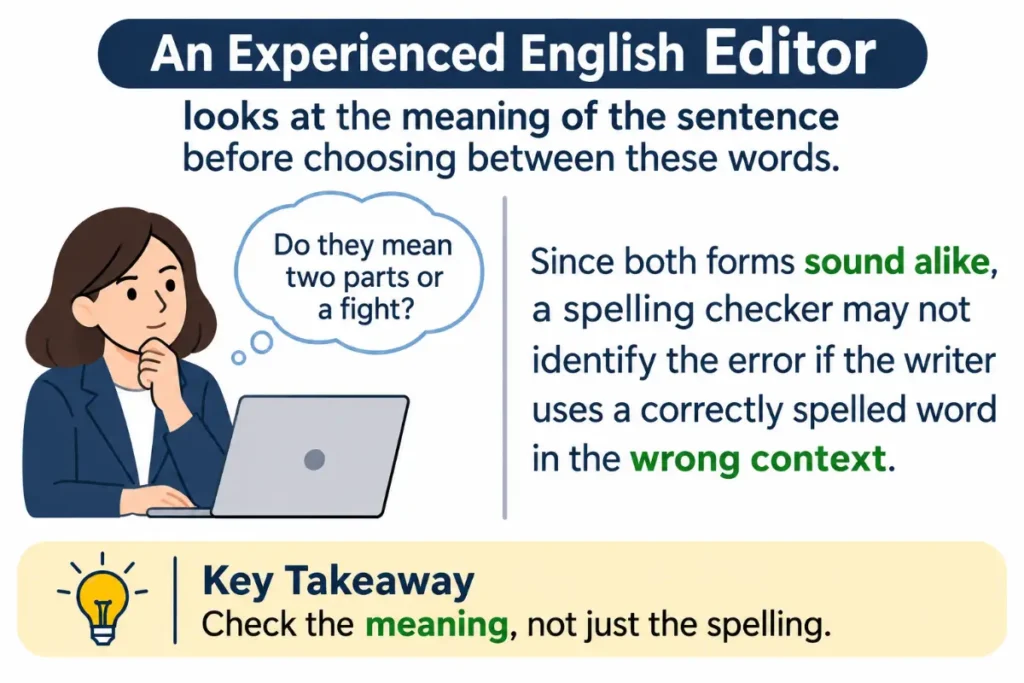
An experienced English editor looks at the meaning of the sentence before choosing between these words. Since both forms sound alike, a spelling checker may not identify the error if the writer uses a correctly spelled word in the wrong context. For example, a tool may accept duel in a sentence about two functions, even though dual is intended. A useful editing habit is to check the noun or action being described. If the sentence refers to two purposes, roles, or features, choose dual. If it describes two opponents competing or fighting, choose duel.
Learn the difference in Implicit vs Complicit Which Word Should You Use 2026.
Conclusion
The difference between dual vs duel comes down to meaning, not pronunciation. Dual describes something with two parts, roles, or purposes, while duel refers to a fight or contest between two opponents. Both are correct English words, and neither is a misspelling of the other.
To remember the distinction, connect dual with two functions and duel with two opponents facing each other. Before using either word, read the whole sentence and identify the idea you want to express. This simple editing habit will help you avoid confusion in everyday writing, professional communication, and academic work.
FAQs
What Is the Main Difference Between Dual and Duel?
Dual describes something with two parts, purposes, or functions. Duel refers to a fight or contest between two opponents. Both words have the same pronunciation, but their meanings and grammatical roles differ. Dual is an adjective, while duel can be a noun or a verb. The sentence’s meaning determines which spelling you need.
Is Dual a Correct English Word?
Yes. Dual is a standard English adjective that means having two parts, functions, or purposes. You can use it in expressions such as dual citizenship, dual purpose, dual controls, and dual responsibility. It appears in everyday conversation, business writing, education, and technical communication. It is not a misspelling of duel.
Is Duel a Real Word?
Yes. Duel is a standard English word that refers to a fight or contest between two opponents. It can work as a noun or a verb. Historically, it often described a formal fight involving weapons. Today, it can also describe a figurative contest, such as two athletes competing for a title.
Are Dual and Duel Pronounced the Same Way?
Yes. Both words are pronounced /ˈduː.əl/ in standard English. They have two syllables, with the main stress on the first syllable. This makes them homophones. Since they sound alike, you cannot identify the correct spelling from pronunciation alone. You need to consider the meaning and grammatical function of the word.
What Does Dual Mean in Everyday English?
Dual means having two parts, roles, functions, or purposes. For example, a dual purpose bag might be suitable for work and travel. A person with dual citizenship holds citizenship in two countries. The word usually appears before a noun and helps explain that something has two connected aspects.
Can Duel Be Used as a Verb?
Yes. Duel can function as a verb meaning to fight or compete against another person. For example, two athletes may duel for a championship, or two characters may duel with swords in a story. Its past tense is dueled in American English and duelled in British English.
What Is a Synonym for Dual?
Possible alternatives include double, twofold, paired, and two part, depending on the sentence. However, these words do not always have exactly the same meaning. Dual often describes two related functions or roles. Double usually emphasizes twice the amount, while paired refers to two things considered together.
What Is Another Word for Duel?
Depending on the context, alternatives include fight, contest, battle, combat, confrontation, and showdown. A formal armed duel may be called a fight or combat, while a figurative duel may be described as a contest or showdown. Choose a synonym that matches the type and intensity of the confrontation.