
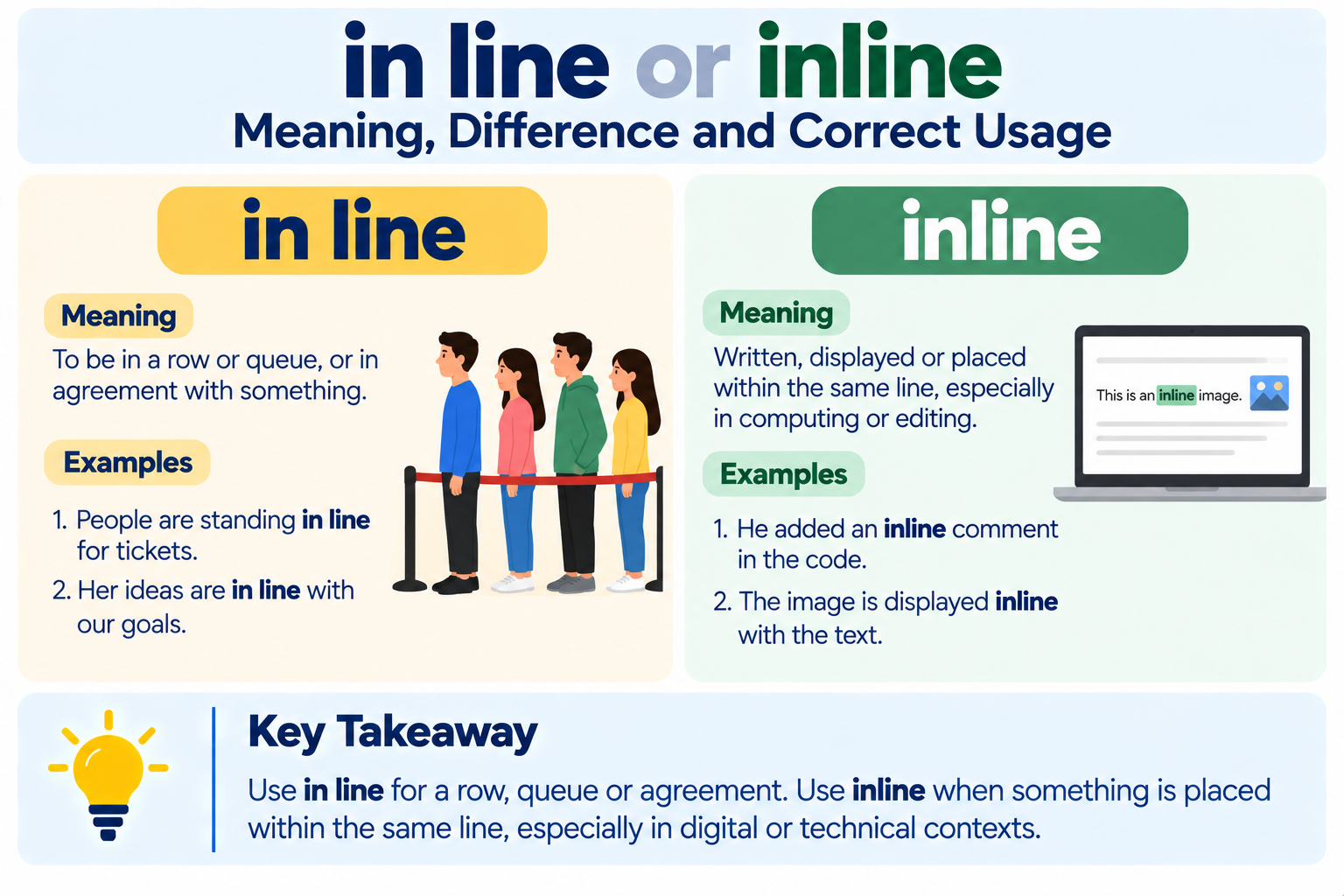
in line or inline can be confusing because the two forms look almost identical but they don’t always mean the same thing. The correct choice depends on what you’re trying to say. In line is normally a two word phrase that often means in a row, waiting in a queue, or matching something. Inline is usually one word when it works as an adjective or adverb in technical and specialized contexts.
The confusion grows because English often turns phrases into single words over time. Technology has also made inline especially common in phrases such as inline code, inline elements, and inline styles. At the same time, everyday English still uses in line for situations such as standing in line or keeping something in line with a plan.
This distinction becomes much easier once you look at the job each form performs in a sentence. You’ll learn the meanings, grammar rules, pronunciation, common mistakes, regional usage, technical meanings, real life examples, and simple editing tips. By the end, you’ll know when to keep the words separate and when the single word is the natural choice.
You may also want to read Is There Any Vs Are There Any.
Quick Definition
In line is normally a two word phrase meaning in a row, waiting in a queue, or aligned with something. Inline is usually a single word used as an adjective or adverb, especially for something contained within another structure or arranged without starting a separate line.
Quick Answer
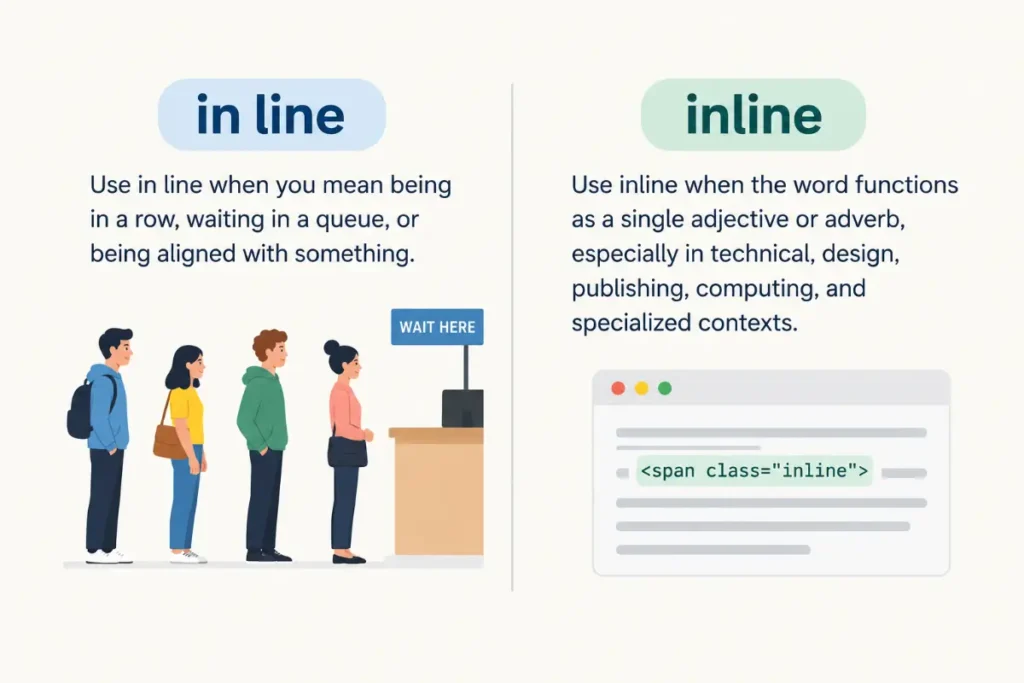
Use in line when you mean being in a row, waiting in a queue, or being aligned with something. Use inline when the word functions as a single adjective or adverb, especially in technical, design, publishing, computing, and specialized contexts.
For example, you can say, We stood in line for tickets. You can also say, The website uses inline styles. The first sentence describes a queue. The second describes a technical method where the style information appears directly within an element.
Comparison Table In Line Or Inline
| Form | Meaning | Part of Speech | Origin | Usage Frequency | Formality | Common Contexts | Example |
|---|---|---|---|---|---|---|---|
| In line | In a row, in a queue, or aligned with something | Prepositional phrase or adjective phrase | English phrase formed from in and line | Very common | Neutral | Queues, alignment, plans, expectations, everyday speech | We waited in line for coffee. |
| Inline | Within a line, structure, or surrounding content; also arranged without a separate break | Adjective or adverb | Compound formed from in and line | Common in specialized and technical usage | Neutral to technical | Computing, design, publishing, manufacturing, formatting | The developer added inline code. |
The table shows why these forms should not be treated as simple spelling alternatives. They can perform different grammatical jobs and describe different ideas.
Meaning And Definition
Meaning Of In Line
In line is usually written as two separate words. It has several related meanings.
The most familiar meaning in American English is waiting in a queue.
We stood in line for tickets.
She is standing in line at the grocery store.
Here in line describes a person waiting behind other people for a service or opportunity.
The phrase can also describe physical alignment.
The chairs are in line with the wall.
In this meaning, something is positioned along the same direction or path as something else.
Another use describes agreement with a plan, rule, expectation, or standard.
The proposal is in line with company policy.
The results are in line with our expectations.
In these examples, the phrase means consistent with or matching something.
In line can also appear in expressions involving behavior or control.
The teacher told the students to get in line.
The manager asked the team to bring expenses in line with the budget.
The exact meaning comes from the surrounding words.
Meaning Of Inline
Inline is normally written as one word when it functions as a compound adjective or adverb.
The word has a broad idea behind it. Something inline is contained within a line, placed directly within another structure, or arranged as part of the same flow rather than being separated into another section.
In computing, inline has a specific meaning.
The page contains inline CSS.
The developer added inline code.
In these examples, the information or code appears directly within the relevant content or structure instead of being placed in a separate file or block.
In publishing and design, inline can describe an element that sits within a line of text or content.
The image appears inline with the paragraph.
In manufacturing or physical systems, inline can describe equipment or processes arranged directly along a production line.
The company installed an inline filter.
The word can also describe something positioned along a straight line.
The exact technical meaning depends on the field, but the central idea remains the same. Inline describes something that exists within or as part of a line or continuous structure.
Key Differences Explained
- Spacing. In line normally consists of two words. Inline is normally one word when it functions as a compound adjective or adverb.
- Meaning. In line often describes a queue, alignment, or agreement. Inline often describes something incorporated directly into a line, structure, or flow.
- Grammar. In line commonly functions as a phrase. Inline can function as an adjective or adverb.
- Context. In line is common in everyday conversation. Inline appears especially often in technical, computing, design, publishing, and specialized contexts.
- Usage pattern. You can stand in line, wait in line, or be in line with a policy. You can use inline code, inline elements, or inline styles.
- Tone. In line is ordinary and conversational. Inline can sound more specialized when used in technical language.
- Pronunciation. The two forms are generally pronounced the same way when they carry the same basic sound pattern. The difference appears mainly in spelling and grammatical function.
- Regional usage. The core distinction remains broadly consistent across major varieties of English. Some expressions involving queues can differ by region, but the spelling principle remains stable.
Which Form Is Correct?
Both forms are correct. The right choice depends on meaning and grammatical function.
Use in line when you are talking about a queue, physical alignment, or something that agrees with a standard, expectation, or plan.
For example:
We waited in line outside the theater.
Your proposal is in line with our goals.
Use inline when you are describing something incorporated into a line or surrounding structure. This is particularly common in technical language.
For example:
The developer used inline CSS.
The article contains an inline image.
The distinction is not simply a matter of style. Changing the spacing can change the grammatical role and meaning.
An experienced editor looks at the entire phrase rather than deciding based on appearance alone. Dictionaries and established usage patterns treat in line and inline as distinct forms because they have developed different functions.
Sentence Examples
Here are natural examples of in line in everyday and professional English.
- We waited in line for almost thirty minutes before entering the store.
- Please stand in line until a staff member calls your name.
- The picture is in line with the center of the page.
- Her explanation is in line with the evidence we found.
- The new policy is in line with the company’s long term goals.
- I was already in line when my friend arrived.
- The chairs should be in line with the table.
- His spending habits aren’t in line with his budget.
- The students formed a line and waited patiently.
- The results were in line with what the researchers expected.
Now consider natural examples of inline.
- The developer added inline CSS to the page.
- The article includes an inline image.
- The editor placed an inline citation after the statement.
- The application supports inline editing.
- The code contains an inline comment.
- The designer used inline icons beside the labels.
- The system provides inline suggestions while you type.
- The document contains several inline references.
- The website displays inline error messages.
- The software allows users to make inline changes without opening another window.
These examples show the practical distinction. In line usually describes a position, queue, relationship, or state. Inline usually describes something built into or positioned within another structure.
Common Mistakes And Spelling Problems
Using Inline For A Queue
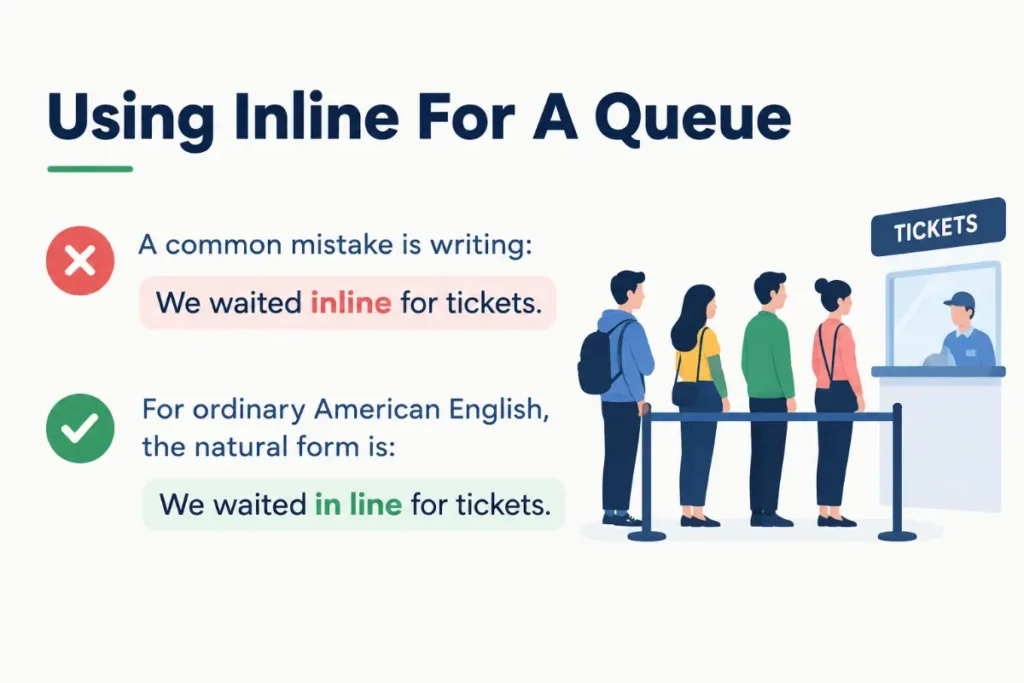
A common mistake is writing:
We waited inline for tickets.
For ordinary American English, the natural form is:
We waited in line for tickets.
The phrase describes people waiting in a queue, so the two word form is appropriate.
Writing In Line When A Compound Adjective Is Needed
Another mistake appears in technical writing.
The developer added in line CSS.
In standard technical usage, inline CSS is the normal form because inline functions as a compound adjective describing CSS.
Confusing In Line With In Line With
In line can stand alone in some contexts.
Please get in line.
But when you mean consistent with something, the common expression is in line with.
The plan is in line with our goals.
Leaving out with can change the meaning or make the sentence incomplete.
Treating Every Compound As A Single Word
English contains many compounds that develop different forms depending on usage. A writer may assume that adding words together always makes the phrase more modern or correct.
That approach doesn’t work here.
The established phrase is in line in many everyday contexts. Specialized terms often use inline.
Confusing Inline With In Line
The two forms can sound identical in speech. That creates a spelling and word boundary problem for writers who rely heavily on sound.
For example, when someone hears inline editing they need to know that inline is a recognized compound term. Context supplies the clue.
This is a useful example of how language processing works. The brain does not interpret speech by spelling every word first. It uses sound, context, familiar patterns, and meaning together. That can make visually similar forms easy to confuse during fast writing.
Pronunciation Guide
In line and inline are generally pronounced with the same basic sound pattern.
A common American pronunciation is approximately:
in line
You can think of the phrase as two spoken parts.
in LINE
Inline is usually pronounced:
in LINE
The main stress falls on line.
The pronunciation therefore doesn’t give you a reliable clue about spacing. You need to use context.
This is one reason the distinction causes problems in writing. When you hear someone say inline CSS you don’t hear a visible space between in and line. The listener understands the meaning from the words that follow and the context.
A useful strategy is to learn common expressions as complete units.
Learn:
wait in line.
stand in line.
in line with.
inline code.
inline editing.
Once these patterns become familiar, the spelling becomes much easier.
Etymology And Word Origin
The two forms share the ordinary English words in and line, but their modern uses developed in different ways.
Line has a long history in English and ultimately comes from Latin linea, referring to a line or something made from flax. The word entered English through French and developed many meanings involving rows, boundaries, direction, writing, and arrangement.
The phrase in line developed naturally from the combination of in and line. It came to describe something positioned along a line and later became associated with waiting in a row or being consistent with something.
Inline developed as a compound form. Its modern technical uses became especially important as fields such as computing, engineering, design, and publishing developed specialized terminology.
This is a common pattern in English. A phrase may begin as separate words and later develop a compound form with a specialized meaning. The two word and one word forms can then continue to coexist because they serve different functions.
A related grammar guide is Cryer vs Crier Which Spelling Is Correct 2026.
Regional Usage
American English
In American English, in line is extremely common for waiting in a queue.
We stood in line outside the restaurant.
This contrasts with the British expression queue up or stand in a queue, which is also understood in the United States but is less typical in ordinary American speech.
Inline is also standard in American English technical usage.
Common examples include inline code, inline editing, inline images, and inline styles.
British English
British English uses both forms. In line can describe alignment or consistency, while inline appears in technical and specialized contexts.
For queues, British speakers often use queue or in a queue.
That means an American speaker might say:
I’m waiting in line.
A British speaker might say:
I’m waiting in a queue.
This regional difference concerns the queue expression rather than the basic distinction between the two spellings.
Australian English
Australian English also uses both forms according to context. Queue related language may vary from American usage, but inline remains common in computing, design, and other technical fields.
The general spelling distinction remains understandable and standard.
Canadian English
Canadian English uses both forms in much the same way as American English. In line is common for queues and alignment, while inline appears regularly in technical and professional language.
Regional differences usually involve preferred expressions rather than a change in the underlying meaning of inline.
Grammar Rules And Part Of Speech
In line is generally a phrase rather than a single lexical item.
Consider:
I am in line.
Here in functions as a preposition and line functions as its object. Together they form a prepositional phrase.
The same structure appears in:
She stood in line.
They are next in line.
We waited in line.
Another important pattern is in line with.
The phrase means consistent with, compatible with, or matching.
Your answer is in line with the evidence.
The decision is in line with company policy.
Inline can function as an adjective.
The website contains inline images.
Inline modifies images.
It can also appear as an adverb in some technical constructions.
The editor lets users edit content inline.
Here inline describes how the editing happens.
This difference is useful because grammar often gives you a clue about spelling.
If you’re talking about a queue, position, or relationship with another thing, in line is likely the right form.
If you’re describing a technical feature or something incorporated directly into another structure, inline is often the natural choice.
In Line With Meaning
The expression in line with deserves special attention because it is extremely common in professional and academic writing.
It means consistent with, compatible with, or matching something.
For example:
The new policy is in line with federal guidance.
The results are in line with previous findings.
Her decision was in line with the organization’s goals.
In each sentence, the phrase does not describe a physical line. It describes agreement or consistency.
This meaning is different from:
We stood in line for coffee.
The first sentence uses in line as part of a comparison or consistency expression. The second describes a queue.
Context tells you which interpretation applies.
Inline In Technical Writing
It has a particularly strong presence in technology.
Inline Code
Inline code appears within ordinary text instead of being displayed as a separate code block.
For example, a technical guide might mention the print() function within a paragraph.
Inline CSS
Inline CSS places style information directly on an HTML element rather than keeping the style rules in a separate stylesheet.
The term is widely recognized in web development.
Inline Editing
Inline editing allows a user to change content directly where it appears.
For example, clicking a name in a table might turn the name into an editable field without opening a separate page.
Inline Images
An inline image appears within surrounding text or content flow.
The exact behavior can depend on the software or publishing system.
Inline Comments
An inline comment appears directly alongside or within the relevant code or content.
Technical fields use inline as a compact compound because the word has developed a specialized meaning.
Real Life Usage Examples
Daily Conversation
I’m standing in line at the pharmacy.
We were already in line when the doors opened.
These are natural everyday uses in American English.
Email And Workplace Communication
The proposed schedule is in line with the team’s availability.
The report includes inline comments from the reviewer.
The first example uses the phrase to mean consistent with something. The second uses inline in a technical or document editing context.
Academic Writing
The findings are in line with earlier research.
The author included an inline citation after the claim.
Academic writing uses both forms but for different purposes.
News Writing
Customers waited in line outside the store before opening time.
The updated system includes inline security checks.
News writing may use in line in everyday reporting and inline when discussing technical systems.
Literature And Storytelling
He stood in line beneath the cold morning sky.
The two buildings were perfectly in line with one another.
These examples show that the two word form can work naturally in descriptive writing as well.
Related And Confused Terms
In A Row
In a row means arranged one after another.
The chairs were placed in a row.
This overlaps with one meaning of in line.
Queue
Queue refers to a line of people or things waiting for something.
The British expression is especially common in everyday speech.
Aligned
Aligned means positioned correctly relative to something else.
The text is aligned with the image.
This can overlap with the alignment sense of in line.
Consistent With
Consistent with means agreeing with or matching something.
The findings are consistent with the earlier results.
This can often replace in line with in formal writing.
Within The Line
Within the line describes something located inside a defined line or boundary.
Its meaning depends heavily on context.
Embedded
Embedded means placed firmly or directly within something else.
This can overlap with technical uses of inline.
In Text
In text means appearing within written material rather than separately.
An inline citation is a citation that appears within the text.
Separate
Separate describes something that is apart from another thing. It can provide the opposite idea in contexts where inline means incorporated directly into surrounding content.
These related terms help clarify why context matters. No single synonym can replace every use of either form.
When To Use A Hyphen
Some readers may wonder about forms such as in line or inline when the term appears before another noun.
The answer depends on the established compound and the style of the field.
Inline is already a standard one word form in many technical expressions.
For example:
inline code.
inline image.
The separate phrase in line remains separate when it has its ordinary phrase meaning.
For example:
The students stood in line.
The results are in line with expectations.
Do not join the words simply because they appear next to each other. Established usage determines the form.
Formal And Informal Usage
In line is highly natural in everyday American English. People use it when talking about queues, physical position, and agreement with plans or expectations.
Inline is more common in specialized language. You may encounter it frequently in software documentation, web development, graphic design, publishing, engineering, and workplace systems.
Neither form is automatically more formal or more correct. The context determines the appropriate form.
A useful writing principle is to avoid changing a familiar phrase just to make it look shorter. If you mean waiting in a queue, use in line. If you mean a technical feature built directly into another structure, inline is usually the established term.

Expert Editor Insight
An experienced editor treats these forms as context dependent rather than as simple spelling variants. The first question is always meaning. If the sentence describes waiting, alignment, or agreement, the two word phrase is usually appropriate. If it describes something incorporated into content, code, design, or another continuous structure, the single word often fits. Grammar and spelling tools can catch some incorrect forms, but they may not understand the intended meaning. A human editor checks the phrase against the surrounding sentence and the conventions of the subject area.
Still confused? Compare pent vs pants Meaning and Usage Explained.
Conclusion
in line or inline is not a simple case of choosing one correct spelling. Both forms are standard, but they serve different purposes. In line is normally used for queues, physical alignment, or agreement with something. Inline is usually a single word when it describes something incorporated directly into a line, structure, or surrounding content, especially in technical language.
The easiest way to choose is to focus on meaning first. If people are waiting or something is aligned or consistent, use in line. If something is built directly into content or a technical structure, inline is often the right choice. Keep common expressions such as in line with and inline code in mind while proofreading.
When you’re unsure, read the whole sentence instead of judging the words in isolation. Context usually provides the answer.
FAQs
Is in line one word or two words?
In line is normally written as two words when it refers to a queue, physical alignment, or consistency with something. For example, We waited in line for coffee and The plan is in line with our goals. The single word inline has different established uses, especially in technical and specialized language.
Is inline grammatically correct?
Yes. Inline is a standard English word when it functions as an adjective or adverb in appropriate contexts. It is common in technical language such as inline code, inline editing, and inline styles. It can also describe something incorporated directly into a line or continuous structure. Its meaning depends on the field and surrounding sentence.
Should I say standing in line or standing inline?
For ordinary American English, say standing in line when you mean waiting in a queue. For example, I’m standing in line at the store. The word inline is not normally used for this everyday queue meaning. It has different uses, especially in technical and specialized language.
What does in line with mean?
In line with means consistent with, compatible with, or matching something. For example, The decision is in line with company policy means the decision agrees with the policy. The expression is common in business, academic, and professional writing. It has nothing to do with waiting in a physical queue in this context.
What does inline mean in computing?
In computing, inline generally describes something placed directly within surrounding content or structure instead of being separated into another location or block. Common examples include inline code, inline CSS, inline comments, and inline editing. The exact meaning depends on the technology, but the central idea is direct incorporation into the surrounding content.
Do American and British English use these forms differently?
The basic distinction remains similar in both varieties. One notable regional difference involves queues. Americans commonly say in line, while British speakers often say in a queue. Inline remains common in technical contexts in both varieties. The difference is therefore more about particular expressions than about the spelling of inline itself.
Is inline always related to technology?
No. Technology provides many familiar examples, but inline has broader uses. It can describe something positioned within a line, arranged as part of a continuous structure, or incorporated directly into surrounding material. Its use in computing is simply one of the most visible modern applications of the word.
How can I remember the difference?
Think about the meaning before the spelling. If you can replace the phrase with waiting in a queue, use in line. If you can replace it with built into or placed directly within something, inline may be appropriate. Also remember the common technical expressions inline code, inline editing, and inline styles. Context will usually make the correct form clear.