

Baloney vs Bologna is a comparison that confuses many English speakers because both words are connected but are not always used in the same way. Bologna is the original spelling of the sausage named after the Italian city of Bologna, while baloney began as a phonetic spelling in American English and later developed an additional slang meaning.
The confusion comes from the fact that these words are pronounced almost the same but can have different meanings depending on the context. Bologna usually refers to the lunch meat, while baloney can refer to the same food in informal American English or be used to describe something that is nonsense or untrue.
Understanding the difference will help you choose the right word in every situation. This guide explains when to use bologna and baloney, how their meanings developed, the differences between formal and informal usage, and plenty of examples to help you avoid common mistakes.
A related grammar guide is Immerse Vs Emerse Which Word Should You Use in 2026.
Quick Definition
Baloney vs bologna comes down to spelling, meaning, and context. Bologna is the traditional spelling for the sausage named after the Italian city. Baloney is an American spelling based on pronunciation and is also a slang word that means nonsense. In formal writing, bologna is usually preferred for the food, while baloney is the standard choice for the slang meaning.
Quick Answer
If you’re talking about the sausage, bologna is the standard spelling and the safest choice in formal writing. If you’re saying that something is nonsense, baloney is the correct word. In casual American English, baloney also appears as an alternate spelling for the lunch meat because it reflects the way many people pronounce bologna.
Baloney vs Bologna Comparison Table
| Feature | Baloney | Bologna |
|---|---|---|
| Correct form | Correct in specific contexts | Correct standard spelling |
| Primary meaning | Slang for nonsense or an alternate spelling of the sausage | A type of cooked sausage |
| Part of speech | Noun | Noun |
| Origin | American spelling based on pronunciation | Italian city name adopted into English |
| Usage frequency | Common in informal American English | Standard worldwide spelling for the food |
| Formality level | Informal for slang Moderate for food | Formal and standard for the food |
| Common contexts | Casual conversation Humor Everyday speech | Food labels Recipes Restaurants Dictionaries |
| Example | That’s complete baloney. | I made a bologna sandwich for lunch. |
Meaning of Baloney vs Bologna
What Does Bologna Mean
Bologna is a cooked sausage made from finely ground meat and seasonings. The name comes from the Italian city of Bologna where a similar style of sausage originated centuries ago. Today the word appears in grocery stores, restaurant menus, cookbooks, food packaging, and dictionaries. Although recipes vary from one country to another, the spelling remains the same.
Examples.
- She packed a bologna sandwich for school.
- The deli sliced fresh bologna for the customer.
- My grandfather still enjoys fried bologna for breakfast.
- The recipe calls for thick slices of bologna.
- We bought smoked bologna from the local butcher.
What Does Baloney Mean
Baloney has two accepted meanings in American English. The first is an alternate spelling of bologna that reflects how many English speakers pronounce the word. The second and far more common meaning is nonsense, foolish talk, or something that is clearly untrue. Native speakers often use it to reject an idea without sounding overly harsh.
Examples.
- That’s pure baloney.
- I don’t believe that story because it sounds like baloney.
- His excuse was nothing but baloney.
- Stop feeding me baloney.
- Everyone knew the rumor was baloney.
Baloney vs Bologna Key Differences
Although these words are closely related, they are not always interchangeable.
Meaning Difference
Bologna refers only to the sausage. Baloney can refer to the sausage in informal American English, but it also means nonsense or foolish talk.
Spelling Difference
Bologna is the original and traditional spelling. Baloney is a pronunciation based spelling that became popular in the United States.
Tone Difference
Bologna sounds neutral and professional. Baloney feels more casual and conversational. As slang it can sound humorous or dismissive.
Grammar Difference
Both words are nouns. When baloney means nonsense, it behaves like an uncountable noun.
Example.
- That’s baloney.
When referring to the food, both words function as common nouns.
Example.
- We bought some bologna.
- We bought some baloney.
Regional Difference
American English commonly recognizes both spellings. Outside the United States, bologna is far more common for the sausage, while baloney is mainly recognized as American slang.
Context Difference
Use bologna in recipes, menus, product names, academic writing, and formal documents. Use baloney in casual conversations when dismissing an idea or claim as nonsense.
Baloney vs Bologna Which One Is Correct
Both words are correct, but they serve different purposes. Choose bologna when writing about the sausage in formal or professional contexts. It is the spelling found in dictionaries, cookbooks, food labels, restaurant menus, and most published writing. Choose baloney when you mean nonsense or foolish talk. This is the accepted spelling for the slang expression and the one most readers expect. If you’re writing casually about the sandwich meat, baloney is also acceptable in American English because it matches the common pronunciation. Still, bologna remains the safer choice if you want your writing to look polished. An experienced editor will almost always keep bologna for the food and baloney for the slang. That simple habit removes confusion and makes your writing clearer.
Examples in Sentences
Bologna Examples
- I ordered a grilled bologna sandwich with mustard.
- The deli sells homemade bologna every weekend.
- She added thin slices of bologna to the lunch box.
- The butcher recommended smoked bologna for the barbecue.
- Our family recipe includes garlic flavored bologna.
- The grocery store was out of beef bologna today.
- He prefers thick cut bologna on fresh bread.
- The picnic included cheese crackers and bologna.
- My grandmother still cooks fried bologna with eggs.
- The chef prepared a gourmet version of traditional bologna.
Baloney Examples
- That’s complete baloney and nobody believed it.
- I knew his excuse was baloney from the beginning.
- Stop telling me baloney and give me the real facts.
- She laughed and called the rumor baloney.
- His explanation sounded like pure baloney.
- The advertisement promised miracles but it was baloney.
- We all agreed that the claim was baloney.
- Don’t waste your time listening to that baloney.
- The internet is full of baloney if you don’t check reliable sources.
- He dismissed the conspiracy theory as baloney.
Still confused? Compare genious or genius Correct Spelling Meaning And Usage.
Common Mistakes With Baloney vs Bologna
These two words confuse people for several reasons. They look different, they sound alike, and one of them has two meanings. Understanding the most common mistakes can help you avoid them in your own writing.
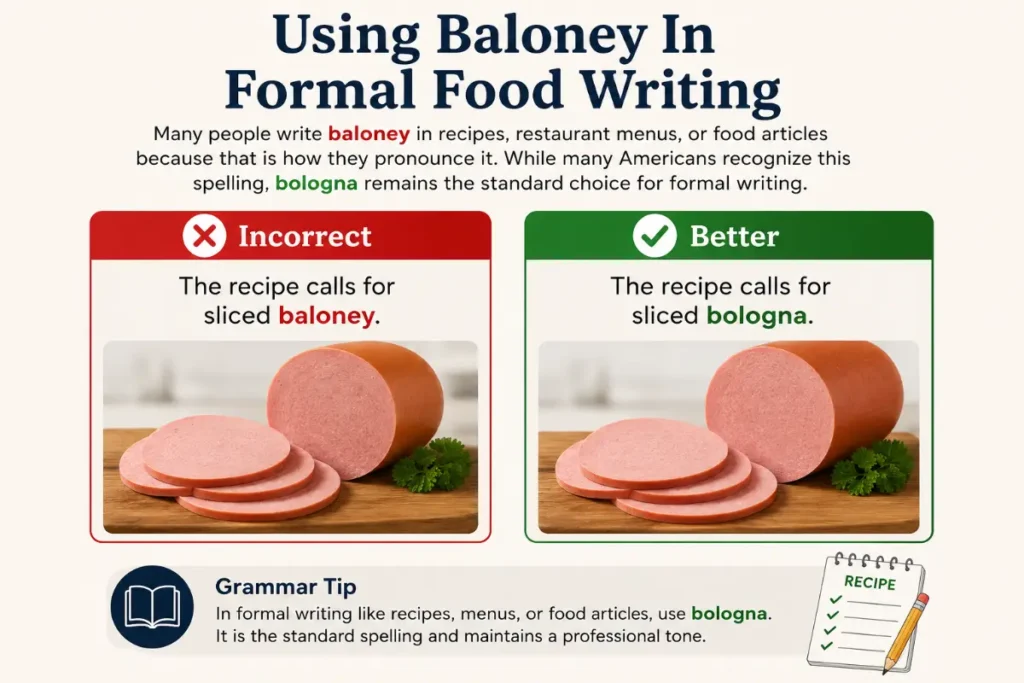
Using Baloney In Formal Food Writing
Many people write baloney in recipes, restaurant menus, or food articles because that is how they pronounce it. While many Americans recognize this spelling, bologna remains the standard choice for formal writing.
Incorrect.
- The recipe calls for sliced baloney.
Better.
- The recipe calls for sliced bologna.
Using Bologna To Mean Nonsense
The slang meaning belongs to baloney, not bologna.
Incorrect.
- That’s complete bologna.
Better.
- That’s complete baloney.
Although some people intentionally spell the slang as bologna for humor, professional editors usually prefer baloney because readers immediately recognize its meaning.
Assuming One Spelling Is Always Wrong
Another common mistake is believing that one spelling is incorrect. The truth is more nuanced.
- Bologna is the traditional spelling for the sausage.
- Baloney is an accepted American spelling for the food and the standard spelling for the slang meaning.
Confusing Pronunciation With Spelling
Many English learners expect bologna to sound exactly as it looks. English pronunciation does not always follow spelling, especially with words borrowed from other languages. That is why pronunciation based spellings like baloney became popular over time.
Baloney vs Bologna Pronunciation Guide
One reason this pair causes confusion is the gap between spelling and pronunciation.
| Word | IPA | Syllables | Common Pronunciation |
|---|---|---|---|
| Baloney | /bəˈloʊni/ | ba LO nee | buh LOH nee |
| Bologna | /bəˈloʊni/ | bo LO gna | buh LOH nee |
Although the spellings are different, both words are pronounced almost exactly the same in modern American English.
Common Pronunciation Mistakes
- Saying every letter in bologna.
- Pronouncing the g sound.
- Reading it as bo LOG na.
- Assuming the ending sounds like agna.
The accepted pronunciation is simply buh LOH nee. A helpful trick is to remember that English kept the traditional Italian spelling but simplified the pronunciation over time.
Baloney vs Bologna Etymology And Word Origin
The history behind these words explains why both forms exist today.
The Origin Of Bologna
The word bologna comes from the Italian city of Bologna, famous for its rich culinary tradition. A finely ground sausage inspired by the region eventually became popular across Europe and later North America. As English adopted the food, it kept the original spelling even though English speakers gradually changed the pronunciation.
How Baloney Appeared
By the late nineteenth and early twentieth centuries, many Americans were pronouncing bologna as baloney. Over time, writers began spelling the word the way people actually said it. Eventually baloney developed a second life as a slang term meaning nonsense or foolish talk. That figurative meaning became extremely popular and is now recognized by major English dictionaries.
Baloney vs Bologna Regional Usage
Both words appear in English speaking countries, but usage is not identical everywhere.
American English
American English recognizes both forms.
- Bologna is the standard spelling for the sausage.
- Baloney is widely used as slang for nonsense.
- Some Americans also write baloney for the lunch meat in informal contexts.
British English
British English strongly favors bologna for the food. The slang word baloney is understood by many people through American movies, television, books, and online media, but it is much less common in everyday British conversation.
Canadian English
Canadian English generally follows American usage. Most formal publications use bologna for the sausage, while baloney appears regularly in casual speech to mean nonsense.
Australian English
Australian English usually keeps bologna for the food. The slang meaning of baloney is recognized but is less common than several local expressions with the same meaning.
Baloney vs Bologna Grammar Rules
Although this comparison is mostly about spelling and meaning, a few grammar rules are worth remembering.
Parts Of Speech
Both baloney and bologna are nouns.
Examples.
- We bought fresh bologna.
- That’s absolute baloney.
Countable And Uncountable Use
When referring to the food, the words are usually treated as mass nouns.
Examples.
- We need more bologna.
- He bought some baloney.
When referring to nonsense, baloney is almost always an uncountable noun.
Examples.
- That’s baloney.
- I don’t believe that baloney.
Plural Forms
Plural forms are uncommon because both words usually describe a food product or an abstract idea. In rare situations discussing different products, writers may use phrases like these.
- Several types of bologna were available.
- Different kinds of bologna are sold across Europe.
Using baloneys or bolognas is unusual and rarely needed.
Common Sentence Structures
Here are natural patterns that native speakers use.
- That’s baloney.
- I don’t believe that baloney.
- We bought fresh bologna.
- She made a bologna sandwich.
- He ordered smoked bologna from the deli.
Real Life Usage Examples
Seeing these words in everyday situations makes their difference much easier to remember.
Daily Conversation
- That’s baloney and you know it.
- Can you pick up some bologna from the store on your way home.
Academic Writing
- Bologna is a cooked sausage with origins linked to northern Italy.
- The expression baloney became popular as American slang during the twentieth century.
Professional Communication
- The catering order includes turkey bologna and roast beef sandwiches.
- Please verify the information before sharing it because unsupported claims can sound like baloney.
Literature
Writers often use baloney in dialogue to make characters sound natural, skeptical, or humorous. The word instantly communicates disbelief without using harsh language.
Media
News articles, cooking websites, food magazines, and grocery advertisements almost always use bologna when referring to the sausage. Opinion columns and entertainment media often use baloney to reject false claims or exaggerated statements.
Here is the final part of the article.
Related Words And Confused Terms
Several English words are closely related to baloney vs bologna because they involve spelling differences, pronunciation, food names, or informal expressions. Learning them can prevent similar mistakes.
Related Food Terms
- Mortadella.
- Salami.
- Frankfurter.
- Sausage.
- Cold cuts.
- Deli meat.
- Luncheon meat.
Related Slang Words
- Nonsense.
- Rubbish.
- Hogwash.
- Bunk.
- Claptrap.
- Poppycock.
- Nonsense talk.
Commonly Confused Word Pairs
- Dessert vs Desert.
- Compliment vs Complement.
- Stationary vs Stationery.
- Principal vs Principle.
- Than vs Then.
- Affect vs Effect.
- Passed vs Past.
These word pairs confuse writers for different reasons, but they all highlight one important lesson. English spelling does not always match pronunciation, and context often determines the correct choice.
Baloney vs Bologna Expert Language Insight
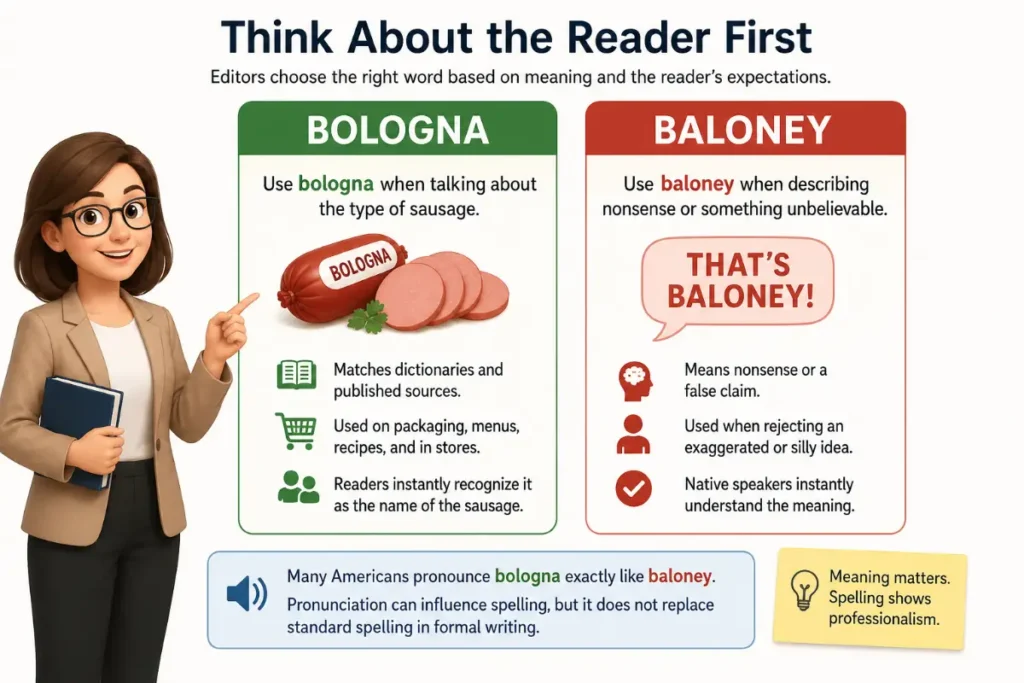
Professional editors rarely confuse these words because they think about the reader first. If you’re writing about food, bologna is almost always the better choice. It matches dictionaries, recipes, grocery packaging, restaurant menus, and most published material. Readers immediately recognize it as the name of the sausage. If you’re describing an unbelievable story or rejecting an exaggerated claim, baloney is the natural choice. Native speakers instantly understand that it means nonsense. One interesting detail is that many Americans pronounce bologna exactly like baloney. That pronunciation helped create the alternate spelling, but pronunciation alone does not replace standard spelling in formal writing.
For another common grammar confusion, see seperate or separate Correct Spelling and Usage Guide.
Conclusion
The confusion behind baloney vs bologna comes from the unusual relationship between spelling and pronunciation. Even though the words sound alike, they are not always interchangeable.
Bologna is the traditional spelling for the sausage and remains the preferred choice in recipes, food packaging, restaurant menus, and formal writing.
Baloney is the accepted slang word for nonsense and is also recognized as an alternate American spelling for the lunch meat. Native speakers use it naturally in everyday conversation, especially when dismissing an unbelievable claim.
Frequently Asked Question
Is Baloney The Same As Bologna?
Yes. They can refer to the same type of sausage. However, bologna is the traditional and standard spelling for the food, while baloney is also a slang word that means nonsense. Context tells readers which meaning you intend.
Why Is Bologna Pronounced Baloney?
The spelling comes from the Italian city of Bologna. As English speakers adopted the word, the pronunciation gradually changed. Over time, many Americans began saying it as baloney, and that pronunciation eventually became an accepted alternate spelling.
Which Spelling Should I Use In Formal Writing?
Use bologna when referring to the sausage. It is the standard spelling found in dictionaries, food labels, recipes, newspapers, and academic writing. Reserve baloney for its slang meaning unless you intentionally choose the informal food spelling.
Is Baloney A Real Dictionary Word?
Yes. Major English dictionaries recognize baloney as a legitimate English word. It appears as an alternate spelling for the sausage and as a noun meaning nonsense or foolish talk.
Can I Use Baloney On A Restaurant Menu?
You can, especially in casual American settings, but bologna is the more professional and widely accepted spelling. Most restaurants, grocery stores, and food manufacturers prefer bologna.
Which Word Is More Common In American English?
American English uses both words. Bologna is more common for the sausage in formal writing, while baloney appears frequently in everyday conversation because of its slang meaning and pronunciation based spelling.
Is Baloney Considered Slang?
Yes. When baloney means nonsense or something untrue, it is an informal slang expression. It is common in conversations, opinion writing, and humorous contexts but is less common in formal academic writing.
How Can I Remember The Difference Between Baloney And Bologna?
Think about the meaning first. If you’re talking about food, write bologna. If you’re calling an idea nonsense, write baloney. That simple rule works in almost every situation.