
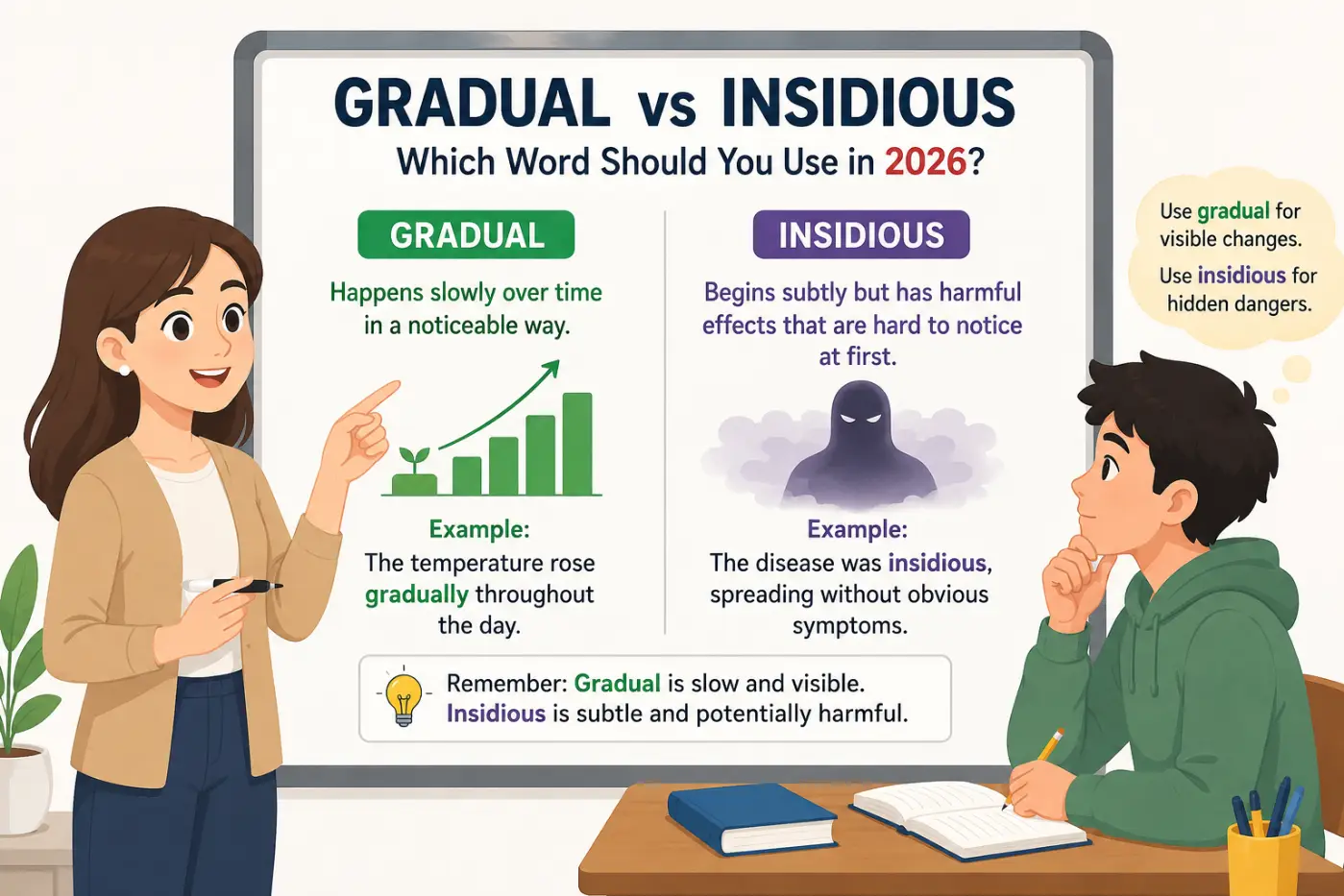
Gradual vs Insidious is a comparison that often confuses English learners and native speakers alike because both words can describe something that develops over time. The key difference is that they are not interchangeable. Gradual describes a slow, steady process, while insidious describes something that spreads slowly in a harmful or deceptive way.
The confusion happens because both words refer to change that occurs little by little. However, gradual has a neutral meaning and simply focuses on the pace of change. Insidious, on the other hand, carries a negative meaning and is used for problems, dangers, or harmful situations that develop quietly and often go unnoticed until they become serious.
Understanding the difference between these two words will help you choose the right one in every situation. In this guide, you’ll learn what gradual and insidious mean, how they differ, when to use each word, common mistakes to avoid, and plenty of real-life examples to make the distinction easy to remember.
You may also want to read cacoon or cocoon Which Spelling Is Correct.
Quick Definition
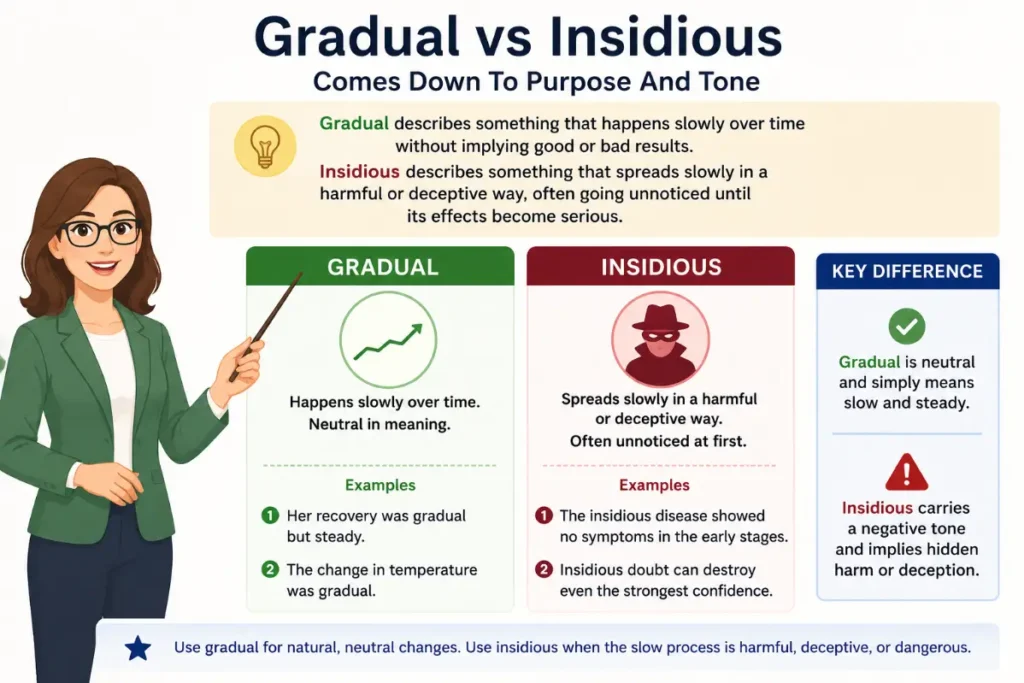
Gradual vs insidious comes down to purpose and tone. Gradual describes something that happens slowly over time without implying good or bad results. Insidious describes something that spreads slowly in a harmful or deceptive way, often going unnoticed until its effects become serious.
Quick Answer
If you simply want to describe slow progress or slow change, use gradual. If you want to describe something that slowly causes harm or quietly becomes dangerous, use insidious. The words share the idea of slow development, but only insidious carries a strongly negative meaning.
Gradual Vs Insidious Comparison Table
| Feature | Gradual | Insidious |
|---|---|---|
| Correct form | Gradual | Insidious |
| Meaning | Happening little by little | Spreading slowly while causing harm |
| Part of speech | Adjective | Adjective |
| Origin | Latin gradus meaning step | Latin insidiosus meaning deceitful or treacherous |
| Usage frequency | Very common | Common in formal writing |
| Formality level | Neutral | Neutral to formal |
| Common contexts | Learning recovery growth improvement change | Disease corruption addiction prejudice pollution threats |
| Emotional tone | Neutral | Negative |
| Example | A gradual improvement in health. | An insidious disease spread through the population. |
Meaning Of Gradual Vs Insidious
Meaning Of Gradual
Gradual means happening slowly through a series of small changes or steps. It does not suggest danger, deception, or hidden intent. It simply describes the pace of change. Writers commonly use gradual when discussing learning, improvement, recovery, aging, climate, business growth, or personal development.
Examples include:
- A gradual increase in sales.
- A gradual improvement in confidence.
- A gradual decline in temperatures.
- A gradual recovery after surgery.
The word focuses on how fast something changes, not on the result.
Meaning Of Insidious
Insidious describes something that develops slowly while causing harm or operating in a subtle way. The danger often remains hidden until it becomes difficult to stop. Doctors, journalists, historians, and researchers frequently use this word because many serious problems begin quietly.
Common examples include:
- An insidious illness.
- An insidious addiction.
- An insidious form of discrimination.
- An insidious cyber threat.
The emphasis is not simply on slow change. It is on hidden danger and harmful consequences.
Gradual Vs Insidious Key Differences
Although both words describe slow development, they create completely different impressions.
Meaning Difference
Gradual describes slow progress or slow change. Insidious describes slow harmful development.
Tone Difference
Gradual has a neutral tone. Insidious has a strongly negative tone.
Grammar Difference
Both words are adjectives. Both usually appear before nouns or after linking verbs.
Examples:
- The recovery was gradual.
- The infection was insidious.
- They noticed gradual progress.
- They faced an insidious threat.
Regional Difference
There is almost no difference between American English, British English, Canadian English, and Australian English. English speakers across these regions understand and use both words in nearly the same way.
Context Difference
Use gradual for ordinary change. Use insidious for hidden harmful change. This single distinction will help you choose the correct word almost every time.
Which One Is Correct
Both words are correct English words. The correct choice depends on your meaning. Choose gradual when describing something that happens step by step. Choose insidious when describing something that quietly causes damage or becomes dangerous over time.
For example:
- The patient made gradual progress after treatment.
- Stress had an insidious effect on his health.
Replacing one word with the other changes the meaning of the sentence.
Gradual Vs Insidious In Sentences
Gradual Examples
- The company experienced gradual growth over five years.
- Her English improved through gradual practice.
- The weather showed a gradual change during spring.
- There was a gradual increase in traffic.
- The child made gradual progress in reading.
- Recovery was gradual but steady.
- Their friendship developed through gradual trust.
- Prices rose at a gradual pace.
- The mountain trail had a gradual climb.
- The community saw gradual improvements after the project.
Insidious Examples
- The disease had an insidious beginning.
- Addiction can have an insidious effect on families.
- Corruption spread in an insidious way.
- The scam relied on insidious deception.
- Stress became an insidious problem.
- The software contained an insidious security risk.
- Misinformation can be surprisingly insidious.
- The damage was insidious and difficult to detect.
- An insidious rumor damaged his reputation.
- The organization faced an insidious internal threat.
Common Mistakes
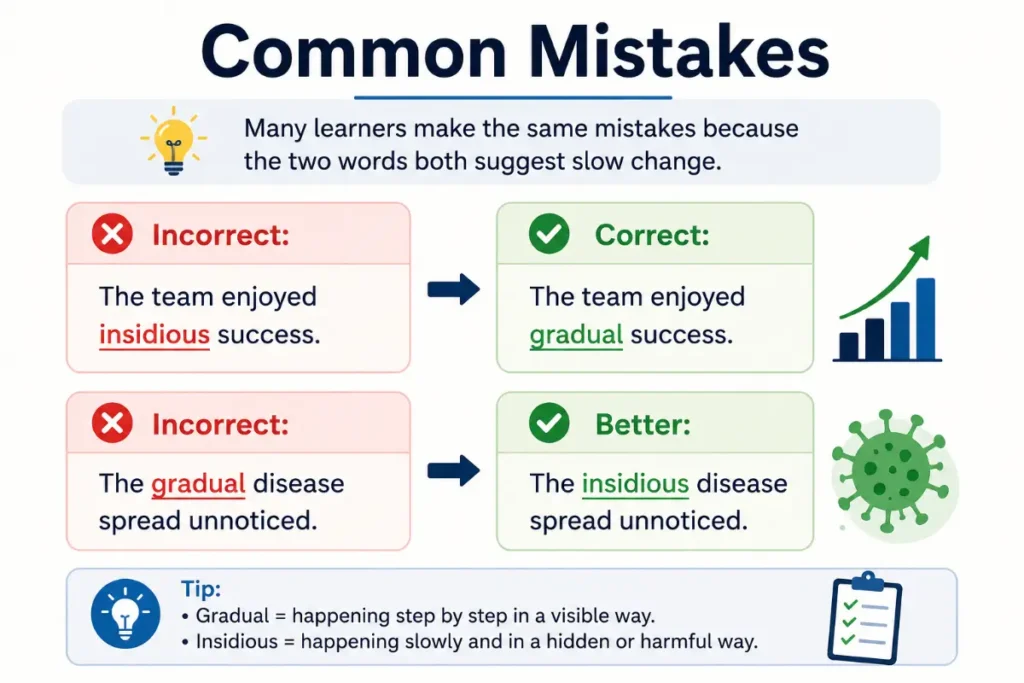
Many learners make the same mistakes because the two words both suggest slow change.
Incorrect: The team enjoyed insidious success.
Correct: The team enjoyed gradual success.
Incorrect: The gradual disease spread unnoticed.
Better: The insidious disease spread unnoticed.
Need another quick comparison? Read According to Alternatives for Clearer Writing.
Gradual Vs Insidious Pronunciation Guide
Using the right word is important, but saying it correctly also builds confidence. Both words are common in conversations, presentations, classrooms, and professional settings.
Gradual Pronunciation
IPA:
American English: /ˈɡrædʒuəl/
British English: /ˈɡrædʒuəl/
Syllable breakdown:
Grad • u • al
The stress falls on the first syllable.
Common Pronunciation Mistakes
- Saying the second syllable too strongly.
- Dropping the final sound and saying gradjool.
- Pronouncing every letter separately instead of letting the sounds flow naturally.
A natural pronunciation sounds smooth, with the last two syllables blending together.
Insidious Pronunciation
IPA:
American English: /ɪnˈsɪdiəs/
British English: /ɪnˈsɪdiəs/
Syllable breakdown:
In • sid • i • ous
The stress falls on the second syllable.
Common Pronunciation Mistakes
- Stressing the first syllable instead of the second.
- Saying the ending as ee us instead of yuhs.
- Skipping the third syllable completely.
Listening to native speakers and repeating the words aloud is one of the fastest ways to remember the correct pronunciation.
Gradual Vs Insidious Etymology And Word Origin
Knowing where a word comes from often makes its meaning much easier to remember.
Origin Of Gradual
Gradual comes from the Latin word gradus, meaning step. The idea of moving one step at a time eventually developed into the modern meaning of something happening little by little. For centuries, English speakers have used gradual to describe steady progress, slow movement, careful improvement, and change that happens over time. That original idea of moving in small steps still shapes the word today.
Origin Of Insidious
Insidious comes from the Latin word insidiosus, meaning treacherous, deceitful, or full of traps. It is related to the Latin word insidiae, which referred to an ambush. Over time, English speakers began using insidious for illnesses, dangers, social problems, and harmful influences that develop quietly before people notice them. Unlike gradual, the history of insidious has always carried a negative meaning.
Gradual Vs Insidious Regional Usage
One helpful fact about these words is that their meanings stay remarkably consistent across major English speaking countries.
American English
American writers frequently use gradual in business, education, medicine, science, and everyday conversation. Examples include gradual improvement, gradual recovery, gradual increase, and gradual decline. Insidious often appears in healthcare, cybersecurity, politics, psychology, and journalism. Common phrases include insidious disease, insidious threat, insidious bias, and insidious influence.
British English
British English follows almost identical usage. Newspapers, universities, and government publications regularly use gradual for neutral change and insidious for hidden danger.
Canadian English
Canadian English shows virtually no difference from American and British usage. Both words keep the same meanings, grammar, and tone.
Australian English
Australian English also uses both words in the same way. Medical writing, academic articles, and news reports often describe diseases, environmental issues, and social problems as insidious when the danger develops slowly.
Is There Any Regional Preference
Not really. Unlike pairs such as color and colour or organize and organise, gradual and insidious do not change meaning across major English varieties. The only noticeable difference comes from writing style, not from the words themselves.
Gradual Vs Insidious Grammar Rules
Although these words have very different meanings, they behave the same way grammatically because both are adjectives. Understanding their grammar helps you build more natural sentences.
Parts Of Speech
Gradual is an adjective.
Insidious is also an adjective.
Both describe nouns.
Examples:
- A gradual improvement.
- An insidious disease.
- A gradual transition.
- An insidious rumor.
Using Them Before Nouns
The most common position is directly before a noun.
Examples:
- A gradual recovery.
- A gradual increase.
- An insidious infection.
- An insidious influence.
This structure appears in newspapers, books, business reports, and everyday English.
Using Them After Linking Verbs
Both words can follow linking verbs such as be, become, remain, seem, appear, and feel.
Examples:
- The improvement was gradual.
- The decline became gradual.
- The disease was insidious.
- The problem seemed insidious.
Comparative And Superlative Forms
These adjectives normally use more and most instead of adding endings.
Examples:
- The second recovery was more gradual.
- This was the most gradual increase on record.
- The new threat proved more insidious.
- It became the most insidious challenge they had faced.
Adverb Forms
Gradual becomes gradually. Insidious becomes insidiously.
Examples:
- Sales gradually increased.
- The infection spread insidiously.
Noun Forms
Gradual forms gradualness, although this noun is uncommon. Insidious forms insidiousness.
Examples:
- The gradualness of the transition helped everyone adapt.
- Historians discussed the insidiousness of political propaganda.
Real Life Usage Examples
Seeing these words in different situations makes the distinction much easier to remember.
Daily Conversation
People usually choose gradual when talking about ordinary life.
Examples:
- My fitness improved gradually after I started walking every day.
- We noticed a gradual change in the neighborhood.
Insidious appears less often in casual conversation because it sounds more serious.
Examples:
- Stress can become an insidious problem.
- Social pressure sometimes has an insidious effect on teenagers.
Academic Writing
Researchers often use gradual when discussing measurable change.
Examples:
- The study showed a gradual decline in pollution levels.
- Students demonstrated gradual improvement throughout the semester.
Insidious appears when discussing hidden risks.
Examples:
- The paper examined the insidious effects of misinformation.
- Researchers warned about the insidious spread of antibiotic resistance.
Professional Communication
Business professionals usually use gradual for growth, change, or improvement.
Examples:
- We expect gradual growth next year.
- Customer satisfaction showed gradual improvement.
Insidious is more common when discussing risk management.
Examples:
- The report identified an insidious cybersecurity threat.
- Leaders addressed the insidious effects of workplace discrimination.
Literature
Authors often use gradual to build realistic character development.
Example: The hero experienced a gradual change in attitude after years of hardship.
Insidious creates suspense and tension.
Example: An insidious fear slowly consumed the entire village.
News And Media
Journalists commonly write about gradual economic recovery, gradual policy changes, or gradual climate shifts. They use insidious for hidden corruption, dangerous diseases, organized crime, cyber attacks, and social problems.
Related Words And Confused Terms
Learning nearby words helps expand your vocabulary while making the meanings even clearer.
Words Related To Gradual
- Slow.
- Progressive.
- Steady.
- Continuous.
- Incremental.
- Stepwise.
- Moderate.
- Measured.
- Gentle.
- Consistent.
These words usually focus on pace rather than danger.
Words Related To Insidious
- Harmful.
- Deceptive.
- Treacherous.
- Dangerous.
- Hidden.
- Subtle.
- Sneaky.
- Malicious.
- Corrupting.
- Toxic.
These words emphasize concealed harm or negative influence.
Expert Language Insight
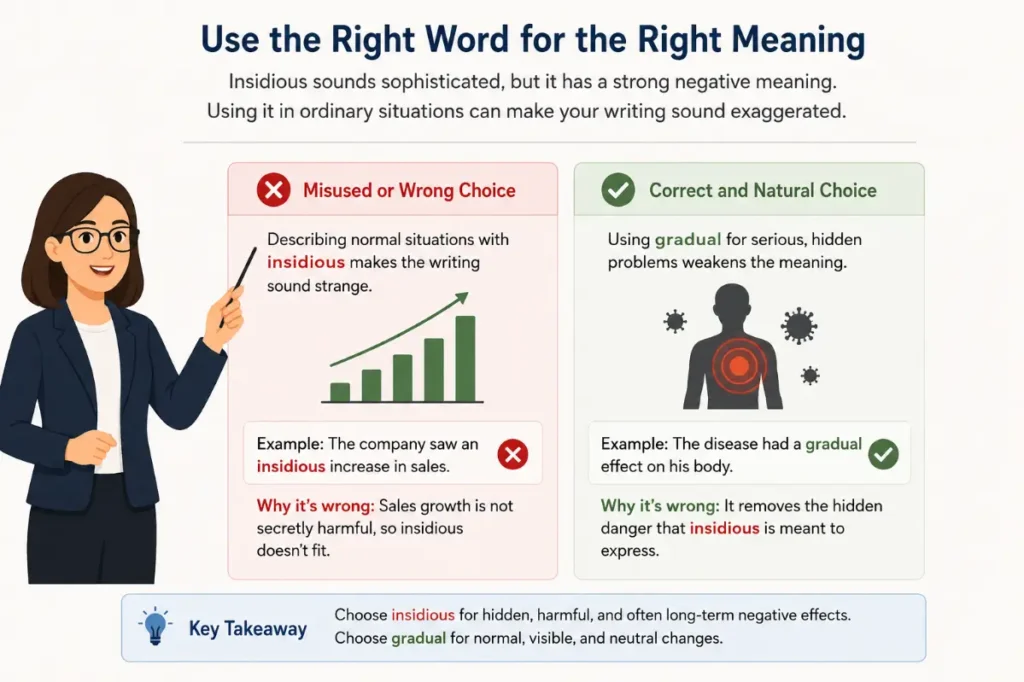
One pattern appears again and again when editing professional writing. Many writers reach for insidious simply because it sounds more sophisticated. In reality, native English speakers use it very carefully. Since it carries a strong negative meaning, using it for ordinary situations can make your writing sound exaggerated. For example, describing a gradual increase in sales as an insidious increase immediately sounds strange because sales growth is not secretly harmful. On the other hand, using gradual to describe a disease that quietly damages the body weakens the sentence because it removes the hidden danger that the writer wants readers to notice.
Learn the difference in Diddo or Ditto Correct Spelling and Meaning.
Conclusion
Choosing between gradual and insidious is easier once you understand the difference in meaning instead of focusing only on the idea of slow change. Use gradual when something happens little by little without implying harm. It fits situations such as improvement, growth, recovery, learning, development, and steady change.
The word describes the pace of change and leaves the emotional tone to the surrounding context. Use insidious when something spreads slowly while quietly causing damage. It is the right choice for hidden dangers, diseases, addictions, prejudice, misinformation, corruption, security threats, and other problems that become serious before people fully recognize them.
Frequently Asked Questions
What Is The Main Difference Between Gradual And Insidious?
The biggest difference is tone and meaning. Gradual describes something that happens little by little without suggesting good or bad results. Insidious describes something that develops slowly while quietly causing harm. Both involve slow change, but only insidious carries a negative meaning.
Can Gradual And Insidious Be Used Interchangeably?
No. Although both words describe change over time, they are not synonyms. Replacing one with the other changes the meaning of the sentence. Use gradual for neutral or ordinary change. Use insidious for hidden dangers, harmful influences, or problems that worsen quietly.
Is Insidious Always Negative?
Yes. Insidious almost always has a negative meaning. It describes something harmful, deceptive, or dangerous that develops slowly and often goes unnoticed at first. Native English speakers rarely use it in a positive context.
Is Gradual A Positive Word?
Not necessarily. Gradual is generally neutral. It simply describes the speed of change. A gradual recovery sounds positive, while a gradual decline sounds negative. The word itself does not express approval or disapproval.
Which Word Is More Common In Everyday English?
Gradual is much more common in everyday conversation. People regularly talk about gradual improvement, gradual change, or gradual growth. Insidious appears more often in healthcare, journalism, academic writing, psychology, and discussions about hidden risks.
How Can I Remember The Difference Between Gradual And Insidious?
Think about the result. If something changes step by step, choose gradual. If it quietly becomes harmful before people notice it, choose insidious. This simple rule works in almost every situation.
Are Gradual And Insidious Both Adjectives?
Yes. Both words are adjectives. They describe nouns and can appear before a noun or after a linking verb. Examples include a gradual increase, an insidious disease, the recovery was gradual, and the threat was insidious.
Which Word Should I Use In Professional Writing?
Choose the word that matches your meaning. Use gradual for neutral descriptions of progress, growth, decline, or change. Use insidious when writing about hidden dangers, harmful trends, or problems that slowly become more serious. Precise word choice makes professional writing stronger and easier to understand.