
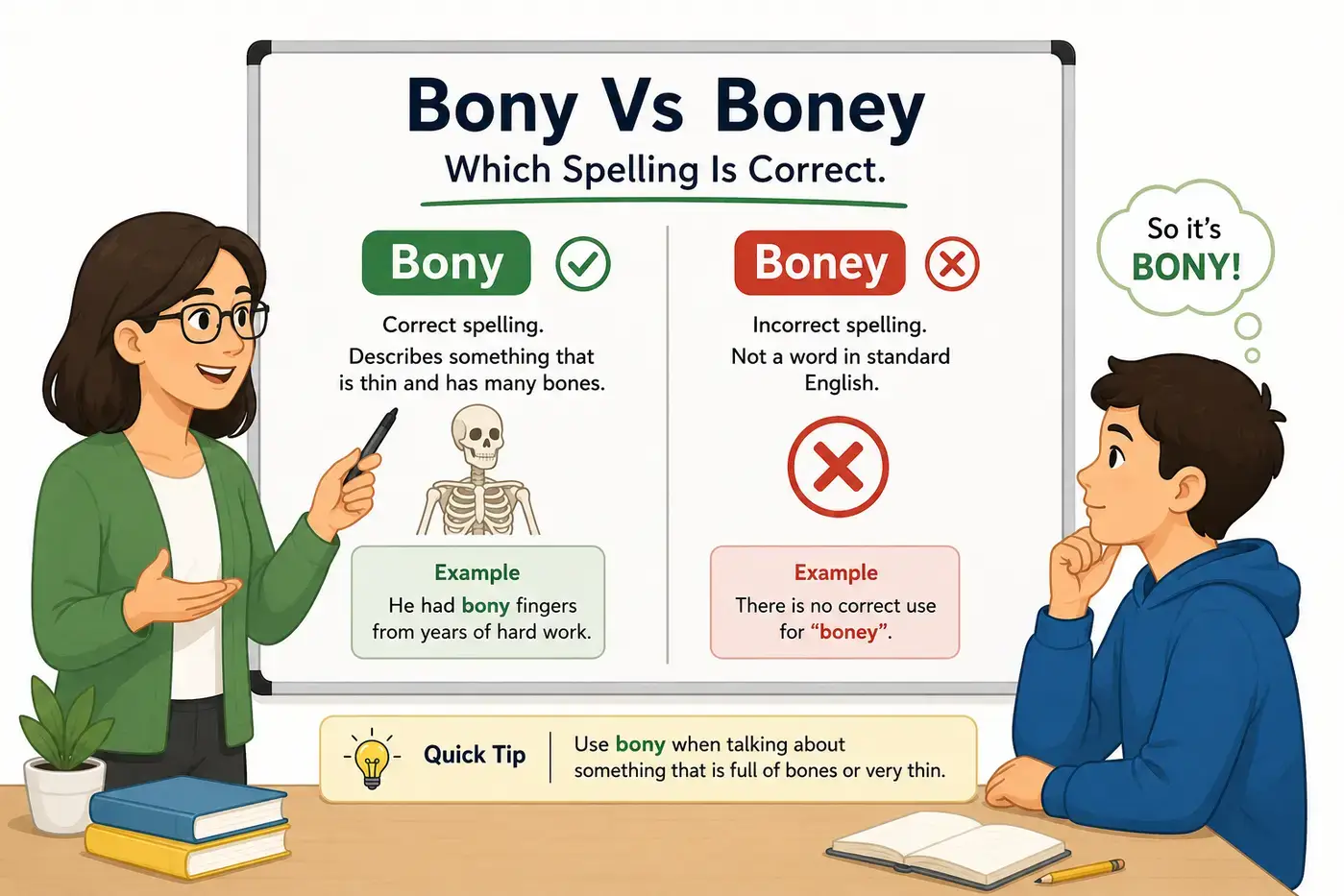
If you’ve typed bony vs boney into a search engine, you’re not alone. These two spellings look almost identical, yet many writers pause before choosing one. Spell checkers, dictionaries, and websites don’t always explain the difference in a simple way, which makes the confusion even more frustrating.
The short answer is that bony is the standard spelling in modern English. You’ll find it in dictionaries, newspapers, books, academic writing, and professional communication. Boney also appears in English, but it’s far less common. It usually works as a variant spelling, appears in proper names, or shows up in informal writing and older sources.
This guide explains the difference in plain English. You’ll learn the meaning of each word, see how native speakers use them, explore grammar rules, compare American and British English, study real examples, and avoid common mistakes. By the end, you’ll know exactly which spelling fits your sentence and why experienced editors almost always choose one over the other.
For another common grammar confusion, see Cubical vs Cubicle Meaning Difference and Correct Usage.
Quick Definition
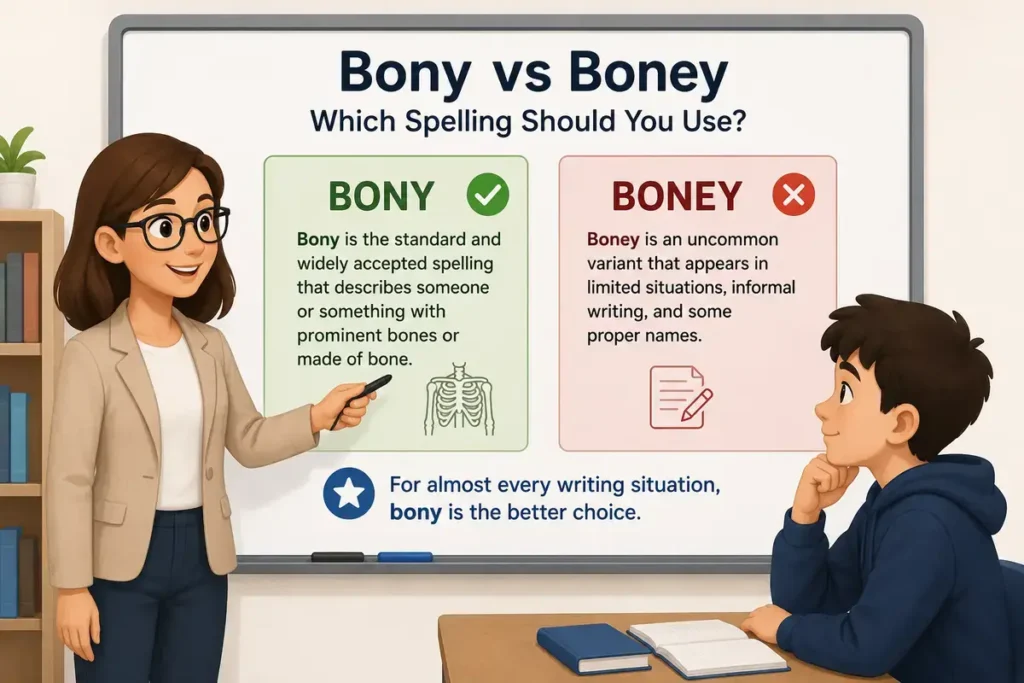
Bony is the standard and widely accepted spelling that describes someone or something with prominent bones or made of bone. Boney is an uncommon variant that appears in limited situations, informal writing, and some proper names. For almost every writing situation, bony is the better choice.
Quick Answer
If you only remember one thing, remember this.
- Bony is the correct and preferred spelling in standard English.
- Boney exists but is much less common.
- Dictionaries recognize bony as the normal adjective.
- Professional writers, editors, teachers, and publishers almost always use bony.
- Unless you’re referring to a specific name or quoted source, choose bony.
Bony Vs Boney Comparison Table
| Feature | Bony | Boney |
|---|---|---|
| Correct standard spelling | Yes | Rare variant |
| Meaning | Having noticeable bones or made of bone | Usually the same meaning but uncommon |
| Part of speech | Adjective | Adjective |
| Origin | From the noun bone with the adjective ending y | Variant spelling developed later |
| Usage frequency | Very common | Rare |
| Formality | Standard in formal and informal writing | Mostly informal or found in names |
| Common contexts | Anatomy health writing fiction everyday conversation | Proper names older texts occasional informal writing |
| Dictionary preference | Preferred | Limited recognition depending on the dictionary |
| Example | The rescued dog looked bony after weeks without food. | The old record used the spelling boney instead of bony. |
Meaning Of Bony
Bony is an adjective that describes someone or something with bones that are easy to see or feel. It can also describe an object made mostly of bone. Writers often use the word in descriptions of people, animals, body parts, and physical appearance.
Common meanings include:
- Having bones that stand out because there is very little fat or muscle.
- Made of bone or containing bone.
- Thin enough that the shape of the bones is clearly visible.
Examples include:
- The puppy looked bony after being lost for several days.
- His bony shoulders showed through his shirt.
- The bird had long bony legs.
- The doctor examined the bony structure of the patient’s hand.
The word usually carries a neutral meaning. Depending on the sentence, it can simply describe someone’s build or suggest poor health, age, or malnutrition.
Meaning Of Boney
Boney is an alternative spelling of bony, but it is uncommon in modern English. Most dictionaries and style guides treat bony as the preferred spelling.
You may still see boney in a few situations.
- Older books and historical publications.
- Family names or business names.
- Song titles, fictional characters, and creative works.
- Informal writing where the writer prefers the alternative spelling.
Although the meaning is generally the same, choosing boney in standard writing can make your work appear inconsistent because most readers expect bony.
Bony Vs Boney Key Differences
At first glance, the two words seem interchangeable. In practice, one clearly dominates modern English.
Spelling Difference
- Bony is the accepted standard spelling.
- Boney is an uncommon variant.
Usage Difference
- Bony appears in dictionaries, textbooks, magazines, medical writing, and everyday English.
- Boney appears far less often and usually in special contexts.
Tone Difference
- Bony feels natural and professional.
- Boney can look old fashioned, regional, or informal.
Grammar Difference
Both words function as adjectives.
Examples include:
- A bony hand.
- A bony fish.
- A bony shoulder.
Replacing bony with boney rarely changes the meaning. It mainly changes how natural the sentence looks to modern readers.
Regional Difference
American English, British English, Canadian English, and Australian English all strongly favor bony. There is no major regional variety that regularly prefers boney in standard published writing.
Context Difference
Use bony in:
- School assignments.
- Professional emails.
- Books.
- Articles.
- Medical writing.
- Business communication.
- Everyday conversation.
Reserve boney for:
- Proper names.
- Historical quotations.
- Creative works that intentionally use the alternative spelling.
Which One Is Correct
The correct answer for almost every situation is bony. It is the spelling recognized and preferred by major English dictionaries and widely used across modern English. Editors choose it because readers instantly recognize it, and it follows current spelling conventions.
You don’t need to stop and think every time you write the word. If you’re describing visible bones, a thin person, an animal, or something made of bone, bony is almost always the right choice. Think of boney as the exception instead of the rule. It isn’t completely wrong, but it isn’t the spelling most readers expect to see.
A simple memory trick makes the choice easy.
Bony follows the same pattern as many common English adjectives ending in y, making it the familiar form people naturally recognize. If your goal is clear, polished writing, bony is the safest and strongest choice every time.
Examples In Sentences
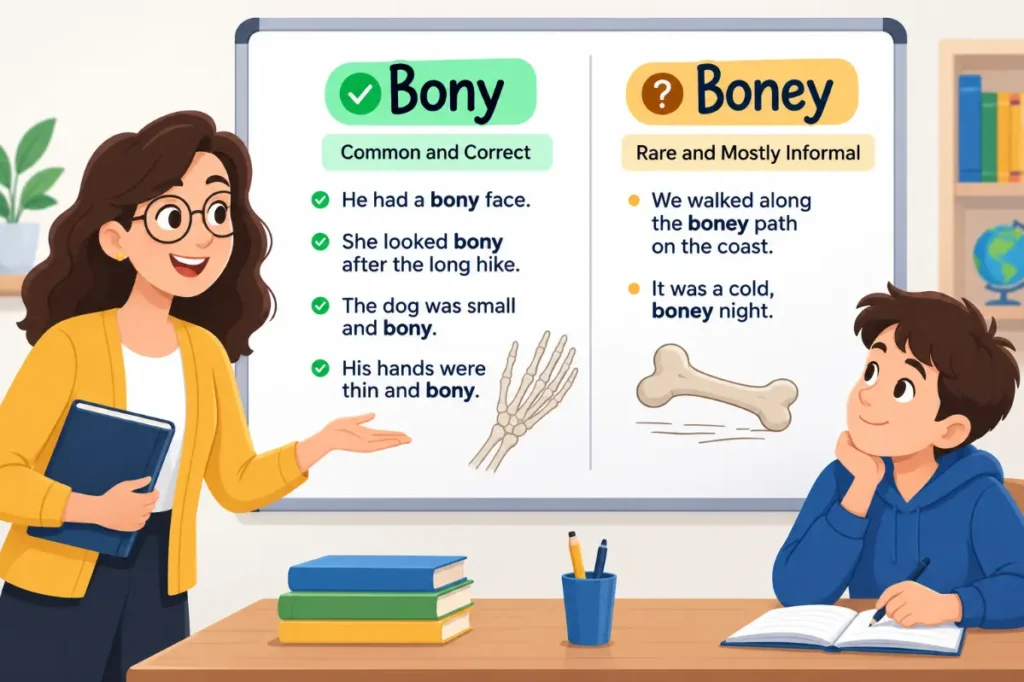
Seeing words in context is one of the fastest ways to remember them. The examples below show how bony appears in natural English. They also demonstrate the limited situations where boney may appear.
Ten Examples Using Bony
- The rescued cat looked bony after spending weeks outdoors.
- His bony fingers gripped the edge of the table.
- The doctor checked the patient’s bony shoulder for signs of injury.
- The old horse had become noticeably bony with age.
- She rested her head against his bony chest.
- The museum displayed several bony remains from ancient sea creatures.
- The child drew a funny picture of a bony dinosaur.
- Despite eating well he still had a naturally bony face.
- The climber’s bony knees showed through his worn trousers.
- The scientist examined the bony structure of the fossil.
Ten Examples Using Boney
- The old newspaper used the spelling boney instead of bony.
- The family business has carried the name Boney for generations.
- The author kept the original boney spelling in the historical quotation.
- A few older dictionaries listed boney as a variant.
- The song title included the word Boney because that was the artist’s choice.
- Some regional publications still contain the spelling boney.
- The archive preserved the document exactly as written including boney.
- The editor left boney unchanged because it appeared in a direct quote.
- You might occasionally find boney in older books.
- Modern editors usually replace boney with bony unless the original spelling must remain.
Many readers also check one-third or one third Correct Spelling and Usage.
Common Mistakes With Bony Vs Boney
Many writers become confused because both spellings exist. Most mistakes happen after seeing the uncommon spelling online or in older material.
Using Boney In Formal Writing
The most common mistake is choosing boney for school essays articles reports or business documents.
Correct.
The dog looked bony after recovering from illness.
Less appropriate.
The dog looked boney after recovering from illness.
Assuming Both Spellings Are Equally Common
Some people believe both spellings appear with the same frequency. They do not.
Published books newspapers academic journals and major dictionaries strongly favor bony.
Changing Historical Spellings
If you are quoting an old document keep the original spelling exactly as it appears. Do not modernize it unless your style guide tells you to do so.
Confusing Bony With Skinny
These words are related but they are not identical.
- Bony describes visible bones or bone structure.
- Skinny describes someone who is very thin.
- A person can be skinny without appearing bony.
- A person can have bony elbows or knees without being skinny.
Pronunciation Guide
The pronunciation of bony and boney is the same in standard English.
IPA Pronunciation
- Bony: /ˈboʊ.ni/
- Boney: /ˈboʊ.ni/
Syllable Breakdown
Bo.
Ny.
The word has two syllables.
How To Say It Naturally
Stress the first syllable.
Say BOH nee.
The second syllable is softer and shorter.
Common Pronunciation Mistakes
- Adding an extra sound between the two syllables.
- Stressing the second syllable instead of the first.
- Pronouncing the vowel like the word body instead of bone.
Listening to native speakers quickly shows that the pronunciation stays the same regardless of the spelling.
Etymology And Word Origin
Understanding a word’s history often explains its modern spelling. The noun bone comes from Old English bān which referred to the hard framework of the body. The word has deep Germanic roots and has remained part of English for well over a thousand years.
The adjective bony developed by adding the common adjective ending y to bone. English uses this pattern with many everyday words. Examples include:
- Cloud becomes cloudy.
- Dirt becomes dirty.
- Wind becomes windy.
- Ice becomes icy.
Following the same pattern bone naturally became bony. The spelling boney appeared later as a variant. It never became the dominant form and gradually faded from standard published English. Today it survives mainly in proper names older publications and occasional informal writing.
Regional Usage Of Bony Vs Boney
English changes from one country to another but this is one case where the major varieties agree.
American English
American English overwhelmingly prefers bony. You’ll see it in newspapers magazines novels medical resources and everyday conversation.
British English
British English also treats bony as the standard spelling. Major British dictionaries and publishers consistently use this form.
Canadian English
Canadian English follows the same pattern. Professional writing educational materials and media almost always use bony.
Australian English
Australian English also favors bony.
The alternative spelling appears only occasionally and usually for historical or stylistic reasons.
Is There A Regional Preference For Boney
Not really.
No major English speaking country regularly recommends boney in modern standard writing. The difference comes from individual preference historical usage or proper names instead of geography.
Grammar Rules For Bony Vs Boney
Grammar is simple because both words work in the same way.
Part Of Speech
Both bony and boney function as adjectives.
Examples.
- A bony arm.
- A bony fish.
- A bony face.
Comparative And Superlative Forms
Like many short adjectives bony forms its comparison with more and most in modern English.
Examples.
- The rescued dog looked more bony than before.
- That was the most bony animal the veterinarian had treated all week.
Some writers may use bonier and boniest, and these forms are also accepted in standard English. They are less common in everyday conversation but appear in published writing.
Plural Forms
Adjectives do not have plural forms in English.
Correct.
- A bony hand.
- Bony hands.
Notice that the adjective stays the same even though the noun changes.
Common Sentence Patterns
You can use bony before a noun.
- A bony shoulder.
- A bony dog.
- A bony face.
You can also use it after a linking verb.
- The horse looked bony.
- His hands seemed bony.
- The bird became bony after the long migration.
Real Life Usage Examples
Native speakers use bony naturally across many situations.
Daily Conversation
- That puppy still looks a little bony.
- My elbows get bony when I lose weight.
Academic Writing
- Researchers examined the bony structure of the skull.
- The report described changes in bony tissue over time.
Professional Communication
- The veterinarian noted several bony areas during the examination.
- The medical record mentioned tenderness around the bony joint.
Literature
Novelists often use bony to create vivid descriptions.
Example.
His bony hands revealed years of hard physical work.
Media
Journalists commonly use bony in stories about health archaeology wildlife and science because it is the accepted modern spelling.
Bony Vs Boney Related Words And Confused Terms
English has many words that look or sound similar. Learning the related terms makes it easier to choose the right one.
Bone
Bone is the noun from which bony is formed.
Example.
The doctor found a small fracture in the bone.
Boneless
Boneless describes something that has no bones or has had its bones removed.
Example.
The recipe calls for boneless chicken breasts.
Bony Fish
A bony fish is a scientific term for fish with a skeleton made primarily of bone. This term appears frequently in biology and zoology.
Example.
Most fish people eat belong to the group known as bony fish.
Skinny
Skinny describes a person who is very thin.
Unlike bony, it does not specifically suggest that the bones are easy to see.
Lean
Lean usually has a more positive meaning. It describes someone with little body fat but healthy muscle.
Gaunt
Gaunt suggests extreme thinness caused by illness, hunger, stress, or exhaustion.
Skeletal
Skeletal creates a stronger image than bony. It often describes someone who is dangerously thin.
Boneyard
A boneyard is a place where animal bones are found or where old aircraft and machinery are stored.
Although it contains the letters boney, it is a separate word with its own history and meaning.

Expert Language Insight
After editing thousands of pages, one pattern becomes obvious. Professional writers almost always choose bony without hesitation. Major dictionaries, publishing houses, universities, newspapers, and style guides consistently prefer this spelling because it matches modern English usage. Readers recognize it immediately, and it never looks out of place.
The spelling boney isn’t completely incorrect. It simply belongs to a much smaller corner of the language. Most people encounter it in proper names, historical documents, older publications, or direct quotations. Outside those situations, it can distract readers because it looks unusual.
If your goal is clear, polished writing, the decision is easy.
Choose bony for essays, articles, reports, emails, books, websites, and everyday communication.
Keep boney only when you’re preserving an original spelling or referring to a specific name that officially uses it. Good writing isn’t about choosing the rarest option. It’s about choosing the one your readers understand without stopping to think.
A related grammar guide is extent vs extant Meaning and Correct Usage.
Conclusion
The answer to bony vs boney is straightforward. Bony is the standard spelling and the one you should use in almost every piece of writing. It appears in dictionaries, academic resources, newspapers, books, and professional communication across the English speaking world.
Boney shares the same basic meaning, but it is much less common. Today, you are most likely to encounter it in proper names, historical sources, or direct quotations where the original spelling has been preserved.
When you’re writing for school, work, publishing, or everyday communication, choosing bony helps your writing look natural, accurate, and polished. It matches modern usage and meets your readers’ expectations without causing confusion. The simplest rule is also the best one. If you’re describing someone with prominent bones or something made of bone, write bony and move on with confidence.
FAQs
Is Bony Or Boney Correct?
Bony is the standard spelling in modern English and the one recommended by major dictionaries and style guides. Boney exists as a rare variant, but it is uncommon in everyday writing. For almost every situation, bony is the best choice.
Why Do Some People Spell It Boney?
Some writers copy the spelling from older books, historical documents, proper names, or informal sources. Since both spellings have appeared over time, the uncommon form still shows up occasionally. Modern English strongly favors bony.
Is Boney Wrong?
Not always. Boney is an accepted variant in some dictionaries and appears in certain names and historical texts. Still, it is not the preferred spelling in current English, so using bony is usually the better option.
Do American And British English Use Different Spellings?
No. American English and British English both prefer bony. Canadian English and Australian English also follow the same standard. There is no major regional variety that recommends boney in normal published writing.
What Does Bony Mean?
Bony means having noticeable bones, containing bone, or showing bones clearly because there is little fat or muscle. The word is commonly used to describe people, animals, body parts, and anatomical structures.
Are Bony And Skinny The Same?
No. Skinny describes someone who is very thin. Bony specifically emphasizes visible or prominent bones. A person can be skinny without looking bony, and someone can have bony hands or knees without being skinny overall.
How Do You Pronounce Bony?
Bony is pronounced /ˈboʊ.ni/. It has two syllables, with the stress on the first syllable. Boney has the same pronunciation, even though the spelling is different.
How Can I Remember The Correct Spelling?
Think about the adjective pattern used in everyday English. Just as cloud becomes cloudy and wind becomes windy, bone becomes bony. Since this is the standard spelling used by professional writers and dictionaries, it is the easiest form to remember.