
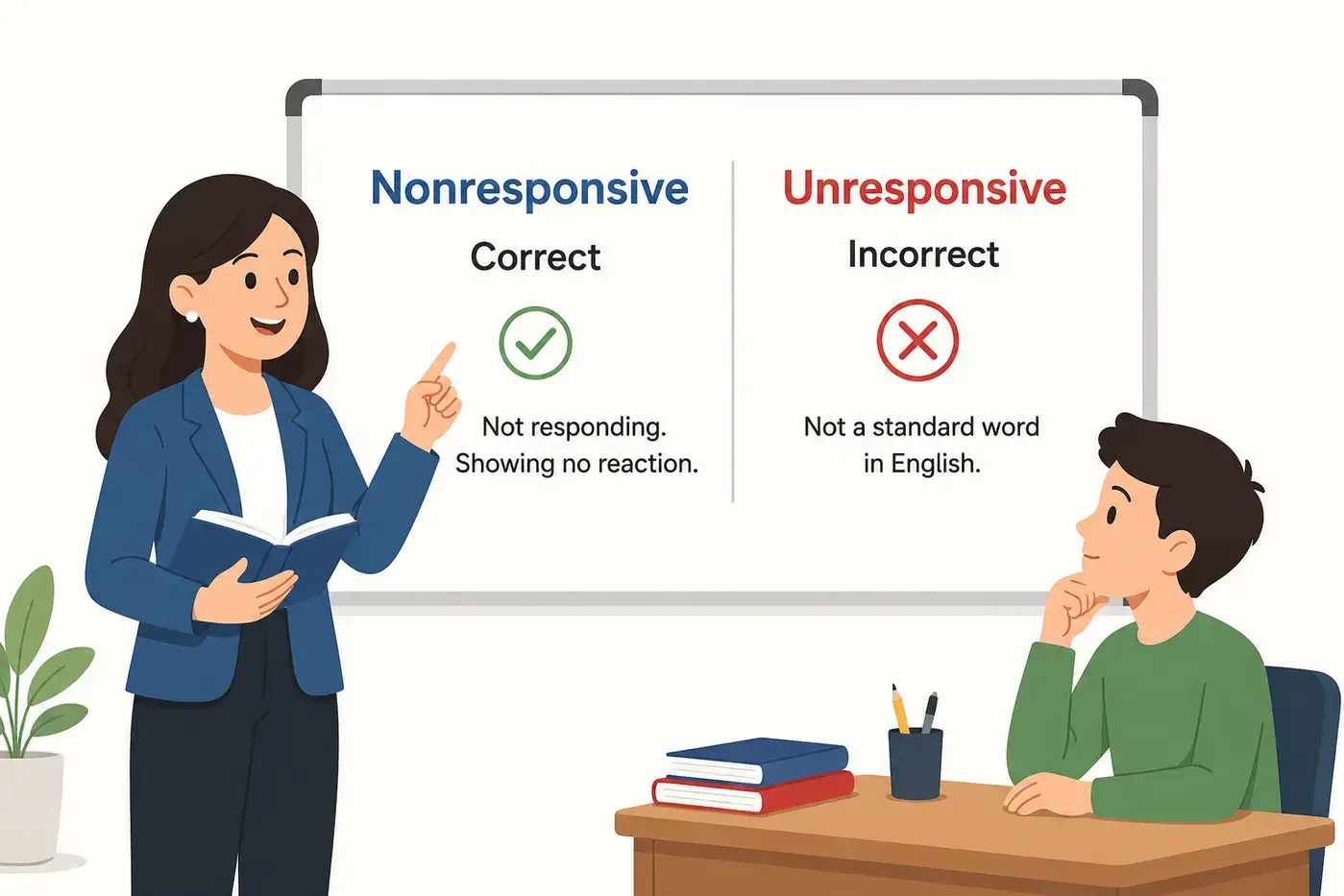
If you’ve seen both nonresponsive vs unresponsive, you’re not alone. The two words appear in medical reports, technical documents, customer service messages, and everyday conversations. At first glance, they seem interchangeable. In many situations, they are. Still, subtle differences in tone, style, and preferred usage can influence which one sounds more natural.
The short answer is simple. Both words are correct English. Even so, unresponsive is the more common choice in modern English. It’s widely used in healthcare, business, technology, and everyday communication. Nonresponsive also appears in professional writing, especially in medicine and technical fields, where it can sound more formal or more precise depending on the context.
This confusion exists because both words describe the same basic idea. They refer to a person, device, system, or organization that does not respond. Since their meanings overlap so closely, many writers wonder if one is more accurate than the other. This guide explains the meaning of each word, their history, grammar, pronunciation, regional preferences, and real life usage. You’ll also learn how experienced editors decide which word fits best in different situations.
For another common grammar confusion, see Swap vs Swop Which Spelling Is Correct..
Quick Definition
When comparing nonresponsive vs unresponsive, both words describe something or someone that fails to respond. Unresponsive is the preferred choice in most modern English because it sounds more natural and appears more often in everyday writing. Nonresponsive remains correct and is common in medical, technical, and formal contexts where precision matters.
Quick Answer
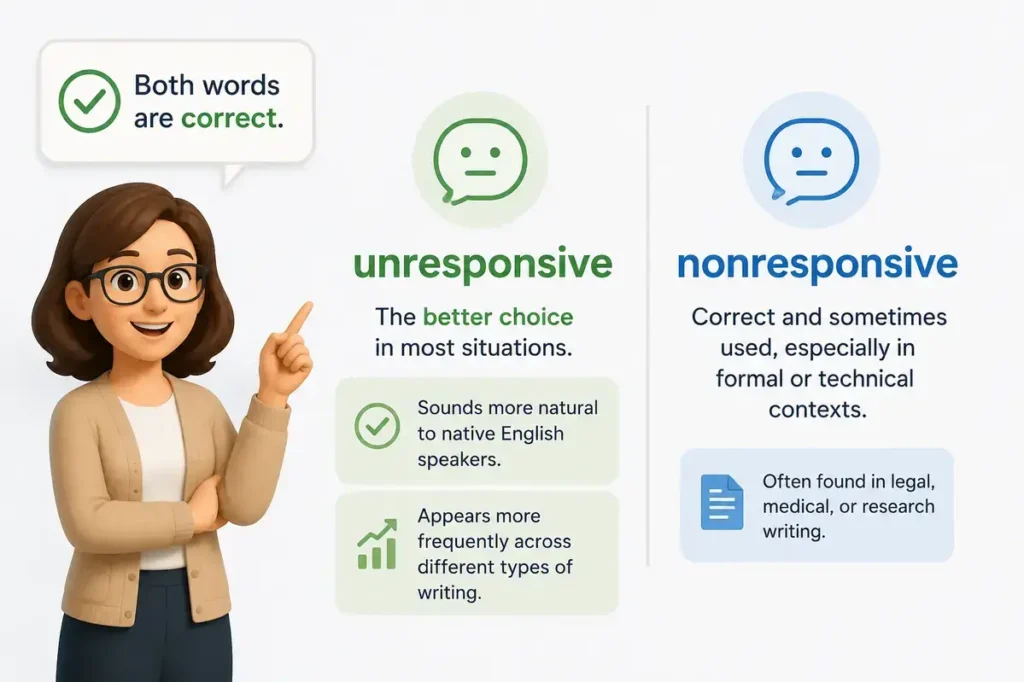
Both words are correct. In most situations, unresponsive is the better choice because it sounds more natural to native English speakers and appears more frequently across different types of writing.
Choose nonresponsive when writing formal medical reports, scientific documents, or technical material that follows established professional terminology.
Nonresponsive Vs Unresponsive Quick Comparison
| Feature | Nonresponsive | Unresponsive |
|---|---|---|
| Correct form | Yes | Yes |
| Meaning | Not responding | Not responding |
| Part of speech | Adjective | Adjective |
| Origin | Prefix non plus responsive | Prefix un plus responsive |
| Usage frequency | Less common | More common |
| Formality | More formal in some fields | Neutral and widely accepted |
| Common contexts | Medicine technology research | Daily conversation healthcare business journalism |
| Natural example | The patient remained nonresponsive after treatment. | The patient remained unresponsive after treatment. |
Meaning Of Nonresponsive
Nonresponsive is an adjective that describes a person, object, machine, organization, or system that does not respond to communication, action, or stimulation. The word combines the prefix non, meaning not, with responsive, meaning reacting or replying to something.
Professionals often use this word in medical records, engineering reports, software documentation, and scientific writing. In these settings, the term can sound slightly more technical and objective.
Examples include a patient who shows no reaction to treatment, a computer that ignores commands, or a company that fails to answer customer inquiries. Although the word is perfectly correct, it appears less often in everyday speech.
Meaning Of Unresponsive
Unresponsive is also an adjective. It describes someone or something that fails to react, answer, or acknowledge an action, question, or stimulus. The prefix un simply means not. Combined with responsive, it creates a word that most native speakers recognize immediately.
This term appears in almost every type of English writing. You’ll find it in newspapers, books, business emails, healthcare documents, technical manuals, and casual conversations. Because it feels more familiar, many editors choose unresponsive unless a style guide recommends another option.
Nonresponsive Vs Unresponsive Meaning Differences
Although both words express nearly the same idea, small differences exist in style and usage.
Meaning
Both words mean not responding.
Neither word changes the basic meaning of a sentence.
Tone
Unresponsive usually sounds more natural and conversational.
Nonresponsive often sounds more technical or clinical.
Grammar
Both function as adjectives.
Each can describe people, organizations, devices, software, vehicles, and abstract concepts.
Professional Preference
Medical professionals often use both terms. Technical writers sometimes prefer nonresponsive because it emphasizes the absence of a response in a more neutral way. General writers usually choose unresponsive because readers recognize it instantly.
Everyday Communication
If you’re writing an email, article, blog post, or social media update, unresponsive is normally the smoother choice.
Which One Is Correct
Both words are correct. No major English dictionary treats either form as incorrect.
If your goal is clear communication, unresponsive is usually the safest option. Native speakers hear it more often, so it sounds familiar and natural. Nonresponsive becomes a stronger choice in specialized writing. Medical journals, engineering reports, software documentation, and scientific papers frequently use it because many professionals are accustomed to that style.
Experienced editors rarely replace one with the other unless consistency is important throughout the document. The best choice depends on your audience. General readers expect unresponsive. Professional readers may encounter both without giving either one a second thought.
Pronunciation Guide
Nonresponsive
IPA pronunciation.
/ˌnɑːn.rɪˈspɑːn.sɪv/
Syllable breakdown.
Non.
Re.
Spon.
Sive.
Unresponsive
IPA pronunciation.
/ˌʌn.rɪˈspɑːn.sɪv/
Syllable breakdown.
Un.
Re.
Spon.
Sive.
Common Pronunciation Mistakes
- Stressing the first syllable too strongly instead of placing emphasis on spon.
- Dropping the second syllable during fast speech.
- Pronouncing the ending as sive instead of siv.
- Confusing responsive with responsible because the words look similar but have different sounds and meanings.
Grammar Rules
Both words follow the same grammar patterns because both are adjectives.
Describing Nouns
They directly describe a person, place, thing, or idea. Examples include patients, employees, computers, phones, websites, software, customers, and organizations.
After Linking Verbs
Both commonly follow linking verbs.
Examples include.
The device is unresponsive.
The system became nonresponsive.
The server remained unresponsive.
Comparative Forms
These adjectives are rarely compared.
Instead of saying more unresponsive or more nonresponsive, writers usually rewrite the sentence for better clarity.
Plural Forms
Neither adjective has a plural form.
The noun changes instead.
Correct examples include.
One patient was unresponsive.
Several patients were unresponsive.
One server became nonresponsive.
Several servers became nonresponsive.
A related grammar guide is Drier Vs Dryer Meaning And Usage Guide2026.
Expert Language Insight
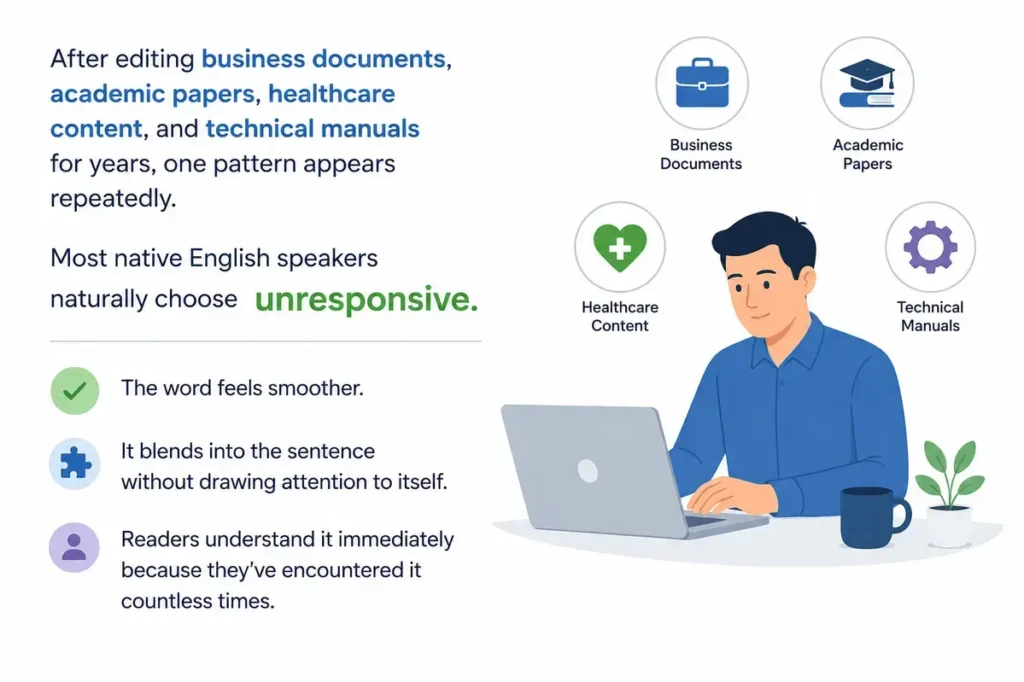
After editing business documents, academic papers, healthcare content, and technical manuals for years, one pattern appears repeatedly. Most native English speakers naturally choose unresponsive. The word feels smoother. It blends into the sentence without drawing attention to itself. Readers understand it immediately because they’ve encountered it countless times.
Nonresponsive has its own place. It often appears in professional writing where consistency matters more than conversational style. Medical teams, engineers, and researchers may continue using it because their industries have adopted the term over many years. Good editors don’t automatically replace one word with the other. They first consider the audience.
If the content targets everyday readers, unresponsive usually creates a better reading experience. If the document follows medical or technical standards, nonresponsive may fit the style more naturally. That small decision reflects an important principle of professional writing. The best word isn’t always the most formal one. It’s the word your audience understands instantly without stopping to think.
Examples In Sentences
Seeing words in context is one of the fastest ways to remember how they work. Both adjectives describe a lack of response, but the situations around them can influence which one sounds more natural.
Examples Using Nonresponsive
- The patient remained nonresponsive after several medical tests.
- Engineers discovered that the control panel became nonresponsive during the update.
- The software stayed nonresponsive until the system restarted.
- Researchers recorded a nonresponsive reaction throughout the experiment.
- The touchscreen became nonresponsive after water damaged the device.
- Several participants appeared nonresponsive to the treatment during the first phase.
- The sensor turned nonresponsive because of a wiring problem.
- Hospital staff monitored the nonresponsive patient throughout the night.
- The laboratory equipment became nonresponsive after the power surge.
- The application stayed nonresponsive until the latest patch was installed.
Examples Using Unresponsive
- The customer support team was unresponsive for several days.
- My phone became unresponsive after I downloaded the new update.
- The child was unresponsive when the teacher called his name.
- The website became unresponsive during heavy traffic.
- She sounded unresponsive during the meeting because she felt exhausted.
- The computer remained unresponsive until it restarted.
- The audience stayed unresponsive during the presentation.
- The manager apologized for the unresponsive service.
- His email account became unresponsive because of a server issue.
- The doctor confirmed that the patient was still unresponsive.
Common Mistakes
These two words look simple, but writers still make several common mistakes.
Mistaking One Word As Incorrect
Many people assume only one form is acceptable. That isn’t true. Both words are recognized by major dictionaries and appear in professional writing.
Assuming They Always Mean Different Things
Some writers spend too much time searching for a hidden difference. In most situations, there isn’t one. The meanings overlap almost completely.
Choosing A Word That Doesn’t Match The Audience
A technical report can comfortably use nonresponsive. A casual blog post or business email usually sounds more natural with unresponsive. Matching your audience matters more than choosing the more formal sounding word.
Confusing Them With Similar Words
People sometimes replace these adjectives with words that carry different meanings.
For example.
Inactive means not operating.
Silent means making no sound.
Unavailable means not accessible.
Ignoring means choosing not to respond.
Each describes a different situation.
Using Them As Verbs
Neither word functions as a verb.
Incorrect.
The device unresponsive after the update.
Correct.
The device became unresponsive after the update.
Incorrect.
The machine nonresponsive during testing.
Correct.
The machine became nonresponsive during testing.
Etymology And Word Origin
Learning where words come from often explains why they exist side by side.
Origin Of Responsive
Both words begin with responsive. Responsive entered English centuries ago through Latin roots connected to the idea of answering or replying. At its core, the word describes reacting to an action, question, signal, or stimulus.
How Nonresponsive Developed
The prefix non simply means not. English often creates precise adjectives by adding this prefix.
Examples include.
- Nonexistent.
- Nonverbal.
- Nonmedical.
- Nonessential.
Following this pattern, nonresponsive developed as a formal way to describe the absence of a response. The word became especially common in scientific writing, medicine, engineering, and government documents.
How Unresponsive Developed
The prefix un is one of the oldest negative prefixes in English.
It appears in thousands of everyday words.
Examples include.
- Unhappy.
- Unclear.
- Unfair.
- Unusual.
Because native speakers encounter this pattern constantly, unresponsive feels immediately familiar. Over time, it became the preferred choice in newspapers, books, conversations, business communication, and general writing.
Regional Usage
English changes slightly across countries, but these two words remain remarkably consistent.
American English
American English strongly favors unresponsive in everyday writing.
Medical professionals and technical writers still use nonresponsive in specialized documents.
British English
British English follows a similar pattern.
General publications usually prefer unresponsive.
Formal reports may include either term.
Australian English
Australian English also leans toward unresponsive for daily communication.
Professional industries continue using both depending on internal style guides.
Canadian English
Canadian English mirrors American and British usage. Readers commonly encounter unresponsive in newspapers, websites, education, and business writing. Technical documents frequently include nonresponsive. Across all four major English varieties, no regional rule declares one word correct and the other incorrect. The difference comes from style, audience, and professional preference rather than geography.
Real Life Usage Examples
These examples show how experienced writers naturally choose each word.
Daily Conversation
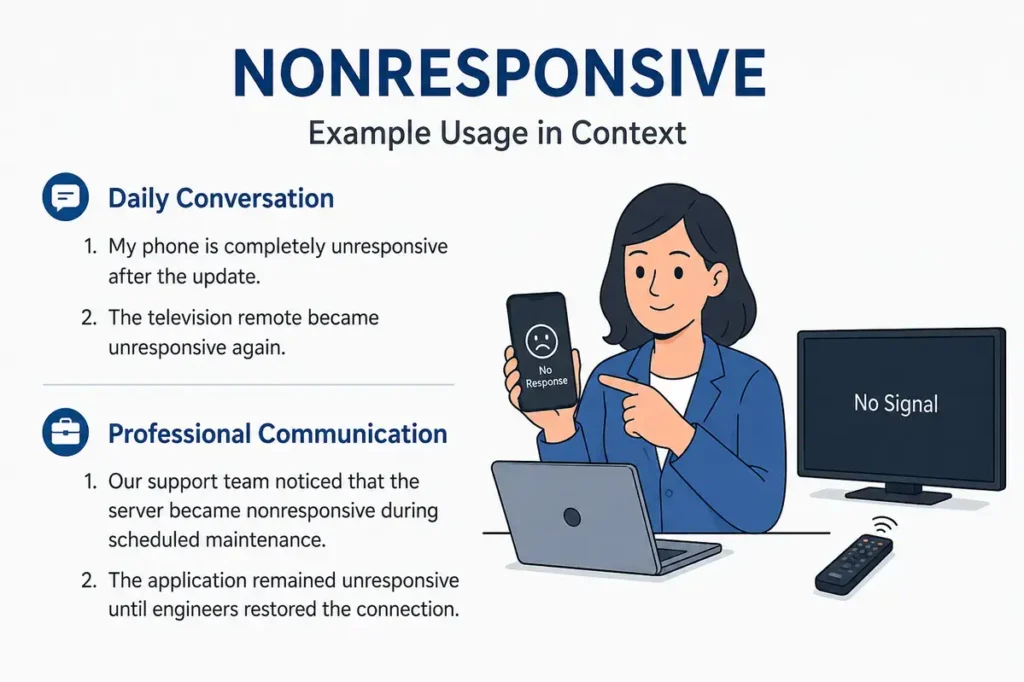
My phone is completely unresponsive after the update.
The television remote became unresponsive again.
Professional Communication
Our support team noticed that the server became nonresponsive during scheduled maintenance. The application remained unresponsive until engineers restored the connection.
Academic Writing
The study reported several participants who remained nonresponsive to the initial treatment. Researchers observed that the experimental device became nonresponsive after repeated testing.
Healthcare
Doctors described the patient as unresponsive when emergency crews arrived. Medical notes later recorded the patient as nonresponsive during neurological testing.
Literature
Novelists usually choose unresponsive because it sounds smoother in narrative writing.
For example.
The crowd stood unresponsive despite his emotional speech.
News And Media
Journalists generally favor unresponsive because it reads naturally and keeps stories easy to understand. A typical news report might read. Officials said the driver was unresponsive when first responders arrived.
Related Words And Commonly Confused Terms
Many words share similar meanings or appear in the same contexts. Understanding the differences helps you choose the most accurate word.
Related Terms
- Responsive.
- Reactive.
- Receptive.
- Active.
- Alert.
- Conscious.
- Inactive.
- Silent.
- Available.
- Reachable.
Commonly Confused Terms
Responsive
Able to react or answer quickly.
Reactive
Responding after something happens.
Inactive
Not operating or functioning.
Unconscious
Without awareness.
An unconscious person is usually unresponsive, but an unresponsive person is not always unconscious.
Silent
Producing no sound.
Silence does not automatically mean someone is unresponsive.
Ignoring
Choosing not to answer. Someone who ignores a message is making a decision. Someone described as unresponsive may be physically unable to respond. Understanding these distinctions makes your writing more precise and prevents accidental misuse.
Nonresponsive Vs Unresponsive In Everyday Writing
Professional editors rarely choose words based only on dictionary definitions. They think about readers first. If you’re writing for a broad audience, unresponsive is usually the better option. Most native speakers recognize it immediately because they see it in news articles, books, websites, emails, and conversations.
Nonresponsive isn’t wrong. It simply feels more technical. That’s one reason it appears more often in medical records, engineering reports, scientific research, and software documentation. Imagine reading these two sentences.
The customer service team was unresponsive.
The customer service team was nonresponsive.
Both are correct. Still, the first sentence sounds more natural to most readers. Now consider a medical report.
The patient remained nonresponsive throughout the examination.
In this setting, many healthcare professionals would accept that wording because it matches the style commonly used in clinical documentation. Good writing isn’t about choosing the fanciest word. It’s about choosing the one your audience understands without effort.

Professional Language Analysis
After reviewing thousands of articles, reports, business documents, and academic papers, one pattern becomes clear. Native speakers rarely stop to think about these two words. They choose the version they’ve seen most often. That’s why unresponsive appears more frequently in everyday English. It feels familiar and reads smoothly.
Editors also pay attention to consistency. If a medical journal uses nonresponsive throughout an article, changing only one occurrence to unresponsive can make the writing feel uneven. The opposite is also true. A blog post written for everyday readers becomes easier to read when it consistently uses unresponsive.
Another point experienced editors consider is tone. Technical writing values precision and consistency. General writing values clarity and readability. Neither approach is better. Each serves a different audience. The strongest writers understand this difference and adjust their language accordingly.
Need another quick comparison? Read Gait vs gate and the correct usage.
Conclusion
Both words are correct, and both describe the same basic idea. The difference isn’t about right or wrong. It’s about audience, tone, and context. For everyday communication, unresponsive is usually the stronger choice. It feels natural, appears more often in modern English, and helps your writing flow without distracting readers.
Nonresponsive continues to play an important role in medicine, science, engineering, and other technical fields where precise and consistent terminology matters. If you’re unsure which word to choose, think about who will read your writing. A general audience will usually expect unresponsive. A professional audience may be comfortable with either term, especially if industry standards favor nonresponsive.
Clear writing doesn’t depend on using the most formal word. It depends on choosing the word that communicates your message quickly and naturally.
Frequently Asked Questions
Is nonresponsive a real English word?
Yes. Nonresponsive is a correct English adjective. It appears in major dictionaries and is widely used in medicine, science, engineering, and technical writing. Although it is less common in everyday conversation, it remains a standard and accepted word.
Is unresponsive more common than nonresponsive?
Yes. Unresponsive appears much more often in newspapers, books, websites, business communication, and casual speech. Its familiar structure makes it the preferred choice for most general audiences.
Can I use both words interchangeably?
In many situations, yes. Both describe someone or something that does not respond. The biggest difference is style. Unresponsive sounds more natural in everyday English, while nonresponsive often fits formal or technical writing.
Which word do doctors usually use?
Doctors use both terms. Many hospitals, medical schools, and healthcare organizations have their own writing guidelines. Some prefer nonresponsive in clinical documentation, while others regularly use unresponsive. Both are accepted in modern medical English.
Is one word more formal than the other?
Nonresponsive often sounds slightly more formal because it appears frequently in technical and scientific writing. Unresponsive has a more neutral tone, making it suitable for both formal and informal communication.
Do British and American English use different forms?
Not significantly. Both varieties recognize and use each word. American, British, Canadian, and Australian English generally prefer unresponsive in everyday writing while accepting nonresponsive in professional contexts.
Can these words describe machines as well as people?
Yes. Both adjectives can describe computers, phones, software, websites, vehicles, equipment, and other systems that fail to react. They are not limited to describing people.
Which word should I use in everyday writing?
For most situations, choose unresponsive. It sounds more natural, reads more smoothly, and matches the expectations of most readers. Use nonresponsive when you’re writing for industries that commonly use that term or when following a specific style guide.