
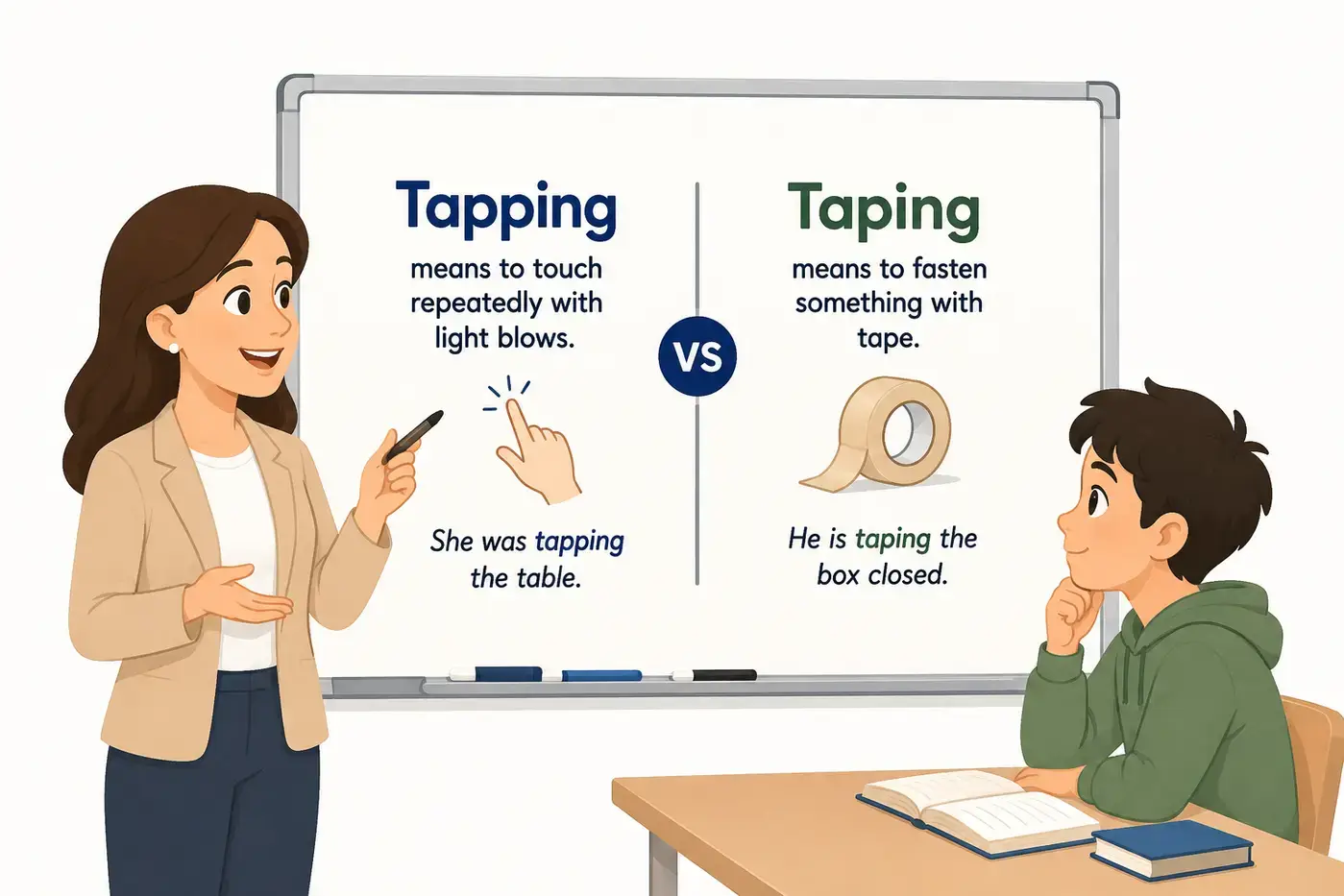
People often pause when typing tapping vs taping. The words look almost identical, yet they describe completely different actions. One refers to a repeated touch or light strike. The other means attaching something with adhesive tape or recording audio or video. A single missing letter changes the meaning completely.
This mix up usually happens because both words come from short verbs that end with a vowel followed by a consonant. English spelling rules also play a part. Many writers know that some verbs double the final consonant before adding ing, but they are not always sure when that rule applies.
If you’ve ever stopped to ask which spelling fits your sentence, you’re in the right place. This guide explains the meaning of each word, shows the grammar behind the spellings, compares their uses, and includes plenty of real examples. By the end, you’ll know exactly which form belongs in every situation and avoid one of the most common writing mistakes involving these two words.
Learn the difference in Home Made Or Homemade Which One Is Correct?(2026).
Featured Snippet
Tapping is the present participle of tap and usually means touching or striking something lightly again and again. Taping is the present participle of tape and means fastening something with adhesive tape or recording sound or video. The correct choice depends entirely on the action you want to describe.
Quick Answer
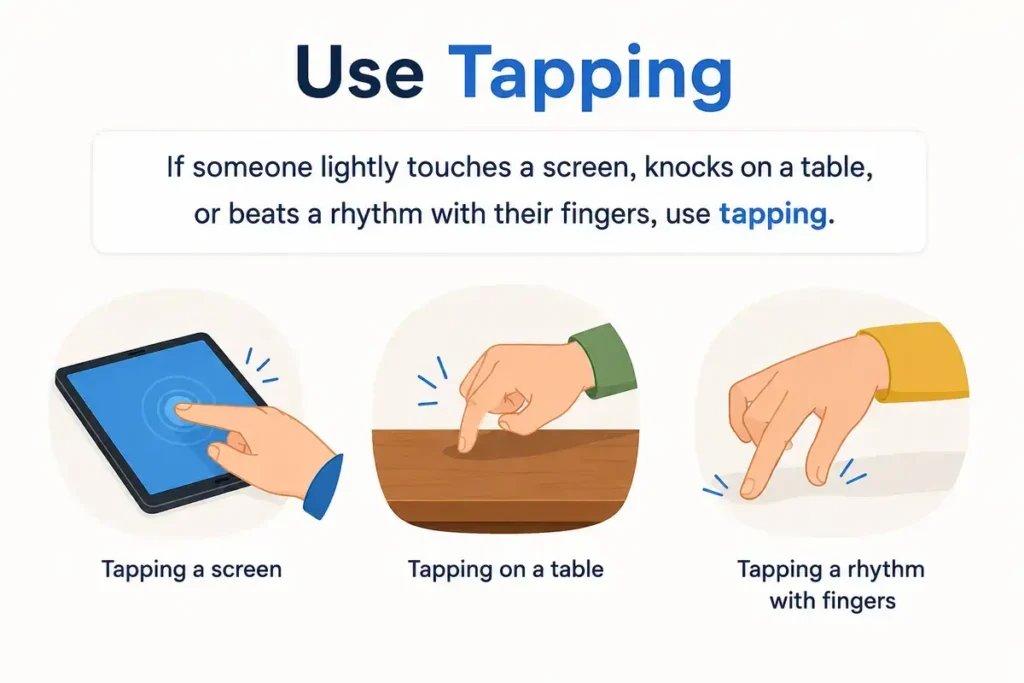
The correct word depends on your meaning. If someone lightly touches a screen, knocks on a table, or beats a rhythm with their fingers, use tapping. If someone seals a package with tape, wraps an injured ankle, or records a television program, use taping. Neither spelling is more correct than the other. They simply describe different actions.
Tapping Vs Taping Comparison
| Feature | Tapping | Taping |
|---|---|---|
| Base word | Tap | Tape |
| Meaning | Touching or striking lightly several times | Attaching with tape or recording audio or video |
| Part of speech | Present participle and gerund | Present participle and gerund |
| Main action | Repeated light contact | Using adhesive tape or making a recording |
| Grammar pattern | Final consonant doubles before adding ing | Silent E drops before adding ing |
| Origin | Old English roots connected with light striking | Derived from tape which entered English through Germanic and French influences |
| Formality | Standard in all writing | Standard in all writing |
| Common contexts | Technology music sports communication woodworking | Medical care packaging construction film television offices |
| Frequency | Very common | Very common |
| Example | She kept tapping the desk. | They were taping the interview. |
Meaning Of Each Word
Meaning Of Tapping
Tapping comes from the verb tap. It describes making light repeated contact with a person or object. The action is usually gentle and rhythmic rather than forceful.
You might tap a keyboard while writing an email. Someone can tap a friend on the shoulder to get attention. Rain can tap against a window throughout the night. A musician can tap a drumstick to keep time before a performance begins.
The word also appears in many technical fields. Engineers talk about tapping threads into metal. Doctors may mention tapping fluid during certain medical procedures. In finance and business, companies sometimes discuss tapping new markets or tapping available resources. The exact meaning changes with the context, yet the central idea remains the same. Something is being accessed or touched in a controlled way.
From an editor’s point of view, this word rarely causes confusion because of its meaning. Most mistakes happen during spelling rather than vocabulary.
Meaning Of Taping
Taping comes from the verb tape. It refers to using adhesive tape to fasten, secure, repair, protect, or mark something. It can also mean recording sound or moving images.
A teacher may tape student artwork to a classroom wall. A shipping clerk may tape a cardboard box before delivery. A physical therapist may tape an athlete’s ankle for additional support during practice.
The recording meaning became especially common during the twentieth century. People once talked about taping television shows on videocassette recorders. Today, professionals still refer to taping interviews, podcasts, documentaries, and live performances, even though digital recording has replaced magnetic tape in many situations.
Editors pay close attention to context here. If the sentence involves adhesive material or recording equipment, taping is almost always the correct choice.
Understanding The Spelling Difference
At first glance, these words seem inconsistent. In reality, each follows a standard English spelling rule.
Why Tap Becomes Tapping
The verb tap ends with one vowel followed by one consonant. English normally doubles the final consonant before adding ing.
Examples include.
- Tap becomes tapping.
- Pat becomes patting.
- Stop becomes stopping.
- Hug becomes hugging.
- Plan becomes planning.
This doubling keeps the pronunciation short and clear. Without the extra letter, the vowel might suggest a different sound.
Why Tape Becomes Taping
The verb tape ends with a silent E. English normally removes that silent E before adding ing.
Examples include.
- Tape becomes taping.
- Move becomes moving.
- Bake becomes baking.
- Save becomes saving.
- Smile becomes smiling.
This pattern appears in thousands of everyday English words. Once you recognize it, the spelling becomes much easier to remember.
Which One Is Correct
The answer is simple.
Both words are correct.
The right choice depends entirely on the action described in your sentence. Use the form based on tap when someone lightly touches, knocks, presses, or strikes something. Use the form based on tape when someone applies adhesive tape or records audio or video. Professional editors never choose between these words based on preference. They choose based on meaning. Context always comes first.
Key Differences
Although these words differ by only one letter, they belong in different situations.
Meaning
One describes repeated light contact. The other describes attaching with tape or making a recording.
Grammar
One follows the consonant doubling rule. The other follows the silent E removal rule.
Usage
One commonly appears in conversations about technology, music, sports, communication, and everyday movement. The other appears in discussions about repairs, shipping, healthcare, photography, filmmaking, broadcasting, and office work.
Tone
Neither word is more formal than the other. Both appear naturally in casual conversations, journalism, academic writing, technical manuals, and professional communication.
Reader Expectations
Native English speakers usually recognize the intended meaning instantly because the surrounding words provide enough context. Editors still check carefully because a single spelling mistake can completely change the sentence.
Expert Language Insight
After reviewing thousands of documents, one pattern appears repeatedly. Writers rarely confuse the meanings of these words. Instead, they accidentally apply the wrong spelling rule.
Many people know that English sometimes doubles the final consonant before adding ing. They simply extend that rule too far and write tape as though it followed the same pattern as tap. Others make the opposite mistake by removing letters from words that should keep the doubled consonant.
Experienced editors do not memorize every individual word. They recognize spelling patterns. Once you understand the two grammar rules involved, this pair becomes surprisingly easy to use.
In professional editing, context always settles the question. Read the sentence naturally. If you picture a finger touching a surface, choose the form based on tap. If you picture adhesive material or recording equipment, choose the form based on tape. That simple habit prevents almost every mistake.
Examples In Sentences
Reading complete sentences is one of the fastest ways to remember the difference. Instead of memorizing rules alone, notice how each word fits naturally into everyday writing.
Examples Using Tapping
- She sat quietly tapping her pencil while waiting for the meeting to begin.
- The child kept tapping on the window during the rainstorm.
- He was tapping the keyboard so quickly that nobody could keep up.
- Someone started tapping on the hotel room door late at night.
- The drummer spent several minutes tapping a steady rhythm before the concert.
- I heard someone tapping my shoulder from behind.
- The customer was tapping the payment terminal to complete the purchase.
- The woodpecker spent the morning tapping against the tree.
- She smiled while tapping her foot to the music.
- The engineer explained that tapping the pipe helped locate the blockage.
Examples Using Taping
- The nurse was taping the bandage securely around the patient’s arm.
- They spent the afternoon taping the interview for the documentary.
- Dad finished taping the moving boxes before loading the truck.
- The coach was taping the player’s ankle before practice.
- She started taping the decorations to the classroom wall.
- The production crew was taping the television show in front of a live audience.
- He carefully finished taping the broken package before shipping it.
- The technician was taping the loose cable to prevent accidents.
- We spent the morning taping a training video for new employees.
- The artist kept taping reference sketches to the studio wall.
Need another quick comparison? Read Grate or Great Which Word Is Correct.
Common Mistakes
Even experienced writers occasionally confuse these words because they look similar. Most mistakes happen during fast typing instead of a lack of vocabulary.
Confusing The Two Meanings
Some writers accidentally use the recording word when describing a physical touch.
Incorrect.
She was taping her fingers on the desk.
Correct.
She was tapping her fingers on the desk.
The action involves repeated light contact, not adhesive tape or recording.
Applying The Wrong Spelling Rule
English has several spelling patterns, and people sometimes mix them together.
Incorrect.
He is tapeing the package.
Correct.
He is taping the package.
The silent E disappears before adding ing.
Forgetting To Double The Final Consonant
This mistake appears often among English learners.
Incorrect.
She is taping her fingers on the table.
Correct.
She is tapping her fingers on the table.
The verb tap follows the consonant doubling rule.
Depending Only On Sound
Both words begin with nearly the same pronunciation. Listening alone will not always help. The surrounding words tell you which meaning fits.
Ignoring Context
Professional editors rarely examine a word by itself. They read the complete sentence first.
Ask yourself one simple question.
Is someone lightly touching something?
Or is someone using adhesive tape or recording something?
The answer usually appears immediately.
Pronunciation Guide
Although the spellings differ, the first syllable sounds almost identical. The ending changes because the base words are different.
Tapping
IPA.
/ˈtæpɪŋ/
Syllable breakdown.
Tap.
Ping.
Stress.
The first syllable receives the stress.
Taping
IPA.
/ˈteɪpɪŋ/
Syllable breakdown.
Tape.
Ing.
Stress.
The first syllable receives the stress.
Common Pronunciation Mistakes
- Some learners pronounce tap and tape exactly the same. They are different vowel sounds.
- Others pronounce the silent E at the end of tape. The letter is never spoken.
- Some speakers shorten the vowel in tape, making it sound like tap. Native speakers clearly distinguish the two sounds.
Reading both words aloud helps train your ear. Once you hear the vowel difference, choosing the correct spelling becomes much easier.
Etymology And Word Origin
Word origins often explain modern spelling patterns better than grammar rules alone.
Origin Of Tap
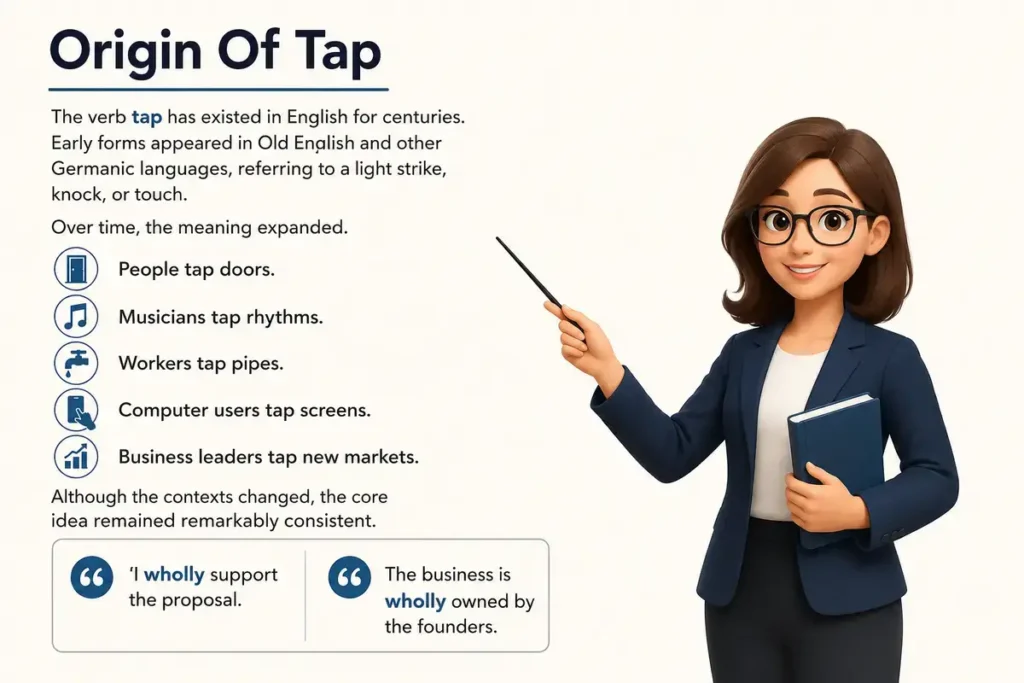
The verb tap has existed in English for centuries. Early forms appeared in Old English and other Germanic languages, referring to a light strike, knock, or touch.
Over time, the meaning expanded.
People tap doors.
Musicians tap rhythms.
Workers tap pipes.
Computer users tap screens.
Business leaders tap new markets.
Although the contexts changed, the core idea remained remarkably consistent.
Origin Of Tape
The noun tape entered English much later. It referred to narrow strips of woven material used for binding or decorating clothing. As new materials appeared, the meaning expanded to include adhesive tape.
During the twentieth century, magnetic recording tape transformed broadcasting, filmmaking, and home entertainment. That development introduced another meaning of the verb tape, which came to mean recording audio or video.
Even though modern recordings are usually digital, people still say they are taping a program or an interview. The older expression survived because language often keeps familiar words long after technology changes.
Regional Usage
One advantage of these words is their consistency. English speaking countries use the same spellings and nearly identical meanings.
American English
American English uses both words exactly as described. People talk about tapping a phone screen. They also talk about taping a package or taping a television interview.
British English
British English follows the same spelling conventions. The only noticeable differences usually involve surrounding vocabulary rather than these verbs themselves.
Australian English
Australian English also keeps the same spellings. Writers naturally use both words according to their meanings without regional spelling changes.
Canadian English
Canadian English follows the same standard. This consistency makes the pair easier than many other English spelling questions. You do not need to learn different regional versions.
Grammar Rules
Understanding the grammar behind these verbs removes most spelling uncertainty.
Parts Of Speech
Both words can function as present participles.
Example.
She is tapping the desk.
They are taping the interview.
Both words can also function as gerunds.
Example.
Tapping helps improve rhythm.
Taping prevents the box from opening.
Verb Tenses
These forms appear most often in continuous tenses.
Present continuous.
She is tapping her fingers.
Past continuous.
They were taping the ceremony.
Future continuous.
We will be tapping the screen again tomorrow.
They will be taping another episode next week.
Plural Forms
Neither word has a plural because they are verb forms.
The related nouns do.
Tap becomes taps.
Tape becomes tapes.
Sentence Structure
Both verbs follow standard English sentence patterns.
Subject plus helping verb plus present participle.
She is tapping.
They were taping.
The grammar stays simple. The challenge comes from selecting the correct base verb.
Real Life Usage Examples
Seeing these words in everyday situations makes the distinction easier to remember.
Daily Conversation
Someone waiting impatiently may start tapping a foot on the floor. A parent might spend a few minutes taping a torn birthday card before giving it to a child.
Academic Writing
Researchers sometimes describe participants tapping buttons during laboratory experiments. Teachers may discuss taping classroom presentations for later review.
Professional Communication
Office workers often mention tapping an access card against a reader to enter the building. Shipping departments regularly write about taping cartons before delivery.
Literature
Novelists use the first word to create atmosphere. A character tapping on a window instantly creates suspense or anticipation. The second word appears naturally in scenes involving repairs, preparation, filmmaking, or medical care.
Media
Journalists describe audiences tapping screens to vote in live competitions. Entertainment reporters frequently mention television crews taping interviews before broadcast. These real situations show that both words remain active in modern English. The difference depends entirely on the action taking place.
Related Words And Confused Terms
English contains many word pairs that look similar but serve completely different purposes. Learning these alongside this topic strengthens your vocabulary and helps you spot patterns more quickly.
Related To Tap
- Tap.
- Tapper.
- Tapped.
- Taps.
- Tappable.
- Touch.
- Knock.
- Strike.
- Drum.
- Pat.
These words usually describe light contact, repeated movement, or gentle impact.
Related To Tape
- Tape.
- Taped.
- Tapes.
- Taper.
- Adhesive.
- Bandage.
- Recording.
- Film.
- Video.
- Wrap.
These words commonly appear in discussions about fastening, recording, broadcasting, healthcare, and packaging.
Commonly Confused Word Pairs
- Affect and Effect.
- Accept and Except.
- Advice and Advise.
- Stationary and Stationery.
- Principal and Principle.
- Lose and Loose.
- Complement and Compliment.
- Desert and Dessert.
- Than and Then.
- Its and It’s.
Each pair demonstrates the same lesson. A small spelling difference can completely change the meaning of a sentence.
Editor’s Perspective
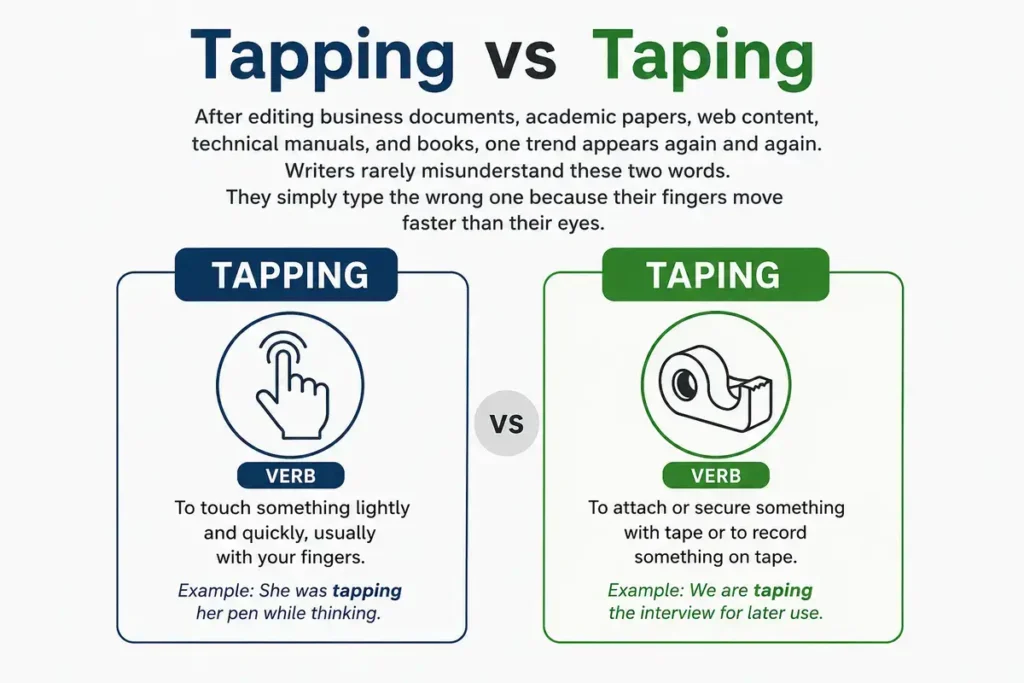
After editing business documents, academic papers, web content, technical manuals, and books, one trend appears again and again. Writers rarely misunderstand these two words. They simply type the wrong one because their fingers move faster than their eyes.
Spell checkers do not always catch the mistake because both forms are legitimate English words. The software checks spelling, not meaning. Professional editors rely on context instead of spelling alone. When reviewing a sentence, they picture the action. If someone is lightly touching a surface, the answer becomes obvious.
If someone is sealing a package, supporting an injured joint, or recording a conversation, the other word fits naturally. That habit takes only a second, yet it prevents an error that automated tools often miss. Native speakers use the same approach without thinking about it. They learned the meanings through years of reading and conversation instead of memorizing grammar rules. As you read more English, choosing the correct form becomes automatic.
Learn the difference in Channel Vs Chanel Which One Is Correct? (2026).
Conclusion
At first glance, these two words seem close enough to confuse almost anyone. In reality, they follow different spelling rules because they come from different base verbs and describe different actions.
One describes light repeated contact like touching a screen, knocking on a door, or keeping a rhythm with your fingers. The other describes fastening something with adhesive tape or recording sound and video.
The easiest way to choose the right form is to picture the action before you write. That single habit works better than trying to memorize isolated spelling rules. Once you understand the consonant doubling rule and the silent E rule, this pair becomes easy to recognize. After a little practice, you’ll choose the correct word naturally every time.
Frequently Asked Questions
Is one spelling more correct than the other?
No. Both spellings are correct English words. The correct choice depends on the action described. One refers to light repeated contact. The other refers to using adhesive tape or recording audio or video.
Why does one word double the final letter?
The base verb ends with one vowel followed by one consonant. English normally doubles the final consonant before adding ing. This keeps the pronunciation consistent.
Why does the other word lose the final E?
English usually drops a silent E before adding ing. The pronunciation stays the same even though the final letter disappears.
Can both words appear in formal writing?
Yes. Both forms are standard English and appear in academic writing, journalism, technical manuals, legal documents, medical writing, and professional communication.
Do British and American English spell these words differently?
No. American English, British English, Australian English, and Canadian English all use the same spellings and meanings. This makes them easier than many other English spelling questions.
Can grammar checkers detect every mistake?
Not always. Grammar tools may miss the error because both words are correctly spelled. Reading the complete sentence remains the best way to catch a meaning mistake.
How can I remember the difference quickly?
Think about the action. Light touch means the verb comes from tap. Adhesive material or recording means the verb comes from tape. The surrounding words usually make the answer obvious.
Are these words common in modern English?
Yes. Both remain common in everyday conversation, education, business, healthcare, technology, sports, entertainment, and journalism. Digital technology has changed how people record media, but the recording meaning continues to be widely used.