
If you’ve searched for sentence or sentance you’re probably trying to figure out which spelling is correct. The good news is that the answer is simple. Sentence is the correct spelling. Sentance is a common misspelling that does not exist as a standard English word. This mistake happens because many English words end with the sound ance. Words like entrance performance and acceptance can make people assume that sentence follows the same pattern. It does not. English spelling often has exceptions and this is one of them.
Another reason for the confusion is pronunciation. In everyday speech the second syllable is soft. That makes it difficult for some learners to hear the difference between ence and ance. As a result they write sentance even though dictionaries and style guides recognize only sentence.
In this guide you’ll learn the correct spelling the meaning of the word its pronunciation origin grammar rules real life examples and the differences between sentence and sentance. By the end you’ll know exactly which form to use and how to avoid this common spelling mistake in your writing.
You may also want to read Tapping Vs Taping Which Word Should You Use in 2026?.
Quick Definition
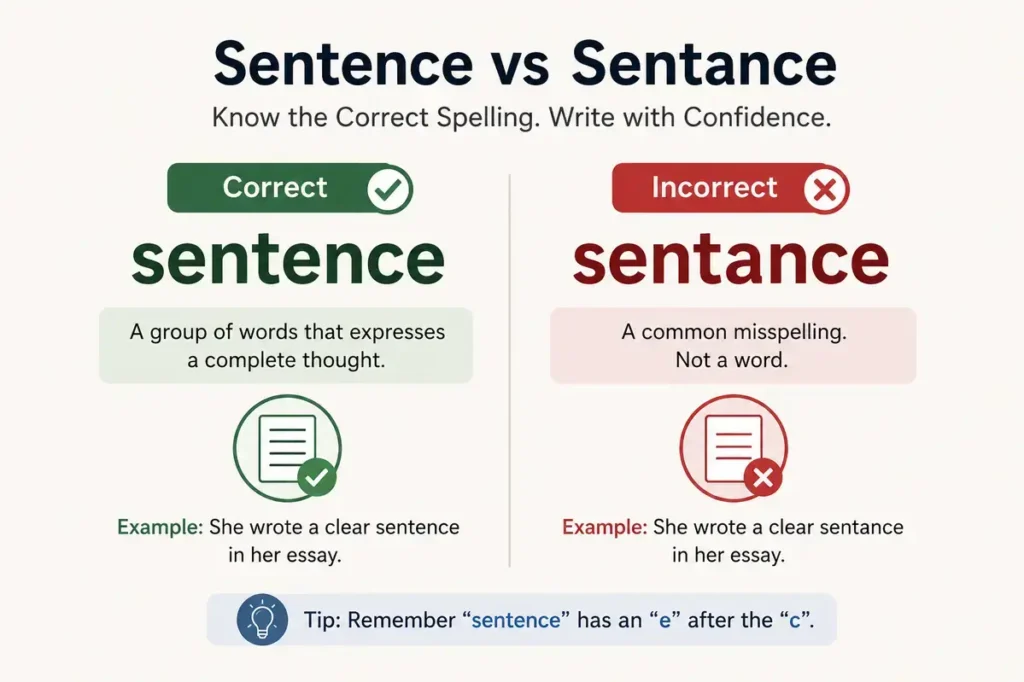
Sentence is the correct English spelling. It refers to a group of words that expresses a complete thought in grammar or a punishment given by a court in law. Sentance is simply a misspelling and should never be used in formal or informal writing.
Sentence Or Sentance Quick Answer
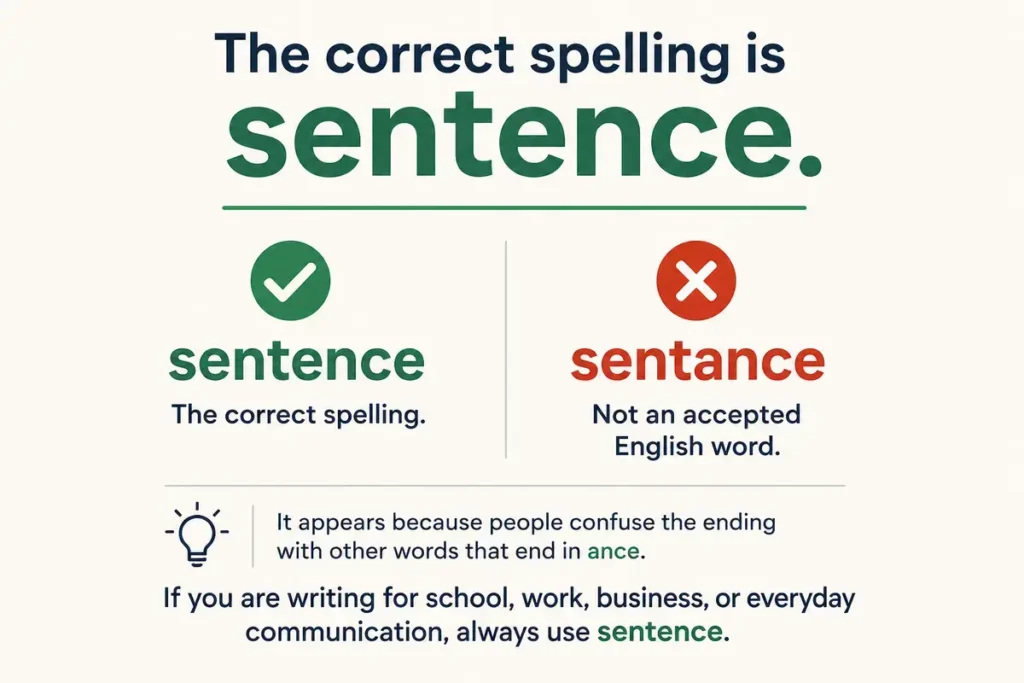
The correct spelling is sentence. Sentance is not an accepted English word. It appears because people confuse the ending with other words that end in ance. If you are writing for school work business or everyday communication always use sentence.
Sentence vs Sentance Comparison Table
| Feature | Sentence | Sentance |
|---|---|---|
| Correct spelling | ✅ Yes | ❌ No |
| Dictionary entry | ✅ Yes | ❌ No |
| Part of speech | Noun; also a verb in limited legal use | Not an English word |
| Meaning | A complete grammatical thought or, in law, a judicial punishment | None |
| Origin | From Latin sententia through Old French | Misspelling of sentence |
| Usage frequency | Extremely common in everyday and formal English | Incorrect spelling |
| Formal writing | Always acceptable | Never acceptable |
| Informal writing | Correct | Still incorrect |
| Seen in | Books, schools, media, legal documents, academic writing, and everyday communication | Typing mistakes, spelling errors, and search queries |
| Example | This sentence is easy to understand. | ❌ This sentance is easy to understand. |
Meaning Of Sentence
The word sentence has two main meanings in English. The intended meaning depends on the context.
Sentence In Grammar
In grammar a sentence is a group of words that expresses a complete thought. It normally contains a subject and a verb. Most sentences also end with a period a question mark or an exclamation point.
Examples.
- The baby is sleeping.
- We enjoyed the movie.
- Can you help me?
Every complete sentence communicates one clear idea.
Sentence In Law
In legal English a sentence is the punishment that a judge gives to someone who has been found guilty of a crime.
Examples.
- The judge handed down a five year sentence.
- She received a lighter sentence after the appeal.
- The court announced the sentence this morning.
Although the meanings are different both are widely accepted and commonly used.
Etymology Of Sentence
The word sentence comes from the Latin word sententia meaning opinion judgment or feeling. It entered English through Old French and gradually developed two common meanings. One relates to language and the other to legal judgment. Today both meanings remain active in modern English.
Meaning Of Sentance
The answer is simple. Sentance is not a real English word. It has no accepted definition in standard American English British English Canadian English or Australian English. When people write sentance they almost always mean sentence. Spell checkers dictionaries editors and grammar tools automatically identify sentance as an error.
Why People Write Sentance
Several factors lead to this mistake.
- The ending sounds similar to many English words ending in ance.
- Fast typing can cause spelling errors.
- English learners sometimes guess the spelling based on pronunciation.
- People memorize the sound instead of the correct spelling.
The mistake is understandable but it should always be corrected before publishing or submitting written work.
Sentence Or Sentance Key Differences
Although these two spellings look similar only one belongs in standard English.
Spelling
Sentence is the correct spelling.
Sentance is incorrect.
Meaning
Sentence has two accepted meanings.
- A complete grammatical statement.
- A legal punishment ordered by a court.
Sentance has no recognized meaning.
Grammar
Sentence functions mainly as a noun.
In legal contexts it can also appear as a verb.
Example.
The judge sentenced the defendant yesterday. Notice that the verb is sentenced not sentanced.
Dictionary Status
Every major English dictionary includes sentence. No standard dictionary recognizes sentance as a correct spelling.
Professional Writing
Teachers editors journalists publishers and professional writers always use sentence. Using sentance may reduce your credibility because readers immediately recognize it as a spelling mistake.
Which One Is Correct
The answer is clear. Sentence is the only correct spelling. Use it every time you write about grammar writing language education or legal punishment. Never use sentance because it is simply a spelling error.
If you are proofreading your work pay close attention to this word. Spell check software usually catches the mistake but it is still worth checking before you submit an assignment send an email or publish an article.
A simple memory trick can help. Think of sentence ending with ence just like presence and existence. Avoid connecting it with words ending in ance because it does not follow that spelling pattern.
Examples In Sentences
Sentence Examples
- Every sentence should express one complete thought.
- She wrote a short sentence on the whiteboard.
- This sentence contains a subject and a verb.
- My teacher asked us to improve each sentence in the paragraph.
- The final sentence summarizes the entire article.
- Please read the first sentence aloud.
- A clear sentence makes writing easier to understand.
- He corrected every sentence before submitting the report.
- This sentence uses proper punctuation.
- The editor rewrote the sentence to improve clarity.
Sentance Examples
The following examples show common mistakes that should be avoided.
- I wrote this sentance yesterday. ❌
- This sentance is too long. ❌
- Please correct the sentance. ❌
- The first sentance has a spelling error. ❌
- She copied the sentance from the book. ❌
- Every sentance needs a verb. ❌
- That sentance sounds confusing. ❌
- He underlined each sentance in red. ❌
- Your sentance needs better punctuation. ❌
- The sentance contains two spelling mistakes. ❌
Each incorrect example should replace sentance with sentence.
Still confused? Compare onsite vs on-site: Correct Usage Explained.
Common Mistakes
The confusion between sentence and sentance is one of the most common spelling mistakes in English. It appears in school assignments emails social media posts and even professional documents. The mistake is easy to make but also easy to fix once you know the correct spelling.
Writing Sentance Instead Of Sentence
This is the most frequent mistake.
Incorrect.
Please write one sentance about your weekend.
Correct.
Please write one sentence about your weekend. The spelling sentance is never correct in standard English.
Trusting Pronunciation Instead Of Spelling
Many people spell words the way they hear them. Since sentence has a soft second syllable some writers assume it ends with ance. English pronunciation does not always match spelling. That is why reading and writing regularly helps reinforce the correct form.
Missing The Legal Meaning
Some learners think sentence only belongs in grammar lessons. In fact the word has another common meaning in law. A judge gives a sentence after someone is found guilty of a crime. Understanding both meanings helps you use the word confidently in different situations.
Confusing Sentence With Similar Words
Words like these can lead to spelling mistakes because they look and sound similar.
- Presence.
- Absence.
- Distance.
- Entrance.
- Acceptance.
Each word has its own spelling pattern. Memorizing one does not guarantee the spelling of another.
Ignoring Spell Check Warnings
Modern writing tools usually underline sentance because it is not a recognized English word. Even so it is a good habit to proofread your work instead of relying completely on software.
Sentence Or Sentance Pronunciation Guide
Pronunciation is another reason people confuse these spellings.
Sentence
IPA
American English.
/ˈsen.təns/
British English.
/ˈsen.təns/
Syllable Breakdown
Sen.
Tence.
The stress falls on the first syllable.
It sounds similar to.
SEN tence
The second syllable is softer and shorter than the first.
Common Pronunciation Mistakes
- Stressing the second syllable instead of the first.
- Assuming the ending sounds exactly like words ending in ance.
- Speaking too quickly and dropping the middle sound.
Listening to native speakers can help you develop a more natural pronunciation.
Sentance
There is no official pronunciation because sentance is not a real English word. If someone pronounces it they are almost always trying to say sentence.
Etymology And Word Origin
Understanding where a word comes from often makes it easier to remember the correct spelling.
Origin Of Sentence
The word sentence comes from the Latin word sententia. Its original meaning included opinion judgment decision and way of thinking. Later it entered Old French as sentence before becoming part of Middle English. Over time the word developed two major meanings.
- A complete statement in grammar.
- A judicial decision in law.
Both meanings grew from the original idea of expressing a judgment or complete thought.
Evolution Through English
English writers have used sentence for hundreds of years. Early legal documents used it to describe judicial decisions. At the same time scholars and teachers used it to describe complete units of written language. Despite many spelling changes in English this word has remained remarkably consistent.
Origin Of Sentance
Unlike sentence the spelling sentance has no historical origin. It did not evolve from Latin Old French or Middle English. Instead it developed as a simple spelling mistake caused by pronunciation and confusion with other English words. That is why dictionaries do not recognize it.
Regional Usage
One helpful fact is that this spelling does not change across English speaking countries.
American English
Americans always write sentence. The spelling appears in schools universities newspapers books legal documents and business communication.
British English
British English follows exactly the same spelling. No respected British dictionary accepts sentance.
Canadian English
Canadian English also uses sentence in every context. Students learn this spelling from the earliest grammar lessons.
Australian English
Australian English follows the same standard. The spelling never changes.
Regional Preference
Unlike words such as color and colour or center and centre this word has only one accepted spelling worldwide. That makes it easier to remember. No matter where English is spoken the correct form is always sentence.
Grammar Rules
Knowing how sentence works in grammar helps you avoid mistakes beyond spelling.
Parts Of Speech
The word sentence is mainly a noun.
Examples.
This sentence is easy to understand.
That sentence needs better punctuation.
It can also function as a verb in legal writing.
Example.
The judge sentenced the defendant yesterday.
Notice the verb is sentenced.
It never becomes sentanced.
Plural Form
Singular.
Sentence.
Plural.
Sentences.
Examples.
The paragraph contains three sentences.
Every sentence has a clear purpose.
Types Of Sentences
English grammar recognizes four main sentence types.
- Declarative sentence.
Makes a statement.
Example.
The meeting starts at nine.
- Interrogative sentence.
Asks a question.
Example.
Are you ready?
- Imperative sentence.
Gives a command or instruction.
Example.
Close the window.
- Exclamatory sentence.
Shows strong emotion.
Example.
What a beautiful day! Understanding these types improves both writing and reading skills.
Sentence Structure
A complete sentence usually includes.
- A subject.
- A verb.
- A complete thought.
Example.
The dog barked loudly. This sentence contains everything needed to communicate a complete idea. Fragments and run on sentences should be corrected because they make writing harder to understand.
Real Life Usage Examples
Seeing sentence in different situations helps reinforce its meaning.
Daily Conversation
People often say.
Can you use that word in a sentence? That sentence made me laugh. I forgot the last sentence you said.
Academic Writing
Teachers frequently ask students to write complete sentences. Grammar books explain sentence structure punctuation and capitalization. Writing assignments often focus on improving sentence clarity and variety.
Professional Communication
Business emails reports and presentations rely on clear sentences. Short direct sentences usually improve readability and reduce misunderstandings. Editors often revise long sentences to make them easier to follow.
Literature
Authors carefully shape every sentence to match the mood pace and voice of a story. Some novels use long flowing sentences while others rely on short powerful ones. Sentence length can influence suspense emotion and rhythm.
Media
Journalists use concise sentences to report facts clearly. Headlines may be short but news articles depend on complete sentences to explain events accurately. Television scripts podcasts and online articles all rely on well written sentences that readers and listeners can understand quickly.
Related Words And Confused Terms
People who search for sentence or sentance often have questions about similar words. Some are related to grammar while others are common spelling mistakes. Learning the difference helps you write with more confidence.
Grammar Related Terms
- Clause.
- Phrase.
- Subject.
- Predicate.
- Verb.
- Noun.
- Adjective.
- Adverb.
- Paragraph.
- Punctuation.
These terms work together to build clear and complete writing.
Commonly Confused Spellings
- Sentence and sentance.
- Separate and seperate.
- Grammar and grammer.
- Receive and recieve.
- Necessary and neccessary.
- Definitely and definately.
- Business and buisness.
- Believe and beleive.
- Occasion and occassion.
- Writing and writting.
Many of these mistakes happen because English spelling does not always match pronunciation.
Words Related To Sentence
- Statement.
- Expression.
- Remark.
- Declaration.
- Question.
- Command.
- Exclamation.
- Utterance.
- Proposition.
- Assertion.
Each word has a slightly different meaning, but all relate to spoken or written communication.
Expert Language Insight
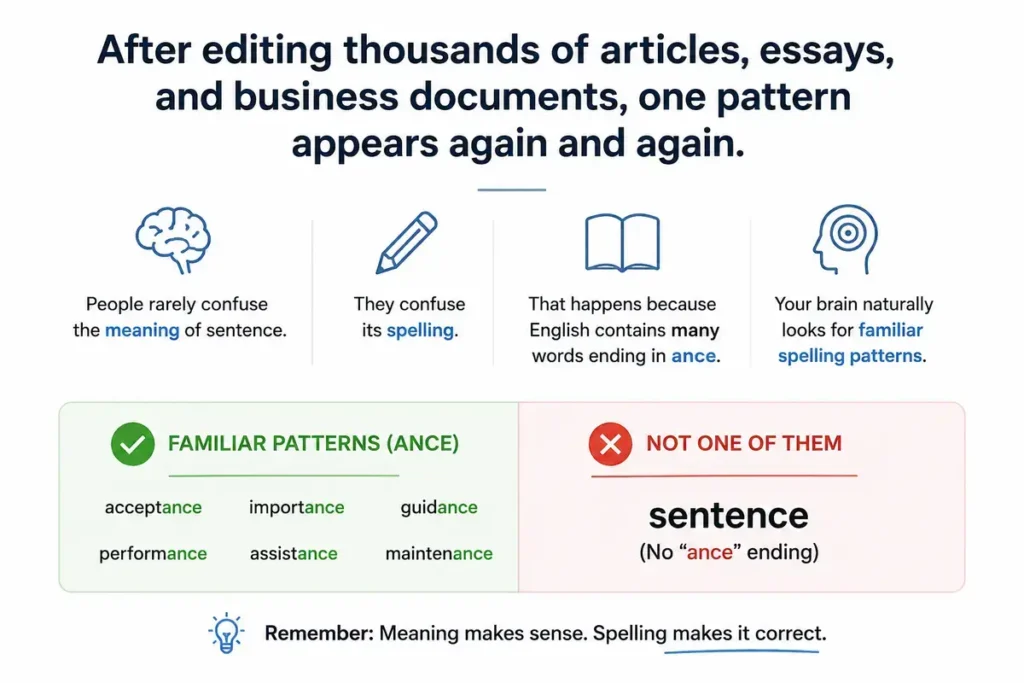
After editing thousands of articles, essays, and business documents, one pattern appears again and again. People rarely confuse the meaning of sentence. They confuse its spelling. That happens because English contains many words ending in ance. Your brain naturally looks for familiar spelling patterns. Unfortunately, sentence is not one of them.
Professional editors almost never see sentance in published writing because proofreading catches it early. Students, new writers, and even experienced professionals sometimes type it by accident, especially when writing quickly.
One habit can eliminate this mistake almost completely. Read your work aloud after you finish writing. When you slow down and review each sentence, spelling errors become much easier to spot. Reading aloud also helps you catch awkward wording, repeated words, missing punctuation, and incomplete thoughts. Another useful habit is to think about the word family.
Sentence.
Sentences.
Sentenced.
Sentencing.
Every form keeps the same root spelling. There is never an a after the first t. Native English speakers do not memorize every spelling rule. They become familiar with correct spellings through reading. The more quality English you read, the more natural the correct form becomes.
If you remember only one thing from this guide, make it this.
Sentence is always correct.
Sentance is always a spelling mistake.
For another common grammar confusion, see Wether or Whether Which Spelling Is Correct.
Conclusion
The answer is simple.
When comparing sentence or sentance, only sentence is correct. It is the standard spelling recognized by dictionaries, teachers, editors, publishers, and professional writers around the world. The word has two accepted meanings. It can describe a complete grammatical thought or a legal punishment ordered by a court.
Sentance has no meaning in standard English. It appears only as a spelling mistake, usually because people rely on pronunciation instead of the correct spelling. A quick proofreading habit can save you from making this error. If you are unsure, remember that every form of the word keeps the same spelling.
Sentence.
Sentences.
Sentenced.
Sentencing.
Once that pattern becomes familiar, choosing the correct spelling feels natural. Using sentence every time will make your writing clearer, more professional, and more credible.
Frequently Asked Questions
Is sentence or sentance correct?
Sentence is the correct spelling. Sentance is a common misspelling and is not recognized by standard English dictionaries. Use sentence in every type of writing, including school assignments, emails, reports, articles, and everyday communication.
Why do people spell sentence as sentance?
The mistake usually comes from pronunciation and confusion with words ending in ance. Since the second syllable sounds soft, many writers guess the spelling instead of remembering the correct form. Regular reading and proofreading help prevent this error.
Is sentance a real word?
No. Sentance is not a real English word. It does not appear in standard dictionaries and should never be used in formal or informal writing. Every time you write sentance, replace it with sentence.
What is the meaning of sentence?
A sentence has two accepted meanings. In grammar, it is a group of words that expresses a complete thought. In law, it refers to the punishment a judge gives after someone is convicted of a crime.
How do you pronounce sentence?
In American English, sentence is pronounced /ˈsen.təns/. It has two syllables, and the first syllable receives the stress. The pronunciation stays almost the same across major English speaking countries.
Can sentence be used as a verb?
Yes. In legal English, sentence can be used as a verb. For example, The judge sentenced the defendant to five years in prison. Outside legal contexts, it is most commonly used as a noun.
Is the spelling different in British English?
No. American English, British English, Canadian English, and Australian English all use the same spelling. Sentence is correct everywhere. Sentance is incorrect everywhere.
How can I remember the correct spelling?
A simple trick is to read and write the word regularly. You can also remember that every form of the word keeps the same spelling.
Sentence.
Sentences.
Sentenced.
Sentencing.
None of these forms contain sentance.