
Touchbase or touch base is a surprisingly common search because many people see both versions in emails, Slack messages, meeting notes, and business conversations. One version is standard English, while the other is usually considered a spelling mistake. The short answer is simple. Touch base is the correct form in modern English when used as a verb phrase meaning to make contact, check in, or briefly communicate with someone. The single word touchbase is far less common and generally not preferred in professional writing.
The confusion exists because English often turns two word phrases into one word over time. Think of login versus log in or setup versus set up. Many writers assume touch base has gone through the same change, but most dictionaries and style guides still treat touch base as the standard form.
In this guide, you will learn the correct spelling, grammar rules, pronunciation, real world usage, regional differences, common mistakes, and the subtle situations where touchbase occasionally appears.
Quick Definition
Google featured snippet ready. Touch base is the correct and widely accepted form. It is a verb phrase that means to contact someone briefly, check in, or reconnect for an update. Touchbase as one word is uncommon and usually considered nonstandard in professional and academic writing.
Touchbase or Touch Base Quick Answer
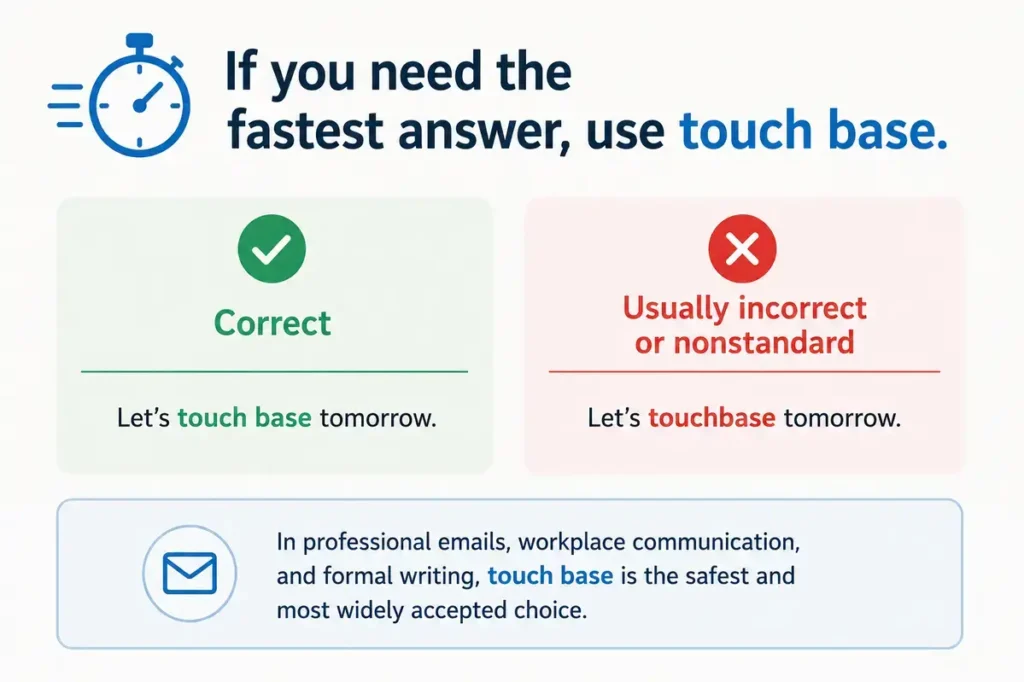
If you need the fastest answer, use touch base. Correct: Let’s touch base tomorrow. Usually incorrect or nonstandard: Let’s touchbase tomorrow. In professional emails, workplace communication, and formal writing, touch base is the safest and most widely accepted choice.
Touchbase Or Touch Base Comparison Table
| Feature | Touchbase | Touch Base |
|---|---|---|
| Standard English | Rarely | Yes |
| Part of Speech | Occasionally used as a noun or brand style | Verb phrase |
| Meaning | Varies by context | Contact or check in |
| Professional Writing | Usually avoid | Preferred |
| Email Usage | Uncommon | Very common |
| Dictionary Support | Limited | Strong |
| Formality | Informal | Informal to semi-formal |
| Example | We had a touchbase. | Let’s touch base next week. |
Meaning Of Touchbase
Touchbase as a single word is not the standard spelling for the common verb phrase. However, you may occasionally see it used as:
- A company or product name.
- An informal noun meaning a brief check in.
- A shorthand used inside some workplaces.
For example:
We had a quick touchbase before the presentation. Even in this sentence, many editors would still rewrite it as touch base or check in.
Etymology And Context
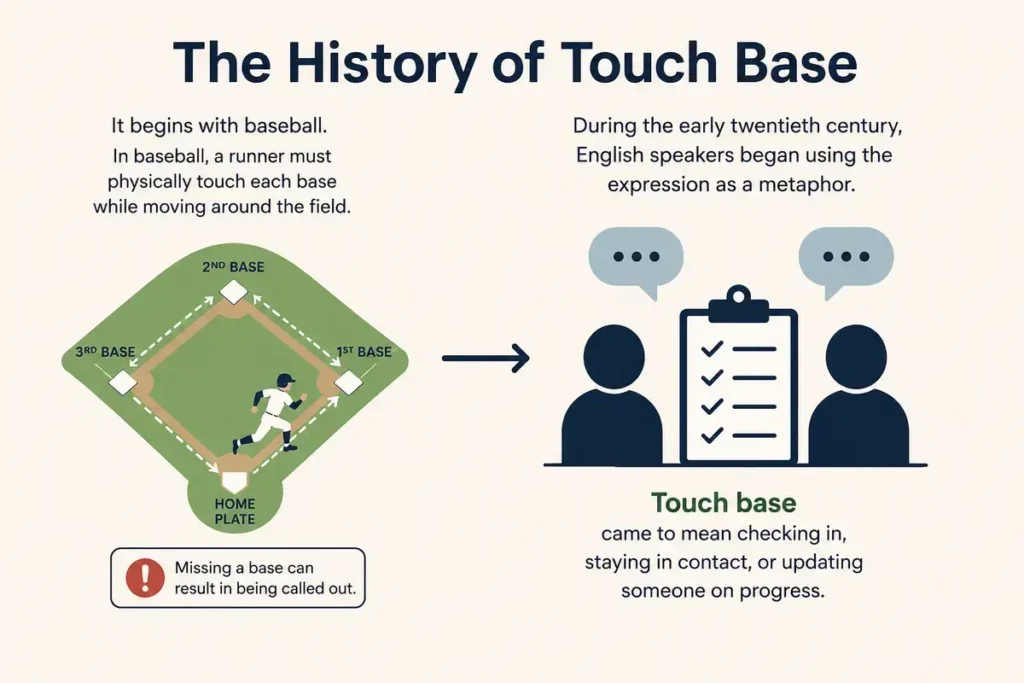
The expression originally came from baseball. A runner literally touches a base while moving around the field. Over time, English speakers began using touch base metaphorically to mean making contact with someone.
Meaning Of Touch Base
Touch base is the standard expression.
It means:
- To contact someone briefly.
- To check in.
- To reconnect.
- To exchange updates.
Common examples:
- Let’s touch base after the meeting.
- I wanted to touch base about the project.
- Can we touch base next week?
Native speakers use this phrase constantly in workplaces, client communication, project management, and team collaboration.
Touchbase Or Touch Base Key Differences
Spelling
- Touch base = standard.
- Touchbase = uncommon.
Grammar
- Touch base functions as a verb phrase.
- Touchbase rarely functions as a standard verb.
Professional Tone
- Touch base sounds natural and professional.
- Touchbase may look like a typo.
Dictionary Acceptance
- Major dictionaries recognize touch base.
- Touchbase has much weaker support.
Which One Is Correct?
Use touch base.
Use touch base in emails, reports, presentations, academic writing, and professional communication.
Examples:
- I’ll touch base with the client tomorrow.
- Let’s touch base after lunch.
- We should touch base before the deadline.
Avoid:
- I’ll touchbase with the client tomorrow.
Most editors and style guides would correct that sentence.
Examples In Sentences
Touchbase Examples
These examples show how the single word occasionally appears, though it is not the preferred standard.
- We scheduled a quick touchbase before the conference.
- Our morning touchbase lasted only ten minutes.
- The team uses touchbase as an internal shorthand.
- She wrote touchbase in the meeting agenda.
- They had a brief touchbase after the call.
- The manager requested a daily touchbase.
- We added a touchbase session to the calendar.
- His note mentioned a touchbase with marketing.
- The startup uses touchbase as a noun.
- Several employees wrote touchbase in informal chats.
Touch Base Examples
These are the natural and recommended examples.
- Let’s touch base tomorrow morning.
- I wanted to touch base about the budget.
- Can we touch base next week?
- She’ll touch base with the client this afternoon.
- We should touch base before submitting the proposal.
- I’ll touch base after I review the documents.
- The manager touched base with every team member.
- Thanks for touching base before the meeting.
- Let’s touch base once the report is finished.
- They touched base to confirm the final details.
Learn the difference in dealt vs delt Correct Spelling Meaning and Usage.
Common Mistakes
Many writers know what the phrase means but still make small mistakes. Most of them happen because people assume the expression follows the same pattern as words like login and setup. It does not.
Writing Touchbase As One Word
This is the most common mistake.
Many people combine the two words because they see similar compound words in English. In standard English, touch base remains the preferred spelling.
Correct.
Let’s touch base after lunch.
Incorrect.
Let’s touchbase after lunch.
Using Touch Base As A Noun
Touch base is mainly a verb phrase. It usually follows a helping verb such as let’s, can, should, will, or need to.
Correct.
Let’s touch base tomorrow.
We should touch base before the deadline.
Less natural.
We had a touch base yesterday. If you need a noun, words like meeting, check in, conversation, discussion, or catch up often sound more natural.
Using The Phrase Too Often
One email may include touch base once. Using it three or four times in the same message quickly becomes repetitive. Instead, vary your language with natural alternatives.
- Check in.
- Catch up.
- Connect.
- Follow up.
- Meet.
- Talk.
- Reach out.
- Discuss.
- Review.
- Update each other.
Good writing sounds fresh because it avoids repeating the same expression.
Using Touch Base In Very Formal Writing
Although touch base is accepted in business English, it is still an informal idiom. In legal documents, academic papers, government reports, or research articles, clearer verbs often work better.
Examples include:
- Contact.
- Consult.
- Communicate.
- Discuss.
- Coordinate.
These choices sound more precise in formal contexts.
Pronunciation Guide
Native speakers pronounce touch base naturally with equal emphasis on both words.
Touch
IPA
American English.
/tʌtʃ/
Syllable Breakdown
Touch.
Base
IPA
American English.
/beɪs/
Syllable Breakdown
Base.
Touch Base
IPA
/tʌtʃ beɪs/
The phrase flows smoothly without a pause between the words.
Common Pronunciation Mistakes
- Saying base too quickly so it sounds like bass.
- Stressing the second word too heavily.
- Blending both words into one long sound.
A natural American pronunciation sounds relaxed and conversational.
Touchbase vs Touch Base Etymology And Word Origin
The history of touch base begins with baseball. In baseball, a runner must physically touch each base while moving around the field. Missing a base can result in being called out. During the early twentieth century, English speakers began using the expression as a metaphor.
Instead of describing a player reaching a base, people used touch base to describe making contact with another person before moving forward. Business professionals adopted the phrase because it communicates the idea of a brief update rather than a lengthy meeting.
Today, millions of people use touch base every day in offices, schools, nonprofit organizations, and remote workplaces. Unlike many expressions that disappear over time, this one has remained popular because it is short, friendly, and easy to understand.
Regional Usage
The meaning of touch base stays almost the same across major English speaking countries.
American English
American English uses touch base very frequently. You will hear it in offices, customer service, project management, education, healthcare, and everyday conversation.
Examples.
Let’s touch base after the presentation. I’ll touch base with you next week.
British English
British speakers understand the expression, but they often choose alternatives.
Common choices include:
- Catch up.
- Check in.
- Get in touch.
- Have a chat.
The phrase still appears in multinational companies and corporate communication.
Canadian English
Canadian English closely follows American usage. Professionals regularly use touch base in emails, meetings, and workplace conversations.
Australian English
Australians understand the phrase, though expressions like catch up and have a chat are also very common. Business communication frequently includes touch base, especially in international organizations.
Regional Preference
There is no spelling difference between American, British, Canadian, and Australian English. The standard form remains touch base.
Grammar Rules
Understanding the grammar behind this expression makes it easier to use correctly.
Part Of Speech
Touch base functions as a verb phrase.
Examples.
Let’s touch base tomorrow. I’ll touch base after the meeting. They touched base before making a decision.
Verb Tense
The phrase changes tense just like other verbs.
Present.
I touch base with clients every Monday.
Present continuous.
We are touching base with suppliers today.
Past.
She touched base yesterday afternoon.
Present perfect.
They have touched base several times this week.
Future.
I’ll touch base after I receive your email.
Common Sentence Patterns
Subject plus touch base plus with someone.
I touched base with the designer.
Let’s plus touch base.
Let’s touch base tomorrow.
Need to plus touch base.
We need to touch base before Friday.
Want to plus touch base.
I wanted to touch base regarding your application.
These patterns appear naturally in everyday English.
Real Life Usage Examples
Seeing the phrase in different situations helps you understand how native speakers use it.
Daily Conversation
I’ll touch base after I pick up the kids.
Let’s touch base this weekend.
We haven’t talked in a while. Let’s touch base soon.
Workplace Communication
I’ll touch base with the finance team this afternoon.
Can we touch base before sending the proposal?
Our manager touched base with every department.
Hi Sarah.
I wanted to touch base about next week’s presentation. Please let me know if you need anything before Friday.
Thanks.
Customer Service
A representative will touch base within two business days. We’ll touch base after reviewing your request.
Education
The professor touched base with each student before final exams. Teachers often touch base with parents during the school year.
Media And Everyday Writing
Business magazines frequently use touch base when discussing communication, leadership, teamwork, and client relationships. Modern workplace guides also recommend the phrase for friendly professional communication, though many encourage writers to mix in alternatives to keep their language fresh.
You may also want to read Envolve vs involve: Correct Spelling and Usage.
Related Words And Confused Terms
People who search for touchbase or touch base often want more than the correct spelling. They also look for similar expressions that fit different situations. Knowing these alternatives helps you write naturally and avoid repeating the same phrase.
Synonyms For Touch Base
- Check in.
- Catch up.
- Connect.
- Get in touch.
- Reach out.
- Follow up.
- Contact.
- Speak.
- Talk.
- Communicate.
Each option has a slightly different tone.
Check in suggests a quick update.
Catch up usually means reconnecting after some time apart.
Follow up refers to continuing an earlier conversation or task.
Reach out means making the first contact, though some writers feel it has become overused in business communication.
Commonly Confused Word Pairs
Several English expressions follow the same grammar pattern as touch base. They often confuse writers because one form is a verb phrase while another is a noun or adjective.
| Verb Phrase | Noun Or Adjective |
|---|---|
| Log in | Login |
| Set up | Setup |
| Check in | Check in as a noun in some contexts |
| Work out | Workout |
| Sign in | Sign in as a noun in limited uses |
Unlike setup or login, touchbase has not become the standard single word form. Most editors still recommend writing touch base.
Related Business Expressions
Depending on the situation, these phrases may sound more natural.
- Schedule a meeting.
- Share an update.
- Exchange ideas.
- Discuss the project.
- Review progress.
- Confirm the details.
- Coordinate plans.
- Stay in contact.
- Keep me updated.
- Continue the conversation.
Using different expressions makes your writing sound more polished and less repetitive.
Touchbase or Touch base Expert Language Insight
As an editor, I often see touch base criticized as business jargon. That criticism is only partly fair. The phrase is clear, familiar, and widely understood. Millions of native speakers use it every day in emails, meetings, and conversations. The real problem is not the phrase itself. The problem is using it too often.
Imagine reading an email that says:
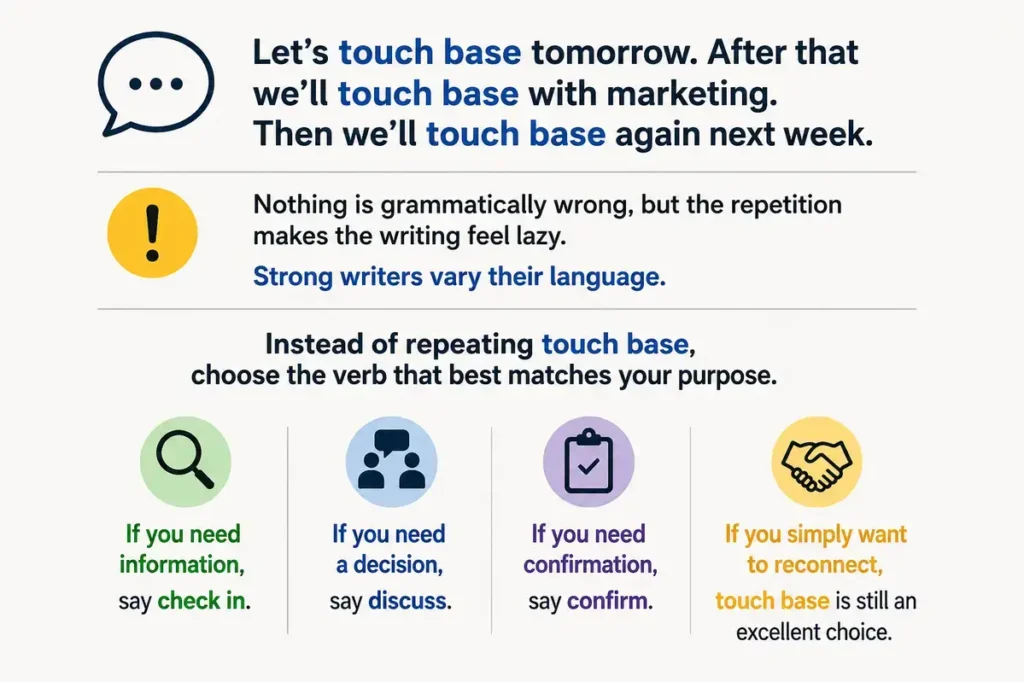
Let’s touch base tomorrow. After that we’ll touch base with marketing. Then we’ll touch base again next week. Nothing is grammatically wrong, but the repetition makes the writing feel lazy. Strong writers vary their language. Instead of repeating touch base, choose the verb that best matches your purpose.
If you need information, say check in.
If you need a decision, say discuss.
To receive confirmation, simply type “confirm.”
If you simply want to reconnect, touch base is still an excellent choice. Another point worth remembering is that native speakers rarely stop to think about the baseball origin. For most people, the phrase simply means making brief contact. The original sports connection has faded into the background.
If you’re writing for an international audience, keep in mind that some readers may find touch base unfamiliar. In those cases, contact, check in, or connect can be clearer. From an editorial perspective, the safest recommendation is simple. Use touch base in everyday business communication, but don’t let it become your only way of saying contact someone.
Still confused? Compare Prefer Or Perfer Which Spelling Is Correct.
Conclusion
The answer is straightforward.
Touch base is the correct spelling and the form you should use in almost every situation. It is a well established verb phrase that means to make brief contact, check in, or exchange updates.
Touchbase as one word is not standard English. While it may appear as a company name, an internal workplace shorthand, or an occasional informal noun, it is not the preferred choice for professional or academic writing.
If you want your writing to sound natural and polished, use touch base in emails, meetings, and everyday communication. At the same time, don’t rely on it for every message. Mixing in alternatives like check in, connect, or follow up will make your writing more engaging and precise. When in doubt, remember this simple rule. If you’re talking about contacting someone, touch base is almost always the right choice.
Frequently Asked Questions
Is touch base or touchbase correct?
Touch base is the correct and widely accepted form. It is a verb phrase that means to make brief contact or exchange updates. Touchbase as one word is uncommon and generally considered nonstandard in professional and academic writing.
Why is touch base written as two words?
The expression comes from baseball, where a runner literally touches a base. English kept the original two word structure when the phrase developed a figurative meaning. Unlike some other expressions, it has not become a standard compound word.
Can I write touchbase in an email?
It’s best not to. Most editors, dictionaries, and style guides recommend touch base. Writing touchbase may look like a typo or an internal company shorthand that readers outside your organization do not recognize.
Is touch base formal or informal?
Touch base is informal to semi formal. It fits naturally in business emails, workplace conversations, and team meetings. In highly formal documents, verbs like contact, consult, or communicate may be more appropriate.
What does touch base mean?
It means to contact someone briefly, share updates, discuss progress, or reconnect before continuing with a task or project. The phrase usually refers to a short conversation rather than a long meeting.
What can I say instead of touch base?
You can use check in, catch up, connect, follow up, contact, reach out, talk, or communicate. The best choice depends on your purpose and the tone of your message.
Do native English speakers use touch base?
Yes. It is very common in American workplaces and is also understood in Canada, Australia, and the United Kingdom. Some regions simply prefer alternatives like catch up or get in touch in everyday conversation.
Is touch base good business English?
Yes. It is accepted in modern business English and appears regularly in professional emails and meetings. Still, experienced writers avoid repeating it too often and mix in other natural expressions to keep their writing engaging.