
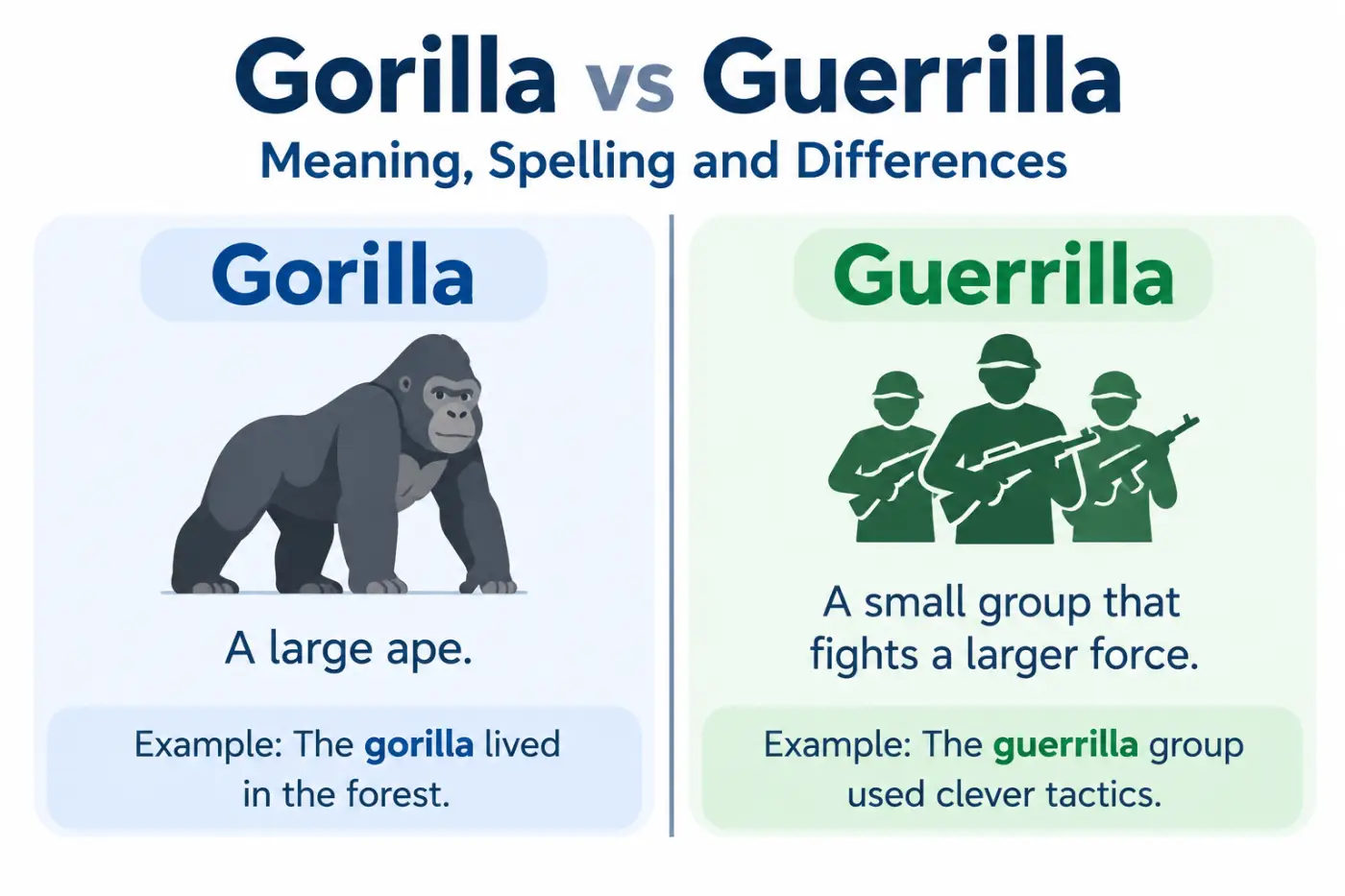
Have you ever confused a large, powerful ape with a person involved in an armed resistance movement? The words gorilla and guerrilla look and sound remarkably similar, but their meanings are completely different. Understanding gorilla vs guerrilla comes down to knowing what each word describes and recognizing the context in which it belongs.
A gorilla is a large, intelligent ape that lives in the forests of central Africa. A guerrilla is a fighter who takes part in an irregular military group, often using surprise attacks and unconventional tactics against a stronger force. Despite their similar spelling and pronunciation, neither word is an alternative spelling of the other.
This distinction matters in everyday conversation, school assignments, journalism, academic writing, and professional communication. A single letter can change the meaning of a sentence entirely. Below, you’ll learn how to spell, pronounce, and use both terms correctly, with practical examples and simple memory tips to help you avoid confusion.
For another common grammar confusion, see Born vs Borne Which Form Should You Use.
Quick Answer: What Is the Difference?
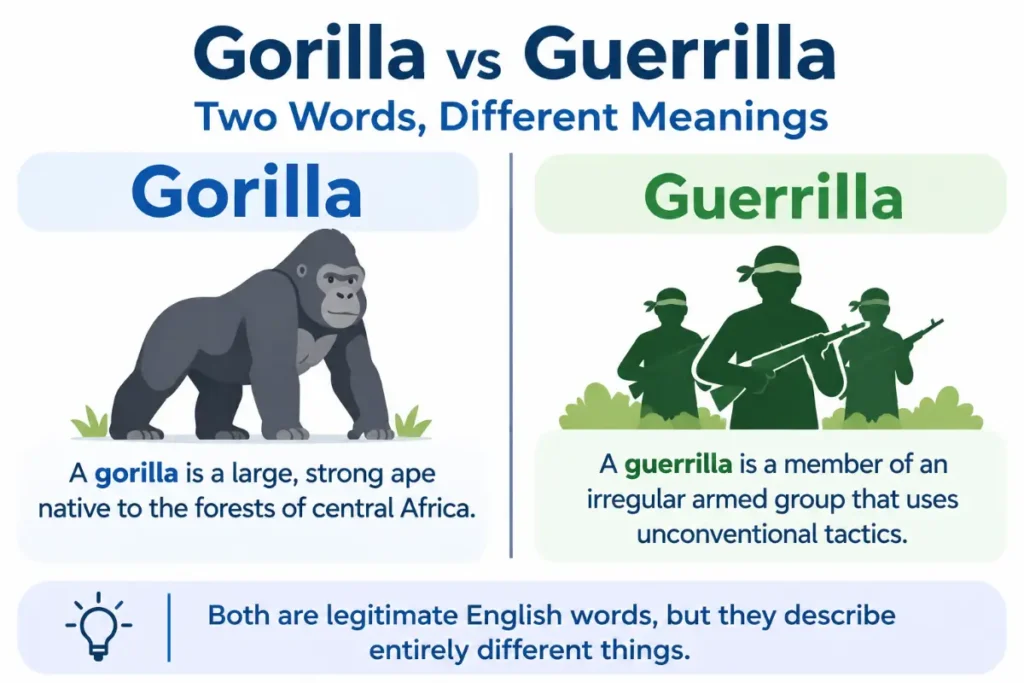
A gorilla is a large, strong ape native to the forests of central Africa. A guerrilla is a member of an irregular armed group that uses unconventional military tactics, such as ambushes and surprise attacks. Both are legitimate English words, but they describe entirely different things. The correct choice depends on whether you’re discussing wildlife or irregular warfare.
Comparison Table: Gorilla and Guerrilla
| Feature | Gorilla | Guerrilla |
|---|---|---|
| Correct spelling | Gorilla | Guerrilla |
| Meaning | A large African ape | An irregular fighter |
| Part of speech | Noun | Noun and adjective |
| Origin | Greek through Latin | Spanish |
| Pronunciation | guh-RIL-uh | guh-RIL-uh |
| Main context | Animals and wildlife | Military and political conflict |
| Formality | Standard English | Standard English |
| Plural form | Gorillas | Guerrillas |
| Related term | Great ape | Guerrilla warfare |
| Example | The gorilla ate some leaves. | The guerrilla fighters moved through the forest. |
The main difference is meaning, not correctness. Neither spelling is a mistake. The words simply belong to different subject areas, and choosing between them requires understanding the sentence.
Meaning and Definition
What Does Gorilla Mean?
A gorilla is a large, powerful primate belonging to the great ape family. It is one of the closest living relatives of humans and shares many physical and behavioral characteristics with other great apes.
Gorillas are native to the forests of central Africa. They generally live in groups led by a dominant adult male, commonly known as a silverback because of the distinctive silver-colored hair that develops across his back as he matures.
Gorillas are primarily herbivorous. Their diets commonly include leaves, stems, shoots, fruit, and other plant material. Although they have impressive strength and large bodies, they are generally peaceful animals unless threatened.
Part of speech: Noun.
Plural: Gorillas.
Typical usage:
- Wildlife documentaries
- Zoos and animal conservation
- Biology and zoology
- Animal behavior research
- Children’s books and educational materials
Example: The silverback gorilla protected its family while the younger animals played nearby.
The word can also appear in figurative expressions. For example, someone might describe a very large or physically powerful person as a gorilla. However, this usage can sound insulting or outdated, so it should be used carefully.
What Does Guerrilla Mean?
A guerrilla is a person who participates in irregular warfare, usually as part of a small, organized fighting group. Guerrilla fighters often operate outside the structure of a conventional national army.
Instead of relying on traditional battlefield formations, they may use surprise attacks, ambushes, sabotage, and rapid movement. These tactics are often used against a larger or better-equipped military force.
Guerrilla warfare has appeared in many historical conflicts around the world. It can involve political, revolutionary, nationalist, or resistance movements, depending on the historical circumstances.
Part of speech: Primarily a noun, but also an adjective.
Plural: Guerrillas.
Typical usage:
- Military history
- Political science
- Armed resistance movements
- Historical research
- Journalism and international affairs
Examples:
- The guerrillas launched a surprise attack before sunrise.
- The army struggled to locate the guerrilla fighters in the mountainous region.
- The historian studied guerrilla warfare during the revolution.
The adjective form describes something connected with this type of irregular fighting. For example, guerrilla tactics refers to military methods based on surprise, mobility, and unconventional attacks.
Key Differences Explained
Although the two terms have similar spellings and pronunciation, several features separate them.
1. Spelling
The most obvious difference is the arrangement of letters.
- Gorilla: G-O-R-I-L-L-A
- Guerrilla: G-U-E-R-R-I-L-L-A
The second word contains additional letters, including the combination gue at the beginning.
This spelling difference is important because both words are recognized English vocabulary. You cannot replace one with the other simply because they sound alike.
2. Meaning
Their definitions have no direct connection.
A gorilla is an animal, while a guerrilla is a person involved in irregular warfare. One belongs to the natural world, and the other belongs to military and political history.
Consider these examples:
- The gorilla climbed a tree at the wildlife sanctuary.
- The guerrilla fighters moved through the jungle.
Both sentences are grammatically correct, but changing the spelling would change the intended meaning.
3. Grammar and Part of Speech
Both words function as nouns, but the second also has an established adjective use.
For example:
- The gorilla looked toward the visitors. (Noun)
- Several guerrillas crossed the border. (Noun)
- The soldiers prepared for guerrilla warfare. (Adjective)
The animal’s name is generally used as a noun. It does not have the same standard adjective function as the military term.
4. Pronunciation
Interestingly, both words are usually pronounced in almost exactly the same way in standard American English.
Their pronunciation is approximately:
guh-RIL-uh
The similarity in sound explains why people sometimes confuse them in spoken communication. However, their written forms remain distinct.
5. Context
Context is one of the easiest ways to determine which spelling belongs in a sentence.
If the sentence discusses animals, forests, wildlife, primates, or conservation, the animal’s name is probably appropriate.
If it discusses military groups, revolutions, armed resistance, ambushes, or unconventional combat, the military term is the correct choice.
6. Formality
Both words are standard English vocabulary and are appropriate in formal writing.
The animal-related term appears in scientific papers, wildlife reports, educational materials, and conservation publications.
The military-related term appears in historical studies, political analysis, military reports, and journalism.
Neither is inherently informal or incorrect.
7. Regional Usage
There is no major spelling difference between American and British English. Both forms are used in the United States, United Kingdom, Australia, and Canada.
The pronunciation may vary slightly between speakers and regional accents, but the distinction in meaning remains the same.
Which Spelling Is Correct?
Both spellings are correct. The choice depends entirely on what you want to describe.
Use gorilla when referring to the large African ape. Use guerrilla when referring to a fighter involved in irregular warfare or something associated with guerrilla tactics.
Established English dictionaries recognize both as separate vocabulary entries. They are not regional alternatives, interchangeable forms, or correct and incorrect versions of the same word.
The spelling difference also reflects their separate linguistic histories. One developed from a term associated with a type of ape, while the other entered English through Spanish military terminology.
Here is a simple way to decide:
- Talking about an animal? Write gorilla.
- Talking about an irregular fighter? Write guerrilla.
- Talking about unconventional military tactics? Write guerrilla as an adjective.
The best spelling is the one that accurately communicates your intended meaning.
10 Natural Sentence Examples
Seeing both words in everyday situations makes the difference easier to remember.
Examples Using Gorilla
- The young gorilla stayed close to its mother while exploring the forest.
- We watched a documentary about mountain gorillas and their natural habitat.
- The zoo introduced a new enrichment program to keep its gorillas active and healthy.
- Scientists observed the gorilla family to learn more about its social behavior.
- My little brother chose a gorilla as the subject of his school science project.
Examples Using Guerrilla
- The guerrilla fighters used the dense forest to avoid detection by enemy forces.
- The military historian explained how guerrilla warfare influenced the outcome of the conflict.
- The documentary examined the experiences of guerrilla groups during the revolution.
- The government struggled to control the region because of the guerrillas’ knowledge of the terrain.
- The historian described the movement’s guerrilla tactics in her latest academic paper.
These examples show that the surrounding words provide useful clues. References to animals, families, and habitats point toward one spelling, while references to armed groups and military tactics point toward the other.
Common Spelling Mistakes and Confusion
Even experienced writers can confuse words that share similar sounds. Here are five mistakes worth watching for.
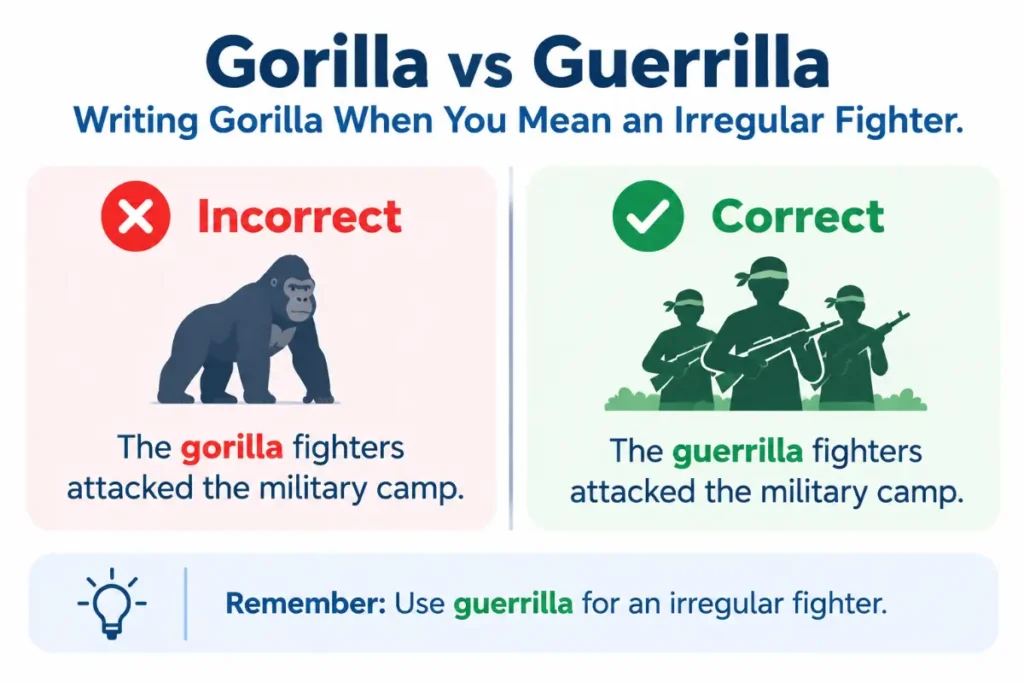
1. Writing Gorilla When You Mean an Irregular Fighter
Incorrect: The gorilla fighters attacked the military camp.
Correct: The guerrilla fighters attacked the military camp.
Why the mistake happens: Both words sound alike, so a writer may select the more familiar spelling without checking the meaning.
Tip: Look for military-related clues such as fighters, attacks, resistance, or warfare.
2. Writing Guerrilla When You Mean the Animal
Incorrect: We saw a guerrilla at the zoo.
Correct: We saw a gorilla at the zoo.
Why the mistake happens: The additional letters in the military term can make it look like a more complicated or technical version of the animal’s name.
Tip: If the sentence mentions a zoo, wildlife, or primates, choose the shorter spelling.
3. Leaving Out Letters in Guerrilla
Incorrect: The guerilla group moved through the mountains.
Correct: The guerrilla group moved through the mountains.
Why the mistake happens: The Spanish-derived spelling is less familiar to some English writers. People may remove one of the repeated letters or omit the initial vowel combination.
Tip: Remember the complete sequence: G-U-E-R-R-I-L-L-A.
4. Confusing the Plural Forms
Incorrect: Several gorillas joined the guerrilla movement.
This sentence is grammatically possible, but it is incorrect if the writer intended to describe several armed fighters rather than animals.
Correct: Several guerrillas joined the movement.
Why the mistake happens: Both nouns form their plurals by adding an s, so the distinction still depends on the original spelling and meaning.
Tip: Check the singular form before adding a plural ending.
5. Using the Animal’s Name in Military Expressions
Incorrect: The army studied gorilla warfare.
Correct: The army studied guerrilla warfare.
Why the mistake happens: The two words have nearly identical pronunciation, making the error easy to miss during proofreading.
Tip: Learn the full expression guerrilla warfare as a fixed vocabulary combination.
For another common grammar confusion, see ember vs gold for Color Meaning and Everyday Use.
Pronunciation Guide
One reason these words are frequently confused is that their standard pronunciation is nearly identical.
Gorilla Pronunciation
- IPA: /ɡəˈrɪlə/
- Syllable breakdown: go-ril-la
- Easy pronunciation: guh-RIL-uh
- Stress: Second syllable
The strongest emphasis falls on the middle syllable, which contains the short vowel sound in sit.
Guerrilla Pronunciation
- IPA: /ɡəˈrɪlə/
- Syllable breakdown: gue-ril-la
- Easy pronunciation: guh-RIL-uh
- Stress: Second syllable
In standard English pronunciation, the initial letters gue produce a /ɡ/ sound rather than being pronounced as separate syllables.
Common Pronunciation Mistakes
Some speakers may try to pronounce every written letter in the longer word. This can create an unnatural pronunciation.
Remember that the initial spelling does not produce an additional syllable. Both terms are generally spoken with three syllables and stress on the middle one.
The spelling distinction is therefore much easier to recognize in writing than in conversation. If you hear either word without context, you may need to ask what the speaker means.
Etymology and Word Origin
The different histories of these terms help explain why they have such different spellings.
Origin of Gorilla
The English word gorilla has a much older history than its modern appearance might suggest.
It comes from the Latin form Gorillae, which was used in an account associated with the ancient Carthaginian explorer Hanno. His expedition reportedly encountered people described with a name resembling this form.
The word later became associated with the African great ape through its use in scientific naming. The modern English term developed from this historical tradition.
Today, it refers specifically to members of the genus Gorilla, which includes the eastern and western gorilla species.
The important point is that the word’s history is connected with the naming and description of the animal.
Origin of Guerrilla
The military term comes from Spanish.
It developed from guerra, meaning war, combined with the Spanish diminutive ending -illa. The resulting word originally carried the sense of a small war or little war.
The term became widely associated with irregular fighters during the Spanish resistance against Napoleon’s forces in the early nineteenth century.
English later adopted the word to describe fighters who use unconventional military tactics rather than operating like a traditional army.
Over time, the term expanded into phrases such as:
- Guerrilla warfare
- Guerrilla fighters
- Guerrilla tactics
- Guerrilla resistance
Its historical development explains the unusual spelling and its connection with military conflict.
Regional Usage in English
Neither word has a different standard spelling across major English-speaking regions.
American English
Both terms are standard in American English.
The animal-related word is common in wildlife documentaries, educational materials, conservation discussions, and everyday conversation.
The military-related word is used in journalism, history, political science, and military discussions.
American speakers generally pronounce both words similarly, with stress on the second syllable.
British English
British English uses the same spellings and meanings.
There is no special British spelling that replaces either form. Both appear in formal and informal communication, including academic writing and news reporting.
Regional accent differences may affect vowel quality, but they do not change the basic distinction.
Australian English
Australian English also follows the same spelling conventions.
The animal’s name appears in wildlife education and conservation contexts, while the military term appears in discussions of historical conflicts and political movements.
No separate Australian spelling is needed.
Canadian English
Canadian English follows the same general conventions as American and British English.
Both terms are recognized standard vocabulary, and neither has a special Canadian spelling.
Regional takeaway: The distinction is semantic rather than geographical. You should use the same spelling rules regardless of whether you’re writing for an American, British, Australian, or Canadian audience.
Grammar Rules and Parts of Speech
Understanding how each word works in a sentence makes it easier to avoid mistakes.
Gorilla as a Noun
The animal’s name is a countable common noun.
It can appear in singular or plural form.
Singular examples:
- A gorilla was sitting near the trees.
- The gorilla appeared calm.
Plural examples:
- The gorillas moved through the forest.
- Several gorillas were observed by researchers.
It can also function as part of a compound noun or noun phrase.
Examples include:
- Gorilla habitat
- Gorilla conservation
- Gorilla behavior
- Gorilla population
In these expressions, the word identifies the animal or a subject connected with it.
Guerrilla as a Noun
The military-related term can refer to one fighter or several fighters.
Examples:
- A guerrilla entered the village.
- The guerrillas retreated into the mountains.
The plural form is created by adding s to the singular word.
Guerrilla as an Adjective
This term also works as an adjective when it describes activities, methods, or organizations connected with irregular warfare.
Common combinations include:
- Guerrilla warfare
- Guerrilla tactics
- Guerrilla movement
- Guerrilla campaign
- Guerrilla fighters
For example:
The government developed a new strategy to counter guerrilla attacks.
Here, the word describes the type of attacks rather than naming a person.
Capitalization and Punctuation
Both words are normally written in lowercase because they are common nouns.
Capitalize them only when they appear at the beginning of a sentence or form part of a proper name or title.
Examples:
- The gorilla was resting.
- Guerrilla warfare changed the course of the conflict.
Neither word requires quotation marks or special punctuation simply because it is being discussed.
Common Grammar Errors
Writers should avoid using the two terms as though they were interchangeable nouns.
They should also remember that the military term can function as an adjective, while the animal’s name is generally used as a noun.
Finally, do not confuse a plural noun with an adjective. In guerrilla fighters, the word describes the type of fighters; it does not mean several guerrillas are necessarily being referred to as a separate group.
Real-Life Usage in Different Situations
The following examples show how both words appear naturally in different types of communication.
1. Daily Conversation
Gorilla:
- Did you see the documentary about mountain gorillas last night?
- The little gorilla was playing with a piece of bamboo.
Guerrilla:
- We learned about guerrilla warfare in history class.
- The book describes how guerrillas operated in the mountains.
In everyday conversation, the subject usually makes the intended meaning clear.
2. Email and Workplace Communication
Gorilla:
- Our conservation team is preparing a report on gorilla habitats.
- The wildlife department has requested updated information about the gorilla population.
Guerrilla:
- The research team is reviewing historical accounts of guerrilla movements.
- Please include a section explaining the role of guerrilla warfare in the conflict.
Professional writing requires precise vocabulary because an incorrect word can change the meaning of an entire report.
3. Academic Writing
Gorilla:
- Researchers examined the social structure of western gorilla populations.
- The study discusses habitat loss and its effects on gorilla conservation.
Guerrilla:
- The historian analyzed the role of guerrilla warfare in the independence movement.
- The research examines the political and military conditions that supported guerrilla resistance.
Academic writers should select the term that matches the subject of their research.
4. News and Journalism
Gorilla:
- Wildlife officials reported the birth of a new gorilla at the conservation center.
- Conservation groups called for stronger protection of endangered gorilla populations.
Guerrilla:
- Officials reported clashes involving guerrilla fighters in the mountainous region.
- The report examined the impact of guerrilla activity on local communities.
Journalists must be especially careful because spelling mistakes can create misleading headlines or confusing reports.
5. Literature and Storytelling
Gorilla:
- The young gorilla watched the sunlight move across the forest floor.
- A silverback gorilla stood quietly beside the river.
Guerrilla:
- The guerrilla slipped through the forest before the soldiers arrived.
- The novel follows a young fighter who becomes involved in a guerrilla movement.
In storytelling, the surrounding details establish whether the writer is describing wildlife or a character involved in armed conflict.
Related and Confused Terms
Several words are connected to these two terms through meaning, subject matter, or common spelling confusion.
1. Ape
An ape is a primate without a tail. Gorillas belong to the great ape family, along with chimpanzees, bonobos, orangutans, and humans.
The term is broader than the name of any single species.
2. Primate
A primate is a member of the mammalian order Primates. This group includes lemurs, monkeys, and apes.
A gorilla is a primate, but not every primate is a gorilla.
3. Silverback
A silverback is a mature male gorilla identified by the silver-colored hair that develops across his back.
The term is closely connected with gorilla social structure and is frequently used in wildlife documentaries.
4. Guerrilla Warfare
Guerrilla warfare is a type of irregular military conflict involving methods such as ambushes, surprise attacks, sabotage, and rapid movement.
It is the most common expression associated with the military term.
5. Insurgent
An insurgent is someone who participates in an organized rebellion against an established authority.
Although insurgents and guerrillas may overlap in some conflicts, the words are not exact synonyms. Insurgent emphasizes opposition to an existing government or authority.
6. Partisan
A partisan is a member or supporter of a group fighting against an occupying force or established authority.
In military history, the term is often associated with resistance movements and irregular fighters.
7. Militant
A militant is someone who supports or participates in aggressive political or ideological action.
The word can describe armed or non-armed activity, depending on context. It is therefore broader than the military meaning of guerrilla.
8. Guerilla
Guerilla is a frequently seen misspelling of the standard English word guerrilla.
It usually results from leaving out one of the letters in the established spelling. In formal writing, use the full standard spelling.
Expert Editor Insight
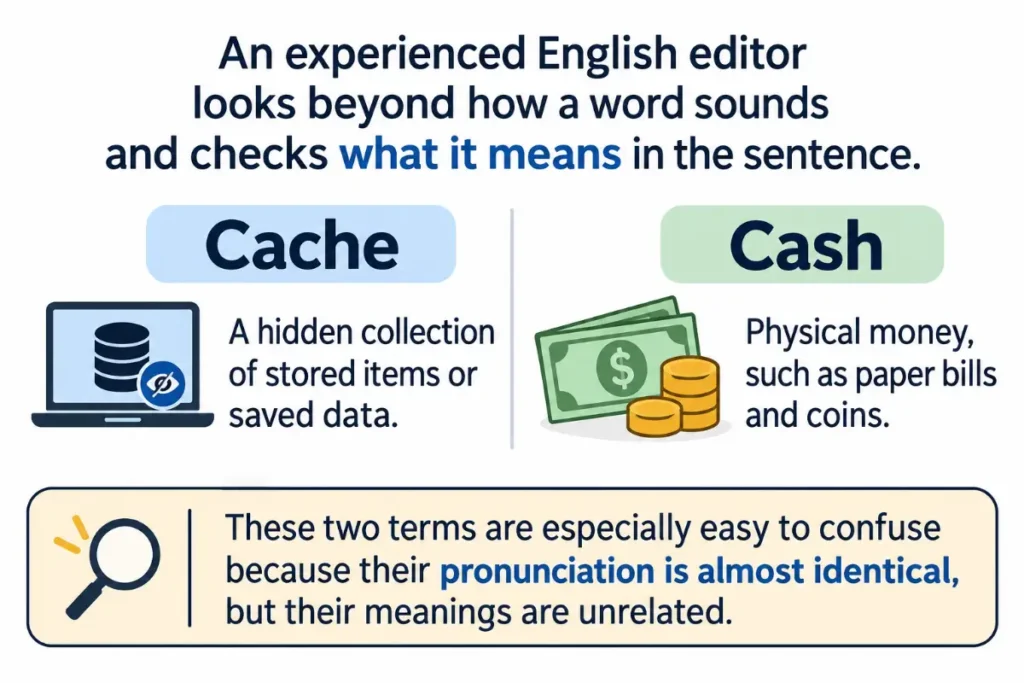
An experienced English editor looks beyond how a word sounds and checks what it means in the sentence. These two terms are especially easy to confuse because their pronunciation is almost identical, but their meanings are unrelated. Spelling and grammar tools may flag an obvious typo, yet they cannot always identify a correctly spelled word used in the wrong context. For example, both animal and military spellings may pass a basic spell-check. The best editing technique is to read the entire sentence and ask whether the subject is an ape or an irregular fighter. Context-based proofreading is more reliable than depending on spell-check alone.
Still confused? Compare Taken vs Taking Which Form Should You Use.
Conclusion
Understanding gorilla vs guerrilla is easier when you remember that both spellings are correct but describe completely different things. A gorilla is a large African ape, while a guerrilla is a fighter involved in irregular warfare. Their similar pronunciation explains the confusion, but their spelling and context make their meanings clear.
The simplest editing trick is to identify the subject before choosing the word: if your sentence discusses wildlife, use the shorter spelling; if it discusses military resistance, use the longer one. Check the meaning, not just the sound, and you’ll avoid this common writing mistake.
FAQs
1. Is gorilla or guerrilla the correct spelling?
Both are correct English spellings, but they have different meanings. Gorilla refers to a large African ape, while guerrilla refers to a person involved in irregular warfare. Neither is a misspelling of the other. Choose the form that matches the subject of your sentence rather than relying on pronunciation.
2. Is guerilla a real word?
Guerilla is generally considered a misspelling of the standard English word guerrilla. The accepted spelling contains the letters G-U-E-R-R-I-L-L-A. Although the shortened version appears in informal writing and online searches, use the standard form in school assignments, professional documents, journalism, and academic work.
3. What does guerrilla mean in simple words?
A guerrilla is a fighter who belongs to an irregular armed group. Such fighters often use surprise attacks, ambushes, and unconventional methods instead of traditional military formations. The term is commonly associated with resistance movements and conflicts in which smaller groups fight against larger or better-equipped forces.
4. What does gorilla mean?
A gorilla is a large, intelligent ape native to central Africa. It belongs to the great ape family and generally lives in forest habitats. Gorillas are primarily plant-eaters and often live in social groups led by a dominant adult male known as a silverback. They are known for their strength and complex social behavior.
5. How do you pronounce both words?
Both words are generally pronounced guh-RIL-uh in standard American English. Each has three syllables, with the strongest stress on the middle syllable. Their pronunciation is so similar that listeners often need context to understand which word someone means. The difference is much clearer when the words are written down.
6. Can guerrilla be used as an adjective?
Yes. The word can function as both a noun and an adjective. As a noun, it identifies an irregular fighter. As an adjective, it describes something associated with irregular warfare. Common examples include guerrilla warfare, guerrilla tactics, guerrilla movements, and guerrilla attacks.
7. Why do people confuse these two words?
People confuse them mainly because they sound almost identical and have similar letter patterns. Their spellings also contain repeated letters, which makes them harder to remember. Since both are legitimate words, ordinary spell-check software may not detect an incorrect choice. Understanding the sentence’s subject is the most reliable way to select the right one.
8. Is the correct spelling different in American and British English?
No. American and British English use the same standard spellings for both terms. Gorilla refers to the animal, while guerrilla refers to an irregular fighter or something connected with irregular warfare. Australian and Canadian English follow the same general spelling conventions. Regional accents may affect pronunciation slightly, but not the written distinction.